Deuteronomy 28:49

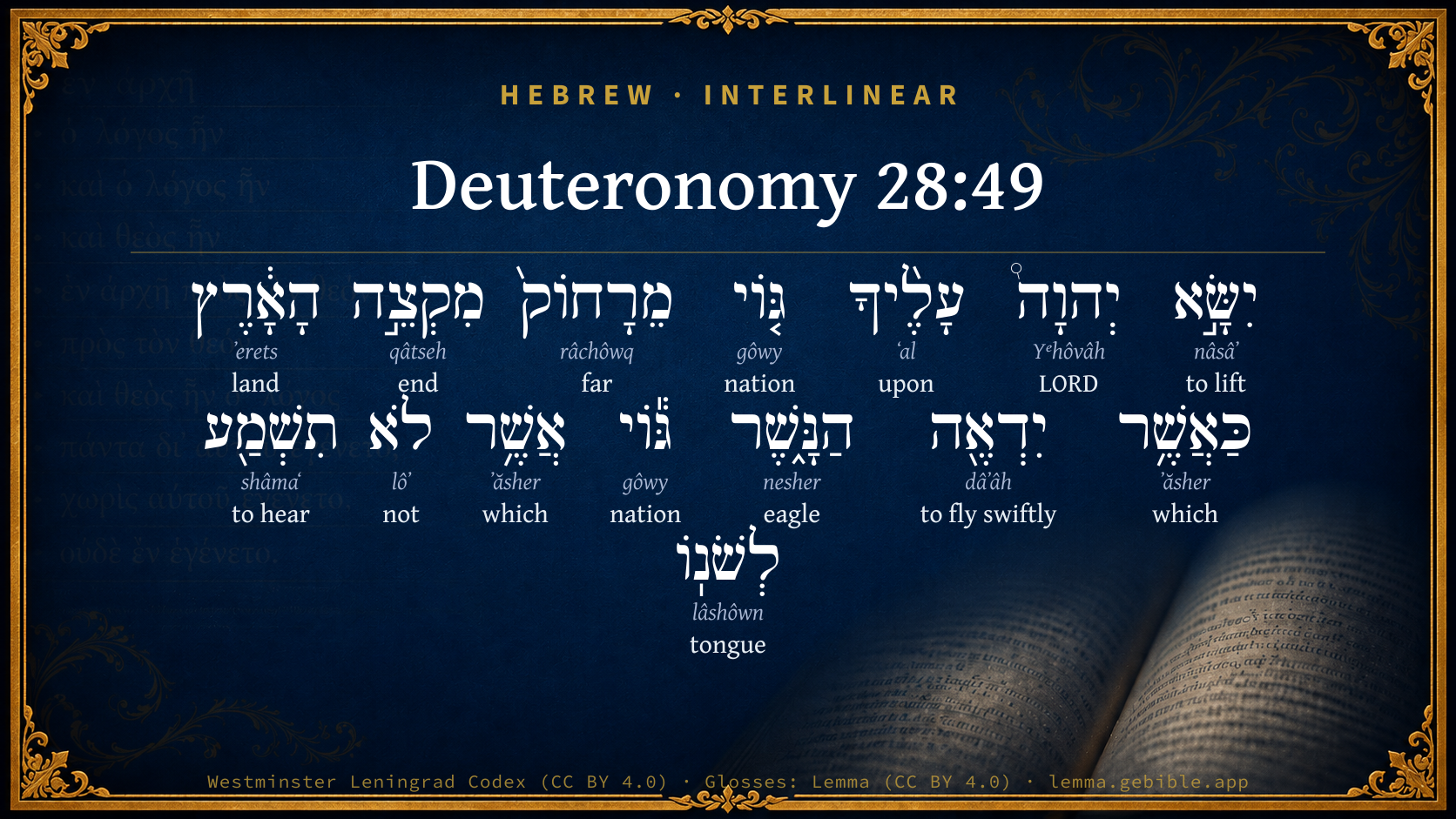
Hebrew (Westminster Leningrad Codex) Deuteronomy 28:49 appears in the Hebrew Old Testament. The text above is from the Westminster Leningrad Codex. Each word links to its Strong’s number, a concise gloss, and parsing drawn from the Open Scriptures Hebrew Bible morphology. Click any word for its full Brown-Driver-Briggs (BDB) entry.
Download image
Cite this verse

Deuteronomy 28:49 (World English Bible). Public Domain. Lemma interlinear Bible study tool, https://lemma.gebible.app/v/deuteronomy/28/49.

Show BibTeX & RIS
BibTeX
RIS
English Translation
Yahweh will bring a nation against you from far, from the end of the earth, as the eagle flies; a nation whose language you shall not understand;
World English Bible · Public Domain
Highlights
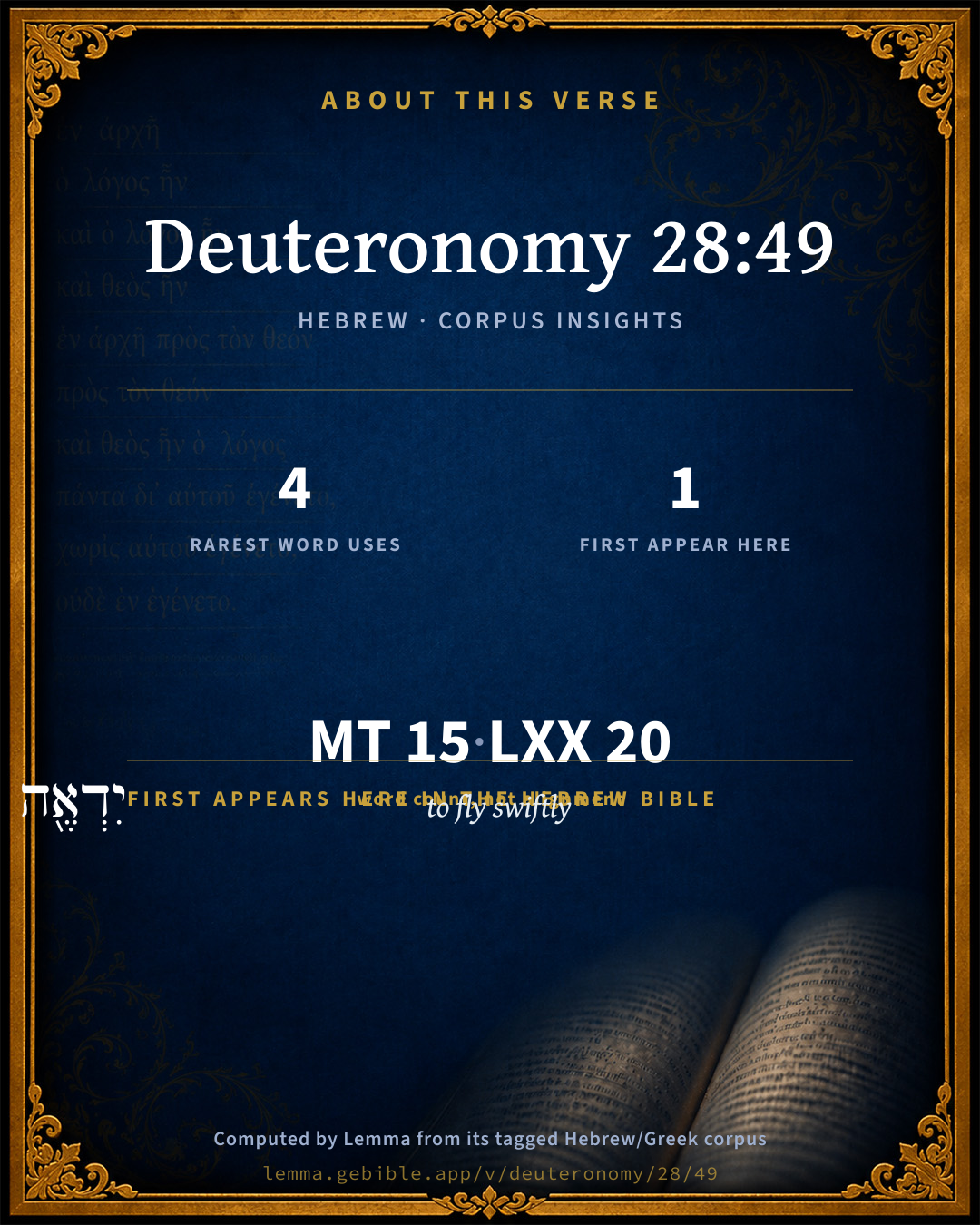
  • 1 first appearance in the Hebrew Bible
Full analysis ↓
Download a study sheet

One document with this verse’s original text, its word-by-word gloss line, the meaning frame, cross-references with their text, attributed commentary, and full source and license credits — printable, and it pastes into notes with its structure intact.

This verse Autodidact and up

Study sheet (.html) Plain text (.txt)

A passage Seminary Student

Up to 50 verses in one chapter. A passage sheet keeps up to 6 commentary sources and 12 cross-references per verse, in the order this page ranks them, and says so on the sheet whenever that leaves anything out. Ask for a single verse and you get the Autodidact verse sheet above.

Everything on this page stays free to read, with no account — the sheet is a download of what is already on screen, not access to it.

Want to remove ads? Support Godless Engineer
Compare translations 3

The same verse in 3 English versions, stacked beneath the original-language interlinear above. Click any original word for its lexicon entry.

Each is an independent rendering of the whole verse — the interlinear is not word-aligned to these translations.

Highlighted words mark where these versions differ — a whole-verse word diff, not a word-by-word alignment.

  • World English Bible Public Domain
    Yahweh will bring a nation against you from far, from the end of the earth, as the eagle flies; a nation whose language you shall not understand;
  • King James Version Public Domain
    The LORD shall bring a nation against thee from far, from the end of the earth, as swift as the eagle flieth; a nation whose tongue thou shalt not understand;
  • unfoldingWord Literal Text CC BY-SA 4.0
    Yahweh will lift up a nation against you from far away, from the end of the earth, like an eagle flies, a nation whose language you do not understand;

unfoldingWord Literal Text — © unfoldingWord, licensed CC BY-SA 4.0. Word-aligned USFM3 via Door43 (git.door43.org/unfoldingWord/en_ult).

Versions to compare (up to 4)

3 of 4 selected

Show all 18 translations

Every available English version of this verse, each an independent rendering of the whole verse.

  • World English Bible Public Domain
    Yahweh will bring a nation against you from far, from the end of the earth, as the eagle flies; a nation whose language you shall not understand;
  • Berean Standard Bible Public Domain
    The LORD will bring a nation from afar, from the ends of the earth, to swoop down upon you like an eagle—a nation whose language you will not understand,
  • Majority Standard Bible Public Domain
    The LORD will bring a nation from afar, from the ends of the earth, to swoop down upon you like an eagle—a nation whose language you will not understand,
  • King James Version Public Domain
    The LORD shall bring a nation against thee from far, from the end of the earth, as swift as the eagle flieth; a nation whose tongue thou shalt not understand;
  • American Standard Version (1901) Public Domain
    Jehovah will bring a nation against thee from far, from the end of the earth, as the eagle flieth; a nation whose tongue thou shalt not understand;
  • Revised Version (1885) Public Domain
    The LORD shall bring a nation against thee from far, from the end of the earth, as the eagle flieth; a nation whose tongue thou shalt not understand;
  • Geneva Bible (1599) Public Domain
    The Lord shall bring a nation vpon thee from farre, euen from the ende of the world, flying swift as an Egle: a nation whose tongue thou shalt not vnderstand:
  • Douay-Rheims (1899) Public Domain
    The Lord will bring upon thee a nation from afar, and from the uttermost ends of the earth, like an eagle that flyeth swiftly, whose tongue thou canst not understand,
  • Young's Literal Translation Public Domain
    `Jehovah doth lift up against thee a nation, from afar, from the end of the earth, as the eagle it flieth; a nation whose tongue thou hast not heard,
  • Literal Standard Version CC BY-SA 4.0
    YHWH lifts up a nation against you from afar, from the end of the earth—it flies as the eagle—a nation whose tongue you have not heard,
  • Unlocked Literal Bible CC BY-SA 4.0
    Yahweh will bring a nation against you from far away, from the ends of the earth, like an eagle flies to its victim, a nation whose language you do not understand;
  • unfoldingWord Literal Text CC BY-SA 4.0
    Yahweh will lift up a nation against you from far away, from the end of the earth, like an eagle flies, a nation whose language you do not understand;
  • Darby Bible Public Domain
    Jehovah will bring a nation against thee from afar, from the end of the earth, like as the eagle flieth, a nation whose tongue thou understandest not;
  • World Messianic Bible Public Domain
    The LORD will bring a nation against you from far away, from the end of the earth, as the eagle flies: a nation whose language you will not understand,
  • Webster's Bible Public Domain
    The LORD shall bring a nation against thee from far, from the end of the earth, as swift as the eagle flieth, a nation whose language thou shalt not understand:
  • Free Bible Version CC BY-SA 4.0
    The Lord will bring a nation to attack you from a long way off, from the ends of the earth. They will swoop down upon you like an eagle, this nation whose language you won't understand.
  • Bible in Basic English Public Domain
    The Lord will send a nation against you from the farthest ends of the earth, coming with the flight of an eagle; a nation whose language is strange to you;
  • JPS Tanakh (1917) Public Domain
    The LORD will bring a nation against thee from far, from the end of the earth, as the vulture swoopeth down; a nation whose tongue thou shalt not understand;

Literal Standard Version (2020), Covenant Press — licensed CC BY-SA 4.0. Text via the HelloAO Bible API (eBible.org). Unlocked Literal Bible (unfoldingWord) — licensed CC BY-SA 4.0. Text via the HelloAO Bible API (eBible.org). unfoldingWord Literal Text — © unfoldingWord, licensed CC BY-SA 4.0. Word-aligned USFM3 via Door43 (git.door43.org/unfoldingWord/en_ult). Free Bible Version, Dr. Jonathan Gallagher — licensed CC BY-SA 4.0. Text via the HelloAO Bible API (eBible.org).

Word by word

More ways to search: Search by grammar → Find every occurrence → Compare this word →

Practice this passage: Drill this verse → Learn its vocabulary →

יִדְאֶ֖ה
dâʼâh
H1675
“to fly swiftly”
Verb, Qal, Imperfect, 3rd Person, Masculine, Singular
Part of Speech
Verb
Stem
Qal
Form
Imperfect
Person
3rd Person
Gender
Masculine
Number
Singular
Full BDB Definition

Origin: a primitive root

TWOT: 394

to fly fast, fly swiftly, dart through the air - (Qal) to fly swiftly, dart
  1. יִשָּׂ֣א nâsâʼ H5375 “to lift” Verb, Qal, Imperfect, 3rd Person, Masculine, Singular
  2. יְהוָה֩ Yᵉhôvâh H3068 “LORD” Noun, Proper
  3. עָלֶ֨יךָ ʻal H5921 “upon · you” Preposition + Suffix, Personal, 2nd Person, Masculine, Singular
  4. גּ֤וֹי gôwy H1471 “nation” Noun, Common, Masculine, Singular, Absolute
  5. מֵרָחוֹק֙ râchôwq H7350 “from · far” Preposition + Adjective, Adjective, Masculine, Singular, Absolute
  6. מִקְצֵ֣ה qâtseh H7097 “from · end of” Preposition + Noun, Common, Both, Singular, Construct
  7. הָאָ֔רֶץ ʼerets H776 “the · land” Particle, Definite Article + Noun, Common, Both, Singular, Absolute
  8. כַּאֲשֶׁ֥ר ʼăsher H834 “like/as · which” Preposition + Particle, Relative
  9. הַנָּ֑שֶׁר nesher H5404 “the · eagle” Particle, Definite Article + Noun, Common, Masculine, Singular, Absolute
  10. גּ֕וֹי gôwy H1471 “nation” Noun, Common, Masculine, Singular, Absolute
  11. אֲשֶׁ֥ר ʼăsher H834 “which” Particle, Relative
  12. לֹא lôʼ H3808 “not” Particle, Negative
  13. תִשְׁמַ֖ע shâmaʻ H8085 “to hear” Verb, Qal, Imperfect, 2nd Person, Masculine, Singular
  14. לְשֹׁנֽוֹ lâshôwn H3956 “tongue · his” Noun, Common, Both, Singular, Construct + Suffix, Personal, 3rd Person, Masculine, Singular

About this verse

These counts appear in no published source. They are computed here, from the morphology-tagged text and Lemma’s own curated glosses. What Lemma adds →

15
words
13
distinct lemmas
Pentateuch
section

Notable vocabulary

The rarest word here is יִדְאֶ֖ה to fly swiftly H1675 — appearing just 4 times in the whole Hebrew Bible.

First appearance in Scripture

This word makes its first canonical appearance in the Hebrew Bible here:

  • יִדְאֶ֖ה to fly swiftly H1675

Shared distinctive vocabulary

יִדְאֶ֖ה to fly swiftly H1675 occurs in 4 verses of the Hebrew Bible. Also found in:

Grammatical profile

  • 3 verbs
  • 7 nouns
  • 1 adjective
  • 1 preposition
  • 3 particles

Verb forms

  • יִשָּׂ֣א Qal · Imperfect
  • יִדְאֶ֖ה Qal · Imperfect
  • תִשְׁמַ֖ע Qal · Imperfect

Repetition

Words recur within this verse — often emphatic in Hebrew:

  • גּ֤וֹי nation H1471 ×2
  • כַּאֲשֶׁ֥ר which H834 ×2

Hebrew & Septuagint length

In English translation the verse runs 27 words from the Hebrew and 29 from the Septuagint (LXX English) — closely comparable.

A rough comparison of the two English renderings, which tokenize alike — not a word-level alignment.

Word counts can differ between the Hebrew and the Greek without any difference in meaning — e.g. the Hebrew direct-object marker אֵת has no separate Greek word, and Greek often adds the article ὁ.

In the original languages it is 15 Hebrew tokens and 20 Greek tokens — but the two are counted differently (Hebrew bundles its prefixes and suffixes into one token; the Greek is in lemma form), so that isn’t a like-for-like length.

Cross-references

18

Topical passages linked to Deuteronomy 28:49 in the Treasury of Scripture Knowledge — connected by theme and wording, ordered by reader-vote popularity; previews shown in the World English Bible.

  • Lamentations 4:19 Our pursuers were swifter than the eagles of the sky: They chased us on the mountains, they laid wait for us in the wilderness.
  • Jeremiah 48:40 For thus says Yahweh: Behold, he shall fly as an eagle, and shall spread out his wings against Moab.
  • Jeremiah 49:22 Behold, he shall come up and fly as the eagle, and spread out his wings against Bozrah: and the heart of the mighty men of Edom at that day shall be as the heart of a woman in her pangs.
  • Isaiah 5:26–30 He will lift up a banner to the nations from far, And he will whistle for them from the end of the earth. Behold, they will come speedily and swiftly.
  • Jeremiah 5:15–17 Behold, I will bring a nation on you from far, house of Israel, says Yahweh: it is a mighty nation, it is an ancient nation, a nation whose language you don't know, neither understand what they say.
  • Ezekiel 17:3 and say, Thus says the Lord Yahweh: A great eagle with great wings and long feathers, full of feathers, which had various colors, came to Lebanon, and took the top of the cedar:
  • Ezekiel 17:12 Say now to the rebellious house, Don't you know what these things mean? tell them, Behold, the king of Babylon came to Jerusalem, and took the king of it, and the princes of it, and brought them to him to Babylon:
  • Hosea 8:1 "Put the trumpet to your lips! Something like an eagle is over Yahweh's house, Because they have broken my covenant, And rebelled against my law.
  • Jeremiah 6:22–23 Thus says Yahweh, Behold, a people comes from the north country; and a great nation shall be stirred up from the uttermost parts of the earth.
  • Habakkuk 1:6–7 For, behold, I raise up the Chaldeans, that bitter and hasty nation, that march through the breadth of the earth, to possess dwelling places that are not theirs.
  • Numbers 24:24 But ships [shall come] from the coast of Kittim, They shall afflict Asshur, and shall afflict Eber; He also shall come to destruction.
  • Jeremiah 4:13 Behold, he shall come up as clouds, and his chariots [shall be] as the whirlwind: his horses are swifter than eagles. Woe to us! for we are ruined.
  • Daniel 6:22–23 My God has sent his angel, and has shut the lions' mouths, and they have not hurt me; because as before him innocence was found in me; and also before you, O king, have I done no hurt.
  • Daniel 9:26 After the sixty-two weeks the Anointed One shall be cut off, and shall have nothing: and the people of the prince who shall come shall destroy the city and the sanctuary; and the end of it shall be with a flood, and even to the end shall be war; desolations are determined.
  • Matthew 24:28 For wherever the carcass is, there will the vultures be gathered together.
  • Luke 19:43–44 For the days will come on you, when your enemies will throw up a barricade against you, surround you, hem you in on every side,
  • 1 Corinthians 14:21 In the law it is written, "By men of strange languages and by the lips of strangers I will speak to this people. Not even thus will they hear me, says the Lord."
  • Ezekiel 3:6 not to many peoples of a strange speech and of a hard language, whose words you can not understand. Surely, if I sent you to them, they would listen to you.

Cross-references courtesy of OpenBible.info (CC BY 4.0).

Hebrew and Greek witnesses Masoretic Hebrew ↔ Greek Septuagint

The same verse in the two great witnesses to the Old Testament, shown verse-for-verse.

These are two independent witnesses, not word-aligned to each other, and the Septuagint is shown in lemma (dictionary) form.

Hebrew Deuteronomy 28:49 Masoretic · Westminster Leningrad Codex

יִשָּׂ֣א יְהוָה֩ עָלֶ֨יךָ גּ֤וֹי מֵרָחוֹק֙ מִקְצֵ֣ה הָאָ֔רֶץ כַּאֲשֶׁ֥ר יִדְאֶ֖ה הַנָּ֑שֶׁר גּ֕וֹי אֲשֶׁ֥ר לֹא תִשְׁמַ֖ע לְשֹׁנֽוֹ

Yahweh will bring a nation against you from far, from the end of the earth, as the eagle flies; a nation whose language you shall not understand;

World English Bible · Public Domain

Greek LXX Deuteronomy 28:49 Septuagint · lemma form

ἐπιἄγω κύριος ἐπί σύ ἔθνος μακρόθεν ἀπό ἔσχατος ὁ γῆ ὡσεί ὅρμημα ἀετός ἔθνος ὅς οὐ ἀκούω ὁ φωνή αὐτός

The Lord shall bring upon you a nation from the extremity of the earth, like the swift flying of an eagle, a nation whose voice you shall not understand;

LXX2012 (modern English Septuagint) · Public Domain

Hebrew: Westminster Leningrad Codex (CC BY 4.0). Greek: Septuagint (public domain); English from LXX2012 (modern English Septuagint) (Public Domain). How the Septuagint differs from the Hebrew →

Targum (Aramaic paraphrase)

2

The Targum is the ancient Jewish Aramaic paraphrase of the Hebrew Scriptures — an interpretive translation, not the Hebrew text itself. Onkelos (literal) and Pseudo-Jonathan (expansive) render the Torah, and Jonathan the Prophets. Coverage is partial: where no permissively-licensed English translation exists for a verse, only the Aramaic is shown. This is verse-level text, not a word-by-word alignment to the Hebrew.

  1. Targum Onkelos Torah (Genesis–Deuteronomy)
    יַיְתִי יְיָ עֲלָךְ עַם מֵרָחִיק מִסְיָפֵי אַרְעָא כְּמָא דִי מִשְׁתְּדִי נִשְׁרָא עַמָא דִי לָא תִשְׁמַע לִישָׁנֵהּ

    (no public-domain English translation for this verse)

    Targum Onkelos — Aramaic: “Onkelos Genesis” (public domain); “Onkelos Exodus” (public domain); “Onkelos Leviticus” (public domain); “Onkelos Numbers” (public domain); “Onkelos Deuteronomy” (public domain). English: “Sefaria Community Translation” (CC0 1.0 (public-domain dedication)); “J.W. Etheridge. The Targums of Onkelos and Jonathan Ben Uzziel on the Pentateuch. London: Longmans, Green, 1862” (public domain). Text via Sefaria.

  2. Targum Pseudo-Jonathan Torah (Genesis–Deuteronomy)
    יְטַיֵיס מֵימְרָא דַיְיָ עֲלֵיכוֹן אוּמָא מִן רָחִיק מִן סְיָפֵי אַרְעָא קְלִילִין כְּמָא דְטַיֵיס גִישְׁרָא אוּמָא דְלָא תִשְׁמַע לִישְׁנֵיהּ

    The Word of the Lord will cause a people to fly upon you from afar, from the ends of the earth, swift as an eagle flieth; a people whose language thou wilt not understand;

    Targum Pseudo-Jonathan — Aramaic: “Targum Jonathan on Genesis” (public domain); “Targum Jonathan on Exodus” (public domain); “Targum Jonathan on Leviticus” (public domain); “Targum Jonathan on Numbers” (public domain); “Targum Jonathan on Deuteronomy” (public domain). English: “The Targum of Jonathan ben Uzziel, trans. J. W. Etheridge, London, 1862” (public domain). Text via Sefaria.

Commentary

Notes on Deuteronomy 28:49 from classic Christian and Jewish commentators (each source and its license shown beneath its notes). The classic Christian expositions comment on the surrounding passage and are grouped to its opening verse, so a note may address several verses; the Jewish commentaries on the Tanakh (Rashi and others) are per-verse, so they appear only where the commentator wrote on this verse.

Lemma curates 59 commentaries, every one of them public domain or Creative Commons licensed, each selected and text-cleaned for this edition rather than reprinted as found. About our sources →

Ellicott's Commentary for English Readers

Deu_28:49-57. CONQUEST OF ISRAEL BY A STRANGE NATION. MISERIES OF THE SIEGE.

(49) The Lord shall bring a nation against thee.—Comp. “Lo, I will bring a nation upon you from far, O house of Israel, saith the Lord: it is a mighty nation, an ancient nation, a nation whose language thou knowest not, neither understandest what they say” (Jer_5:15). In this instance the Chaldseans were intended, “that bitter and hasty nation” (Hab_1:6).

As swift as the eagle flieth.—The eagles of Rome may be alluded to here. And of the Chaldæans it is said, “They shall fly as the eagle that hasteth to eat” (Hab_1:8).

Whose tongue thou shalt not understand.—I am told by a learned Jewish friend that (excellent linguists as the Jews often are) hundreds of the people never attain the least acquaintance with the tongue of the countries where they are dispersed, and seem to lose the power of doing so. I have myself been surprised by more than one example, even in London, of their being wholly unable to take up the commonest matter of business when presented to them in an English way. It is not from lack of ability, but from a kind of paralysis of the understanding, except within a certain range of thought.

A Bible Commentary for English Readers, edited by Charles John Ellicott (1878–1897) — public domain. Text from a community e-Sword module.

Trapp's Complete Commentary

John Trapp

Deu 28:49 The LORD shall bring a nation against thee from far, from the end of the earth, [as swift] as the eagle flieth; a nation whose tongue thou shalt not understand;

Ver. 49. As the eagle fleeth.] Swiftly, strongly, greedily, the Vulturine eagle especially.

John Trapp, A Commentary or Exposition upon All the Books of the Old and New Testament (1647–1656) — public domain. Text from a community e-Sword module.

Joseph Benson's Commentary

Deu 28:49. The Lord shall bring a nation against thee from far — “The Chaldeans might be said to come from far, in comparison of the Moabites, Philistines, and other neighbouring nations, which used to infest Judea.” See Jer 5:15; Jer 6:22. And they are represented as pursuing them with the swiftness of eagles, Lam 4:19. But the Romans, no doubt, were chiefly intended. “They were truly brought ‘from far, from the end of the earth;’ Vespasian and Adrian, the two great conquerors and destroyers of the Jews, both coming from commanding here in Britain. The Romans too, from the rapidity of their conquests, might very well be compared to eagles, and perhaps not without an allusion to the standard of the Roman armies, which was an eagle, and their language was more unknown to the Jews than the Chaldee.” — Bishop Newton.

Joseph Benson's Commentary on the Old and New Testaments (1811–1818) — public domain. Text from a community e-Sword module.

Tyndale Open Study Notes

Tyndale Open Resources

28:49 like a vulture (or eagle): This simile indicates how rapidly the enemy would come. • whose language you do not understand: Both Assyrian and Babylonian were dialects of Akkadian, a language that was related to Hebrew but vastly different in grammar, syntax, and vocabulary (see Isa 36:11-13).

Tyndale Open Study Notes — © Tyndale Open Resources, licensed CC BY-SA 4.0. Text via the HelloAO Bible API.

Jamieson, Fausset & Brown

Robert Jamieson, A. R. Fausset & David Brown

The Lord shall bring a nation against thee from far--the invasion of the Romans--"they came from far." The soldiers of the invading army were taken from France, Spain, and Britain--then considered "the end of the earth." Julius Severus, the commander, afterwards Vespasian and Hadrian, left Britain for the scene of contest. Moreover, the ensign on the standards of the Roman army was "an eagle"; and the dialects spoken by the soldiers of the different nations that composed that army were altogether unintelligible to the Jews.

Jamieson, Fausset & Brown — Commentary Critical and Explanatory on the Whole Bible (1871) — public domain (CC PDM 1.0). Text via the HelloAO Bible API.

Adam Clarke's Commentary

Verse 49. A nation - from far] Probably the Romans.

As the eagle flieth] The very animal on all the Roman standards. The Roman eagle is proverbial.

Whose tongue thou shalt not understand] The Latin language, than which none was more foreign to the structure and idiom of the Hebrew.

Adam Clarke's Commentary on the Bible (1810–1826) — public domain. Text from a community e-Sword/MySword module.

The Cambridge Bible for Schools and Colleges

gen. ed. J. J. S. Perowne

49. from far, etc.] Isa_5:26 of Assyrians, Jer_5:15 of Babylonians (though perhaps originally of Scythians).

as the vulture swoopeth] See on Deu_14:12 f.; cp. Hos_8:1 of Assyrians; Hab_1:8, Jer_48:40; Jer_49:22 of Babylonians.

whose tongue thou shalt not understand] Lit. hear; Jer_5:15 of Babylonians, cp. Isa_28:11 of Assyrians (and Deu_33:9).

The Cambridge Bible for Schools and Colleges (gen. ed. J. J. S. Perowne; Cambridge University Press, 1878–1918) — public domain. Text from a community e-Sword module.

John Gill's Exposition

And thou shall eat the fruit of thine body,.... Than which nothing can be more shocking and unnatural, which is explained as follows:

the flesh of thy sons and of thy daughters, which the Lord thy God hath given thee; which is an aggravation of the cruel and inhuman fact:

in the siege, and in the straitness wherewith thine enemies shall distress thee; this shows the cause of it, a famine by reason of the closeness of the siege, so that no provisions could be brought in for their relief; and all within being eaten up, and everything that was eatable, even the most nauseous and disagreeable, they would be led on to this strange, unheard of, and barbarous action, eating their own children. This was fulfilled in the siege of Samaria, Kg2 6:25; and in the siege of Jerusalem by Nebuchadnezzar, Lam 2:10 and again in the Apocrypha:"Moreover he hath delivered them to be in subjection to all the kingdoms that are round about us, to be as a reproach and desolation among all the people round about, where the Lord hath scattered them.'' (Baruch 2:4)and in the siege of the same city by the Romans; of which an instance will be hereafter given.

John Gill's Exposition of the Whole Bible (1746–1763) — public domain (CC PDM 1.0). Text via the HelloAO Bible API.

Haydock's Catholic Bible Commentary

Swiftly. The Chaldeans are designated in the same manner, Jeremias v. 5., and Ezechiel xvii. 3, 12. The Romans also carried an eagle, as their chief standard, and the rapidity of their conquests astonished all the world.

George Leo Haydock (1774–1849), Haydock's Catholic Family Bible and Commentary, 1859 edition — public domain. Excludes Psalms (Douay-Rheims chapter numbering differs from Protestant) and Deuterocanonical books (Catholic canon only).

Matthew Poole's English Annotations

As the eagle flieth, Heb. as the eagle flies, i.e. not only swiftly, as is expressed in our translation, for which the Babylonian is noted and compared to an eagle, Jer 4:13; Eze 17:3; Dan 7:4; but also fiercely and greedily, as the eagle to its prey; also strongly and irresistibly. Possibly this may be understood of the Romans, who did come

from far, from the end of the earth, more truly and literally than the Chaldeans, whose country was not far from Judea, and this may allude to the eagle, which was in their ensigns.

Matthew Poole's English Annotations on the Holy Bible (1683–1685) — public domain. Text from a community e-Sword/MySword module.

Whedon's Commentary on the Bible

Daniel D. Whedon

49. The Lord shall bring a nation against thee from far — The Assyrians, the Babylonians, and the Romans were God’s ministers to fulfil this prophecy. The language seems most applicable to the Roman power. Compare this denunciation with the history of the siege and destruction of Jerusalem as given by Josephus in his Jewish War.

Daniel D. Whedon (gen. ed.), Commentary on the Old and New Testaments (1874–1909) — public domain. Text from a community e-Sword module.

The Pulpit Commentary

Vers. 49, 50. The description here given of the enemy to whom Israel was to be subjected, applies more or less closely to all the nations whom God raised up from time to time, to invade Israel and chastise the people for their rebellion the Chaldeans (cf. Jer_48:40 Jer_49:22; Eze_17:5-7; Hab_1:6, etc.) the Assyrians, (cf. Isa_5:26 Isa_38:11 Isa_23:1-9) the Medes; (Isa_13:17, Isa_13:18) but there are features in the description which apply especially to the Romans; and the horrors delineated in the latter part of the section (vers. 52-57) carry one"s thoughts immediately to the terrible scenes which transpired during the wars of Vespasian and Titus with the Jews as narrated by Josephus ("De Bell. Jud.," 6.; see Milman, " Hist. of the Jews," bk. 16.). As the eagle flieth. The eagle was the common ensign of the legion in the Roman army; and by the Latin writers aquila (eagle) is sometimes used for a legion. (Caes., "Hisp.," 30; cf. Mat_24:28)

Vers. 49-59. The extremity of the curse.

A truly appalling description of the evils which would overtake apostate Israel; one, too, not more remarkable for the sustained vehemence and energy of its thought and diction, than for the minuteness and literality with which its predictions have been fulfilled.

I THE PROPHECY IN THE LIGHT OF ITS FULFILLMENT. The wonderfulness of these predictions is not removed by any date we may assign to the Book of Deuteronomy. For:

1. It is certain that the Assyrian and Chaldean invasions to which a reference is no doubt included (Jer_4:13 Jer_5:15) fell far short of what was necessary for their complete fulfillment.

(1) The Babylonian Captivity was only of seventy years" duration.

(2) The Jews returned and remained long afterwards in possession of their land.

2. It is equally certain that, in the subsequent conquest of the nation by the Romans, with the dispersion that followed; the rod which lasts to our own day, every feature in the prophecy has been exhaustively fulfilled.

(1) The Romans agree better than either Assyrians or Chaldeans with the description or the foreign foes in vers. 49, 50.

(2) The sufferings of the siege (vers. 52-57) had their literal fulfillment in the Roman wars, and especially in the siege of Jerusalem under Titus (cf. Josephus, "Wars of the Jews," bk. 5:10, 3; 6:3, 3, 4; 6:8, 2).

(3) "Hundreds of thousands were sold as slaves" (cf. ver. 68); "and the whole people were cast forth as wanderers among the Gentiles; and they have ever since remained a nation of exiles, unsettled, harassed, and oppressed, in many instances most cruelly, not only by pagans and Mohammedans, but also (to our shame be it spoken) by Christian nations; and still remaining a distinct people, though without a home" (Whately, "Evidences").

(4) "To serve other gods" may mean no more than to be banished from the territory of Jehovah, and to dwell in and be compelled to conform to the laws of a country where other gods are recognized. (cf. 1Sa_26:17) It is also true that, to shield themselves from persecution, the Jews have too often been willing to dissemble and conform to worships which their hearts abhorred (saint and image worship: adoration of the host, etc.); while in idolatrous countries their religion is frequently so corrupted as to be scarcely recognizable. The Beni-Israel, near Bombay, eg. remain a distinct people, but, together with Jehovah, worship the gods of the Hindus. Predictions

(1) so minute,

(2) so extensive in their range, yet

(3) so exhaustively verified by events, cannot be ascribed to accident, but constitute an irrefragable proof of the inspiration that dictated them.

Their fulfillment converts the very unbelief and rejection of the Jews into a powerful argument for Christianity.

II LESSONS FROM THE PROPHECY.

1. The severity of God. If the fulfillment of these predictions teaches anything, it is that God will not shrink from the punishment of sin. We shudder as we read the details of these curses wonderful.... great plagues, and of long continuance, and sore sicknesses, and of long continuance" (ver. 59), and ask ourselves, Can God really tolerate the sight of, not to say inflict, such incredible sufferings? Yet we find that not one of these curses failed of its accomplishment. So solemn a fact bids the sinner pause and ponder his chance of escaping in the great "day of wrath, and revelation of the righteous judgment of God". (Rom_2:5)

2. The self-ruinous character of sin. The fulfillment of these threatenings was largely, though not wholly, brought about by simply giving sin scope to work out its own evil results. The bitterest element in retribution must be the feeling which the sinner has of self-wrought ruin. "He that soweth to the flesh shall of the flesh reap corruption". (Gal_6:8) Like water, which, left to itself, will not cease running till it has found its level; like a clock, which, left to itself, will not cease going till it has run itself completely down; like a tree, which, left to grow, cannot but bring forth its appropriate fruit; so sin has a level to seek, a course to ran, a fruit to mature, and "the end of those things is death". J.O. (Rom_6:21)

The Pulpit Commentary (1880–1919), ed. H.D.M. Spence-Jones & Joseph S. Exell — public domain. Text from a community e-Sword module.

unfoldingWord translationNotes

Door43 World Missions Community

General Information:

Moses speaks to the Israelites as if they were one man, so the words "you" and "your" here are singular. (See: Forms of You)

from far away, from the ends of the earth

These two phrases mean the same thing and emphasize that the enemy will come from a nation that is very far away from Israel. (See: Doublet)

from the ends of the earth

This is an idiom. AT: "from places that you know nothing about" (See: Idiom)

like an eagle flies to its victim

This means the enemy will come suddenly and the Israelites will not be able to stop them. (See: Simile)

a nation with a fierce face that does not respect the aged and does not show favor

The word "nation" is a metonym for the people of that nation. AT: "a nation whose people have fierce expressions, who do not respect the aged and do not show favor" (See: Metonymy)

until you are destroyed

This can be stated in active form. AT: "until they destroy you" or "until they leave you with nothing" (See: Active or Passive)

translationWords

nation

earth

eagle

understand

cow

fruit

grain

wine

oil

flocks

perish

unfoldingWord translationNotes — © Distant Shores Media and the Door43 World Missions Community, licensed CC BY-SA 4.0. Source: git.door43.org/Door43/en_tn.

Rashi

Rabbi Shlomo Yitzchaki (Rashi)

כאשר ידאה הנשר [THE LORD WILL BRING A NATION AGAINST YOU FROM AFAR], AS THE EAGLE SWOOPS DOWN — i.e. suddenly, and by a successful march, and its horses will be swift.

לא תשמע לשנו means, a nation whose tongue thou shalt not understand. Similar is, (Genesis 41:15) “You understand (תשמע) a dream to interpret it”, and so, too, (Genesis 42:23) “that Joseph understood (שמע)”; entendre in old French

Rashi on the Tanakh — English translations: “The Judaica Press complete Tanach with Rashi, translated by A. J. Rosenberg” (CC BY 4.0); “Pentateuch with Rashi's commentary by M. Rosenbaum and A.M. Silbermann, 1929-1934” (public domain); “The Metsudah Tanach series, Lakewood, N.J” (CC BY 4.0); and “The Book of Joshua, Metsudah Publications, 1997” (CC BY 4.0). Text via Sefaria.

Lesson kit

Teaching starters — assembled from the data on this page, not authored interpretation. Every prompt links to the verse data it draws on. Edit before teaching.

Deuteronomy, in the Pentateuch, opens this verse with 15 words (13 distinct Hebrew lemmas). Its most distinctive word is dâʼâh (“to fly swiftly”). A historical commentator’s framing appears above. Read the whole chapter for the surrounding context.

Discussion questions

  1. The word dâʼâh carries the sense “to fly swiftly.” How does it shape the verse?
  2. The word “to fly swiftly” first appears here in Scripture. What is being introduced at this debut?
  3. Psalms 18:10 shares the word «to fly swiftly» with this verse. How do the two illuminate each other?
  4. “nation” occurs 2× in this one verse. What is the effect of the repetition?
  5. These translations render this verse differently. What is at stake in choosing one wording over another?
  6. The verb «יִשָּׂ֣א» is Qal Imperfect. How does its form color the action?
  7. Reading how Ellicott's Commentary for English Readers and Trapp's Complete Commentary read this verse, where do the two commentators agree and where do they part?

Things to notice

Reading settings

Reading text

Shown beneath each verse's original-language words.

Old Testament
Old Testament edition

Read the OT as the Masoretic Hebrew (MT) or the Greek Septuagint (LXX).

English shown for the Greek Septuagint (in the Hebrew ↔ Greek comparison).

Comparing translations? Open the Compare panel on any verse page to stack up to four side by side.