
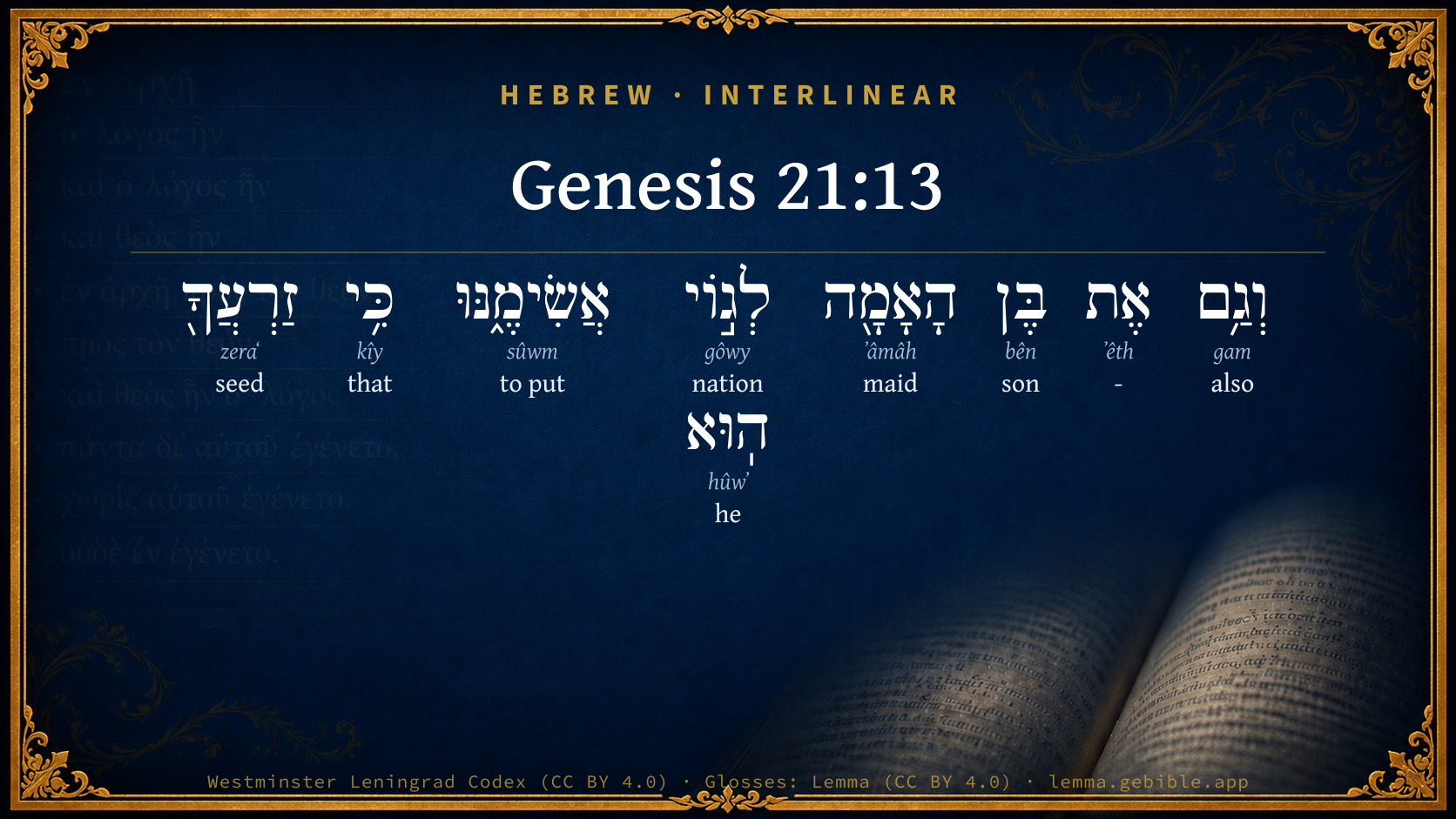
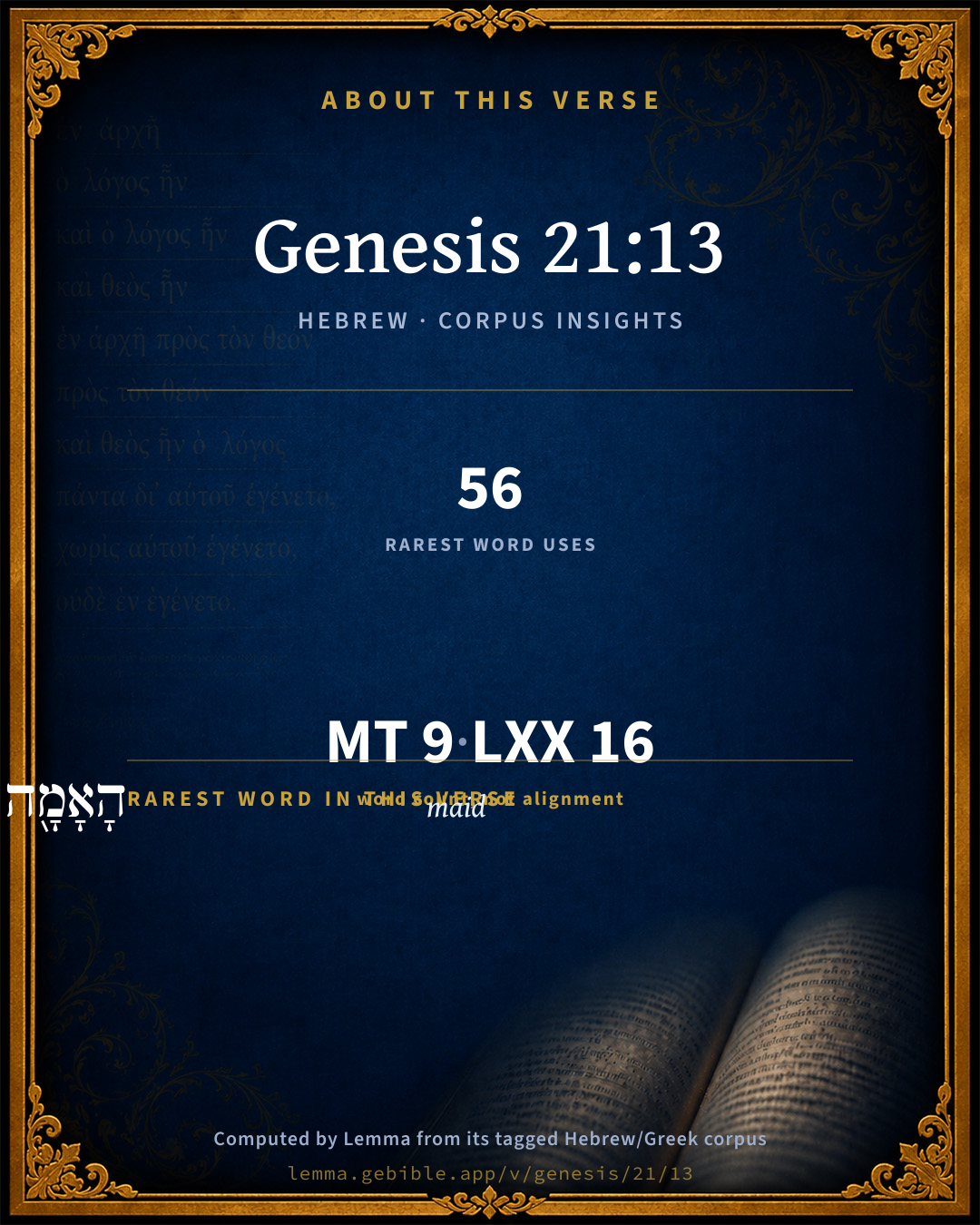
Genesis 21:13

Hebrew (Westminster Leningrad Codex) Genesis 21:13 appears in the Hebrew Old Testament. The text above is from the Westminster Leningrad Codex. Each word links to its Strong’s number, a concise gloss, and parsing drawn from the Open Scriptures Hebrew Bible morphology. Click any word for its full Brown-Driver-Briggs (BDB) entry.
Download image
Cite this verse

Genesis 21:13 (World English Bible). Public Domain. Lemma interlinear Bible study tool, https://lemma.gebible.app/v/genesis/21/13.

Show BibTeX & RIS
BibTeX
RIS
English Translation
Also of the son of the handmaid will I make a nation, because he is your seed."
World English Bible · Public Domain
Download a study sheet

One document with this verse’s original text, its word-by-word gloss line, the meaning frame, cross-references with their text, attributed commentary, and full source and license credits — printable, and it pastes into notes with its structure intact.

This verse Autodidact and up

Study sheet (.html) Plain text (.txt)

A passage Seminary Student

Up to 50 verses in one chapter. A passage sheet keeps up to 6 commentary sources and 12 cross-references per verse, in the order this page ranks them, and says so on the sheet whenever that leaves anything out. Ask for a single verse and you get the Autodidact verse sheet above.

Everything on this page stays free to read, with no account — the sheet is a download of what is already on screen, not access to it.

Want to remove ads? Support Godless Engineer
Compare translations 3

The same verse in 3 English versions, stacked beneath the original-language interlinear above. Click any original word for its lexicon entry.

Each is an independent rendering of the whole verse — the interlinear is not word-aligned to these translations.

Highlighted words mark where these versions differ — a whole-verse word diff, not a word-by-word alignment.

  • World English Bible Public Domain
    Also of the son of the handmaid will I make a nation, because he is your seed."
  • King James Version Public Domain
    And also of the son of the bondwoman will I make a nation, because he is thy seed.
  • unfoldingWord Literal Text CC BY-SA 4.0
    And the son of the slave woman I will also make into a nation, because he your offspring.”

unfoldingWord Literal Text — © unfoldingWord, licensed CC BY-SA 4.0. Word-aligned USFM3 via Door43 (git.door43.org/unfoldingWord/en_ult).

Versions to compare (up to 4)

3 of 4 selected

Show all 18 translations

Every available English version of this verse, each an independent rendering of the whole verse.

  • World English Bible Public Domain
    Also of the son of the handmaid will I make a nation, because he is your seed."
  • Berean Standard Bible Public Domain
    But I will also make a nation of the slave woman’s son, because he is your offspring.”
  • Majority Standard Bible Public Domain
    But I will also make a nation of the slave woman’s son, because he is your offspring.”
  • King James Version Public Domain
    And also of the son of the bondwoman will I make a nation, because he is thy seed.
  • American Standard Version (1901) Public Domain
    And also of the son of the handmaid will I make a nation, because he is thy seed.
  • Revised Version (1885) Public Domain
    And also of the son of the bondwoman will I make a nation, because he is thy seed.
  • Geneva Bible (1599) Public Domain
    As for the sonne of the bond woman, I will make him a nation also, because he is thy seede.
  • Douay-Rheims (1899) Public Domain
    But I will make the son also of the bondwoman a great nation, because he is thy seed.
  • Young's Literal Translation Public Domain
    As to the son of the handmaid also, for a nation I set him, because he `is' thy seed.'
  • Literal Standard Version CC BY-SA 4.0
    As for the son of the handmaid also, for a nation I set him, because he [is] your seed.”
  • Unlocked Literal Bible CC BY-SA 4.0
    I will also make the son of the servant woman into a nation, because he is your descendant.”
  • unfoldingWord Literal Text CC BY-SA 4.0
    And the son of the slave woman I will also make into a nation, because he your offspring.”
  • Darby Bible Public Domain
    But also the son of the handmaid will I make a nation, because he is thy seed.
  • World Messianic Bible Public Domain
    I will also make a nation of the son of the servant, because he is your child.”
  • Webster's Bible Public Domain
    And also of the son of the bond-woman will I make a nation, because he is thy seed.
  • Free Bible Version CC BY-SA 4.0
    Don't worry—I will also make the son of the slave woman into a nation because he's your son.”
  • Bible in Basic English Public Domain
    And I will make a nation of the son of your servant-woman, because he is your seed.
  • JPS Tanakh (1917) Public Domain
    And also of the son of the bondwoman will I make a nation, because he is thy seed.'

Literal Standard Version (2020), Covenant Press — licensed CC BY-SA 4.0. Text via the HelloAO Bible API (eBible.org). Unlocked Literal Bible (unfoldingWord) — licensed CC BY-SA 4.0. Text via the HelloAO Bible API (eBible.org). unfoldingWord Literal Text — © unfoldingWord, licensed CC BY-SA 4.0. Word-aligned USFM3 via Door43 (git.door43.org/unfoldingWord/en_ult). Free Bible Version, Dr. Jonathan Gallagher — licensed CC BY-SA 4.0. Text via the HelloAO Bible API (eBible.org).

Word by word

More ways to search: Search by grammar → Find every occurrence → Compare this word →

Practice this passage: Drill this verse → Learn its vocabulary →

הָאָמָ֖ה
ʼâmâh
H519
“the · maid”
Particle, Definite Article + Noun, Common, Feminine, Singular, Absolute
Part of Speech
Particle + Noun
Type
Common
Gender
Feminine
Number
Singular
State
Absolute
Full BDB Definition

Origin: apparently a primitive word

TWOT: 112

maid-servant, female slave, maid, handmaid, concubine - of humility (figuratively)
  1. וְגַ֥ם gam H1571 “and · also” Conjunction + Particle, Accusative
  2. אֶת ʼêth H853 “-” Particle, Direct Object
  3. בֶּן bên H1121 “son of” Noun, Common, Masculine, Singular, Construct
  4. לְג֣וֹי gôwy H1471 “to/for · nation” Preposition + Noun, Common, Masculine, Singular, Absolute
  5. אֲשִׂימֶ֑נּוּ sûwm H7760 “to put · him” Verb, Qal, Imperfect, 1st Person, Common, Singular + Suffix, Personal, 3rd Person, Masculine, Singular
  6. כִּ֥י kîy H3588 “that” Conjunction
  7. זַרְעֲךָ֖ zeraʻ H2233 “seed · your” Noun, Common, Masculine, Singular, Construct + Suffix, Personal, 2nd Person, Masculine, Singular
  8. הֽוּא hûwʼ H1931 “he” Pronoun, Personal, 3rd Person, Masculine, Singular

About this verse

These counts appear in no published source. They are computed here, from the morphology-tagged text and Lemma’s own curated glosses. What Lemma adds →

9
words
9
distinct lemmas
Pentateuch
section

Shared distinctive vocabulary

הָאָמָ֖ה maid H519 occurs in 49 verses of the Hebrew Bible. Also found in:

Grammatical profile

  • 1 verb
  • 4 nouns
  • 1 pronoun
  • 1 conjunction
  • 2 particles

Verb forms

  • אֲשִׂימֶ֑נּוּ Qal · Imperfect

Hebrew & Septuagint length

In English translation the verse runs 17 words from the Hebrew and 18 from the Septuagint (LXX English) — closely comparable.

A rough comparison of the two English renderings, which tokenize alike — not a word-level alignment.

Word counts can differ between the Hebrew and the Greek without any difference in meaning — e.g. the Hebrew direct-object marker אֵת has no separate Greek word, and Greek often adds the article ὁ.

In the original languages it is 9 Hebrew tokens and 16 Greek tokens — but the two are counted differently (Hebrew bundles its prefixes and suffixes into one token; the Greek is in lemma form), so that isn’t a like-for-like length.

Cross-references

4

Topical passages linked to Genesis 21:13 in the Treasury of Scripture Knowledge — connected by theme and wording, ordered by reader-vote popularity; previews shown in the World English Bible.

  • Genesis 16:10 The angel of Yahweh said to her, "I will greatly multiply your seed, that they will not be numbered for multitude."
  • Genesis 17:20 As for Ishmael, I have heard you. Behold, I have blessed him, and will make him fruitful, and will multiply him exceedingly. He will become the father of twelve princes, and I will make him a great nation.
  • Genesis 21:18 Get up, lift up the boy, and hold him in your hand. For I will make him a great nation."
  • Genesis 25:12–18 Now this is the history of the generations of Ishmael, Abraham's son, whom Hagar the Egyptian, Sarah's handmaid, bore to Abraham.

Cross-references courtesy of OpenBible.info (CC BY 4.0).

Hebrew and Greek witnesses Masoretic Hebrew ↔ Greek Septuagint

The same verse in the two great witnesses to the Old Testament, shown verse-for-verse.

These are two independent witnesses, not word-aligned to each other, and the Septuagint is shown in lemma (dictionary) form.

Hebrew Genesis 21:13 Masoretic · Westminster Leningrad Codex

וְגַ֥ם אֶת בֶּן הָאָמָ֖ה לְג֣וֹי אֲשִׂימֶ֑נּוּ כִּ֥י זַרְעֲךָ֖ הֽוּא

Also of the son of the handmaid will I make a nation, because he is your seed."

World English Bible · Public Domain

Greek LXX Genesis 21:13 Septuagint · lemma form

καί ὁ υἱός δέ ὁ παιδίσκη οὗτος εἰς ἔθνος μέγας ποιέω αὐτός ὅτι σπέρμα σός εἰμί

And moreover I will make the son of this bondwoman a great nation, because he is your seed.

LXX2012 (modern English Septuagint) · Public Domain

On this verse, The Cambridge Bible for Schools and Colleges discusses the Septuagint’s reading. Read the note in Commentary ↓

Hebrew: Westminster Leningrad Codex (CC BY 4.0). Greek: Septuagint (public domain); English from LXX2012 (modern English Septuagint) (Public Domain). How the Septuagint differs from the Hebrew →

Targum (Aramaic paraphrase)

2

The Targum is the ancient Jewish Aramaic paraphrase of the Hebrew Scriptures — an interpretive translation, not the Hebrew text itself. Onkelos (literal) and Pseudo-Jonathan (expansive) render the Torah, and Jonathan the Prophets. Coverage is partial: where no permissively-licensed English translation exists for a verse, only the Aramaic is shown. This is verse-level text, not a word-by-word alignment to the Hebrew.

  1. Targum Onkelos Torah (Genesis–Deuteronomy)
    וְאַף יָת בַּר אַמְתָא לְעַם אֲשַׁוִּנֵּהּ אֲרֵי בְנָךְ הוּא

    (no public-domain English translation for this verse)

    Targum Onkelos — Aramaic: “Onkelos Genesis” (public domain); “Onkelos Exodus” (public domain); “Onkelos Leviticus” (public domain); “Onkelos Numbers” (public domain); “Onkelos Deuteronomy” (public domain). English: “Sefaria Community Translation” (CC0 1.0 (public-domain dedication)); “J.W. Etheridge. The Targums of Onkelos and Jonathan Ben Uzziel on the Pentateuch. London: Longmans, Green, 1862” (public domain). Text via Sefaria.

  2. Targum Pseudo-Jonathan Torah (Genesis–Deuteronomy)
    וְאוֹף יַת בַּר אַמְתָא לְעַם לִיסְטִים אֲשַׁוִינֵיהּ אֲרוּם בְּרָךְ הוּא

    But the son of the handmaid have I set for a predatory people (le-am leistim), because he is thy son.

    Targum Pseudo-Jonathan — Aramaic: “Targum Jonathan on Genesis” (public domain); “Targum Jonathan on Exodus” (public domain); “Targum Jonathan on Leviticus” (public domain); “Targum Jonathan on Numbers” (public domain); “Targum Jonathan on Deuteronomy” (public domain). English: “The Targum of Jonathan ben Uzziel, trans. J. W. Etheridge, London, 1862” (public domain). Text via Sefaria.

Commentary

Notes on Genesis 21:13 from classic Christian and Jewish commentators (each source and its license shown beneath its notes). The classic Christian expositions comment on the surrounding passage and are grouped to its opening verse, so a note may address several verses; the Jewish commentaries on the Tanakh (Rashi and others) are per-verse, so they appear only where the commentator wrote on this verse.

Lemma curates 59 commentaries, every one of them public domain or Creative Commons licensed, each selected and text-cleaned for this edition rather than reprinted as found. About our sources →

Trapp's Complete Commentary

John Trapp

Gen 21:13 And also of the son of the bondwoman will I make a nation, because he [is] thy seed.

Ver. 13. Because he is thy seed.] So bountiful a Master is God, so liberal a Lord, that he blesseth his servants in their seed too. We count it a great favour if an earthly lord give an old servant a country cottage, with some small annuity for life; but God’s love extends beyond life; as David’s love to Jonathan preserves Mephibosheth from the gallows, yea, promoteth him to a princely allowance, and respect at court. Your children shall find and feel it, double and treble, said that martyr, whatsoever you do or suffer for the Lord’s sake. {a}

{a} Act. and Mon., fol. 1481.

John Trapp, A Commentary or Exposition upon All the Books of the Old and New Testament (1647–1656) — public domain. Text from a community e-Sword module.

Joseph Benson's Commentary

Gen 21:13. The casting out of Ishmael was not his ruin. He shall be a nation because he is thy seed — We are not sure that it was his eternal ruin. It is presumption to say, that all those who are left out of the external dispensation of God’s covenant are excluded from his spiritual mercies. Those may be saved who are not thus honoured.

Joseph Benson's Commentary on the Old and New Testaments (1811–1818) — public domain. Text from a community e-Sword module.

Geneva Bible (1599)

Geneva Bible translators

The Ishmaelites shall come of him.

Geneva Bible (1599) marginal notes — public domain. Text via Bolls.life.

Jamieson, Fausset & Brown

Robert Jamieson, A. R. Fausset & David Brown

also of the son of the bondwoman will I make a nation--Thus Providence overruled a family brawl to give rise to two great and extraordinary peoples.

Jamieson, Fausset & Brown — Commentary Critical and Explanatory on the Whole Bible (1871) — public domain (CC PDM 1.0). Text via the HelloAO Bible API.

Ellicott's Commentary for English Readers

(13) The son of the bondwoman.—Heb., of the handmaid. Hagar is never acknowledged as Abraham’s wife, though her child, as Abraham’s son, receives a noble promise for the father’s sake.

A Bible Commentary for English Readers, edited by Charles John Ellicott (1878–1897) — public domain. Text from a community e-Sword module.

The Cambridge Bible for Schools and Colleges

gen. ed. J. J. S. Perowne

13. a nation] Cf. Gen_16:10, Gen_17:20. The LXX and the Sam. read “a great nation.”

The Cambridge Bible for Schools and Colleges (gen. ed. J. J. S. Perowne; Cambridge University Press, 1878–1918) — public domain. Text from a community e-Sword module.

John Gill's Exposition

And Abraham rose up early in the morning,.... It was in the night the Lord spoke to him, and bid him hearken to the voice of Sarah; and, as soon as it was morning, he arose, and was not disobedient to the heavenly vision; for, though the thing he was directed to was disagreeable to flesh and blood, and contrary to his natural affection, yet, it being the will of God, he readily complied with it:

and took bread and a bottle of water; a loaf of bread very probably, and a leathern or wooden bottle of water, as Aben Ezra supposes it to be; for there is no need to say that these are put for all necessaries, and a liberal provision that might be made by Abraham; but it is to be taken strictly, according to the letter and history, as a matter of fact, since it could be no more than Hagar could carry, and did carry upon her shoulder: and, though Abraham could have sent cattle laden with provisions, and servants to attend them, yet he did not, which his natural affection and liberal disposition might dictate to him; but, as he was to hearken in this affair to whatsoever Sarah said, and act accordingly, perhaps this was all she would grant; or it might be so ordered by the providence of God, as a chastisement for their ill behaviour, and that they might know the difference between being in Abraham's house and out of it; and that there might be an opportunity given to show favour to them for Abraham's sake, who might probably direct them to some place where to go; and, till they came there, this might be a sufficient supply, when he gave them reason to expect more from him; but they got into the wilderness, wandered about and lost their way, and so became destitute of provisions; and this may be an emblem of the low, mean, and starving condition such are in who are under the law, and seek for happiness by the works of it:

and gave it unto Hagar, putting it on her shoulder; that is, the bread and the water, which might be put in one parcel or bundle, or in a basket, and so laid and carried on her shoulder: the Targum of Jonathan adds,"and bound it to her loins, to show that she was an handmaid:"

and the child; not that the child was "on her shoulder", which is quite improbable; for, since he was thirteen years of age when he was circumcised, he must be fourteen when Isaac was born; and if Isaac was two years old when weaned, Ishmael must be sixteen; and if he was three years of age, he must be seventeen; and if five years, he must be nineteen: some of the Jewish writers say (z), he was twenty seven years of age when he went out of his father's house; but they seem to come nearest the truth that make this event to be when he was at the age of seventeen (a), and when he must be too big to be carried on his mother's shoulder: but the sense is, that Abraham, when he put the provision on her shoulder, gave Ishmael to her, delivered him into her hand, to be taken care of by her; and very probably she led him in her hand:

and sent her away out of his house to some place assigned for her; the Targum of Jonathan adds, with a bill of divorce, dismissing her not only from his house, but as his wife; and so the Jewish writers (b) generally understand it: but there is no reason to believe there was any such custom before the law of Moses: nay, they go further, and say, that he dismissed her from himself, and from Isaac his son, and from this world, and from the world to come:

and she departed, and wandered in the wilderness of Beersheba; or, as the Targum of Jonathan, in the wilderness which was near to Beersheba; the place where it is probable Abraham now lived, and where Isaac was born, and the above affair was transacted, which was afterwards called by this name; for this is said by way of anticipation, see Gen 21:31. Beersheba is said (c) to be twelve miles from Gerar, and twenty miles from Hebron, to the south (d).

(z) Pirke Eliezer, c. 30. Bereshit Rabba, sect. 53. fol. 47. 4. (a) Shalshalet Hakabala, fol. 2. 2. (b) Pirke Eliezer & Shalshalet, ut supra. (z), (a).) (c) Bunting's Travels, p. 57. (d) Hieron. de loc. Heb. fol. 89. E.

John Gill's Exposition of the Whole Bible (1746–1763) — public domain (CC PDM 1.0). Text via the HelloAO Bible API.

The Pulpit Commentary

And also of the son of the bond-woman will I make a nation. Literally, to nation I will set or put him; a promise already given, (Gen_17:20) but here repeated to render Ishmael"s dismissal easier. Because he is thy seed. "Thy son according to the flesh, though not after the promise, as Isaac was" (Ainsworth); a proof that men may sometimes receive mercies for their fathers" sakes.

The Pulpit Commentary (1880–1919), ed. H.D.M. Spence-Jones & Joseph S. Exell — public domain. Text from a community e-Sword module.

John Wesley's Explanatory Notes

The casting out of Ishmael was not his ruin. He shall be a nation because he is thy seed - We are not sure that it was his eternal ruin. It is presumption to say, that all these who are left out of the external dispensation of God's covenant are excluded from all his mercies. Those may be saved who are not thus honoured.

John Wesley, Explanatory Notes Upon the Whole Bible (1754–1765) — public domain. Text via the GEBible commentary corpus.

Radak

Rabbi David Kimhi (Radak)

וגם את בן האמה, do not worry that he will perish when he leaves your house; on the contrary, I will make him develop into a great nation because he is your descendant

Radak on the Tanakh — English translations: “Sefaria Community Translation” (CC0 1.0 (public-domain dedication)); “Eliyahu Munk, HaChut Hameshulash” (CC BY 4.0); “Rabbi Mike Feuer, Jerusalem Anthology” (CC BY 4.0); and “R. David Kimhi on the first book of Psalms, Translated by R.G. Finch, London, 1919” (public domain). Text via Sefaria.

Lesson kit

Teaching starters — assembled from the data on this page, not authored interpretation. Every prompt links to the verse data it draws on. Edit before teaching.

Genesis, in the Pentateuch, opens this verse with 9 words (9 distinct Hebrew lemmas). Its most distinctive word is ʼâmâh (“maid”). A historical commentator’s framing appears above. Read the whole chapter for the surrounding context.

Discussion questions

  1. How does “maid” (ʼâmâh) shape what this verse is saying?
  2. How does Genesis 20:17, which shares the word «maid», read alongside this verse?
  3. These translations render this verse differently. What is at stake in choosing one wording over another?
  4. «אֲשִׂימֶ֑נּוּ» is a Qal Imperfect verb. How does that grammatical form shape the action described?
  5. Compare how Trapp's Complete Commentary and Joseph Benson's Commentary read this verse. Where do they agree or differ?

Things to notice

Reading settings

Reading text

Shown beneath each verse's original-language words.

Old Testament
Old Testament edition

Read the OT as the Masoretic Hebrew (MT) or the Greek Septuagint (LXX).

English shown for the Greek Septuagint (in the Hebrew ↔ Greek comparison).

Comparing translations? Open the Compare panel on any verse page to stack up to four side by side.