
Joshua 3:17

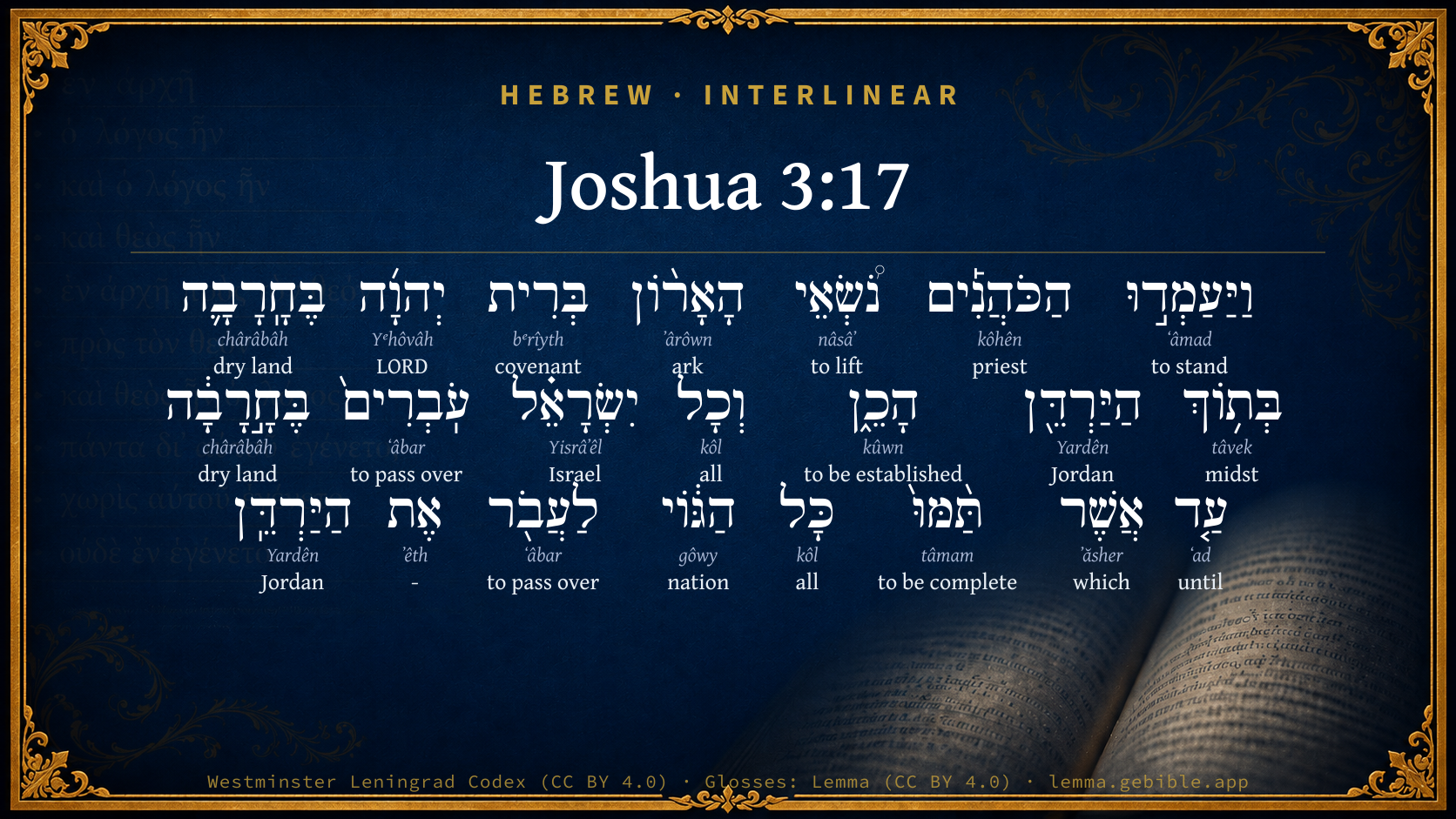
Hebrew (Westminster Leningrad Codex) Joshua 3:17 appears in the Hebrew Old Testament. The text above is from the Westminster Leningrad Codex. Each word links to its Strong’s number, a concise gloss, and parsing drawn from the Open Scriptures Hebrew Bible morphology. Click any word for its full Brown-Driver-Briggs (BDB) entry.
Download image
Cite this verse

Joshua 3:17 (World English Bible). Public Domain. Lemma interlinear Bible study tool, https://lemma.gebible.app/v/joshua/3/17.

Show BibTeX & RIS
BibTeX
RIS
English Translation
The priests who bore the ark of the covenant of Yahweh stood firm on dry ground in the midst of the Jordan; and all Israel passed over on dry ground, until all the nation were passed clean over the Jordan.
World English Bible · Public Domain
Download a study sheet

One document with this verse’s original text, its word-by-word gloss line, the meaning frame, cross-references with their text, attributed commentary, and full source and license credits — printable, and it pastes into notes with its structure intact.

This verse Autodidact and up

Study sheet (.html) Plain text (.txt)

A passage Seminary Student

Up to 50 verses in one chapter. A passage sheet keeps up to 6 commentary sources and 12 cross-references per verse, in the order this page ranks them, and says so on the sheet whenever that leaves anything out. Ask for a single verse and you get the Autodidact verse sheet above.

Everything on this page stays free to read, with no account — the sheet is a download of what is already on screen, not access to it.

Want to remove ads? Support Godless Engineer
Compare translations 3

The same verse in 3 English versions, stacked beneath the original-language interlinear above. Click any original word for its lexicon entry.

Each is an independent rendering of the whole verse — the interlinear is not word-aligned to these translations.

Highlighted words mark where these versions differ — a whole-verse word diff, not a word-by-word alignment.

  • World English Bible Public Domain
    The priests who bore the ark of the covenant of Yahweh stood firm on dry ground in the midst of the Jordan; and all Israel passed over on dry ground, until all the nation were passed clean over the Jordan.
  • King James Version Public Domain
    And the priests that bare the ark of the covenant of the LORD stood firm on dry ground in the midst of Jordan, and all the Israelites passed over on dry ground, until all the people were passed clean over Jordan.
  • unfoldingWord Literal Text CC BY-SA 4.0
    So the priests, the carriers of the Box of the Covenant of Yahweh, stood firmly on dry ground in the midst of the Jordan. And all of Israel crossing over on dry ground until when all of the nation had finished crossing over the Jordan.

unfoldingWord Literal Text — © unfoldingWord, licensed CC BY-SA 4.0. Word-aligned USFM3 via Door43 (git.door43.org/unfoldingWord/en_ult).

Versions to compare (up to 4)

3 of 4 selected

Show all 18 translations

Every available English version of this verse, each an independent rendering of the whole verse.

  • World English Bible Public Domain
    The priests who bore the ark of the covenant of Yahweh stood firm on dry ground in the midst of the Jordan; and all Israel passed over on dry ground, until all the nation were passed clean over the Jordan.
  • Berean Standard Bible Public Domain
    The priests carrying the ark of the covenant of the LORD stood firm on dry ground in the middle of the Jordan, while all Israel crossed over the dry ground, until the entire nation had crossed the Jordan.
  • Majority Standard Bible Public Domain
    The priests carrying the ark of the covenant of the LORD stood firm on dry ground in the middle of the Jordan, while all Israel crossed over the dry ground, until the entire nation had crossed the Jordan.
  • King James Version Public Domain
    And the priests that bare the ark of the covenant of the LORD stood firm on dry ground in the midst of Jordan, and all the Israelites passed over on dry ground, until all the people were passed clean over Jordan.
  • American Standard Version (1901) Public Domain
    And the priests that bare the ark of the covenant of Jehovah stood firm on dry ground in the midst of the Jordan; and all Israel passed over on dry ground, until all the nation were passed clean over the Jordan.
  • Revised Version (1885) Public Domain
    And the priests that bare the ark of the covenant of the LORD stood firm on dry ground in the midst of Jordan, and all Israel passed over on dry ground, until all the nation were passed clean over Jordan.
  • Geneva Bible (1599) Public Domain
    But the Priestes that bare the Arke of the couenant of the Lord, stoode drie within Iorden readie prepared, and all the Israelites went ouer dry, vntill all the people were gone cleane ouer through Iorden.
  • Douay-Rheims (1899) Public Domain
    And the people marched over against Jericho: and the priests that carried the ark of the covenant of the Lord, stood girded upon the dry ground in the midst of the Jordan, and all the people passed over through the channel that was dried up.
  • Young's Literal Translation Public Domain
    and the priests bearing the ark of the covenant of Jehovah stand on dry ground in the midst of the Jordan -- established, and all Israel are passing over on dry ground till that all the nation hath completed to pass over the Jordan.
  • Literal Standard Version CC BY-SA 4.0
    and the priests carrying the Ark of the Covenant of YHWH stand on dry ground in the midst of the Jordan—established, and all Israel are passing over on dry ground until all the nation has completed to pass over the Jordan.
  • Unlocked Literal Bible CC BY-SA 4.0
    The priests that carried the ark of the covenant of Yahweh stood on dry ground in the middle of the Jordan until all the people of Israel crossed over on dry ground.
  • unfoldingWord Literal Text CC BY-SA 4.0
    So the priests, the carriers of the Box of the Covenant of Yahweh, stood firmly on dry ground in the midst of the Jordan. And all of Israel crossing over on dry ground until when all of the nation had finished crossing over the Jordan.
  • Darby Bible Public Domain
    And the priests who bore the ark of the covenant of Jehovah stood firm on dry ground in the midst of the Jordan. And all Israel went over on dry ground, until all the nation had completely gone over the Jordan.
  • World Messianic Bible Public Domain
    The priests who bore the ark of the LORD’s covenant stood firm on dry ground in the middle of the Jordan; and all Israel crossed over on dry ground, until all the nation had passed completely over the Jordan.
  • Webster's Bible Public Domain
    And the priests that bore the ark of the covenant of the LORD stood firm on dry ground in the midst of Jordan, and all the Israelites passed over on dry ground, until all the people had passed quite over Jordan.
  • Free Bible Version CC BY-SA 4.0
    The priests carrying the Ark stood on the dried-up riverbed of the Jordan as all the people went by, staying there until everyone had crossed over on dry ground.
  • Bible in Basic English Public Domain
    And the priests who took up the ark of the agreement of the Lord kept their places, with their feet on dry land in the middle of Jordan, while all Israel went over on dry land, till all the nation had gone over Jordan.
  • JPS Tanakh (1917) Public Domain
    And the priests that bore the ark of the covenant of the LORD stood firm on dry ground in the midst of the Jordan, while all Israel passed over on dry ground, until all the nation were passed clean over the Jordan.

Literal Standard Version (2020), Covenant Press — licensed CC BY-SA 4.0. Text via the HelloAO Bible API (eBible.org). Unlocked Literal Bible (unfoldingWord) — licensed CC BY-SA 4.0. Text via the HelloAO Bible API (eBible.org). unfoldingWord Literal Text — © unfoldingWord, licensed CC BY-SA 4.0. Word-aligned USFM3 via Door43 (git.door43.org/unfoldingWord/en_ult). Free Bible Version, Dr. Jonathan Gallagher — licensed CC BY-SA 4.0. Text via the HelloAO Bible API (eBible.org).

Word by word

More ways to search: Search by grammar → Find every occurrence → Compare this word →

Practice this passage: Drill this verse → Learn its vocabulary →

בֶּחָֽרָבָ֛ה
chârâbâh
H2724
“in/at the · dry land”
Preposition, Determined + Noun, Common, Feminine, Singular, Absolute
Part of Speech
Preposition + Noun
Type
Common
Gender
Feminine
Number
Singular
State
Absolute
Full BDB Definition

Origin: from H2720

TWOT: 731e

dry land, dry ground
  1. וַיַּעַמְד֣וּ ʻâmad H5975 “and · to stand” Conjunction + Verb, Qal, Sequential Imperfect, 3rd Person, Masculine, Plural
  2. הַכֹּהֲנִ֡ים kôhên H3548 “the · priests” Particle, Definite Article + Noun, Common, Masculine, Plural, Absolute
  3. נֹ֠שְׂאֵי nâsâʼ H5375 “lifting” Verb, Qal, Participle Active, Masculine, Plural, Construct
  4. הָאָר֨וֹן ʼârôwn H727 “the · ark” Particle, Definite Article + Noun, Common, Both, Singular, Absolute
  5. בְּרִית bᵉrîyth H1285 “covenant of” Noun, Common, Feminine, Singular, Construct
  6. יְהוָ֜ה Yᵉhôvâh H3068 “LORD” Noun, Proper
  7. בְּת֥וֹךְ tâvek H8432 “in/at · midst of” Preposition + Noun, Common, Masculine, Singular, Construct
  8. הַיַּרְדֵּ֖ן Yardên H3383 “the · Jordan” Particle, Definite Article + Noun, Proper
  9. הָכֵ֑ן kûwn H3559 “to be established” Verb, Hiphil, Infinitive Absolute
  10. וְכָל kôl H3605 “and · all of” Conjunction + Noun, Common, Masculine, Singular, Construct
  11. יִשְׂרָאֵ֗ל Yisrâʼêl H3478 “Israel” Noun, Proper
  12. עֹֽבְרִים֙ ʻâbar H5674 “passing over” Verb, Qal, Participle Active, Masculine, Plural, Absolute
  13. בֶּחָ֣רָבָ֔ה chârâbâh H2724 “in/at the · dry land” Preposition, Determined + Noun, Common, Feminine, Singular, Absolute
  14. עַ֤ד ʻad H5704 “until” Preposition
  15. אֲשֶׁר ʼăsher H834 “which” Particle, Relative
  16. תַּ֨מּוּ֙ tâmam H8552 “to be complete” Verb, Qal, Perfect, 3rd Person, Common, Plural
  17. כָּל kôl H3605 “all of” Noun, Common, Masculine, Singular, Construct
  18. הַגּ֔וֹי gôwy H1471 “the · nation” Particle, Definite Article + Noun, Common, Masculine, Singular, Absolute
  19. לַעֲבֹ֖ר ʻâbar H5674 “to pass over” Preposition + Verb, Qal, Infinitive Construct
  20. אֶת ʼêth H853 “-” Particle, Direct Object
  21. הַיַּרְדֵּֽן Yardên H3383 “the · Jordan” Particle, Definite Article + Noun, Proper

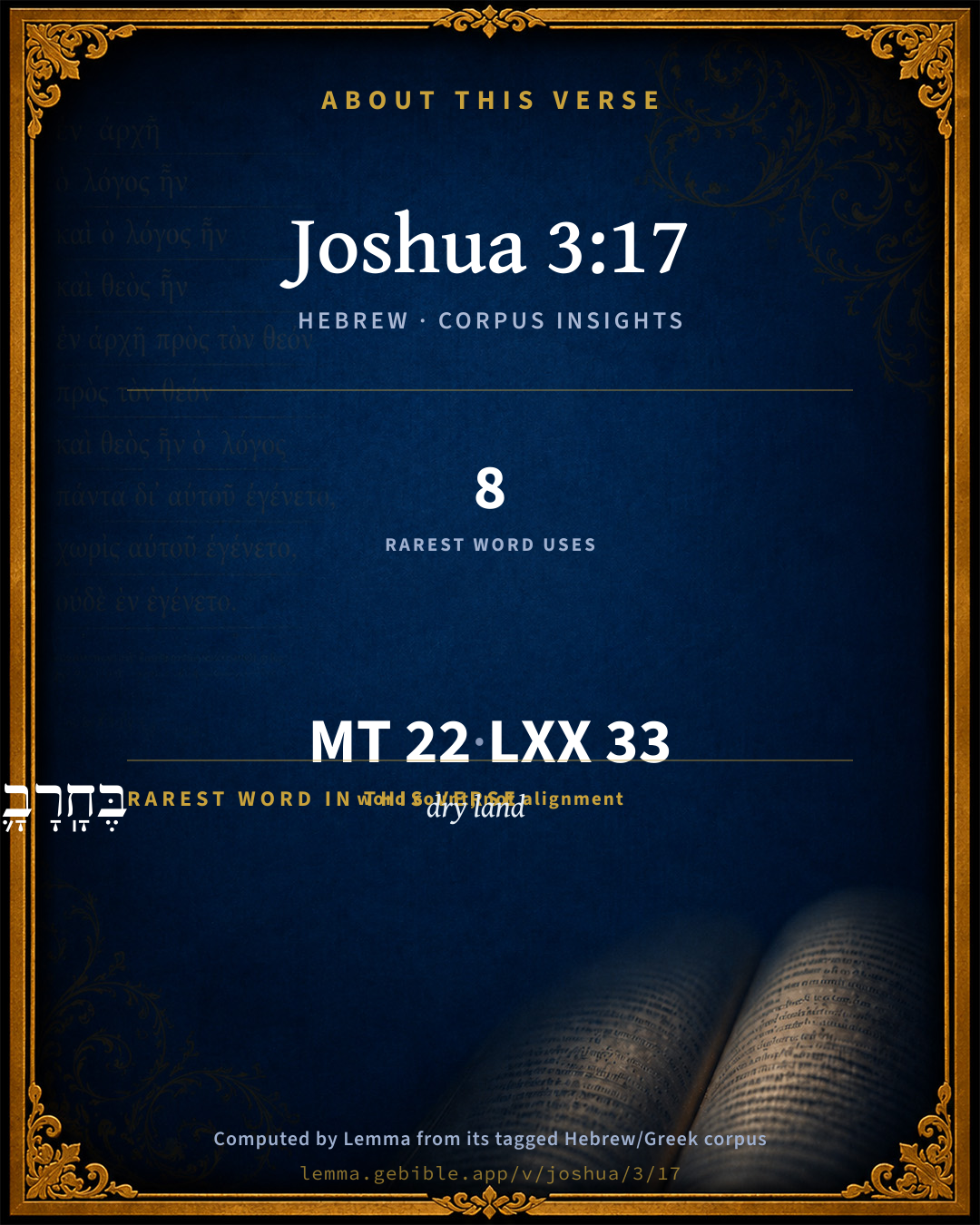
About this verse

These counts appear in no published source. They are computed here, from the morphology-tagged text and Lemma’s own curated glosses. What Lemma adds →

22
words
18
distinct lemmas
Historical
section

Notable vocabulary

The rarest word here is בֶּחָֽרָבָ֛ה dry land H2724 — appearing just 8 times in the whole Hebrew Bible.

Shared distinctive vocabulary

בֶּחָֽרָבָ֛ה dry land H2724 occurs in 7 verses of the Hebrew Bible. Also found in:

Grammatical profile

  • 6 verbs
  • 13 nouns
  • 1 preposition
  • 2 particles

Verb forms

  • וַיַּעַמְד֣וּ Qal · Sequential Imperfect
  • נֹ֠שְׂאֵי Qal · Participle Active
  • הָכֵ֑ן Hiphil · Infinitive Absolute
  • עֹֽבְרִים֙ Qal · Participle Active
  • תַּ֨מּוּ֙ Qal · Perfect
  • לַעֲבֹ֖ר Qal · Infinitive Construct

Repetition

Words recur within this verse — often emphatic in Hebrew:

  • בֶּחָֽרָבָ֛ה dry land H2724 ×2
  • הַיַּרְדֵּ֖ן Jordan H3383 ×2
  • וְכָל all H3605 ×2
  • עֹֽבְרִים֙ to pass over H5674 ×2

Hebrew & Septuagint length

In English translation the verse runs 40 words from the Hebrew and 42 from the Septuagint (LXX English) — closely comparable.

A rough comparison of the two English renderings, which tokenize alike — not a word-level alignment.

Word counts can differ between the Hebrew and the Greek without any difference in meaning — e.g. the Hebrew direct-object marker אֵת has no separate Greek word, and Greek often adds the article ὁ.

In the original languages it is 22 Hebrew tokens and 33 Greek tokens — but the two are counted differently (Hebrew bundles its prefixes and suffixes into one token; the Greek is in lemma form), so that isn’t a like-for-like length.

Cross-references

7

Topical passages linked to Joshua 3:17 in the Treasury of Scripture Knowledge — connected by theme and wording, ordered by reader-vote popularity; previews shown in the World English Bible.

  • Exodus 14:22 The children of Israel went into the midst of the sea on the dry ground, and the waters were a wall to them on their right hand, and on their left.
  • Exodus 14:29 But the children of Israel walked on dry land in the midst of the sea, and the waters were a wall to them on their right hand, and on their left.
  • Psalms 66:6 He turned the sea into dry land. They went through the river on foot. There, we rejoiced in him.
  • Isaiah 25:8 He has swallowed up death forever; and the Lord Yahweh will wipe away tears from off all faces; and the reproach of his people will he take away from off all the earth: for Yahweh has spoken it.
  • Joshua 4:3 and command you them, saying, Take hence out of the midst of the Jordan, out of the place where the priests' feet stood firm, twelve stones, and carry them over with you, and lay them down in the lodging-place, where you shall lodge this night.
  • 2 Kings 2:8 Elijah took his mantle, and wrapped it together, and struck the waters, and they were divided here and there, so that they two went over on dry ground.
  • Hebrews 11:29 By faith, they passed through the Red sea as on dry land. When the Egyptians tried to do so, they were swallowed up.

Cross-references courtesy of OpenBible.info (CC BY 4.0).

Hebrew and Greek witnesses Masoretic Hebrew ↔ Greek Septuagint

The same verse in the two great witnesses to the Old Testament, shown verse-for-verse.

These are two independent witnesses, not word-aligned to each other, and the Septuagint is shown in lemma (dictionary) form.

Hebrew Joshua 3:17 Masoretic · Westminster Leningrad Codex

וַיַּעַמְד֣וּ הַכֹּהֲנִ֡ים נֹ֠שְׂאֵי הָאָר֨וֹן בְּרִית יְהוָ֜ה בֶּחָֽרָבָ֛ה בְּת֥וֹךְ הַיַּרְדֵּ֖ן הָכֵ֑ן וְכָל יִשְׂרָאֵ֗ל עֹֽבְרִים֙ בֶּחָ֣רָבָ֔ה עַ֤ד אֲשֶׁר תַּ֨מּוּ֙ כָּל הַגּ֔וֹי לַעֲבֹ֖ר אֶת הַיַּרְדֵּֽן

The priests who bore the ark of the covenant of Yahweh stood firm on dry ground in the midst of the Jordan; and all Israel passed over on dry ground, until all the nation were passed clean over the Jordan.

World English Bible · Public Domain

Greek LXX Joshua 3:17 Septuagint · lemma form

καί ἵστημι ὁ ἱερεύς ὁ αἴρω ὁ κιβωτός ὁ διαθήκη κύριος ἐπί ξηρός ἐν μέσος ὁ ἰορδάνης καί πᾶς ὁ υἱός ἰσραήλ διαβαίνω διά ξηρός ἕως συντελέω πᾶς ὁ λαός διαβαίνω ὁ ἰορδάνης

And the priests that bore the ark of the covenant of the Lord stood on dry land in the midst of Jordan; and all the children of Israel went through on dry land, until all the people had completely gone over Jordan.

LXX2012 (modern English Septuagint) · Public Domain

On this verse, Haydock's Catholic Bible Commentary discusses the Septuagint’s reading. Read the note in Commentary ↓

Hebrew: Westminster Leningrad Codex (CC BY 4.0). Greek: Septuagint (public domain); English from LXX2012 (modern English Septuagint) (Public Domain). How the Septuagint differs from the Hebrew →

Targum (Aramaic paraphrase)

1

The Targum is the ancient Jewish Aramaic paraphrase of the Hebrew Scriptures — an interpretive translation, not the Hebrew text itself. Onkelos (literal) and Pseudo-Jonathan (expansive) render the Torah, and Jonathan the Prophets. Coverage is partial: where no permissively-licensed English translation exists for a verse, only the Aramaic is shown. This is verse-level text, not a word-by-word alignment to the Hebrew.

  1. Targum Jonathan Prophets (Joshua–Malachi)
    וְקָמוּ כַהֲנַיָא נַטְלֵי אֲרוֹן קַיָמָא דַייָ בְּיַבֶּשְׁתָּא בְּגוֹ יַרְדְנָא מְתַקְנַיָא וְכָל יִשְׂרָאֵל עָבְרִין בְּיַבֶּשְׁתָּא עַד דִשְׁלִימוּ כָּל עַמָא לְמֶעְבַּר יַת יַרְדְנָא:

    (no public-domain English translation for this verse)

    Targum Jonathan — Aramaic: “Mikraot Gedolot” (public domain). English: “Sefaria Community Translation” (CC0 1.0 (public-domain dedication)); “London "Chaldee Paraphrase," 1871” (public domain). Text via Sefaria.

Commentary

Notes on Joshua 3:17 from classic Christian and Jewish commentators (each source and its license shown beneath its notes). The classic Christian expositions comment on the surrounding passage and are grouped to its opening verse, so a note may address several verses; the Jewish commentaries on the Tanakh (Rashi and others) are per-verse, so they appear only where the commentator wrote on this verse.

Lemma curates 59 commentaries, every one of them public domain or Creative Commons licensed, each selected and text-cleaned for this edition rather than reprinted as found. About our sources →

Trapp's Complete Commentary

John Trapp

Jos 3:17 And the priests that bare the ark of the covenant of the LORD stood firm on dry ground in the midst of Jordan, and all the Israelites passed over on dry ground, until all the people were passed clean over Jordan.

Ver. 17. And all the Israelites passed over.] He was a bold Israelite that first set foot on the water: but no "Israelite indeed" need fear to pass through corporal death, having the ark of God’s covenant in his eye, to take possession of the heavenly Canaan.

John Trapp, A Commentary or Exposition upon All the Books of the Old and New Testament (1647–1656) — public domain. Text from a community e-Sword module.

Joseph Benson's Commentary

Jos 3:17. Stood firm — That is, in one and the same place and posture; their feet were neither moved by any waters flowing in upon them, nor sunk into any mire, which one might think was at the bottom of the river. And this may be opposed to their standing in the brink of the water when they came to it, as commanded, (Jos 3:8,) which was but for a while, till the waters were divided and gone away; and then they were to go farther, even into the midst of Jordan, where they were to stand constantly and fixedly, as the Hebrew word signifies, until all were passed over. The midst of Jordan — In the middle and deepest part of the river. This manifests how firmly the priests believed the word of the Lord, and confided in his power, otherwise they would not have dared to stand so long in the midst of the channel of a river, whose rapid waters stood suspended above them in mountainous heaps, ready every moment to overwhelm them unless miraculously withheld by the power of God.

Joseph Benson's Commentary on the Old and New Testaments (1811–1818) — public domain. Text from a community e-Sword module.

Tyndale Open Study Notes

Tyndale Open Resources

3:17 The repetition of the phrase on dry ground emphasizes that God performed a miracle.

Tyndale Open Study Notes — © Tyndale Open Resources, licensed CC BY-SA 4.0. Text via the HelloAO Bible API.

Geneva Bible (1599)

Geneva Bible translators

Either tarrying till the people were past, or as some read, sure, as though they had been upon the dry land.

Geneva Bible (1599) marginal notes — public domain. Text via Bolls.life.

Jamieson, Fausset & Brown

Robert Jamieson, A. R. Fausset & David Brown

the priests . . . and all the Israelites passed over on dry ground--the river about Jericho has a firm pebbly bottom, on which the host might pass, without inconvenience when the water was cleared off.

Next: Joshua Chapter 4

Jamieson, Fausset & Brown — Commentary Critical and Explanatory on the Whole Bible (1871) — public domain (CC PDM 1.0). Text via the HelloAO Bible API.

Adam Clarke's Commentary

Verse 17. The priests - stood firm on dry ground] They stood in the mid channel, and shifted not their position till the camp, consisting of nearly 600,000 effective men, besides women, children, c., had passed over.

1. Is it not surprising that the Canaanites did not dispute this passage with the Israelites? It is likely they would, had they had any expectation that such a passage would have been attempted. They must have known that the Israelitish camp was on the other side of the Jordan, but could they have supposed that a passage for such a host was possible when the banks of the Jordan were quite overflowed? It was not merely because they were panic struck that they did not dispute this passage, but because they must have supposed it impossible and when they found the attempt was made, the passage was effected before they could prepare to prevent it.

2. GOD now appears in such a way, and works in such a manner, as to leave no doubt concerning his presence or his power, or of his love to Israel. After this, was it possible for this people ever to doubt his being or his bounty? This, with the miraculous passage of the Red Sea, were well calculated to have established their faith for ever; and those who did not yield to the evidence afforded by these two miracles were incapable of rational conviction.

3. In some respects the passage of the Jordan was more strikingly miraculous than that even of the Red Sea. In the latter God was pleased to employ an agent; the sea went back by a strong east wind all that night, and made the sea dry land, Ex 14:21. Nothing of this kind appeared in the passage of the Jordan; a very rapid river (for so all travellers allow it to be) went back to its source without any kind of agency but the invisible hand of the invisible God.

4. Through the whole period of the Jewish history these miracles, so circumstantially related, were never denied by any, but on the contrary conscientiously believed by all. Nor did any of them in their revolts from God, which were both foul and frequent, ever call these great facts in question, when even so full of enmity against God as to blaspheme his name, and give his glory to dumb idols! Is not this a manifest proof that these facts were incontestable? and that Jehovah had so done his marvellous works that they should be had in everlasting remembrance? Reader, the same God who is over all is rich in mercy to all that call upon him. HE changes not, neither is he weary: trust in the Lord for ever, for in the Lord Jehovah is everlasting strength; and HE ever saves his followers out of the hands of all their enemies, and, having guided them by his counsel, will receive them into his glory.

Adam Clarke's Commentary on the Bible (1810–1826) — public domain. Text from a community e-Sword/MySword module.

The Cambridge Bible for Schools and Colleges

gen. ed. J. J. S. Perowne

17. all the Israelites passed over] Where the passage exactly took place cannot now be determined, but the typical significance of the narrative is very impressive. Whether we consider (i) the solemn inauguration of Joshua to his office; or (ii) his attestation by the waters of the Jordan; or (iii) the choice of twelve men, one from each tribe, to be the bearers of the twelve stones, and the builders of the monument founded therewith (1Co_3:10; Rev_21:14), we see types of the other “Joshua,” Who was solemnly inaugurated and divinely attested by the rushing waters of the same stream, and Who ordained His twelve Apostles to be the Pillars of His Church, and the builders of the Spiritual Temple. See above, Introduction, p. 25.

The Cambridge Bible for Schools and Colleges (gen. ed. J. J. S. Perowne; Cambridge University Press, 1878–1918) — public domain. Text from a community e-Sword module.

John Gill's Exposition

And the priests that bare the ark of the Lord stood firm on dry ground in the midst of Jordan,.... Which for its breadth Mr. Maundrell, the above mentioned traveller, says (c) might be about twenty yards over, and its depth exceeded his height; but Dr. Shaw (d), a later traveller still, says,"the river Jordan is by far the most considerable river, excepting the Nile, either of the coast of Syria, or of Barbary. I computed it to be about thirty yards broad, but the depth I could not measure, except at the brink, where I found it to be three yards.''Now in the midst of this river the priests bearing the ark stood firm on dry ground, the waters above being stopped and those below cut off. This perhaps might give rise to the fables among the Heathens of the river Scamander being swelled for the destruction of Achilles, and dried up by Vulcan, of which Homer (e) makes mention; and of the river Inachus, dried up by Neptune, as the Grecians fable; however, if Heathens can credit these accounts, surely we Christians ought to believe this, attested by divine revelation. And this may denote the presence of Christ with his people in afflictions, who will not suffer those waters to overflow them, and in death itself, when the swellings of Jordan shall not come near them to distress them; and when the covenant of grace will appear firm and sure, and be their great support; and when also the feet of the ministers of Christ stand firm, and their faith fails not; which is of great use, and very encouraging to the spiritual Israel of God:

and all the Israelites passed over on dry ground; the waters being divided to a space large enough for such a body of people to pass over, and which continued

until all the people were clean passed over Jordan; perfectly and completely, not one being left behind, or lost in the passage through it; in the midst of which the priests stood until all were passed over. So the spiritual Israel of God must all go over Jordan's river, or must all go through the valley of the shadow of death; and they will all go over safe to Canaan's land, to the heavenly glory; their souls go immediately to heaven at death, and their bodies will be raised at the last day, and be reunited to them, and partake of happiness with them; nor will anyone of them be lost; they all clean pass over, and arrive safe; for they are the chosen of God, the care and charge of Christ, the purchase of his blood, partake of his grace, and have the earnest of his Spirit.

(c) Maundrell, Journey from Aleppo to Jerusalem, p. 83. (d) Travels, p. 346. (e) Iliad. 21.

Next: Joshua Chapter 4

John Gill's Exposition of the Whole Bible (1746–1763) — public domain (CC PDM 1.0). Text via the HelloAO Bible API.

Albert Barnes' Notes on the Bible

The miraculous passage to the holy land through Jordan is not less pregnant with typical meaning than that through the Red Sea (compare 1Co 10:1-2). The solemn inauguration of Joshua to his office, and his miraculous attestation, by the same waters with which Jesus was baptized on entering on the public exercise of His ministry (compare Mat 3:16-17); the choice of twelve men, one from each tribe to be the bearers of the twelve stones, and the builders of the monument erected therewith (compare 1Co 3:10; Rev 21:14): these were divinely-ordered occurrences, not without a further bearing than their more immediate one upon Israel. Nor must in this point of view the name “Adam,” the place where the stream flowed to the people which cut them off from the promises, and the failure for the time under the rule of Joshua of the full and rapid flood which supplies the Dead Sea, be overlooked.

Albert Barnes' Notes on the Bible (1834–1885) — public domain. Text from a community e-Sword/MySword module.

Haydock's Catholic Bible Commentary

Jericho, at Bethabara, which was five or six leagues from the Dead Sea, all which space was left dry. Jericho was three leagues from the Jordan. (Calmet) --- Girded. Septuagint, "ready," preparing the way for all the army. Hebrew, "firm," and undaunted. (Haydock) --- A great part of the day must have been spent in crossing the river, and erecting the two monuments. (Menochius)

George Leo Haydock (1774–1849), Haydock's Catholic Family Bible and Commentary, 1859 edition — public domain. Excludes Psalms (Douay-Rheims chapter numbering differs from Protestant) and Deuterocanonical books (Catholic canon only).

Matthew Poole's English Annotations

Stood firm, i.e. in one and the same place and posture; their feet neither moved by any waters flowing in upon them, nor sinking into any mire, which one might think was at the bottom of the river. And this may be opposed unto their other standing in the brink of the water when they came to it, commanded Jos 3:8, which was but for a while, till the waters were divided and gone away; and then they were to go farther, even

into the midst of Jordan, as is here said, where they are to stand constantly and fixedly, as this Hebrew word signifies, until all were passed over. If it be said that what is prescribed Jos 3:8, is here said to be executed, and therefore the midst of Jordan here is the same place with the brink of the water of Jordan, Jos 3:8; it may be answered, that the manifest variation of the phrase shows that it is not absolutely the same thing or place which is spoken of there and here; but what is there enjoined is here executed with advantage; for when it is said that they

stood firm...in the midst of Jordan, it must needs be supposed that they first came to the brink of the water, and that they stood there for a season, till the waters were cut off and dried up, as appears from the nature of the thing; and that then they went farther, even into the midst of Jordan. In the midst of Jordan: either,

1. Within Jordan, as it is expressed above, Jos 3:8; for that phrase doth not always signify the exact middle of a place, but any part within it, as appears from Gen 45:6; Exo 8:22; 24:18; Jos 7:13; 10:13; Pro 30:19. Or rather,

2. In the middle and deepest part of the river. For,

1. Words should be taken properly, where they may without any inconveniency, which is the case here.

2. The ark went before them to direct, and encourage, and secure them in the dangers of their passages, for which ends the middle was the fittest place.

3. In this sense the same phrase is used, Jos 4:3,8; for certainly those stones which were to be witnesses and monuments of their passage over Jordan should not be taken from the brink or brim of the river, or from the shore which Jordan overflowed only at that season, but from the most inward and deepest parts of the river; and Jos 3:16-17, where the priests are said to ascend or come up out of Jordan, and out of the midst of Jordan unto the dry land; whereas had this been meant only of the first entrance into the river, they must have been said first to go down into Jordan, and then to go up to the land.

Matthew Poole's English Annotations on the Holy Bible (1683–1685) — public domain. Text from a community e-Sword/MySword module.

Whedon's Commentary on the Bible

Daniel D. Whedon

17. The priests… stood firm on dry ground — The priests stood above, near the wall of waters, and the people passed below. The ark, the symbol of the presence of Jehovah, was the instrument of the miracle, as the rod of Moses had been in the division of the Red Sea. Thus God honours his own ordinances.

Dry ground — Not hard and dusty ground, but dry only in the sense of being drained of water. See note on Jos_4:18.

All the Israelites passed… clean over Jordan — The Jordan is now passed, and Canaan is attained! The forty years’ sojourn is closed, and for the first ecstatic moment the feet of the tribes are standing on the Promised Land! Their departure from Egypt and their arrival in Canaan are signalized by parallel miracles of sea and river. Both at their exit and at their entrance Jehovah leads them through a watery gate, by cleaving the waves asunder. Through all ages the Church has seen in the desert sojourn the symbol of our probationary life, and in the crossing the Jordan the symbol of death. Yet is there this memorable difference: the crossing the Jordan was to Israel the commencement of a new warfare; the transit of Christian death is into eternal repose.

Daniel D. Whedon (gen. ed.), Commentary on the Old and New Testaments (1874–1909) — public domain. Text from a community e-Sword module.

The Pulpit Commentary

Firm. The LXX does not translate this. The Vulgate renders accincti. The original, literally translated, means to cause to stand upright. In the midst of Jordan. That is, they stood surrounded by water, but not in midstream, which would be expressed by brqB as in ver. 10, where our version has "among". (see note on Jos_4:9) So Drusius: "In medio Jordanis; i.e., intra Jordanem. Sic Tyrus legitur sita in corde maris; i.e., intra mare nam non procul abest a continente." Clean over. The word is the same as that translated "failed" in the last note. It means completion the people had entirely finished crossing." Origen thus explains, in his fourth homily on Joshua, the mystical signification of this crossing the Jordan: "Cure catechumenorum aggregatus es numero, et praeceptis Ecclesiasticis parere coepisti digressus es mare rubrum, et in deserti stationibus positus, ad audiendam Dei legem, et intuendum Mosei vulture per gloriam Domini revelatum quotidie vacas. Si vero ad mysticum baptismi veneris fontem, et consistente sacerdotali et Levitico ordine initiatus fueris venerandis illis magnificisque sacramentis quae norunt illi quos nosse fas est, hanc etiam sacerdotum ministeriis Jordane digresso terram repromissionis intratis, in qua te post Moysen suscipi Jesus, et ipse tibi efficitur novi itineris dux."

The Pulpit Commentary (1880–1919), ed. H.D.M. Spence-Jones & Joseph S. Exell — public domain. Text from a community e-Sword module.

John Wesley's Explanatory Notes

Stood firm - That is, in one and the same place and posture; their feet neither moved by any waters moving in upon them, nor sinking into any mire, which one might think was at the bottom of the river. And this may be opposed to their standing on the bank of the water when they came to it, commanded, ver. 8, which was but for a while, 'till the waters were divided and gone away; and then they were to go farther, even into the midst of Jordan, where they are to stand constantly and fixedly, as this Hebrew word signifies, until all were passed over. The midst of Jordan - In the middle and deepest part of the river.

John Wesley, Explanatory Notes Upon the Whole Bible (1754–1765) — public domain. Text via the GEBible commentary corpus.

Keil & Delitzsch

C. F. Keil & F. Delitzsch

But the priests stood with the ark of the covenant "in the midst of Jordan," i.e., in the bed of the river, not merely by the river, "upon dry ground, הכן," lit., firmando, i.e., with a firm foot, whilst all Israel went over upon dry ground, "till all the people were passed over." This could easily have been accomplished in half a day, if the people formed a procession of a mile or upwards in breadth.

Keil & Delitzsch — Biblical Commentary on the Old Testament (1861–1891) — public domain (CC PDM 1.0). Text via the HelloAO Bible API. (Old Testament only.)

unfoldingWord translationNotes

Door43 World Missions Community

General Information:

The miraculous Jordan River crossing continues.

the Jordan

This refers to the Jordan River bed. (See: Assumed Knowledge and Implicit Information)

crossed over

This phrase means to go to the opposite bank of the river. AT: "traveled from this side to the opposite side" (See: Idiom)

translationWords

priest

ark of the covenant

Yahweh

Jordan River

Israel

unfoldingWord translationNotes — © Distant Shores Media and the Door43 World Missions Community, licensed CC BY-SA 4.0. Source: git.door43.org/Door43/en_tn.

Rashi

Rabbi Shlomo Yitzchaki (Rashi)

And the Kohanim remained standing. They remained standing at the edge of the Jordan.

In the midst of the Jordan. So long as they remained standing, the upper waters did not descend below, and during this time all the people were crossing on dry land.

Firmly They were placed firmly, exactly opposite each other.

Rashi on the Tanakh — English translations: “The Judaica Press complete Tanach with Rashi, translated by A. J. Rosenberg” (CC BY 4.0); “Pentateuch with Rashi's commentary by M. Rosenbaum and A.M. Silbermann, 1929-1934” (public domain); “The Metsudah Tanach series, Lakewood, N.J” (CC BY 4.0); and “The Book of Joshua, Metsudah Publications, 1997” (CC BY 4.0). Text via Sefaria.

Lesson kit

Teaching starters — assembled from the data on this page, not authored interpretation. Every prompt links to the verse data it draws on. Edit before teaching.

Joshua, in the Historical, opens this verse with 22 words (18 distinct Hebrew lemmas). Its most distinctive word is chârâbâh (“dry land”). A historical commentator’s framing appears above. Read the whole chapter for the surrounding context.

Discussion questions

  1. How does “dry land” (chârâbâh) shape what this verse is saying?
  2. How does Genesis 7:22, which shares the word «dry land», read alongside this verse?
  3. What does the repetition of “dry land” (2× in this one verse) do in this verse?
  4. The translations on this page render this verse differently — a whole-verse word diff, not a word-by-word alignment. What might account for the different wordings?
  5. «וַיַּעַמְד֣וּ» is a Qal Sequential Imperfect verb. How does that grammatical form shape the action described?
  6. Compare how Trapp's Complete Commentary and Joseph Benson's Commentary read this verse. Where do they agree or differ?

Things to notice

Reading settings

Reading text

Shown beneath each verse's original-language words.

Old Testament
Old Testament edition

Read the OT as the Masoretic Hebrew (MT) or the Greek Septuagint (LXX).

English shown for the Greek Septuagint (in the Hebrew ↔ Greek comparison).

Comparing translations? Open the Compare panel on any verse page to stack up to four side by side.