
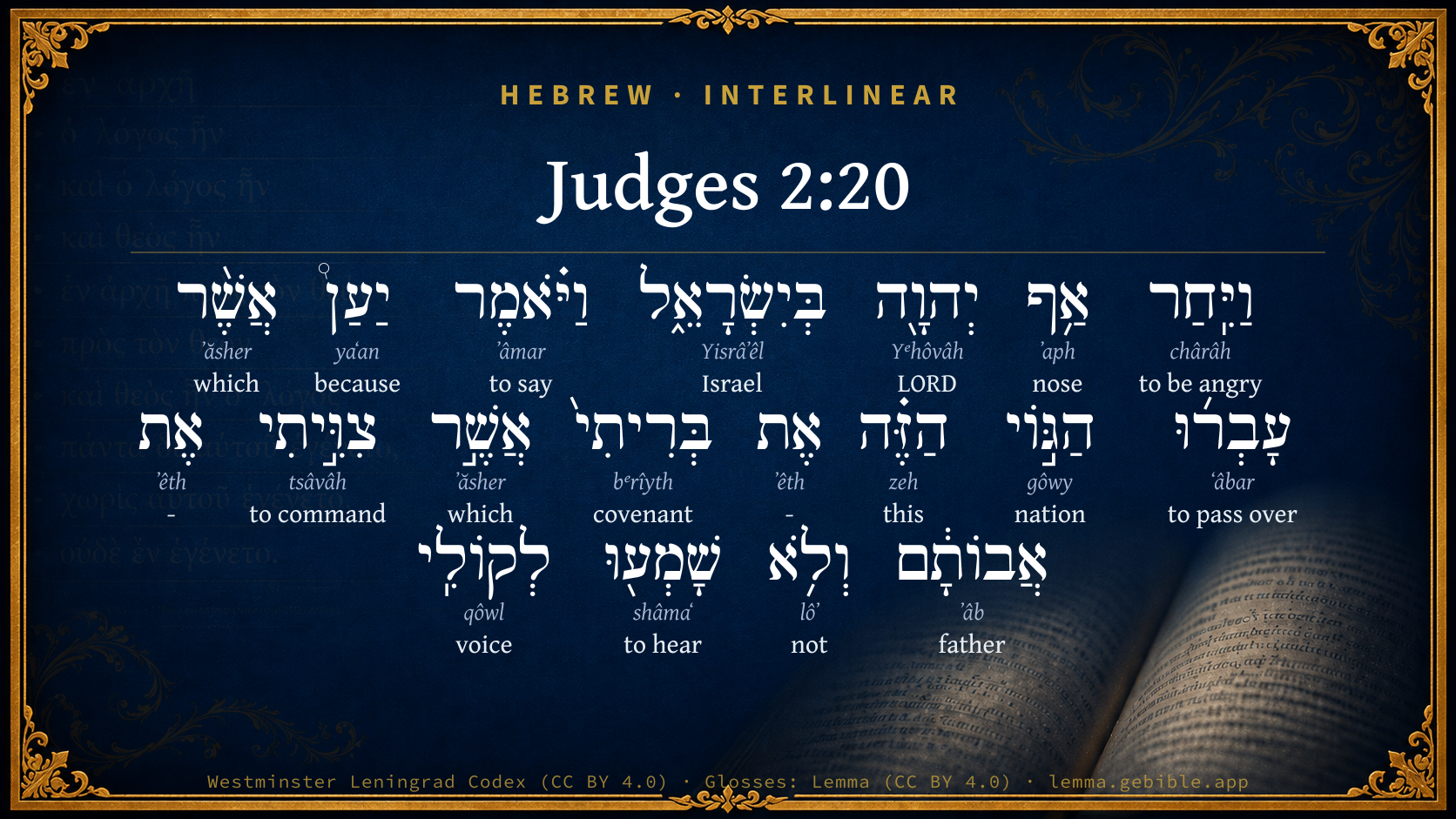
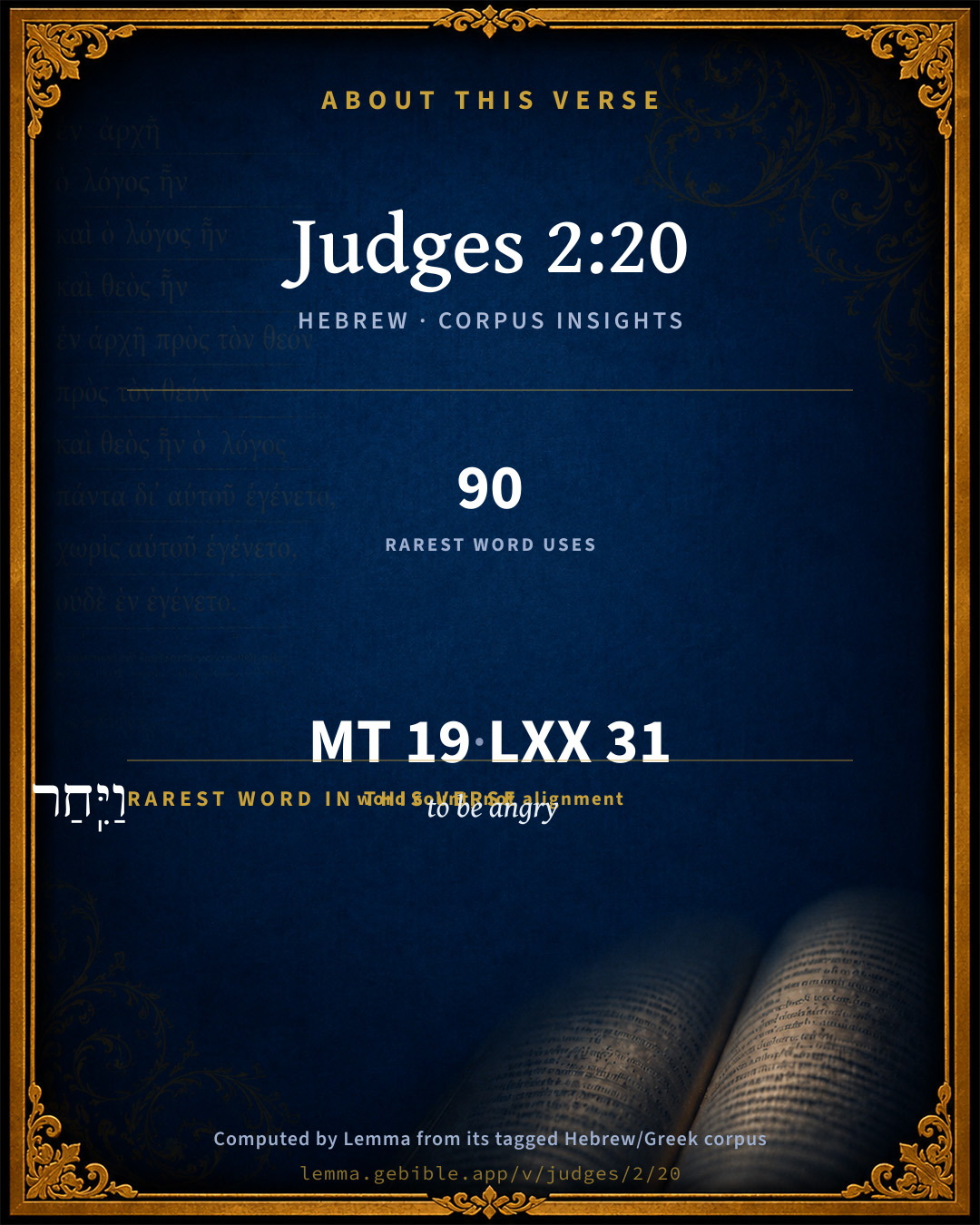
Judges 2:20

Hebrew (Westminster Leningrad Codex) Judges 2:20 appears in the Hebrew Old Testament. The text above is from the Westminster Leningrad Codex. Each word links to its Strong’s number, a concise gloss, and parsing drawn from the Open Scriptures Hebrew Bible morphology. Click any word for its full Brown-Driver-Briggs (BDB) entry.
Download image
Cite this verse

Judges 2:20 (World English Bible). Public Domain. Lemma interlinear Bible study tool, https://lemma.gebible.app/v/judges/2/20.

Show BibTeX & RIS
BibTeX
RIS
English Translation
The anger of Yahweh was kindled against Israel; and he said, Because this nation have transgressed my covenant which I commanded their fathers, and have not listened to my voice;
World English Bible · Public Domain
Download a study sheet

One document with this verse’s original text, its word-by-word gloss line, the meaning frame, cross-references with their text, attributed commentary, and full source and license credits — printable, and it pastes into notes with its structure intact.

This verse Autodidact and up

Study sheet (.html) Plain text (.txt)

A passage Seminary Student

Up to 50 verses in one chapter. A passage sheet keeps up to 6 commentary sources and 12 cross-references per verse, in the order this page ranks them, and says so on the sheet whenever that leaves anything out. Ask for a single verse and you get the Autodidact verse sheet above.

Everything on this page stays free to read, with no account — the sheet is a download of what is already on screen, not access to it.

Want to remove ads? Support Godless Engineer
Compare translations 3

The same verse in 3 English versions, stacked beneath the original-language interlinear above. Click any original word for its lexicon entry.

Each is an independent rendering of the whole verse — the interlinear is not word-aligned to these translations.

Highlighted words mark where these versions differ — a whole-verse word diff, not a word-by-word alignment.

  • World English Bible Public Domain
    The anger of Yahweh was kindled against Israel; and he said, Because this nation have transgressed my covenant which I commanded their fathers, and have not listened to my voice;
  • King James Version Public Domain
    And the anger of the LORD was hot against Israel; and he said, Because that this people hath transgressed my covenant which I commanded their fathers, and have not hearkened unto my voice;
  • unfoldingWord Literal Text CC BY-SA 4.0
    So the nose of Yahweh burned against Israel and he said, “In that this nation has transgressed my covenant that I commanded their fathers and they have not listened to my voice,

unfoldingWord Literal Text — © unfoldingWord, licensed CC BY-SA 4.0. Word-aligned USFM3 via Door43 (git.door43.org/unfoldingWord/en_ult).

Versions to compare (up to 4)

3 of 4 selected

Show all 18 translations

Every available English version of this verse, each an independent rendering of the whole verse.

  • World English Bible Public Domain
    The anger of Yahweh was kindled against Israel; and he said, Because this nation have transgressed my covenant which I commanded their fathers, and have not listened to my voice;
  • Berean Standard Bible Public Domain
    So the anger of the LORD burned against Israel, and He said, “Because this nation has transgressed the covenant I laid down for their fathers and has not heeded My voice,
  • Majority Standard Bible Public Domain
    So the anger of the LORD burned against Israel, and He said, “Because this nation has transgressed the covenant I laid down for their fathers and has not heeded My voice,
  • King James Version Public Domain
    And the anger of the LORD was hot against Israel; and he said, Because that this people hath transgressed my covenant which I commanded their fathers, and have not hearkened unto my voice;
  • American Standard Version (1901) Public Domain
    And the anger of Jehovah was kindled against Israel; and he said, Because this nation have transgressed my covenant which I commanded their fathers, and have not hearkened unto my voice;
  • Revised Version (1885) Public Domain
    And the anger of the LORD was kindled against Israel; and he said, Because this nation have transgressed my covenant which I commanded their fathers, and have not hearkened unto my voice;
  • Geneva Bible (1599) Public Domain
    Wherfore the wrath of the Lord was kindled against Israel, and he sayd, Because this people hath transgressed my couenant, which I commaded their fathers, and hath not obeyed my voyce,
  • Douay-Rheims (1899) Public Domain
    And the wrath of the Lord was kindled against Israel, and he said: Behold this nation hath made void my covenant, which I had made with their fathers, and hath despised to hearken to my voice:
  • Young's Literal Translation Public Domain
    And the anger of Jehovah doth burn against Israel, and He saith, `Because that this nation have transgressed My covenant which I commanded their fathers, and have not hearkened to My voice --
  • Literal Standard Version CC BY-SA 4.0
    And the anger of YHWH burns against Israel, and He says, “Because that this nation has transgressed My covenant which I commanded their fathers, and have not listened to My voice—
  • Unlocked Literal Bible CC BY-SA 4.0
    The anger of Yahweh burned against Israel; he said, “Because this nation has broken the terms of my covenant that I had set in place for their fathers—because they have not listened to my voice—
  • unfoldingWord Literal Text CC BY-SA 4.0
    So the nose of Yahweh burned against Israel and he said, “In that this nation has transgressed my covenant that I commanded their fathers and they have not listened to my voice,
  • Darby Bible Public Domain
    So the anger of the LORD was kindled against Israel; and he said, "Because this people have transgressed my covenant which I commanded their fathers, and have not obeyed my voice,
  • World Messianic Bible Public Domain
    The LORD’s anger burned against Israel; and he said, “Because this nation transgressed my covenant which I commanded their fathers, and has not listened to my voice,
  • Webster's Bible Public Domain
    And the anger of the LORD was hot against Israel; and he said, Because that this people hath transgressed my covenant which I commanded their fathers, and have not hearkened to my voice;
  • Free Bible Version CC BY-SA 4.0
    As a result the Lord became angry with Israel and he told them, “Because this nation has broken the agreement I ordered their forefathers to obey, and has not paid attention to what I said,
  • Bible in Basic English Public Domain
    And the wrath of the Lord was burning against Israel, and he said, Because this nation has not been true to my agreement which I made with their fathers, and has not given ear to my voice;
  • JPS Tanakh (1917) Public Domain
    And the anger of the LORD was kindled against Israel; and He said: 'Because this nation have transgressed My covenant which I commanded their fathers, and have not hearkened unto My voice;

Literal Standard Version (2020), Covenant Press — licensed CC BY-SA 4.0. Text via the HelloAO Bible API (eBible.org). Unlocked Literal Bible (unfoldingWord) — licensed CC BY-SA 4.0. Text via the HelloAO Bible API (eBible.org). unfoldingWord Literal Text — © unfoldingWord, licensed CC BY-SA 4.0. Word-aligned USFM3 via Door43 (git.door43.org/unfoldingWord/en_ult). Free Bible Version, Dr. Jonathan Gallagher — licensed CC BY-SA 4.0. Text via the HelloAO Bible API (eBible.org).

Word by word

More ways to search: Search by grammar → Find every occurrence → Compare this word →

Practice this passage: Drill this verse → Learn its vocabulary →

וַיִּֽחַר
chârâh
H2734
“and · to be angry”
Conjunction + Verb, Qal, Sequential Imperfect, 3rd Person, Masculine, Singular
Part of Speech
Conjunction + Verb
Stem
Qal
Form
Sequential Imperfect
Person
3rd Person
Gender
Masculine
Number
Singular
Full BDB Definition

Origin: a primitive root [compare H2787 ]

TWOT: 736

to be hot, furious, burn, become angry, be kindled - (Qal) to burn, kindle (anger) - (Niphal) to be angry with, be incensed - (Hiphil) to burn, kindle - (Hithpael) to heat oneself in vexation
  1. אַ֥ף ʼaph H639 “nose” Particle, Accusative
  2. יְהוָ֖ה Yᵉhôvâh H3068 “LORD” Noun, Proper
  3. בְּיִשְׂרָאֵ֑ל Yisrâʼêl H3478 “in/at · Israel” Preposition + Noun, Proper
  4. וַיֹּ֗אמֶר ʼâmar H559 “and · to say” Conjunction + Verb, Qal, Sequential Imperfect, 3rd Person, Masculine, Singular
  5. יַעַן֩ yaʻan H3282 “because” Conjunction
  6. אֲשֶׁ֨ר ʼăsher H834 “which” Particle, Relative
  7. עָבְר֜וּ ʻâbar H5674 “to pass over” Verb, Qal, Perfect, 3rd Person, Common, Plural
  8. הַגּ֣וֹי gôwy H1471 “the · nation” Particle, Definite Article + Noun, Common, Masculine, Singular, Absolute
  9. הַזֶּ֗ה zeh H2088 “the · this” Particle, Definite Article + Pronoun, Demonstrative, Masculine, Singular
  10. אֶת ʼêth H853 “-” Particle, Direct Object
  11. בְּרִיתִי֙ bᵉrîyth H1285 “covenant · my” Noun, Common, Feminine, Singular, Construct + Suffix, Personal, 1st Person, Common, Singular
  12. אֲשֶׁ֣ר ʼăsher H834 “which” Particle, Relative
  13. צִוִּ֣יתִי tsâvâh H6680 “to command” Verb, Piel, Perfect, 1st Person, Common, Singular
  14. אֶת ʼêth H853 “-” Particle, Direct Object
  15. אֲבוֹתָ֔ם ʼâb H1 “fathers · their” Noun, Common, Masculine, Plural, Construct + Suffix, Personal, 3rd Person, Masculine, Plural
  16. וְלֹ֥א lôʼ H3808 “and · not” Conjunction + Particle, Negative
  17. שָׁמְע֖וּ shâmaʻ H8085 “to hear” Verb, Qal, Perfect, 3rd Person, Common, Plural
  18. לְקוֹלִֽי qôwl H6963 “to/for · voice · my” Preposition + Noun, Common, Masculine, Singular, Construct + Suffix, Personal, 1st Person, Common, Singular

About this verse

These counts appear in no published source. They are computed here, from the morphology-tagged text and Lemma’s own curated glosses. What Lemma adds →

19
words
17
distinct lemmas
Historical
section

Grammatical profile

  • 5 verbs
  • 6 nouns
  • 1 pronoun
  • 1 conjunction
  • 6 particles

Verb forms

  • וַיִּֽחַר Qal · Sequential Imperfect
  • וַיֹּ֗אמֶר Qal · Sequential Imperfect
  • עָבְר֜וּ Qal · Perfect
  • צִוִּ֣יתִי Piel · Perfect
  • שָׁמְע֖וּ Qal · Perfect

Repetition

A word recurs within this verse — often emphatic in Hebrew:

  • אֲשֶׁ֨ר which H834 ×2

Hebrew & Septuagint length

In English translation the verse runs 30 words from the Hebrew and 30 from the Septuagint (LXX English) — the same length.

A rough comparison of the two English renderings, which tokenize alike — not a word-level alignment.

Word counts can differ between the Hebrew and the Greek without any difference in meaning — e.g. the Hebrew direct-object marker אֵת has no separate Greek word, and Greek often adds the article ὁ.

In the original languages it is 19 Hebrew tokens and 31 Greek tokens — but the two are counted differently (Hebrew bundles its prefixes and suffixes into one token; the Greek is in lemma form), so that isn’t a like-for-like length.

Cross-references

11

Topical passages linked to Judges 2:20 in the Treasury of Scripture Knowledge — connected by theme and wording, ordered by reader-vote popularity; previews shown in the World English Bible.

  • Judges 2:14 The anger of Yahweh was kindled against Israel, and he delivered them into the hands of spoilers who despoiled them; and he sold them into the hands of their enemies round about, so that they could not any longer stand before their enemies.
  • Joshua 23:16 When you disobey the covenant of Yahweh your God, which he commanded you, and go and serve other gods, and bow down yourselves to them; then will the anger of Yahweh be kindled against you, and you shall perish quickly from off the good land which he has given to you.
  • Exodus 24:3–8 Moses came and told the people all the words of Yahweh, and all the ordinances; and all the people answered with one voice, and said, "All the words which Yahweh has spoken will we do."
  • Exodus 32:10–11 Now therefore leave me alone, that my wrath may burn hot against them, and that I may consume them; and I will make of you a great nation."
  • Deuteronomy 29:10–13 You stand this day all of you before Yahweh your God; your heads, your tribes, your elders, and your officers, even all the men of Israel,
  • Deuteronomy 32:22 For a fire is kindled in my anger, Burns to the lowest Sheol, Devours the earth with its increase, Sets on fire the foundations of the mountains.
  • Joshua 24:21–25 The people said to Joshua, No; but we will serve Yahweh.
  • Judges 3:8 Therefore the anger of Yahweh was kindled against Israel, and he sold them into the hand of Cushan Rishathaim king of Mesopotamia: and the children of Israel served Cushan Rishathaim eight years.
  • Judges 10:7 The anger of Yahweh was kindled against Israel, and he sold them into the hand of the Philistines, and into the hand of the children of Ammon.
  • Jeremiah 31:32 not according to the covenant that I made with their fathers in the day that I took them by the hand to bring them out of the land of Egypt; which my covenant they broke, although I was a husband to them, says Yahweh.
  • Ezekiel 20:37 I will cause you to pass under the rod, and I will bring you into the bond of the covenant;

Cross-references courtesy of OpenBible.info (CC BY 4.0).

Hebrew and Greek witnesses Masoretic Hebrew ↔ Greek Septuagint

The same verse in the two great witnesses to the Old Testament, shown verse-for-verse.

These are two independent witnesses, not word-aligned to each other, and the Septuagint is shown in lemma (dictionary) form.

Hebrew Judges 2:20 Masoretic · Westminster Leningrad Codex

וַיִּֽחַר אַ֥ף יְהוָ֖ה בְּיִשְׂרָאֵ֑ל וַיֹּ֗אמֶר יַעַן֩ אֲשֶׁ֨ר עָבְר֜וּ הַגּ֣וֹי הַזֶּ֗ה אֶת בְּרִיתִי֙ אֲשֶׁ֣ר צִוִּ֣יתִי אֶת אֲבוֹתָ֔ם וְלֹ֥א שָׁמְע֖וּ לְקוֹלִֽי

The anger of Yahweh was kindled against Israel; and he said, Because this nation have transgressed my covenant which I commanded their fathers, and have not listened to my voice;

World English Bible · Public Domain

Greek LXX Judges 2:20 Septuagint · lemma form

καί ὀργίζω θυμός κύριος ἐν ὁ ἰσραήλ καί εἶπον ἀντί ὅς ὅσος ἐν καταλείπω ὁ ἔθνος οὗτος ὁ διαθήκη ἐγώ ὅς ἐντέλλομαι ὁ πατήρ αὐτός καί οὐ εἰςἀκούω ὁ φωνή ἐγώ

And the Lord was very angry with Israel, and said, Forasmuch as this nation has forsaken my covenant which I commanded their fathers, and has not listened to my voice,

LXX2012 (modern English Septuagint) · Public Domain

Hebrew: Westminster Leningrad Codex (CC BY 4.0). Greek: Septuagint (public domain); English from LXX2012 (modern English Septuagint) (Public Domain). How the Septuagint differs from the Hebrew →

Targum (Aramaic paraphrase)

1

The Targum is the ancient Jewish Aramaic paraphrase of the Hebrew Scriptures — an interpretive translation, not the Hebrew text itself. Onkelos (literal) and Pseudo-Jonathan (expansive) render the Torah, and Jonathan the Prophets. Coverage is partial: where no permissively-licensed English translation exists for a verse, only the Aramaic is shown. This is verse-level text, not a word-by-word alignment to the Hebrew.

  1. Targum Jonathan Prophets (Joshua–Malachi)
    וּתְקֵיף רוּגְזָא דַייָ בְּיִשְׂרָאֵל וַאֲמַר חֲלַף דִי עֲבָרוּ עַמָא הָדֵין עַל קַיָמִי דִי פַקֵדִית יַת אֲבָהַתְהוֹן וְלָא קַבִּילוּ לְמֵימְרִי:

    (no public-domain English translation for this verse)

    Targum Jonathan — Aramaic: “Mikraot Gedolot” (public domain). English: “Sefaria Community Translation” (CC0 1.0 (public-domain dedication)); “London "Chaldee Paraphrase," 1871” (public domain). Text via Sefaria.

Commentary

Notes on Judges 2:20 from classic Christian and Jewish commentators (each source and its license shown beneath its notes). The classic Christian expositions comment on the surrounding passage and are grouped to its opening verse, so a note may address several verses; the Jewish commentaries on the Tanakh (Rashi and others) are per-verse, so they appear only where the commentator wrote on this verse.

Lemma curates 59 commentaries, every one of them public domain or Creative Commons licensed, each selected and text-cleaned for this edition rather than reprinted as found. About our sources →

The Cambridge Bible for Schools and Colleges

gen. ed. J. J. S. Perowne

20–22. These verses are clearly not the sequel of Jdg_2:11-19; Jdg_2:20 continues Jdg_2:13 (see note); the opening words repeat Jdg_2:14; the nations in Jdg_2:21 are not on the frontiers, round about Israel (Jdg_2:14), but those left by Joshua in the midst of Israel; they are spared not only to punish Israel’s sin, but to test its loyalty. The change of view indicates a different hand: Jdg_2:20-21 seem to come from E; the source of Jdg_2:22 is not so evident, D (Moore, Nowack), half E and half D (Budde), a later gloss (Lagrange). The three verses have been worked over and expanded in the editorial process, but the main contents may be assigned to E. For hearkened unto my voice in E cf. Exo_15:26; Exo_18:24.

transgressed my covenant which I commanded] Jos_7:11? Rje, Jos_23:16 D; cf. Jos_7:15, Deu_17:2, 1Ki_11:11, Jer_34:18. The covenant inaugurated at Sinai, renewed at Shechem (Jos_24:24-25), imposed obligations upon Israel which practically amounted to commands; hence Jehovah could be said to “command His covenant,” i.e. the obligations involved in the covenant. Thus in Deu_4:13 the covenant is identified with the Decalogue, in ib. Deu_5:2-3 it is followed by the Decalogue; cf. Deu_33:9 (|| thy promise), Psa_111:9.

The Cambridge Bible for Schools and Colleges (gen. ed. J. J. S. Perowne; Cambridge University Press, 1878–1918) — public domain. Text from a community e-Sword module.

Trapp's Complete Commentary

John Trapp

Jdg 2:20 And the anger of the LORD was hot against Israel; and he said, Because that this people hath transgressed my covenant which I commanded their fathers, and have not hearkened unto my voice;

Ver. 20. And the anger of the Lord was hot.] He is not made all of mercy, as some dream, but can be angry: and "who knoweth the power of his wrath?" {Psa 90:11} It is such as men can neither avoid nor abide.

John Trapp, A Commentary or Exposition upon All the Books of the Old and New Testament (1647–1656) — public domain. Text from a community e-Sword module.

Albert Barnes' Notes on the Bible

This verse is connected with Jdg 2:13. The intermediate verses refer to much later times; they have the appearance of being the reflections of the compiler interspersed with the original narrative. But Jdg 2:20 catches up the thread only to let it fall immediately. All that follows, down to the end of Jdg 3:7, seems to be another digression, closing with words like those of Jdg 2:13.

It does not appear how this message was given to Israel, whether by Angel, or prophet, or Urim, nor indeed is it certain whether any message was given. The words may be understood as merely explaining what passed through the divine mind, and expressing the thoughts which regulated the divine proceeding.

Albert Barnes' Notes on the Bible (1834–1885) — public domain. Text from a community e-Sword/MySword module.

Keil & Delitzsch

C. F. Keil & F. Delitzsch

Chastisement of the Rebellious Nation. - Jdg 2:20, Jdg 2:21. On account of this idolatry, which was not only constantly repeated, but continued to grow worse and worse, the anger of the Lord burned so fiercely against Israel, that He determined to destroy no more of the nations which Joshua had left when he died, before the people that had broken His covenant. In order to set forth this divine purpose most distinctly, it is thrown into the form of a sentence uttered by God through the expression וגו ויּאמר. The Lord said, "Because this people has transgressed my covenant, ... I also will no longer keep my covenant promise (Exo 23:23, Exo 23:27., Exo 34:10.), and will no more drive out any of the remaining Canaanites before them" (see Jos 23:13).

Keil & Delitzsch — Biblical Commentary on the Old Testament (1861–1891) — public domain (CC PDM 1.0). Text via the HelloAO Bible API. (Old Testament only.)

Adam Clarke's Commentary

Verse 20. The anger of the Lord was hot] They were as fuel by their transgressions; and the displeasure of the Lord was as a fire about to kindle and consume that fuel.

Adam Clarke's Commentary on the Bible (1810–1826) — public domain. Text from a community e-Sword/MySword module.

Ellicott's Commentary for English Readers

(20) This people.—Comp. Isa_6:9-10, “Go, and tell this people”; Jdg_8:12.

Hath transgressed my covenant.—The same expression is used in Jos_23:16.

A Bible Commentary for English Readers, edited by Charles John Ellicott (1878–1897) — public domain. Text from a community e-Sword module.

John Gill's Exposition

And the anger of the Lord was hot against Israel,.... As at first, so whenever they fell into idolatry; see Jdg 2:14,

and he said, because this people have transgressed my covenant which I commanded their fathers; made at Sinai, in which they were enjoined to have no other gods before him:

and have not hearkened to my voice; in his commands, and particularly what related to his worship and against idolatry.

John Gill's Exposition of the Whole Bible (1746–1763) — public domain (CC PDM 1.0). Text via the HelloAO Bible API.

Whedon's Commentary on the Bible

Daniel D. Whedon

20. Anger… hot — Compare Jdg_2:14, note.

He said — Repeatedly, by Joshua (Jos_23:13) and the angel at Bochim. Jdg_2:3.

Daniel D. Whedon (gen. ed.), Commentary on the Old and New Testaments (1874–1909) — public domain. Text from a community e-Sword module.

unfoldingWord translationNotes

Door43 World Missions Community

The anger of Yahweh burned against Israel

The anger of Yahweh is described as burning like a fire. See how you translated this phrase in Judges 2:14. (See: Metaphor)

this nation has broken

Here "nation" represents the people. AT: "these people have broken" or "the Israelites have broken" (See: Metonymy)

fathers

Here this refers to the ancestors of a certain person or people group.

they have not listened to my voice

Here "voice" represents what Yahweh said. AT: "they have not obeyed what I commanded them" or "they have not obeyed me" (See: Metonymy)

any of the nations

Here "nations" represents the people groups that lived in Canaan before the Israelites. (See: Metonymy)

they will keep the way of Yahweh and walk in it

How Yahweh wants people to live or behave is spoken of as if it were a way or road. A person obeying Yahweh is spoken of as if they were walking in his way. (See: Metaphor)

did not drive them out quickly and give them into the hand of Joshua

These two phrases mean the same thing and can be combined. AT: "he did not let Joshua quickly conquer them and drive them out" (See: Doublet)

into the hand of Joshua

Here "hand" is a metonym for power, and "Joshua" represents himself and his army. AT: "into the power of Joshua and his army" (See: Metonymy and Synecdoche)

translationWords

Israel

nation

covenant

ancestor

voice

cast out

Joshua

test

walk

unfoldingWord translationNotes — © Distant Shores Media and the Door43 World Missions Community, licensed CC BY-SA 4.0. Source: git.door43.org/Door43/en_tn.

Lesson kit

Teaching starters — assembled from the data on this page, not authored interpretation. Every prompt links to the verse data it draws on. Edit before teaching.

Judges, in the Historical, opens this verse with 19 words (17 distinct Hebrew lemmas). Its most distinctive word is chârâh (“to be angry”). A historical commentator’s framing appears above. Read the whole chapter for the surrounding context.

Discussion questions

  1. How does “to be angry” (chârâh) shape what this verse is saying?
  2. Judges 2:14 shares this passage’s theme. How do the two illuminate each other?
  3. “which” occurs 2× in this one verse. What is the effect of the repetition?
  4. The translations on this page render this verse differently — a whole-verse word diff, not a word-by-word alignment. What might account for the different wordings?
  5. The verb «וַיִּֽחַר» is Qal Sequential Imperfect. How does its form color the action?
  6. Reading how The Cambridge Bible for Schools and Colleges and Trapp's Complete Commentary read this verse, where do the two commentators agree and where do they part?

Things to notice

Reading settings

Reading text

Shown beneath each verse's original-language words.

Old Testament
Old Testament edition

Read the OT as the Masoretic Hebrew (MT) or the Greek Septuagint (LXX).

English shown for the Greek Septuagint (in the Hebrew ↔ Greek comparison).

Comparing translations? Open the Compare panel on any verse page to stack up to four side by side.