2 Samuel 8:11

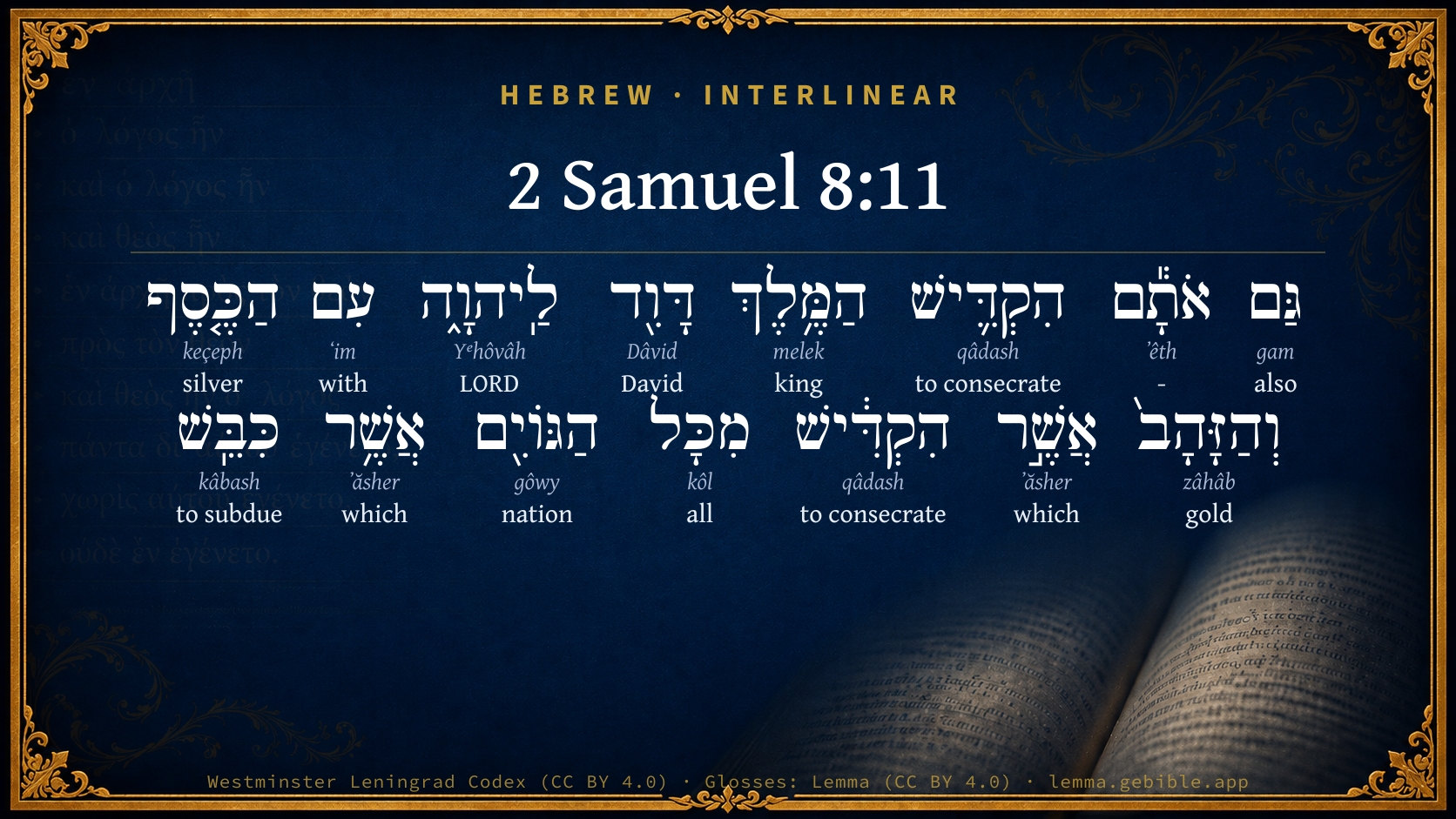
Hebrew (Westminster Leningrad Codex) 2 Samuel 8:11 appears in the Hebrew Old Testament. The text above is from the Westminster Leningrad Codex. Each word links to its Strong’s number, a concise gloss, and parsing drawn from the Open Scriptures Hebrew Bible morphology. Click any word for its full Brown-Driver-Briggs (BDB) entry.
Download image
Cite this verse

2 Samuel 8:11 (World English Bible). Public Domain. Lemma interlinear Bible study tool, https://lemma.gebible.app/v/2-samuel/8/11.

Show BibTeX & RIS
BibTeX
RIS
English Translation
These also did king David dedicate to Yahweh, with the silver and gold that he dedicated of all the nations which he subdued;
World English Bible · Public Domain
Download a study sheet

One document with this verse’s original text, its word-by-word gloss line, the meaning frame, cross-references with their text, attributed commentary, and full source and license credits — printable, and it pastes into notes with its structure intact.

This verse Autodidact and up

Study sheet (.html) Plain text (.txt)

A passage Seminary Student

Up to 50 verses in one chapter. A passage sheet keeps up to 6 commentary sources and 12 cross-references per verse, in the order this page ranks them, and says so on the sheet whenever that leaves anything out. Ask for a single verse and you get the Autodidact verse sheet above.

Everything on this page stays free to read, with no account — the sheet is a download of what is already on screen, not access to it.

Want to remove ads? Support Godless Engineer
Compare translations 3

The same verse in 3 English versions, stacked beneath the original-language interlinear above. Click any original word for its lexicon entry.

Each is an independent rendering of the whole verse — the interlinear is not word-aligned to these translations.

Highlighted words mark where these versions differ — a whole-verse word diff, not a word-by-word alignment.

  • World English Bible Public Domain
    These also did king David dedicate to Yahweh, with the silver and gold that he dedicated of all the nations which he subdued;
  • King James Version Public Domain
    Which also king David did dedicate unto the LORD, with the silver and gold that he had dedicated of all nations which he subdued;
  • unfoldingWord Literal Text CC BY-SA 4.0
    King David also consecrated them to Yahweh, with the silver and the gold that he consecrated from all of the nations that he had subdued,

unfoldingWord Literal Text — © unfoldingWord, licensed CC BY-SA 4.0. Word-aligned USFM3 via Door43 (git.door43.org/unfoldingWord/en_ult).

Versions to compare (up to 4)

3 of 4 selected

Show all 18 translations

Every available English version of this verse, each an independent rendering of the whole verse.

  • World English Bible Public Domain
    These also did king David dedicate to Yahweh, with the silver and gold that he dedicated of all the nations which he subdued;
  • Berean Standard Bible Public Domain
    and King David dedicated these to the LORD, along with the silver and gold he had dedicated from all the nations he had subdued—
  • Majority Standard Bible Public Domain
    and King David dedicated these to the LORD, along with the silver and gold he had dedicated from all the nations he had subdued—
  • King James Version Public Domain
    Which also king David did dedicate unto the LORD, with the silver and gold that he had dedicated of all nations which he subdued;
  • American Standard Version (1901) Public Domain
    These also did king David dedicate unto Jehovah, with the silver and gold that he dedicated of all the nations which he subdued;
  • Revised Version (1885) Public Domain
    These also did king David dedicate unto the LORD, with the silver and gold that he dedicated of all the nations which he subdued;
  • Geneva Bible (1599) Public Domain
    And King Dauid did dedicate them vnto the Lord with the siluer and golde that he had dedicate of all the nations, which he had subdued:
  • Douay-Rheims (1899) Public Domain
    And king David dedicated them to the Lord, together with the silver and gold that he had dedicated of all the nations, which he had subdued:
  • Young's Literal Translation Public Domain
    also them did king David sanctify to Jehovah, with the silver and the gold which he sanctified of all the nations which he subdued:
  • Literal Standard Version CC BY-SA 4.0
    also King David sanctified them to YHWH, with the silver and the gold which he sanctified of all the nations which he subdued:
  • Unlocked Literal Bible CC BY-SA 4.0
    King David set aside these objects to Yahweh, together with the silver and gold from all the nations that he conquered—
  • unfoldingWord Literal Text CC BY-SA 4.0
    King David also consecrated them to Yahweh, with the silver and the gold that he consecrated from all of the nations that he had subdued,
  • Darby Bible Public Domain
    Them also king David dedicated to Jehovah, with the silver and the gold that he had dedicated of all the nations that he had subdued:
  • World Messianic Bible Public Domain
    King David also dedicated these to the LORD, with the silver and gold that he dedicated of all the nations which he subdued—
  • Webster's Bible Public Domain
    Which also king David dedicated to the LORD, with the silver and gold that he had dedicated of all nations which he subdued;
  • Free Bible Version CC BY-SA 4.0
    King David dedicated these gifts to the Lord, along with the silver and gold he had taken from all the nations he had subdued:
  • Bible in Basic English Public Domain
    These King David made holy to the Lord, together with the silver and gold which he had taken from the nations he had overcome--
  • JPS Tanakh (1917) Public Domain
    These also did king David dedicate unto the LORD, with the silver and gold that he dedicated of all the nations which he subdued:

Literal Standard Version (2020), Covenant Press — licensed CC BY-SA 4.0. Text via the HelloAO Bible API (eBible.org). Unlocked Literal Bible (unfoldingWord) — licensed CC BY-SA 4.0. Text via the HelloAO Bible API (eBible.org). unfoldingWord Literal Text — © unfoldingWord, licensed CC BY-SA 4.0. Word-aligned USFM3 via Door43 (git.door43.org/unfoldingWord/en_ult). Free Bible Version, Dr. Jonathan Gallagher — licensed CC BY-SA 4.0. Text via the HelloAO Bible API (eBible.org).

Word by word

More ways to search: Search by grammar → Find every occurrence → Compare this word →

Practice this passage: Drill this verse → Learn its vocabulary →

כִּבֵּֽשׁ
kâbash
H3533
“to subdue”
Verb, Piel, Perfect, 3rd Person, Masculine, Singular
Part of Speech
Verb
Stem
Piel
Form
Perfect
Person
3rd Person
Gender
Masculine
Number
Singular
Full BDB Definition

Origin: a primitive root

TWOT: 951

to subject, subdue, force, keep under, bring into bondage - (Qal) - to bring into bondage, make subservient - to subdue, force, violate - to subdue, dominate, tread down - (Niphal) to be subdued - (Piel) to subdue - (Hiphil) to bring into bondage
  1. גַּם gam H1571 “also” Particle, Accusative
  2. אֹתָ֕ם ʼêth H853 “- · them” Particle, Direct Object + Suffix, Personal, 3rd Person, Masculine, Plural
  3. הִקְדִּ֛ישׁ qâdash H6942 “to consecrate” Verb, Hiphil, Perfect, 3rd Person, Masculine, Singular
  4. הַמֶּ֥לֶךְ melek H4428 “the · king” Particle, Definite Article + Noun, Common, Masculine, Singular, Absolute
  5. דָּוִ֖ד Dâvid H1732 “David” Noun, Proper
  6. לַֽיהוָ֑ה Yᵉhôvâh H3068 “to/for · LORD” Preposition + Noun, Proper
  7. עִם ʻim H5973 “with” Preposition
  8. הַכֶּ֤סֶף keçeph H3701 “the · silver” Particle, Definite Article + Noun, Common, Masculine, Singular, Absolute
  9. וְהַזָּהָב֙ zâhâb H2091 “and · the · gold” Conjunction + Particle, Definite Article + Noun, Common, Masculine, Singular, Absolute
  10. אֲשֶׁ֣ר ʼăsher H834 “which” Particle, Relative
  11. הִקְדִּ֔ישׁ qâdash H6942 “to consecrate” Verb, Hiphil, Perfect, 3rd Person, Masculine, Singular
  12. מִכָּל kôl H3605 “from · all of” Preposition + Noun, Common, Masculine, Singular, Construct
  13. הַגּוֹיִ֖ם gôwy H1471 “the · nations” Particle, Definite Article + Noun, Common, Masculine, Plural, Absolute
  14. אֲשֶׁ֥ר ʼăsher H834 “which” Particle, Relative

About this verse

These counts appear in no published source. They are computed here, from the morphology-tagged text and Lemma’s own curated glosses. What Lemma adds →

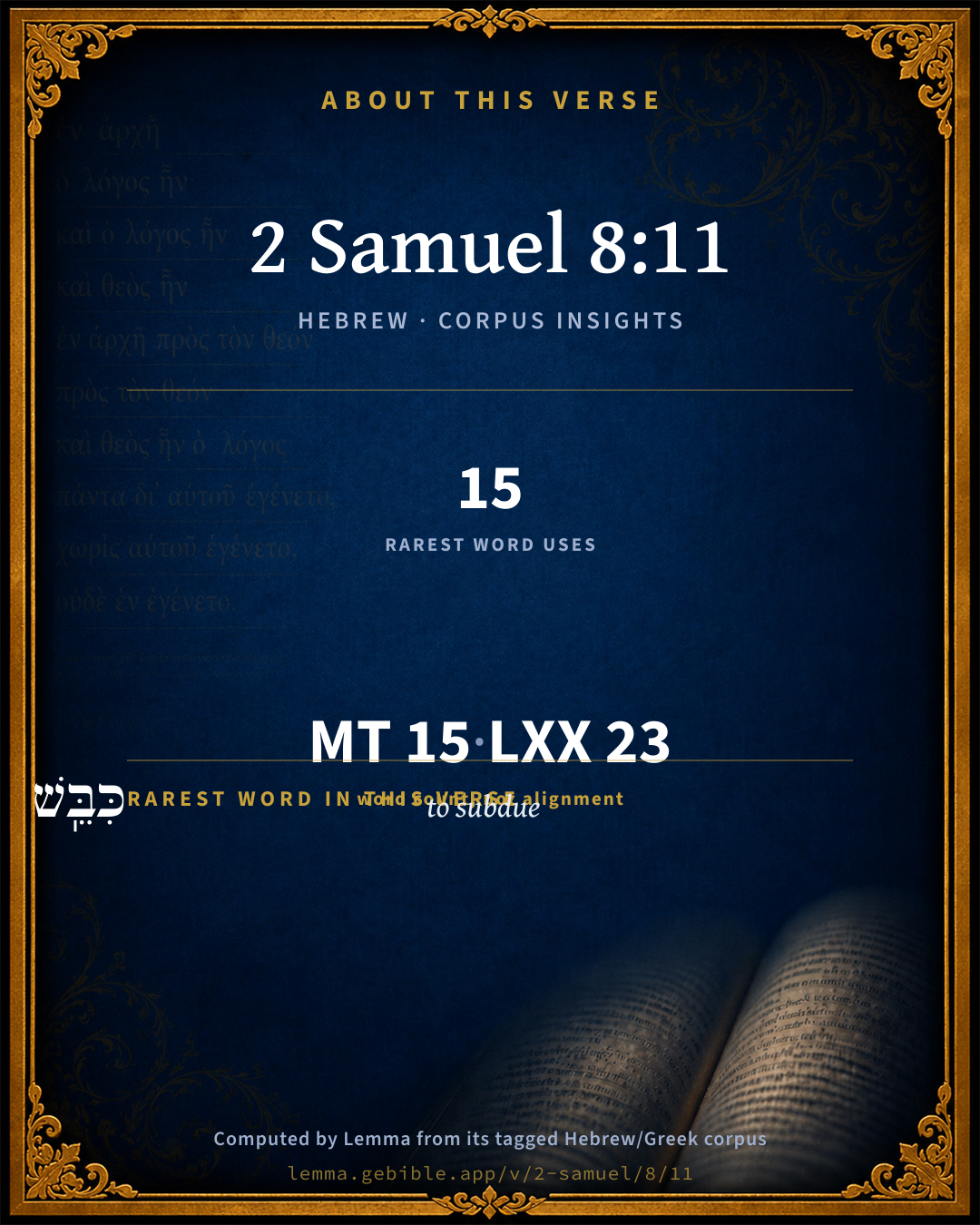
15
words
13
distinct lemmas
Historical
section

Notable vocabulary

The rarest word here is כִּבֵּֽשׁ to subdue H3533 — appearing just 15 times in the whole Hebrew Bible.

Shared distinctive vocabulary

כִּבֵּֽשׁ to subdue H3533 occurs in 13 verses of the Hebrew Bible. Also found in:

Grammatical profile

  • 3 verbs
  • 7 nouns
  • 1 preposition
  • 4 particles

Verb forms

  • הִקְדִּ֛ישׁ Hiphil · Perfect
  • הִקְדִּ֔ישׁ Hiphil · Perfect
  • כִּבֵּֽשׁ Piel · Perfect

Repetition

Words recur within this verse — often emphatic in Hebrew:

  • הִקְדִּ֛ישׁ to consecrate H6942 ×2
  • אֲשֶׁ֣ר which H834 ×2

Hebrew & Septuagint length

In English translation the verse runs 23 words from the Hebrew and 26 from the Septuagint (LXX English) — closely comparable.

A rough comparison of the two English renderings, which tokenize alike — not a word-level alignment.

Word counts can differ between the Hebrew and the Greek without any difference in meaning — e.g. the Hebrew direct-object marker אֵת has no separate Greek word, and Greek often adds the article ὁ.

In the original languages it is 15 Hebrew tokens and 23 Greek tokens — but the two are counted differently (Hebrew bundles its prefixes and suffixes into one token; the Greek is in lemma form), so that isn’t a like-for-like length.

Cross-references

6

Topical passages linked to 2 Samuel 8:11 in the Treasury of Scripture Knowledge — connected by theme and wording, ordered by reader-vote popularity; previews shown in the World English Bible.

  • 1 Kings 7:51 Thus all the work that king Solomon worked in the house of Yahweh was finished. Solomon brought in the things which David his father had dedicated, [even] the silver, and the gold, and the vessels, and put them in the treasuries of the house of Yahweh.
  • 1 Chronicles 26:26–28 This Shelomoth and his brothers were over all the treasures of the dedicated things, which David the king, and the heads of the fathers' [houses], the captains over thousands and hundreds, and the captains of the host, had dedicated.
  • 1 Chronicles 18:11 These also did king David dedicate to Yahweh, with the silver and the gold that he carried away from all the nations; from Edom, and from Moab, and from the children of Ammon, and from the Philistines, and from Amalek.
  • 1 Chronicles 22:14–16 Now, behold, in my affliction I have prepared for the house of Yahweh one hundred thousand talents of gold, and one thousand thousand talents of silver, and of brass and iron without weight; for it is in abundance: timber also and stone have I prepared; and you may add to them.
  • 1 Chronicles 29:2 Now I have prepared with all my might for the house of my God the gold for the [things of] gold, and the silver for the [things of] silver, and the brass for the [things of] brass, the iron for the [things of] iron, and wood for the [things of] wood; onyx stones, and [stones] to be set, stones for inlaid work, and of various colors, and all manner of precious stones, and marble stones in abundance.
  • Micah 4:13 Arise and thresh, daughter of Zion; For I will make your horn iron, And I will make your hoofs brass; And you will beat in pieces many peoples: And I will devote their gain to Yahweh, And their substance to the Lord of the whole earth.

Cross-references courtesy of OpenBible.info (CC BY 4.0).

Hebrew and Greek witnesses Masoretic Hebrew ↔ Greek Septuagint

The same verse in the two great witnesses to the Old Testament, shown verse-for-verse.

These are two independent witnesses, not word-aligned to each other, and the Septuagint is shown in lemma (dictionary) form.

Hebrew 2 Samuel 8:11 Masoretic · Westminster Leningrad Codex

גַּם אֹתָ֕ם הִקְדִּ֛ישׁ הַמֶּ֥לֶךְ דָּוִ֖ד לַֽיהוָ֑ה עִם הַכֶּ֤סֶף וְהַזָּהָב֙ אֲשֶׁ֣ר הִקְדִּ֔ישׁ מִכָּל הַגּוֹיִ֖ם אֲשֶׁ֥ר כִּבֵּֽשׁ

These also did king David dedicate to Yahweh, with the silver and gold that he dedicated of all the nations which he subdued;

World English Bible · Public Domain

Greek LXX 2 Samuel 8:11 Septuagint · lemma form

καί οὗτος ἁγιάζω ὁ βασιλεύς δαυίδ ὁ κύριος μετά ὁ ἀργύριον καί μετά ὁ χρυσίον ὅς ἁγιάζω ἐκ πᾶς ὁ πόλις ὅς καταδυναστεύω

And these king David consecrated to the Lord, with the silver and with the gold which he consecrated out of all the cities which he conquered,

LXX2012 (modern English Septuagint) · Public Domain

Hebrew: Westminster Leningrad Codex (CC BY 4.0). Greek: Septuagint (public domain); English from LXX2012 (modern English Septuagint) (Public Domain). How the Septuagint differs from the Hebrew →

Targum (Aramaic paraphrase)

1

The Targum is the ancient Jewish Aramaic paraphrase of the Hebrew Scriptures — an interpretive translation, not the Hebrew text itself. Onkelos (literal) and Pseudo-Jonathan (expansive) render the Torah, and Jonathan the Prophets. Coverage is partial: where no permissively-licensed English translation exists for a verse, only the Aramaic is shown. This is verse-level text, not a word-by-word alignment to the Hebrew.

  1. Targum Jonathan Prophets (Joshua–Malachi)
    אַף יַתְהוֹן אַקְדִישׁ מַלְכָּא דָוִד קֳדָם יְיָ עִם כַּסְפָּא וְדַהֲבָא דִי אַקְדִישׁ מִכָּל עַמְמַיָא דִי כַבֵּשׁ:

    (no public-domain English translation for this verse)

    Targum Jonathan — Aramaic: “Mikraot Gedolot” (public domain). English: “Sefaria Community Translation” (CC0 1.0 (public-domain dedication)); “London "Chaldee Paraphrase," 1871” (public domain). Text via Sefaria.

Commentary

Notes on 2 Samuel 8:11 from classic Christian and Jewish commentators (each source and its license shown beneath its notes). The classic Christian expositions comment on the surrounding passage and are grouped to its opening verse, so a note may address several verses; the Jewish commentaries on the Tanakh (Rashi and others) are per-verse, so they appear only where the commentator wrote on this verse.

Lemma curates 59 commentaries, every one of them public domain or Creative Commons licensed, each selected and text-cleaned for this edition rather than reprinted as found. About our sources →

Ellicott's Commentary for English Readers

(11) Which also.—The dedication of the gifts of Toi is especially mentioned, because these were not, like those of 2Sa_8:7; 2Sa_8:11-12, the spoils of conquered nations. David, forbidden himself to build the temple, makes every provision possible for its erection.

A Bible Commentary for English Readers, edited by Charles John Ellicott (1878–1897) — public domain. Text from a community e-Sword module.

Trapp's Complete Commentary

John Trapp

2Sa 8:11 Which also king David did dedicate unto the LORD, with the silver and gold that he had dedicated of all nations which he subdued;

Ver. 11. Which also king David did dedicate unto the Lord.] For the building and beautifying of his temple. So did Christ, when he went forth conquering and to conquer, {Rev 6:2} make use of the spoils he took from the world for the good of his Church, and for the building up of that spiritual temple; - the precious arts, for instance, which, as in the first plantation of the gospel in Europe, he shipped before into Greece, as his munition, meaning to send his soldiers soon after. So in the reviving of the gospel by the late happy reformation, there was sent before it as a harbinger, a general resurrection of all learning. The Greek tongue, by the sack of Constantinople, was sent by the Turk, though for no good will, into these western climates. The art of printing, which the Chinese say they had amongst them long before, was here made use of: and by that means, among other excellent books, conducing to the reformation, was published the Complutensian Bible in six volumes, A.D. 1515, at the charge of Cardinal Ximines, Archbishop of Toledo, two years before Luther stirred. An excellent work surely, and such as may well be reckoned among those means and instruments whereby the truth was restored, and Popery profligated: since both the original languages of the Bible, before only in the hands of the Jews and Grecians, together with the Chaldee, were now generally made known. Neander telleth us that that Bible, set forth by a limb of Antichrist ( ducatorum sexcentis millenis millibus impensis), was a singular help to Luther. {a}

{a} Geogr., part 1.

John Trapp, A Commentary or Exposition upon All the Books of the Old and New Testament (1647–1656) — public domain. Text from a community e-Sword module.

Tyndale Open Study Notes

Tyndale Open Resources

8:11-12 Captured war booty and diplomatic exchanges went into God’s treasury rather than the king’s treasury. Voluntary gifts (8:11a) and plunder exacted from defeated foes (8:11b-12) also were dedicated . . . to the Lord.

Tyndale Open Study Notes — © Tyndale Open Resources, licensed CC BY-SA 4.0. Text via the HelloAO Bible API.

Jamieson, Fausset & Brown

Robert Jamieson, A. R. Fausset & David Brown

Which also king David did dedicate unto the Lord--Eastern princes have always been accustomed to hoard up vast quantities of gold. This is the first instance of a practice uniformly followed by David of reserving, after defraying expenses and bestowing suitable rewards upon his soldiers, the remainder of the spoil taken in war, to accumulate for the grand project of his life--the erection of a national temple at Jerusalem.

Jamieson, Fausset & Brown — Commentary Critical and Explanatory on the Whole Bible (1871) — public domain (CC PDM 1.0). Text via the HelloAO Bible API.

John Gill's Exposition

Which also King David did dedicate unto the Lord,.... He devoted it to sacred uses, particularly to the building of the house of the Lord, as he also had the gold and the brass he took from Hadadezer: together

with the silver and the gold he had dedicated of all nations which he subdued; who are after particularly mentioned; he did not convert the spoils he took to his own use, but observed the law God gave to the kings of Israel, that they should not greatly multiply to themselves silver and gold, Deu 17:17. He set it apart, and laid it up for the service of the sanctuary; and this accounts for the abundance of gold, silver, and brass, which David had amassed together, and left to his son Solomon to build the temple with; see Ch1 28:1.

John Gill's Exposition of the Whole Bible (1746–1763) — public domain (CC PDM 1.0). Text via the HelloAO Bible API.

Haydock's Catholic Bible Commentary

Subdued. This was the custom of most conquerors. But no prince was ever more religious in this respect than David. He had an officer appointed over the sacred treasure, which contained the presents of Samuel, Saul, &c., 1 Paralipomenon xxvi. 26, 28.

George Leo Haydock (1774–1849), Haydock's Catholic Family Bible and Commentary, 1859 edition — public domain. Excludes Psalms (Douay-Rheims chapter numbering differs from Protestant) and Deuterocanonical books (Catholic canon only).

Matthew Poole's English Annotations

Unto the Lord; to the building of God’s temple. So he showed his affection to God and his house, in preparing for it when he was not permitted to build it.

Matthew Poole's English Annotations on the Holy Bible (1683–1685) — public domain. Text from a community e-Sword/MySword module.

Whedon's Commentary on the Bible

Daniel D. Whedon

Metheg-ammah — Margin, the bridle of Ammah; literally, the bridle of the mother. It is not a proper name, but a figurative expression for the capital city of a province — the government of the mother city. So Gesenius and Furst. There is an Arabic proverb: “I give thee not my bridle,” that is, I do not yield the control of myself to thee. Instead of this expression we have in 1Ch_18:1 : Gath and her towns; Hebrew, Gath and her daughters. On this capital city of the Philistines see on Jos_11:22. Ewald explains it as the bridle of the arm; that is, David tore from the Philistines the power by which they curbed Israel, as a rider curbs his horse by the bridle which his arm controls.

Daniel D. Whedon (gen. ed.), Commentary on the Old and New Testaments (1874–1909) — public domain. Text from a community e-Sword module.

The Pulpit Commentary

Which also King David did dedicate. The blessing became more blessed by this use of it, and it shows how strong were David"s feelings, that he thus gave to God"s house, not only the spoils of war, but also gifts of friendship. It was in this way that he accumulated those large stores of the precious metals enumerated in 1Ch 29., and employed in making the sacred vessels of the temple. Their vast amount is the more remarkable because Palestine previously was almost destitute of them. Wherever the armies of Israel went, they made diligent search after everything that would serve towards the building of their sanctuary.

Ver. 11. (JERUSALEM.)

Dedication of property to God.

According to the custom of the time, the most valuable of the spoils of war became the property of David; and these, along with the presents brought to him, he devoted to a sacred use in preparation for the building of the temple. (1Ch_18:8) The spirit which he displayed had been shown at the erection of the tabernacle; (Exo_35:29) and it was participated in by many. (1Ch_26:26-28 1Ch_29:5-9) Other instances occurred at a much earlier period. (Gen_14:3 Gen_28:22) David"s act was:

1. Unselfish. The evil of selfishness specially appears in undue attachment to earthly possessions; "which is idolatry," and "a root of all evil." It ofttimes increases with the increase of worldly good, "like the Indian fig tree connecting itself vitally at a hundred spots, with the soil over which it spreads." Hence the injunction, "If riches increase," etc... (62:10). A good man receives that he may give, and feels that "it is more lessed to give than to receive.

2. Grrateful. David recognized the hand of God in his victories; and herein testified his thankfulness to his Divine Helper and Benefactor. Wealth is his gift; so is the power to acquire it. (Deu_8:17, Deu_8:18) But how often are its possessors forgetful of this, proud, and unthankful! "All things come of thee, and of thine own have we given thee". (1Ch_29:14)

3. Faithful. Earthly good is not an absolute gift, but a trust; it is put into our power only for a brief season; its possession involves the responsibility of its employment according to the will of the Owner; and its faithful use is conducive to the possession of "the true riches". (Luk_16:9-12) Whilst it should be altogether employed according to his will, a due proportion of it should be set apart as sacred to the claims of the needy, the support of Diane worship, and the spread of the gospel. It would appear that every Jewish family in ancient times devoted as much as a fourth part of its income to religious and charitable purposes. But inasmuch as no definite rule is now enjoined, every man must determine the proportion for himself by earnest thought and prayer, without reference to what others may do, and with a view to giving, not as little, but as much as possible. It has been stated that more wealth has been made in England during the last fifty years than during the preceding eighteen centuries. But notwithstanding numerous examples of noble beneficence, how small a part of it comparatively has been devoted to the highest ends (Pro_3:9, Pro_3:10; Luk_19:13; 1Co_4:2 1Co_16:1 2Co_8:9; 1Ti_6:17-19)

4. Devotional. David"s offering was religious; in it he offered himself to God; and sought to fulfil his purposes concerning the welfare of his people and the promotion of his honour and glory in the earth. This is the highest motive; and those who are actuated by it obtain an unspeakable blessing both here and hereafter (Mal_3:10; Mat_25:21)

Largely thou givest, gracious Lord, Largely thy gifts should be restored; Freely thou givest, and thy word Is, "Freely give." He only, who forgets to hoard, Has learnt to live. (Keble.)

The Pulpit Commentary (1880–1919), ed. H.D.M. Spence-Jones & Joseph S. Exell — public domain. Text from a community e-Sword module.

Keil & Delitzsch

C. F. Keil & F. Delitzsch

David also sanctified Toi's presents to the Lord (handed them over to the treasury of the sanctuary), together with the silver and gold which he had sanctified from all the conquered nations, from Aram, Moab, etc. Instead of הקדּישׁ אשׁר the text of the Chronicles has נשׂא אשׁר, which he took, i.e., took as booty. Both are equally correct; there is simply a somewhat different turn given to the thought.

(Note: Bertheau erroneously maintains that נשׂא אשׁר, which he took, is at variance with Sa2 8:7, as, according to this passage, the golden shields of Hadadezer did not become the property of the Lord. But there is not a word to that effect in Sa2 8:7. On the contrary, his taking the shields to Jerusalem implies, rather than precludes, the intention to devote them to the purposes of the sanctuary.)

In the enumeration of the conquered nations in Sa2 8:12, the text of the Chronicles differs from that of the book before us. In the first place, we find "from Edom" instead of "from Aram;" and secondly, the clause "and of the spoil of Hadadezer, son of Rehob king of Zobah," is altogether wanting there. The text of the Chronicles is certainly faulty here, as the name of Aram (Syria) could not possibly be omitted. Edom could much better be left out, not "because the conquest of Edom belonged to a later period," as Movers maintains, but because the conquest of Edom is mentioned for the first time in the subsequent verses. But if we bear in mind that in Sa2 8:12 of both texts not only are those tribes enumerated the conquest of which had been already noticed, but all the tribes that David ever defeated and subjugated, even the Ammonites and Amalekites, to the war with whom no allusion whatever is made in the present chapter, we shall see that Edom could not be omitted. Consequently "from Syria" must have dropped out of the text of the Chronicles, and "from Edom" out of the one before us; so that the text in both instances ran originally thus, "from Syria, and from Edom, and from Moab." For even in the text before us, "from Aram" (Syria) could not well be omitted, notwithstanding the fact that the booty of Hadadezer is specially mentioned at the close of the verse, for the simple reason that David not only made war upon Syria-Zobah (the kingdom of Hadadezer) and subdued it, but also upon Syria-Damascus, which was quite independent of Zobah.

Keil & Delitzsch — Biblical Commentary on the Old Testament (1861–1891) — public domain (CC PDM 1.0). Text via the HelloAO Bible API. (Old Testament only.)

unfoldingWord translationNotes

Door43 World Missions Community

and Amalek

"and the Amalekites"

the plundered goods

These are the valuable items that soldiers take from the people they defeated.

Hadadezer son of Rehob, the king of Zobah

See how you translated these names in 2 Samuel 8:3.

translationWords

nation

Aram

Moab

Ammon

Philistines

Amalek

king

unfoldingWord translationNotes — © Distant Shores Media and the Door43 World Missions Community, licensed CC BY-SA 4.0. Source: git.door43.org/Door43/en_tn.

Lesson kit

Teaching starters — assembled from the data on this page, not authored interpretation. Every prompt links to the verse data it draws on. Edit before teaching.

2 Samuel, in the Historical, opens this verse with 15 words (13 distinct Hebrew lemmas). Its most distinctive word is kâbash (“to subdue”). A historical commentator’s framing appears above. Read the whole chapter for the surrounding context.

Discussion questions

  1. The word kâbash carries the sense “to subdue.” How does it shape the verse?
  2. How does Genesis 1:28, which shares the word «to subdue», read alongside this verse?
  3. What does the repetition of “to consecrate” (2× in this one verse) do in this verse?
  4. The translations on this page render this verse differently — a whole-verse word diff, not a word-by-word alignment. What might account for the different wordings?
  5. «הִקְדִּ֛ישׁ» is a Hiphil Perfect verb. How does that grammatical form shape the action described?
  6. Compare how Ellicott's Commentary for English Readers and Trapp's Complete Commentary read this verse. Where do they agree or differ?

Things to notice

Reading settings

Reading text

Shown beneath each verse's original-language words.

Old Testament
Old Testament edition

Read the OT as the Masoretic Hebrew (MT) or the Greek Septuagint (LXX).

English shown for the Greek Septuagint (in the Hebrew ↔ Greek comparison).

Comparing translations? Open the Compare panel on any verse page to stack up to four side by side.