
Psalms 79:10

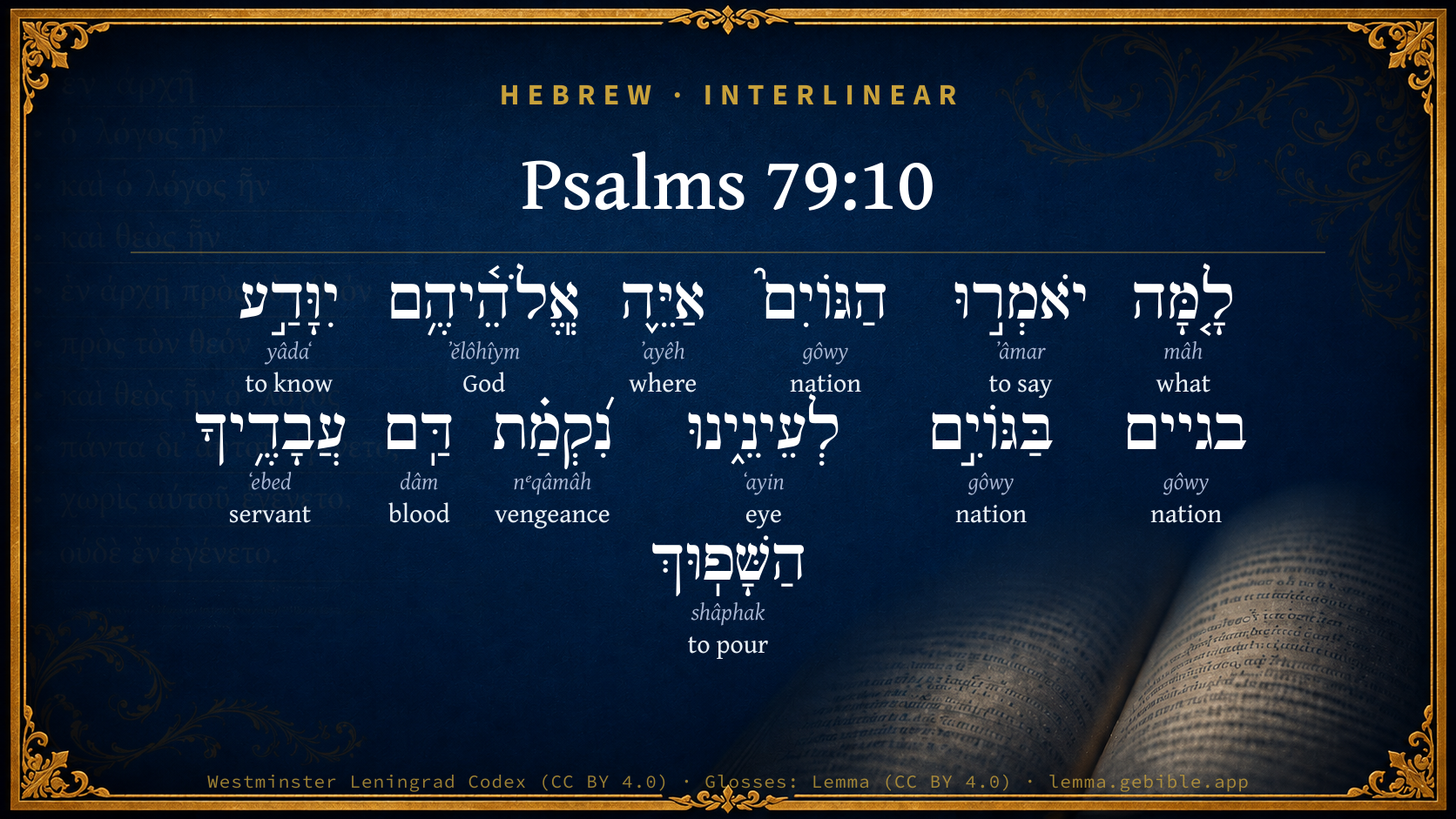
Hebrew (Westminster Leningrad Codex) Psalms 79:10 appears in the Hebrew Old Testament. The text above is from the Westminster Leningrad Codex. Each word links to its Strong’s number, a concise gloss, and parsing drawn from the Open Scriptures Hebrew Bible morphology. Click any word for its full Brown-Driver-Briggs (BDB) entry.
Download image
Cite this verse

Psalms 79:10 (World English Bible). Public Domain. Lemma interlinear Bible study tool, https://lemma.gebible.app/v/psalms/79/10.

Show BibTeX & RIS
BibTeX
RIS
English Translation
Why should the nations say, "Where is their God?" Let it be known among the nations, before our eyes, That vengeance for your servants' blood is being poured out.
World English Bible · Public Domain
Download a study sheet

One document with this verse’s original text, its word-by-word gloss line, the meaning frame, cross-references with their text, attributed commentary, and full source and license credits — printable, and it pastes into notes with its structure intact.

This verse Autodidact and up

Study sheet (.html) Plain text (.txt)

A passage Seminary Student

Up to 50 verses in one chapter. A passage sheet keeps up to 6 commentary sources and 12 cross-references per verse, in the order this page ranks them, and says so on the sheet whenever that leaves anything out. Ask for a single verse and you get the Autodidact verse sheet above.

Everything on this page stays free to read, with no account — the sheet is a download of what is already on screen, not access to it.

Want to remove ads? Support Godless Engineer
Compare translations 3

The same verse in 3 English versions, stacked beneath the original-language interlinear above. Click any original word for its lexicon entry.

Each is an independent rendering of the whole verse — the interlinear is not word-aligned to these translations.

Highlighted words mark where these versions differ — a whole-verse word diff, not a word-by-word alignment.

  • World English Bible Public Domain
    Why should the nations say, "Where is their God?" Let it be known among the nations, before our eyes, That vengeance for your servants' blood is being poured out.
  • King James Version Public Domain
    Wherefore should the heathen say, Where is their God? let him be known among the heathen in our sight by the revenging of the blood of thy servants which is shed.
  • unfoldingWord Literal Text CC BY-SA 4.0
    Why should the nations say, “Where their God?” Let the vengeance of the poured-out blood of your servants be known among the nations to our eyes.

unfoldingWord Literal Text — © unfoldingWord, licensed CC BY-SA 4.0. Word-aligned USFM3 via Door43 (git.door43.org/unfoldingWord/en_ult).

Versions to compare (up to 4)

3 of 4 selected

Show all 18 translations

Every available English version of this verse, each an independent rendering of the whole verse.

  • World English Bible Public Domain
    Why should the nations say, "Where is their God?" Let it be known among the nations, before our eyes, That vengeance for your servants' blood is being poured out.
  • Berean Standard Bible Public Domain
    Why should the nations ask, “Where is their God?” Before our eyes, make known among the nations Your vengeance for the bloodshed of Your servants.
  • Majority Standard Bible Public Domain
    Why should the nations ask, “Where is their God?” Before our eyes, make known among the nations Your vengeance for the bloodshed of Your servants.
  • King James Version Public Domain
    Wherefore should the heathen say, Where is their God? let him be known among the heathen in our sight by the revenging of the blood of thy servants which is shed.
  • American Standard Version (1901) Public Domain
    Wherefore should the nations say, Where is their God? Let the avenging of the blood of thy servants which is shed Be known among the nations in our sight.
  • Revised Version (1885) Public Domain
    Wherefore should the heathen say, Where is their God? let the revenging of the blood of thy servants which is shed be known among the heathen in our sight.
  • Geneva Bible (1599) Public Domain
    Wherefore should the heathen say, Where is their God? let him be knowen among the heathen in our sight by the vengeance of the blood of thy seruants that is shed.
  • Douay-Rheims (1899) Public Domain
    Lest they should say among the Gentiles: Where is their God? And let him be made known among the nations before our eyes, By the revenging the blood of thy servants, which hath been shed:
  • Young's Literal Translation Public Domain
    Why do the nations say, `Where `is' their God?' Let be known among the nations before our eyes, The vengeance of the blood of Thy servants that is shed.
  • Literal Standard Version CC BY-SA 4.0
    Why do the nations say, “Where [is] their God?” Let [it] be known among the nations before our eyes, || The vengeance of the blood of Your servants that is shed.
  • Unlocked Literal Bible CC BY-SA 4.0
    Why should the nations say, “Where is their God?” May the blood of your servants that was shed be avenged on the nations before our eyes.
  • unfoldingWord Literal Text CC BY-SA 4.0
    Why should the nations say, “Where their God?” Let the vengeance of the poured-out blood of your servants be known among the nations to our eyes.
  • Darby Bible Public Domain
    Wherefore should the nations say, Where is their God? Let the avenging of the blood of thy servants that is shed be known among the nations in our sight.
  • World Messianic Bible Public Domain
    Why should the nations say, “Where is their God?” Let it be known among the nations, before our eyes, that vengeance for your servants’ blood is being poured out.
  • Webster's Bible Public Domain
    Why should the heathen say, Where is their God? let him be known among the heathen in our sight by avenging the blood of thy servants which is shed.
  • Free Bible Version CC BY-SA 4.0
    Why should the heathen nations be able to say, “Where is their God?” May they experience your punishment for shedding the blood of your servants, and may we see it.
  • Bible in Basic English Public Domain
    Why may the nations say, Where is their God? Let payment for the blood of your servants be made openly among the nations before our eyes.
  • JPS Tanakh (1917) Public Domain
    Wherefore should the nations say: 'Where is their God?' Let the avenging of Thy servants' blood that is shed be made known among the nations in our sight.

Literal Standard Version (2020), Covenant Press — licensed CC BY-SA 4.0. Text via the HelloAO Bible API (eBible.org). Unlocked Literal Bible (unfoldingWord) — licensed CC BY-SA 4.0. Text via the HelloAO Bible API (eBible.org). unfoldingWord Literal Text — © unfoldingWord, licensed CC BY-SA 4.0. Word-aligned USFM3 via Door43 (git.door43.org/unfoldingWord/en_ult). Free Bible Version, Dr. Jonathan Gallagher — licensed CC BY-SA 4.0. Text via the HelloAO Bible API (eBible.org).

Word by word

More ways to search: Search by grammar → Find every occurrence → Compare this word →

Practice this passage: Drill this verse → Learn its vocabulary →

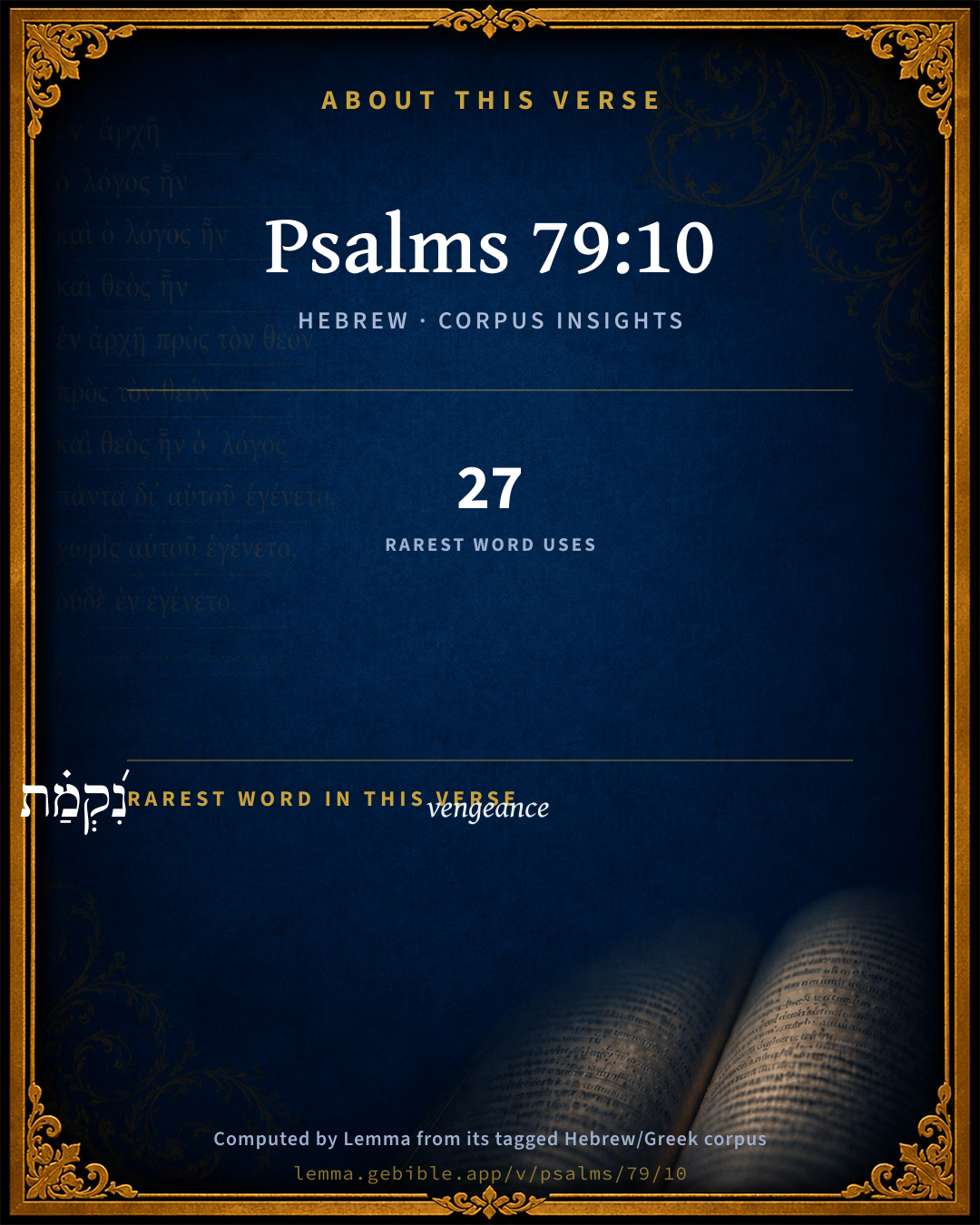
נִ֝קְמַ֗ת
nᵉqâmâh
H5360
“vengeance of”
Noun, Common, Feminine, Singular, Construct
Part of Speech
Noun
Type
Common
Gender
Feminine
Number
Singular
State
Construct
Full BDB Definition

Origin: from H5359

TWOT: 1413b

vengeance - vengeance (by God, by Israel, by enemies of Israel)
  1. לָ֤מָּה mâh H4100 “to/for · what” Preposition + Particle, Interrogative
  2. יֹאמְר֣וּ ʼâmar H559 “to say” Verb, Qal, Imperfect, 3rd Person, Masculine, Plural
  3. הַגּוֹיִם֮ gôwy H1471 “the · nations” Particle, Definite Article + Noun, Common, Masculine, Plural, Absolute
  4. אַיֵּ֪ה ʼayêh H346 “where” Particle, Interrogative
  5. אֱֽלֹהֵ֫יהֶ֥ם ʼĕlôhîym H430 “God(s) · their” Noun, Common, Masculine, Plural, Construct + Suffix, Personal, 3rd Person, Masculine, Plural
  6. יִוָּדַ֣ע yâdaʻ H3045 “to know” Verb, Niphal, Jussive, 3rd Person, Masculine, Singular
  7. בגיים gôwy H1471 “in/at the · nations” Preposition, Determined + Noun, Common, Masculine, Plural, Absolute
  8. בַּגּוֹיִ֣ם gôwy H1471 “in/at the · nations” Preposition, Determined + Noun, Common, Masculine, Plural, Absolute
  9. לְעֵינֵ֑ינוּ ʻayin H5869 “to/for · eyes · our” Preposition + Noun, Common, Both, Dual, Construct + Suffix, Personal, 1st Person, Common, Plural
  10. דַּֽם dâm H1818 “blood of” Noun, Common, Masculine, Singular, Construct
  11. עֲבָדֶ֥יךָ ʻebed H5650 “servants · your” Noun, Common, Masculine, Plural, Construct + Suffix, Personal, 2nd Person, Masculine, Singular
  12. הַשָּׁפֽוּךְ shâphak H8210 “the · poured” Particle, Definite Article + Verb, Qal, Participle Passive, Masculine, Singular, Absolute

About this verse

These counts appear in no published source. They are computed here, from the morphology-tagged text and Lemma’s own curated glosses. What Lemma adds →

13
words
11
distinct lemmas
Wisdom
section

Shared distinctive vocabulary

נִ֝קְמַ֗ת vengeance H5360 occurs in 22 verses of the Hebrew Bible. Also found in:

Grammatical profile

  • 3 verbs
  • 8 nouns
  • 2 particles

Verb forms

  • יֹאמְר֣וּ Qal · Imperfect
  • יִוָּדַ֣ע Niphal · Jussive
  • הַשָּׁפֽוּךְ Qal · Participle Passive

Repetition

A word recurs within this verse — often emphatic in Hebrew:

  • הַגּוֹיִם֮ nation H1471 ×3

Hebrew & Septuagint length

In English translation the verse runs 29 words from the Hebrew and 32 from the Septuagint (LXX English) — closely comparable.

A rough comparison of the two English renderings, which tokenize alike — not a word-level alignment.

Word counts can differ between the Hebrew and the Greek without any difference in meaning — e.g. the Hebrew direct-object marker אֵת has no separate Greek word, and Greek often adds the article ὁ.

Cross-references

16

Topical passages linked to Psalms 79:10 in the Treasury of Scripture Knowledge — connected by theme and wording, ordered by reader-vote popularity; previews shown in the World English Bible.

  • Psalms 42:10 As with a sword in my bones, my adversaries reproach me, While they continually ask me, "Where is your God?"
  • Exodus 6:7 and I will take you to me for a people, and I will be to you a God; and you shall know that I am Yahweh your God, who brings you out from under the burdens of the Egyptians.
  • Exodus 7:5 The Egyptians shall know that I am Yahweh, when I stretch forth my hand on Egypt, and bring out the children of Israel from among them."
  • Psalms 42:3 My tears have been my food day and night, While they continually ask me, "Where is your God?"
  • Psalms 94:1 Yahweh, you God to whom vengeance belongs, You God to whom vengeance belongs, shine forth.
  • Psalms 115:2 Why should the nations say, "Where is their God, now?"
  • Ezekiel 39:21–22 I will set my glory among the nations; and all the nations shall see my judgment that I have executed, and my hand that I have laid on them.
  • Micah 7:10 Then my enemy will see it, And shame will cover her who said to me, Where is Yahweh your God? Then my enemy will see me and will cover her shame. Now she will be trodden down like the mire of the streets.
  • Revelation 18:20 Rejoice over her, O heaven, you saints, apostles, and prophets; for God has judged your judgment on her."
  • Psalms 9:16 Yahweh has made himself known. He has executed judgment. The wicked is snared by the work of his own hands. Meditation. Selah.
  • Psalms 58:11 So that men shall say, "Most assuredly there is a reward for the righteous. Most assuredly there is a God who judges the earth."
  • Psalms 83:17–18 Let them be disappointed and dismayed forever. Yes, let them be confounded and perish;
  • Jeremiah 51:35 The violence done to me and to my flesh be on Babylon, shall the inhabitant of Zion say; and, My blood be on the inhabitants of Chaldea, shall Jerusalem say.
  • Ezekiel 36:23 I will sanctify my great name, which has been profaned among the nations, which you have profaned in the midst of them; and the nations shall know that I am Yahweh, says the Lord Yahweh, when I shall be sanctified in you before their eyes.
  • Joel 2:17 Let the priests, the ministers of Yahweh, weep between the porch and the altar, And let them say, "Spare your people, Yahweh, And don't give your heritage to reproach, That the nations should rule over them. Why should they say among the peoples, 'Where is their God?'"
  • Romans 12:19 Don't seek revenge yourselves, beloved, but give place to God's wrath. For it is written, "Vengeance belongs to me; I will repay, says the Lord."

Cross-references courtesy of OpenBible.info (CC BY 4.0).

Hebrew and Greek witnesses Masoretic Hebrew ↔ Greek Septuagint

The same verse in the two great witnesses to the Old Testament, shown verse-for-verse.

You’re reading Greek Psalm 78 (Hebrew Psalm 79). The Septuagint counts the superscription, so verse numbers can differ from the Hebrew — chapter-level alignment, not verse-by-verse. Numbering follows Rahlfs.

These are two independent witnesses, not word-aligned to each other, and the Septuagint is shown in lemma (dictionary) form.

Hebrew Psalms 79:10 Masoretic · Westminster Leningrad Codex

לָ֤מָּה יֹאמְר֣וּ הַגּוֹיִם֮ אַיֵּ֪ה אֱֽלֹהֵ֫יהֶ֥ם יִוָּדַ֣ע בגיים בַּגּוֹיִ֣ם לְעֵינֵ֑ינוּ נִ֝קְמַ֗ת דַּֽם עֲבָדֶ֥יךָ הַשָּׁפֽוּךְ

Why should the nations say, "Where is their God?" Let it be known among the nations, before our eyes, That vengeance for your servants' blood is being poured out.

World English Bible · Public Domain

Greek LXX Greek Psalm 78:10 Septuagint · lemma form

μήποτε εἶπον ὁ ἔθνος ποῦ εἰμί ὁ θεός αὐτός καί γιγνώσκω ἐν ὁ ἔθνος ἐνώπιον ὁ ὀφθαλμός ἐγώ ὁ ἐκδίκησις ὁ αἷμα ὁ δοῦλος σύ ὁ ἐκχέω

Lest haply they should say among the heathen, Where is their God? and let the avenging of your servant's blood that has been shed be known among the heathen before our eyes.

LXX2012 (modern English Septuagint) · Public Domain

Hebrew: Westminster Leningrad Codex (CC BY 4.0). Greek: Septuagint (public domain); English from LXX2012 (modern English Septuagint) (Public Domain). How the Septuagint differs from the Hebrew →

Commentary

Notes on Psalms 79:10 from classic Christian and Jewish commentators (each source and its license shown beneath its notes). The classic Christian expositions comment on the surrounding passage and are grouped to its opening verse, so a note may address several verses; the Jewish commentaries on the Tanakh (Rashi and others) are per-verse, so they appear only where the commentator wrote on this verse.

Lemma curates 59 commentaries, every one of them public domain or Creative Commons licensed, each selected and text-cleaned for this edition rather than reprinted as found. About our sources →

Trapp's Complete Commentary

John Trapp

Psa 79:10 Wherefore should the heathen say, Where [is] their God? let him be known among the heathen in our sight [by] the revenging of the blood of thy servants [which is] shed.

Ver. 10. Where is their God?] See Psa 43:3. So Turks at this day (when they have the better of Christians) cry, Where is the Christian’s God? We are the right Mussulmans, &c.

By the revenging of the blood of thy servants, &c.] For the which make thou inquisition, and do justice.

John Trapp, A Commentary or Exposition upon All the Books of the Old and New Testament (1647–1656) — public domain. Text from a community e-Sword module.

The Biblical Illustrator

Joseph S. Exell

Psa_79:10

Wherefore should the heathen say, Where is their God?

A bad spirit and a theological error

I. A bad spirit. Where is their God?

1. There is a tendency in wicked men to deal in it. This spirit always indicates--

(1) A mean nature.

(2) A malignant nature.

(3) A haughty nature.

2. There is a susceptibility even in good men to be pained by it. This is no sign of strength and greatness, but the reverse; the really great and strong man will feel no more the most cutting gibes of scorners than granite the drops of morning dew.

II. A theological error. The question implies that the true God would not allow His people to suffer oppression and death at the hands of others.

1. The creatures whom God has created with an inner sovereignty, He allows to act freely both for good and evil.

2. All the evil that comes into the universe in this way He overrules for good. (Homilist.)

The Biblical Illustrator, edited by Joseph S. Exell (c. 1880s–1900s) — public domain. Text from a community e-Sword module.

Adam Clarke's Commentary

Verse 10. Where is their God?] Show where thou art by rising up for our redemption, and the infliction of deserved punishment upon our enemies.

Adam Clarke's Commentary on the Bible (1810–1826) — public domain. Text from a community e-Sword/MySword module.

John Calvin's Commentaries

10. Why should the heathen say, Where is their God? Here the people of God, in urging his name as a plea at the throne of grace: do so in a different sense from that in which they had urged it before. He extends his compassion towards us for his own name’s sake; for, as he is merciful, and will have our mouths stopped, that he alone may be accounted righteous, he freely pardons our sins. But here, the faithful beseech him that he would not allow his sacred name to be exposed to the blasphemies and insults of the wicked. From this we are taught that we do not pray in a right manner, unless a concern about our own salvation, and zeal for the glory of God, are inseparably joined together in our exercise. From the second clause of the verse, the same question may be raised which we have just now answered. Although God declares that he will execute vengeance upon our enemies, we are not warranted to thirst for revenge when we are injured. Let us remember that this form of prayer was not dictated for all men indiscriminately, that they might make use of it whenever impelled by their own passions, but that, under the guidance and instruction of the Holy Spirit, they might plead the cause of the whole Church, in common, against the wicked. If we would, therefore, offer up to God a prayer like this in a right manner, in the first place, our minds must be illuminated by the wisdom of the Holy Spirit; and, secondly, our zeal, which is often corrupted by the turbid affections of the flesh, must be pure and well-regulated; and then, with such a pure and well-tempered zeal, we may lawfully beseech God to show us, by evident examples, how precious, in his sight, is the life of his servants whose blood he avenges. The faithful are not to be understood as expressing any desire to be glutted with the sight of the shedding of human blood, as if they longed greedily after it: they only desire that God would grant them some confirmation of their faith, in the exercise of his fatherly love which is manifested when he avenges the wrongs done to his own people. It is farther to be noticed, that the appellation, the servants of God, is given to those who, nevertheless, were justly punished on account of their sins; for although he may chastise us, yet he does not forthwith cast us off, but, on the contrary, testifies thereby that our salvation is the object of his care. Again, we know that when the anger of God is extended over the whole body of the Church, as the good and the bad are mingled together in her, the former are punished in common with the latter, even as Ezekiel, Jeremiah, Daniel, and others, were carried into captivity. They were not, it is true, altogether faultless; but it is certain that so great a calamity was not brought upon the Jews on their account. In their person, there was rather set forth a spectacle to the ungodly, that they might be the more deeply affected.

John Calvin's Commentaries (1540-1563) — public domain. Text from the Calvin Translation Society English edition (1840s-50s) via the Christian Classics Ethereal Library (ccel.org). Calvin's coverage is partial (roughly two-thirds of the Bible); uncommented books and verses are honest gaps, never fabricated. The 19th-century editor's footnotes and remarks are omitted so the notes are faithfully Calvin's own voice.

Ellicott's Commentary for English Readers

(10) Wherefore.—Taken from Joe_2:17.

Let him be known.—Better, Let it be known, i.e., where God is. Let the answer to the question be given in vengeance, and let us see it.

A Bible Commentary for English Readers, edited by Charles John Ellicott (1878–1897) — public domain. Text from a community e-Sword module.

The Cambridge Bible for Schools and Colleges

gen. ed. J. J. S. Perowne

10. Wherefore &c.] The same plea in Psa_115:2 (cp. also Psa_115:1 with Psa_79:9); Joe_2:17. Cp. Exo_32:12; Psa_42:3; Mic_7:10.

let him be known] Better:

Let vengeance for thy servants’ blood that is shed

Be made known among the heathen in our sight.

Defer not vengeance to some future generation: let us see with our own eyes the fitting punishment of the enemies of Israel. This verse and Psa_79:9 are based upon Deu_32:43. Note how the thought of vengeance goes side by side with that of deliverance in Isa_35:4; Isa_47:3; Isa_59:17; Isa_61:2; Isa_63:4; and in Jer_50:15; Jer_50:28; Jer_51:6; Jer_51:11; Jer_51:36, chapters which also probably date from the Exile.

The Cambridge Bible for Schools and Colleges (gen. ed. J. J. S. Perowne; Cambridge University Press, 1878–1918) — public domain. Text from a community e-Sword module.

John Gill's Exposition

Wherefore should the Heathen say, where is their God?.... They boast of, and put their confidence in, and expect salvation from? he does not appear for them, he is not with them; he has forsaken them, and will not help them; than which nothing can be more afflicting and distressing to the Lord's people; see Psa 42:3,

let him be known among the Heathen in our sight; in his holiness and justice, as a God of power, and to whom vengeance belongs; let him be known by his judgments executed upon the Heathen, openly and publicly in our sight, and in the view of the whole world; see Psa 9:16, so it follows,

by the revenging of the blood of thy servants, which is shed; as in Psa 79:3, which blood God will revenge according to the request of his people, and give them blood to drink by way of retaliation; by which means his vindictive justice will be known, and it will be seen where the God of his people is, that he is with them, and maintains their cause; see Rev 6:9. The words may be rendered in connection with the preceding clause thus; "let it be known among the Heathen in our sight, even the revenging of the blood of thy servants which is shed"; though Kimchi supplies the words as we do, "by a revenging", &c.

John Gill's Exposition of the Whole Bible (1746–1763) — public domain (CC PDM 1.0). Text via the HelloAO Bible API.

Albert Barnes' Notes on the Bible

Wherefore should the heathen say Where is their God? - The nations. Why should such a course of forbearance toward them be pursued as to lead them to ask the question whether God is able to punish them, or to come to the conclusion that he is not the God of those who profess to worship him. See Psa 42:3, note; Psa 42:10, note.

Let him be known among the heathen - Let him so manifest himself among them that they cannot but see that he is God; that he is a just God; that he is the Friend and Protector of his people.

In our sight - So that we may see it; or, so that it may be seen that he is our Friend and Protector.

By the revenging of the blood of thy servants which is shed - Margin, vengeance. The true idea is, “Let the avenging of the blood of thy servants - the blood poured out, or shed, be known among the nations in our sight.” The prayer is that God would so interpose that there could be no doubt that it was on account of the blood of his people which had been shed by their enemies. It is a prayer that just punishment might be executed - a prayer which may be offered at anytime.

Albert Barnes' Notes on the Bible (1834–1885) — public domain. Text from a community e-Sword/MySword module.

Matthew Poole's English Annotations

Their God; he whom they served, and of whom they boasted. He is lost and gone, or grown impotent or idle.

Let him be known among the heathen, by the execution of his judgments upon them, according to Psa 9:16.

In our sight; that we may live to see it, and praise thy name for it.

Matthew Poole's English Annotations on the Holy Bible (1683–1685) — public domain. Text from a community e-Sword/MySword module.

The Pulpit Commentary

Wherefore should the heathen say, Where is their God?. (so Joe_2:17) A triumph over a foreign nation was always regarded in the ancient world as a triumph over their gods. Their gods were bound to protect them, and, if they did not, must either have been absent or powerless. (comp. 2Ki_18:33-35 2Ki_19:12) Let him be known among the heathen in our sight by the revenging of the blood of thy servants which is shed; rather, let there be shown forth among the heathen in our sight vengeance for the blood of thy servants that has been shed; or, in other words, "Let an evident judgment, visible to us, fall upon the heathen who have shed the blood of our brethren, thy true servants." An immediate judgment is prayed for; but it did not please God to send the judgment till after the expiration of a long term of years.

The heathen taunt.

I THE HEATHEN DID SAY THIS Where is their God? The Jew had talked so much of his God, how great and glorious he was, what wonderful works he had done, the victories he had given them, that now, in view of their burning city, their desecrated temple, the heaps of slain in their streets, the heathen in pride and scorn flung this taunt in their face Where is your God?

II AND THE HEATHEN SAY IT STILL. Missionaries go to them, and tell them of God, so holy, merciful, righteous, that many of them are won for God; but lo! there come, soon after, fellow countrymen of the missionaries traders, sailors, and others, who bring vile alcoholic drinks, murderous weapons, vices unnamable, and much else with them, and do their bad best to make the heathen"s home a hell: what wonder if they should ask, as they do Where is your God?

III AND MEN GODLESS AS HEATHENS SAY IT HERE IN OUR OWN LAND.

1. So called scientific men. One of them, the other day, contemptuously declared that he had been looking down a microscope for some thirty years, and he hadn"t found God yet; and he was sure he should have found him if there was a God to be found. And many others scoff at the idea of God, and deny his existence, or, at any rate, defy you to prove it.

2. Others, because of the problems of moral and physical evil, refuse to believe in God.

3. Others under the pressure of trial and earthly care: hence they have become bitter and hard, and so east off all Faith.

4. Many others, as they mark the glaring inconsistencies of professed Christians. They condemn them all as false, hypocritical, and insincere.

IV But we ask WHEREFORE SHOULD THEY SAY THIS?

1. Wherefore the man of science? For God is known by the spirit, not the intellect.

2. Or the mind baffled by moral problems? Our children trust us, when they cannot understand: should not God"s children trust him?

3. Or the care-embittered soul? Does the denial of God make care lighter? Would it not be better to humble one"s self before God, and to hide in the shelter of his love?

4. And the declaimer against the inconsistencies of the Church? He exaggerates them, and ignores the mass of true-hearted believers.

CONCLUSION. But let us take care to give no occasion for the heathen to say Where, etc.? S.C.

The Pulpit Commentary (1880–1919), ed. H.D.M. Spence-Jones & Joseph S. Exell — public domain. Text from a community e-Sword module.

J. A. Alexander on Psalms

Joseph Addison Alexander

10. Wherefore should the nations say, Where (is) their God ? Known among the nations, in our sight, be the avenging of the blood of thy servants, the (blood) poured out, (or shed), as was described above, in Psa 79:3. This argument in favour of God's interposition, founded on the false conclusions which his enemies would draw from his refusal, is of frequent occurrence in the Pentateuch. See Exo 32:12, Num 14:13-16, Deu 9:28, and compare Joe 2:17, from which the words before us are directly borrowed. Where is their God, the invisible, spiritual being whom they worship, but who cannot save them from external dangers? Or the meaning may be, Where is the proof of that almighty power, and that love for his own people, of which they have so often and so loudly boasted? The English Bible makes the verb in the second clause agree with God (let him be known), and supplies a preposition before vengeance (by the revenging). But the ancient versions, followed by the Prayer Book and the best modern interpreters, construe the verb and noun together (known be the avenging). The diversity of gender may be easily reduced to the general law of Hebrew syntax, that when the verb precedes its subject, and especially when separated from it, the former may assume the masculine form, not as such, but as the primitive and simplest form. In our sight, literally to our eyes, just as we say in English, to our faces. This aggravating circumstance is borrowed from Deu 6:22, and the idea of avenging blood from Deu 32:43.

Joseph Addison Alexander, The Psalms Translated and Explained (1850) — public domain. Text from a community e-Sword module.

unfoldingWord translationNotes

Door43 World Missions Community

Why should the nations say, "Where is their God?"

This can be translated as a statement. AT: "The nations should not be able to say, 'Where is their God?'" (See: Rhetorical Question)

Where is their God?

This taunt can be translated as a statement. AT: "Their God cannot do anything!" (See: Rhetorical Question)

May the blood of your servants that was shed be avenged on the nations before our eyes

To shed blood is a metonym for killing innocent people. This can be translated in active form. AT: "Avenge your innocent servants whom the nations killed where we can see you do it" (See: Metonymy and Rhetorical Question)

before our eyes

"in our sight" or "while we are present"

May the groans of the prisoners come before you

Asaph speaks of the sound made by prisoners in pain and sorrow as if it were a person who appears before a king. AT: "Listen carefully to the groans of the prisoners and help them" (See: Metaphor and Assumed Knowledge and Implicit Information)

children of death

This is an idiom that refers to people who are condemned to death. AT: "those who are condemned to die" (See: Idiom)

translationWords

blood

servant

avenge

prison

power

die

life

unfoldingWord translationNotes — © Distant Shores Media and the Door43 World Missions Community, licensed CC BY-SA 4.0. Source: git.door43.org/Door43/en_tn.

Lesson kit

Teaching starters — assembled from the data on this page, not authored interpretation. Every prompt links to the verse data it draws on. Edit before teaching.

Psalms, in the Wisdom, opens this verse with 13 words (11 distinct Hebrew lemmas). Its most distinctive word is nᵉqâmâh (“vengeance”). A historical commentator’s framing appears above. Read the whole chapter for the surrounding context.

Discussion questions

  1. The word nᵉqâmâh carries the sense “vengeance.” How does it shape the verse?
  2. How does Numbers 31:2, which shares the word «vengeance», read alongside this verse?
  3. What does the repetition of “nation” (3× in this one verse) do in this verse?
  4. These translations render this verse differently. What is at stake in choosing one wording over another?
  5. «יֹאמְר֣וּ» is a Qal Imperfect verb. How does that grammatical form shape the action described?
  6. Compare how Trapp's Complete Commentary and The Biblical Illustrator read this verse. Where do they agree or differ?

Things to notice

Reading settings

Reading text

Shown beneath each verse's original-language words.

Old Testament
Old Testament edition

Read the OT as the Masoretic Hebrew (MT) or the Greek Septuagint (LXX).

English shown for the Greek Septuagint (in the Hebrew ↔ Greek comparison).

Comparing translations? Open the Compare panel on any verse page to stack up to four side by side.