Jeremiah 49:14

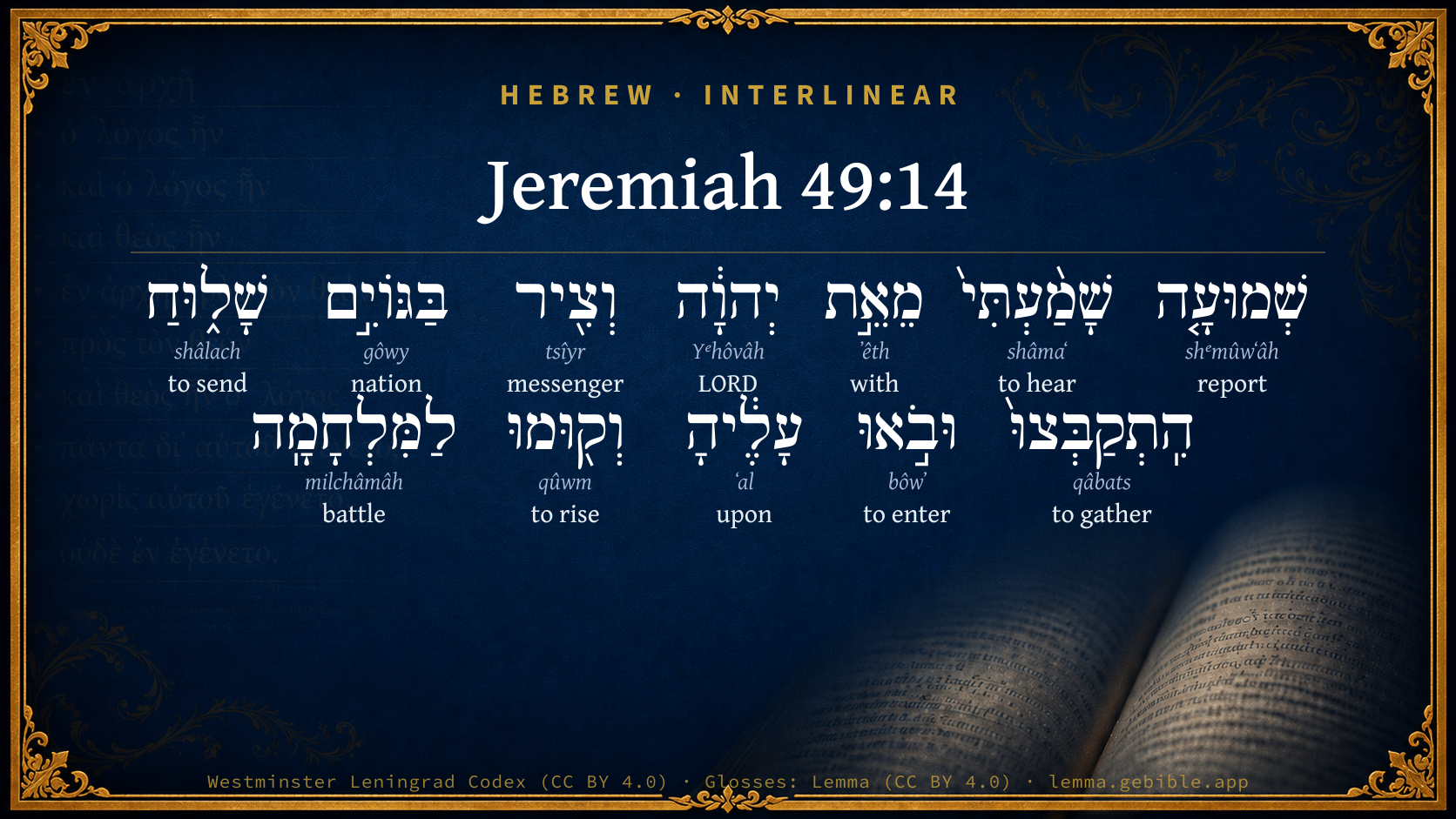
Hebrew (Westminster Leningrad Codex) Jeremiah 49:14 appears in the Hebrew Old Testament. The text above is from the Westminster Leningrad Codex. Each word links to its Strong’s number, a concise gloss, and parsing drawn from the Open Scriptures Hebrew Bible morphology. Click any word for its full Brown-Driver-Briggs (BDB) entry.
Download image
Cite this verse

Jeremiah 49:14 (World English Bible). Public Domain. Lemma interlinear Bible study tool, https://lemma.gebible.app/v/jeremiah/49/14.

Show BibTeX & RIS
BibTeX
RIS
English Translation
I have heard news from Yahweh, and an ambassador is sent among the nations, [saying], Gather yourselves together, and come against her, and rise up to the battle.
World English Bible · Public Domain
Download a study sheet

One document with this verse’s original text, its word-by-word gloss line, the meaning frame, cross-references with their text, attributed commentary, and full source and license credits — printable, and it pastes into notes with its structure intact.

This verse Autodidact and up

Study sheet (.html) Plain text (.txt)

A passage Seminary Student

Up to 50 verses in one chapter. A passage sheet keeps up to 6 commentary sources and 12 cross-references per verse, in the order this page ranks them, and says so on the sheet whenever that leaves anything out. Ask for a single verse and you get the Autodidact verse sheet above.

Everything on this page stays free to read, with no account — the sheet is a download of what is already on screen, not access to it.

Want to remove ads? Support Godless Engineer
Compare translations 3

The same verse in 3 English versions, stacked beneath the original-language interlinear above. Click any original word for its lexicon entry.

Each is an independent rendering of the whole verse — the interlinear is not word-aligned to these translations.

Highlighted words mark where these versions differ — a whole-verse word diff, not a word-by-word alignment.

  • World English Bible Public Domain
    I have heard news from Yahweh, and an ambassador is sent among the nations, [saying], Gather yourselves together, and come against her, and rise up to the battle.
  • King James Version Public Domain
    I have heard a rumour from the LORD, and an ambassador is sent unto the heathen, saying, Gather ye together, and come against her, and rise up to the battle.
  • unfoldingWord Literal Text CC BY-SA 4.0
    I have heard news from Yahweh, and a messenger has been sent out to the nations, ‘Gather together and attack her. Get ready for battle.’

unfoldingWord Literal Text — © unfoldingWord, licensed CC BY-SA 4.0. Word-aligned USFM3 via Door43 (git.door43.org/unfoldingWord/en_ult).

Versions to compare (up to 4)

3 of 4 selected

Show all 18 translations

Every available English version of this verse, each an independent rendering of the whole verse.

  • World English Bible Public Domain
    I have heard news from Yahweh, and an ambassador is sent among the nations, [saying], Gather yourselves together, and come against her, and rise up to the battle.
  • Berean Standard Bible Public Domain
    I have heard a message from the LORD; an envoy has been sent to the nations: “Assemble yourselves to march against her! Rise up for battle!”
  • Majority Standard Bible Public Domain
    I have heard a message from the LORD; an envoy has been sent to the nations: “Assemble yourselves to march against her! Rise up for battle!”
  • King James Version Public Domain
    I have heard a rumour from the LORD, and an ambassador is sent unto the heathen, saying, Gather ye together, and come against her, and rise up to the battle.
  • American Standard Version (1901) Public Domain
    I have heard tidings from Jehovah, and an ambassador is sent among the nations, `saying', Gather yourselves together, and come against her, and rise up to the battle.
  • Revised Version (1885) Public Domain
    I have heard tidings from the LORD, and an ambassador is sent among the nations, saying, Gather yourselves together, and come against her, and rise up to the battle.
  • Geneva Bible (1599) Public Domain
    I haue heard a rumour from the Lord, and an ambassadour is sent vnto the heathen, saying, Gather you together, and come against her, and rise vp to the battell.
  • Douay-Rheims (1899) Public Domain
    I have heard a rumour from the Lord, and an ambassador is sent to the nations: Gather yourselves together, and come against her, and let us rise up to battle.
  • Young's Literal Translation Public Domain
    A report I have heard from Jehovah, And an ambassador among nations is sent, Gather yourselves and come in against her, And rise ye for battle.
  • Literal Standard Version CC BY-SA 4.0
    I have heard a report from YHWH, || And an ambassador is sent among nations, || Gather yourselves and come in against her, || And rise for battle.
  • Unlocked Literal Bible CC BY-SA 4.0
    I have heard news from Yahweh, and a messenger has been sent out to the nations, 'Gather together and attack her. Get ready for battle.'
  • unfoldingWord Literal Text CC BY-SA 4.0
    I have heard news from Yahweh, and a messenger has been sent out to the nations, ‘Gather together and attack her. Get ready for battle.’
  • Darby Bible Public Domain
    I have heard a rumour from Jehovah, and an ambassador is sent among the nations: -- Gather yourselves together, and come against her and rise up for the battle.
  • World Messianic Bible Public Domain
    I have heard news from the LORD, and an ambassador is sent among the nations, saying, “Gather yourselves together! Come against her! Rise up to the battle!”
  • Webster's Bible Public Domain
    I have heard a rumor from the LORD, and an embassador is sent to the heathen, saying, Assemble, and come against her, and rise up to the battle.
  • Free Bible Version CC BY-SA 4.0
    I received this message from the Lord. He has sent a messenger to the nations: Get yourselves ready to attack Edom! Prepare for battle!
  • Bible in Basic English Public Domain
    Word has come to me from the Lord, and a representative has been sent to the nations, to say, Come together and go up against her, and take your places for the fight.
  • JPS Tanakh (1917) Public Domain
    I have heard a message from the LORD, and an ambassador is sent among the nations: 'Gather yourselves together, and come against her, and rise up to the battle.'

Literal Standard Version (2020), Covenant Press — licensed CC BY-SA 4.0. Text via the HelloAO Bible API (eBible.org). Unlocked Literal Bible (unfoldingWord) — licensed CC BY-SA 4.0. Text via the HelloAO Bible API (eBible.org). unfoldingWord Literal Text — © unfoldingWord, licensed CC BY-SA 4.0. Word-aligned USFM3 via Door43 (git.door43.org/unfoldingWord/en_ult). Free Bible Version, Dr. Jonathan Gallagher — licensed CC BY-SA 4.0. Text via the HelloAO Bible API (eBible.org).

Word by word

More ways to search: Search by grammar → Find every occurrence → Compare this word →

Practice this passage: Drill this verse → Learn its vocabulary →

וְצִ֖יר
tsîyr
H6735
“and · messenger”
Conjunction + Noun, Common, Masculine, Singular, Absolute
Part of Speech
Conjunction + Noun
Type
Common
Gender
Masculine
Number
Singular
State
Absolute
Full BDB Definition

Origin: from H6696

TWOT: 1913a , 1914a , 1914b

envoy, messenger - pivot of door, hinge - pang, distress
  1. שְׁמוּעָ֤ה shᵉmûwʻâh H8052 “report” Noun, Common, Feminine, Singular, Absolute
  2. שָׁמַ֨עְתִּי֙ shâmaʻ H8085 “to hear” Verb, Qal, Perfect, 1st Person, Common, Singular
  3. מֵאֵ֣ת ʼêth H854 “from · with” Preposition + Preposition
  4. יְהוָ֔ה Yᵉhôvâh H3068 “LORD” Noun, Proper
  5. בַּגּוֹיִ֣ם gôwy H1471 “in/at the · nations” Preposition, Determined + Noun, Common, Masculine, Plural, Absolute
  6. שָׁל֑וּחַ shâlach H7971 “sent” Verb, Qal, Participle Passive, Masculine, Singular, Absolute
  7. הִֽתְקַבְּצוּ֙ qâbats H6908 “to gather” Verb, Hithpael, Perfect, 3rd Person, Common, Plural
  8. וּבֹ֣אוּ bôwʼ H935 “and · enter” Conjunction + Verb, Qal, Imperative, 2nd Person, Masculine, Plural
  9. עָלֶ֔יהָ ʻal H5921 “upon · her” Preposition + Suffix, Personal, 3rd Person, Feminine, Singular
  10. וְק֖וּמוּ qûwm H6965 “and · rise” Conjunction + Verb, Qal, Imperative, 2nd Person, Masculine, Plural
  11. לַמִּלְחָמָֽה milchâmâh H4421 “to/for the · battle” Preposition, Determined + Noun, Common, Feminine, Singular, Absolute

About this verse

These counts appear in no published source. They are computed here, from the morphology-tagged text and Lemma’s own curated glosses. What Lemma adds →

12
words
12
distinct lemmas
Prophets
section

Notable vocabulary

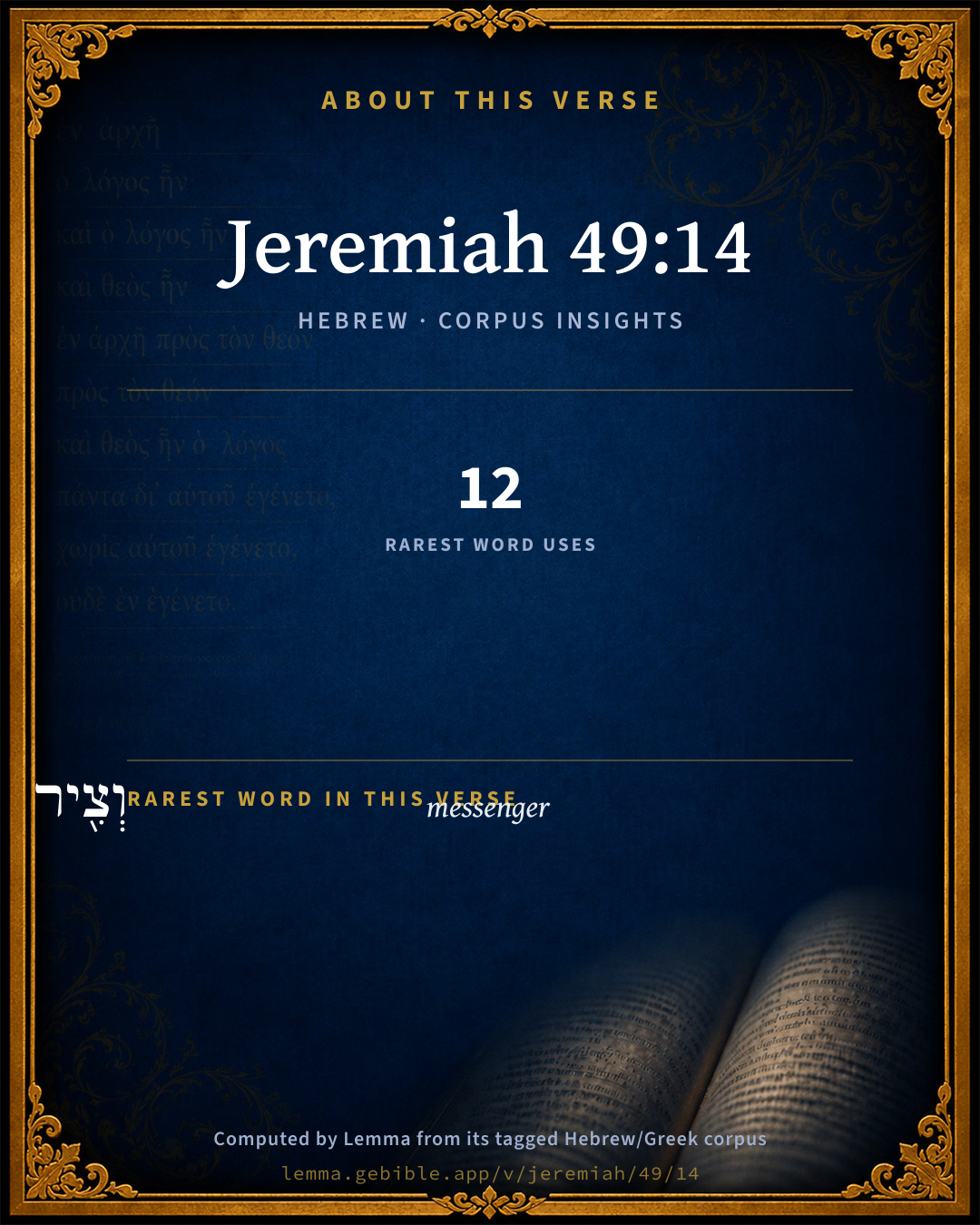
The rarest word here is וְצִ֖יר messenger H6735 — appearing just 12 times in the whole Hebrew Bible.

Shared distinctive vocabulary

וְצִ֖יר messenger H6735 occurs in 11 verses of the Hebrew Bible. Also found in:

Grammatical profile

  • 5 verbs
  • 5 nouns
  • 2 prepositions

Verb forms

  • שָׁמַ֨עְתִּי֙ Qal · Perfect
  • שָׁל֑וּחַ Qal · Participle Passive
  • הִֽתְקַבְּצוּ֙ Hithpael · Perfect
  • וּבֹ֣אוּ Qal · Imperative
  • וְק֖וּמוּ Qal · Imperative

Cross-references

11

Topical passages linked to Jeremiah 49:14 in the Treasury of Scripture Knowledge — connected by theme and wording, ordered by reader-vote popularity; previews shown in the World English Bible.

  • Isaiah 30:4 For their princes are at Zoan, and their ambassadors are come to Hanes.
  • Isaiah 13:2–3 Set up an ensign on the bare mountain, lift up the voice to them, wave the hand, that they may go into the gates of the nobles.
  • Isaiah 18:2–3 that sends ambassadors by the sea, even in vessels of papyrus on the waters, [saying], Go, you swift messengers, to a nation tall and smooth, to a people awesome from their beginning onward, a nation that measures out and treads down, whose land the rivers divide!
  • Isaiah 37:7 Behold, I will put a spirit in him, and he shall hear news, and shall return to his own land; and I will cause him to fall by the sword in his own land.
  • Jeremiah 50:9–16 For, behold, I will stir up and cause to come up against Babylon a company of great nations from the north country; and they shall set themselves in array against her; from there she shall be taken: their arrows shall be as of an expert mighty man; none shall return in vain.
  • Jeremiah 51:11 Make sharp the arrows; hold firm the shields: Yahweh has stirred up the spirit of the kings of the Medes; because his purpose is against Babylon, to destroy it: for it is the vengeance of Yahweh, the vengeance of his temple.
  • Jeremiah 51:27–28 Set up a standard in the land, blow the trumpet among the nations, prepare the nations against her, call together against her the kingdoms of Ararat, Minni, and Ashkenaz: appoint a marshal against her; cause the horses to come up as the rough canker-worm.
  • Jeremiah 51:46 Don't let your heart faint, neither fear for the news that shall be heard in the land; for news shall come one year, and after that in another year [shall come] news, and violence in the land, ruler against ruler.
  • Ezekiel 7:25–26 Destruction comes; and they shall seek peace, and there shall be none.
  • Obadiah 1:1–4 The vision of Obadiah. This is what the Lord Yahweh says about Edom. We have heard news from Yahweh, and an ambassador is sent among the nations, saying, "Arise, and let's rise up against her in battle.
  • Matthew 24:6 You will hear of wars and rumors of wars. See that you aren't troubled, for all this must happen, but the end is not yet.

Cross-references courtesy of OpenBible.info (CC BY 4.0).

Hebrew and Greek witnesses Masoretic Hebrew ↔ Greek Septuagint

The same verse in the two great witnesses to the Old Testament, shown verse-for-verse.

These are two independent witnesses, not word-aligned to each other, and the Septuagint is shown in lemma (dictionary) form.

Hebrew Jeremiah 49:14 Masoretic · Westminster Leningrad Codex

שְׁמוּעָ֤ה שָׁמַ֨עְתִּי֙ מֵאֵ֣ת יְהוָ֔ה וְצִ֖יר בַּגּוֹיִ֣ם שָׁל֑וּחַ הִֽתְקַבְּצוּ֙ וּבֹ֣אוּ עָלֶ֔יהָ וְק֖וּמוּ לַמִּלְחָמָֽה

I have heard news from Yahweh, and an ambassador is sent among the nations, [saying], Gather yourselves together, and come against her, and rise up to the battle.

World English Bible · Public Domain

Greek LXX Structure differs

In the Septuagint, Jeremiah is about an eighth shorter than the Hebrew and arranges its material differently — the Oracles Against the Nations (Hebrew chapters 46–51) appear in the middle of the Greek book, after 25:13. Because the chapter and verse boundaries do not line up, a verse-for-verse comparison with the Hebrew is not shown.

A verse-for-verse comparison isn’t shown here because the chapters and verses don’t line up. Switch to the LXX edition with the MT / LXX toggle above to read the Greek directly.

Hebrew: Westminster Leningrad Codex (CC BY 4.0). Greek: Septuagint (public domain); English from a public-domain English Septuagint. How the Septuagint differs from the Hebrew →

Targum (Aramaic paraphrase)

1

The Targum is the ancient Jewish Aramaic paraphrase of the Hebrew Scriptures — an interpretive translation, not the Hebrew text itself. Onkelos (literal) and Pseudo-Jonathan (expansive) render the Torah, and Jonathan the Prophets. Coverage is partial: where no permissively-licensed English translation exists for a verse, only the Aramaic is shown. This is verse-level text, not a word-by-word alignment to the Hebrew.

  1. Targum Jonathan Prophets (Joshua–Malachi)
    בְּסוֹרָא שְׁמָעֵית מִן קֳדָם יְיָ וְאִזְגַד בְּעַמְמַיָא שְׁלִיחַ אִתְכְּנִישׁוּ וַאֲתוֹ עֲלָהּ וְקוּמוּ לְאַגָחָא קְרָבָא:

    (no public-domain English translation for this verse)

    Targum Jonathan — Aramaic: “Mikraot Gedolot” (public domain). English: “Sefaria Community Translation” (CC0 1.0 (public-domain dedication)); “London "Chaldee Paraphrase," 1871” (public domain). Text via Sefaria.

Commentary

Notes on Jeremiah 49:14 from classic Christian and Jewish commentators (each source and its license shown beneath its notes). The classic Christian expositions comment on the surrounding passage and are grouped to its opening verse, so a note may address several verses; the Jewish commentaries on the Tanakh (Rashi and others) are per-verse, so they appear only where the commentator wrote on this verse.

Lemma curates 59 commentaries, every one of them public domain or Creative Commons licensed, each selected and text-cleaned for this edition rather than reprinted as found. About our sources →

Trapp's Complete Commentary

John Trapp

Jer 49:14 I have heard a rumour from the LORD, and an ambassador is sent unto the heathen, [saying], Gather ye together, and come against her, and rise up to the battle.

Ver. 14. I have heard a rumour from the Lord.] See on Oba 1:1.

John Trapp, A Commentary or Exposition upon All the Books of the Old and New Testament (1647–1656) — public domain. Text from a community e-Sword module.

Joseph Benson's Commentary

Jer 49:14-16. I have heard a rumour — Hebrew, שׁמועה, a report or message, from the Lord, and an ambassador is sent unto the heathen. Obadiah begins his prophecy against Edom in similar words. The prophets, it must be observed, “often represent God as summoning armies, and setting them in array of battle against those people whom he has decreed to destroy. And his stirring up men’s spirits to invade such countries, is described here as if he had sent an ambassador to the Chaldeans and their confederates, to engage them in a war against the Idumeans; according to the methods which earthly princes use to engage their allies.” — Lowth. For lo, I will make thee small, &c. — I will bring thee low and make thee very contemptible. Thy terribleness hath deceived thee — “Thou hast been formerly terrible to all about thee, and looked upon as impregnable; and the confidence thou hast had in this thy strength hath made thee careless and secure, and thereby given thy enemies an advantage against thee.” O thou that dwellest in the clefts, &c. — St. Jerome, who lived in the neighbourhood, tells us, in his commentary upon Obadiah, “that Idumea was a rocky mountainous country, and that the inhabitants dwelt in caves dug out of the rocks and hills.” Though thou shouldest make thy nest as high as the eagle — The greatest height or strength cannot place thee out of the reach of divine vengeance. The eagle is remarkable for its flying high, and making its nest in very high and inaccessible rocks: see note on Job 39:27-28.

Joseph Benson's Commentary on the Old and New Testaments (1811–1818) — public domain. Text from a community e-Sword module.

Tyndale Open Study Notes

Tyndale Open Resources

49:14 The ambassador might have been an angel sent by God (cp. 1 Kgs 22:20-22).

Tyndale Open Study Notes — © Tyndale Open Resources, licensed CC BY-SA 4.0. Text via the HelloAO Bible API.

Geneva Bible (1599)

Geneva Bible translators

That is, Bozrah.

Geneva Bible (1599) marginal notes — public domain. Text via Bolls.life.

Jamieson, Fausset & Brown

Robert Jamieson, A. R. Fausset & David Brown

(Oba 1:1-3).

ambassador . . . unto the heathen--a messenger from God to stir up the Chaldeans against Edom.

Jamieson, Fausset & Brown — Commentary Critical and Explanatory on the Whole Bible (1871) — public domain (CC PDM 1.0). Text via the HelloAO Bible API.

Adam Clarke's Commentary

Verse 14. I have heard a rumour] The Lord has revealed to me what he is about to do to the Edomites.

An ambassador is sent] I believe this means only that God has given permission, and has stirred up the hearts of these nations to go against those whom he has doomed to destruction.

Adam Clarke's Commentary on the Bible (1810–1826) — public domain. Text from a community e-Sword/MySword module.

John Calvin's Commentaries

The Prophet again shews that God would be the author of the calamity of which he speaks; for if things were viewed by men, no one could have thought that the Idumeans could in so short a time be destroyed. It was therefore necessary for the faithful to raise upwards their minds. And this the Prophet had in view when he said that all this would be from God.

But most forcible are his words when he says, We have heard a hearing; some say, “a report,” but improperly, as I think; for though, שמועה, shemuoe, often means a report or rumor, yet here it ought to be taken for a proclamation, which God published as it were by his own heralds. For the similitude is taken from men, proclaiming war against their enemies by a solemn rite. Then Jeremiah says, that a voice was heard sent from above, because it was God’s purpose publicly and openly to testify, that what we read here of the destruction of Edom would take place. We now then understand the meaning of the Prophet, when he says, A hearing have we heard from Jehovah

Then follows immediately a confirmation, a messenger, or an ambassador, is sent to the nations God, indeed, had no messenger or herald to proclaim war against the Idumeans, or to rouse up the Assyrians and Chaldeans; but the Prophets usually spoke thus, that men, being led to the very scene, might know that what was said was real, and would not be without its effect, as prophecies were as so many embassies. And according to this view, the prophets, as we have stated elsewhere, sometimes besieged and stormed cities, sometimes sounded the trumpet, even for this purpose, to show that their doctrine was linked with its execution, for God never spoke by them to no purpose or in vain. The Prophet at the same time reminds us that the Chaldeans and the Assyrians were in God’s hand, so that he could by a nod or a hiss rouse them to war, as it is said elsewhere,

“God will hiss for the fly of Egypt.” (Isaiah 7:18)

The Prophet then means, that the Chaldeans and the Assyrians would be ready to obey God, as though they were hired soldiers, and enlisted under his banner.

We now then see how forcible was this mode of speaking; for the faithful might hence learn, that it was in God’s power to perform whatever he proclaimed by his servant, because he could by one word rouse, draw, arm, and lead to war the Assyrians and the Chaldeans, as he also says, Be ye assembled, and come against her, and rise up to battle And he speaks of many nations, lest any one should think that the Idumeans would be able to resist, for he is not immediately conquered who is attacked by his enemies. But the Prophet meets this doubt, and says that there would be many nations, who, with their united strength, would come against the people of Edom, so that they would have no power to resist. Nearly the same words are found in Obadiah. It now follows —

John Calvin's Commentaries (1540-1563) — public domain. Text from the Calvin Translation Society English edition (1840s-50s) via the Christian Classics Ethereal Library (ccel.org). Calvin's coverage is partial (roughly two-thirds of the Bible); uncommented books and verses are honest gaps, never fabricated. The 19th-century editor's footnotes and remarks are omitted so the notes are faithfully Calvin's own voice.

Ellicott's Commentary for English Readers

(14) I have heard a rumour from the Lord . . .—The thought is that of Jehovah, as the great King, sending forth His herald or envoy to call the nations to the attack on Edom. (Comp. Jer_46:3-4.)

A Bible Commentary for English Readers, edited by Charles John Ellicott (1878–1897) — public domain. Text from a community e-Sword module.

The Cambridge Bible for Schools and Colleges

gen. ed. J. J. S. Perowne

14–18. These vv. are parallel to Oba_1:1-4, whence they are borrowed; see introd. note.

The Cambridge Bible for Schools and Colleges (gen. ed. J. J. S. Perowne; Cambridge University Press, 1878–1918) — public domain. Text from a community e-Sword module.

John Gill's Exposition

I have heard a rumour from the Lord,.... "A hearing" (l); or a report concerning the destruction of Edom, made to him in a dream or vision, by the spirit of God, as a spirit of prophecy:

and an ambassador is sent to the Heathen; or a messenger; Jeremiah the prophet, as some; or an angel, as Kimchi suggests, sent to gather the nations to war against Bozrah; or a divine impulse, as others, with which the Chaldeans were impressed; which was as a voice to them,

saying, gather ye together, and come against her, and rise up to the battle; get your forces together, and come against Bozrah or Edom, to invade and subdue it; attack it in a military way, not doubting of victory; see Oba 1:1.

(l) "auditum audivi", V. L. Pagninus, Montanus, Schmidt.

John Gill's Exposition of the Whole Bible (1746–1763) — public domain (CC PDM 1.0). Text via the HelloAO Bible API.

Haydock's Catholic Bible Commentary

Ambassador; Jeremias: or rather this is a personification of the passions, which would sufficiently prompt the Chaldeans. (Calmet) --- A good angel might urge them to execute the divine decrees. (Theodoret) --- The greatest armies are thus made use of by Providence, without approving of their malicious designs.

George Leo Haydock (1774–1849), Haydock's Catholic Family Bible and Commentary, 1859 edition — public domain. Excludes Psalms (Douay-Rheims chapter numbering differs from Protestant) and Deuterocanonical books (Catholic canon only).

Matthew Poole's English Annotations

I have heard a rumour from the Lord: Obadiah beginneth his prophecy much with such words. God hath revealed his will to me in a vision or a dream.

An ambassador is sent unto the heathen: he speaks after the manner of earthly princes, who use to send their ambassadors to other princes to declare their minds to them.

Saying, Gather ye together, and come against her, and rise up to the battle: the meaning is, God hath made such impressions upon other nations, he hath inclined them, or set them on work, to get together in armies to come against Edom in battle.

Matthew Poole's English Annotations on the Holy Bible (1683–1685) — public domain. Text from a community e-Sword/MySword module.

Whedon's Commentary on the Bible

Daniel D. Whedon

14. Rumour — Tidings.

Ambassador — Herald.

Daniel D. Whedon (gen. ed.), Commentary on the Old and New Testaments (1874–1909) — public domain. Text from a community e-Sword module.

The Pulpit Commentary

Vers. 14-18. Based at first on the older prophecy; (see Oba_1:1-4) then follow two verses in Jeremiah"s peculiar manner. As yet Edom feels himself secure in his rocky home. But a Divine impulse already stirs the nation, through whom Jehovah wills to humble the proud. Edom shall become a second Sodom.

I have heard a rumour. In Obadiah it is we have heard," i.e. the company of prophets. (comp. Isa_53:1, "Who hath believed our report?" according to one interpretation) Jeremiah, to justify his adoption of the outward form of his prophecy, declares that he is personally responsible for its substance. "Rumour," or as the word is elsewhere rendered, "report," is a technical term for a prophetic revelation; (Oba_1:1 Isa_28:9, 19 53:1; comp. Isa_21:10 Isa_28:22) and it is from this Old Testament usage that akoh acquires its special meaning in Rom_10:16, Rom_10:17. In fact, akoh , or bearing, is a more exact equivalent of the original. A prophet is one who has "listened in the council of God", (Job_15:8, corrected version; comp. Amo_3:7) and "when the Lord Jehovah hath spoken, who can but prophesy?" (Amo_3:8) Prophetic perception of Divine truth is so exceptional a thing that it can only be expressed approximately in terms of everyday life. One while it may be called a "hearing," a "report," another while a "vision" or "intuition." He who makes to hear or see is, of course, Jehovah, through the objective influence of his Spirit. It is important to study the Biblical phraseology, which has a depth of meaning too often overlooked, owing to the blunter edge which time has given to our modern speech. An ambassador; rather, a herald. Unto the heathen; rather, unto the nations. There is no religious idea involved; the word goyim literally means "nations," and there is no reason for deviating from the primary sense. In the next verse it is even more necessary to make this correction.

The Pulpit Commentary (1880–1919), ed. H.D.M. Spence-Jones & Joseph S. Exell — public domain. Text from a community e-Sword module.

John Wesley's Explanatory Notes

An ambassador - He speaks after the manner of earthly princes, who use to send their ambassadors to other princes to declare their minds to them. God hath inclined them to come against Edom.

John Wesley, Explanatory Notes Upon the Whole Bible (1754–1765) — public domain. Text via the GEBible commentary corpus.

unfoldingWord translationNotes

Door43 World Missions Community

General Information:

Jeremiah is now speaking to the people of Edom.

I have heard

The word "I" refers to Jeremiah.

a messenger has been sent out

This can be stated in active form. AT: "Yahweh has sent out a messenger" (See: Active or Passive)

to the nations, 'Gather together ... for battle.'

It is understood "Gather together" is the beginning of the messenger's message. AT: "to tell the nations, 'Gather together ... for battle.'" or "to the nations, and he will tell them, 'Gather together ... for battle.'" (See: Ellipsis)

attack her

The word "her" refers to Edom.

I have made you

The word "I" refers to Yahweh. Here "you" refers to the nation of Edom.

made you small

Here "small" represents having the least political importance. AT: "made you least important" (See: Assumed Knowledge and Implicit Information)

despised by people

This can be stated in active form. AT: "and people despise you" (See: Active or Passive)

translationWords

Yahweh

messenger

send

nation

unfoldingWord translationNotes — © Distant Shores Media and the Door43 World Missions Community, licensed CC BY-SA 4.0. Source: git.door43.org/Door43/en_tn.

Lesson kit

Teaching starters — assembled from the data on this page, not authored interpretation. Every prompt links to the verse data it draws on. Edit before teaching.

Jeremiah, in the Prophets, opens this verse with 12 words (12 distinct Hebrew lemmas). Its most distinctive word is tsîyr (“messenger”). A historical commentator’s framing appears above. Read the whole chapter for the surrounding context.

Discussion questions

  1. The word tsîyr carries the sense “messenger.” How does it shape the verse?
  2. How does 1 Samuel 4:19, which shares the word «messenger», read alongside this verse?
  3. These translations render this verse differently. What is at stake in choosing one wording over another?
  4. «שָׁמַ֨עְתִּי֙» is a Qal Perfect verb. How does that grammatical form shape the action described?
  5. Compare how Trapp's Complete Commentary and Joseph Benson's Commentary read this verse. Where do they agree or differ?

Things to notice

Reading settings

Reading text

Shown beneath each verse's original-language words.

Old Testament
Old Testament edition

Read the OT as the Masoretic Hebrew (MT) or the Greek Septuagint (LXX).

English shown for the Greek Septuagint (in the Hebrew ↔ Greek comparison).

Comparing translations? Open the Compare panel on any verse page to stack up to four side by side.