Nehemiah 5:9

Hebrew (Westminster Leningrad Codex) Nehemiah 5:9 appears in the Hebrew Old Testament. The text above is from the Westminster Leningrad Codex. Each word links to its Strong’s number, a concise gloss, and parsing drawn from the Open Scriptures Hebrew Bible morphology. Click any word for its full Brown-Driver-Briggs (BDB) entry.
Download image
Cite this verse

Nehemiah 5:9 (World English Bible). Public Domain. Lemma interlinear Bible study tool, https://lemma.gebible.app/v/nehemiah/5/9.

Show BibTeX & RIS
BibTeX
RIS
English Translation
Also I said, The thing that you do is not good: ought you not to walk in the fear of our God, because of the reproach of the nations our enemies?
World English Bible · Public Domain
Download a study sheet

One document with this verse’s original text, its word-by-word gloss line, the meaning frame, cross-references with their text, attributed commentary, and full source and license credits — printable, and it pastes into notes with its structure intact.

This verse Autodidact and up

Study sheet (.html) Plain text (.txt)

A passage Seminary Student

Up to 50 verses in one chapter. A passage sheet keeps up to 6 commentary sources and 12 cross-references per verse, in the order this page ranks them, and says so on the sheet whenever that leaves anything out. Ask for a single verse and you get the Autodidact verse sheet above.

Everything on this page stays free to read, with no account — the sheet is a download of what is already on screen, not access to it.

Want to remove ads? Support Godless Engineer
Compare translations 3

The same verse in 3 English versions, stacked beneath the original-language interlinear above. Click any original word for its lexicon entry.

Each is an independent rendering of the whole verse — the interlinear is not word-aligned to these translations.

Highlighted words mark where these versions differ — a whole-verse word diff, not a word-by-word alignment.

  • World English Bible Public Domain
    Also I said, The thing that you do is not good: ought you not to walk in the fear of our God, because of the reproach of the nations our enemies?
  • King James Version Public Domain
    Also I said, It is not good that ye do: ought ye not to walk in the fear of our God because of the reproach of the heathen our enemies?
  • unfoldingWord Literal Text CC BY-SA 4.0
    And I said, “This thing that you are doing is not good. Should you not walk in the fear of our God, because of the reproach of the nations, our enemies?

unfoldingWord Literal Text — © unfoldingWord, licensed CC BY-SA 4.0. Word-aligned USFM3 via Door43 (git.door43.org/unfoldingWord/en_ult).

Versions to compare (up to 4)

3 of 4 selected

Show all 18 translations

Every available English version of this verse, each an independent rendering of the whole verse.

  • World English Bible Public Domain
    Also I said, The thing that you do is not good: ought you not to walk in the fear of our God, because of the reproach of the nations our enemies?
  • Berean Standard Bible Public Domain
    So I continued, “What you are doing is not right. Shouldn’t you walk in the fear of our God to avoid the reproach of our foreign enemies?
  • Majority Standard Bible Public Domain
    So I continued, “What you are doing is not right. Shouldn’t you walk in the fear of our God to avoid the reproach of our foreign enemies?
  • King James Version Public Domain
    Also I said, It is not good that ye do: ought ye not to walk in the fear of our God because of the reproach of the heathen our enemies?
  • American Standard Version (1901) Public Domain
    Also I said, The thing that ye do is not good: ought ye not to walk in the fear of our God, because of the reproach of the nations our enemies?
  • Revised Version (1885) Public Domain
    Also I said, The thing that ye do is not good: ought ye not to walk in the fear of our God, because of the reproach of the heathen our enemies?
  • Geneva Bible (1599) Public Domain
    I said also, That which ye do, is not good. Ought ye not to walke in the feare of our God, for the reproche of the heathen our enemies?
  • Douay-Rheims (1899) Public Domain
    And I said to them: The thing you do is not good: why walk you not in the fear of our God, that we be not exposed to the reproaches of the Gentiles our enemies?
  • Young's Literal Translation Public Domain
    And I say, `Not good `is' the thing that ye are doing; in the fear of our God do ye not walk, because of the reproach of the nations our enemies?
  • Literal Standard Version CC BY-SA 4.0
    And I say, “The thing that you are doing [is] not good; do you not walk in the fear of our God, because of the reproach of the nations our enemies?
  • Unlocked Literal Bible CC BY-SA 4.0
    Also I said, “What you are doing is not good. Should you not walk in the fear of our God to prevent the taunts of the nations that are our enemies?
  • unfoldingWord Literal Text CC BY-SA 4.0
    And I said, “This thing that you are doing is not good. Should you not walk in the fear of our God, because of the reproach of the nations, our enemies?
  • Darby Bible Public Domain
    And I said, The thing that ye do is not good. Ought ye not to walk in the fear of our God, so as not to be the reproach of the nations our enemies?
  • World Messianic Bible Public Domain
    Also I said, “The thing that you do is not good. Shouldn’t you walk in the fear of our God because of the reproach of the nations, our enemies?
  • Webster's Bible Public Domain
    Also I said, That is not good which ye do: ought ye not to walk in the fear of our God because of the reproach of the heathen our enemies?
  • Free Bible Version CC BY-SA 4.0
    “What you're doing isn't right,” I told them. “Don't you think you should respect our God so that enemy nations don't criticize us?
  • Bible in Basic English Public Domain
    And I said, What you are doing is not good: is it not the more necessary for you to go in the fear of our God, because of the shame which the nations may put on us?
  • JPS Tanakh (1917) Public Domain
    Also I said: 'The thing that ye do is not good; ought ye not to walk in the fear of our God, because of the reproach of the heathen our enemies?

Literal Standard Version (2020), Covenant Press — licensed CC BY-SA 4.0. Text via the HelloAO Bible API (eBible.org). Unlocked Literal Bible (unfoldingWord) — licensed CC BY-SA 4.0. Text via the HelloAO Bible API (eBible.org). unfoldingWord Literal Text — © unfoldingWord, licensed CC BY-SA 4.0. Word-aligned USFM3 via Door43 (git.door43.org/unfoldingWord/en_ult). Free Bible Version, Dr. Jonathan Gallagher — licensed CC BY-SA 4.0. Text via the HelloAO Bible API (eBible.org).

Word by word

More ways to search: Search by grammar → Find every occurrence → Compare this word →

Practice this passage: Drill this verse → Learn its vocabulary →

בְּיִרְאַ֤ת
yirʼâh
H3374
“in/at · fear of”
Preposition + Noun, Common, Feminine, Singular, Construct
Part of Speech
Preposition + Noun
Type
Common
Gender
Feminine
Number
Singular
State
Construct
Full BDB Definition

Origin: from H3373

TWOT: 907b

fear, terror, fearing - fear, terror - awesome or terrifying thing (object causing fear) - fear (of God), respect, reverence, piety - revered
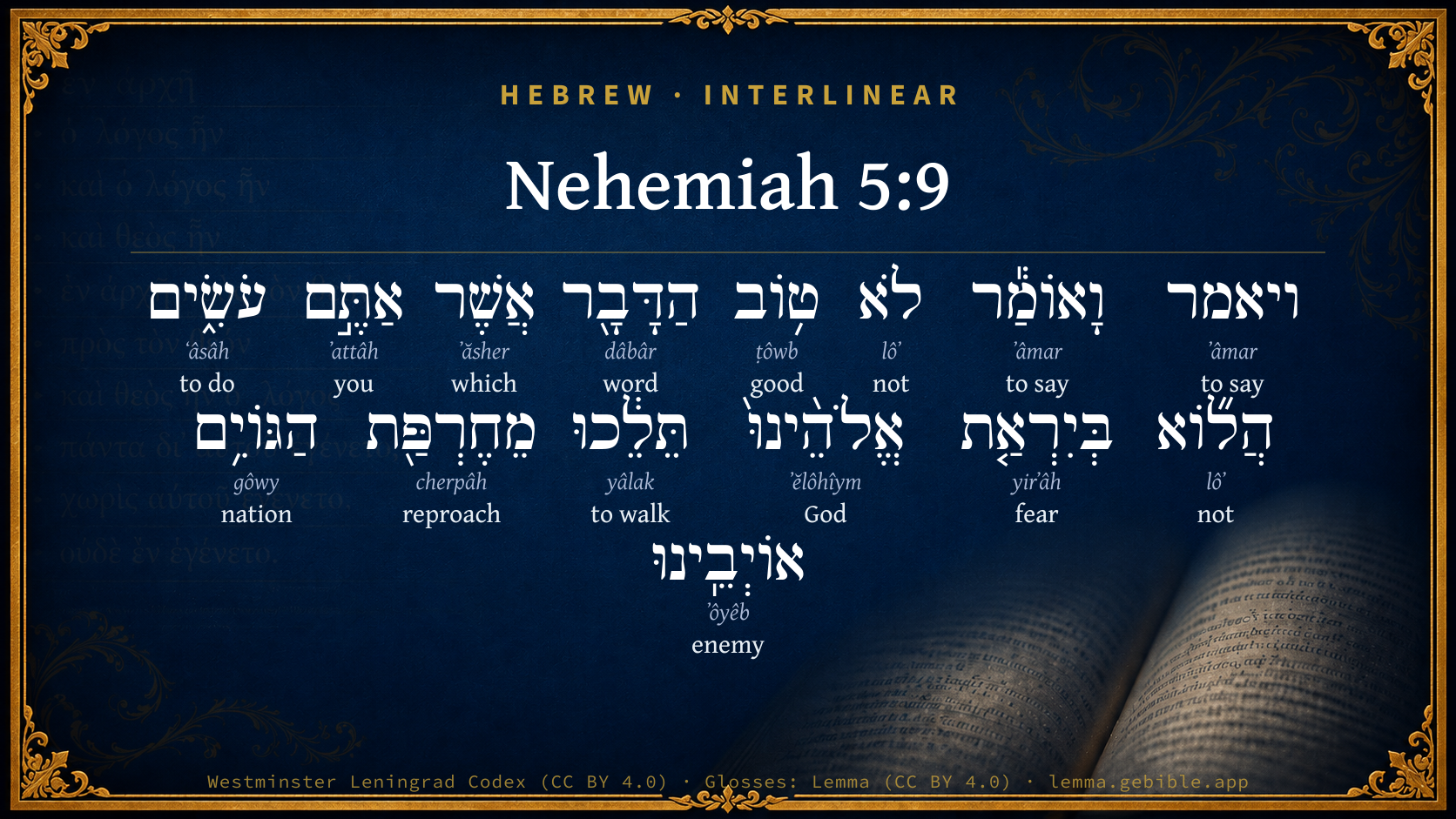
  1. ויאמר ʼâmar H559 “and · to say” Conjunction + Verb, Qal, Sequential Imperfect, 3rd Person, Masculine, Singular
  2. וָאוֹמַ֕ר ʼâmar H559 “and · to say” Conjunction + Verb, Qal, Sequential Imperfect, 1st Person, Common, Singular
  3. לֹא lôʼ H3808 “not” Particle, Negative
  4. ט֥וֹב ṭôwb H2896 “good” Adjective, Adjective, Masculine, Singular, Absolute
  5. הַדָּבָ֖ר dâbâr H1697 “the · word” Particle, Definite Article + Noun, Common, Masculine, Singular, Absolute
  6. אֲשֶׁר ʼăsher H834 “which” Particle, Relative
  7. אַתֶּ֣ם ʼattâh H859 “you” Pronoun, Personal, 2nd Person, Masculine, Plural
  8. עֹשִׂ֑ים ʻâsâh H6213 “doing” Verb, Qal, Participle Active, Masculine, Plural, Absolute
  9. הֲל֞וֹא lôʼ H3808 “not” Particle, Interrogative + Particle, Negative
  10. אֱלֹהֵ֨ינוּ֙ ʼĕlôhîym H430 “God(s) · our” Noun, Common, Masculine, Plural, Construct + Suffix, Personal, 1st Person, Common, Plural
  11. תֵּלֵ֔כוּ yâlak H3212 “to walk” Verb, Qal, Imperfect, 2nd Person, Masculine, Plural
  12. מֵחֶרְפַּ֖ת cherpâh H2781 “from · reproach of” Preposition + Noun, Common, Feminine, Singular, Construct
  13. הַגּוֹיִ֥ם gôwy H1471 “the · nations” Particle, Definite Article + Noun, Common, Masculine, Plural, Absolute
  14. אוֹיְבֵֽינוּ ʼôyêb H341 “enemy · us” Verb, Qal, Participle Active, Masculine, Plural, Construct + Suffix, Personal, 1st Person, Common, Plural

About this verse

These counts appear in no published source. They are computed here, from the morphology-tagged text and Lemma’s own curated glosses. What Lemma adds →

15
words
13
distinct lemmas
Historical
section

Shared distinctive vocabulary

בְּיִרְאַ֤ת fear H3374 occurs in 42 verses of the Hebrew Bible. Also found in:

Grammatical profile

  • 5 verbs
  • 5 nouns
  • 1 adjective
  • 1 pronoun
  • 3 particles

Verb forms

  • ויאמר Qal · Sequential Imperfect
  • וָאוֹמַ֕ר Qal · Sequential Imperfect
  • עֹשִׂ֑ים Qal · Participle Active
  • תֵּלֵ֔כוּ Qal · Imperfect
  • אוֹיְבֵֽינוּ Qal · Participle Active

Repetition

Words recur within this verse — often emphatic in Hebrew:

  • ויאמר to say H559 ×2
  • לֹא not H3808 ×2

Cross-references

18

Topical passages linked to Nehemiah 5:9 in the Treasury of Scripture Knowledge — connected by theme and wording, ordered by reader-vote popularity; previews shown in the World English Bible.

  • Leviticus 25:36 Take no interest from him or profit, but fear your God; that your brother may live among you.
  • 2 Samuel 12:14 However, because by this deed you have given great occasion to Yahweh's enemies to blaspheme, the child also who is born to you shall surely die."
  • Proverbs 18:5 To be partial to the faces of the wicked is not good, Nor to deprive the innocent of justice.
  • Romans 2:24 For "the name of God is blasphemed among the Gentiles because of you," just as it is written.
  • 1 Peter 2:12 having good behavior among the nations, so in that which they speak against you as evil-doers, they may by your good works, which they see, glorify God in the day of visitation.
  • Titus 2:5 to be sober-minded, chaste, workers at home, kind, being in subjection to their own husbands, that God's word may not be blasphemed.
  • Genesis 13:7–8 There was a strife between the herdsmen of Abram's cattle and the herdsmen of Lot's cattle: and the Canaanite and the Perizzite lived then in the land.
  • Genesis 20:11 Abraham said, "Because I thought, 'Surely the fear of God is not in this place. They will kill me for my wife's sake.'
  • Genesis 42:18 Joseph said to them the third day, "Do this, and live, for I fear God.
  • 1 Samuel 2:24 No, my sons; for it is no good report that I hear: you make Yahweh's people to disobey.
  • Nehemiah 4:4 Hear, our God; for we are despised: and turn back their reproach on their own head, and give them up for a spoil in a land of captivity;
  • Nehemiah 5:15 But the former governors who were before me were chargeable to the people, and took of them bread and wine, besides forty shekels of silver; yes, even their servants bore rule over the people: but I didn't do so, because of the fear of God.
  • Proverbs 16:29 A man of violence entices his neighbor, And leads him in a way that is not good.
  • Proverbs 17:26 Also to punish the righteous is not good, Nor to flog officials for their integrity.
  • Proverbs 19:2 It isn't good to have zeal without knowledge; Nor being hasty with one's feet and missing the way.
  • Proverbs 24:23 These also are sayings of the wise. To show partiality in judgment is not good.
  • Acts 9:31 So the assemblies throughout all Judea and Galilee and Samaria had peace, and were built up. They were multiplied, walking in the fear of the Lord and in the comfort of the Holy Spirit.
  • 1 Timothy 5:14 I desire therefore that the younger widows marry, bear children, rule the household, and give no occasion to the adversary for reviling.

Cross-references courtesy of OpenBible.info (CC BY 4.0).

Hebrew and Greek witnesses Masoretic Hebrew ↔ Greek Septuagint

The same verse in the two great witnesses to the Old Testament, shown verse-for-verse.

These are two independent witnesses, not word-aligned to each other, and the Septuagint is shown in lemma (dictionary) form.

Hebrew Nehemiah 5:9 Masoretic · Westminster Leningrad Codex

ויאמר וָאוֹמַ֕ר לֹא ט֥וֹב הַדָּבָ֖ר אֲשֶׁר אַתֶּ֣ם עֹשִׂ֑ים הֲל֞וֹא בְּיִרְאַ֤ת אֱלֹהֵ֨ינוּ֙ תֵּלֵ֔כוּ מֵחֶרְפַּ֖ת הַגּוֹיִ֥ם אוֹיְבֵֽינוּ

Also I said, The thing that you do is not good: ought you not to walk in the fear of our God, because of the reproach of the nations our enemies?

World English Bible · Public Domain

Greek LXX Structure differs

The Septuagint has no separate book of Nehemiah. Its Greek text is the second half of Esdras B (2 Esdras), chapters 11–23; Ezra is the first half (1–10).

A verse-for-verse comparison isn’t shown here because the chapters and verses don’t line up. Switch to the LXX edition with the MT / LXX toggle above to read the Greek directly.

On this verse, The Cambridge Bible for Schools and Colleges discusses the Septuagint’s reading. Read the note in Commentary ↓

Hebrew: Westminster Leningrad Codex (CC BY 4.0). Greek: Septuagint (public domain); English from a public-domain English Septuagint. How the Septuagint differs from the Hebrew →

Commentary

Notes on Nehemiah 5:9 from classic Christian and Jewish commentators (each source and its license shown beneath its notes). The classic Christian expositions comment on the surrounding passage and are grouped to its opening verse, so a note may address several verses; the Jewish commentaries on the Tanakh (Rashi and others) are per-verse, so they appear only where the commentator wrote on this verse.

Lemma curates 59 commentaries, every one of them public domain or Creative Commons licensed, each selected and text-cleaned for this edition rather than reprinted as found. About our sources →

Trapp's Complete Commentary

John Trapp

Neh 5:9 Also I said, It [is] not good that ye do: ought ye not to walk in the fear of our God because of the reproach of the heathen our enemies?

Ver. 9. Also I said, It is not good that ye do No oratory is so powerful as that of mildness. The drops that fall easily upon the corn ripen and fill the ear; when hasty showers lay all flat to the earth, without hope of recovery. Gregory hath observed, that they that could not be cured with strong potions have been recovered with warm water. Reprovers of others must deal warily, as bone-setters; and as we take a mote out of one’s eye.

Ought ye not to walk in the fear of our God] Which would have reined you in, and restrained you from such exorbitancies. Gen 42:18, You need not fear me, said Joseph to his brethren, for I fear God, and therefore dare do you no hurt. Ye shall not oppress one another; "but thou shalt fear thy God: for I am the Lord your God," Lev 25:17. And "will ye not tremble at my presence?" saith the Lord, Jer 5:22. "Tremble, thou earth, at the presence of the Lord, at the presence of the God of Jacob," Psa 114:7. Oppressors are called Canaanites, Hos 12:7. He is Canaan that is a mere natural man, utterly void of God’s holy fear, Eze 16:3, the balances of deceit are in his hand; be loveth to oppress. To him that is afflicted pity should be showed from his friend (as it should have been to these poor Jews from their hard-hearted countrymen and kinsmen), but he forsaketh the fear of the Almighty, and is therefore merciless.

Because of the reproach of the heathen our enemies?] Who watch for our halting more earnestly than a dog doth for a bone, and will be glad of any occasion to speak evil of us and of our religion, with, These are your professors, &c. You see what tyrants and tigers they are one to another. Hereby the banks of blasphemy will be broken down in them, to speak evil with open mouth of the name of God. And will ye trample upon that dear and dread name?

John Trapp, A Commentary or Exposition upon All the Books of the Old and New Testament (1647–1656) — public domain. Text from a community e-Sword module.

The Biblical Illustrator

Joseph S. Exell

Neh_5:9

Ought ye not to walk in the fear of our God, because of the reproach of the heathen our enemies?

Jealousy for the honour of God

There was much good sense and Christian wisdom in the reply which was once given to a dignitary of our Church by a simple rural pastor. The latter had said to the former, If you act so, what will the people say? The reply was, Do you care what the people say? The rejoinder of the plain man was, I care as little as any man what the people say; but I care a great deal what the people have a right to say. How just the distinction! Human opinion ought to have no weight with us when it contravenes duty; but it ought to weigh much with us when we incur its censure by the violation of duty. The ungodly will judge chiefly of Christianity by those who profess it, and be largely won or scandalised by the manner in which it is adorned or disgraced by them. (Hugh Stowell, M. A.)

The Biblical Illustrator, edited by Joseph S. Exell (c. 1880s–1900s) — public domain. Text from a community e-Sword module.

Joseph Benson's Commentary

Neh 5:9. It is not good that ye do — Though you get money by it, you contract guilt, and expose yourselves to the displeasure of God; ought ye not to walk in the fear of our God? — Certainly you ought, for you profess religion and relation to him; and if you do walk in his fear, you will neither be covetous of worldly gain, nor cruel toward your brethren. They that live in the fear of God, will not dare to do an ill thing. Because of the reproach of the heathen our enemies — Who are round about you, and are enemies to us, our God, and our religion. They observe all your actions, and will reproach both you for such barbarous usage of your brethren, and religion for your sakes.

Joseph Benson's Commentary on the Old and New Testaments (1811–1818) — public domain. Text from a community e-Sword module.

Tyndale Open Study Notes

Tyndale Open Resources

5:9 walk in the fear of our God: See Lev 25:35-43. • avoid being mocked: See also Neh 1:3; 2:19; 4:1-3.

Tyndale Open Study Notes — © Tyndale Open Resources, licensed CC BY-SA 4.0. Text via the HelloAO Bible API.

Geneva Bible (1599)

Geneva Bible translators

Who by this occasion will blaspheme the Name of God, seeing that our acts are no better than theirs.

Meaning, Nehemiah.

Geneva Bible (1599) marginal notes — public domain. Text via Bolls.life.

Adam Clarke's Commentary

Verse 9. Ought ye not to walk in the fear of our God] If ye wish to accredit that religion ye profess which comes from the God of justice and mercy; should you not, in the sight of the heathen, abstain from injustice and cruelty? Can they credit your profession, when they see such practices? The inconsistent conduct of some professors of religion does much harm in the Church of God.

Adam Clarke's Commentary on the Bible (1810–1826) — public domain. Text from a community e-Sword/MySword module.

Ellicott's Commentary for English Readers

(9) Because of the reproach.—The text of another strong argument used in the assembly. We learn in Nehemiah 6 how watchful the heathen were: all matters were reported to them, and every act of oppression would become a reproach against the God of the Jews.

A Bible Commentary for English Readers, edited by Charles John Ellicott (1878–1897) — public domain. Text from a community e-Sword module.

The Cambridge Bible for Schools and Colleges

gen. ed. J. J. S. Perowne

9. Also I said] ‘And I said.’ The C’thib in the Hebrew text (which is probably due to an error of transcription) gives the meaning ‘and it was said,’ i.e. by Nehemiah. The rendering ‘and I said’ follows the reading of the K’ri, LXX., Vulg.

It is not good that ye do] R.V. The thing that ye do Is not good. The R.V. rendering is in itself preferable to that of the A.V. In addition it enables the English reader to recognize the exact correspondence of this clause with words in Exo_18:17. The sentence is so simple that too much must not be made of the resemblance. But the supposition that Nehemiah’s words perhaps unconsciously repeated a familiar sentence from ‘the book of the law’ is not to be lightly dismissed. That the words of Jethro to Moses should be used by Nehemiah to the money-lenders indicates the courtesy of his expostulation. Fiercer language would have only exasperated them.

ought ye not, &c.] or ‘will ye, or should ye, not,’ &c.

walk in the fear of our God] This precise phrase does not, apparently, occur elsewhere in the O. T. It condenses the thought of Deu_10:12, ‘And now, Israel, what doth the Lord thy God require of thee, but to fear the Lord thy God, to walk in all his ways,’ (cf. Neh_8:6). We find it in the N. T. in Act_9:31, ‘The church … walking in the fear of the Lord and in the comfort of the Holy Ghost was multiplied.’ ‘The fear of God,’ cf. Neh_5:15. ‘The fear of the Lord’ is the usual expression, espec. in Pss. and Prov. ‘The fear of God,’ cf. Gen_20:11; 2Sa_23:3; 2Ch_26:5, R.V. Marg. The fear of God’s hatred of oppression should be before the eyes of all. Cf. Pro_14:31, ‘He that oppresseth the poor reproacheth his Maker.’

because of the reproach of the heathen our enemies] Though the general sense is obvious, there is some uncertainty as to the exact shade of meaning to be attached to these words. (1) It may mean ‘on account of the reproach wherewith our enemies have reproached us; since, so long as we have not walked in the fear of our God, we have been feeble and weak and have deserved the reproach of our enemies. If we walk in His fear, He will bless us and remove the cause of their reproach.’ Cf. chap. Neh_4:4. (2) It may mean ‘for fear of incurring the just reproach of our enemies,’ seeing that, if they hear of your cruel and ungenerous action to your brethren, they will have good cause to rebuke and ridicule our people. Cf. Neh_6:13.

‘the heathen our enemies.’ On ‘the heathen’ see Neh_5:8. The two words are only here combined in these books. For ‘our enemies’ cf. Neh_4:15, Neh_6:1; Neh_6:16. For the general meaning see 2Sa_12:14, ‘thou hast given great occasion to the enemies of the Lord to blaspheme.’ Cf. Isa_52:5.

The Cambridge Bible for Schools and Colleges (gen. ed. J. J. S. Perowne; Cambridge University Press, 1878–1918) — public domain. Text from a community e-Sword module.

John Gill's Exposition

I likewise, and my brethren, and my servants, might exact of them money and corn,.... For our maintenance, in consideration of the services done by us, which would appear but reasonable, but this we decline for the sake of easing our poor brethren:

I pray you let us leave off this usury; and not exact it, as has been too much and too long used.

John Gill's Exposition of the Whole Bible (1746–1763) — public domain (CC PDM 1.0). Text via the HelloAO Bible API.

Matthew Poole's English Annotations

It is not good, i. e. it is a very bad and wicked thing; as this same phrase is used, Pro 16:29; 17:26; 18:5; 19:2. A common figure, called meiosis, where more is understood than is expressed.

Because of the reproach of the heathen our enemies; who are round about you, and observe all your actions, and will loath and reproach both you for such barbarous usage of your brethren, and religion for your sakes; which, if you have any love or respect either to God or to yourselves, you will prevent.

Matthew Poole's English Annotations on the Holy Bible (1683–1685) — public domain. Text from a community e-Sword/MySword module.

Whedon's Commentary on the Bible

Daniel D. Whedon

9. Walk in the fear of our God — Have all your conduct show reverence for God, and fear to break his laws.

Because of the reproach of the heathen — That is, lest ye make yourselves an occasion of reproach among the heathen, and they say: These Jews despise their own laws by oppressing their own brethren.

Daniel D. Whedon (gen. ed.), Commentary on the Old and New Testaments (1874–1909) — public domain. Text from a community e-Sword module.

The Pulpit Commentary

Also I said. To silence the nobles was not enough. To shame them was not enough. What was wanted was to persuade them. Nehemiah therefore continued his address. It is not good that ye do. It is not good in itself, apart from any contrast with what I have been doing. Ought ye not to walk or, literally, "will ye not walkin the fear of our God? Will ye not really, "fear God and keep his commandments, not in the letter only, but in the spirit? Will ye not cease to oppress your brethren? Will ye not deal kindly and gently with them? Because of the reproach of the heathen our enemies. If the mere fear of God, the desire to escape his displeasure and win his approval, is not enough, will not the thought of the light in which you will appear to the heathen influence you? You make a profession of religion; you claim to be actuated by high motives; to be merciful, compassionate, and self-denying. If they see you as keen after gain as any of themselves, as regardless of others, as pitiless and oppressive, what a reproach will not this bring on your religion! What a proof will it not seem to be that you are no better than your neighbours, and your religion, therefore, no whit superior to theirs!

Avoidance of reproach.

"Ought ye not to walk?" etc. The "reproach" spoken of here is supposed by some to be that arising from the feeble condition of the Jews, which the conduct of these extortioners was likely to perpetuate and increase. Better, however, to interpret it of the just reproach which such conduct would occasion.

I REPROACHES OF MEN WHICH ARE NOT TO BE REGARDED. Those which are directed against

1. The Christian faith.

2. Christian confession. The bold acknowledgment of Christ.

3. Christian life and work. "Fear ye not the reproach of men," etc.. (Isa_51:7. See also Rom_15:3 Heb_11:26)

II REPROACHES THAT SHOULD BE REGARDED. Those which are directed against manifest inconsistencies between our faith and our life, our professions and our practices. Men of the world can understand our religion sufficiently to discern wherein we fail. Their judgment of some things in our conduct may be just, and is then fitted to quicken our consciences and lead us to improvement. "Fas est et ab hoste doceri." We should be careful not to give just "occasion to the enemies of the Lord to blaspheme," for the sake of the credit of religion, the good of enemies themselves, and of other men who may be well disposed, but to whom our inconsistencies are a stumbling-block. Amongst the occasions of just reproach may be named

1. Untruthfulness and dishonesty in worldly transactions.

2. Insincerity and cant in religious utterances.

3. Selfishness and self-indulgence.

4. Dissension and contention among Christians.

5. Censoriousness.

6. Gloominess. As contrasted with our representations of the happiness of religion.

7. Worldly ambition or policy in Church life and work.

III THE SUREST WAY TO AVOID JUST REPROACH. "Ought ye not to walk in the fear of God." Genuine, habitual piety, actuating our whole life, will produce such fruits as will commend themselves even to the irreligious who are not malignant foes of what is good, and "put to silence the ignorance of foolish men." Thus fearing God we shall not need to be much concerned about the judgment of men. Finally, those who reproach Christians with their inconsistencies condemn themselves. The light by which they do so reveals their own duty. They are as really bound to be genuine and consistent Christians as those whom they reproach. The obligation to piety and goodness does not spring from the profession of religion, though this may add strength to it; it rests on all to whom the gospel is known, and if you know enough to condemn others, you know enough to teach you what you ought to be, and to leave you without excuse.

The Pulpit Commentary (1880–1919), ed. H.D.M. Spence-Jones & Joseph S. Exell — public domain. Text from a community e-Sword module.

John Wesley's Explanatory Notes

Reproach - Who are round about you, and observe all your actions, and will reproach both you for such barbarous usage of your brethren, and religion for your sakes.

John Wesley, Explanatory Notes Upon the Whole Bible (1754–1765) — public domain. Text via the GEBible commentary corpus.

unfoldingWord translationNotes

Door43 World Missions Community

Also I said

The pronoun "I" refers to Nehemiah.

What you are doing

"You" here refers to the Jewish nobles.

Should you not walk in the fear of our God to prevent the taunts of the nations that are our enemies?

This is a rhetorical question that Nehemiah is using to scold the nobles. It can be translated as a statement. AT: "You should walk in the fear of our God to prevent the taunts of the nations that are our enemies." (See: Rhetorical Question)

walk in the fear of our God

This is and idiom. Here "walk" refers to a person's behavior and the way he lives. AT: "live your life in a way that honors God" (See: Idiom)

the taunts of the nations that are our enemies

The word "taunt" means "slander" or "mockery" and it can be expressed as a verb. AT: "the nations who are our enemies from taunting us" or "the enemy nations from mocking us" (See: Abstract Nouns)

lending

borrowing or giving something to someone expecting repayment

loans

This is any money, food, or property that one person could let another person borrow in order to repay debts. The borrower would then be indebted to the lender.

percentage

A part of the value of the loan that the borrower was charged in interest.

you exacted from them

"you charged them" or "you made them pay"

translationWords

good

walk

fear

God

nation

adversary

brother

servant

vineyard

olive

grain

wine

oil

unfoldingWord translationNotes — © Distant Shores Media and the Door43 World Missions Community, licensed CC BY-SA 4.0. Source: git.door43.org/Door43/en_tn.

Rashi

Rabbi Shlomo Yitzchaki (Rashi)

The thing...is not good The thing is evil in the eyes of the Holy One, blessed be He.

because of the reproach because of the reproach of the heathens who are our enemies.

Rashi on the Tanakh — English translations: “The Judaica Press complete Tanach with Rashi, translated by A. J. Rosenberg” (CC BY 4.0); “Pentateuch with Rashi's commentary by M. Rosenbaum and A.M. Silbermann, 1929-1934” (public domain); “The Metsudah Tanach series, Lakewood, N.J” (CC BY 4.0); and “The Book of Joshua, Metsudah Publications, 1997” (CC BY 4.0). Text via Sefaria.

Lesson kit

Teaching starters — assembled from the data on this page, not authored interpretation. Every prompt links to the verse data it draws on. Edit before teaching.

Nehemiah, in the Historical, opens this verse with 15 words (13 distinct Hebrew lemmas). Its most distinctive word is yirʼâh (“fear”). A historical commentator’s framing appears above. Read the whole chapter for the surrounding context.

Discussion questions

  1. The word yirʼâh carries the sense “fear.” How does it shape the verse?
  2. How does Genesis 20:11, which shares the word «fear», read alongside this verse?
  3. What does the repetition of “to say” (2× in this one verse) do in this verse?
  4. These translations render this verse differently. What is at stake in choosing one wording over another?
  5. «ויאמר» is a Qal Sequential Imperfect verb. How does that grammatical form shape the action described?
  6. Compare how Trapp's Complete Commentary and The Biblical Illustrator read this verse. Where do they agree or differ?

Things to notice

Reading settings

Reading text

Shown beneath each verse's original-language words.

Old Testament
Old Testament edition

Read the OT as the Masoretic Hebrew (MT) or the Greek Septuagint (LXX).

English shown for the Greek Septuagint (in the Hebrew ↔ Greek comparison).

Comparing translations? Open the Compare panel on any verse page to stack up to four side by side.