
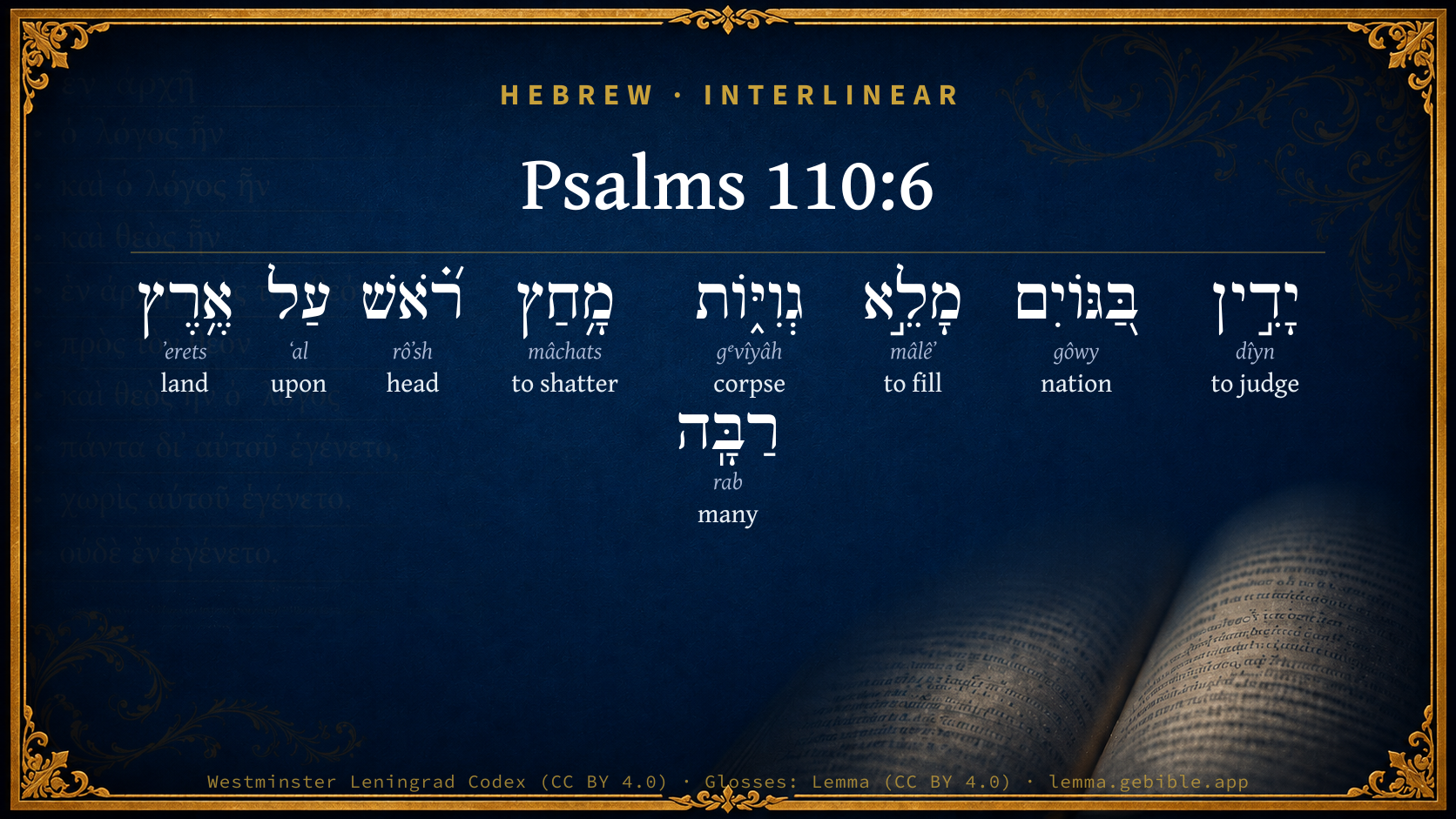
Psalms 110:6

Hebrew (Westminster Leningrad Codex) Psalms 110:6 appears in the Hebrew Old Testament. The text above is from the Westminster Leningrad Codex. Each word links to its Strong’s number, a concise gloss, and parsing drawn from the Open Scriptures Hebrew Bible morphology. Click any word for its full Brown-Driver-Briggs (BDB) entry.
Download image
Cite this verse

Psalms 110:6 (World English Bible). Public Domain. Lemma interlinear Bible study tool, https://lemma.gebible.app/v/psalms/110/6.

Show BibTeX & RIS
BibTeX
RIS
English Translation
He will judge among the nations. He will heap up dead bodies. He will crush the ruler of the whole earth.
World English Bible · Public Domain
Download a study sheet

One document with this verse’s original text, its word-by-word gloss line, the meaning frame, cross-references with their text, attributed commentary, and full source and license credits — printable, and it pastes into notes with its structure intact.

This verse Autodidact and up

Study sheet (.html) Plain text (.txt)

A passage Seminary Student

Up to 50 verses in one chapter. A passage sheet keeps up to 6 commentary sources and 12 cross-references per verse, in the order this page ranks them, and says so on the sheet whenever that leaves anything out. Ask for a single verse and you get the Autodidact verse sheet above.

Everything on this page stays free to read, with no account — the sheet is a download of what is already on screen, not access to it.

Want to remove ads? Support Godless Engineer
Compare translations 3

The same verse in 3 English versions, stacked beneath the original-language interlinear above. Click any original word for its lexicon entry.

Each is an independent rendering of the whole verse — the interlinear is not word-aligned to these translations.

Highlighted words mark where these versions differ — a whole-verse word diff, not a word-by-word alignment.

  • World English Bible Public Domain
    He will judge among the nations. He will heap up dead bodies. He will crush the ruler of the whole earth.
  • King James Version Public Domain
    He shall judge among the heathen, he shall fill the places with the dead bodies; he shall wound the heads over many countries.
  • unfoldingWord Literal Text CC BY-SA 4.0
    He will judge the nations; he fills bodies, he crushes the head, upon abundant land.

unfoldingWord Literal Text — © unfoldingWord, licensed CC BY-SA 4.0. Word-aligned USFM3 via Door43 (git.door43.org/unfoldingWord/en_ult).

Versions to compare (up to 4)

3 of 4 selected

Show all 18 translations

Every available English version of this verse, each an independent rendering of the whole verse.

  • World English Bible Public Domain
    He will judge among the nations. He will heap up dead bodies. He will crush the ruler of the whole earth.
  • Berean Standard Bible Public Domain
    He will judge the nations, heaping up the dead; He will crush the leaders far and wide.
  • Majority Standard Bible Public Domain
    He will judge the nations, heaping up the dead; He will crush the leaders far and wide.
  • King James Version Public Domain
    He shall judge among the heathen, he shall fill the places with the dead bodies; he shall wound the heads over many countries.
  • American Standard Version (1901) Public Domain
    He will judge among the nations, He will fill `the places' with dead bodies; He will strike through the head in many countries.
  • Revised Version (1885) Public Domain
    He shall judge among the nations, he shall fill the places with dead bodies; he shall strike through the head in many countries.
  • Geneva Bible (1599) Public Domain
    He shalbe iudge among the heathen: he shall fill all with dead bodies, and smite the head ouer great countreis.
  • Douay-Rheims (1899) Public Domain
    He shall judge among nations, he shall fill ruins: he shall crush the heads in the land of the many.
  • Young's Literal Translation Public Domain
    He doth judge among the nations, He hath completed the carcases, Hath smitten the head over the mighty earth.
  • Literal Standard Version CC BY-SA 4.0
    He judges among the nations, || He has completed the carcasses, || Has struck the head over the mighty earth.
  • Unlocked Literal Bible CC BY-SA 4.0
    He will judge the nations; he will fill the battlegrounds with dead bodies; he will kill the leaders in many countries.
  • unfoldingWord Literal Text CC BY-SA 4.0
    He will judge the nations; he fills bodies, he crushes the head, upon abundant land.
  • Darby Bible Public Domain
    He shall judge among the nations; he shall fill [all places] with dead bodies; he shall smite through the head over a great country.
  • World Messianic Bible Public Domain
    He will judge among the nations. He will heap up dead bodies. He will crush the ruler of the whole earth.
  • Webster's Bible Public Domain
    He will judge among the heathen, he will fill the places with the dead bodies; he will wound the heads over many countries.
  • Free Bible Version CC BY-SA 4.0
    He will execute judgment on the nations, filling their lands with corpses. He will strike down those who rule all over the earth.
  • Bible in Basic English Public Domain
    He will be judge among the nations, the valleys will be full of dead bodies; the head over a great country will be wounded by him.
  • JPS Tanakh (1917) Public Domain
    He will judge among the nations; He filleth it with dead bodies, He crusheth the head over a wide land.

Literal Standard Version (2020), Covenant Press — licensed CC BY-SA 4.0. Text via the HelloAO Bible API (eBible.org). Unlocked Literal Bible (unfoldingWord) — licensed CC BY-SA 4.0. Text via the HelloAO Bible API (eBible.org). unfoldingWord Literal Text — © unfoldingWord, licensed CC BY-SA 4.0. Word-aligned USFM3 via Door43 (git.door43.org/unfoldingWord/en_ult). Free Bible Version, Dr. Jonathan Gallagher — licensed CC BY-SA 4.0. Text via the HelloAO Bible API (eBible.org).

Word by word

More ways to search: Search by grammar → Find every occurrence → Compare this word →

Practice this passage: Drill this verse → Learn its vocabulary →

About this verse

These counts appear in no published source. They are computed here, from the morphology-tagged text and Lemma’s own curated glosses. What Lemma adds →

9
words
9
distinct lemmas
Wisdom
section

Notable vocabulary

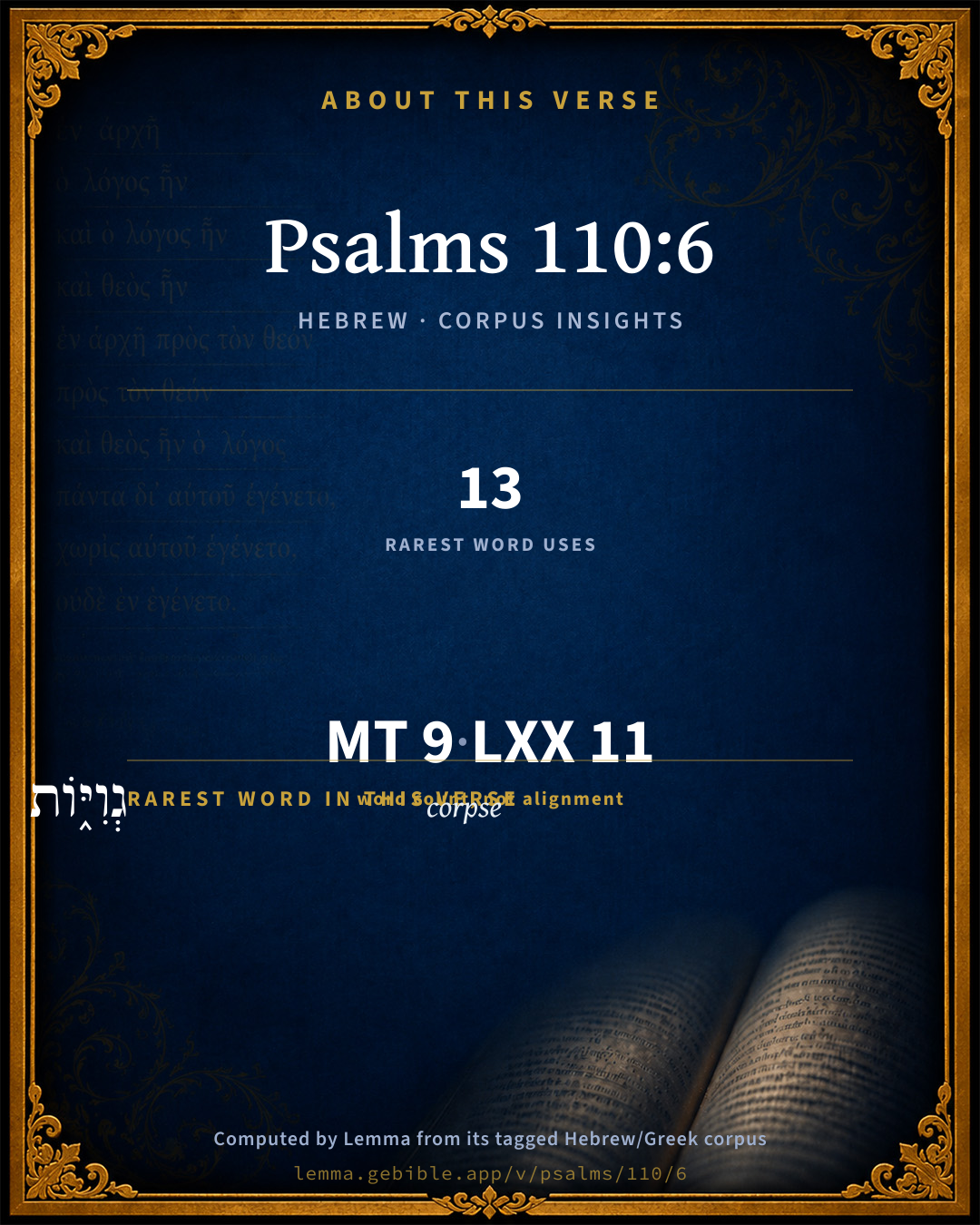
The rarest word here is גְוִיּ֑וֹת corpse H1472 — appearing just 13 times in the whole Hebrew Bible.

Shared distinctive vocabulary

גְוִיּ֑וֹת corpse H1472 occurs in 11 verses of the Hebrew Bible. Also found in:

Grammatical profile

  • 3 verbs
  • 4 nouns
  • 1 adjective
  • 1 preposition

Verb forms

  • יָדִ֣ין Qal · Imperfect
  • מָלֵ֣א Qal · Perfect
  • מָ֥חַץ Qal · Perfect

Hebrew & Septuagint length

In English translation the verse runs 21 words from the Hebrew and 24 from the Septuagint (LXX English) — closely comparable.

A rough comparison of the two English renderings, which tokenize alike — not a word-level alignment.

Word counts can differ between the Hebrew and the Greek without any difference in meaning — e.g. the Hebrew direct-object marker אֵת has no separate Greek word, and Greek often adds the article ὁ.

In the original languages it is 9 Hebrew tokens and 11 Greek tokens — but the two are counted differently (Hebrew bundles its prefixes and suffixes into one token; the Greek is in lemma form), so that isn’t a like-for-like length.

Cross-references

21

Topical passages linked to Psalms 110:6 in the Treasury of Scripture Knowledge — connected by theme and wording, ordered by reader-vote popularity; previews shown in the World English Bible.

  • Psalms 68:21 But God will strike through the head of his enemies, The hairy scalp of such a one as still continues in his guiltiness.
  • Isaiah 2:4 He will judge between the nations, And will decide concerning many peoples; And they shall beat their swords into plowshares, And their spears into pruning-hooks. Nation shall not lift up sword against nation, Neither shall they learn war any more.
  • Micah 4:3 And he will judge between many peoples, And will decide concerning strong nations afar off. They will beat their swords into plowshares, And their spears into pruning hooks. Nation will not lift up sword against nation, Neither will they learn war any more.
  • John 5:22 For the Father judges no one, but he has given all judgment to the Son,
  • Revelation 19:11 I saw the heaven opened, and behold, a white horse, and he who sat on it is called Faithful and True. In righteousness he judges and makes war.
  • Isaiah 42:4 He will not fail nor be discouraged, until he have set justice in the earth; and the isles shall wait for his law.
  • Revelation 14:20 The winepress was trodden outside of the city, and blood came out from the winepress, even to the bridles of the horses, as far as one thousand six hundred stadia.
  • Genesis 3:15 I will put enmity between you and the woman, and between your offspring and her offspring. He will bruise your head, and you will bruise his heel."
  • 1 Samuel 2:10 Those who strive with Yahweh shall be broken to pieces; Against them will he thunder in the sky: Yahweh will judge the ends of the earth; He will give strength to his king, Exalt the horn of his anointed.
  • Isaiah 11:3 His delight shall be in the fear of Yahweh; and he shall not judge after the sight of his eyes, neither decide after the hearing of his ears;
  • Isaiah 34:2–8 For Yahweh has indignation against all the nations, and wrath against all their host: he has utterly destroyed them, he has delivered them to the slaughter.
  • Isaiah 42:1 Behold, my servant, whom I uphold; my chosen, in whom my soul delights: I have put my Spirit on him; he will bring forth justice to the Gentiles.
  • Isaiah 43:2–4 When you pass through the waters, I will be with you; and through the rivers, they shall not overflow you: when you walk through the fire, you shall not be burned, neither shall the flame kindle on you.
  • Isaiah 51:5 My righteousness is near, my salvation is gone forth, and my arms shall judge the peoples; the isles shall wait for me, and on my arm shall they trust.
  • Isaiah 66:16–17 For by fire will Yahweh execute judgment, and by his sword, on all flesh; and the slain of Yahweh shall be many.
  • Isaiah 66:24 They shall go forth, and look on the dead bodies of the men who have transgressed against me: for their worm shall not die, neither shall their fire be quenched; and they shall be an abhorring to all flesh.
  • Ezekiel 38:21–22 I will call for a sword against him to all my mountains, says the Lord Yahweh: every man's sword shall be against his brother.
  • Ezekiel 39:4 You shall fall on the mountains of Israel, you, and all your hordes, and the peoples who are with you: I will give you to the ravenous birds of every sort, and to the animals of the field to be devoured.
  • Ezekiel 39:11–20 It shall happen in that day, that I will give to Gog a place for burial in Israel, the valley of those who pass through on the east of the sea; and it shall stop those who pass through: and there shall they bury Gog and all his multitude; and they shall call it The valley of Hamon Gog.
  • Joel 3:12–16 "Let the nations arouse themselves, And come up to the valley of Jehoshaphat; For there will I sit to judge all the surrounding nations.
  • Habakkuk 3:13 You went forth for the salvation of your people, For the salvation of your anointed. You crushed the head of the land of wickedness. You stripped them head to foot. Selah.

Cross-references courtesy of OpenBible.info (CC BY 4.0).

Hebrew and Greek witnesses Masoretic Hebrew ↔ Greek Septuagint

The same verse in the two great witnesses to the Old Testament, shown verse-for-verse.

You’re reading Greek Psalm 109 (Hebrew Psalm 110). The Septuagint counts the superscription, so verse numbers can differ from the Hebrew — chapter-level alignment, not verse-by-verse. Numbering follows Rahlfs.

These are two independent witnesses, not word-aligned to each other, and the Septuagint is shown in lemma (dictionary) form.

Hebrew Psalms 110:6 Masoretic · Westminster Leningrad Codex

יָדִ֣ין בַּ֭גּוֹיִם מָלֵ֣א גְוִיּ֑וֹת מָ֥חַץ רֹ֝֗אשׁ עַל אֶ֥רֶץ רַבָּֽה

He will judge among the nations. He will heap up dead bodies. He will crush the ruler of the whole earth.

World English Bible · Public Domain

Greek LXX Greek Psalm 109:6 Septuagint · lemma form

κρίνω ἐν ὁ ἔθνος πληρόω πτῶμα συνθλάω κεφαλή ἐπί γῆ πολύς

He shall judge among the nations, he shall fill up the number of corpses, he shall crush the heads of many on the earth.

LXX2012 (modern English Septuagint) · Public Domain

Hebrew: Westminster Leningrad Codex (CC BY 4.0). Greek: Septuagint (public domain); English from LXX2012 (modern English Septuagint) (Public Domain). How the Septuagint differs from the Hebrew →

Commentary

Notes on Psalms 110:6 from classic Christian and Jewish commentators (each source and its license shown beneath its notes). The classic Christian expositions comment on the surrounding passage and are grouped to its opening verse, so a note may address several verses; the Jewish commentaries on the Tanakh (Rashi and others) are per-verse, so they appear only where the commentator wrote on this verse.

Lemma curates 59 commentaries, every one of them public domain or Creative Commons licensed, each selected and text-cleaned for this edition rather than reprinted as found. About our sources →

Trapp's Complete Commentary

John Trapp

Psa 110:6 He shall judge among the heathen, he shall fill [the places] with the dead bodies; he shall wound the heads over many countries.

Ver. 6. He shall judge among the heathen] Do execution upon his enemies, as Psa 110:1, whether kings or commoners.

He shall fill the places] The ditches of their own camps.

He shall wound the heads] Heb. head; cruentabit caput, whereby some understand the Roman empire, with its image, antichrist with his adherents, who are called heathens, Rev 11:2. Others, Turks and Saracens, reading the next words, Over the land of Rabbah, the chief city of the Ammonites, who were likewise Arabians; and so they make it an allusion to David’s victories over the Ammonites, 2Sa 10:6-19; 2Sa 12:26-31

John Trapp, A Commentary or Exposition upon All the Books of the Old and New Testament (1647–1656) — public domain. Text from a community e-Sword module.

Joseph Benson's Commentary

Psa 110:6. He shall judge among the heathen — Shall demonstrate himself to all the heathen world to be their lawgiver and judge, and shall condemn and punish those that reject his salvation, and disobey his laws, rendering indignation and wrath, tribulation and anguish unto all that refuse to obey the truth, but obey unrighteousness, Rom 2:8-9. He shall fill the places with the dead bodies — Of his enemies, or of those powers whom he shall strike through in the day of his wrath; and he shall wound the heads — The principals, or rulers, over, or of, many countries — That is, the Roman emperors themselves, who shall then rule over the greatest part of the world, or all those princes who oppose him. The reader will easily discern that the psalmist here describes the exercise of Christ’s regal power and supreme dominion; his conquest over sin and sinners, and over all the opposition of the powers of darkness, in metaphorical expressions, taken from earthly conquests; and that this, and the like passages, are not to be understood literally and grossly, but figuratively and spiritually, according to the nature of Christ’s kingdom.

Joseph Benson's Commentary on the Old and New Testaments (1811–1818) — public domain. Text from a community e-Sword module.

J. A. Alexander on Psalms

Joseph Addison Alexander

6. (Psa 110:6) He will judge among the nations—he has filled (them) with corpses—he has smitten the head over much, land (or over the wide earth). By another sudden change of form, the Messiah is again spoken of as a third person. The judgment here ascribed to him is only another name and figure for the conquest just described. The form of expression in the last clause is unusual and obscure. The common version makes both head and land collectives, the heads over many countries. Some interpreters explain the second word in this way, but the first more strictly, as. denoting a single ruler over many countries. Others invert the torms, and understand by head the various chiefs of nations, but by earth the whole earth with its qualifying epithet of great or wide. Amidst these questions of construction or minute interpretation, the general idea is clear enough, to wit, that of universal conquest on the part of the Messiah, and extending to all earthly principalities and powers.

Joseph Addison Alexander, The Psalms Translated and Explained (1850) — public domain. Text from a community e-Sword module.

Geneva Bible (1599)

Geneva Bible translators

No power shall be able to resist him.

Geneva Bible (1599) marginal notes — public domain. Text via Bolls.life.

Adam Clarke's Commentary

Verse 6. He shall judge among the heathen] David shall greatly extend his dominion, and rule over the Idumeans, Moabites, Philistines, c.

He shall fill-with the dead bodies] He shall fill pits - make heaps of slain there shall be an immense slaughter among his enemies.

He shall wound the heads] He shall so bring down the power of all the neighbouring kings, as to cause them to acknowledge him as their lord, and pay him tribute.

Adam Clarke's Commentary on the Bible (1810–1826) — public domain. Text from a community e-Sword/MySword module.

Ellicott's Commentary for English Readers

(6) He shall judge.—Comp. Psa_9:8, &c.

He shall fill.—The construction is peculiar, and in the Hebrew for heathen and corpses there is a play on words. A slight change in the vowel pointing gives a better construction than is obtained by understanding any word as the Authorised Version does, and critics generally: He judges among the heathen fulness of corpses. At first the poet meant to write, “He judges among the heathen fulness of judgment” (comp. Job_36:17), but, for the sake of the play on the sound, changed his words to “fulness of corpses.”

He shall wound the heads.—Literally, crushes a head over a vast land, where “head” means, as in Jdg_7:16; Jdg_7:20, a band or host of men. The picture is of a vast battle-field with heaps of slain. Others understand, “the chief or master of a wide land.” (Comp. Hab_3:14, “head of his villages.”)

A Bible Commentary for English Readers, edited by Charles John Ellicott (1878–1897) — public domain. Text from a community e-Sword module.

The Cambridge Bible for Schools and Colleges

gen. ed. J. J. S. Perowne

6. He shall judge among the nations] The subject of the sentence must be Jehovah. Cp. Psa_7:8; Psa_9:8; Psa_76:9. The nations are the enemies of Psa_110:2. On them He will execute judgement, vindicating the cause of His king and people.

he shall fill (the battle-field) with corpses] This is on the whole the best rendering of an obscurely brief phrase. The tense is, as before, a prophetic perfect.

he shall shatter the heads over many countries] i.e. their rulers. But the usage of the phrase in Psa_68:21, Hab_3:13, points rather to the rendering, he shall shatter the head (of his enemies) over (all) the wide earth. The earth is the battle-field whereon He deals deadly blows upon all His enemies. Delitzsch and others think that the last words may also be rendered the land of Rabbah, and may contain at least an allusive reference to David’s conquest of the Ammonite capital (2Sa_12:26 ff.).

The Cambridge Bible for Schools and Colleges (gen. ed. J. J. S. Perowne; Cambridge University Press, 1878–1918) — public domain. Text from a community e-Sword module.

John Gill's Exposition

He shall judge among the Heathen,.... Either rule among the Gentiles, making them through his Gospel obedient by word and deed, and so reigning in their hearts by his Spirit and grace; and, by making many converts among them, enlarge his dominion from sea to sea, and from the river to the ends of the earth: or inflict judgments on the Heathen; that is, the Papists, as they are called. These are the Gentiles to whom the outward court is given; the nations that will be angry when the time of his wrath, and to judge the dead, is come; and whom Christ will break in pieces with his iron rod; and are the Heathen that shall perish out of his land, when he is King over all the earth, Rev 11:2.

He shall fill the places with the dead bodies: the Targum adds,

"of the ungodly that are slain;''

namely, at the battle of Armageddon; when the fowls of the air shall be called to eat the flesh of kings, captains, and mighty men; of horses and their riders; of all men, bond and free, great and small, Rev 19:17.

He shall wound the heads over many countries; that is, kings over many countries; as the Targum explains it: it is to be read in the singular number, "he shall wound the heads over a large country" (c); him who is the head over a large country; meaning either Satan, the god of this world, the wicked one, under whom the world lies; and who has deceived the inhabitants of the earth, and rules them at his pleasure; him Christ has wounded and bruised, even his head; destroyed him and all his power, policy, schemes, and works, agreeably to the first hint concerning him, Gen 3:15 or else antichrist, who is head over a large country, or many countries; the whore that sits on many waters, which are people, nations, and tongues, and reigns over the kings of the earth; who has seven heads and ten horns; one of whose heads has been wounded already, of which it has been curing again; but ere long this beast will receive such a wound from Christ, as that he will never recover of it; when he shall consume him with the breath of his mouth, and the brightness of his coming; see Rev 17:2, Th2 2:8. Musculus renders it, "the head of the country of Rabbah": and refers it to David's conquest of the king of the Ammonites, whose head city was Rabbah, Ch1 20:1.

(c) "caput super terram multam", Pagninus, Montanus; "vel amplam", Piscator, Coceius; so Gejerus & Michaelis.

John Gill's Exposition of the Whole Bible (1746–1763) — public domain (CC PDM 1.0). Text via the HelloAO Bible API.

Albert Barnes' Notes on the Bible

He shall judge among the heathen - Among the “nations.” That is, he shall set up a kingdom, or shall rule over the nations of the earth. He shall come to execute judgment and justice, and shall apportion to people what is due to them. See the notes at Isa 11:3-5.

He shall fill the places with the dead bodies - He shall make a great slaughter - indicative of conquest, and of the subjugation of the world to himself. It would be “as if” the bodies of the slain in battle strewed the ground, or filled the valleys of the earth.

He shall wound the heads - The same word is used here that occurs in the previous verse, and that is there rendered “shall strike.” It is the language of “conquest,” as if the world was to be subdued to himself by war.

Over many countries - Margin, “great.” Over vast and extensive regions, carrying his conquests into distant lands. This will be fulfilled only when all the earth shall be subject to the reign of the Messiah. 1Co 15:24-28.

Albert Barnes' Notes on the Bible (1834–1885) — public domain. Text from a community e-Sword/MySword module.

Matthew Poole's English Annotations

Shall judge; either,

1. Conquer and govern them; or rather,

2. Condemn and punish them, as it is explained in the following clauses, and as this word is used, Gen 15:14; Rom 2:1,2; 1Pe 4:6, and elsewhere.

The places; or, the place of battle, which is necessarily supposed in the fight, and therefore may very well be understood. Dead bodies of his enemies, slain by his hand, and lying in the field in great numbers and heaps, and that unburied, to their greater infamy.

Shall wound the heads, Heb. the head; which may be understood, either,

1. Of some one person and eminent adversary of Christ, and of his kingdom; either the devil, by comparing this with Gen 3:15; Heb 2:14, who was indeed the head or ruler of many countries, and indeed of all nations, except that of Israel; or the Roman empire, which was the great enemy and obstructer of Christ’s kingdom, and therefore was to be destroyed by him, as is declared, Dan 2:44,45; 7:7, &c.; or the great antichrist, or the beast after which the whole world wondered, Rev 13:3, which Christ will destroy, as we read, 2Th 2:8, and in divers places of St. John’s Revelation. Or,

2. Of all those heads or princes which opposed him; the singular number head being here put collectively for heads, as is very usual in the Hebrew tongue and text; and so the meaning is, that none of Christ’s enemies, though never so many or great, and their empire be never so large and potent, shall be able to withstand his force, or escape out of his hand; and that he shall not only destroy the common soldiers, but also their greatest commanders and princes, who in such cases do frequently make their escape. But this and the other like passages, both here and in the prophets, are not to be understood grossly and carnally, but spiritually, according to the nature of Christ’s kingdom, the weapons of Christ’s warfare, by which he accomplished his great works, being spiritual; and therefore such must be his battles and judgments, as is evident from many other scriptures, although these also are followed many times with temporal plagues.

Matthew Poole's English Annotations on the Holy Bible (1683–1685) — public domain. Text from a community e-Sword/MySword module.

The Treasury of David

Charles H. Spurgeon

Ver. 6. He shall judge among the heathen, or, among the nations. All nations shall feel his power, and either yield to it joyfully or be crushed before it.

He shall fill the places with the dead bodies. In the terrible battles of his gospel all opponents shall fall till the field of fight is heaped high with the slain. This need not be understood literally, but as a poetical description of the overthrow of all rebellious powers and the defeat of all unholy principles. Yet should kings oppose the Lord with weapons of war, the result would be their overwhelming defeat and the entire destruction of their forces. Read in connection with this prophecy the passage which begins at the seventeenth verse of Re 19:1 and runs on to the end of the chapter. Terrible things in righteousness will be seen ere the history of this world comes to an end.

He shall wound the heads over many countries. He will strike at the greatest powers which resist him, and wound not merely common men, but those who rule and reign. If the nations will not have Christ for their Head, they shall find their political heads to be powerless to protect them. Or the passage may be read, "he has smitten the head over the wide earth." The monarch of the greatest nation shall not be able to escape the sword of the Lord; nor shall that dread spiritual prince who rules over the children of disobedience be able to escape without a deadly wound. Pope and priest must fall, with Mahomet and other deceivers who are now heads of the people. Jesus must reign and they must perish.

Ver. 6. He shall fill the places with the dead bodies. This notes the greatness of the victory, that none should be left to bury the dead. There shall be an universal destruction of wicked men together in the day of God's wrath, they shall be bound up in bundles, and heaped for damnation, Mt 13:30; Ps 37:38; Isa 1:28; Ps 66:17. And it notes the shame and dishonour of the enemy, they shall be like dung upon the face of the earth, and shall be beholden to their victors for a base and dishonourable burial, as we see in the great battle with Gog and Magog, Eze 39:11-16. Edward Reynolds.

Ver. 6. Dead bodies. Either the corpses of the vanquished enemy; or (possibly) the living bodies of men in a state of servitude, as in Ge 47:18; Ne 9:37. (The construction as in Ex 15:9) In the latter case, the meaning may be: that the bodies of those who had been enslaved by the Usurper, Death, were now claimed back by their rightful Lord. The full number is claimed back. The "last enemy" being destroyed, "all things" are brought beneath Christ's sway. William Kay.

Ver. 6. The heads. Rather, the head; doubtless, the head of the Old Serpent (according to the prophecy in Ge 3:15), who acts in all who resist Christ. The verb "machats", which is used here, is employed to describe the prophetical and typical act of Jael, smiting the head of God's enemy, Sisera (Jud 5:26 4:22); and it is used in Ps 68:21, which describes Christ's victory, "God shall wound the head of his enemies"; and also by Hab 3:13, "Thou woundest the head out of the house of the wicked." Christopher Wordsworth.

Ver. 6. The fearful calamities which have happened to nations

through their sinful rejection of the Lord Jesus.

Psalms 110:7*

Charles H. Spurgeon's The Treasury of David (1869–1885) — public domain. Psalms only. Text from a community e-Sword/MySword module.

Whedon's Commentary on the Bible

Daniel D. Whedon

6. He shall judge—See on Psa_110:5.

Fill the places with the dead bodies—This may be considered as a simple carrying out of the figure, to give it symmetry and completeness, not to be applied literally. The gospel, indeed, makes no provision for civil war, or physical resistance, for its own propagation, but disclaims and forbids both. Yet, as physical resistance of the gospel, on the part of human governments, involves the natural rights of conscience and of human liberty, such oppression must originate wars, wherein, in a secondary sense, the issue will lie between the oppressors and the oppressed, but, in a higher sense, between the kingdom and government of Christ and the wicked persecutors of his cause. Such wars are a conflict between right and wrong, truth and error, Christ and the hostile powers of the earth; and they are the last appeal for justice on the part of the oppressed, against “those which destroy the earth.” In such cases Christ is the arbiter, who will cause wars to turn to the interests of humanity and the breaking down of obstacles to his kingdom. See Rev_11:17-18; Rev_19:11-21.

Heads over many countries—Same as “kings,” Psa_110:5, where the word rendered strike through, is the same as wound here. The Hebrew for head is singular, and the clause might be rendered “The chief of the great, or wide, earth,” applying it to Satan. But such a rendering, though it formerly found favour, could not be sustained from the Old Testament standpoint. We should take it collectively for kings and heads of governments, or better, perhaps, with Bishop Alexander, for antichrist, “the head of a dark confederacy of evil, which shall not be shattered until the last dread struggle.”

Daniel D. Whedon (gen. ed.), Commentary on the Old and New Testaments (1874–1909) — public domain. Text from a community e-Sword module.

The Pulpit Commentary

He shall judge among the heathen; i.e. execute the royal office not only over Israel, but over the nations of the earth generally. (comp. Psa_7:9 Psa_9:9 Psa_96:10, etc.) He shall fill the places with the dead bodies; rather, he shall fill the earth with dead bodies; i.e. with the corpses of those whom he has slain while executing judgment. He shall wound the heads over many countries. Thus translated, the clause merely repeats ver. 5. Perhaps a better rendering is that of Dr. Kay, "He shall smite him that is head over the wide earth either Satan or "the central power of the whole confederacy of evil."

The Pulpit Commentary (1880–1919), ed. H.D.M. Spence-Jones & Joseph S. Exell — public domain. Text from a community e-Sword module.

John Wesley's Explanatory Notes

Judge - Condemn and punish them. The places - Or, the place of battle. Dead bodies - Of his enemies. Heads - All those princes who oppose him. But this and the like passages are not to be understood grossly, but spiritually, according to the nature of Christ's kingdom.

John Wesley, Explanatory Notes Upon the Whole Bible (1754–1765) — public domain. Text via the GEBible commentary corpus.

Rashi

Rabbi Shlomo Yitzchaki (Rashi)

a heap of corpses Heb. מלא, a heap of corpses. מלא is an expression of gathering, as (Jer. 12:6): “have called a gang (מלא) after you”; (Isa. 31:4), “although a band (מלא) of shepherds gather against him.” Now where did He execute justice, making them a heap of corpses? (Exod. 14:30), “the Egyptians dead on the seashore.”

He crushed the head on a great land This resembles the prophecy of Habakkuk (3:12): “You have crushed the head of the house of the wicked.” [This refers to] the head of Pharaoh, who was the head and the prince of a land greater and more esteemed than all the lands, as is said (above 102:20): “a ruler of peoples [sent] and loosed his bonds,” for all the nations were under the rule of Egypt.

Rashi on the Tanakh — English translations: “The Judaica Press complete Tanach with Rashi, translated by A. J. Rosenberg” (CC BY 4.0); “Pentateuch with Rashi's commentary by M. Rosenbaum and A.M. Silbermann, 1929-1934” (public domain); “The Metsudah Tanach series, Lakewood, N.J” (CC BY 4.0); and “The Book of Joshua, Metsudah Publications, 1997” (CC BY 4.0). Text via Sefaria.

Lesson kit

Teaching starters — assembled from the data on this page, not authored interpretation. Every prompt links to the verse data it draws on. Edit before teaching.

Psalms, in the Wisdom, opens this verse with 9 words (9 distinct Hebrew lemmas). Its most distinctive word is gᵉvîyâh (“corpse”). A historical commentator’s framing appears above. Read the whole chapter for the surrounding context.

Discussion questions

  1. What does “corpse” (gᵉvîyâh) contribute to the verse as a whole?
  2. Genesis 47:18 shares the word «corpse» with this verse. How do the two illuminate each other?
  3. These translations render this verse differently; the difference is in the English rendering, not the original. What questions does that raise?
  4. The verb «יָדִ֣ין» is Qal Imperfect. How does its form color the action?
  5. Reading how Trapp's Complete Commentary and Joseph Benson's Commentary read this verse, where do the two commentators agree and where do they part?

Things to notice

Reading settings

Reading text

Shown beneath each verse's original-language words.

Old Testament
Old Testament edition

Read the OT as the Masoretic Hebrew (MT) or the Greek Septuagint (LXX).

English shown for the Greek Septuagint (in the Hebrew ↔ Greek comparison).

Comparing translations? Open the Compare panel on any verse page to stack up to four side by side.