
Genesis 12:2

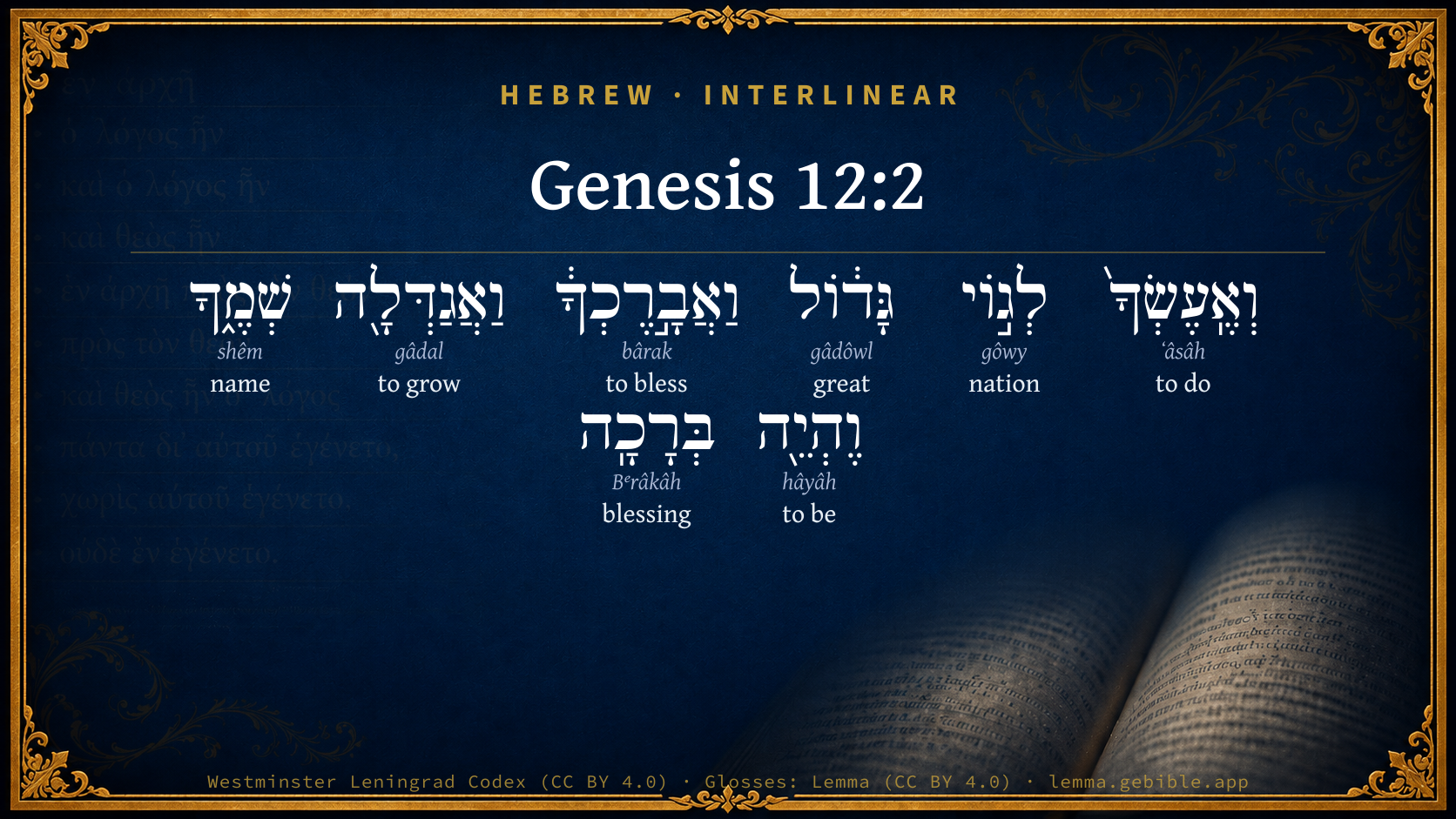
Hebrew (Westminster Leningrad Codex) Genesis 12:2 appears in the Hebrew Old Testament. The text above is from the Westminster Leningrad Codex. Each word links to its Strong’s number, a concise gloss, and parsing drawn from the Open Scriptures Hebrew Bible morphology. Click any word for its full Brown-Driver-Briggs (BDB) entry.
Download image
Cite this verse

Genesis 12:2 (World English Bible). Public Domain. Lemma interlinear Bible study tool, https://lemma.gebible.app/v/genesis/12/2.

Show BibTeX & RIS
BibTeX
RIS
English Translation
I will make of you a great nation. I will bless you, and make your name great. You will be a blessing.
World English Bible · Public Domain
Highlights
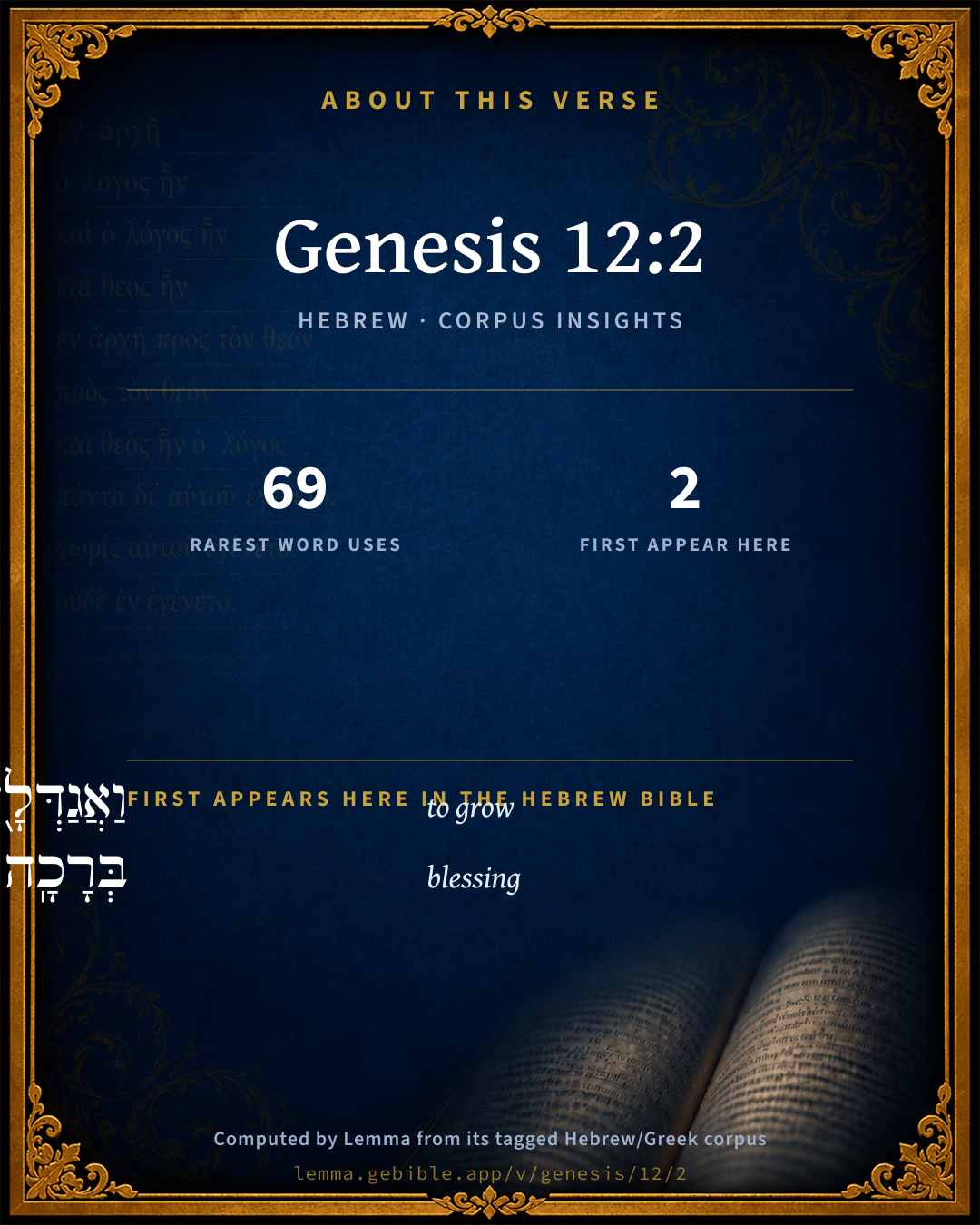
  • 2 first appearances in the Hebrew Bible
Full analysis ↓
Download a study sheet

One document with this verse’s original text, its word-by-word gloss line, the meaning frame, cross-references with their text, attributed commentary, and full source and license credits — printable, and it pastes into notes with its structure intact.

This verse Autodidact and up

Study sheet (.html) Plain text (.txt)

A passage Seminary Student

Up to 50 verses in one chapter. A passage sheet keeps up to 6 commentary sources and 12 cross-references per verse, in the order this page ranks them, and says so on the sheet whenever that leaves anything out. Ask for a single verse and you get the Autodidact verse sheet above.

Everything on this page stays free to read, with no account — the sheet is a download of what is already on screen, not access to it.

Want to remove ads? Support Godless Engineer
Compare translations 3

The same verse in 3 English versions, stacked beneath the original-language interlinear above. Click any original word for its lexicon entry.

Each is an independent rendering of the whole verse — the interlinear is not word-aligned to these translations.

Highlighted words mark where these versions differ — a whole-verse word diff, not a word-by-word alignment.

  • World English Bible Public Domain
    I will make of you a great nation. I will bless you, and make your name great. You will be a blessing.
  • King James Version Public Domain
    And I will make of thee a great nation, and I will bless thee, and make thy name great; and thou shalt be a blessing:
  • unfoldingWord Literal Text CC BY-SA 4.0
    And I will make you into a great nation, and I will bless you, and I will make your name great, and you shall be a blessing.

unfoldingWord Literal Text — © unfoldingWord, licensed CC BY-SA 4.0. Word-aligned USFM3 via Door43 (git.door43.org/unfoldingWord/en_ult).

Versions to compare (up to 4)

3 of 4 selected

Show all 18 translations

Every available English version of this verse, each an independent rendering of the whole verse.

  • World English Bible Public Domain
    I will make of you a great nation. I will bless you, and make your name great. You will be a blessing.
  • Berean Standard Bible Public Domain
    I will make you into a great nation, and I will bless you; I will make your name great, so that you will be a blessing.
  • Majority Standard Bible Public Domain
    I will make you into a great nation, and I will bless you; I will make your name great, so that you will be a blessing.
  • King James Version Public Domain
    And I will make of thee a great nation, and I will bless thee, and make thy name great; and thou shalt be a blessing:
  • American Standard Version (1901) Public Domain
    and I will make of thee a great nation, and I will bless thee, and make they name great; and be thou a blessing;
  • Revised Version (1885) Public Domain
    and I will make of thee a great nation, and I will bless thee, and make thy name great; and be thou a blessing:
  • Geneva Bible (1599) Public Domain
    And I will make of thee a great nation, and will blesse thee, and make thy name great, and thou shalt be a blessing.
  • Douay-Rheims (1899) Public Domain
    And I will make of thee a great nation, and I will bless thee, and magnify thy name, and thou shalt be blessed.
  • Young's Literal Translation Public Domain
    And I make thee become a great nation, and bless thee, and make thy name great; and be thou a blessing.
  • Literal Standard Version CC BY-SA 4.0
    And I make you become a great nation, and bless you, and make your name great; and be a blessing.
  • Unlocked Literal Bible CC BY-SA 4.0
    I will make of you a great nation, and I will bless you, and make your name great, and you will be a blessing.
  • unfoldingWord Literal Text CC BY-SA 4.0
    And I will make you into a great nation, and I will bless you, and I will make your name great, and you shall be a blessing.
  • Darby Bible Public Domain
    And I will make of thee a great nation, and bless thee, and make thy name great; and thou shalt be a blessing.
  • World Messianic Bible Public Domain
    I will make of you a great nation. I will bless you and make your name great. You will be a blessing.
  • Webster's Bible Public Domain
    And I will make of thee a great nation, and I will bless thee, and make thy name great; and thou shalt be a blessing:
  • Free Bible Version CC BY-SA 4.0
    I will make you the ancestor of a great nation and I will bless you. I will make sure you have a great reputation and that you are a blessing to others.
  • Bible in Basic English Public Domain
    And I will make of you a great nation, blessing you and making your name great; and you will be a blessing:
  • JPS Tanakh (1917) Public Domain
    And I will make of thee a great nation, and I will bless thee, and make thy name great; and be thou a blessing.

Literal Standard Version (2020), Covenant Press — licensed CC BY-SA 4.0. Text via the HelloAO Bible API (eBible.org). Unlocked Literal Bible (unfoldingWord) — licensed CC BY-SA 4.0. Text via the HelloAO Bible API (eBible.org). unfoldingWord Literal Text — © unfoldingWord, licensed CC BY-SA 4.0. Word-aligned USFM3 via Door43 (git.door43.org/unfoldingWord/en_ult). Free Bible Version, Dr. Jonathan Gallagher — licensed CC BY-SA 4.0. Text via the HelloAO Bible API (eBible.org).

Word by word

More ways to search: Search by grammar → Find every occurrence → Compare this word →

Practice this passage: Drill this verse → Learn its vocabulary →

בְּרָכָֽה
Bᵉrâkâh
H1293
“blessing”
Noun, Common, Feminine, Singular, Absolute
Part of Speech
Noun
Type
Common
Gender
Feminine
Number
Singular
State
Absolute
Full BDB Definition

Origin: from H1288

TWOT: None

blessing - (source of) blessing - blessing, prosperity - blessing, praise of God - a gift, present - treaty of peace
  1. וְאֶֽעֶשְׂךָ֙ ʻâsâh H6213 “and · to do · you” Conjunction + Verb, Qal, Imperfect, 1st Person, Common, Singular + Suffix, Personal, 2nd Person, Masculine, Singular
  2. לְג֣וֹי gôwy H1471 “to/for · nation” Preposition + Noun, Common, Masculine, Singular, Absolute
  3. גָּד֔וֹל gâdôwl H1419 “great” Adjective, Adjective, Masculine, Singular, Absolute
  4. וַאֲבָ֣רֶכְךָ֔ bârak H1288 “and · to bless · you” Conjunction + Verb, Piel, Imperfect, 1st Person, Common, Singular + Suffix, Personal, 2nd Person, Masculine, Singular
  5. וַאֲגַדְּלָ֖ה gâdal H1431 “and · to grow” Conjunction + Verb, Piel, Imperfect, 1st Person, Common, Singular
  6. שְׁמֶ֑ךָ shêm H8034 “name · your” Noun, Common, Masculine, Singular, Construct + Suffix, Personal, 2nd Person, Masculine, Singular
  7. וֶהְיֵ֖ה hâyâh H1961 “and · be” Conjunction + Verb, Qal, Imperative, 2nd Person, Masculine, Singular

About this verse

These counts appear in no published source. They are computed here, from the morphology-tagged text and Lemma’s own curated glosses. What Lemma adds →

8
words
8
distinct lemmas
Pentateuch
section

First appearance in Scripture

These words make their first canonical appearance in the Hebrew Bible here:

  • וַאֲגַדְּלָ֖ה to grow H1431
  • בְּרָכָֽה blessing H1293

Grammatical profile

  • 4 verbs
  • 3 nouns
  • 1 adjective

Verb forms

  • וְאֶֽעֶשְׂךָ֙ Qal · Imperfect
  • וַאֲבָ֣רֶכְךָ֔ Piel · Imperfect
  • וַאֲגַדְּלָ֖ה Piel · Imperfect
  • וֶהְיֵ֖ה Qal · Imperative

Hebrew & Septuagint length

In English translation the verse runs 22 words from the Hebrew and 22 from the Septuagint (LXX English) — the same length.

A rough comparison of the two English renderings, which tokenize alike — not a word-level alignment.

Word counts can differ between the Hebrew and the Greek without any difference in meaning — e.g. the Hebrew direct-object marker אֵת has no separate Greek word, and Greek often adds the article ὁ.

Cross-references

26

Topical passages linked to Genesis 12:2 in the Treasury of Scripture Knowledge — connected by theme and wording, ordered by reader-vote popularity; previews shown in the World English Bible.

  • 2 Samuel 7:9 and I have been with you wherever you went, and have cut off all your enemies from before you; and I will make you a great name, like the name of the great ones who are in the earth.
  • Galatians 3:14 that the blessing of Abraham might come on the Gentiles through Christ Jesus; that we might receive the promise of the Spirit through faith.
  • Genesis 18:18 seeing that Abraham has surely become a great and mighty nation, and all the nations of the earth will be blessed in him?
  • Genesis 17:4–6 "As for me, behold, my covenant is with you. You will be the father of a multitude of nations.
  • Genesis 28:3–4 May God Almighty bless you, and make you fruitful, and multiply you, that you may be a company of peoples,
  • Genesis 35:11 God said to him, "I am God Almighty. Be fruitful and multiply. A nation and a company of nations will be from you, and kings will come out of your loins.
  • Genesis 46:3 He said, "I am God, the God of your father. Don't be afraid to go down into Egypt; for there I will make of you a great nation.
  • Genesis 26:4 I will multiply your seed as the stars of the sky, and will give to your seed all these lands. In your seed will all the nations of the earth be blessed,
  • Genesis 24:35 Yahweh has blessed my master greatly. He has become great. He has given him flocks and herds, silver and gold, men-servants and maid-servants, and camels and donkeys.
  • Genesis 13:16 I will make your offspring as the dust of the earth, so that if a man can number the dust of the earth, then your seed may also be numbered.
  • Genesis 15:5 Yahweh brought him outside, and said, "Look now toward the sky, and count the stars, if you are able to count them." He said to Abram, "So shall your seed be."
  • Exodus 1:7 The children of Israel were fruitful, and increased abundantly, and multiplied, and grew exceedingly mighty; and the land was filled with them.
  • Genesis 22:17–18 that in blessing I will bless you, and in multiplying I will multiply your seed as the stars of the heavens, and as the sand which is on the seashore. Your seed will possess the gate of his enemies.
  • Genesis 27:29 Let peoples serve you, Nations bow down to you. Be lord over your brothers, Let your mother's sons bow down to you. Cursed be everyone who curses you, Blessed be everyone who blesses you."
  • Galatians 3:7 Know therefore that those who are of faith, the same are children of Abraham.
  • Deuteronomy 26:5 You shall answer and say before Yahweh your God, A Syrian ready to perish was my father; and he went down into Egypt, and sojourned there, few in number; and he became there a nation, great, mighty, and populous.
  • Exodus 32:10 Now therefore leave me alone, that my wrath may burn hot against them, and that I may consume them; and I will make of you a great nation."
  • Genesis 19:29 It happened, when God destroyed the cities of the plain, that God remembered Abraham, and sent Lot out of the midst of the overthrow, when he overthrew the cities in which Lot lived.
  • Genesis 28:14 Your seed will be as the dust of the earth, and you will spread abroad to the west, and to the east, and to the north, and to the south. In you and in your seed will all the families of the earth be blessed.
  • Numbers 14:12 I will strike them with the pestilence, and disinherit them, and will make of you a nation greater and mightier than they.
  • Romans 4:11 He received the sign of circumcision, a seal of the righteousness of the faith which he had while he was in uncircumcision, that he might be the father of all those who believe, though they be in uncircumcision, that righteousness might also be accounted to them.
  • Numbers 24:9–10 He couched, he lay down as a lion, As a lioness; who shall rouse him up? Blessed be everyone who blesses you, Cursed be everyone who curses you.
  • 1 Kings 3:8–9 Your servant is in the midst of your people which you have chosen, a great people, that can't be numbered nor counted for multitude.
  • 1 Kings 1:47 Moreover the king's servants came to bless our lord king David, saying, Your God make the name of Solomon better than your name, and make his throne greater than your throne: and the king bowed himself on the bed.
  • Micah 7:20 You will give truth to Jacob, and mercy to Abraham, As you have sworn to our fathers from the days of old.
  • Genesis 14:14–16 When Abram heard that his relative was taken captive, he led forth his trained men, born in his house, three hundred and eighteen, and pursued as far as Dan.

Cross-references courtesy of OpenBible.info (CC BY 4.0).

Hebrew and Greek witnesses Masoretic Hebrew ↔ Greek Septuagint

The same verse in the two great witnesses to the Old Testament, shown verse-for-verse.

These are two independent witnesses, not word-aligned to each other, and the Septuagint is shown in lemma (dictionary) form.

Hebrew Genesis 12:2 Masoretic · Westminster Leningrad Codex

וְאֶֽעֶשְׂךָ֙ לְג֣וֹי גָּד֔וֹל וַאֲבָ֣רֶכְךָ֔ וַאֲגַדְּלָ֖ה שְׁמֶ֑ךָ וֶהְיֵ֖ה בְּרָכָֽה

I will make of you a great nation. I will bless you, and make your name great. You will be a blessing.

World English Bible · Public Domain

Greek LXX Genesis 12:2 Septuagint · lemma form

καί ποιέω σύ εἰς ἔθνος μέγας καί εὐλογέω σύ καί μεγαλύνω ὁ ὄνομα σύ καί εἰμί εὐλογητός

And I will make you a great nation, and I will bless you and magnify your name, and you shall be blessed.

LXX2012 (modern English Septuagint) · Public Domain

On this verse, The Pulpit Commentary discusses the Septuagint’s reading. Read the note in Commentary ↓

Hebrew: Westminster Leningrad Codex (CC BY 4.0). Greek: Septuagint (public domain); English from LXX2012 (modern English Septuagint) (Public Domain). How the Septuagint differs from the Hebrew →

Targum (Aramaic paraphrase)

2

The Targum is the ancient Jewish Aramaic paraphrase of the Hebrew Scriptures — an interpretive translation, not the Hebrew text itself. Onkelos (literal) and Pseudo-Jonathan (expansive) render the Torah, and Jonathan the Prophets. Coverage is partial: where no permissively-licensed English translation exists for a verse, only the Aramaic is shown. This is verse-level text, not a word-by-word alignment to the Hebrew.

  1. Targum Onkelos Torah (Genesis–Deuteronomy)
    וְאֶעְבְּדִנָּךְ לְעַם סַגִּי וֶאֱבָרֵכִנָּךְ וַאֲרַבֵּי שְׁמָךְ וּתְהֵא מְבָרֵךְ

    And I will make thee to (be) a great people, and will bless thee, and magnify thy name, and thou shalt be blessed.

    Targum Onkelos — Aramaic: “Onkelos Genesis” (public domain); “Onkelos Exodus” (public domain); “Onkelos Leviticus” (public domain); “Onkelos Numbers” (public domain); “Onkelos Deuteronomy” (public domain). English: “Sefaria Community Translation” (CC0 1.0 (public-domain dedication)); “J.W. Etheridge. The Targums of Onkelos and Jonathan Ben Uzziel on the Pentateuch. London: Longmans, Green, 1862” (public domain). Text via Sefaria.

  2. Targum Pseudo-Jonathan Torah (Genesis–Deuteronomy)
    וְאַעֲבִידְנָךְ לְעָם רָב וְאֵבָרְכִינָךְ וְאַרַבֵּי שְׁמָךְ וּתְהֵי מְבָרֵךְ

    And I will make thee a great people, and will bless thee, and magnify thy name, and thou shalt be blessed.

    Targum Pseudo-Jonathan — Aramaic: “Targum Jonathan on Genesis” (public domain); “Targum Jonathan on Exodus” (public domain); “Targum Jonathan on Leviticus” (public domain); “Targum Jonathan on Numbers” (public domain); “Targum Jonathan on Deuteronomy” (public domain). English: “The Targum of Jonathan ben Uzziel, trans. J. W. Etheridge, London, 1862” (public domain). Text via Sefaria.

Commentary

Notes on Genesis 12:2 from classic Christian and Jewish commentators (each source and its license shown beneath its notes). The classic Christian expositions comment on the surrounding passage and are grouped to its opening verse, so a note may address several verses; the Jewish commentaries on the Tanakh (Rashi and others) are per-verse, so they appear only where the commentator wrote on this verse.

Lemma curates 59 commentaries, every one of them public domain or Creative Commons licensed, each selected and text-cleaned for this edition rather than reprinted as found. About our sources →

Trapp's Complete Commentary

John Trapp

Gen 12:2 And I will make of thee a great nation, and I will bless thee, and make thy name great; and thou shalt be a blessing:

Ver. 2. And I will make of thee a great nation.] Why then should the scornful Jews call us nations or Gentiles in contempt? yea, heathen bastards, heathen dogs, as they do at this day? {a} Surely, either themselves are of this great Goi or nation here mentioned, or else they have not Abraham to their father; choose them which.

I will bless thee.] As a father his children, with all spiritual comforts, {Eph 1:3} and earthly contentments; with the blessings of the right hand, and of the left; with "the upper and nether springs," {Jdg 1:15} as Caleb blessed his daughter Achsah. "He will give grace and glory," and (if that be not enough) "no good thing will he withhold," &c. {Psa 84:11} Hence Moses cries out, "Happy art thou O Israel; who is like unto thee!" &c. {Deu 33:29}

And make thy name great.] A great name then is a great blessing. So David took it. {2Sa 7:9} And it was no small comfort to him, that whatever he did, pleased the people. Blessing and praise (or good name) is expressed by one and the same word {b} in both Testaments. {Pro 27:21} Only (as it is in the same text) it then proves a blessing, when it is to a man "as the fining pot for silver, and furnace for gold," when it melts us, and makes us better, when it works in us a care to walk worthy of the praise given us, to purge ourselves from all filth, that we may be as pure vessels, meet for the Master’s use, fit to be set upon the celestial shelf, as that martyr phrased it, {c} "Since thou hast been precious in my sight, thou hast been honourable". {Isa 43:4} Virtue is instead of a thousand coat-of-arms on shields.

And thou shalt be a blessing.] That is, in a high degree blessed; or a common blessing {d} to all, wherever thou comest, who shall fare the better for thee. Or, a public pattern of blessing (so some Hebrews expound it). Those that wish well to themselves, or others, shall pray God that Abram’s blessedness may befall them. The contrary hereunto is now befallen his unhappy posterity for their obstinacy. A curse they are become among the Gentiles, as was foretold them. {Zec 8:13} Sanctius, upon that text, tells us, that all over Turkey they have taken it up for a curse, - I would I might die a Jew, then; and, Let me be a Jew if I deceive thee. {e}

{a} Pareus in Rom 11:25. See my True Treasur., p. 297.

{b} ברכה ευλογια

{c} Act. and Mon.

{d} Vir bonus est commune bonum .

{e} In execrationibus dicunt, Iudaeus sim si fallo . - Sanct.

John Trapp, A Commentary or Exposition upon All the Books of the Old and New Testament (1647–1656) — public domain. Text from a community e-Sword module.

Joseph Benson's Commentary

Gen 12:2. I will make of thee a great nation — When God took him from his own people, he promised to make him the head of another people. This promise was both a great relief to Abram’s burden, for he had now no child, and a great trial to Abram’s faith, for his wife had been long barren; so that if he believe, it must be against hope, and his faith must build purely upon that power which “can out of stones raise up children unto Abraham.” I will bless thee — Either particularly with the blessing of fruitfulness, as he had blessed Adam and Noah; or in general, I will bless thee with all manner of blessings, both of the upper and nether springs: leave thy father’s house, and I will give thee a father’s blessing, better than that of thy progenitors. I will make thy name great — By deserting his country he lost his name there. Care not for that, says God, but trust me, and I will make thee a greater name than ever thou couldst have had there. Thou shalt be a blessing — Thy testimony for God, thy example, thy prayers, and power with God, thy wisdom and prudence, thy peaceable and benevolent disposition and conduct, shall make thee a blessing in all places where thou shalt sojourn. I will bless them that bless thee, &c. — I will be a friend to thy friends, and an enemy to thy enemies; thus making, as it were, a kind of league, offensive and defensive, with Abram. Abram heartily espoused God’s cause, and here God promises to interest himself m his behalf.

Joseph Benson's Commentary on the Old and New Testaments (1811–1818) — public domain. Text from a community e-Sword module.

Tyndale Open Study Notes

Tyndale Open Resources

12:2 make you famous (literally make your name great): Abram received the fame sought by the builders of Babel (see 11:4 and study note). • and you will be a blessing (or so that you will be a blessing): This clause is a command in Hebrew, but it is also a promise conditioned upon Abram’s obedience to God’s command (12:1): “Go . . . so that you will be a blessing. Be a blessing, so that I can bless and curse others.”

Tyndale Open Study Notes — © Tyndale Open Resources, licensed CC BY-SA 4.0. Text via the HelloAO Bible API.

Geneva Bible (1599)

Geneva Bible translators

The world shall recover by thy seed, which is Christ, the blessing which they lost in Adam.

Geneva Bible (1599) marginal notes — public domain. Text via Bolls.life.

Adam Clarke's Commentary

Verse 2. I will make of thee a great nation] i.e., The Jewish people; and make thy name great, alluding to the change of his name from Abram, a high father, to Abraham, the father of a multitude.

Adam Clarke's Commentary on the Bible (1810–1826) — public domain. Text from a community e-Sword/MySword module.

John Calvin's Commentaries

2. And I will make of thee a great nation. Hitherto Moses has related what Abram had been commanded to do; now he annexes the promise of God to the command; and that for no light cause. For as we are slothful to obey, the Lord would command in vain, unless we are animated by a superadded confidence in his grace and benediction. Although I have before alluded to this, in the history of Noah, it will not be useless to inculcate it again, for the passage itself requires something to be said; and the repetition of a doctrine of such great moment ought not to seem superfluous. For it is certain that faith cannot stand, unless it be founded on the promises of God. But faith alone produces obedience. Therefore in order that our minds may be disposed to follow God, it is not sufficient for him simply to command what he pleases, unless he also promises his blessing. We must mark the promise, that Abram, whose wife was still barren, should become a great nation. This promise might have been very efficacious, if God, by the actual state of things, had afforded ground of hope respecting its fulfillment; but now, seeing that the barrenness of his wife threatened him with perpetual privation of offspring, the bare promise itself would have been cold, if Abram had not wholly depended upon the word of God; wherefore, though he perceives the sterility of his wife, he yet apprehends, by hope, that great nation which is promised by the word of God. And Isaiah greatly extols this act of favor, that God, by his blessing, increased his servant Abram whom he found alone and solitary to so great a nations (Isaiah 2:2.) The noun גוי(goi,) “my nation,” (Genesis 12:4,) though detestable to the Jews, is in this place, and in many others, taken as a term of honor. And it is here used emphatically, to show that he should not only have posterity from his own seed in great number, but a peculiar people, separated from others, who should be called by his own name.

I will bless thee. This is partly added, to explain the preceding sentence. For, lest Abram should despair, God offers his own blessing, which was able to effect more in the way of miracle, than is seen to be effected, in other cases, by natural means. The benediction, however, here pronounced, extends farther than to offspring; and implies, that he should have a prosperous and joyous issue of all his affairs; as appears from the succeeding context, “And will make thy name great, and thou shalt be a blessing.” For such happiness is promised him, as shall fill all men everywhere with admiration, so that they shall introduce the name of Abram, as an example, into their formularies of pronouncing benediction. Others use the term in the sense of augmentation, ‘Thou shalt be a blessing,’ that is, ‘All shall bless thee.’ But the former sense is the more suitable. Some also expound it actively, as if it had been said, ‘My grace shall not reside in thee, so that thou alone mayest enjoy it, but it shall flow far unto all nations. I therefore now so deposit it with thee, that it may overflow into all the world.’ But God does not yet proceed to that communication, as I shall show presently.

John Calvin's Commentaries (1540-1563) — public domain. Text from the Calvin Translation Society English edition (1840s-50s) via the Christian Classics Ethereal Library (ccel.org). Calvin's coverage is partial (roughly two-thirds of the Bible); uncommented books and verses are honest gaps, never fabricated. The 19th-century editor's footnotes and remarks are omitted so the notes are faithfully Calvin's own voice.

Ellicott's Commentary for English Readers

(2, 3) Thou shalt be a blessing.—More correctly, Be thou a blessing. The promises made to Abram are partly personal and partly universal, embracing the whole world. In return for all that he abandons he is to become the founder of a powerful nation, who will honour his name, and teach the inheritors of their spiritual privileges to share in their veneration for him. But in the command to “be” or “become a blessing,” we reach a higher level, and it is the glory of Abram’s faith that it was not selfish, and in return for his consenting to lead the life of a stranger, he was to be the means of procuring religious privileges, not only for his own descendants, but also “for all families of the earth” (Heb., of the ground—the adâmâh). Not for the earth as the material universe, but solely in its connection with man. Wherever man makes his home upon it, there, through Abram, spiritual blessings will be offered him.

I will bless . . . —These words indicate relations mysteriously close between Jehovah and Abram, whereby the friends and enemies of the one become so equally to the other. But in the second clause our version has not noticed an essential difference between the verbs used. They occur together again in Exo_22:28, and are there more correctly rendered by “revile” and “curse.” The one word signifies to treat lightly and contemptuously, the other to pronounce a curse, usually in a judicial manner. We might, therefore, translate, “I will curse—pass a sentence of rejection upon—him that speaketh lightly of, or revileth thee.”

In thee shall all families of the earth be blessed.—Some authorities translate, “shall bless themselves;” but there is a different conjugation to express this meaning, and no reason exists for forcing it upon the text. Henceforward Abram and the nation sprung from him were to be the intermediaries between God and mankind, and accordingly revelation was virtually confined to them. But though the knowledge of God’s will was to be given through them, it was for the benefit of all the families of every race and kindred distributed throughout the habitable world, the adâmâh (Rom_3:29; Rom_10:12, &c).

A Bible Commentary for English Readers, edited by Charles John Ellicott (1878–1897) — public domain. Text from a community e-Sword module.

The Cambridge Bible for Schools and Colleges

gen. ed. J. J. S. Perowne

2. The promise, (1) of national greatness, (2) of personal privilege, embraces a double relation, to the world and to the individual.

a great nation] This thought stands in the forefront. The personal aspect of the promise made to Abram is from the first merged in the thought of its historic influence throughout the ages.

I will bless thee] The experience of happiness in the personal relation to Jehovah is to be the pledge of the ultimate fulfilment of blessing to the world.

make thy name great] Contrast Gen_11:4. The blessing of Abram, in its spiritual influence upon the world, will be of more enduring renown than any of the material forces of the world.

be thou a blessing] i.e. one who impersonates true felicity; cf. Zec_8:13. Not a source, but a type, of blessing, to be pronounced upon others. The imperative expresses a consequence which is intended (Gesenius, Heb. Gr. § 110. 1) = “so that thou shalt be a blessing.” By a slight alteration of the pointing, Giesebrecht reads “and it (the name) shall be a blessing.” For the “curse” of the primaeval age (Gen_3:13, Gen_4:11, Gen_5:29, Gen_9:25 (J)) is substituted the “blessing” of the Chosen Family.

The Cambridge Bible for Schools and Colleges (gen. ed. J. J. S. Perowne; Cambridge University Press, 1878–1918) — public domain. Text from a community e-Sword module.

John Gill's Exposition

And I will make of thee a great nation,.... In a literal sense, as the people of the Jews were that descended from him, and in a spiritual sense believers in all ages and of all nations, that walk in the steps of the faith of Abram, who are his children, and are blessed with him:

and I will bless thee; not only with temporal blessings, but principally with spiritual ones, since Abram in person had no share of the land of Canaan; even with the adoption of children and friendship with God; with justification by the imputed righteousness of Christ, which blessedness came upon him when uncircumcised; with a large measure of faith, and every other grace; with the sanctification of the Spirit, and an increase of it until brought to perfection; and with eternal glory and happiness, a right, title, and meetness for it, and the full possession of it:

and make thy name great; as it was among the Jews his descendants, who boasted of having Abram for their father; and among the several nations of the world; his name is famous in profane history, and is in high esteem with the Mahometans to this day; and especially his name is great and famous, and the memory of him precious among all those who have obtained like precious faith with him, in every age and in every nation:

and thou shall be a blessing; to all that knew him and conversed with him, they receiving spiritual light and knowledge by means of his instruction, and to all that should hear and read of his faith and piety, being encouraged by his example: or, "shall be blessing"; blessing itself, that is, most blessed, exceedingly blessed; as a very wicked man may be called wickedness itself; as "scelus" for "scelestus" with the Latins; so a good man may be called blessing itself, extremely happy.

John Gill's Exposition of the Whole Bible (1746–1763) — public domain (CC PDM 1.0). Text via the HelloAO Bible API.

Matthew Poole's English Annotations

I will bless thee with all my blessings, spiritual, temporal, and eternal; (see Deu 7:13; 28:2, &c.; Eph 1:3)

and thou shalt be, both a pattern and instrument of blessedness to others; to thy posterity, who shall be blessed for thy sake; to thy servants and friends, who shall be blessed by thy instruction and help; and to all the world, as it follows.

Matthew Poole's English Annotations on the Holy Bible (1683–1685) — public domain. Text from a community e-Sword/MySword module.

Whedon's Commentary on the Bible

Daniel D. Whedon

2. I will make of thee a great nation — Great promises correspond with the great sacrifices commanded. 1) He left his nation, but should himself be the founder of a great nation. 2) He sacrificed kindred, but should be blessed with a spiritual kinship, as yet by him unimagined and inconceivable, but hailed afar off by faith. Heb_11:13. 3) He broke away from ancestral ties, but his own name should be illustrious as father of the faithful, ancestor of the Hebrew people, and of the world’s Messiah. 4) Most glorious of all,

Thou shalt be a blessing — Hebrews, Be thou a blessing. “It is more blessed to give than to receive;” and, like the great Antitype, Abram’s highest glory was in being a fount of blessing to all mankind. He should be famous, not for what he took from men, but for what he gave to men; not like Sesostris, Caesar, Alexander, for the victories of the sword, but for the grander victories of truth and love.

Abram signifies “the lofty Father,” and to-day Christians, Mohammedans, and Jews contend with each other in the veneration which they show for Abram as a father. Alexander Severus, the Roman emperor, built a chapel in his palace in which all the great religions of the earth were honored; and it is related that the statues of Abram and Zoroaster stood there with those of Orpheus and of Christ. Probably no human name is to-day so widely honored as that of the “father of the faithful.”

Daniel D. Whedon (gen. ed.), Commentary on the Old and New Testaments (1874–1909) — public domain. Text from a community e-Sword module.

The Pulpit Commentary

Vers. 2, 3. And I will make of thee a great nation. A compensation for leaving his small kindred. The nation should be great

(1) numerically (Keil, Rosenm

(2) influentially (Kalisch, Inglis),

(3) spiritually (Luther, Wordsworth).

And I will bless thee. Temporally (Pererius, Murphy), with every kind of good (Rosenm in particular with offspring (Vatablus); but also spiritually (Rupertus, Bush), in the sense., e.g., of being justified by faith,. (Gal_3:8) (Candlish) The blessing was a recompense for the deprivations entailed upon him by forsaking the place of his birth and kindred (Murphy). And make thy name great. Render thee illustrious and renowned (Rosenm not so much in the annals of the world as in the history of the Church (Bush); in return for leaving thy father"s house (Murphy). So God made David a great name (2Sa_7:9; cf. Pro_22:1; Ecc_7:3) And thou shalt be a blessing. Ie. "blessed," as in; Zec_8:12 (Chaldee, Syriac, LXX, Dathe, Rosenm Gesenius) or "a type or example of blessing," so that men shall introduce thy name into their formularies of blessing (Kimchi, Clericus, Knobel, Calvin); but, best, "a source of blessing" (spiritual) to others" (Tuch, Delitzsch, Keil, Kalisch, Murphy). The sense in which Abram was to be a source of blessing to others is explained in the next verse. First, men were to be either blessed or cursed of God according as their attitude to Abram was propitious or hostile. And I will bless them grace expecting they will be many to bless (Delitzsch)that bless thee, and curse (with a judicial curse, the word being the same as in Gen_3:14 Gen_4:11) him only an individual here and there, in the judgment of the Deity, being likely to inherit this malediction (Delitzsch) that curseth (literally, treateth lightly or despiseth The verb is applied in Gen_8:11 to the diminution of the waters of the flood) thee. The Divine Being thus identifies himself with Abram, and solemnly engages to regard Abrams friends and enemies as his, as Christ does with his Church. (Act_1:4) And in thee shall all the families of the earth be blessed. Not Mess themselves by thee or in thy name (Jarchi, Clericus); but in thee, as the progenitor of the promised seed, shall all the families of the ground (which was cursed on account of sin, Genesis ill 17) be spiritually blessed cf. Gal_3:8 (Calvin, Luther, Rosenm Keil, Wordsworth, Murphy, "Speaker"s Commentary") Thus the second sense in which Abram was constituted a blessing lay in this, that the whole fullness of the Divine promise of salvation for the world was narrowed up to his line, by which it was in future to be carried forward, and at the appointed season, when the woman s seed was horn, distributed among mankind.

Abraham useful.

thou shalt be a blessing." This is part of the sixfold promise given to Abraham. He was to be a blessing to all nations. It is a very great joy to a devout soul to become a blessing temporally or spiritually to others.

I EVERY MAN OF FAITH IS A CENTER OF BLESSING. Men who yield to their carnal natures cannot bless others. The Christian should not incidentally, but intentionally, bless others. Where a man is corrupt his working will be injurious; purity is a benediction to mankind.

II A DEVOUT AND FAITHFUL MAN IS A BLESSING CHIEFLY TO THOSE WHO CAN RECEIVE HIS INFLUENCE. The light of the sun causes one substance to decay, another to fructify. The life of a servant of God may only provoke a sneer and opposition in some souls; but in others joy, thankfulness, love, and effort at imitation. To some an apostle was "a savor of death unto death.

III THE MEASURE OF OUR FAITH IS THE MEASURE OF THE BLESSING WE SHALL TRANSMIT TO OTHERS. We sometimes hinder the operation of God"s promise by our self-righteous humility, which ignores the fact that God often uses the "weak things of the world to confound the things that are mighty." There must be faith in God"s continued working. He can make the future fruitful in proportion to our faith. Look at what he made of Paul, Luther, Wesley, and Whitfield because they were all men of strong faith.

IV TO BE A BLESSING THROUGH THE POWER AND FAVOR OF GOD IS THE HIGHEST HONOR IN THE WORLD. It was God who "made" Abraham a blessing; he gave him the power, fostered his faith, and perpetuated his influence. What honor could Abraham have comparable with this? It is probable that Abraham thought little of the honor which would come to him; but God adapted his promise to that which he knew to be the desire of the secret soul of Abraham. Seeing a longing in the heart to lift men to a higher level, he gratifies it by making Abraham a blessing. All should cherish such desires. The help we can give to others morally is far greater than that we can bestow materially. To live an aimless life is a disgrace and sin, but to live to bless others is Divine. H.

HOMILIES BY W. ROBERTS

Vers. 2, 3.

Sevenfold promises.

I OF THE FEE-INCARNATE JEHOVAH TO ABRAM.

1. A great inheritance.

2. A great posterity.

3. A great name.

4. A great blessing.

5. A great alliance.

6. A great defense.

7. A great influence.

II OF THE INCARNATE WORD TO HIS DISCIPLES.

1. The kingdom of heaven.

2. Divine consolation.

3. Inheritance of the earth.

4. Divine satisfaction.

5. Divine mercy.

6. The vision of God.

7. A place in God"s family. (see Mat_5:1-9)

III OF THE GLORIFIED CHRIST TO HIS CHURCH.

1. The tree of life.

2. A crown of life.

3. Hidden manna, the white stone, and a new name.

4. Power over the nations, and the morning star.

5. White raiment.

6. The distinction of being made a pillar in God"s temple.

7. A seat on Christ"s throne. W. (see Rev 2:, Rev_2:3)

The Pulpit Commentary (1880–1919), ed. H.D.M. Spence-Jones & Joseph S. Exell — public domain. Text from a community e-Sword module.

John Wesley's Explanatory Notes

Here is added an encouraging promise, nay a complication of promises,

1. I will make of thee a great nation - When God took him from his own people, he promised to make him the head of another people. This promise was.

1. A great relief to Abram's burden, for he had now no child.

2. A great trial to Abram's faith, for his wife had been long barren, so that if he believe, it must be against hope, and his faith must build purely upon that power which can out of stones raise up children unto Abraham.

2. I will bless thee - Either particularly with the blessing of fruitfulness, as he had blessed Adam and Noah; or in general, I will bless thee with all manner of blessings, both of the upper and nether springs: leave thy father's house, and I will give thee a father's blessing, better than that of thy progenitors.

3. I will make thy name great - By deserting his country he lost his name there: care not for that, (saith God) but trust me, and I will make thee a greater name than ever thou couldst have had there.

4. Thou shalt be a blessing - That is, thy life shall be a blessing to the places where thou shalt sojourn.

5. I will bless them that bless thee, and curse him that curseth thee - This made it a kind of league offensive and defensive between God and Abram. Abram heartily espoused God's cause, and here God promiseth to interest himself in his.

6. In thee shall all the families of the earth be blessed - This was the promise that crowned all the rest, for it points at the Messiah, in whom all the promises are yea and amen.

John Wesley, Explanatory Notes Upon the Whole Bible (1754–1765) — public domain. Text via the GEBible commentary corpus.

Scofield Reference Notes

C. I. Scofield

And

For analysis and summary of the Abrahamic Covenant, (See Scofield "Gen 15:18").

The Scofield Reference Bible (1917 edition), notes by C. I. Scofield — public domain. Text from a community e-Sword module.

Rashi

Rabbi Shlomo Yitzchaki (Rashi)

ואעשך לגוי גדול AND I WILL MAKE OF THEE A GREAT NATION —Since travelling is the cause of three things—it decreases (breaks up) family life, it reduces one’s wealth and lessens one’s renown, he therefore needed these three blessings: that God should promise him children, wealth and a great name (Genesis Rabbah 39:11).

ואברכך AND I WILL BLESS THEE —with wealth (Genesis Rabbah 39:11).

והיה ברכה AND BE THOU A BLESSING — Blessings are entrusted to you; hitherto they were in My power — I blessed Adam and Noah — but from now on you shall bless whomsoever you wish (Genesis Rabbah 39:11) Another explanation is: AND I WILL MAKE THEE A GREAT NATION, this alludes to the fact that we say in our prayer “God of Abraham”; AND I WILL BLESS THEE — that we say, “God of Isaac”; AND I WILL MAKE THY NAME GREAT — that we say, “God of Jacob”. One might think that we should conclude the benediction in which these invocations are recited by mentioning again the names of all the patriarchs — the text therefore states “Be thou a blessing” meaning, with you (i.e. with your name only) shall they conclude the benediction and not with them (their names) (Pesachim 117b).

מארצך FROM THY LAND — But had he not already departed from there together with his father and had reached as far as Haran (Genesis 11:31)? But thus God in effect said to him: Go still further away — leave now thy father’s house also.

אשר אראך WHICH I WILL SHOW THEE — He did not reveal to him at once which land it was in order that he should hold it in high esteem and in order to reward him for complying with each and every command. Similar is, (Genesis 22:2) “Take thy son — thine only son — whom thou lovest — even Isaac”; similar is (Genesis 22:2) “upon one of the mountains which I will tell thee of”; similar is, (Jonah 3:2) “And make unto it the proclamation that I shall tell thee of” (Genesis Rabbah 39:9).

Rashi on the Tanakh — English translations: “The Judaica Press complete Tanach with Rashi, translated by A. J. Rosenberg” (CC BY 4.0); “Pentateuch with Rashi's commentary by M. Rosenbaum and A.M. Silbermann, 1929-1934” (public domain); “The Metsudah Tanach series, Lakewood, N.J” (CC BY 4.0); and “The Book of Joshua, Metsudah Publications, 1997” (CC BY 4.0). Text via Sefaria.

Ramban (Nachmanides)

Rabbi Moshe ben Nachman (Ramban / Nachmanides)

AND BE THOU A BLESSING. You will be the blessing by whom people will be blessed, saying, “G-d make thee as Abraham.” To this He added that all families of the earth will cite him in blessing, not just the people of his country alone. It may be that the expression, And in thee shall all the families of the earth be blessed, means that they will all be blessed on his account.Now this portion of Scripture is not completely elucidated. What reason was there that the Holy One, blessed be He, should say to Abraham, “Leave your country, and I will do you good in a completely unprecedented measure,” without first stating that Abraham worshipped G-d or that he was a righteous man, [and] perfect? Or it should state as a reason for his leaving the country that the very journey to another land constituted an act of seeking the nearness of G-d. The custom of Scripture is to state, “Walk before Me, and hearken to My voice, and I will do good unto you,” as is the case with David and Solomon, 3:13-14. as well as throughout the Torah: If ye walk in My statute; And it shall come to pass, if thou shalt hearken diligently unto the voice of the Eternal thy G-d. And in the case of Isaac, it says, For My servant Abraham’s sake. But there is no reason for G-d to promise [Abraham a reward merely] for his leaving the country.However, the reason [for G-d’s promising Abraham this reward] is that the people of Ur of the Chaldees did him much evil on account of his belief in the Holy One, blessed be He, and he fled from them to go to the land of Canaan, tarrying for a time at Haran, whereupon the Eternal told him to leave these places as well and to fulfill his original intention that his worship be dedicated to Him alone and that he call upon people [for the worhip of] the Name of the Eternal in the Chosen Land. There He would make his name great, and these nations would bless themselves by him, not as they treated him in Ur of the Chaldees, where they abused and cursed him, put him in prison or in the fiery furnace. He further told Abraham that He will bless those who bless him, and if some individual will curse him, he will be cursed in turn.This then is the meaning of this portion of Scripture. The Torah, however, did not want to deal at length with the opinions of idol worshippers and explain the matter between him and the Chaldeans in the subject of faith, just as it dealt briefly with the matter of the generation of Enosh, Note 280. and their thesis concerning the idol-worship which they instituted.

Ramban (Nachmanides) on the Tanakh — English translation: “Commentary on the Torah by Ramban (Nachmanides). Translated and annotated by Charles B. Chavel. New York, Shilo Pub. House, 1971-1976” (CC BY 4.0). Text via Sefaria.

Radak

Rabbi David Kimhi (Radak)

ואעשך לגוי גדול, even though your wife is barren, I will cure her and in this country she will bear a child.

ואברך, I will give you additional goodness, such as material wealth, possessions and honour, as we read in 13,2 “Avram was very rich in cattle, silver, and gold.”

ואגדלה שמך, your name will be known throughout many nations due to how blessed you are, due to your good deeds, and the success of your undertakings. Examples were Avram’s defeat of the four most powerful kings on earth at that time, when he freed Lot and the King of Sodom. The Canaanites (בני חת) said to him when he wanted to buy a burial plot for Sarah “you are a prince in our midst” (Genesis 23,6). We find a similar statement which G’d made to David in Chronicles I 17,8 ועשיתי לך שם בשם הגדולים אשר בארץ, “I will make you as renowned as the greatest men on earth.” This is part of the good that G’d does for people.

והיה ברכה, the construction והיה is similar to the future tense (not imperative) תהיה, i.e. “you will become.” [the author, presumably, finds it difficult for man to be commanded to be a source of blessing. How does one go about carrying out such a directive? Ed.] We encounter a similar construction as an imperative when G’d orders Moses to ascend the mountain and to die there on the mountain, עלה ומות בהר, seeing that “dying” is understood to be something passive, not active. Hence he would translate that verse also as “ascend the mountain where you will die.” (Deuteronomy, 32,48-50) Similar constructions which describe something impossible are found in Ovadiah 1,4 ואם בין כוכבים שים קנך, where one cannot order someone to make his nest among the stars. These formulations are substitutes for regular future tenses. G’d is telling Avram that his blessings and his fame will be so great that they will spill over to benefit those around him. This promise has become fulfilled to such an extent that when people bless their children they wish them: “may the Lord bless you with the blessing of Avraham”

Radak on the Tanakh — English translations: “Sefaria Community Translation” (CC0 1.0 (public-domain dedication)); “Eliyahu Munk, HaChut Hameshulash” (CC BY 4.0); “Rabbi Mike Feuer, Jerusalem Anthology” (CC BY 4.0); and “R. David Kimhi on the first book of Psalms, Translated by R.G. Finch, London, 1919” (public domain). Text via Sefaria.

Lesson kit

Teaching starters — assembled from the data on this page, not authored interpretation. Every prompt links to the verse data it draws on. Edit before teaching.

Genesis, in the Pentateuch, opens this verse with 8 words (8 distinct Hebrew lemmas). Its most distinctive word is Bᵉrâkâh (“blessing”). A historical commentator’s framing appears above. Read the whole chapter for the surrounding context.

Discussion questions

  1. How does “blessing” (Bᵉrâkâh) shape what this verse is saying?
  2. 2 words make their first appearance in Scripture here. What does this debut establish?
  3. How does 2 Samuel 7:9, which shares this passage’s theme, read alongside this verse?
  4. These translations render this verse differently; the difference is in the English rendering, not the original. What questions does that raise?
  5. «וְאֶֽעֶשְׂךָ֙» is a Qal Imperfect verb. How does that grammatical form shape the action described?
  6. Compare how Trapp's Complete Commentary and Joseph Benson's Commentary read this verse. Where do they agree or differ?

Things to notice

  • 2 words make their first canonical appearance in Scripture here.
  • These translations choose different wording for 3 words in this verse.
  • 8 distinct Hebrew lemmas span 8 words in this verse.

Reading settings

Reading text

Shown beneath each verse's original-language words.

Old Testament
Old Testament edition

Read the OT as the Masoretic Hebrew (MT) or the Greek Septuagint (LXX).

English shown for the Greek Septuagint (in the Hebrew ↔ Greek comparison).

Comparing translations? Open the Compare panel on any verse page to stack up to four side by side.