Psalms 18:43

Hebrew (Westminster Leningrad Codex) Psalms 18:43 appears in the Hebrew Old Testament. The text above is from the Westminster Leningrad Codex. Each word links to its Strong’s number, a concise gloss, and parsing drawn from the Open Scriptures Hebrew Bible morphology. Click any word for its full Brown-Driver-Briggs (BDB) entry.
Download image
Cite this verse

Psalms 18:43 (World English Bible). Public Domain. Lemma interlinear Bible study tool, https://lemma.gebible.app/v/psalms/18/43.

Show BibTeX & RIS
BibTeX
RIS
English Translation
You have delivered me from the strivings of the people. You have made me the head of the nations. A people whom I have not known shall serve me.
World English Bible · Public Domain
Download a study sheet

One document with this verse’s original text, its word-by-word gloss line, the meaning frame, cross-references with their text, attributed commentary, and full source and license credits — printable, and it pastes into notes with its structure intact.

This verse Autodidact and up

Study sheet (.html) Plain text (.txt)

A passage Seminary Student

Up to 50 verses in one chapter. A passage sheet keeps up to 6 commentary sources and 12 cross-references per verse, in the order this page ranks them, and says so on the sheet whenever that leaves anything out. Ask for a single verse and you get the Autodidact verse sheet above.

Everything on this page stays free to read, with no account — the sheet is a download of what is already on screen, not access to it.

Want to remove ads? Support Godless Engineer
Compare translations 3

The same verse in 3 English versions, stacked beneath the original-language interlinear above. Click any original word for its lexicon entry.

Each is an independent rendering of the whole verse — the interlinear is not word-aligned to these translations.

Highlighted words mark where these versions differ — a whole-verse word diff, not a word-by-word alignment.

  • World English Bible Public Domain
    You have delivered me from the strivings of the people. You have made me the head of the nations. A people whom I have not known shall serve me.
  • King James Version Public Domain
    Thou hast delivered me from the strivings of the people; and thou hast made me the head of the heathen: a people whom I have not known shall serve me.
  • unfoldingWord Literal Text CC BY-SA 4.0
    You rescue me from the disputes of people. You made me as the head of nations. People I did not know serve me.

unfoldingWord Literal Text — © unfoldingWord, licensed CC BY-SA 4.0. Word-aligned USFM3 via Door43 (git.door43.org/unfoldingWord/en_ult).

Versions to compare (up to 4)

3 of 4 selected

Show all 18 translations

Every available English version of this verse, each an independent rendering of the whole verse.

  • World English Bible Public Domain
    You have delivered me from the strivings of the people. You have made me the head of the nations. A people whom I have not known shall serve me.
  • Berean Standard Bible Public Domain
    You have delivered me from the strife of the people; You have made me the head of nations; a people I had not known shall serve me.
  • Majority Standard Bible Public Domain
    You have delivered me from the strife of the people; You have made me the head of nations; a people I had not known shall serve me.
  • King James Version Public Domain
    Thou hast delivered me from the strivings of the people; and thou hast made me the head of the heathen: a people whom I have not known shall serve me.
  • American Standard Version (1901) Public Domain
    Thou hast delivered me from the strivings of the people; Thou hast made me the head of the nations: A people whom I have not known shall serve me.
  • Revised Version (1885) Public Domain
    Thou hast delivered me from the strivings of the people; thou hast made me the head of the nations: a people whom I have not known shall serve me.
  • Geneva Bible (1599) Public Domain
    Thou hast deliuered me from the contentions of the people: thou hast made me the head of the heathen: a people, whom I haue not knowen, shall serue me.
  • Douay-Rheims (1899) Public Domain
    And I shall beat them as small as the dust before the wind; I shall bring them to nought, like the dirt in the streets.
  • Young's Literal Translation Public Domain
    Thou dost deliver me From the strivings of the people, Thou placest me for a head of nations, A people I have not known do serve me.
  • Literal Standard Version CC BY-SA 4.0
    You deliver me || From the strivings of the people, || You place me for a head of nations, || A people I have not known serve me.
  • Unlocked Literal Bible CC BY-SA 4.0
    You rescued me from the disputes of people. You have made me the head over nations. People that I have not known serve me.
  • unfoldingWord Literal Text CC BY-SA 4.0
    You rescue me from the disputes of people. You made me as the head of nations. People I did not know serve me.
  • Darby Bible Public Domain
    Thou hast delivered me from the strivings of the people; thou hast made me the head of the nations: a people I knew not doth serve me.
  • World Messianic Bible Public Domain
    You have delivered me from the strivings of the people. You have made me the head of the nations. A people whom I have not known shall serve me.
  • Webster's Bible Public Domain
    \\18:42\\Then I beat them small as the dust before the wind: I cast them out as the dirt in the streets.
  • Free Bible Version CC BY-SA 4.0
    You rescued me from rebellious people; you made me ruler over nations—people I didn't know now serve me.
  • Bible in Basic English Public Domain
    You have made me free from the fightings of the people; you have made me the head of the nations: a people of whom I had no knowledge will be my servants.
  • JPS Tanakh (1917) Public Domain
    (18-44) Thou hast delivered me from the contentions of the people; Thou hast made me the head of the nations; a people whom I have not known serve me.

Literal Standard Version (2020), Covenant Press — licensed CC BY-SA 4.0. Text via the HelloAO Bible API (eBible.org). Unlocked Literal Bible (unfoldingWord) — licensed CC BY-SA 4.0. Text via the HelloAO Bible API (eBible.org). unfoldingWord Literal Text — © unfoldingWord, licensed CC BY-SA 4.0. Word-aligned USFM3 via Door43 (git.door43.org/unfoldingWord/en_ult). Free Bible Version, Dr. Jonathan Gallagher — licensed CC BY-SA 4.0. Text via the HelloAO Bible API (eBible.org).

Word by word

More ways to search: Search by grammar → Find every occurrence → Compare this word →

Practice this passage: Drill this verse → Learn its vocabulary →

תְּפַלְּטֵנִי֮
pâlaṭ
H6403
“to escape · me”
Verb, Piel, Imperfect, 2nd Person, Masculine, Singular + Suffix, Personal, 1st Person, Common, Singular
Part of Speech
Verb
Stem
Piel
Form
Imperfect
Person
2nd Person
Gender
Masculine
Number
Singular
Full BDB Definition

Origin: a primitive root

TWOT: 1774

to escape, save, deliver, slip away - (Qal) to escape - (Piel) - to bring into security, deliver - to cause to escape, cast forth - to be delivered - to slip away - (Hiphil) to bring into security, bring to safety
  1. מֵרִ֪יבֵ֫י rîyb H7379 “from · disputes of” Preposition + Noun, Common, Both, Plural, Construct
  2. עָ֥ם ʻam H5971 “people” Noun, Common, Masculine, Singular, Absolute
  3. תְּ֭שִׂימֵנִי sûwm H7760 “to put · me” Verb, Qal, Imperfect, 2nd Person, Masculine, Singular + Suffix, Personal, 1st Person, Common, Singular
  4. לְרֹ֣אשׁ rôʼsh H7218 “to/for · head of” Preposition + Noun, Common, Masculine, Singular, Construct
  5. גּוֹיִ֑ם gôwy H1471 “nations” Noun, Common, Masculine, Plural, Absolute
  6. עַ֖ם ʻam H5971 “people” Noun, Common, Masculine, Singular, Absolute
  7. לֹא lôʼ H3808 “not” Particle, Negative
  8. יָדַ֣עְתִּי yâdaʻ H3045 “to know” Verb, Qal, Perfect, 1st Person, Common, Singular
  9. יַֽעַבְדֽוּנִי ʻâbad H5647 “to serve · me” Verb, Qal, Imperfect, 3rd Person, Masculine, Plural + Suffix, Personal, 1st Person, Common, Singular

About this verse

These counts appear in no published source. They are computed here, from the morphology-tagged text and Lemma’s own curated glosses. What Lemma adds →

10
words
9
distinct lemmas
Wisdom
section

Notable vocabulary

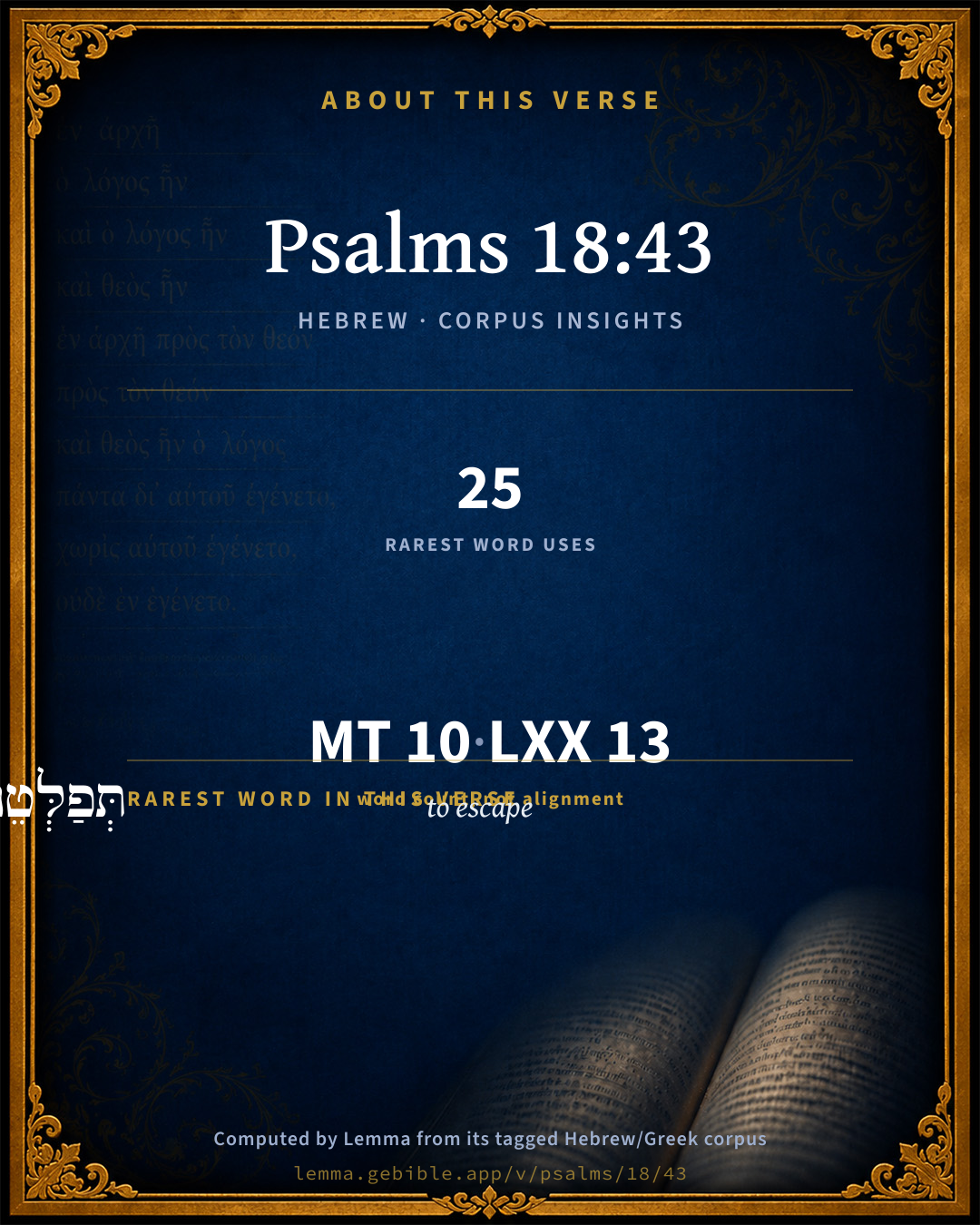
The rarest word here is תְּפַלְּטֵנִי֮ to escape H6403 — appearing just 25 times in the whole Hebrew Bible.

Shared distinctive vocabulary

תְּפַלְּטֵנִי֮ to escape H6403 occurs in 23 verses of the Hebrew Bible. Also found in:

Grammatical profile

  • 4 verbs
  • 5 nouns
  • 1 particle

Verb forms

  • תְּפַלְּטֵנִי֮ Piel · Imperfect
  • תְּ֭שִׂימֵנִי Qal · Imperfect
  • יָדַ֣עְתִּי Qal · Perfect
  • יַֽעַבְדֽוּנִי Qal · Imperfect

Repetition

A word recurs within this verse — often emphatic in Hebrew:

  • עָ֥ם people H5971 ×2

Hebrew & Septuagint length

In English translation the verse runs 29 words from the Hebrew and 25 from the Septuagint (LXX English) — closely comparable.

A rough comparison of the two English renderings, which tokenize alike — not a word-level alignment.

Word counts can differ between the Hebrew and the Greek without any difference in meaning — e.g. the Hebrew direct-object marker אֵת has no separate Greek word, and Greek often adds the article ὁ.

In the original languages it is 10 Hebrew tokens and 13 Greek tokens — but the two are counted differently (Hebrew bundles its prefixes and suffixes into one token; the Greek is in lemma form), so that isn’t a like-for-like length.

Cross-references

21

Topical passages linked to Psalms 18:43 in the Treasury of Scripture Knowledge — connected by theme and wording, ordered by reader-vote popularity; previews shown in the World English Bible.

  • Isaiah 55:5 Behold, you shall call a nation that you don't know; and a nation that didn't know you shall run to you, because of Yahweh your God, and for the Holy One of Israel; for he has glorified you.
  • 2 Samuel 3:1 Now there was long war between the house of Saul and the house of David: and David grew stronger and stronger, but the house of Saul grew weaker and weaker.
  • Isaiah 52:15 so shall he sprinkle many nations; kings shall shut their mouths at him: for that which had not been told them shall they see; and that which they had not heard shall they understand.
  • 1 Peter 2:10 who in time past were no people, but now are God's people, who had not obtained mercy, but now have obtained mercy.
  • 2 Samuel 19:9 All the people were at strife throughout all the tribes of Israel, saying, The king delivered us out of the hand of our enemies, and he saved us out of the hand of the Philistines; and now he is fled out of the land from Absalom.
  • Ephesians 1:22 He put all things in subjection under his feet, and gave him to be head over all things for the assembly,
  • 2 Samuel 22:44–46 You also have delivered me from the strivings of my people; You have kept me to be the head of the nations: A people whom I have not known shall serve me.
  • Psalms 22:27–28 All the ends of the earth shall remember and turn to Yahweh. All the relatives of the nations shall worship before you.
  • Acts 5:31 God exalted him with his right hand to be a Prince and a Savior, to give repentance to Israel, and remission of sins.
  • Romans 15:12 Again, Isaiah says, "There will be the root of Jesse, He who arises to rule over the Gentiles; On him will the Gentiles hope."
  • Romans 15:18 For I will not dare to speak of any things except those which Christ worked through me, for the obedience of the Gentiles, by word and deed,
  • Romans 16:26
  • Revelation 11:15 The seventh angel sounded, and great voices in heaven followed, saying, "The kingdom of the world has become the Kingdom of our Lord, and of his Christ. He will reign forever and ever!"
  • 2 Samuel 2:9–10 and he made him king over Gilead, and over the Ashurites, and over Jezreel, and over Ephraim, and over Benjamin, and over all Israel.
  • 2 Samuel 8:1–18 After this it happened that David struck the Philistines, and subdued them: and David took the bridle of the mother city out of the hand of the Philistines.
  • Isaiah 49:22–23 Thus says the Lord Yahweh, Behold, I will lift up my hand to the nations, and set up my ensign to the peoples; and they shall bring your sons in their bosom, and your daughters shall be carried on their shoulders.
  • Hosea 1:10 Yet the number of the children of Israel will be as the sand of the sea, which can't be measured nor numbered; and it will come to pass that, in the place where it was said to them, 'You are not my people,' they will be called 'sons of the living God.'
  • 2 Samuel 5:1–25 Then came all the tribes of Israel to David to Hebron, and spoke, saying, Behold, we are your bone and your flesh.
  • 2 Samuel 10:1–19 It happened after this, that the king of the children of Ammon died, and Hanun his son reigned in his place.
  • Psalms 108:9 Moab is my wash pot. I will toss my sandal on Edom. I will shout over Philistia."
  • Isaiah 49:6 yes, he says, It is too light a thing that you should be my servant to raise up the tribes of Jacob, and to restore the preserved of Israel: I will also give you for a light to the Gentiles, that you may be my salvation to the end of the earth.

Cross-references courtesy of OpenBible.info (CC BY 4.0).

Hebrew and Greek witnesses Masoretic Hebrew ↔ Greek Septuagint

The same verse in the two great witnesses to the Old Testament, shown verse-for-verse.

You’re reading Greek Psalm 17 (Hebrew Psalm 18). The Septuagint counts the superscription, so verse numbers can differ from the Hebrew — chapter-level alignment, not verse-by-verse. Numbering follows Rahlfs.

These are two independent witnesses, not word-aligned to each other, and the Septuagint is shown in lemma (dictionary) form.

Hebrew Psalms 18:43 Masoretic · Westminster Leningrad Codex

תְּפַלְּטֵנִי֮ מֵרִ֪יבֵ֫י עָ֥ם תְּ֭שִׂימֵנִי לְרֹ֣אשׁ גּוֹיִ֑ם עַ֖ם לֹא יָדַ֣עְתִּי יַֽעַבְדֽוּנִי

You have delivered me from the strivings of the people. You have made me the head of the nations. A people whom I have not known shall serve me.

World English Bible · Public Domain

Greek LXX Greek Psalm 17:43 Septuagint · lemma form

καί λεπτύνω αὐτός ὡς χοῦς κατά πρόσωπον ἄνεμος ὡς πηλός πλατύς λεαίνω αὐτός

Deliver me from the gain sayings of the people: you shall make me head of the Gentiles: a people whom I knew not served me,

LXX2012 (modern English Septuagint) · Public Domain

Hebrew: Westminster Leningrad Codex (CC BY 4.0). Greek: Septuagint (public domain); English from LXX2012 (modern English Septuagint) (Public Domain). How the Septuagint differs from the Hebrew →

Commentary

Notes on Psalms 18:43 from classic Christian and Jewish commentators (each source and its license shown beneath its notes). The classic Christian expositions comment on the surrounding passage and are grouped to its opening verse, so a note may address several verses; the Jewish commentaries on the Tanakh (Rashi and others) are per-verse, so they appear only where the commentator wrote on this verse.

Lemma curates 59 commentaries, every one of them public domain or Creative Commons licensed, each selected and text-cleaned for this edition rather than reprinted as found. About our sources →

Trapp's Complete Commentary

John Trapp

Psa 18:43 Thou hast delivered me from the strivings of the people; [and] thou hast made me the head of the heathen: a people [whom] I have not known shall serve me.

Ver. 43. Thou hast delivered me from the strivings of the people] viz. In the rebellions under Absalom, and Sheba, the son of Bichri. These, like bubbles which children blow up into the air, were soon blown out; and fell into the eyes of those who with the blasts of disloyalty and ambition held up the same.

Thou hast made me head of the heathen] Philistines, Syrians, Ammonites, &c. This is most true of Christ, head of his Church, which consisteth of all nations, and most of these were unknown unto him as man; and, by hearing of him, they were brought to submit unto him, when the apostles came and preached him among them. Hence it followeth,

John Trapp, A Commentary or Exposition upon All the Books of the Old and New Testament (1647–1656) — public domain. Text from a community e-Sword module.

Joseph Benson's Commentary

Psa 18:43-44. Thou hast delivered me from the strivings of the people — From the contentions, seditions, and tumults of my own people under Saul, and during the civil war raised by Abner in favour of Ishbosheth, when the tribes strove with each other; and from the invasions of the Philistines who attacked him soon after his accession to the throne. Thou hast made me the head of the heathen — Of the Ammonites, Moabites, Edomites, Syrians, and others, who were become tributary to him by his victories over them: see 2. Samuel Psa 8:1; 1 Chronicles 18. A people whom I have not known — Whom I had no acquaintance with nor relation to, not even by thy promise or grant; that is, barbarous and remote nations, shall serve me — Shall be subject to me. As soon as they hear of me — At the fame of my name and victorious arms, or upon the first tidings of my coming toward them; they shall obey me — They shall instantly comply with my will, as soon as they understand it. The strangers shall submit themselves unto me — The Hebrew is literally, the sons of the strangers shall lie unto me; that is, shall submit themselves to me, not willingly and cheerfully, as they will pretend, but only out of fear and by constraint. By this it appears, that this is spoken with reference to David, and not (as some would have it) to Christ; because Christ’s people are a willing people, (Psa 110:3,) and those whom he conquers freely obey him.

Joseph Benson's Commentary on the Old and New Testaments (1811–1818) — public domain. Text from a community e-Sword module.

J. A. Alexander on Psalms

Joseph Addison Alexander

44. (Psa 18:43). Thou wilt save me from the strifes of the people; thou wilt place me at the head (or for a chief) of nations; a people I have not known shall serve me. He was not only to be freed from the internal strifes of his own people, but by that deliverance enabled to subdue other nations. The closing words of the psalm, and its obvious connection with the promises in 2 Samuel 7., shew that this anticipation was not limited to David's personal triumphs, either at home or abroad, but meant to comprehend the victories of his successors, and especially of him in whom the royal line was at once to end and be perpetuated. It may, therefore, be affirmed with truth that this prediction had its complete fulfilment only in Christ.

Joseph Addison Alexander, The Psalms Translated and Explained (1850) — public domain. Text from a community e-Sword module.

Tyndale Open Study Notes

Tyndale Open Resources

18:43-45 With God’s victorious help, the psalmist achieved military and political success, thus fulfilling the history of David’s dynasty (Ps 2). The previous laments find some resolution in this psalm.

Tyndale Open Study Notes — © Tyndale Open Resources, licensed CC BY-SA 4.0. Text via the HelloAO Bible API.

Geneva Bible (1599)

Geneva Bible translators

The kingdom of Christ is in David’s kingdom prefigured, who by the preaching of his word bringeth all to his subjection.

Which dwell round about me.

Geneva Bible (1599) marginal notes — public domain. Text via Bolls.life.

Jamieson, Fausset & Brown

Robert Jamieson, A. R. Fausset & David Brown

Not only does He conquer civil foes, but foreigners, who are driven from their places of refuge.

Jamieson, Fausset & Brown — Commentary Critical and Explanatory on the Whole Bible (1871) — public domain (CC PDM 1.0). Text via the HelloAO Bible API.

Adam Clarke's Commentary

Verse 43. The strivings of the people] Disaffections and insurrections among my own subjects, as in the revolt of Absalom, the civil war of Abner in favour of Ish-bosheth, c.

The head of the heathen] ראש גוים rosh goyim, "the chief," or "governor, of the nations" all the circumjacent heathen people; all these were subdued by David, and brought under tribute.

A people whom I have not known] The people whom he knew were those of the twelve tribes; those whom he did not know were the Syrians, Philistines, Idumeans, &c. All these served him, that is, paid him tribute.

Adam Clarke's Commentary on the Bible (1810–1826) — public domain. Text from a community e-Sword/MySword module.

John Calvin's Commentaries

43. Thou shalt deliver me from the contentions of the people. David states, in a few words, that he had experienced the assistance of God in all variety of ways. He was in great danger from the tumults which sometimes arose among his own subjects, if God had not wonderfully allayed them, and subdued the fierceness of the people. It also happened, contrary to the general expectation, that David, as is stated in the second clause of the verse, was victorious far and wide, and overthrew the neighboring nations who had a little before discomfited all Israel by their forces. It was an astonishing renovation of things, when he not only suddenly restored to their former estate the people of Israel, who had been greatly reduced by defeat and slaughter, but also made his tributaries the neighboring nations, with whom before, on account of their hostility to the nation of Israel, it was impossible to live in peace. It would have been much to see the kingdom, after having sustained so grievous a calamity, still surviving, and after having again collected strength recovering its former state; but God, contrary to all expectation, conferred upon the people of Israel more than this; he enabled them even to subdue those who before had been their conquerors. David makes mention of both these; he tells us, in the first place, that when the people rose up in tumult against him, it was none other but God who stilled these commotions which took place within the kingdom; and, in the second place, that it was under the authority, and by the conduct and power of God, that powerful nations were subjected to him, and that the limits of the kingdom, which, in the time of Saul, had been weak and half broken, were greatly enlarged. Hence it is evident that David was assisted by God, not less with respect to his domestic affairs, that is to say, within his own kingdom, than against foreign enemies. As the kingdom of David was a type under which the Holy Spirit intended to shadow forth to us the kingdom of Christ, let us remember that, both in erecting and preserving it, it is necessary for God not only to stretch forth his arm and fight against avowed enemies, who from without rise up against him, but also to repress the tumults and strifes which may take place within the Church. This was clearly shown in the person of Christ from the beginning. In the first place, he met with much opposition from the infatuated obstinacy of those of his own nation. In the next place, the experience of all ages shows that the dissensions and strifes with which hypocrites rend and mangle the Church, are not less hurtful in undermining the kingdom of Christ, (if God do not interpose his hand to prevent their injurious effects,) than the violent efforts of his enemies. Accordingly God, to advance and maintain the kingdom of his own Son, not only overthrows before him external enemies, but also delivers him from domestic contentions; that is to say, from those within his kingdom, which is the Church. “C’est a dire au dedans de son royaume qui est l’Eglise.” — Fr.

A people whom I have not known shall serve me. The whole of this passage strongly confirms what I have just now touched upon, that the statements here made are not to be restricted to the person of David, but contain a prophecy respecting the kingdom of Christ which was to come. David, it is true, might have boasted that nations, with whose manners and dispositions he was only very imperfectly acquainted, were subject to him; but it is nevertheless certain, that none of the nations which he conquered were altogether unknown to him, nor removed at so great a distance as to render it difficult for him to acquire some knowledge of them. The conquests of David, therefore, and the submission of the people to him, were only an obscure figure in which God has exhibited to us some faint representation of the boundless dominion of his own Son, whose kingdom extends

“from the rising of the sun, even unto the going down of the same,” (Malachi 1:11,)

and comprehends the whole world.

John Calvin's Commentaries (1540-1563) — public domain. Text from the Calvin Translation Society English edition (1840s-50s) via the Christian Classics Ethereal Library (ccel.org). Calvin's coverage is partial (roughly two-thirds of the Bible); uncommented books and verses are honest gaps, never fabricated. The 19th-century editor's footnotes and remarks are omitted so the notes are faithfully Calvin's own voice.

Ellicott's Commentary for English Readers

(43) People.—The parallelism favours the interpretation which takes “people” as equivalent to peoples—the Gentiles. But as in Samuel it is “my people,” explain it of the early political troubles of David. Notice also in Samuel “preserved,” instead of “made.”

A Bible Commentary for English Readers, edited by Charles John Ellicott (1878–1897) — public domain. Text from a community e-Sword module.

The Cambridge Bible for Schools and Colleges

gen. ed. J. J. S. Perowne

43. from the strivings of the people] 2 Sam. has “from the strivings of my people,” and the reference seems to be to the civil war and internal dissension which disturbed the early years of David’s reign, while Saul’s house still endeavoured to maintain its position. See 2Sa_3:1. Through all these conflicts he had been safely brought, and made the head of the nations, supreme among surrounding peoples, See 2Sa_8:1-14; Psa_2:8.

thou hast made me] In 2 Sam. “thou hast preserved me to be the head of the nations.”

a people whom I have not known shall serve me] Rather, a people whom I knew not did serve meb. There is no reason for the sudden transition of the A.V. to the future here and in the two following verses. David is still thankfully recounting how God had raised him to his present eminence. There may be a special reference to the subjugation of the Syrians and their allies, whom he might well describe as “a people whom he had not known.” See 2Sa_8:6; 2Sa_10:19.

43–45. The establishment of David’s dominion at home and abroad.

The Cambridge Bible for Schools and Colleges (gen. ed. J. J. S. Perowne; Cambridge University Press, 1878–1918) — public domain. Text from a community e-Sword module.

John Gill's Exposition

As soon as they hear of me they shall obey me,.... That is, as soon as they should hear of Christ, through the preaching of the word, by which faith would come, they should readily and at once receive, embrace, and profess the Gospel, and yield a cheerful submission to the ordinances of it; and which has had its accomplishment among the Gentiles, Act 28:28;

the strangers shall submit themselves unto me; meaning either the same persons as before; the Gentiles, who were aliens from the commonwealth of Israel, and strangers to the covenant of promise, who should submit to Christ, to his Gospel, to his righteousness, and to the sceptre of his kingdom; though some interpret it of the degenerate Jews, "the sons of the stranger", as the words may be rendered; who, though called the children of God, and the children of the kingdom, yet were, as our Lord says, of their father the devil; and these, some of them, in a flattering and dissembling way, feigned themselves to be the followers and disciples of Christ: and, indeed, it looks as if hypocrites were intended, whether among Jews or Gentiles, or both, since the word here used, and rendered "submit", signifies to "lie"; and so it is in the metaphrase of Apollinarius; or, as in the margin of some Bibles, to "yield a feigned obedience"; see Psa 66:3. There seems to be an allusion to the conquest of nations, some of the inhabitants of which readily and heartily submit, but others only feignedly, and through fear, and the force of superior power they cannot withstand.

John Gill's Exposition of the Whole Bible (1746–1763) — public domain (CC PDM 1.0). Text via the HelloAO Bible API.

Albert Barnes' Notes on the Bible

Thou hast delivered me from the strivings of the people - From the contentions of the people; or, from the efforts which they have made to overcome and subdue me. The allusion is to the efforts made by the people, under the guidance of their leaders. It is not “strivings” among his own followers, but the efforts, the strivings, the contentions of his enemies, who endeavored to obtain the mastery over him, and to subdue him.

Thou hast made me the head of the heathen - The head of the nations; that is, the nations round about. In other words, he had, by the divine aid, brought them into subjection to him, or so subdued them that they became tributary to him. The word “heathen” with us expresses an idea which is not necessarily connected with the original word. That word is simply nations - גוים gôyim. It is true that those nations were pagans in the present sense of the term, but that idea is not necessarily connected with the word. The meaning is, that surrounding nations had been made subject to him; or that he had been made to rule over them. David, in fact, thus brought the surrounding people under subjection to him, and made them tributary. In 2 Sam. 8 he is said to have subdued Philistia, and Moab, and Syria, and Edom, in all of which countries he put “garrisons,” and all of which he made tributary to himself.

A people whom I have not known shall serve me - People that I had not before heard of. This is the language of confident faith that his kingdom would be still further extended, so as to embrace nations before unknown to him. His past victories, and the fact that his kingdom had been so established and was already so extended, justified the expectation that it would still be further enlarged; that the fame of his conquests would reach other nations, and that they would willingly yield themselves to him. After the victories which he had achieved, as celebrated in this psalm, that might be expected to follow as a matter of course. It is the triumphant exultation of a conqueror, and it seems to have been his expectation, not that his successors would extend the empire, but, that other nations would become voluntarily subject to him.

Albert Barnes' Notes on the Bible (1834–1885) — public domain. Text from a community e-Sword/MySword module.

Matthew Poole's English Annotations

From the strivings of the people; from contentions, and seditions, and tumults of my own people under Saul, and Ish-bosheth, and Absalom.

The head of the heathen; of the Ammonites, Moabites, Edomites, Syrians, and others.

Whom I have not known; whom I had no acquaintance with, nor relation to, no, not by thy promise or grant; even barbarous and remote nations.

Matthew Poole's English Annotations on the Holy Bible (1683–1685) — public domain. Text from a community e-Sword/MySword module.

Whedon's Commentary on the Bible

Daniel D. Whedon

43. From the strivings of the people—This better applies to internal faction, such as was experienced during the seven years that Ishbosheth disputed the throne with David, rather than to foreign war. 2 Samuel 2-3. In the parallel place, (2Sa_22:44,) the people reads “my people.” confirming this view.

Head of the heathen—Or, the nations. True of David, and more true of Christ.

Daniel D. Whedon (gen. ed.), Commentary on the Old and New Testaments (1874–1909) — public domain. Text from a community e-Sword module.

The Pulpit Commentary

Thou hast delivered me from the strivings of the people. David now approaches his conclusion. In one verse he at once sums up his past deliverances and anticipates fresh glories. God has delivered him from the strivings of those who were hostile to him among his own people (see vers. 4-18), and has also given him victory over the heathen. In the future he will do even more. And thou hast made me the head of the heathen. The antithesis between "people" ( and "heathen," or "nations" ( is unmistakable. The long series of David"s victories have made him "head" over the latter. This is less clearly seen in the history of David"s reign than in the description given of the state of the kingdom inherited from David by Solomon. (1Ki_4:21, 1Ki_4:24) A people whom I have not known shall serve me. It is not clear that this was ever fulfilled literally in the person of David, and, we are entitled to explain it as a Messianic prophecy, parallel with that of Psa_2:8.

The Pulpit Commentary (1880–1919), ed. H.D.M. Spence-Jones & Joseph S. Exell — public domain. Text from a community e-Sword module.

John Wesley's Explanatory Notes

People - From contentions, and seditions, under Saul, and Ishbosheth, and Absalom. Heathens - Of the Ammonites, Moabites, Edomites, Syrians, and others. Not known - Even barbarous and remote nations.

John Wesley, Explanatory Notes Upon the Whole Bible (1754–1765) — public domain. Text via the GEBible commentary corpus.

Keil & Delitzsch

C. F. Keil & F. Delitzsch

(Heb.: 18:44-46) Thus victorious in God, David became what he now is, viz., the ruler of a great kingdom firmly established both in home and foreign relations. With respect to the גּוים and the verb תּפלּטני which follows, ריבי עם can only be understood of the conflicts among his own people, in which David was involved by the persecution of Saul and the rebellions of Absolom and Sheba the son of Bichri; and from which Jahve delivered him, in order to preserve him for his calling of world-wide dominion in accordance with the promise. We therefore interpret the passage according to בּרית עם in Isa 49:8, and קנאת־עם in Isa 26:11; whereas the following עם comes to have a foreign application by reason of the attributive clause לא־ידעתּי (Ges. 123, 3). The Niph. נשׁמע in Psa 18:45 is the reflexive of שׁמע, to obey (e.g., Exo 24:7), and is therefore to be rendered: show themselves obedient (= Ithpa. in Dan 7:27). לשׁמע אזן implies more than that they obeyed at the word; שׁמע means information, rumour, and שׁמע אזן is the opposite of personal observation (Job 42:5), it is therefore to be rendered: they submitted even at the tidings of my victories; and Sa2 8:9. is an example of this. כּחשׁ to lie, disown, feign, and flatter, is sued here, as it is frequently, of the extorted humility which the vanquished show towards the conqueror. Psa 18:46 completes the picture of the reason of the sons of a foreign country "putting a good face on a bad game." They faded away, i.e., they became weak and faint-hearted (Exo 18:18), incapable of holding out against or breaking through any siege by David, and trembled, surrendering at discretion, out of their close places, i.e., out of their strongholds behind which they had shut themselves in (cf. Ps 142:8). The signification of being alarmed, which in this instance, being found in combination with a local מן, is confined to the sense of terrified flight, is secured to the verb חרג by the Arabic ḥarija (root ḥr, of audible pressure, crowding, and the like) to be pressed, crowded, tight, or narrow, to get in a strait, and the Targumic חרנּא דמותא = אימתא דמותא (vid., the Targums on Deu 32:25). Arab. ḥjl, to limp, halt, which is compared by Hitzig, is far removed as to the sound; and the most natural, but colourless Arab. chrj, to go out of (according to its radical meaning - cf. Arab. chrq, chr‛, etc. - : to break forth, erumpere), cannot be supported in Hebrew or Aramaic. The ירגּזוּ found in the borrowed passage in Micah, Mic 7:17, favours our rendering.

Keil & Delitzsch — Biblical Commentary on the Old Testament (1861–1891) — public domain (CC PDM 1.0). Text via the HelloAO Bible API. (Old Testament only.)

unfoldingWord translationNotes

Door43 World Missions Community

disputes

disagreements, arguments

have made me the head over nations

Here "head" represents the ruler. AT: "appointed me to be the ruler over many nations" (See: Metonymy)

foreigners were forced to bow

This can be stated in active form. AT: "God forced foreigners to bow" (See: Active or Passive)

foreigners came trembling

Here "trembling" shows that they were very afraid. This can be stated clearly in the translation. AT: "foreigners came shaking, showing that they were very afraid" (See: Assumed Knowledge and Implicit Information)

translationWords

people group

head

nation

know

servant

obey

alien

bow

stronghold

unfoldingWord translationNotes — © Distant Shores Media and the Door43 World Missions Community, licensed CC BY-SA 4.0. Source: git.door43.org/Door43/en_tn.

Rashi

Rabbi Shlomo Yitzchaki (Rashi)

Then I ground them Heb. ואשחקם, an expression of crushing.

I did pour them like loose mud, which is not thick, as (in Gen. 42:35): “when they emptied (מריקים) their sacks”; (in Jer. 48:11), “has not been poured (הורק) from one vessel to another vessel.”

Rashi on the Tanakh — English translations: “The Judaica Press complete Tanach with Rashi, translated by A. J. Rosenberg” (CC BY 4.0); “Pentateuch with Rashi's commentary by M. Rosenbaum and A.M. Silbermann, 1929-1934” (public domain); “The Metsudah Tanach series, Lakewood, N.J” (CC BY 4.0); and “The Book of Joshua, Metsudah Publications, 1997” (CC BY 4.0). Text via Sefaria.

Lesson kit

Teaching starters — assembled from the data on this page, not authored interpretation. Every prompt links to the verse data it draws on. Edit before teaching.

Psalms, in the Wisdom, opens this verse with 10 words (9 distinct Hebrew lemmas). Its most distinctive word is pâlaṭ (“to escape”). A historical commentator’s framing appears above. Read the whole chapter for the surrounding context.

Discussion questions

  1. What does “to escape” (pâlaṭ) contribute to the verse as a whole?
  2. 2 Samuel 22:2 shares the word «to escape» with this verse. How do the two illuminate each other?
  3. “people” occurs 2× in this one verse. What is the effect of the repetition?
  4. These translations render this verse differently. What is at stake in choosing one wording over another?
  5. The verb «תְּפַלְּטֵנִי֮» is Piel Imperfect. How does its form color the action?
  6. Reading how Trapp's Complete Commentary and Joseph Benson's Commentary read this verse, where do the two commentators agree and where do they part?

Things to notice

Reading settings

Reading text

Shown beneath each verse's original-language words.

Old Testament
Old Testament edition

Read the OT as the Masoretic Hebrew (MT) or the Greek Septuagint (LXX).

English shown for the Greek Septuagint (in the Hebrew ↔ Greek comparison).

Comparing translations? Open the Compare panel on any verse page to stack up to four side by side.