2 Kings 21:2

Hebrew (Westminster Leningrad Codex) 2 Kings 21:2 appears in the Hebrew Old Testament. The text above is from the Westminster Leningrad Codex. Each word links to its Strong’s number, a concise gloss, and parsing drawn from the Open Scriptures Hebrew Bible morphology. Click any word for its full Brown-Driver-Briggs (BDB) entry.
Download image
Cite this verse

2 Kings 21:2 (World English Bible). Public Domain. Lemma interlinear Bible study tool, https://lemma.gebible.app/v/2-kings/21/2.

Show BibTeX & RIS
BibTeX
RIS
English Translation
He did that which was evil in the sight of Yahweh, after the abominations of the nations whom Yahweh cast out before the children of Israel.
World English Bible · Public Domain
Download a study sheet

One document with this verse’s original text, its word-by-word gloss line, the meaning frame, cross-references with their text, attributed commentary, and full source and license credits — printable, and it pastes into notes with its structure intact.

This verse Autodidact and up

Study sheet (.html) Plain text (.txt)

A passage Seminary Student

Up to 50 verses in one chapter. A passage sheet keeps up to 6 commentary sources and 12 cross-references per verse, in the order this page ranks them, and says so on the sheet whenever that leaves anything out. Ask for a single verse and you get the Autodidact verse sheet above.

Everything on this page stays free to read, with no account — the sheet is a download of what is already on screen, not access to it.

Want to remove ads? Support Godless Engineer
Compare translations 3

The same verse in 3 English versions, stacked beneath the original-language interlinear above. Click any original word for its lexicon entry.

Each is an independent rendering of the whole verse — the interlinear is not word-aligned to these translations.

Highlighted words mark where these versions differ — a whole-verse word diff, not a word-by-word alignment.

  • World English Bible Public Domain
    He did that which was evil in the sight of Yahweh, after the abominations of the nations whom Yahweh cast out before the children of Israel.
  • King James Version Public Domain
    And he did that which was evil in the sight of the LORD, after the abominations of the heathen, whom the LORD cast out before the children of Israel.
  • unfoldingWord Literal Text CC BY-SA 4.0
    And he did evil in the eyes of Yahweh, like the abominations of the nations that Yahweh had driven out from the face of the sons of Israel.

unfoldingWord Literal Text — © unfoldingWord, licensed CC BY-SA 4.0. Word-aligned USFM3 via Door43 (git.door43.org/unfoldingWord/en_ult).

Versions to compare (up to 4)

3 of 4 selected

Show all 18 translations

Every available English version of this verse, each an independent rendering of the whole verse.

  • World English Bible Public Domain
    He did that which was evil in the sight of Yahweh, after the abominations of the nations whom Yahweh cast out before the children of Israel.
  • Berean Standard Bible Public Domain
    And he did evil in the sight of the LORD by following the abominations of the nations that the LORD had driven out before the Israelites.
  • Majority Standard Bible Public Domain
    And he did evil in the sight of the LORD by following the abominations of the nations that the LORD had driven out before the Israelites.
  • King James Version Public Domain
    And he did that which was evil in the sight of the LORD, after the abominations of the heathen, whom the LORD cast out before the children of Israel.
  • American Standard Version (1901) Public Domain
    And he did that which was evil in the sight of Jehovah, after the abominations of the nations whom Jehovah cast out before the children of Israel.
  • Revised Version (1885) Public Domain
    And he did that which was evil in the sight of the LORD, after the abominations of the heathen, whom the LORD cast out before the children of Israel.
  • Geneva Bible (1599) Public Domain
    And he did euill in the sight of the Lord after the abomination of the heathen, whom the Lord had cast out before the children of Israel.
  • Douay-Rheims (1899) Public Domain
    And he did evil in the sight of the Lord, according to the idols of the nations, which the Lord destroyed from before the face of the children of Israel.
  • Young's Literal Translation Public Domain
    and he doth the evil thing in the eyes of Jehovah, according to the abominations of the nations that Jehovah dispossessed from the presence of the sons of Israel,
  • Literal Standard Version CC BY-SA 4.0
    and he does evil in the eyes of YHWH, according to the abominations of the nations that YHWH dispossessed from the presence of the sons of Israel,
  • Unlocked Literal Bible CC BY-SA 4.0
    He did what was evil in the sight of Yahweh, like the disgusting things of the nations whom Yahweh had driven out before the people of Israel.
  • unfoldingWord Literal Text CC BY-SA 4.0
    And he did evil in the eyes of Yahweh, like the abominations of the nations that Yahweh had driven out from the face of the sons of Israel.
  • Darby Bible Public Domain
    And he did evil in the sight of Jehovah, like the abominations of the nations that Jehovah had dispossessed from before the children of Israel.
  • World Messianic Bible Public Domain
    He did that which was evil in the LORD’s sight, after the abominations of the nations whom the LORD cast out before the children of Israel.
  • Webster's Bible Public Domain
    And he did that which was evil in the sight of the LORD, after the abominations of the heathen, whom the LORD cast out before the children of Israel.
  • Free Bible Version CC BY-SA 4.0
    He did what was evil in the Lord's sight by following the disgusting pagan practices of the nations that the Lord had driven out before the Israelites.
  • Bible in Basic English Public Domain
    He did evil in the eyes of the Lord, copying the disgusting ways of those nations whom the Lord had sent out before the children of Israel.
  • JPS Tanakh (1917) Public Domain
    And he did that which was evil in the sight of the LORD, after the abominations of the nations, whom the LORD cast out before the children of Israel.

Literal Standard Version (2020), Covenant Press — licensed CC BY-SA 4.0. Text via the HelloAO Bible API (eBible.org). Unlocked Literal Bible (unfoldingWord) — licensed CC BY-SA 4.0. Text via the HelloAO Bible API (eBible.org). unfoldingWord Literal Text — © unfoldingWord, licensed CC BY-SA 4.0. Word-aligned USFM3 via Door43 (git.door43.org/unfoldingWord/en_ult). Free Bible Version, Dr. Jonathan Gallagher — licensed CC BY-SA 4.0. Text via the HelloAO Bible API (eBible.org).

Word by word

More ways to search: Search by grammar → Find every occurrence → Compare this word →

Practice this passage: Drill this verse → Learn its vocabulary →

כְּתֽוֹעֲבֹת֙
tôwʻêbah
H8441
“like/as · abominations of”
Preposition + Noun, Common, Feminine, Plural, Construct
Part of Speech
Preposition + Noun
Type
Common
Gender
Feminine
Number
Plural
State
Construct
Full BDB Definition

Origin: act part of H8581

TWOT: 2530a

a disgusting thing, abomination, abominable - in ritual sense (of unclean food, idols, mixed marriages) - in ethical sense (of wickedness etc)
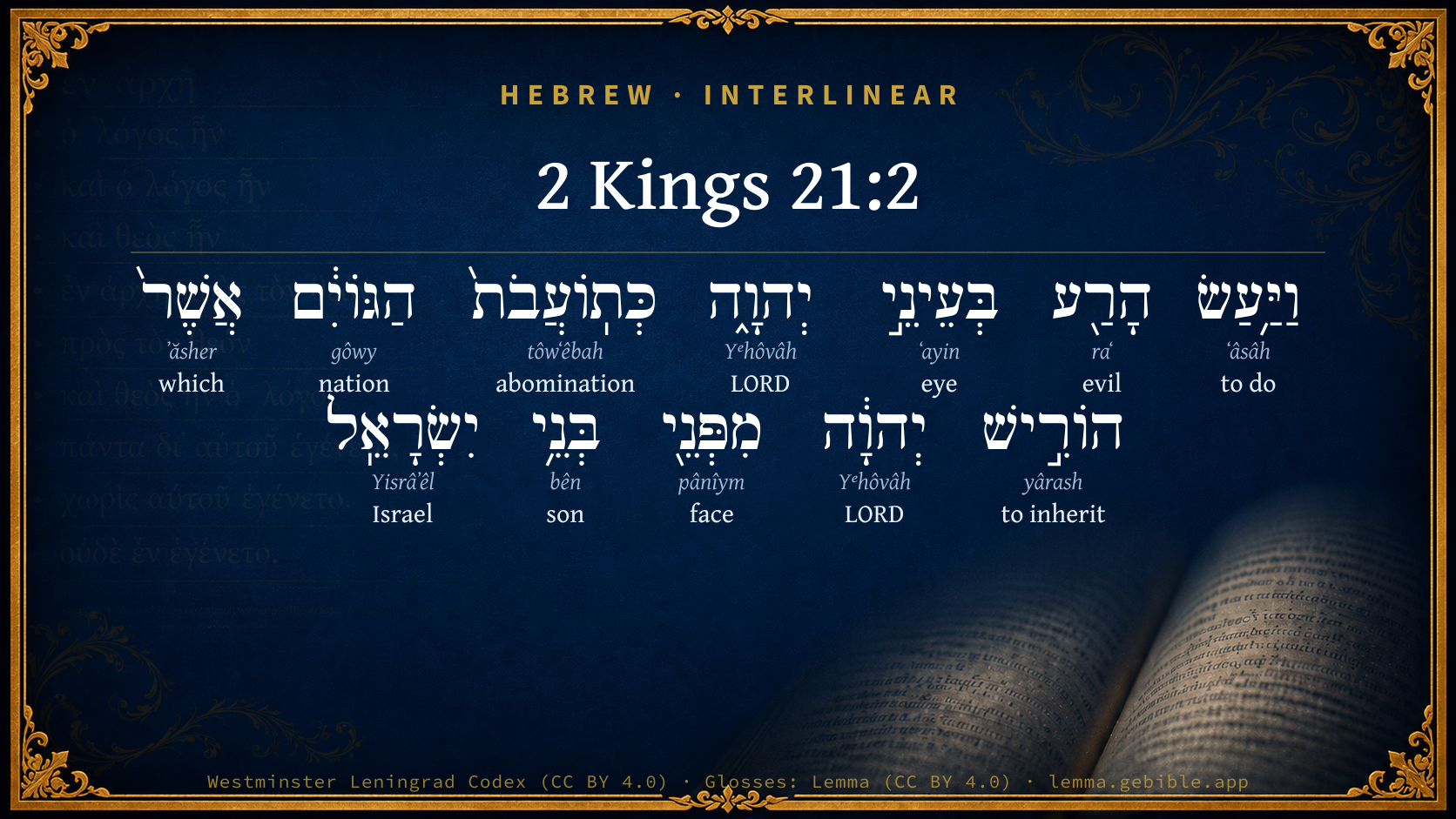
  1. וַיַּ֥עַשׂ ʻâsâh H6213 “and · to do” Conjunction + Verb, Qal, Sequential Imperfect, 3rd Person, Masculine, Singular
  2. הָרַ֖ע raʻ H7451 “the · evil” Particle, Definite Article + Adjective, Adjective, Masculine, Singular, Absolute
  3. בְּעֵינֵ֣י ʻayin H5869 “in/at · eyes of” Preposition + Noun, Common, Both, Dual, Construct
  4. יְהוָ֑ה Yᵉhôvâh H3068 “LORD” Noun, Proper
  5. הַגּוֹיִ֔ם gôwy H1471 “the · nations” Particle, Definite Article + Noun, Common, Masculine, Plural, Absolute
  6. אֲשֶׁר֙ ʼăsher H834 “which” Particle, Relative
  7. הוֹרִ֣ישׁ yârash H3423 “to inherit” Verb, Hiphil, Perfect, 3rd Person, Masculine, Singular
  8. יְהוָ֔ה Yᵉhôvâh H3068 “LORD” Noun, Proper
  9. מִפְּנֵ֖י pânîym H6440 “from · face(s) of” Preposition + Noun, Common, Both, Plural, Construct
  10. בְּנֵ֥י bên H1121 “sons of” Noun, Common, Masculine, Plural, Construct
  11. יִשְׂרָאֵֽל Yisrâʼêl H3478 “Israel” Noun, Proper

About this verse

These counts appear in no published source. They are computed here, from the morphology-tagged text and Lemma’s own curated glosses. What Lemma adds →

12
words
11
distinct lemmas
Historical
section

Grammatical profile

  • 2 verbs
  • 8 nouns
  • 1 adjective
  • 1 particle

Verb forms

  • וַיַּ֥עַשׂ Qal · Sequential Imperfect
  • הוֹרִ֣ישׁ Hiphil · Perfect

Repetition

A word recurs within this verse — often emphatic in Hebrew:

  • יְהוָ֑ה LORD H3068 ×2

Hebrew & Septuagint length

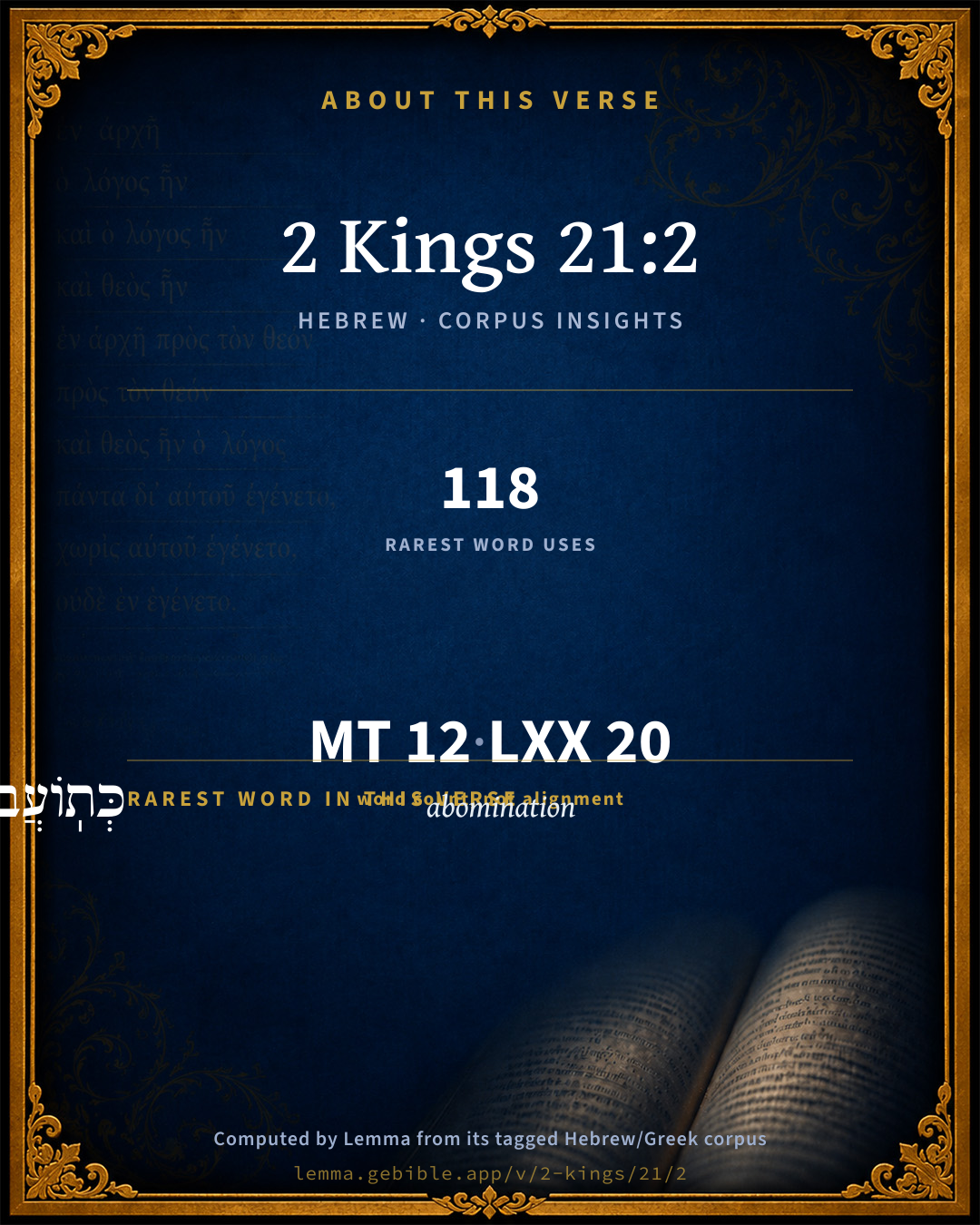
In English translation the verse runs 26 words from the Hebrew and 31 from the Septuagint (LXX English) — closely comparable.

A rough comparison of the two English renderings, which tokenize alike — not a word-level alignment.

Word counts can differ between the Hebrew and the Greek without any difference in meaning — e.g. the Hebrew direct-object marker אֵת has no separate Greek word, and Greek often adds the article ὁ.

In the original languages it is 12 Hebrew tokens and 20 Greek tokens — but the two are counted differently (Hebrew bundles its prefixes and suffixes into one token; the Greek is in lemma form), so that isn’t a like-for-like length.

Cross-references

10

Topical passages linked to 2 Kings 21:2 in the Treasury of Scripture Knowledge — connected by theme and wording, ordered by reader-vote popularity; previews shown in the World English Bible.

  • Leviticus 18:25–29 The land was defiled: therefore I punished its iniquity, and the land vomitted out her inhabitants.
  • Deuteronomy 12:31 You shall not do so to Yahweh your God: for every abomination to Yahweh, which he hates, have they done to their gods; for even their sons and their daughters do they burn in the fire to their gods.
  • 2 Kings 16:2–4 Twenty years old was Ahaz when he began to reign; and he reigned sixteen years in Jerusalem: and he didn't do that which was right in the eyes of Yahweh his God, like David his father.
  • 2 Kings 21:7 He set the engraved image of Asherah, that he had made, in the house of which Yahweh said to David and to Solomon his son, In this house, and in Jerusalem, which I have chosen out of all the tribes of Israel, will I put my name forever;
  • 2 Kings 21:16 Moreover Manasseh shed innocent blood very much, until he had filled Jerusalem from one end to another; besides his sin with which he made Judah to sin, in doing that which was evil in the sight of Yahweh.
  • 2 Kings 22:17 Because they have forsaken me, and have burned incense to other gods, that they might provoke me to anger with all the work of their hands, therefore my wrath shall be kindled against this place, and it shall not be quenched.
  • 2 Chronicles 33:2–4 He did that which was evil in the sight of Yahweh, after the abominations of the nations whom Yahweh cast out before the children of Israel.
  • 2 Chronicles 36:14 Moreover all the chiefs of the priests, and the people, trespassed very greatly after all the abominations of the nations; and they polluted the house of Yahweh which he had made holy in Jerusalem.
  • Jeremiah 15:4 I will cause them to be tossed back and forth among all the kingdoms of the earth, because of Manasseh, the son of Hezekiah, king of Judah, for that which he did in Jerusalem.
  • Ezekiel 16:51 Neither has Samaria committed half of your sins; but you have multiplied your abominations more than they, and have justified your sisters by all your abominations which you have done.

Cross-references courtesy of OpenBible.info (CC BY 4.0).

Hebrew and Greek witnesses Masoretic Hebrew ↔ Greek Septuagint

The same verse in the two great witnesses to the Old Testament, shown verse-for-verse.

These are two independent witnesses, not word-aligned to each other, and the Septuagint is shown in lemma (dictionary) form.

Hebrew 2 Kings 21:2 Masoretic · Westminster Leningrad Codex

וַיַּ֥עַשׂ הָרַ֖ע בְּעֵינֵ֣י יְהוָ֑ה כְּתֽוֹעֲבֹת֙ הַגּוֹיִ֔ם אֲשֶׁר֙ הוֹרִ֣ישׁ יְהוָ֔ה מִפְּנֵ֖י בְּנֵ֥י יִשְׂרָאֵֽל

He did that which was evil in the sight of Yahweh, after the abominations of the nations whom Yahweh cast out before the children of Israel.

World English Bible · Public Domain

Greek LXX 2 Kings 21:2 Septuagint · lemma form

καί ποιέω ὁ πονηρός ἐν ὀφθαλμός κύριος κατά ὁ βδέλυγμα ὁ ἔθνος ὅς ἐκαἴρω κύριος ἀπό πρόσωπον ὁ υἱός ἰσραήλ

And he did that which was evil in the eyes of the Lord, according to the abominations of the nations which the Lord cast out from before the children of Israel.

LXX2012 (modern English Septuagint) · Public Domain

Hebrew: Westminster Leningrad Codex (CC BY 4.0). Greek: Septuagint (public domain); English from LXX2012 (modern English Septuagint) (Public Domain). How the Septuagint differs from the Hebrew →

Targum (Aramaic paraphrase)

1

The Targum is the ancient Jewish Aramaic paraphrase of the Hebrew Scriptures — an interpretive translation, not the Hebrew text itself. Onkelos (literal) and Pseudo-Jonathan (expansive) render the Torah, and Jonathan the Prophets. Coverage is partial: where no permissively-licensed English translation exists for a verse, only the Aramaic is shown. This is verse-level text, not a word-by-word alignment to the Hebrew.

  1. Targum Jonathan Prophets (Joshua–Malachi)
    וַעֲבַד דְבִישׁ קֳדָם יְיָ כְּתוֹעֲבַת עַמְמַיָא דְתָרִיךְ יְיָ מִן קֳדָם בְּנֵי יִשְׂרָאֵל:

    (no public-domain English translation for this verse)

    Targum Jonathan — Aramaic: “Mikraot Gedolot” (public domain). English: “Sefaria Community Translation” (CC0 1.0 (public-domain dedication)); “London "Chaldee Paraphrase," 1871” (public domain). Text via Sefaria.

Commentary

Notes on 2 Kings 21:2 from classic Christian and Jewish commentators (each source and its license shown beneath its notes). The classic Christian expositions comment on the surrounding passage and are grouped to its opening verse, so a note may address several verses; the Jewish commentaries on the Tanakh (Rashi and others) are per-verse, so they appear only where the commentator wrote on this verse.

Lemma curates 59 commentaries, every one of them public domain or Creative Commons licensed, each selected and text-cleaned for this edition rather than reprinted as found. About our sources →

Trapp's Complete Commentary

John Trapp

2Ki 21:2 And he did [that which was] evil in the sight of the LORD, after the abominations of the heathen, whom the LORD cast out before the children of Israel.

Ver. 2. And he did evil in the sight of the Lord.] Drawn thereunto, likely, by his young courtiers and evil counsellors: as young lapwings are apt to be snatched up by every buzzard. Little did good Hezekiah - when he was so loath to die because he had no son to succeed him - think, what a son he should leave behind him. The Rabbis fable, that Isaiah, coming on a time to visit Hezekiah, told him that his son Manasseh there present should prove a great persecutor of the prophets, and of himself in particular: and that hereupon Hezekiah would have slain Manasseh, but that the prophet held and hindered him.

John Trapp, A Commentary or Exposition upon All the Books of the Old and New Testament (1647–1656) — public domain. Text from a community e-Sword module.

Joseph Benson's Commentary

2Ki 21:2. He did evil in the sight of the Lord — Through his own vicious inclinations, and the instigation of the wicked princes of Judah, who in Hezekiah’s time were secret enemies to the reformation which he was endeavouring to effect; and now, when the restraint which they had been under was removed by his death, broke forth into open hostility against it, and corrupted the king’s tender years with their wicked counsels. After the abominations of the heathen — It had been his father’s first care to root all idolatry out of his kingdom, and to restore the service of the temple to its pristine order and splendour. But this his graceless son, on the contrary, made it his study to banish religion and morality out of the country, to revive the old idolatry, and to introduce new and unheard-of idols and ceremonies; besides witchcraft, sorceries, and every wicked custom that was used among the heathen far and near. Baal became now the favourite object of his worship: Moloch and the valley of Hinnom were now more frequented than ever; the impious king encouraging his impious subjects to sacrifice their children there, as Ahaz had done before. He did not, however, pass unpunished for these offences: but for the particulars of his punishment, which are not mentioned in this book, the reader must be referred to 2Ch 33:11, &c. See Dodd.

Joseph Benson's Commentary on the Old and New Testaments (1811–1818) — public domain. Text from a community e-Sword module.

Adam Clarke's Commentary

Verse 2. After the abominations of the heathen] He exactly copied the conduct of those nations which God had cast out of that land.

Adam Clarke's Commentary on the Bible (1810–1826) — public domain. Text from a community e-Sword/MySword module.

Ellicott's Commentary for English Readers

(2) And he did that which was evil.—Perhaps under the pernicious influence of his courtiers. (Comp. the case of Rehoboam.)

After the abominations.—Comp. Deu_29:17; 1Ki_11:5.

The heathen . . . cast.—The nations . . . dispossessed—i.e., the peoples of Canaan (2Ki_17:8).

A Bible Commentary for English Readers, edited by Charles John Ellicott (1878–1897) — public domain. Text from a community e-Sword module.

The Cambridge Bible for Schools and Colleges

gen. ed. J. J. S. Perowne

2. after the abominations of the heathen] He followed all the idolatrous practices of the nations of Canaan, but as is said below, in verse 2, it was greater sin in him than in them, because he sinned in spite of knowledge.

The Cambridge Bible for Schools and Colleges (gen. ed. J. J. S. Perowne; Cambridge University Press, 1878–1918) — public domain. Text from a community e-Sword module.

John Gill's Exposition

And he did that which was evil in the sight of the Lord,.... Was guilty of idolatry:

after the abomination of the Heathen, whom the Lord cast out before the children of Israel: the old Canaanites; he committed idolatry in imitation of them, and as the Phoenicians now did before the children of Israel: the old Canaanites; he committed idolatry in imitation of them, and as the Phoenicians now did.

John Gill's Exposition of the Whole Bible (1746–1763) — public domain (CC PDM 1.0). Text via the HelloAO Bible API.

Albert Barnes' Notes on the Bible

Manasseh during his minority naturally fell under the influence of the chief Jewish nobles, with whom the pure religion of Yahweh was always unpopular (compare 2Ch 24:17-18; Jer 8:1-2). They seem to have persuaded him, not only to undo Hezekiah’s work, but to proceed to lengths in polytheism, magic, and idolatry, unknown before. The sins of Manasseh’s reign appear to have been those which filled up the measure of Judah’s iniquity, and brought down the final sentence of doom on the last remnant of the chosen people (2Ki 23:26; compare Jer 15:4).

Albert Barnes' Notes on the Bible (1834–1885) — public domain. Text from a community e-Sword/MySword module.

Haydock's Catholic Bible Commentary

Idols. Hebrew, "abominations," (Calmet) as their worship was attended with the greatest infamy and dissolution, and was in itself the source of God’s chastisements. (Haydock)

George Leo Haydock (1774–1849), Haydock's Catholic Family Bible and Commentary, 1859 edition — public domain. Excludes Psalms (Douay-Rheims chapter numbering differs from Protestant) and Deuterocanonical books (Catholic canon only).

Matthew Poole's English Annotations

Did that which was evil in the sight of the Lord; partly by the instigation of the wicked princes of Judah, who in Hezekiah’s time were secret enemies to his reformation, and now, when their fetters were knocked off by Hezekiah’s death, break forth into open hostility against it, and corrupt the king’s tender years with their wicked counsel; and principally by his own vicious inclination.

Matthew Poole's English Annotations on the Holy Bible (1683–1685) — public domain. Text from a community e-Sword/MySword module.

Whedon's Commentary on the Bible

Daniel D. Whedon

2. He did… after the abominations of the heathen — Keil thinks that the young and inexperienced king was led into idolatry by such a godless party in the nation as is described in Isa_28:14; Isa_30:9-11.

Daniel D. Whedon (gen. ed.), Commentary on the Old and New Testaments (1874–1909) — public domain. Text from a community e-Sword module.

The Pulpit Commentary

And he did that which was evil in the sight of the Lord. Manasseh was too young at the death of his father for his character to have been then definitively formed. He probably fell under the influence of the "princes of Judah," who, supported by many of the priests, had maintained themselves as a party antagonistic to Isaiah during the whole of Hezekiah"s reign. Hezekiah"s reformation had been carried out against their wishes.

They had always leant towards foreign alliances (Isa_20:5 Isa_30:1-7) and foreign rites. (Isa_2:6-9 Isa_65:3) The accession of a boy-kingwould be joyfully hailed by them, and they would make every effort to draw him to their side. It would seem that they were successful. After the abominations of the heathen the details which follow in vers. 3-9 sufficiently explain this strong expressionwhom the Lord east out before the children of Israel. It was solely because of their abominations that they were east out (see Gen_15:16; Lev_18:25 Lev_20:23; Deu_9:5 Deu_18:12, etc.)

The Pulpit Commentary (1880–1919), ed. H.D.M. Spence-Jones & Joseph S. Exell — public domain. Text from a community e-Sword module.

Lesson kit

Teaching starters — assembled from the data on this page, not authored interpretation. Every prompt links to the verse data it draws on. Edit before teaching.

2 Kings, in the Historical, opens this verse with 12 words (11 distinct Hebrew lemmas). Its most distinctive word is tôwʻêbah (“abomination”). A historical commentator’s framing appears above. Read the whole chapter for the surrounding context.

Discussion questions

  1. What does “abomination” (tôwʻêbah) contribute to the verse as a whole?
  2. How does Leviticus 18:25–29, which shares this passage’s theme, read alongside this verse?
  3. What does the repetition of “LORD” (2× in this one verse) do in this verse?
  4. The translations on this page render this verse differently — a whole-verse word diff, not a word-by-word alignment. What might account for the different wordings?
  5. «וַיַּ֥עַשׂ» is a Qal Sequential Imperfect verb. How does that grammatical form shape the action described?
  6. Compare how Trapp's Complete Commentary and Joseph Benson's Commentary read this verse. Where do they agree or differ?

Things to notice

Reading settings

Reading text

Shown beneath each verse's original-language words.

Old Testament
Old Testament edition

Read the OT as the Masoretic Hebrew (MT) or the Greek Septuagint (LXX).

English shown for the Greek Septuagint (in the Hebrew ↔ Greek comparison).

Comparing translations? Open the Compare panel on any verse page to stack up to four side by side.