Psalms 66:7

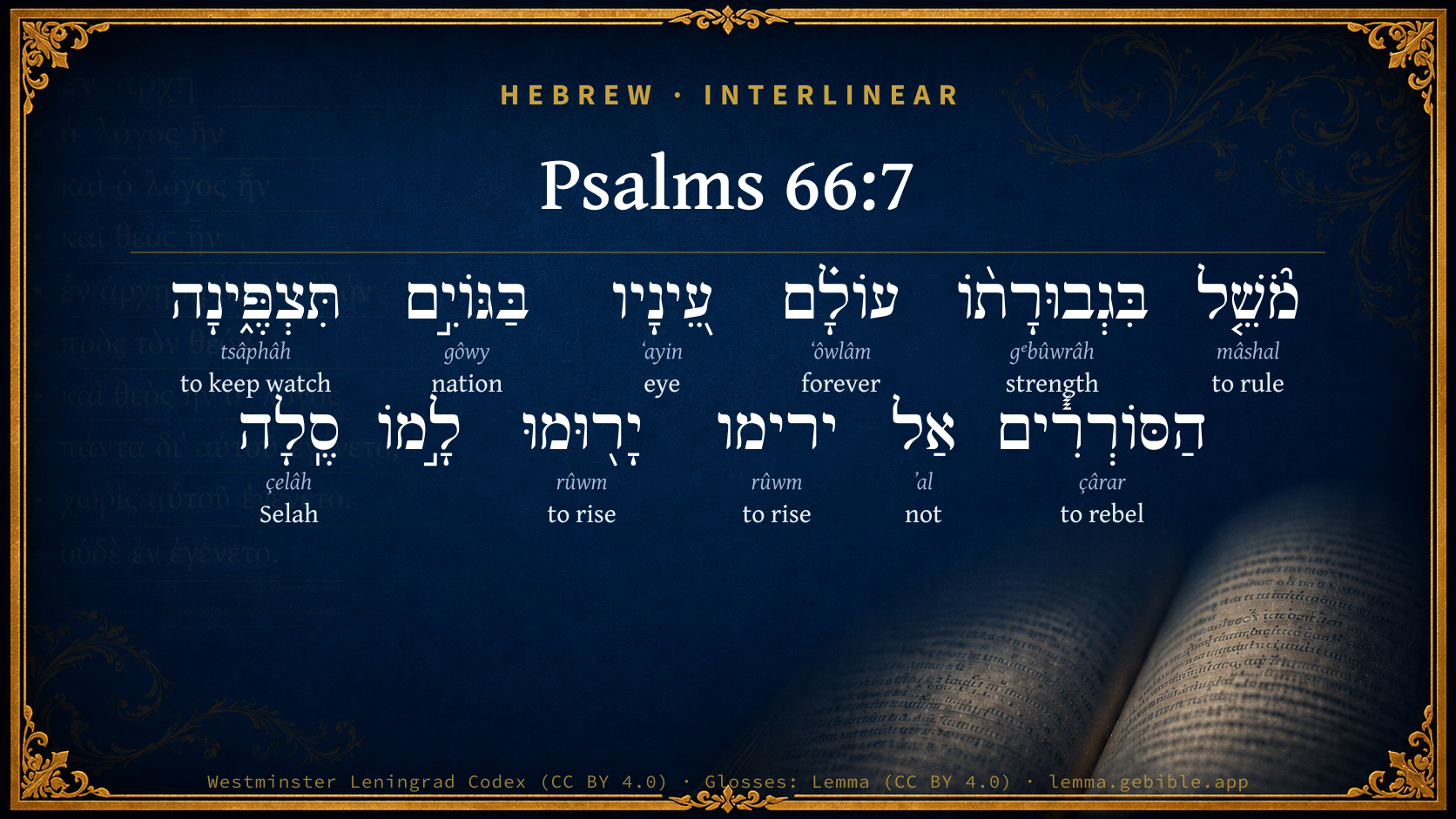
Hebrew (Westminster Leningrad Codex) Psalms 66:7 appears in the Hebrew Old Testament. The text above is from the Westminster Leningrad Codex. Each word links to its Strong’s number, a concise gloss, and parsing drawn from the Open Scriptures Hebrew Bible morphology. Click any word for its full Brown-Driver-Briggs (BDB) entry.
Download image
Cite this verse

Psalms 66:7 (World English Bible). Public Domain. Lemma interlinear Bible study tool, https://lemma.gebible.app/v/psalms/66/7.

Show BibTeX & RIS
BibTeX
RIS
English Translation
He rules by his might forever. His eyes watch the nations. Don't let the rebellious rise up against him. Selah.
World English Bible · Public Domain
Download a study sheet

One document with this verse’s original text, its word-by-word gloss line, the meaning frame, cross-references with their text, attributed commentary, and full source and license credits — printable, and it pastes into notes with its structure intact.

This verse Autodidact and up

Study sheet (.html) Plain text (.txt)

A passage Seminary Student

Up to 50 verses in one chapter. A passage sheet keeps up to 6 commentary sources and 12 cross-references per verse, in the order this page ranks them, and says so on the sheet whenever that leaves anything out. Ask for a single verse and you get the Autodidact verse sheet above.

Everything on this page stays free to read, with no account — the sheet is a download of what is already on screen, not access to it.

Want to remove ads? Support Godless Engineer
Compare translations 3

The same verse in 3 English versions, stacked beneath the original-language interlinear above. Click any original word for its lexicon entry.

Each is an independent rendering of the whole verse — the interlinear is not word-aligned to these translations.

Highlighted words mark where these versions differ — a whole-verse word diff, not a word-by-word alignment.

  • World English Bible Public Domain
    He rules by his might forever. His eyes watch the nations. Don't let the rebellious rise up against him. Selah.
  • King James Version Public Domain
    He ruleth by his power for ever; his eyes behold the nations: let not the rebellious exalt themselves. Selah.
  • unfoldingWord Literal Text CC BY-SA 4.0
    He is ruling by his might forever; his eyes watch over the nations. Let the ones rebelling not exalt themselves. Selah

unfoldingWord Literal Text — © unfoldingWord, licensed CC BY-SA 4.0. Word-aligned USFM3 via Door43 (git.door43.org/unfoldingWord/en_ult).

Versions to compare (up to 4)

3 of 4 selected

Show all 18 translations

Every available English version of this verse, each an independent rendering of the whole verse.

  • World English Bible Public Domain
    He rules by his might forever. His eyes watch the nations. Don't let the rebellious rise up against him. Selah.
  • Berean Standard Bible Public Domain
    He rules forever by His power; His eyes watch the nations. Do not let the rebellious exalt themselves. Selah
  • Majority Standard Bible Public Domain
    He rules forever by His power; His eyes watch the nations. Do not let the rebellious exalt themselves. Selah
  • King James Version Public Domain
    He ruleth by his power for ever; his eyes behold the nations: let not the rebellious exalt themselves. Selah.
  • American Standard Version (1901) Public Domain
    He ruleth by his might for ever; His eyes observe the nations: Let not the rebellious exalt themselves. Selah
  • Revised Version (1885) Public Domain
    He ruleth by his might for ever; his eyes observe the nations: let not the rebellious exalt themselves. Selah
  • Geneva Bible (1599) Public Domain
    He ruleth the worlde with his power: his eyes beholde the nations: the rebellious shall not exalt them selues. Selah.
  • Douay-Rheims (1899) Public Domain
    Who by his power ruleth for ever: his eyes behold the nations; let not them that provoke him he exalted in themselves.
  • Young's Literal Translation Public Domain
    Ruling by His might to the age, His eyes among the nations do watch, The refractory exalt not themselves. Selah.
  • Literal Standard Version CC BY-SA 4.0
    Ruling by His might for all time, || His eyes watch among the nations, || The stubborn do not exalt themselves. Selah.
  • Unlocked Literal Bible CC BY-SA 4.0
    He rules forever by his might; his eyes observe the nations; let not the rebellious exalt themselves. Selah
  • unfoldingWord Literal Text CC BY-SA 4.0
    He is ruling by his might forever; his eyes watch over the nations. Let the ones rebelling not exalt themselves. Selah
  • Darby Bible Public Domain
    He ruleth by his power for ever; his eyes observe the nations: let not the rebellious exalt themselves. Selah.
  • World Messianic Bible Public Domain
    He rules by his might forever. His eyes watch the nations. Don’t let the rebellious rise up against him. Selah.
  • Webster's Bible Public Domain
    He ruleth by his power for ever; his eyes behold the nations: let not the rebellious exalt themselves. Selah.
  • Free Bible Version CC BY-SA 4.0
    He rules forever through his power. He keeps an eye on the nations, watching to make sure no rebels rise up in opposition. Selah.
  • Bible in Basic English Public Domain
    He is ruling in power for ever; his eyes are watching the nations: may his haters have no strength against him. (Selah.)
  • JPS Tanakh (1917) Public Domain
    Who ruleth by His might for ever; His eyes keep watch upon the nations; let not the rebellious exalt themselves. Selah

Literal Standard Version (2020), Covenant Press — licensed CC BY-SA 4.0. Text via the HelloAO Bible API (eBible.org). Unlocked Literal Bible (unfoldingWord) — licensed CC BY-SA 4.0. Text via the HelloAO Bible API (eBible.org). unfoldingWord Literal Text — © unfoldingWord, licensed CC BY-SA 4.0. Word-aligned USFM3 via Door43 (git.door43.org/unfoldingWord/en_ult). Free Bible Version, Dr. Jonathan Gallagher — licensed CC BY-SA 4.0. Text via the HelloAO Bible API (eBible.org).

Word by word

More ways to search: Search by grammar → Find every occurrence → Compare this word →

Practice this passage: Drill this verse → Learn its vocabulary →

הַסּוֹרְרִ֓ים
çârar
H5637
“the · rebelling”
Particle, Definite Article + Verb, Qal, Participle Active, Masculine, Plural, Absolute
Part of Speech
Particle + Verb
Stem
Qal
Form
Participle Active
Gender
Masculine
Number
Plural
State
Absolute
Full BDB Definition

Origin: a primitive root

TWOT: 1549

to rebel, be stubborn, be rebellious, be refractory - (Qal) - to be stubborn - stubborn, rebel (substantive)
  1. מֹ֘שֵׁ֤ל mâshal H4910 “ruling” Verb, Qal, Participle Active, Masculine, Singular, Absolute
  2. בִּגְבוּרָת֨וֹ gᵉbûwrâh H1369 “in/at · strength · his” Preposition + Noun, Common, Feminine, Singular, Construct + Suffix, Personal, 3rd Person, Masculine, Singular
  3. עוֹלָ֗ם ʻôwlâm H5769 “forever” Noun, Common, Masculine, Singular, Absolute
  4. עֵ֭ינָיו ʻayin H5869 “eyes · his” Noun, Common, Both, Dual, Construct + Suffix, Personal, 3rd Person, Masculine, Singular
  5. בַּגּוֹיִ֣ם gôwy H1471 “in/at the · nations” Preposition, Determined + Noun, Common, Masculine, Plural, Absolute
  6. תִּצְפֶּ֑ינָה tsâphâh H6822 “to keep watch” Verb, Qal, Imperfect, 3rd Person, Feminine, Plural
  7. אַל ʼal H408 “not” Particle, Negative
  8. ירימו rûwm H7311 “to rise” Verb, Hiphil, Jussive, 3rd Person, Masculine, Plural
  9. יָר֖וּמוּ rûwm H7311 “to rise” Verb, Qal, Jussive, 3rd Person, Masculine, Plural
  10. סֶֽלָה çelâh H5542 “Selah” Particle, Interjection

About this verse

These counts appear in no published source. They are computed here, from the morphology-tagged text and Lemma’s own curated glosses. What Lemma adds →

12
words
10
distinct lemmas
Wisdom
section

Notable vocabulary

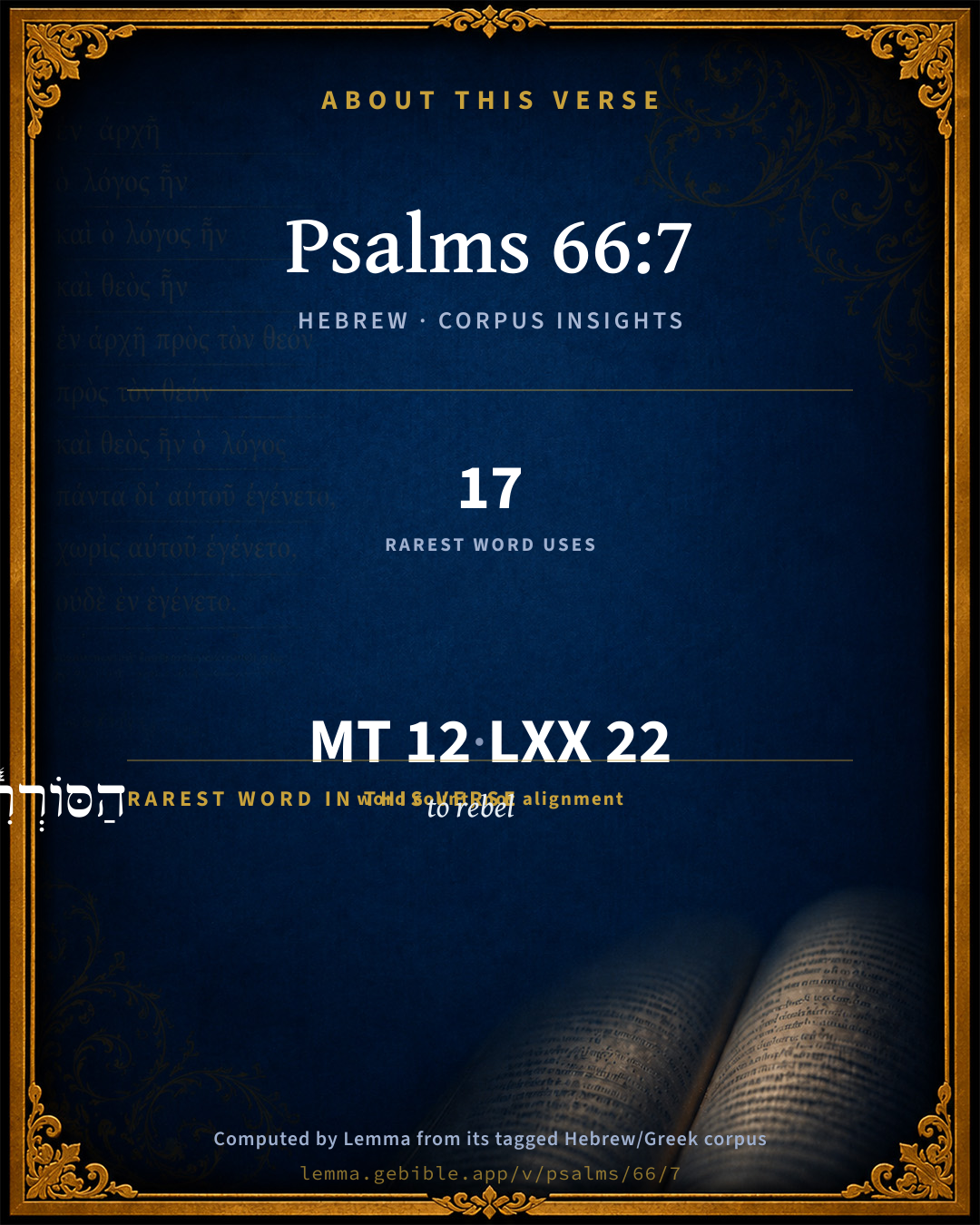
The rarest word here is הַסּוֹרְרִ֓ים to rebel H5637 — appearing just 17 times in the whole Hebrew Bible.

Shared distinctive vocabulary

הַסּוֹרְרִ֓ים to rebel H5637 occurs in 16 verses of the Hebrew Bible. Also found in:

Grammatical profile

  • 5 verbs
  • 4 nouns
  • 1 preposition
  • 2 particles

Verb forms

  • מֹ֘שֵׁ֤ל Qal · Participle Active
  • תִּצְפֶּ֑ינָה Qal · Imperfect
  • הַסּוֹרְרִ֓ים Qal · Participle Active
  • ירימו Hiphil · Jussive
  • יָר֖וּמוּ Qal · Jussive

Repetition

A word recurs within this verse — often emphatic in Hebrew:

  • ירימו to rise H7311 ×2

Hebrew & Septuagint length

In English translation the verse runs 20 words from the Hebrew and 26 from the Septuagint (LXX English) — closely comparable.

A rough comparison of the two English renderings, which tokenize alike — not a word-level alignment.

Word counts can differ between the Hebrew and the Greek without any difference in meaning — e.g. the Hebrew direct-object marker אֵת has no separate Greek word, and Greek often adds the article ὁ.

In the original languages it is 12 Hebrew tokens and 22 Greek tokens — but the two are counted differently (Hebrew bundles its prefixes and suffixes into one token; the Greek is in lemma form), so that isn’t a like-for-like length.

Cross-references

19

Topical passages linked to Psalms 66:7 in the Treasury of Scripture Knowledge — connected by theme and wording, ordered by reader-vote popularity; previews shown in the World English Bible.

  • Psalms 11:4 Yahweh is in his holy temple. Yahweh is on his throne in heaven. His eyes observe. His eyes examine the children of men.
  • 2 Chronicles 16:9 For the eyes of Yahweh run back and forth throughout the whole earth, to show himself strong in the behalf of them whose heart is perfect toward him. Herein you have done foolishly; for from henceforth you shall have wars.
  • Matthew 28:18 Jesus came to them and spoke to them, saying, "All authority has been given to me in heaven and on earth.
  • Job 9:4 God who is wise in heart, and mighty in strength: Who has hardened himself against him, and prospered?
  • Psalms 33:13 Yahweh looks from heaven. He sees all the sons of men.
  • Psalms 62:11 God has spoken once, Twice I have heard this, That power belongs to God.
  • Psalms 75:4–5 I said to the arrogant, "Don't boast;" To the wicked, "Don't lift up the horn.
  • Psalms 140:8 Yahweh, don't grant the desires of the wicked. Don't let their evil plans succeed, or they will become proud. Selah.
  • Daniel 4:35 All the inhabitants of the earth are reputed as nothing; and he does according to his will in the army of heaven, and among the inhabitants of the earth; and none can stay his hand, or tell him, What do you?
  • Daniel 5:20–28 But when his heart was lifted up, and his spirit was hardened so that he dealt proudly, he was deposed from his kingly throne, and they took his glory from him:
  • Exodus 18:11 Now I know that Yahweh is greater than all gods because of the thing in which they dealt arrogantly against them."
  • Psalms 2:10–12 Now therefore be wise, you kings. Be instructed, you judges of the earth.
  • Psalms 52:1–5 Why do you boast of mischief, mighty man? God's loving kindness endures continually.
  • Psalms 73:3–12 For I was envious of the arrogant, When I saw the prosperity of the wicked.
  • Psalms 145:13 Your kingdom is an everlasting kingdom. Your dominion endures throughout all generations.
  • Isaiah 10:7–16 However he doesn't mean so, neither does his heart think so; but it is in his heart to destroy, and to cut off not a few nations.
  • Isaiah 37:28–29 But I know your sitting down, and your going out, and your coming in, and your raging against me.
  • Daniel 6:26–27 I make a decree, that in all the dominion of my kingdom men tremble and fear before the God of Daniel; for he is the living God, and steadfast forever, His kingdom that which shall not be destroyed; and his dominion shall be even to the end.
  • Matthew 6:13 Bring us not into temptation, but deliver us from the evil one. For yours is the Kingdom, the power, and the glory forever. Amen.'

Cross-references courtesy of OpenBible.info (CC BY 4.0).

Hebrew and Greek witnesses Masoretic Hebrew ↔ Greek Septuagint

The same verse in the two great witnesses to the Old Testament, shown verse-for-verse.

You’re reading Greek Psalm 65 (Hebrew Psalm 66). The Septuagint counts the superscription, so verse numbers can differ from the Hebrew — chapter-level alignment, not verse-by-verse. Numbering follows Rahlfs.

These are two independent witnesses, not word-aligned to each other, and the Septuagint is shown in lemma (dictionary) form.

Hebrew Psalms 66:7 Masoretic · Westminster Leningrad Codex

מֹ֘שֵׁ֤ל בִּגְבוּרָת֨וֹ עוֹלָ֗ם עֵ֭ינָיו בַּגּוֹיִ֣ם תִּצְפֶּ֑ינָה הַסּוֹרְרִ֓ים אַל ירימו יָר֖וּמוּ לָ֣מוֹ סֶֽלָה

He rules by his might forever. His eyes watch the nations. Don't let the rebellious rise up against him. Selah.

World English Bible · Public Domain

Greek LXX Greek Psalm 65:7 Septuagint · lemma form

ὁ δεσπόζω ἐν ὁ δυναστεία αὐτός ὁ αἰών ὁ ὀφθαλμός αὐτός ἐπί ὁ ἔθνος ἐπιβλέπω ὁ παραπικραίνω μή ὑψόω ἐν ἑαυτοῦ διάψαλμα

who by his power is Lord over the age, his eyes look upon the nations; let not them that provoke him be exalted in themselves. Pause.

LXX2012 (modern English Septuagint) · Public Domain

Hebrew: Westminster Leningrad Codex (CC BY 4.0). Greek: Septuagint (public domain); English from LXX2012 (modern English Septuagint) (Public Domain). How the Septuagint differs from the Hebrew →

Commentary

Notes on Psalms 66:7 from classic Christian and Jewish commentators (each source and its license shown beneath its notes). The classic Christian expositions comment on the surrounding passage and are grouped to its opening verse, so a note may address several verses; the Jewish commentaries on the Tanakh (Rashi and others) are per-verse, so they appear only where the commentator wrote on this verse.

Lemma curates 59 commentaries, every one of them public domain or Creative Commons licensed, each selected and text-cleaned for this edition rather than reprinted as found. About our sources →

Trapp's Complete Commentary

John Trapp

Psa 66:7 He ruleth by his power for ever; his eyes behold the nations: let not the rebellious exalt themselves. Selah.

Ver. 7. He ruleth by his power] As sole sovereign, universal monarch, αυτοκρατωρ, παντοκρατωρ. Sesostris, king of Egypt, would needs be styled κοσμοκρατωρ, emperor of the whole world (Herod. l. 2); he lived about the time of Samson, and perished by the hands of his own householdservants.

His eyes behold the nations] For which purpose they run to and fro through the earth, 2Ch 16:9.

Let not the rebellious, &c.] Heb. the off fallen, froward, and refractory persons; these shall soon be repressed and crest fallen.

John Trapp, A Commentary or Exposition upon All the Books of the Old and New Testament (1647–1656) — public domain. Text from a community e-Sword module.

The Biblical Illustrator

Joseph S. Exell

Psa_66:7

He ruleth by His power for ever: His eyes behold the nations.

The nature and design of moral government

Everything around points us to a law or rule, by which creation is governed, and this implies a mind that cannot work in vain. But against this, the rebellious exalt themselves. And they do this because they are rebellious; atheism is of the heart more than of the reason.

I. Of the nature and design of moral government. And this government is--

1. Sovereign. This essential to the prevention of confusion.

2. Of irresistible power.

3. Universal in its extent.

4. Is, and must be, essentially benevolent.

Many object to this, and deny it. But let them remember the vast scale of Gods works, and how little we know. The next thing to be borne in mind is the tendency and purpose to bring all to a happy issue. This is an essential point in considering the moral government of God. All will end in the rectification of present disorders and in the bliss of creation.

II. Inferences from the foregoing.

1. Sin is the source of all misery.

2. The greatest benevolence consists in making God known.

3. We are unspeakably indebted to God for the revelation of His will, that in Christ all can have life eternal. (F. A. Cox, D. D. , LL. D.)

The government of God

I. The government of God is sustained by omnipotence. When revolutions rise, and changes take place in the empires of the world which affect the condition of millions now living, and which shape the destiny of coming generations, it is sheer folly to ascribe them solely or chiefly to the restlessness of the peoples, to the despotism of monarchs, or to the policy of statesmen. They are signs that the Divine power rules over, and that the Divine hand works out the destinies of men. He can curb the impetuous passions of men, or turn them into a channel in which they shall work out His great designs in complete, though unconscious, subservience to His will; He can put a hook in leviathans jaw, and cast down Antichrist from his seat; He can control the whirlwind in its stormy path, and check the mad fury of a long-oppressed people; He can arrest the lightning in its rapid flight and hush to silence the deep-voiced thunder; and He can stop the deadlier bolts of war and bid the angry nations be at peace.

II. The government of God is one of universal oversight. There is nothing, however great or trivial, which can transpire in His wide domain unobserved by Him. All events pass under His eye. All objects, the vast and the minute alike, are present to His view. He telleth the number of the stars. The very hairs of our head are all numbered. God is everywhere, omnipresence as well as omnipotence belongs to Him.

III. There are rebels against the divine government,

1. The exaltation of the creature may be through pride, through ambition, through vain desire, through unholy presumption, but whatever may be the secret feeling that prompts it, or whatever the form which it takes, the eye of God sees it, and His power can crush it when He will. It is vain for any of us, even in our most secret soul, to set ourselves against Him, for He track- the rebellious thought to its remotest hiding-place within us, nay, He knows it in its first formation in the chambers of the heart.

2. Mans opposition to His Maker is as unreasonable as it is futile and hopeless. Why should we set ourselves against His law? Is He not our best Friend, our constant Benefactor, our loving Father? Is not His rule the rule of righteous love? Is not His throne the throne of grace? Is not His law a law of liberty, and in keeping of it is there not great reward? (F. Stephens.)

God and the nations

The God of individuals is the God also of nations; the law of righteousness which applies to individuals applies also to nations; and nations are accountable to God, and must be judged by Him just as surely as individuals. Men are slow to believe this truth. They seem to think that there is one law for the individual and another law for the nation, and that it is vain to expect that a nation should be ruled by the teaching of the New Testament and the Sermon on the Mount. Great statesmen are not ashamed, even in Christian England, to go in direct opposition to that teaching, to appeal to the lowest, the most brutal, the fighting instincts of the people; to urge them to cherish and practise the spirit of retaliation, and to encourage them to hurl defiance against all the nations of the world. But surely the teaching of our Lord should rule nations as well as individual men; and nations should seek to be guided not by the old law, which says, An eye for an eye, and a tooth for a tooth, but by the new and diviner law, which says that men should do unto others whatsoever they would that others should do to them. God sits on the throne of the universe. The sceptre of universal dominion is in the hands of righteousness. The eyes of the Lord keep watch on the nations, and nations must be judged by the righteous judgment of God. (G. Hunsworth, M. A.)

The Biblical Illustrator, edited by Joseph S. Exell (c. 1880s–1900s) — public domain. Text from a community e-Sword module.

Joseph Benson's Commentary

Psa 66:7. He ruleth by his power for ever — The same power which God possessed and exerted for his people in ancient times, he still possesses in as great vigour as ever, and is as able and ready to act for them as ever he was: which he hath shown in this late and glorious instance. His eyes behold the nations — He sees all their secret and subtle devices, and can and will defeat them, when he sees fit. Let not the rebellious exalt themselves — Lift up their hands against God or his people. Or, the rebellious; that is, those that rebel against this Almighty God and his laws, shall not exalt themselves, as they vainly hope and design to do, but shall be brought down and destroyed, as is here implied.

Joseph Benson's Commentary on the Old and New Testaments (1811–1818) — public domain. Text from a community e-Sword module.

J. A. Alexander on Psalms

Joseph Addison Alexander

7. (Psa 66:7) Ruling by his might for ever; his eyes over (or among) the nations watch; let not the rebels exalt themselves. Selah. The participle in the first clause is expressive of habitual action, "he iconstantly, habitually rules." See above, Psa 22:28. By his might, with which he was before described as girded. See above, Psa 65:6. The noun eternity is used adverbially to mean for ever. The divine inspection here described implies that man can no more evade God's power than resist it. The last clause may be either a prayer to God or an admonition to his enemies. Exalt themselves: the Keri or marginal reading is, be high for them (or for themselves); the Kethib or textual reading, lift (or raise) for themselves, in which case horn may be supplied from Psa 75:4-5, or head from Psa 110:7. The rebels, i.e. against God, his stubborn and incorrigible enemies.

Joseph Addison Alexander, The Psalms Translated and Explained (1850) — public domain. Text from a community e-Sword module.

Tyndale Open Study Notes

Tyndale Open Resources

66:7 God’s power brings redemption. The same word occurs in 65:6 for God’s power in creation (see also 80:2).

Tyndale Open Study Notes — © Tyndale Open Resources, licensed CC BY-SA 4.0. Text via the HelloAO Bible API.

Geneva Bible (1599)

Geneva Bible translators

He proveth that God will extend his grace also to the Gentiles, because he punisheth among them such as will not obey his calling.

Geneva Bible (1599) marginal notes — public domain. Text via Bolls.life.

Jamieson, Fausset & Brown

Robert Jamieson, A. R. Fausset & David Brown

behold the nations--watch their conduct.

Jamieson, Fausset & Brown — Commentary Critical and Explanatory on the Whole Bible (1871) — public domain (CC PDM 1.0). Text via the HelloAO Bible API.

Adam Clarke's Commentary

Verse 7. He ruleth by his power] His omnipotence is employed to support his followers, and cast down his enemies.

His eyes behold the nations] He sees what they purpose, what they intend to do; and what they will do, if he restrain them not.

Let not the rebellious exalt themselves.] They shall not succeed in their designs: they have their own aggrandizement in view, but thou wilt disappoint and cast them down.

Selah.] Mark this. It is true.

Adam Clarke's Commentary on the Bible (1810–1826) — public domain. Text from a community e-Sword/MySword module.

John Calvin's Commentaries

7. He ruleth by his power over the world The Hebrew word עולם, olam, which I have translated the world, signifies occasionally an age, or eternity; but the first sense seems to agree best with the context, and the meaning of the words is, that God is endued with the power necessary for wielding the government of the world. What follows agrees with this, that his eyes behold the nations Under the law, Judea was the proper seat of his kingdom; but his providence always extended to the world at large; and the special favor shown to the posterity of Abraham, in consideration of the covenant, did not prevent him from extending an eye of providential consideration to the surrounding nations. As an evidence of his care reaching to the different countries round, he takes notice of the judgments which God executed upon the wicked and the ungodly. He proves that there was no part of the human family which God overlooked, by referring to the fact of the punishment of evil-doers. There may be much in the Divine administration of the world calculated to perplex our conclusions; but there are always some tokens to be seen of his judgments, and these sufficiently clear to strike the eye of an acute and attentive observer.

John Calvin's Commentaries (1540-1563) — public domain. Text from the Calvin Translation Society English edition (1840s-50s) via the Christian Classics Ethereal Library (ccel.org). Calvin's coverage is partial (roughly two-thirds of the Bible); uncommented books and verses are honest gaps, never fabricated. The 19th-century editor's footnotes and remarks are omitted so the notes are faithfully Calvin's own voice.

Ellicott's Commentary for English Readers

(7) His eyes behold.—Better, his eyes keep watch on the nations. God is, as it were, Israel’s outpost, ever on the alert to warn and defend them against surrounding nations.

Let not . . .—Literally, the rebellious, let them not exalt for themselves, where we may supply “horn” as in Psa_75:4-5, or “head” as in Psa_3:3; Psa_110:7. For the rebellious, comp. Psa_68:6.

A Bible Commentary for English Readers, edited by Charles John Ellicott (1878–1897) — public domain. Text from a community e-Sword module.

The Cambridge Bible for Schools and Colleges

gen. ed. J. J. S. Perowne

7. by his power] By his might (R.V.), as Psa_65:6.

for ever] What is true for the past is true for the present and the future. God’s sovereignty is eternal. Cp. Psa_145:13; Jer_10:10.

his eyes behold the nations] Better, as R.V. renders the word in Pro_15:3, keep watch upon. He is the world’s watchman, sleeplessly on the watch lest any foe should injure Israel. Cp. Psa_33:10; Psa_33:13 ff; Isa_27:3; and Hezekiah’s prayer (Isa_37:17), “open thine eyes, O Lord, and see.”

let not the rebellious exalt themselves] A warning to those who obstinately resist God’s will (Psa_68:6; Psa_68:18) to humble themselves (Psa_2:10 f), rather than a prayer to God to humble them (Psa_9:19). Cp. God’s reproof of Sennacherib by Isaiah (Isa_37:23), “Against whom hast thou exalted thy voice and lifted up thine eyes on high?”

The Cambridge Bible for Schools and Colleges (gen. ed. J. J. S. Perowne; Cambridge University Press, 1878–1918) — public domain. Text from a community e-Sword module.

John Gill's Exposition

He ruleth by his power forever,.... Christ is the Ruler in Israel, King over his holy hill of Zion; who must reign till all enemies are put under his feet. He rules in the kingdom of nature and providence by his power, and does whatsoever he pleases; nor can any stay his hand. He rules in the kingdom of grace, in the hearts of his people, by his efficacious grace; which makes them willing, in the day of his power, to be subject to him; and in the latter day he will take to himself his great power and reign, when he will be King for ever. His kingdom is an everlasting kingdom, it shall never be subverted nor usurped; nor will he in it be succeeded by another; he will reign to the end of the world, throughout the thousand years, with his saints on earth, and then with them in heaven for evermore. The Targum renders it,

"over the world;''

over the whole world; for Christ will be King over all the earth in the latter day, Zac 14:9;

his eyes behold the nations; the antichristian states. He sees all the idolatry and wickedness committed in them; and his eyes will be as flames of fire to destroy them, when the time is come. The allusion is to God's looking through the pillar of fire and cloud upon the Egyptians in the Red sea, and troubling them, Exo 14:24;

let not the rebellious exalt themselves. That are rebels against Christ, would not have him to reign over them; antichrist, who exalts himself above all that is called God, and all his followers. Or, "they shall not exalt themselves" (a): or, as the Targum,

"they shall not be exalted in themselves for ever;''

see Rev 18:7.

Selah; on this word; see Gill on Psa 3:2.

(a) "haudquaquam sese exultabunt", Tigurine version, Musculus, & Gejerus.

John Gill's Exposition of the Whole Bible (1746–1763) — public domain (CC PDM 1.0). Text via the HelloAO Bible API.

Albert Barnes' Notes on the Bible

He ruleth by his power for ever - literally, “Ruling by his power forever.” The idea is, that he does this constantly; in each age and generation. He never has ceased to rule; he never will. His dominion extends from age to age, and will stretch forward forever. The power which he evinced in delivering his people he retains now, and will retain forever. In that unchanging power, his people may confide; that unchanging power, the wicked should fear.

His eyes behold the nations - All nations; all people. He sees all their conduct. They can conceal nothing from him. They should, therefore, stand in awe. The wicked have much to fear from One who sees all that they do, and who has power to crush and destroy them. Compare the notes at Psa 11:4.

Let not the rebellious exalt themselves - Be lifted up with pride, or feel secure. They cannot overcome an Almighty God; they cannot escape from his power. The word rebellious here has reference to those who are impatient under the restraints of the law of God, and who are disposed to east off his authority. The admonition is one that may be addressed to all who thus rebel against God, whether they are nations or individuals. Alike they must feel the vengeance of his arm, and fall beneath his power.

Albert Barnes' Notes on the Bible (1834–1885) — public domain. Text from a community e-Sword/MySword module.

Matthew Poole's English Annotations

The same power which God had and put forth for his people in ancient time, he still hath in as great vigour as ever, and is not at all weakened by age, and is as able and ready to act for them now as ever he was; which he hath showed by this late and glorious instance.

His eyes behold the nations; he sees all their secret and subtle devices, and can and will defeat them, when he sees fit.

Let not the rebellious exalt themselves; lift up their hands against God, or against his people. Or, the rebellious (i.e. those people which rebel against this almighty God and his laws) shall not exalt themselves, as they vainly hope and design to do; but shall be brought down and destroyed, as is hereby implied.

Matthew Poole's English Annotations on the Holy Bible (1683–1685) — public domain. Text from a community e-Sword/MySword module.

The Treasury of David

Charles H. Spurgeon

Ver. 7. He ruleth by his power for ever. He has not deceased, nor abdicated, nor suffered defeat. The prowess displayed at the Red Sea is undiminished: the divine dominion endures throughout eternity.

His eyes behold the nations. Even as he looked out of the cloud upon the Egyptians and discomfited them, so does he spy out his enemies, and mark their conspiracies. His hand rules and his eye observes, his hand has not waxed weak, nor his eye dim. As so many grasshoppers he sees the people and tribes, at one glance he takes in all their ways. He oversees all and overlooks none.

Let not the rebellious exalt themselves. The proudest have no cause to be proud. Could they see themselves as God sees them they would shrivel into nothing. Where rebellion reaches to a great head, and hopes most confidently for success, it is a sufficient reason for abating our fears, that the Omnipotent ruler is also an Omniscient observer. O proud rebels, remember that the Lord aims his arrows at the high soaring eagles and brings them down from their nest among the stars. "He hath put down the mighty from their seats, and exalted them of low degree." After a survey of the Red Sea and Jordan, rebels, if they were in their senses, would have no more stomach for the fight, but would humble themselves at the Conqueror's feet.

Selah. Pause again, and take time to bow low before the throne of the Eternal.

Ver. 7. His eyes behold the nations. The radical meaning of the word hku is augazein, to shine, and metonymically to examine with a bright eye; to inspect with a piercing glance, and thence to behold, for either good or evil, as Pr 15:3: "The eyes of the Lord are in every place, beholding the evil and the good." Here it is taken in an adverse sense, and means, to watch from a watch tower, to threaten from a lofty place. Ps 37:32: "The wicked watcheth the righteous; "and Job 15:22: He is waited for "from the watch tower for the sword; "that is to say, the sword is drawn above the head of the wicked, as if it threatened him from the watch tower of God. But, at the same time, there is also a reference to God's looking from the pillar of fire, and of cloud, upon the host of Pharaoh in the Red Sea. Ex 14:24. Hermann Venema.

Ver. 7. His eyes behold the nations. This should give check to much iniquity. Can a man's conscience easily and delightedly swallow that which he is sensible falls under the cognizance of God, when it is hateful to the eye of his holiness, and renders the action odious to him? "Doth not he see my ways, and count all my steps?" saith Job, (Job 31:4)... The consideration of this attribute should make us humble. How dejected would a person be if he were sure all the angels in heaven, and men upon earth, did perfectly know his crimes, with all their aggravations! But what is created knowledge to an infinite and just censuring understanding? When we consider that he knows our actions, whereof there are multitudes, and our thoughts, whereof there are millions; that he views all the blessings bestowed upon us; all the injuries we have returned to him; that he exactly knows his own bounty, and our ingratitude; all the idolatry, blasphemy, and secret enmity in every man's heart against him; all tyrannical oppressions, hidden lusts, omissions of necessary duties, violations of plain precepts, every foolish imagination, with all the circumstances of them, and that perfectly in all their full anatomy, every mite of unworthiness and wickedness in every circumstance... should not the consideration of this melt our hearts into humiliation before him, and make us earnest in begging pardon and forgiveness of him. Stephen Charnock.

Ver. 7. Sovereignty, immutability ("for ever"), and omniscience, --the enemies of proud rebels.

Psalms 66:8*

Charles H. Spurgeon's The Treasury of David (1869–1885) — public domain. Psalms only. Text from a community e-Sword/MySword module.

Whedon's Commentary on the Bible

Daniel D. Whedon

7. His eyes behold—His eyes watch. A police-watch is intended. Thus exact knowledge and perfect power leave no hope of impunity.

Nations— The Hebrew word is almost exclusively used of the Gentiles, or heathen nations, throughout the Bible. It is to these he has chiefly addressed himself hitherto. Psa_66:8 opens a new division of the psalm, with new associations.

Let not the rebellious—A caution to the haughty monarchs who contemned Israel. See Psa_2:3; Psa_2:12; 2Ki_18:29-35; Dan_3:15

Daniel D. Whedon (gen. ed.), Commentary on the Old and New Testaments (1874–1909) — public domain. Text from a community e-Sword module.

The Pulpit Commentary

He ruleth by his power forever; his eyes behold (or, observe) the nations. God keeps perpetual watch upon the heathen nations, whose general attitude is that of hostility to his "peculiar people," lest his people should suffer at their hands. Although they may professedly be submissive (ver. 3), their submission is not to be depended on. Let not the rebellious exalt themselves. At any time rebellion may break out, his people be attacked, and "the nations" endeavour to "exalt themselves." All such attempts, however, will be in vain, since "by his power God ruleth forever."

The Pulpit Commentary (1880–1919), ed. H.D.M. Spence-Jones & Joseph S. Exell — public domain. Text from a community e-Sword module.

Rashi

Rabbi Shlomo Yitzchaki (Rashi)

will not exalt themselves Their hand will not be high.

Rashi on the Tanakh — English translations: “The Judaica Press complete Tanach with Rashi, translated by A. J. Rosenberg” (CC BY 4.0); “Pentateuch with Rashi's commentary by M. Rosenbaum and A.M. Silbermann, 1929-1934” (public domain); “The Metsudah Tanach series, Lakewood, N.J” (CC BY 4.0); and “The Book of Joshua, Metsudah Publications, 1997” (CC BY 4.0). Text via Sefaria.

Lesson kit

Teaching starters — assembled from the data on this page, not authored interpretation. Every prompt links to the verse data it draws on. Edit before teaching.

Psalms, in the Wisdom, opens this verse with 12 words (10 distinct Hebrew lemmas). Its most distinctive word is çârar (“to rebel”). A historical commentator’s framing appears above. Read the whole chapter for the surrounding context.

Discussion questions

  1. What does “to rebel” (çârar) contribute to the verse as a whole?
  2. How does Deuteronomy 21:18, which shares the word «to rebel», read alongside this verse?
  3. What does the repetition of “to rise” (2× in this one verse) do in this verse?
  4. These translations render this verse differently. What is at stake in choosing one wording over another?
  5. «מֹ֘שֵׁ֤ל» is a Qal Participle Active verb. How does that grammatical form shape the action described?
  6. Compare how Trapp's Complete Commentary and The Biblical Illustrator read this verse. Where do they agree or differ?

Things to notice

Reading settings

Reading text

Shown beneath each verse's original-language words.

Old Testament
Old Testament edition

Read the OT as the Masoretic Hebrew (MT) or the Greek Septuagint (LXX).

English shown for the Greek Septuagint (in the Hebrew ↔ Greek comparison).

Comparing translations? Open the Compare panel on any verse page to stack up to four side by side.