
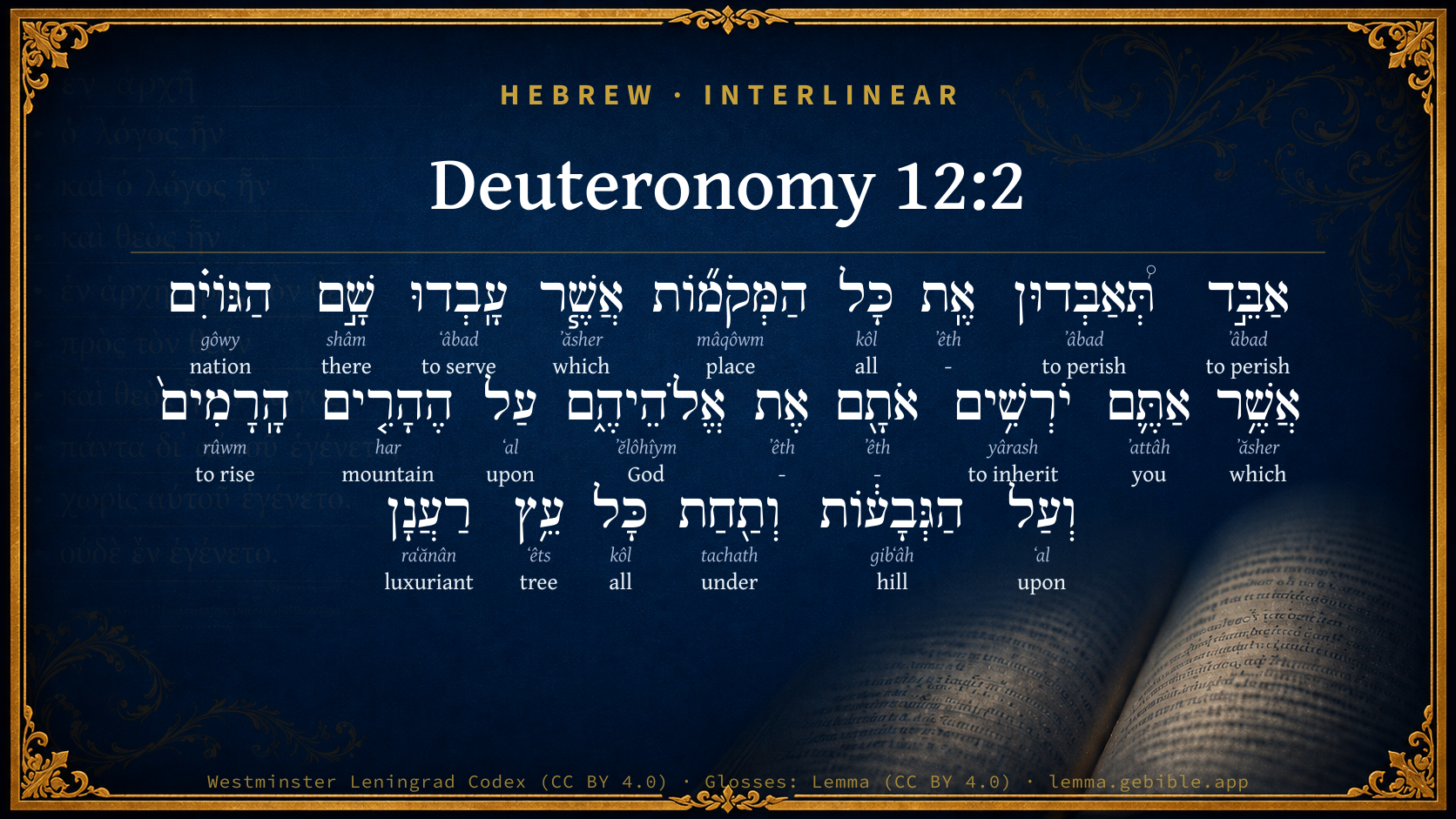
Deuteronomy 12:2

Hebrew (Westminster Leningrad Codex) Deuteronomy 12:2 appears in the Hebrew Old Testament. The text above is from the Westminster Leningrad Codex. Each word links to its Strong’s number, a concise gloss, and parsing drawn from the Open Scriptures Hebrew Bible morphology. Click any word for its full Brown-Driver-Briggs (BDB) entry.
Download image
Cite this verse

Deuteronomy 12:2 (World English Bible). Public Domain. Lemma interlinear Bible study tool, https://lemma.gebible.app/v/deuteronomy/12/2.

Show BibTeX & RIS
BibTeX
RIS
English Translation
You shall surely destroy all the places in which the nations that you shall dispossess served their gods, on the high mountains, and on the hills, and under every green tree:
World English Bible · Public Domain
Highlights
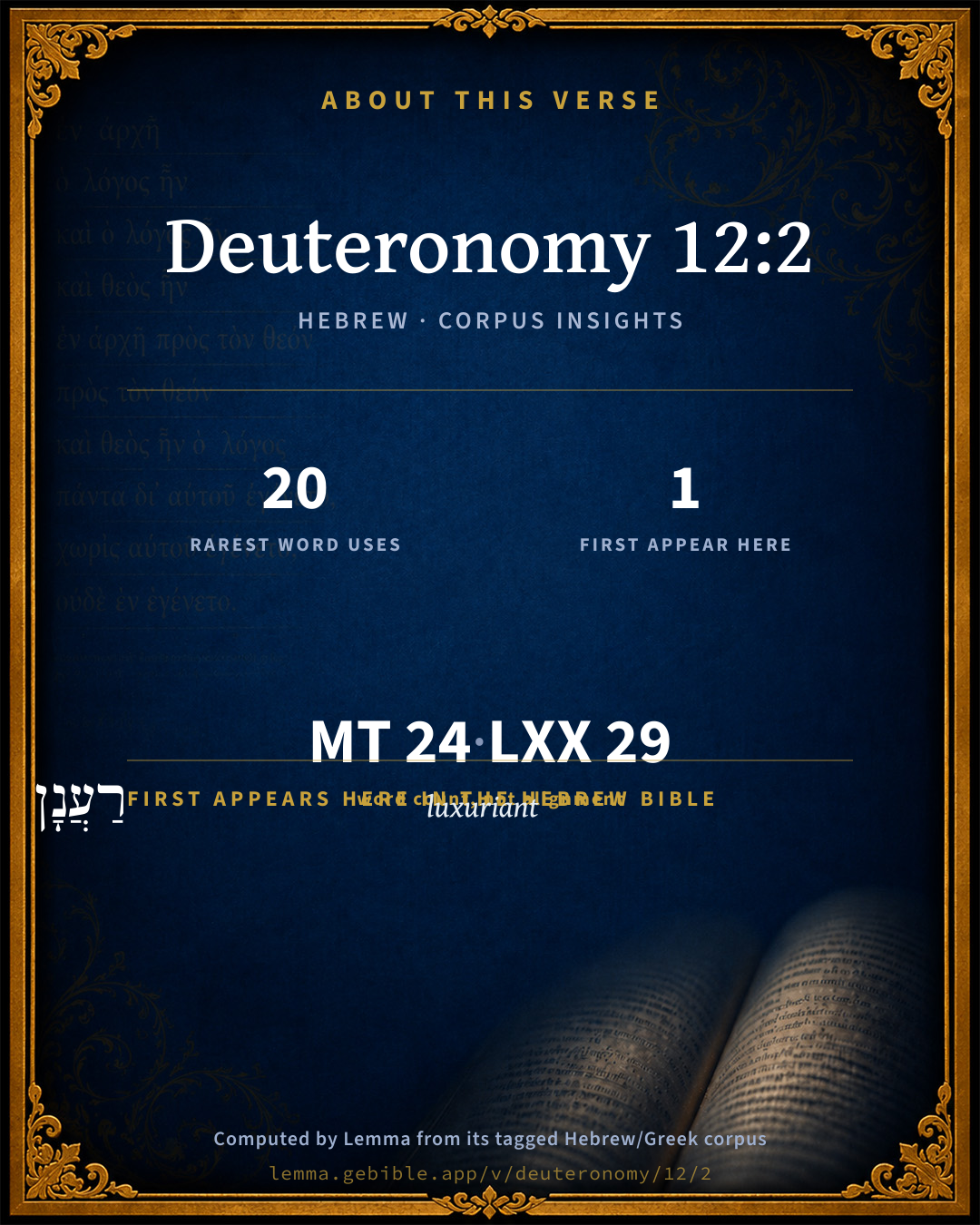
  • 1 first appearance in the Hebrew Bible
Full analysis ↓
Download a study sheet

One document with this verse’s original text, its word-by-word gloss line, the meaning frame, cross-references with their text, attributed commentary, and full source and license credits — printable, and it pastes into notes with its structure intact.

This verse Autodidact and up

Study sheet (.html) Plain text (.txt)

A passage Seminary Student

Up to 50 verses in one chapter. A passage sheet keeps up to 6 commentary sources and 12 cross-references per verse, in the order this page ranks them, and says so on the sheet whenever that leaves anything out. Ask for a single verse and you get the Autodidact verse sheet above.

Everything on this page stays free to read, with no account — the sheet is a download of what is already on screen, not access to it.

Want to remove ads? Support Godless Engineer
Compare translations 3

The same verse in 3 English versions, stacked beneath the original-language interlinear above. Click any original word for its lexicon entry.

Each is an independent rendering of the whole verse — the interlinear is not word-aligned to these translations.

Highlighted words mark where these versions differ — a whole-verse word diff, not a word-by-word alignment.

  • World English Bible Public Domain
    You shall surely destroy all the places in which the nations that you shall dispossess served their gods, on the high mountains, and on the hills, and under every green tree:
  • King James Version Public Domain
    Ye shall utterly destroy all the places, wherein the nations which ye shall possess served their gods, upon the high mountains, and upon the hills, and under every green tree:
  • unfoldingWord Literal Text CC BY-SA 4.0
    Destroying, you shall destroy all the places that the nations that you shall dispossess them served their gods there, on the high mountains and on the hills and under every green tree.

unfoldingWord Literal Text — © unfoldingWord, licensed CC BY-SA 4.0. Word-aligned USFM3 via Door43 (git.door43.org/unfoldingWord/en_ult).

Versions to compare (up to 4)

3 of 4 selected

Show all 18 translations

Every available English version of this verse, each an independent rendering of the whole verse.

  • World English Bible Public Domain
    You shall surely destroy all the places in which the nations that you shall dispossess served their gods, on the high mountains, and on the hills, and under every green tree:
  • Berean Standard Bible Public Domain
    Destroy completely all the places where the nations you are dispossessing have served their gods—atop the high mountains, on the hills, and under every green tree.
  • Majority Standard Bible Public Domain
    Destroy completely all the places where the nations you are dispossessing have served their gods—atop the high mountains, on the hills, and under every green tree.
  • King James Version Public Domain
    Ye shall utterly destroy all the places, wherein the nations which ye shall possess served their gods, upon the high mountains, and upon the hills, and under every green tree:
  • American Standard Version (1901) Public Domain
    Ye shall surely destroy all the places wherein the nations that ye shall dispossess served their gods, upon the high mountains, and upon the hills, and under every green tree:
  • Revised Version (1885) Public Domain
    Ye shall surely destroy all the places, wherein the nations which ye shall possess served their gods, upon the high mountains, and upon the hills, and under every green tree:
  • Geneva Bible (1599) Public Domain
    Yee shall vtterly destroy all the places wherein the nations which ye shall possesse, serued their gods vpon the hie mountaines and vpon the hilles, and vnder euery greene tree.
  • Douay-Rheims (1899) Public Domain
    Destroy all the places in which the nations, that you shall possess, worshipped their gods upon high mountains, and hills, and under every shady tree:
  • Young's Literal Translation Public Domain
    ye do utterly destroy all the places where the nations which ye are dispossessing served their gods, on the high mountains, and on the heights, and under every green tree;
  • Literal Standard Version CC BY-SA 4.0
    You utterly destroy all the places where the nations which you are dispossessing served their gods, on the high mountains, and on the heights, and under every green tree;
  • Unlocked Literal Bible CC BY-SA 4.0
    You will surely destroy all the places where the nations that you will dispossess worshiped their gods, on the high mountains, on the hills, and under every green tree.
  • unfoldingWord Literal Text CC BY-SA 4.0
    Destroying, you shall destroy all the places that the nations that you shall dispossess them served their gods there, on the high mountains and on the hills and under every green tree.
  • Darby Bible Public Domain
    Ye shall utterly destroy all the places wherein the nations which ye shall dispossess have served their gods, upon the high mountains, and upon the hills, and under every green tree;
  • World Messianic Bible Public Domain
    You shall surely destroy all the places in which the nations that you shall dispossess served their gods: on the high mountains, and on the hills, and under every green tree.
  • Webster's Bible Public Domain
    Ye shall utterly destroy all the places in which the nations which ye shall possess served their gods, upon the high mountains, and upon the hills, and under every green tree:
  • Free Bible Version CC BY-SA 4.0
    You are to completely destroy all the pagan shrines where the nations you're driving out worshiped their gods: on the top of high mountains, on the hills, and under every green tree.
  • Bible in Basic English Public Domain
    You are to give up to the curse all those places where the nations, whom you are driving out, gave worship to their gods, on the high mountains and the hills and under every green tree:
  • JPS Tanakh (1917) Public Domain
    Ye shall surely destroy all the places, wherein the nations that ye are to dispossess served their gods, upon the high mountains, and upon the hills, and under every leafy tree.

Literal Standard Version (2020), Covenant Press — licensed CC BY-SA 4.0. Text via the HelloAO Bible API (eBible.org). Unlocked Literal Bible (unfoldingWord) — licensed CC BY-SA 4.0. Text via the HelloAO Bible API (eBible.org). unfoldingWord Literal Text — © unfoldingWord, licensed CC BY-SA 4.0. Word-aligned USFM3 via Door43 (git.door43.org/unfoldingWord/en_ult). Free Bible Version, Dr. Jonathan Gallagher — licensed CC BY-SA 4.0. Text via the HelloAO Bible API (eBible.org).

Word by word

More ways to search: Search by grammar → Find every occurrence → Compare this word →

Practice this passage: Drill this verse → Learn its vocabulary →

רַעֲנָן
raʻănân
H7488
“luxuriant”
Adjective, Adjective, Masculine, Singular, Absolute
Part of Speech
Adjective
Type
Adjective
Gender
Masculine
Number
Singular
State
Absolute
Full BDB Definition

Origin: from an unused root meaning to be green

TWOT: 2190a

(Palel) to be or grow luxuriant or fresh or green (verb) - luxuriant, fresh (adjective)
  1. אַבֵּ֣ד ʼâbad H6 “to perish” Verb, Piel, Infinitive Absolute
  2. תְּ֠אַבְּדוּן ʼâbad H6 “to perish” Verb, Piel, Imperfect, 2nd Person, Masculine, Plural + Suffix, n
  3. אֶֽת ʼêth H853 “-” Particle, Direct Object
  4. כָּל kôl H3605 “all of” Noun, Common, Masculine, Singular, Construct
  5. הַמְּקֹמ֞וֹת mâqôwm H4725 “the · places” Particle, Definite Article + Noun, Common, Masculine, Plural, Absolute
  6. אֲשֶׁ֧ר ʼăsher H834 “which” Particle, Relative
  7. עָֽבְדוּ ʻâbad H5647 “to serve” Verb, Qal, Perfect, 3rd Person, Common, Plural
  8. שָׁ֣ם shâm H8033 “there” Adverb
  9. הַגּוֹיִ֗ם gôwy H1471 “the · nations” Particle, Definite Article + Noun, Common, Masculine, Plural, Absolute
  10. אֲשֶׁ֥ר ʼăsher H834 “which” Particle, Relative
  11. אַתֶּ֛ם ʼattâh H859 “you” Pronoun, Personal, 2nd Person, Masculine, Plural
  12. יֹרְשִׁ֥ים yârash H3423 “inheriting” Verb, Qal, Participle Active, Masculine, Plural, Absolute
  13. אֹתָ֖ם ʼêth H853 “- · them” Particle, Direct Object + Suffix, Personal, 3rd Person, Masculine, Plural
  14. אֶת ʼêth H853 “-” Particle, Direct Object
  15. אֱלֹהֵיהֶ֑ם ʼĕlôhîym H430 “God(s) · their” Noun, Common, Masculine, Plural, Construct + Suffix, Personal, 3rd Person, Masculine, Plural
  16. עַל ʻal H5921 “upon” Preposition
  17. הֶהָרִ֤ים har H2022 “the · mountains” Particle, Definite Article + Noun, Common, Masculine, Plural, Absolute
  18. הָֽרָמִים֙ rûwm H7311 “the · rising” Particle, Definite Article + Verb, Qal, Participle Active, Masculine, Plural, Absolute
  19. וְעַל ʻal H5921 “and · upon” Conjunction + Preposition
  20. הַגְּבָע֔וֹת gibʻâh H1389 “the · hills” Particle, Definite Article + Noun, Common, Feminine, Plural, Absolute
  21. וְתַ֖חַת tachath H8478 “and · under” Conjunction + Preposition
  22. כָּל kôl H3605 “all of” Noun, Common, Masculine, Singular, Construct
  23. עֵ֥ץ ʻêts H6086 “tree” Noun, Common, Masculine, Singular, Absolute

About this verse

These counts appear in no published source. They are computed here, from the morphology-tagged text and Lemma’s own curated glosses. What Lemma adds →

24
words
18
distinct lemmas
Pentateuch
section

Notable vocabulary

The rarest word here is רַעֲנָן luxuriant H7488 — appearing just 20 times in the whole Hebrew Bible.

First appearance in Scripture

This word makes its first canonical appearance in the Hebrew Bible here:

  • רַעֲנָן luxuriant H7488

Shared distinctive vocabulary

רַעֲנָן luxuriant H7488 occurs in 20 verses of the Hebrew Bible. Also found in:

Grammatical profile

  • 5 verbs
  • 8 nouns
  • 1 adjective
  • 1 pronoun
  • 3 prepositions
  • 1 adverb
  • 5 particles

Verb forms

  • אַבֵּ֣ד Piel · Infinitive Absolute
  • תְּ֠אַבְּדוּן Piel · Imperfect
  • עָֽבְדוּ Qal · Perfect
  • יֹרְשִׁ֥ים Qal · Participle Active
  • הָֽרָמִים֙ Qal · Participle Active

Repetition

Words recur within this verse — often emphatic in Hebrew:

  • אַבֵּ֣ד to perish H6 ×2
  • כָּל all H3605 ×2
  • עַל upon H5921 ×2
  • אֲשֶׁ֧ר which H834 ×2

Hebrew & Septuagint length

In English translation the verse runs 31 words from the Hebrew and 30 from the Septuagint (LXX English) — closely comparable.

A rough comparison of the two English renderings, which tokenize alike — not a word-level alignment.

Word counts can differ between the Hebrew and the Greek without any difference in meaning — e.g. the Hebrew direct-object marker אֵת has no separate Greek word, and Greek often adds the article ὁ.

In the original languages it is 24 Hebrew tokens and 29 Greek tokens — but the two are counted differently (Hebrew bundles its prefixes and suffixes into one token; the Greek is in lemma form), so that isn’t a like-for-like length.

Cross-references

13

Topical passages linked to Deuteronomy 12:2 in the Treasury of Scripture Knowledge — connected by theme and wording, ordered by reader-vote popularity; previews shown in the World English Bible.

  • Deuteronomy 7:5 But thus shall you deal with them: you shall break down their altars, and dash in pieces their pillars, and hew down their Asherim, and burn their engraved images with fire.
  • Numbers 33:51–52 Speak to the children of Israel, and tell them, When you pass over the Jordan into the land of Canaan,
  • 2 Kings 16:4 He sacrificed and burnt incense in the high places, and on the hills, and under every green tree.
  • Exodus 34:12–17 Be careful, lest you make a covenant with the inhabitants of the land where you are going, lest it be for a snare in the midst of you:
  • Deuteronomy 7:25–26 The engraved images of their gods shall you burn with fire: you shall not covet the silver or the gold that is on them, nor take it to you, lest you be snared therein; for it is an abomination to Yahweh your God.
  • 2 Kings 17:10–11 and they set them up pillars and Asherim on every high hill, and under every green tree;
  • Jeremiah 3:6 Moreover Yahweh said to me in the days of Josiah the king, Have you seen that which backsliding Israel has done? she is gone up on every high mountain and under every green tree, and there has played the prostitute.
  • Ezekiel 20:28–29 For when I had brought them into the land, which I swore to give to them, then they saw every high hill, and every thick tree, and they offered there their sacrifices, and there they presented the provocation of their offering; there also they made their sweet savor, and they poured out there their drink-offerings.
  • Exodus 23:24 You shall not bow down to their gods, nor serve them, nor follow their practices, but you shall utterly overthrow them and demolish their pillars.
  • Numbers 22:41 It happened in the morning, that Balak took Balaam, and brought him up into the high places of Baal; and he saw from there the utmost part of the people.
  • Judges 2:2 and you shall make no covenant with the inhabitants of this land; you shall break down their altars. But you have not listened to my voice: why have you done this?
  • 2 Kings 23:13 The high places that were before Jerusalem, which were on the right hand of the mountain of corruption, which Solomon the king of Israel had built for Ashtoreth the abomination of the Sidonians, and for Chemosh the abomination of Moab, and for Milcom the abomination of the children of Ammon, did the king defile.
  • Hosea 4:13 They sacrifice on the tops of the mountains, And burn incense on the hills, under oaks and poplars and terebinths, Because its shade is good. Therefore your daughters play the prostitute, And your brides commit adultery.

Cross-references courtesy of OpenBible.info (CC BY 4.0).

Hebrew and Greek witnesses Masoretic Hebrew ↔ Greek Septuagint

The same verse in the two great witnesses to the Old Testament, shown verse-for-verse.

These are two independent witnesses, not word-aligned to each other, and the Septuagint is shown in lemma (dictionary) form.

Hebrew Deuteronomy 12:2 Masoretic · Westminster Leningrad Codex

אַבֵּ֣ד תְּ֠אַבְּדוּן אֶֽת כָּל הַמְּקֹמ֞וֹת אֲשֶׁ֧ר עָֽבְדוּ שָׁ֣ם הַגּוֹיִ֗ם אֲשֶׁ֥ר אַתֶּ֛ם יֹרְשִׁ֥ים אֹתָ֖ם אֶת אֱלֹהֵיהֶ֑ם עַל הֶהָרִ֤ים הָֽרָמִים֙ וְעַל הַגְּבָע֔וֹת וְתַ֖חַת כָּל עֵ֥ץ רַעֲנָן

You shall surely destroy all the places in which the nations that you shall dispossess served their gods, on the high mountains, and on the hills, and under every green tree:

World English Bible · Public Domain

Greek LXX Deuteronomy 12:2 Septuagint · lemma form

ἀπώλεια ἀποὀλλύω πᾶς ὁ τόπος ἐν ὅς λατρεύω ἐκεῖ ὁ θεός αὐτός ὅς σύ κληρονομέω αὐτός ἐπί ὁ ὄρος ὁ ὑψηλός καί ἐπί ὁ θίς καί ὑποκάτω δένδρον δασύς

You⌃ shall utterly destroy all the places in which they served their gods, whose land you⌃ inherit, on the high mountains and on the hills, and under the thick tree.

LXX2012 (modern English Septuagint) · Public Domain

On this verse, The Cambridge Bible for Schools and Colleges discusses the Septuagint’s reading. Read the note in Commentary ↓

Hebrew: Westminster Leningrad Codex (CC BY 4.0). Greek: Septuagint (public domain); English from LXX2012 (modern English Septuagint) (Public Domain). How the Septuagint differs from the Hebrew →

Targum (Aramaic paraphrase)

2

The Targum is the ancient Jewish Aramaic paraphrase of the Hebrew Scriptures — an interpretive translation, not the Hebrew text itself. Onkelos (literal) and Pseudo-Jonathan (expansive) render the Torah, and Jonathan the Prophets. Coverage is partial: where no permissively-licensed English translation exists for a verse, only the Aramaic is shown. This is verse-level text, not a word-by-word alignment to the Hebrew.

  1. Targum Onkelos Torah (Genesis–Deuteronomy)
    אַבָּדָא תְאַבְּדוּן יָת כָּל אַתְרַיָא דִי פְלָחוּ תַמָן עַמְמַיָא דִי אַתּוּן יָרְתִין יָתְהוֹן יָת טַעֲוָתְהוֹן עַל טוּרַיָא רָמַיָא וְעַל רָמָתָא וּתְחוֹת כָּל אִילַן עַבּוֹף

    (no public-domain English translation for this verse)

    Targum Onkelos — Aramaic: “Onkelos Genesis” (public domain); “Onkelos Exodus” (public domain); “Onkelos Leviticus” (public domain); “Onkelos Numbers” (public domain); “Onkelos Deuteronomy” (public domain). English: “Sefaria Community Translation” (CC0 1.0 (public-domain dedication)); “J.W. Etheridge. The Targums of Onkelos and Jonathan Ben Uzziel on the Pentateuch. London: Longmans, Green, 1862” (public domain). Text via Sefaria.

  2. Targum Pseudo-Jonathan Torah (Genesis–Deuteronomy)
    אַבָּדָא תְאַבְּדוּן יַת כָּל אַתְרַיָא דִי פְלָחוּ תַּמָּן עַמְמַיָא דְאַתּוּן יַרְתוּן יַתְהוֹן וְיַת טַעֲוַותְהוֹן עַל טַוְורַיָא רָמַיָא וְעַל גְּלִימָתָא וּתְחוֹת כָּל אִילַן דְּרִיוְיֵיהּ שַׁפִּיר

    You shall utterly destroy all the places in which the people (whose land) you will possess have worshipped their idols, upon the high mountains and hills, and under every tree of beautiful form.

    Targum Pseudo-Jonathan — Aramaic: “Targum Jonathan on Genesis” (public domain); “Targum Jonathan on Exodus” (public domain); “Targum Jonathan on Leviticus” (public domain); “Targum Jonathan on Numbers” (public domain); “Targum Jonathan on Deuteronomy” (public domain). English: “The Targum of Jonathan ben Uzziel, trans. J. W. Etheridge, London, 1862” (public domain). Text via Sefaria.

Commentary

Notes on Deuteronomy 12:2 from classic Christian and Jewish commentators (each source and its license shown beneath its notes). The classic Christian expositions comment on the surrounding passage and are grouped to its opening verse, so a note may address several verses; the Jewish commentaries on the Tanakh (Rashi and others) are per-verse, so they appear only where the commentator wrote on this verse.

Lemma curates 59 commentaries, every one of them public domain or Creative Commons licensed, each selected and text-cleaned for this edition rather than reprinted as found. About our sources →

The Cambridge Bible for Schools and Colleges

gen. ed. J. J. S. Perowne

2–7. First Statement of the Law of the One Altar

In the Pl. address, with one later insertion, Deu_12:3, and possibly another Deu_12:5 b; the rest is a unity. It appropriately opens with the command to destroy all the places at which the nations worship, whom Israel is about to dispossess; for it was the use of these sanctuaries for the worship of Jehovah and the consequent confusion of Him with the Canaanite deities that produced the evils from which the only practical escape was by concentrating His worship. The preface to this first form of the law differs from that to the second which is also Pl.

Deu_12:2. surely destroy] A form of the vb. used only with Pl. address, Deu_11:4, Deu_12:2-3. Another form of the same vb. is used both with Sg. and Pl., Deu_7:24, Deu_8:20, etc.

all the places] The Heb. maḳôm, lit. place of standing up but used in the widest sense of spot or locality, is to be understood throughout this ch. as holy or sacred place (cp. Gen_12:6, the maḳôm of Shechem); like its Ar. form, maḳâm, ‘sacred place,’ whether as the place where one stands up to pray (one of the special senses of the vb. kâm) or, with the name of a saint attached to it, as the place of his burial which he still haunts, or at which he once stood, e.g. ‘maḳâm ’Ibrahim’ (Pocock, Specimen Hist. Arabum, 124). But in this restricted sense the Heb. maḳôm is rather the place of the Deity, His habitation: cp. Deu_12:5, Isa_60:13, place of my sanctuary = place of my feet; Eze_43:7, place of my throne, of the soles of my feet, where I dwell, etc.; Act_6:13, this holy place, 14, this place.

wherein the nations which ye are to dispossess worshipped their gods] On dispossess see Deu_9:1. Worshipped or have worshipped may be a sign of the writer’s own time when the Canaanites were no more; yet it is not incompatible with the standpoint of the speaker.

upon the high mountains, and upon the hills, and under every green tree] A frequent combination in O.T. The part of a hill selected for a shrine was not the top but either one of the lower promontories (so, and not tops, in Hos_4:13; Eze_6:13), or a hollow below the summit or between two summits (e.g. the high-place at Gezer discovered by Mr Macalister) within reach of water. Green can hardly be the meaning of the Heb. ra‘ãnân, which is either luxuriant, branching and overshadowing, or mobile and wavy, or full of sound; as variously appears from the forms of the same root in Ar. (= loose, with much motion, quickly changing, but also redundant and bulging), from the LXX translations of the Heb. (leafy, overshadowing, and the like), and from such passages as Hos_4:13 (they sacrifice under oaks, poplars, and terebinths, for their shade is good), Eze_6:13 (under every spreading tree and thick oak), Eze_20:28 (every thick tree). ‘The luxury of the trees’ (Bacon), ‘her leafy arms with such extent were spread’ (Dryden). The presence of a god was suggested not merely by the power of life manifest in the greenness of the tree (W. K. Smith, Rel. Sem. 173) nor only by its conspicuousness in the landscape and the shade it gave from a glowing atmosphere, but also by the mobility (cp. the N.H. ra‘al, to wave, and the Syr. r‘ula, shaking) and the rustling of the tree which suggested the movement or speech of the deity; the sound of a marching in the tops of the mulberry trees … Jehovah gone forth before thee (2Sa_5:24), the sound of Jehovah God walking in the garden in the wind (Gen_3:8), and terebinths of Moreh, i.e. Revealer, oracle-giver (Deu_11:30; Gen_12:6). It is among these ideas of luxuriance, shade, mobility and sound that the meaning of ra‘ãnân is to be found. That it cannot mean green is also proved by its application to oil, Psa_92:10 (11), where LXX renders it by rich.

These sites, naturally sympathetic to worship, were used by the Semites as by other races. On mountains, as especially places of burnt offering, see W. R. Smith, Rel. Sem. 99, III, 470 f.; on trees as objects of worship, id. 125 f., 169; and believed by modern Arabs to be inhabited by spirits, Musil, Ethn. Bericht, 325 f. So frequently in the O.T. of the Canaanite cults. But the same sites were indicated by God to the Hebrew Patriarchs:—Abraham was bidden to offer Isaac on a mountain (J, Gen_22:2), Jehovah appeared to him at the place of Shechem, the oak or terebinth of Moreh, and there he built an altar to Jehovah (J, Gen_12:6 f.), similarly at the oak of Mamre (J, Gen_13:18); while at Be’ersheba he planted a tamarisk and called on God’s name (J, Gen_21:33). At Sinai Moses went up into the Mount to meet God (JE, Exodus 19 ff.). So too after Israel’s entrance into Canaan:—an oak stood in the sanctuary of Jehovah at Shechem (E, Jos_24:26). As in Abraham’s time, Gideon was bidden build an altar on the top of the stronghold, and Jehovah’s angel appeared to him under the oak in ‘Ophrah and there Gideon presented offerings and built an altar to Jehovah (Jdg_6:11; Jdg_6:19; Jdg_6:24; Jdg_6:26); under Samuel the ark of Jehovah was taken to the house of Abinadab on the hill (1Sa_7:1), and Israel sacrificed at Miṣpah, Gilgal, and Ramah at the high place there (1Sa_7:5 ff., 1Sa_7:16 f., 1Sa_9:12 f.,1Sa_9:19), on the hill of God with a high place (1Sa_10:5; 1Sa_10:10; 1Sa_10:13), and Nob (1Sa_21:1 ff.); cp. the altars built by Saul on the field of a victory over the Philistines (1Sa_14:35) and by David on the threshing floor of Araunah, where the angel had appeared (2Sa_24:21; 2Sa_24:25) and the yearly sacrifice by David’s family at Beth-lehem (1Sa_20:6; 1Sa_20:29), and Solomon’s sacrifices at Gibeon, the great high place (1Ki_3:4). Elijah was bidden to go to Carmel, and build there an altar to Jehovah (1Ki_18:19 f., 1Ki18:32), and again went to Ḥoreb the Mount of God (1Ki_19:8 ff.). Deut. itself repeats the account of Moses’ intercourse with Jehovah on the Mount (9, 10) and contains (Deu_27:4 ff., partly from E?) the command to put up stones inscribed with the Law and an altar upon Mt Ebal. Therefore down at least to the building of the Temple in Jerusalem, it was the custom in Judah and Benjamin to worship Jehovah on such high places as those at which the Canaanites worshipped their gods, and this custom was continued in N. Israel by Elijah. By the 8th century Israel appears to have promiscuously adopted the Canaanite shrines, and the prophets complain of their apostasy and licentious rites on the headlands of the mountains and on the hills and under every spreading tree with special mention of oaks, poplars, and terebinths and predict the futility and disappointment of their trust in such places (Hos_4:12 f.; Isa_1:29; Jer_2:20; Jer_3:6; Jer_3:8; Jer_3:13; Jer_3:23; Jer_17:1 f.; Eze_6:13; Eze_18:5 f., Eze_20:28; Isa_57:5; Isa_65:7). The prophets regard all this as a backsliding from the pure worship of earlier times. Israel ought to have known better than sink to such traitorous and degrading practices. But the prophets appeal to no law on the subject and it is clear that their objections to sites so natural for worship, and used by the Patriarchs and leaders of Israel with the sanction of Israel’s God, is due both to the emergence with prophecy of a purer religion and to the experience throughout the intervening centuries of the evil effect on Israel of the associations of these sites with the immoral practices of the Canaanites and of the trust in purely material objects which they engendered in the worshippers. Nothing could overcome these evils except the destruction of the high places and the concentration of the worship of Jehovah upon one altar. Hence the rise of D’s law, clearly unknown to the Judges, Prophets, and Kings of Israel at least down to Solomon and also to Elijah. The law is therefore the result of the teaching of the prophets of the 8th century; but this conclusion does not preclude the possibility of earlier sporadic attempts, especially in Judah, to do away with the heathen sanctuaries (see Introd. § 11).

Deu_12:3. Destruction of altars, and other sacred objects in the Canaanite places. Similarly Deu_8:5; cp. Exo_34:13. But here the verse is evidently a later intrusion; it breaks the connection between Deu_12:2; Deu_12:4.

break down] Rather, tear down; in O.T. of altars, high places, walls.

altars] Lit. positions for slaughter and sacrifice. See Driver on Exo_20:24.

pillars … Asherim] For these see on Deu_16:21-22. The verbs burn and hew down ought probably to be transposed (Grätz), cp. LXX and Deu_7:5; Deu_7:25.

graven images of their gods] Apparently distinct from the pillars and ’Ashçrîm. Heb. pasîI as in Deu_7:5; Deu_7:25 (also in Hos. and Mic.) another form of pesel, Deu_4:16; Deu_4:23; Deu_4:25, Deu_5:8.

and destroy their name out of that place] Deu_7:24 with another form of the same vb.: see on Deu_12:2. To destroy the worship of a god is to prevent his manifestation to men, so that it is as if he ceased to be. Cp. the analogy in Israel, when Moses pleads that Jehovah will not destroy for His name’s sake; if they perish, who will perpetuate His name, i.e. His worship, His revelation, Himself? See on Deu_12:4.

Deu_12:4. Ye shall not do so unto the Lord your God] Clearly this follows not the preceding verse but Deu_12:2.

Deu_12:5. the place which the Lord your God shall choose] Place, Sg., in contrast to all the places of Deu_12:2. ‘Jehovah chooses it (in contrast to the sanctuaries chosen by Israel themselves) for a sanctuary for Himself, as He has chosen the people that it may be holy to Him (cp. Deu_7:6). He is therefore no limited, local deity, tied to the soil, like the Ba‘alim. He might have chosen another place out of all your tribes than Jerusalem’ (Bertholet). The phrase is D’s regular description of the One Sanctuary: either alone, Deu_12:18; Deu_12:26, Deu_14:25, Deu_15:20; Deu_16:7; Deu_16:15-16, Deu_17:8; Deu_17:10, Deu_18:6, Deu_31:11; or with additions:—in one of thy tribes (Deu_12:14) = out of all your tribes (here LXX, in one of your cities); to put His name there, here Deu_12:21, Deu_14:24; to cause His name to dwell there, Deu_12:11, Deu_14:23, Deu_16:2; Deu_16:6; Deu_16:11, Deu_26:2. All these except Deu_12:4; Deu_12:11 are in the Sg. address. The only other passage in the Hex. in which the phrase occurs is the deuteronomic Jos_9:27. In E. Exo_20:24, the parallel but contradictory phrase is in every place where I record my name (see Driver’s note). For shall choose Sam. has curiously hath chosen, abandoning the standpoint of the speaker, assumed by the Heb. text, for that of the writer. The place is of course Jerusalem (cp. 1Ki_8:44; 1Ki_8:48 and other deuteronomic passages in Kings). The naming of the place would not be compatible with the standpoint of the speaker, and was superfluous to the generation for whom D wrote.

to put his name there] For other instances of the phrase in D and its alternative, cause his name to dwell there, see previous note. The name of God is just God Himself as manifested to men. So E, Exo_23:21, of the angel sent by Him before Israel: my name is in him; and J, Exo_33:19, of the moral nature of Israel’s God: I will make all my goodness pass before thee and will proclaim the name of Jehovah before thee. His sanctuary is the place of Jehovah’s name (Isa_18:7) because there He reveals Himself to Israel; to Jerusalem the nations shall gather to the name of Jehovah (Jer_3:17); cp. the deuteronomic phrase to build an house to the name of Jehovah (2Sa_7:13; 1Ki_3:2; 1Ki_5:3; 1Ki_5:5 (17, 19). 1Ki_8:16-20; 1Ki_8:44; 1Ki_8:48.

even unto his habitation] So Heb.; but LXX (as in Deu_12:11), to cause it to dwell. If this reading be adopted the following vb. must refer back to the words, to the place, at the beginning of the verse.

shall ye seek] A technical term for resort to the Deity or his shrine: Deu_12:30, after other gods (but with sense of enquiring); J, Gen_25:22, to Jehovah; Amo_5:5, to Bethel. In Deu_4:29 the sense is not technical but has a moral force. For another meaning of the same vb. see Deu_11:12.

and thither thou shall come] The only Sg. phrase in this statement of the law; but either delete thou shalt come with LXX B, or read ye shall come with Sam., LXX A and other codd. and Luc.

Deu_12:6. Thither all sacrifices and sacred dues are to be brought; for variants in the other statements of the law see Deu_12:11; Deu_12:13; Deu_12:17; Deu_12:27.

your burnt offerings and your sacrifices] ‘Olôth and zebaḥim: the two most ordinary forms of animal sacrifice, Deu_12:11; Deu_12:27; Exo_10:25 (J) and Deu_18:12 (E), but in Exo_20:24 (E), ‘olôth and shelamîm. The ‘ôlah, what goes up, either upon the altar or in smoke to heaven, was the whole victim (except the hide) and was wholly consumed (hence the LXX, ὁλοκαύτωμα, Vg. holocaustum); the worshippers took no part of it. The zebaḥ, lit. the slaughtering—at first all slaughter of domestic animals was sacrificial—was the more ancient and common form of sacrifice, of which the blood was poured out and the fat burned as the Deity’s portion, certain other parts were given to the priest as his due (see on terumah below) and the rest eaten by the worshippers. In early Israel the zebaḥ is mentioned along with the minḥah (lit. gift), the cereal or ‘meat’ offering (1Sa_3:14; 1Sa_26:19). The shelem: R.V. peace offering (after the LXX), according to others thank offering, is more probably, because of its name (from shillem, to fulfil or discharge) and because of its use (instead of zebaḥ) for sacrifices in general, fulfilment, discharge, i.e. of vows, etc. Yet in this case the form shillum would be more natural. See on Deu_27:7.

These ordinary sacrifices, then, which the older law in E directs shall lie made on an altar in every place where Jehovah shall record His name (Exo_20:24), must, according to D, be brought to the One Altar. The necessary corollary is not given in this first statement of the law but follows in the third, Deu_12:15 f., Deu_12:20 ff.

your tithes] or tenths: at first used generally in Eng.—‘every tithe soul,’ ‘the tithe of a hair’ (Shakespeare)—but like the Scots ‘tiends’ generally limited to taxes of one-tenth especially in kind; in D of corn, wine and oil, Deu_12:17, Deu_14:23, of the increase of thy seed, Deu_14:22, of the increase of each third year, Deu_14:28, Deu_26:12. See further on these passages.

the heave offering of your hand] Heb. terumah from herîm, to raise; not as the Eng. translation suggests that which is elevated ritually before the altar; but that which is lifted off or out of a greater mass, LXX, ἀφαίρεμα, and separated or abstracted, LXX, ἀφόρισμα, for the sanctuary. In D (before which it does not occur) only here and Deu_12:11; Deu_12:17. Probably it is here intended to cover the firstfruits of corn, wine, oil and wool, Deu_18:4, of all the fruit of thy ground, Deu_26:2 (on which see further), already prescribed in the earlier legislation of E, Exo_23:16; Exo_23:19. The term is much more frequent in P and Ezekiel and with a wider application: of fruits of the soil, Num_15:19-21 (cp. Neh_10:37); of gold, silver, bronze and other precious objects for the sanctuary, Exo_25:2 f.; of the sanctuary half-shekel, Exo_30:13; of the lands reserved for priests and Levites, Eze_45:1; Eze_45:6 f.; of the portions for priests lifted off the sacrificial victims, Lev_7:14; Exo_29:27 f. Contribution is therefore the Eng. word which comes nearest to it, but is not satisfactory1[131]. Of your hand: it is not to be abstracted by an official but must be a direct and personal gift of the worshipper.

[131] Transfer or conveyance is also possible.

your vows] Things vowed to God or to the sanctuary in connection with prayers, for deliverance from some pressing danger or the success of an enterprise, see further on Deu_23:21-23 (22–24), and here note only the development from the simple directions of D to the elaborate and discriminating laws of P on the same subject, Lev_27:1-29; Numbers 30 (further in the Mishna tractate Nedarim); and the frauds practised with vows, Mal_1:14, and the casuistry, Mat_15:4 f.; Mar_7:10 f.

your freewill offerings] Sacrifices you are moved to make without previous promise or legal injunction.

firstlings of your herd and of your flock] See on Deu_15:19-23.

Deu_12:7. and there ye shall eat before the Lord your God] i.e. sacra-mentally; for this eating is as much a part of the religious rite as the offering of certain portions of the victim on the altar. Before your God (Deu_12:12; Deu_12:18, Deu_14:23; Deu_14:26, etc.), in His presence; there is no statement that the feast was shared with Him, though of course the burning of the fat on the altar meant that He shared it; and there can be no doubt that this physical communion of the deity and his worshippers was the original meaning of such sacrifices (see W. R. Smith, Rel. Sem. 207 ff.). The absence of the statement of any such idea was, however, to be expected in D.

and ye shall rejoice in all that ye put your hand unto] Rejoice, so simply, Deu_14:26; before Jehovah thy God, Deu_16:11, Deu_27:7; rejoice in the feast, Deu_16:14; be altogether joyful, Deu_16:15; in all the good which Jehovah thy God hath given thee, Deu_25:11; in all the mission or enterprise of your hand, Deu_12:18, Deu_15:10, Deu_23:20 (21); cp. Deu_28:8; Deu_28:20, blessing … and rebuking in all that thou puttest thy hand to. This last expression is peculiar to D and synonymous with the work of thy hand (Deu_2:7, Deu_14:29, Deu_16:15, Deu_24:19, Deu_28:12, Deu_30:9). The sacrament was thus also an eucharist; a thanksgiving for the success of the year’s toil.

It has been rightly emphasised (Steuern. and Berth.) that in so elaborate a list of offerings, apparently meant to be complete, there is no mention of the sin and guilt offerings which are enforced in P; these, therefore, were unknown, or disregarded, by the deuteronomists. The worship to which Israel is commanded in D is, in spite of D’s rigorous ethical teaching and sense of Israel’s sins, one only of joyous communion with Jehovah and thankfulness for the material blessings which He annually provides.

ye and your households] The family character of the worship is frequently emphasised by D and is very striking in view of his centralisation of Israel’s worship. Here again there is a contrast with P.

I. First Division of the Laws: on Worship and Religious Institutions—Deu_12:2 to Deu_16:17, Deu_16:21 to Deu_17:7

Some 16 laws occupying because of their subject the premier place in the Code.

2–28. The Law of the One Altar and its Corollary

As we have seen the law of One Sanctuary for Israel was, in the circumstances of that people in the 7th century, an inevitable consequence from the prophetic proclamation of One God for Israel. For the practice of worshipping Him at many shrines, sanctioned by Himself in the earlier period of Israel’s settlement, had, especially as many of the sites chosen were those of the Canaanite worship of local Ba‘alim, tended to break up the people’s belief in His Unity. He became to their minds many Jehovahs (see above on Deu_6:4); and at the same time their conceptions of Him were degraded by the confusion of His attributes with those of the deities to whose shrines He had succeeded. Therefore as the Unity of Jehovah and His ethical character are the burden of the Miṣwah or Charge introductory to the Code it is appropriate that the first of the laws should be that abolishing the custom of sacrifice at many sanctuaries and limiting His ritual to a single altar. Note, too, how this is immediately followed by a warning against the worship of other gods (Deu_12:29-31); and that the next laws (Deu_12:32 to Deu_13:18) deal with those who entice, or are enticed, to that worship. Nothing could more clearly show how urgently the concentration of the worship of Jehovah was required in the interest of faith in His Unity and in His spiritual nature. How thoroughly such a law contradicts the earlier legislation about altars, as well as the divinely sanctioned practice of sacrifice in Israel after the settlement; and how far it is incompatible with the corresponding laws in P, will appear in the notes.

The chapter has some obvious editorial insertions disturbing the connection (Deu_12:3; Deu_12:15-16; Deu_12:32); but there are besides repetitions of the central injunction of the law in the same or similar phraseology and introduced or followed by different reasons for it. A careful analysis shows that these are not due to the discursiveness of one writer, but are statements of the same law from different writers of the same religious school. This conclusion is confirmed by the prevalence in Deu_12:2-12 of the Pl. and in Deu_12:13-28 of the Sg. form of address. But even within Deu_12:2-12 there is a double statement of the central injunction; on the other hand in Deu_12:13-28 the repetitions are either clearly editorial insertions, or due to the necessity of repeating the central injunction of the law in a practical corollary permitting the non-sacrificial enjoyment of flesh to Israelites, too far from the One Altar to be able regularly to consecrate it there. Thus we may distinguish three statements or editions of the law, 1st Deu_12:2-7 Pl.; 2nd Deu_12:8-12 Pl.; 3rd Deu_12:13-19 Sg., with the practical corollary or supplement to the law, Deu_12:20-27, the whole enforced by a general exhortation in Deu_12:28. All three statements have much in common: defining the One Sanctuary as the place which Jehovah your (or thy) God shall choose to put His name there (1st and 3rd) or cause His name to dwell there (2nd); detailing the same list of sacrifices and offerings which are to be brought (1st and 2nd) or offered (3rd which has also take and go), but with some variations, for while all have burnt offerings, vows, tithes, contributions (A.V. and R.V. heave offerings), only the 1st and 3rd add sacrifices to burnt-offerings, the 2nd speaks of choice vows, the 3rd defines the tithes to be in kind, the 1st and 3rd add freewill offerings and firstlings and the 3rd speaks of holy things. The variations in the descriptions of how the feasts are to be enjoyed and who are to enjoy them are just such as might be made by different but sympathetic writers with the same aim. But all three give different prefaces to the law, the first two containing different reasons for it. As it is uncertain whether we have these three readings of the law complete, it is impossible to say which of them is the earlier. It is natural to suppose priority for the Sg. statement; but as they stand the 1st is the least developed. And it is only the 3rd or Sg. statement which has added to it the practical corollary of permission for the non-sacrificial enjoyment of flesh.

The Cambridge Bible for Schools and Colleges (gen. ed. J. J. S. Perowne; Cambridge University Press, 1878–1918) — public domain. Text from a community e-Sword module.

Trapp's Complete Commentary

John Trapp

Deu 12:2 Ye shall utterly destroy all the places, wherein the nations which ye shall possess served their gods, upon the high mountains, and upon the hills, and under every green tree:

Ver. 2. Ye shall utterly destroy.] This clause of this law is judicial, peculiar only to the Jews, saith a grave interpreter; as being chiefly intended to prevent their worshipping God in any other place than that one that he had appointed, to which we in the days of the gospel are not tied. See Deu 12:5-6. It was a temporary ordinance, saith another, and a part of Moses’s polity, now abrogate.

John Trapp, A Commentary or Exposition upon All the Books of the Old and New Testament (1647–1656) — public domain. Text from a community e-Sword module.

The Biblical Illustrator

Joseph S. Exell

Deu_12:2

Destroy all the places.

Destruction of evil

The first thing Israel had to do appears to be a work of violence. All idols were to be destroyed. Israel could understand no other language. This is not the language of today; but the thing inculcated upon Israel is the lesson for the present time: words change, but duties remain. Violence was the only method that could commend itself to infantile Israel. The hand was the reasoner; the breaking hammer was the instrument of logic in days so remote and so unfavoured. Forgetting this, how many people misunderstand instructions given to the ancient Church; they speak of the violence of those instructions, the bloodthirstiness even of Him who gave the instructions to Israel. Hostile critics select such expressions and hold them up as if in mid-air, that the sunlight may get well round about them; and attention is called to the barbarity, the brutality, the revolting violence of so-called Divine commandments. It is false reasoning on the part of the hostile critic. We must think ourselves back to the exact period of time and the particular circumstances at which and under which the instructions were delivered. But all the words of violence have dropped away. Destroy, overthrow, burn, hew down, are words which are not found in the instructions given to Christian evangelists. Has the law then passed away? Not a jot or tittle of it. Is there still to be a work of this kind accomplished in heathen nations? That is the very work that must first be done. This is the work that is aimed at by the humblest and meekest teacher who shoulders the Gospel yoke and proceeds to Christianise the nations. Now we destroy by reasoning, and that is a far more terrible destruction than the supposed annihilation that can be wrought by manual violence. You cannot conquer an enemy by the arm, the rod, or the weapon of war; you subdue him, overpower him, or impose some momentary restraint upon him; fear of you takes possession of his heart, and he sues for peace because he is afraid. That is not conquest; there is nothing eternal in such an issue. How, then, to destroy an enemy? By converting him--by changing his motive, by penetrating into his most secret life, and accomplishing the mystery of regeneration in his affections. That mystery accomplished, the conquest is complete and everlasting; the work of destruction has been accomplished; burning and hewing down, and all actions indicative of mere violence have disappeared. (J. Parker D. D.)

The Biblical Illustrator, edited by Joseph S. Exell (c. 1880s–1900s) — public domain. Text from a community e-Sword module.

Joseph Benson's Commentary

Deu 12:2. Ye shall destroy all the places — Temples, chapels, altars, groves, as appears from other scriptures. Green tree — As the Gentiles consecrated divers trees to their false gods, so they worshipped these under them. Pillars — Upon which their images were set. Names — That is, all the memorials of them, and the very names given to the places from the idols. Not do so — That is, not worship him in several places, mountains, and groves.

Joseph Benson's Commentary on the Old and New Testaments (1811–1818) — public domain. Text from a community e-Sword module.

Tyndale Open Study Notes

Tyndale Open Resources

12:2 green tree: The Canaanites selected groves of trees for worship sites because their lush foliage demonstrated fertility. Sometimes trees were stylized in the form of wooden poles driven into the ground and dedicated to the worship of the mother goddess, Asherah (see 7:5).

Tyndale Open Study Notes — © Tyndale Open Resources, licensed CC BY-SA 4.0. Text via the HelloAO Bible API.

Jamieson, Fausset & Brown

Robert Jamieson, A. R. Fausset & David Brown

Ye shall utterly destroy all the places, wherein the nations which ye shall possess served their gods--This divine command was founded on the tendencies of human nature; for to remove out of sight everything that had been associated with idolatry, that it might never be spoken of and no vestige of it remain, was the only effectual way to keep the Israelites from temptations to it. It is observable that Moses does not make any mention of temples, for such buildings were not in existence at that early period. The "places" chosen as the scene of heathen worship were situated either on the summit of a lofty mountain, or on some artificial mound, or in a grove, planted with particular trees, such as oaks, poplars, and elms (Isa 57:5-7; Hos 4:13). The reason for the selection of such sites was both to secure retirement and to direct the attention upward to heaven; and the "place" was nothing else than a consecrated enclosure, or at most, a canopy or screen from the weather.

Jamieson, Fausset & Brown — Commentary Critical and Explanatory on the Whole Bible (1871) — public domain (CC PDM 1.0). Text via the HelloAO Bible API.

Ellicott's Commentary for English Readers

(2) Ye shall utterly destroy.—First of all these requirements is the destruction of every vestige of idolatry. In the land of Jehovah there must be no trace of any other god but Him. The non-fulfilment of this command in the early history of Israel has led some to suppose that the command itself belongs to later times. But it must be observed that the destruction of these things is inextricably connected with the conquest of the country in detail. It was part of the work assigned to the several tribes of Israel when the land had been divided by Joshua. His work was to conquer the Canaanitish armies, and give Israel possession of their chief cities. He then assigned the land to the several tribes, to make it their own throughout. Obviously, if every tribe had insisted upon destroying all monuments of idolatry in its own territory, one of two results must have followed: either the remnant of the Canaanitish nations must have been excited to fresh acts of rebellion and hostility, resulting in their extermination, or else they must have yielded themselves entirely to the worship of Jehovah. But Israel disobeyed the order. They did not themselves yield to idolatry in Joshua’s time. The disturbance made respecting the altar Ed (see Joshua 22) is quite sufficient of itself to prove the strictness of the law against strange altars. But the Canaanites being left undisturbed after they ceased to resist openly, and their objects of worship being left unmolested, there were constant temptations to idolatry, to which Israel yielded. And thus it was not until the times of Heze-kiah and Josiah that these laws were carried out. But this does not prove the law to have come into existence then, any more than the present condition of the human race proves that man was not made in God’s image in Paradise.

A Bible Commentary for English Readers, edited by Charles John Ellicott (1878–1897) — public domain. Text from a community e-Sword module.

John Gill's Exposition

Ye shall utterly destroy all the places wherein the nations which ye shall possess served their gods,.... The temples erected for the worship of them by the Canaanites, of which there were many, as appears by the various names of places given them from the temples in them, as Bethshemesh, Bethbaalmeon, Bethpeor, and others:

upon the high mountains and upon the hills: which they chose to worship on, being nearer the heavens, and which they thought most acceptable to their gods; and some of them had their names from hence, as Baalpeor, in like manner as Jupiter Olympius was called by the Greeks; see Jer 2:20,

and under every green tree; which being shady and solitary, and pleasant to the sight, they fancied their gods delighted in, and this notion prevailed among other nations; and there is scarcely any deity but what had some tree or another devoted to it; as the oak to Jupiter, the laurel to Apollo, the ivy to Bacchus, the olive to Minerva, the myrtle to Venus, &c. see Jer 2:20.

John Gill's Exposition of the Whole Bible (1746–1763) — public domain (CC PDM 1.0). Text via the HelloAO Bible API.

Haydock's Catholic Bible Commentary

Tree. See Genesis xxi. 33. All the monuments of idolatry must be destroyed. The very names of the idols must be abhorred and obliterated, (Exodus xxiii. 13,) to shew that they have lost possession of the country. So, (ver. 5,) to put his name there, means to take possession of a place.

George Leo Haydock (1774–1849), Haydock's Catholic Family Bible and Commentary, 1859 edition — public domain. Excludes Psalms (Douay-Rheims chapter numbering differs from Protestant) and Deuterocanonical books (Catholic canon only).

Matthew Poole's English Annotations

All the places; temples, chapels, altars, groves, as appears from other scriptures. The Gentiles used to employ the

high mountains for their idolatry; (see Isa 57:5,7; Eze 6:13; Hos 4:13) and as they consecrated divers trees to their false gods, so they worshipped these under them:

Matthew Poole's English Annotations on the Holy Bible (1683–1685) — public domain. Text from a community e-Sword/MySword module.

The Pulpit Commentary

Vers. 2, 3. In order to this, Israel was, as soon as the land was possessed, to destroy all the objects and means of idolatrous worship in the land. Upon the high mountains, and upon the hills, and under every green tree (cf. Isa_57:7; Jer_2:20 Jer_3:6 Jer_17:2; 2Ki_16:4 2Ki_17:10) The heathen had their places of worship on lofty elevations, probably because they imagined they were thus nearer to the object of their worship; and they sought also the shade of woods or thick-foliaged trees, (Eze_6:13) under which to perform their rites, as tending to inspire awe, and as in keeping with the mysterious character of their rites. These places of heathen worship in Canaan the Israelites were utterly to destroy, along with the images of their deities and other objects of idolatrous worship. Burn their groves; their asherahs, idol-pillars of wood (cf. Deu_7:5)

The Pulpit Commentary (1880–1919), ed. H.D.M. Spence-Jones & Joseph S. Exell — public domain. Text from a community e-Sword module.

John Wesley's Explanatory Notes

All the places - Temples, chapels, altars, groves, as appears from other scriptures. Green-tree - As the Gentiles consecrated divers trees to their false gods, so they worshipped these under them.

John Wesley, Explanatory Notes Upon the Whole Bible (1754–1765) — public domain. Text via the GEBible commentary corpus.

Rashi

Rabbi Shlomo Yitzchaki (Rashi)

אבד תאבדון YE SHALL UTTERLY DESTROY — Destroy and again destroy! (i.e. utterly destroy). From here we learn that he who eradicates an object of idol-worship must thoroughly uproot it (i.e. remove every trace of it) (Sifrei Devarim 60:1).

את כל המקמות אשר עבדו שם וגו׳ [YE SHALL UTTERLY DESTROY] ALL THE PLACES (according to Rashi: FROM ALL THE PLACES) WHEREIN [THE NATIONS …] SERVED — And what shall ye destroy from them? Their gods which are upon the mountains (Avodah Zarah 45a).

Rashi on the Tanakh — English translations: “The Judaica Press complete Tanach with Rashi, translated by A. J. Rosenberg” (CC BY 4.0); “Pentateuch with Rashi's commentary by M. Rosenbaum and A.M. Silbermann, 1929-1934” (public domain); “The Metsudah Tanach series, Lakewood, N.J” (CC BY 4.0); and “The Book of Joshua, Metsudah Publications, 1997” (CC BY 4.0). Text via Sefaria.

Lesson kit

Teaching starters — assembled from the data on this page, not authored interpretation. Every prompt links to the verse data it draws on. Edit before teaching.

Deuteronomy, in the Pentateuch, opens this verse with 24 words (18 distinct Hebrew lemmas). Its most distinctive word is raʻănân (“luxuriant”). A historical commentator’s framing appears above. Read the whole chapter for the surrounding context.

Discussion questions

  1. How does “luxuriant” (raʻănân) shape what this verse is saying?
  2. The word “luxuriant” first appears here in Scripture. What is being introduced at this debut?
  3. 1 Kings 14:23 shares the word «luxuriant» with this verse. How do the two illuminate each other?
  4. “to perish” occurs 2× in this one verse. What is the effect of the repetition?
  5. The translations on this page render this verse differently — a whole-verse word diff, not a word-by-word alignment. What might account for the different wordings?
  6. The verb «אַבֵּ֣ד» is Piel Infinitive Absolute. How does its form color the action?
  7. Reading how The Cambridge Bible for Schools and Colleges and Trapp's Complete Commentary read this verse, where do the two commentators agree and where do they part?

Things to notice

Reading settings

Reading text

Shown beneath each verse's original-language words.

Old Testament
Old Testament edition

Read the OT as the Masoretic Hebrew (MT) or the Greek Septuagint (LXX).

English shown for the Greek Septuagint (in the Hebrew ↔ Greek comparison).

Comparing translations? Open the Compare panel on any verse page to stack up to four side by side.