
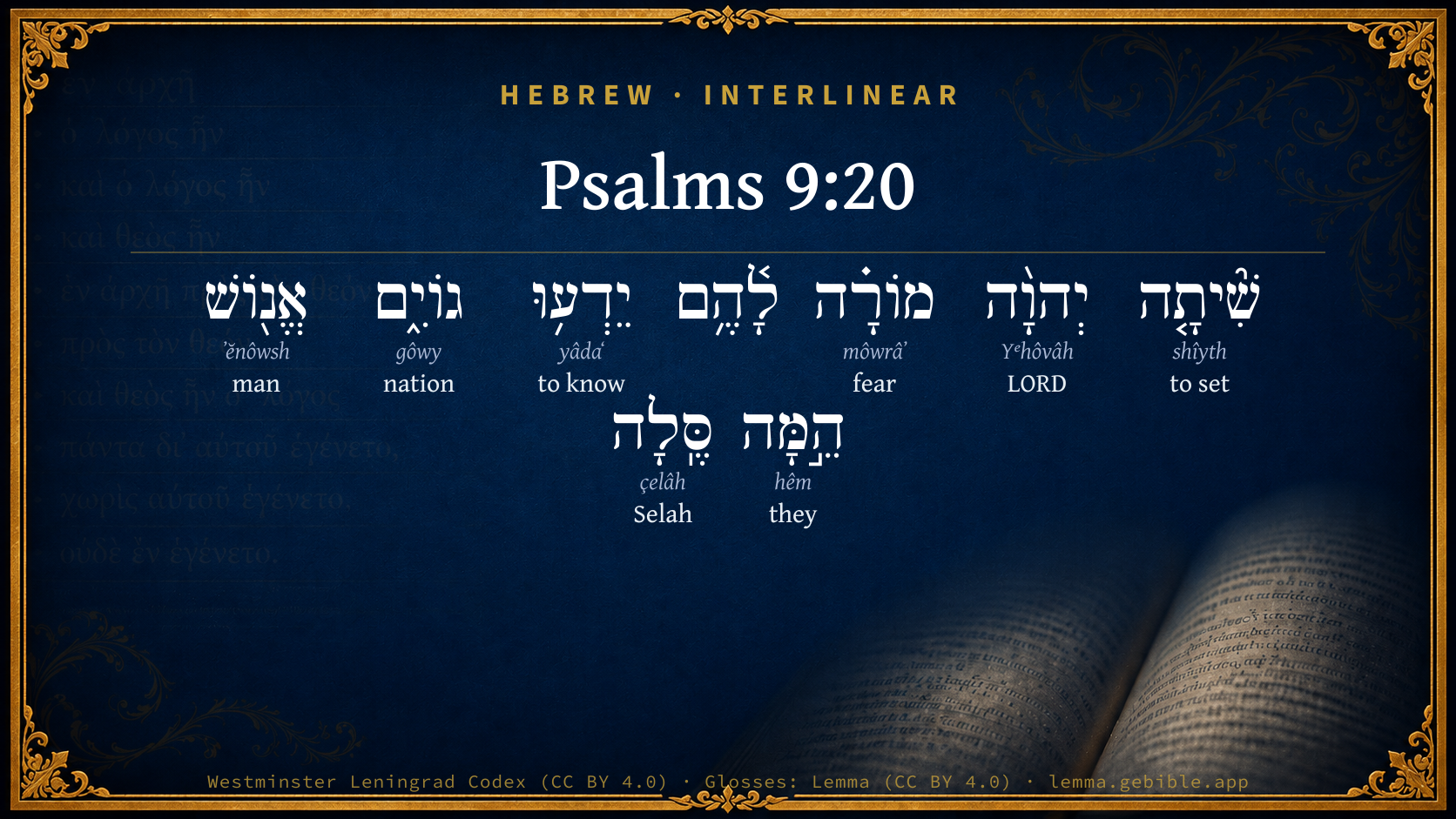
Psalms 9:20

Hebrew (Westminster Leningrad Codex) Psalms 9:20 appears in the Hebrew Old Testament. The text above is from the Westminster Leningrad Codex. Each word links to its Strong’s number, a concise gloss, and parsing drawn from the Open Scriptures Hebrew Bible morphology. Click any word for its full Brown-Driver-Briggs (BDB) entry.
Download image
Cite this verse

Psalms 9:20 (World English Bible). Public Domain. Lemma interlinear Bible study tool, https://lemma.gebible.app/v/psalms/9/20.

Show BibTeX & RIS
BibTeX
RIS
English Translation
Put them in fear, Yahweh. Let the nations know that they are only men. Selah.
World English Bible · Public Domain
Download a study sheet

One document with this verse’s original text, its word-by-word gloss line, the meaning frame, cross-references with their text, attributed commentary, and full source and license credits — printable, and it pastes into notes with its structure intact.

This verse Autodidact and up

Study sheet (.html) Plain text (.txt)

A passage Seminary Student

Up to 50 verses in one chapter. A passage sheet keeps up to 6 commentary sources and 12 cross-references per verse, in the order this page ranks them, and says so on the sheet whenever that leaves anything out. Ask for a single verse and you get the Autodidact verse sheet above.

Everything on this page stays free to read, with no account — the sheet is a download of what is already on screen, not access to it.

Want to remove ads? Support Godless Engineer
Compare translations 3

The same verse in 3 English versions, stacked beneath the original-language interlinear above. Click any original word for its lexicon entry.

Each is an independent rendering of the whole verse — the interlinear is not word-aligned to these translations.

Highlighted words mark where these versions differ — a whole-verse word diff, not a word-by-word alignment.

  • World English Bible Public Domain
    Put them in fear, Yahweh. Let the nations know that they are only men. Selah.
  • King James Version Public Domain
    Put them in fear, O LORD: that the nations may know themselves to be but men. Selah.
  • unfoldingWord Literal Text CC BY-SA 4.0
    Put terror to them, Yahweh! May nations know they are human. Selah

unfoldingWord Literal Text — © unfoldingWord, licensed CC BY-SA 4.0. Word-aligned USFM3 via Door43 (git.door43.org/unfoldingWord/en_ult).

Versions to compare (up to 4)

3 of 4 selected

Show all 18 translations

Every available English version of this verse, each an independent rendering of the whole verse.

  • World English Bible Public Domain
    Put them in fear, Yahweh. Let the nations know that they are only men. Selah.
  • Berean Standard Bible Public Domain
    Lay terror upon them, O LORD; let the nations know they are but men. Selah
  • Majority Standard Bible Public Domain
    Lay terror upon them, O LORD; let the nations know they are but men. Selah
  • King James Version Public Domain
    Put them in fear, O LORD: that the nations may know themselves to be but men. Selah.
  • American Standard Version (1901) Public Domain
    Put them in fear, O Jehovah: Let the nations know themselves to be but men. Selah
  • Revised Version (1885) Public Domain
    Put them in fear, O LORD: let the nations know themselves to be but men. Selah
  • Geneva Bible (1599) Public Domain
    Put them in feare, O Lord, that the heathen may knowe that they are but men. Selah.
  • Douay-Rheims (1899) Public Domain
    Arise, O Lord, let not man be strengthened: let the Gentiles be judged in thy sight.
  • Young's Literal Translation Public Domain
    Appoint, O Jehovah, a director to them, Let nations know they `are' men! Selah.
  • Literal Standard Version CC BY-SA 4.0
    Appoint them to fear, O YHWH, || Let nations know they [are] men! Selah.
  • Unlocked Literal Bible CC BY-SA 4.0
    Terrify them, Yahweh; may the nations know that they are mere men. Selah
  • unfoldingWord Literal Text CC BY-SA 4.0
    Put terror to them, Yahweh! May nations know they are human. Selah
  • Darby Bible Public Domain
    Put them in fear, Jehovah: that the nations may know themselves to be but men. Selah.
  • World Messianic Bible Public Domain
    Put them in fear, LORD. Let the nations know that they are only men. Selah.
  • Webster's Bible Public Domain
    \\9:19\\Arise, O LORD; let not man prevail: let the heathen be judged in thy sight.
  • Free Bible Version CC BY-SA 4.0
    Lord, terrify them! Let them know they are only human! Selah.
  • Bible in Basic English Public Domain
    Put them in fear, O Lord, so that the nations may see that they are only men. (Selah.)
  • JPS Tanakh (1917) Public Domain
    (9-21) Set terror over them, O LORD; let the nations know they are but men. Selah

Literal Standard Version (2020), Covenant Press — licensed CC BY-SA 4.0. Text via the HelloAO Bible API (eBible.org). Unlocked Literal Bible (unfoldingWord) — licensed CC BY-SA 4.0. Text via the HelloAO Bible API (eBible.org). unfoldingWord Literal Text — © unfoldingWord, licensed CC BY-SA 4.0. Word-aligned USFM3 via Door43 (git.door43.org/unfoldingWord/en_ult). Free Bible Version, Dr. Jonathan Gallagher — licensed CC BY-SA 4.0. Text via the HelloAO Bible API (eBible.org).

Word by word

More ways to search: Search by grammar → Find every occurrence → Compare this word →

Practice this passage: Drill this verse → Learn its vocabulary →

About this verse

These counts appear in no published source. They are computed here, from the morphology-tagged text and Lemma’s own curated glosses. What Lemma adds →

9
words
8
distinct lemmas
Wisdom
section

Notable vocabulary

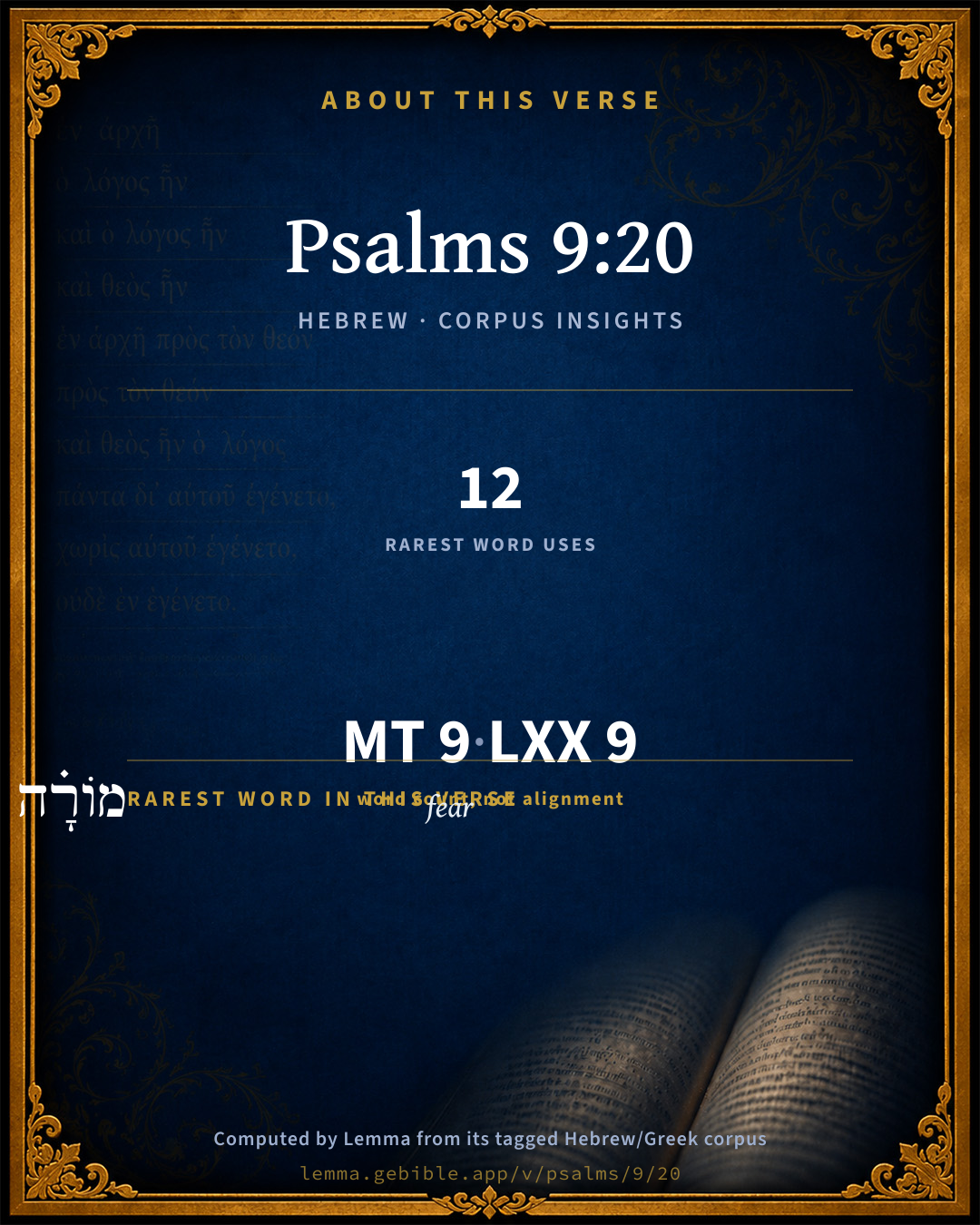
The rarest word here is מוֹרָ֗ה fear H4172 — appearing just 12 times in the whole Hebrew Bible.

Shared distinctive vocabulary

מוֹרָ֗ה fear H4172 occurs in 12 verses of the Hebrew Bible. Also found in:

Grammatical profile

  • 2 verbs
  • 4 nouns
  • 1 pronoun
  • 1 preposition
  • 1 particle

Verb forms

  • שִׁ֘יתָ֤ה Qal · Imperative
  • יֵדְע֥וּ Qal · Imperfect

Hebrew & Septuagint length

In English translation the verse runs 15 words from the Hebrew and 19 from the Septuagint (LXX English) — closely comparable.

A rough comparison of the two English renderings, which tokenize alike — not a word-level alignment.

Word counts can differ between the Hebrew and the Greek without any difference in meaning — e.g. the Hebrew direct-object marker אֵת has no separate Greek word, and Greek often adds the article ὁ.

In the original languages it is 9 Hebrew tokens and 9 Greek tokens — but the two are counted differently (Hebrew bundles its prefixes and suffixes into one token; the Greek is in lemma form), so that isn’t a like-for-like length.

Cross-references

12

Topical passages linked to Psalms 9:20 in the Treasury of Scripture Knowledge — connected by theme and wording, ordered by reader-vote popularity; previews shown in the World English Bible.

  • Isaiah 31:3 Now the Egyptians are men, and not God; and their horses flesh, and not spirit: and when Yahweh shall stretch out his hand, both he who helps shall stumble, and he who is helped shall fall, and they all shall be consumed together.
  • Psalms 62:9 Surely men of low degree are just a breath, And men of high degree are a lie. In the balances they will go up. They are together lighter than a breath.
  • Psalms 82:6–7 I said, "You are gods, All of you are sons of the Most High.
  • Jeremiah 32:40 and I will make an everlasting covenant with them, that I will not turn away from following them, to do them good; and I will put my fear in their hearts, that they may not depart from me.
  • Deuteronomy 2:25 This day will I begin to put the dread of you and the fear of you on the peoples who are under the whole sky, who shall hear the report of you, and shall tremble, and be in anguish because of you.
  • Psalms 76:12 He will cut off the spirit of princes. He is feared by the kings of the earth.
  • Acts 12:22–23 The people shouted, "The voice of a god, and not of a man!"
  • Exodus 23:27 I will send my terror before you, and will confuse all the people to whom you come, and I will make all your enemies turn their backs to you.
  • Ezekiel 28:9 Will you yet say before him who kills you, I am God? but you are man, and not God, in the hand of him who wounds you.
  • Ezekiel 30:13 Thus says the Lord Yahweh: I will also destroy the idols, and I will cause the images to cease from Memphis; and there shall be no more a prince from the land of Egypt: and I will put a fear in the land of Egypt.
  • Exodus 15:16 Terror and dread falls on them. By the greatness of your arm they are as still as a stone; Until your people pass over, Yahweh, Until the people pass over who you have purchased.
  • Ezekiel 28:2 Son of man, tell the prince of Tyre, Thus says the Lord Yahweh: Because your heart is lifted up, and you have said, I am a god, I sit in the seat of God, in the midst of the seas; yet you are man, and not God, though you did set your heart as the heart of God;-

Cross-references courtesy of OpenBible.info (CC BY 4.0).

Hebrew and Greek witnesses Masoretic Hebrew ↔ Greek Septuagint

The same verse in the two great witnesses to the Old Testament, shown verse-for-verse.

You’re reading Greek Psalm 9 (Hebrew Psalm 9). The Septuagint counts the superscription, so verse numbers can differ from the Hebrew — chapter-level alignment, not verse-by-verse. Numbering follows Rahlfs.

These are two independent witnesses, not word-aligned to each other, and the Septuagint is shown in lemma (dictionary) form.

Hebrew Psalms 9:20 Masoretic · Westminster Leningrad Codex

שִׁ֘יתָ֤ה יְהוָ֨ה מוֹרָ֗ה לָ֫הֶ֥ם יֵדְע֥וּ גוֹיִ֑ם אֱנ֖וֹשׁ הֵ֣מָּה סֶּֽלָה

Put them in fear, Yahweh. Let the nations know that they are only men. Selah.

World English Bible · Public Domain

Greek LXX Greek Psalm 9:20 Septuagint · lemma form

ἀναἵστημι κύριος μή κραταιόω ἄνθρωπος κρίνω ἔθνος ἐνώπιον σύ

Appoint, O Lord, a lawgiver over them: let the heathen know that they are men. Pause. (Psalm 9a )

LXX2012 (modern English Septuagint) · Public Domain

On this verse, John Calvin's Commentaries discusses the Septuagint’s reading. Read the note in Commentary ↓

Hebrew: Westminster Leningrad Codex (CC BY 4.0). Greek: Septuagint (public domain); English from LXX2012 (modern English Septuagint) (Public Domain). How the Septuagint differs from the Hebrew →

Commentary

Notes on Psalms 9:20 from classic Christian and Jewish commentators (each source and its license shown beneath its notes). The classic Christian expositions comment on the surrounding passage and are grouped to its opening verse, so a note may address several verses; the Jewish commentaries on the Tanakh (Rashi and others) are per-verse, so they appear only where the commentator wrote on this verse.

Lemma curates 59 commentaries, every one of them public domain or Creative Commons licensed, each selected and text-cleaned for this edition rather than reprinted as found. About our sources →

Trapp's Complete Commentary

John Trapp

Psa 9:20 Put them in fear, O LORD: [that] the nations may know themselves [to be but] men. Selah.

Ver. 20. Put them in fear, O Lord] Strike them with a panic terror, as once the Canaanites, Philistines, 1Sa 5:1-12; Syrians, 2Ki 7:6-7; Germans, in the war against the Hussites, &c. Some read it, Put a law upon them, bridle them, bound them, as thou hast done the sea, Job 38:11. The Greek and Syriac favour this reading.

That the nations may know themselves to be but men] And not gods, as that proud prince of Tyrus, Eze 27:1-36, and Antiochus, who would needs be styled Yεος, to such a height of pride will persecutors grow, if they prosper, and he not taken a link lower, as we say. Homo, id est fracti, saith R. Obad. on this text; men, that is, broken, cracked creatures, morbis mortiquo obnoxii, woeful wights, sorry and sickly captives. This to know savingly is the beginning of true humility, saith Augustine here.

John Trapp, A Commentary or Exposition upon All the Books of the Old and New Testament (1647–1656) — public domain. Text from a community e-Sword module.

J. A. Alexander on Psalms

Joseph Addison Alexander

21. (Psa 9:20). Set, place, or join, O Jehovah, fear to them. Let nations know, or then shall nations know, (that) man, not God, (are) they. Selah. God is entreated so to frighten them, that they may become conscious of their own insignificance and weakness. The word translated fear is elsewhere used to signify a razor. Hence some would render the first clause, apply the razor to them, i. e. shave them, in allusion to the oriental feeling with respect to the beard. But this seems far-fetched, and the masoretic reading yields a better sense. The precise import of the first phrase seems to be, set fear as a guard over them (Psa 141:3), or join it to them as a constant companion. The word translated man is still the same as in the foregoing verse, and was therefore intended to suggest the idea of human frailty, as contrasted with divine omnipotence.

Joseph Addison Alexander, The Psalms Translated and Explained (1850) — public domain. Text from a community e-Sword module.

Geneva Bible (1599)

Geneva Bible translators

Which they cannot learn without the fear of thy judgment.

Geneva Bible (1599) marginal notes — public domain. Text via Bolls.life.

Jamieson, Fausset & Brown

Robert Jamieson, A. R. Fausset & David Brown

By their effectual subjection, make them to realize their frail nature (Psa 8:4), and deter them from all conceit and future rebellion.

Next: Psalms Chapter 10

Jamieson, Fausset & Brown — Commentary Critical and Explanatory on the Whole Bible (1871) — public domain (CC PDM 1.0). Text via the HelloAO Bible API.

Adam Clarke's Commentary

Verse 20. Put them in fear] שיתה יהוה מורה להם shithah Yehovah morah lahem, "O Lord, place a teacher among them," that they may know they also are accountable creatures, grow wise unto salvation, and be prepared for a state of blessedness. Several MSS. read מורא morre, fear; but teacher or legislator is the reading of all the versions except the Chaldee. Coverdale has hit the sense, translating thus: O Lorde, set a Scholemaster over them: and the old Psalter, Sett Lord a brynger of Law abouen tham.

That the nations may know themselves to be but men] אנוש enosh; Let the Gentiles be taught by the preaching of thy Gospel that they are weak and helpless, and stand in need of the salvation which Christ has provided for them. This may be the spirit of the petition. And this is marked by the extraordinary note Selah; Mark well, take notice. So the term may be understood.

"This whole Psalm," says Dr. Horsley, "seems naturally to divide into three parts. The first ten verses make the FIRST part; the six following, the SECOND; and the remaining four the THIRD.

"The FIRST part is prophetic of the utter extermination of the irreligious persecuting faction. The prophecy is delivered in the form of an Επινικιον, or song of victory, occasioned by the promise given in the fifteenth verse of the tenth Psalm; and through the whole of this song the psalmist, in the height of a prophetic enthusiasm, speaks of the threatened vengeance as accomplished.

"The SECOND part opens with an exhortation to the people of God to praise him as the Avenger of their wrongs, and the watchful Guardian of the helpless, and, as if the flame of the prophetic joy which the oracular voice had lighted in the psalmist's mind was beginning to die away, the strain is gradually lowered, and the notes of triumph are mixed with supplication and complaint, as if the mind of the psalmist were fluttering between things present and to come, and made itself alternately present to his actual condition and his future hope.

"In the THIRD part the psalmist seems quite returned from the prophetic enthusiasm to his natural state, and closes the whole song with explicit but cool assertions of the future destruction of the wicked, and the deliverance of the persecuted saints, praying for the event."

ANALYSIS OF THE NINTH PSALM

This Psalm consists of five chief parts: -

I. David's thanksgiving, Ps 9:1-2, amplified and continued till the tenth verse.

II. An exhortation to others to do the like, Ps 9:11, and the reason of it, Ps 9:12.

III. A petition for himself, Ps 9:13, and the reason of it, Ps 9:14.

IV. A remembrance of God's mercy in the overthrow of his enemies, for which he sings a song of triumph, from Ps 9:15-19.

V. A prayer in the conclusion against the prevalence of the heathen, Ps 9:19-20.

I. His profession of praise is set down in the two first verses, in which we may perceive, -

1. The matter of it, with the extent: All the marvellous works of God.

2. That he varies the synonyms. I will praise thee; I will show forth; I will be glad and rejoice in thee; I win sing praise to thy name, O thou Most High! in which there is a climax.

3. The principle whence this praise flowed: 1. Not from the lips, but from the heart. 2. From the whole heart: "I will praise thee with my whole heart."

This he amplifies from the cause, which is double:

1. That which outwardly moved him, and gave him a just occasion to do so; the overthrow of his enemies: "When my enemies are turned back;" who were not overcome by strength or valour, but by the presence and power of God.

2. They shall fall and perish at thy presence. Thou wast the chief cause of this victory; and, therefore, deservest the thanks. Of this the prophet makes a full narrative in the two next verses, setting God as it were upon the bench, and doing the office of Judge. 1. "Thou maintainest my right, and my cause." 2. "Thou sattest on the throne judging right." 3. "Thou hast rebuked the heathen." 4. "Thou hast destroyed the wicked; thou hast put out their name for ever." In a word, Thou art a just Judge, and defendest the innocent, and punishest their oppressors; and therefore I will praise thee.

3. And then, upon the confidence of God's justice and power, he exults over his enemies. O thou enemy, destructions are come to a perpetual end. Thy power of hurting and destroying is taken away; the fortified cities in which thou dwellest are overthrown; and their memory and thine are perished.

4. Next, to make his assertion clearer; to the enemies' power he opposes that of God; his kingdom to their kingdom. But the Lord, in the administration of his kingdom, is, 1. Eternal: "The Lord shall endure for ever." 2. His office to be Judge: "He hath prepared his throne for judgment." 3. He is a universal Judge: "He shall judge the whole world." 4. He is a just Judge: "He shall judge in righteousness; he shall minister judgment to the people in uprightness." 5. He is a merciful Judge: "For the Lord will be a refuge for the oppressed; a refuge in times of trouble."

5. The effect of this execution of justice. His people are encouraged: who are here described, 1. By their knowing him: "They that know thy name." 2. By trusting in him: "Will put their trust in thee." 3. By their seeking him: "For thou, Lord, hast not forsaken them that seek thee."

II. An exhortation to others to praise God: "Sing praises to the Lord." The reason of this, 1. He dwells in Zion. 2. He works graciously there: "Sing praises to the Lord that DWELLS in Zion: declare among the people his DOINGS." 3. That will destroy their oppressors, and avenge their blood: "When he maketh inquisition for blood, he remembereth them; he forgetteth not the cry of the humble."

III. A petition for himself: "Have mercy on me, O Lord; consider my trouble," c. for which he gives these reasons:-

1. That "I may show forth thy praise."

2. "ALL thy praise."

3. "In the gates of the daughter of Zion."

4. That I may do it with joyful lips.

5. Which I will do: "I WILL rejoice in thy salvation."

IV. Then he sings forth his song of triumph ever his enemies:-

1. The "heathen are sunk down in the pit they have made."

2. "In the net which they hid are their own feet taken."

3. This is the Lord's work. Though wicked men did doubt before of his providence and justice; yet now "the Lord was known by the judgment which he executed."

4. For "the wicked was snared in the work of his own hands. Higgaion, Selah." Which is a thing exceedingly to be meditated upon, and not forgotten.

5. "The wicked shall be turned into hell, and all the people that forget God." 1. Their breath is in their nostrils, and die they must. 2. If they repent not, they shall suffer eternal punishment. 3. However this may be, God's goodness shall be manifested to the innocent: "The expectation of the poor shall not perish for ever."

V. A prayer in the conclusion against the prevalence of the heathen, in which he shows great earnestness and faith:-

1. "Arise, O Lord; let not man prevail."

2. "Let the heathen be judged in thy sight."

3. "Put them in fear, O Lord!" Now they fear nothing, being in their height of prosperity. They are insolent and proud; manifest thy Divine presence to their terror.

4. For then they will know themselves to be but men-infirm and mortal creatures; and not insult over thy people, nor glory in their own strength and prosperity.

The original word has been translated teacher, lawgiver, governor. Then send them, 1. A teacher, who may make them wise unto salvation. 2. A lawgiver, who shall rule them in thy fear. 3. A governor, that shall tame and reduce to order their fierce and savage nature. Let the nations be converted unto thee. This will be the noblest triumph. Let their hearts be conquered by thy mercy. And thus the Psalm will conclude as it began, To the Conqueror, on whose vesture and thigh is the name written, KING OF KINGS, AND LORD OF LORDS.

Adam Clarke's Commentary on the Bible (1810–1826) — public domain. Text from a community e-Sword/MySword module.

John Calvin's Commentaries

20. Put them in fear, O Jehovah. The Septuagint translates מורה, morah, [νομοθέτης,] a lawgiver, deriving it from ירה, yarah, which sometimes signifies to teach. The Chaldee version reads fear, but the Syriac, Ethiopic, and Vulgate versions follow the Septuagint. The Arabic employs a word of nearly the same import, signifying a doctor or teacher of the law. In it is, “O Lord set a schoolmaster over them.” Augustine and Jerome, who adopted the reading of the Septuagint, render the words, “Set, O Lord, a lawgiver over them;” and it was their opinion that lawgiver means antichrist, to whom God in his wrath gave dominion over the nations. According to others, lawgiver means Christ. Dr Horsley reads, “O Jehovah, appoint thou a teacher over them.” Ainsworth and Dr Adam Clarke adopt the same rendering, and view the words as a prayer that the nations may learn humility and piety, that they may know their accountability to God, and become wise unto salvation.

“Tous fleax de Dieu par lesquels est rembarre comme a grans coups de marteau.” — Fr.

There follows next the point to which the nations must be brought, namely, to acknowledge themselves to be mortal men. This, at first sight, seems to be a matter of small importance; but the doctrine which it contains is far from being trifling. What is man, that he dares of himself to move a finger? And yet all the ungodly run to excess as boldly and presumptuously as if there were nothing to hinder them from doing whatever they please. It is certainly through a distempered imagination that they claim to themselves what is peculiar to God; and, in short, they would never run to so great excess if they were not ignorant of their own condition. David, when he beseeches God to strike the nations with terror, that they may know that they are men, The original word is אנוש, enosh; and therefore it is a prayer that they may know themselves to be but miserable, frail, and dying men. The word is in the singular number, but it is used collectively.

John Calvin's Commentaries (1540-1563) — public domain. Text from the Calvin Translation Society English edition (1840s-50s) via the Christian Classics Ethereal Library (ccel.org). Calvin's coverage is partial (roughly two-thirds of the Bible); uncommented books and verses are honest gaps, never fabricated. The 19th-century editor's footnotes and remarks are omitted so the notes are faithfully Calvin's own voice.

Ellicott's Commentary for English Readers

(20) Put them in fear.—There is a difficulty about the reading. The LXX., Vulg., and Syriac read “place a lawgiver or master over them.” So Syriac, “law.” Hitzig conjectures, “set a guard upon them.” With the present reading apparently the rendering should be, put a terror upon them: i.e., “give such a proof of power as to trouble and subdue them.”

A Bible Commentary for English Readers, edited by Charles John Ellicott (1878–1897) — public domain. Text from a community e-Sword module.

The Cambridge Bible for Schools and Colleges

gen. ed. J. J. S. Perowne

20. Put them in fear] Lit. set terror for them: some awe-inspiring exhibition of power, such as were the wonders of the Exodus. (Deu_4:34; Deu_26:8; Deu_34:12; Jer_32:21.) The rendering of LXX, Vulg., Syr., appoint a lawgiver over them, (reading môreh for môrah) is certainly wrong, though it is adopted by Luther and by some modern critics.

The Cambridge Bible for Schools and Colleges (gen. ed. J. J. S. Perowne; Cambridge University Press, 1878–1918) — public domain. Text from a community e-Sword module.

Albert Barnes' Notes on the Bible

Put them in fear, O Lord - From this it is evident that the enemies of the psalmist were bold, daring, confident in their own strength, and in the belief that they would succeed. He prays, therefore, that these bold and daring invaders of the rights of others might be made to stand in awe, and to tremble before the great and terrible majesty of God; that they might thus have just views of themselves, and see how weak and feeble they were as compared with Him.

That the nations may know - The nations particularly referred to in this psalm as arrayed against the writer.

Themselves to be but men - That they may see themselves as they are - poor, feeble creatures; as nothing when compared with God; that instead of their pride and self-confidence, their belief that they can accomplish any purpose that they choose, they may see that they are not like God, but that they are frail and feeble mortals. The psalmist seems to have supposed that if they understood this, they would be humbled and would desist from their purposes; and he therefore prays that God would interpose and show them precisely what they were. If men understood this, they would not dare to arrayy themselves against their Maker.

Albert Barnes' Notes on the Bible (1834–1885) — public domain. Text from a community e-Sword/MySword module.

Matthew Poole's English Annotations

Subdue their proud and insolent spirits, and strike them with terror, or with some terrible judgment. But men, Heb. weak, and miserable, and mortal men, and therefore altogether unable to oppose the omnipotent and eternal God. This he saith, because wicked men, when they are advanced to great power and majesty, are very prone to forget their own frailty, and to carry themselves as if they were gods. See Isa 31:3; Eze 30:7,8; Da 5:21.

Matthew Poole's English Annotations on the Holy Bible (1683–1685) — public domain. Text from a community e-Sword/MySword module.

The Treasury of David

Charles H. Spurgeon

Ver. 20. One would think that men would not grow so vain as to deny themselves to be but men, but it appears to be a lesson which only a divine schoolmaster can teach to some proud spirits. Crowns leave their wearers

but men, degrees of eminent learning make their owners not more than men, valour and conquest cannot elevate beyond the dead level of "but men; "and all the wealth of Croesus, the wisdom of Solon, the power of Alexander, the eloquence of Demosthenes, if added together, would leave the possessor but a man. May we ever remember this lest like those in the text, we should be

put in fear. Before leaving this Psalm, it will be very profitable if the student will peruse it again as the triumphal hymn of the Redeemer, as he devoutly brings the glory of his victories and lays it down at his Father's feet. Let us joy in his joy, and our joy shall be full.

Ver. 20. Put them in fear, O Lord, etc. We should otherwise think ourselves gods. We are so inclined to sin that we need strong restraints, and so swelled with a natural pride against God, that we need thorns in the flesh to let out the corrupt matter. The constant hanging the rod over us makes us lick the dust, and acknowledge ourselves to be altogether at the Lord's mercy. Though God hath pardoned us, he will make us wear the halter about our necks to humble us. Stephen Charnock.

Ver. 20. That the nations may know themselves to be but men. The original word is (Heb.), enosh; and therefore it is a prayer that they may know themselves to be but miserable, frail, and dying men. The word is in the singular number, but it is used collectively. John Calvin.

Ver. 20. A needful lesson, and how it is taught.

Charles H. Spurgeon's The Treasury of David (1869–1885) — public domain. Psalms only. Text from a community e-Sword/MySword module.

The Pulpit Commentary

Put them in fear, O Lord; literally, set fear to them; i.e. "make them afraid," either by striking a panic terror into them, as into the Syrians when they had brought Samaria to the last gasp, (2Ki_7:6, 2Ki_7:7) or by causing them calmly to review the situation, and to see how dangerous it was to assail God"s people. (2Ki_6:23) That the nations may know themselves to be but men. May recognize, i.e. , their weakness; may remember that they are enosh mere weak, frail, sickly, perishing mortals. Selah. Here this word occurs for the second time at the end of a psalm (see above, Psa_3:8) a position which militates against the idea of its signifying "a pause," since there must always have been a pause at the end of every psalm.

The Pulpit Commentary (1880–1919), ed. H.D.M. Spence-Jones & Joseph S. Exell — public domain. Text from a community e-Sword module.

Rashi

Rabbi Shlomo Yitzchaki (Rashi)

Arise, O Lord David was praying before the Holy One, blessed be He, that He rise and hasten to do this.

let...have no power [i.e., let] the wicked man [not] enjoy longevity in his greatness.

for Your anger Because of the anger with which they angered You in Your sanctuary.

Rashi on the Tanakh — English translations: “The Judaica Press complete Tanach with Rashi, translated by A. J. Rosenberg” (CC BY 4.0); “Pentateuch with Rashi's commentary by M. Rosenbaum and A.M. Silbermann, 1929-1934” (public domain); “The Metsudah Tanach series, Lakewood, N.J” (CC BY 4.0); and “The Book of Joshua, Metsudah Publications, 1997” (CC BY 4.0). Text via Sefaria.

Radak

Rabbi David Kimhi (Radak)

Arise, O Lord: קומה, Arise, with the accent milra. And he says: “Arise.” as he says, “Lift up Thyself”; and all is figurative, (calling to God) that He should rise up to judge the wicked.

let not man prevail: – Let not the children of men who possess strength and might against Israel prevail any more.

Let the nations be judged before Thy face, – פניך על, equivalent to לפניך. And so, “other gods before Me (פני על)” (Exod. 20:3; Deut. 5:7).

Radak on the Tanakh — English translations: “Sefaria Community Translation” (CC0 1.0 (public-domain dedication)); “Eliyahu Munk, HaChut Hameshulash” (CC BY 4.0); “Rabbi Mike Feuer, Jerusalem Anthology” (CC BY 4.0); and “R. David Kimhi on the first book of Psalms, Translated by R.G. Finch, London, 1919” (public domain). Text via Sefaria.

Lesson kit

Teaching starters — assembled from the data on this page, not authored interpretation. Every prompt links to the verse data it draws on. Edit before teaching.

Psalms, in the Wisdom, opens this verse with 9 words (8 distinct Hebrew lemmas). Its most distinctive word is môwrâʼ (“fear”). A historical commentator’s framing appears above. Read the whole chapter for the surrounding context.

Discussion questions

  1. How does “fear” (môwrâʼ) shape what this verse is saying?
  2. How does Genesis 9:2, which shares the word «fear», read alongside this verse?
  3. The translations on this page render this verse differently — a whole-verse word diff, not a word-by-word alignment. What might account for the different wordings?
  4. «שִׁ֘יתָ֤ה» is a Qal Imperative verb. How does that grammatical form shape the action described?
  5. Compare how Trapp's Complete Commentary and J. A. Alexander on Psalms read this verse. Where do they agree or differ?

Things to notice

Reading settings

Reading text

Shown beneath each verse's original-language words.

Old Testament
Old Testament edition

Read the OT as the Masoretic Hebrew (MT) or the Greek Septuagint (LXX).

English shown for the Greek Septuagint (in the Hebrew ↔ Greek comparison).

Comparing translations? Open the Compare panel on any verse page to stack up to four side by side.