
1 Chronicles 14:17

Hebrew (Westminster Leningrad Codex) 1 Chronicles 14:17 appears in the Hebrew Old Testament. The text above is from the Westminster Leningrad Codex. Each word links to its Strong’s number, a concise gloss, and parsing drawn from the Open Scriptures Hebrew Bible morphology. Click any word for its full Brown-Driver-Briggs (BDB) entry.
Download image
Cite this verse

1 Chronicles 14:17 (World English Bible). Public Domain. Lemma interlinear Bible study tool, https://lemma.gebible.app/v/1-chronicles/14/17.

Show BibTeX & RIS
BibTeX
RIS
English Translation
The fame of David went out into all lands; and Yahweh brought the fear of him on all nations.
World English Bible · Public Domain
Download a study sheet

One document with this verse’s original text, its word-by-word gloss line, the meaning frame, cross-references with their text, attributed commentary, and full source and license credits — printable, and it pastes into notes with its structure intact.

This verse Autodidact and up

Study sheet (.html) Plain text (.txt)

A passage Seminary Student

Up to 50 verses in one chapter. A passage sheet keeps up to 6 commentary sources and 12 cross-references per verse, in the order this page ranks them, and says so on the sheet whenever that leaves anything out. Ask for a single verse and you get the Autodidact verse sheet above.

Everything on this page stays free to read, with no account — the sheet is a download of what is already on screen, not access to it.

Want to remove ads? Support Godless Engineer
Compare translations 3

The same verse in 3 English versions, stacked beneath the original-language interlinear above. Click any original word for its lexicon entry.

Each is an independent rendering of the whole verse — the interlinear is not word-aligned to these translations.

Highlighted words mark where these versions differ — a whole-verse word diff, not a word-by-word alignment.

  • World English Bible Public Domain
    The fame of David went out into all lands; and Yahweh brought the fear of him on all nations.
  • King James Version Public Domain
    And the fame of David went out into all lands; and the LORD brought the fear of him upon all nations.
  • unfoldingWord Literal Text CC BY-SA 4.0
    And the name of David went out into all of the lands, and Yahweh put the fear of him on all of the nations.

unfoldingWord Literal Text — © unfoldingWord, licensed CC BY-SA 4.0. Word-aligned USFM3 via Door43 (git.door43.org/unfoldingWord/en_ult).

Versions to compare (up to 4)

3 of 4 selected

Show all 18 translations

Every available English version of this verse, each an independent rendering of the whole verse.

  • World English Bible Public Domain
    The fame of David went out into all lands; and Yahweh brought the fear of him on all nations.
  • Berean Standard Bible Public Domain
    And David’s fame went out into every land, and the LORD caused all nations to fear him.
  • Majority Standard Bible Public Domain
    And David’s fame went out into every land, and the LORD caused all nations to fear him.
  • King James Version Public Domain
    And the fame of David went out into all lands; and the LORD brought the fear of him upon all nations.
  • American Standard Version (1901) Public Domain
    And the fame of David went out into all lands; and Jehovah brought the fear of him upon all nations.
  • Revised Version (1885) Public Domain
    And the fame of David went out unto all lands; and the LORD brought the fear of him upon all nations.
  • Geneva Bible (1599) Public Domain
    And the fame of Dauid went out into all landes, and the Lord brought the feare of him vpon all nations.
  • Douay-Rheims (1899) Public Domain
    And the name of David became famous in all countries, and the Lord made all nations fear him.
  • Young's Literal Translation Public Domain
    and the name of David goeth out into all the lands, and Jehovah hath put his fear on all the nations.
  • Literal Standard Version CC BY-SA 4.0
    and the name of David goes out into all the lands, and YHWH has put his fear on all the nations.
  • Unlocked Literal Bible CC BY-SA 4.0
    Then David's fame went out into all lands, and Yahweh caused all nations to fear him.
  • unfoldingWord Literal Text CC BY-SA 4.0
    And the name of David went out into all of the lands, and Yahweh put the fear of him on all of the nations.
  • Darby Bible Public Domain
    And the fame of David went out into all lands; and Jehovah brought the fear of him upon all the nations.
  • World Messianic Bible Public Domain
    The fame of David went out into all lands; and the LORD brought the fear of him on all nations.
  • Webster's Bible Public Domain
    And the fame of David went out into all lands; and the LORD brought the fear of him upon all nations.
  • Free Bible Version CC BY-SA 4.0
    As a result David's reputation was spread everywhere, and the Lord made all the nations afraid of David.
  • Bible in Basic English Public Domain
    And David's name was honoured in all lands; and the Lord put the fear of him on all nations.
  • JPS Tanakh (1917) Public Domain
    And the fame of David went out into all lands; and the LORD brought the fear of him upon all nations.

Literal Standard Version (2020), Covenant Press — licensed CC BY-SA 4.0. Text via the HelloAO Bible API (eBible.org). Unlocked Literal Bible (unfoldingWord) — licensed CC BY-SA 4.0. Text via the HelloAO Bible API (eBible.org). unfoldingWord Literal Text — © unfoldingWord, licensed CC BY-SA 4.0. Word-aligned USFM3 via Door43 (git.door43.org/unfoldingWord/en_ult). Free Bible Version, Dr. Jonathan Gallagher — licensed CC BY-SA 4.0. Text via the HelloAO Bible API (eBible.org).

Word by word

More ways to search: Search by grammar → Find every occurrence → Compare this word →

Practice this passage: Drill this verse → Learn its vocabulary →

פַּחְדּ֖וֹ
pachad
H6343
“terror · his”
Noun, Common, Masculine, Singular, Construct + Suffix, Personal, 3rd Person, Masculine, Singular
Part of Speech
Noun
Type
Common
Gender
Masculine
Number
Singular
State
Construct
Full BDB Definition

Origin: from H6342

TWOT: 1756a

terror, dread - dread - object of dread
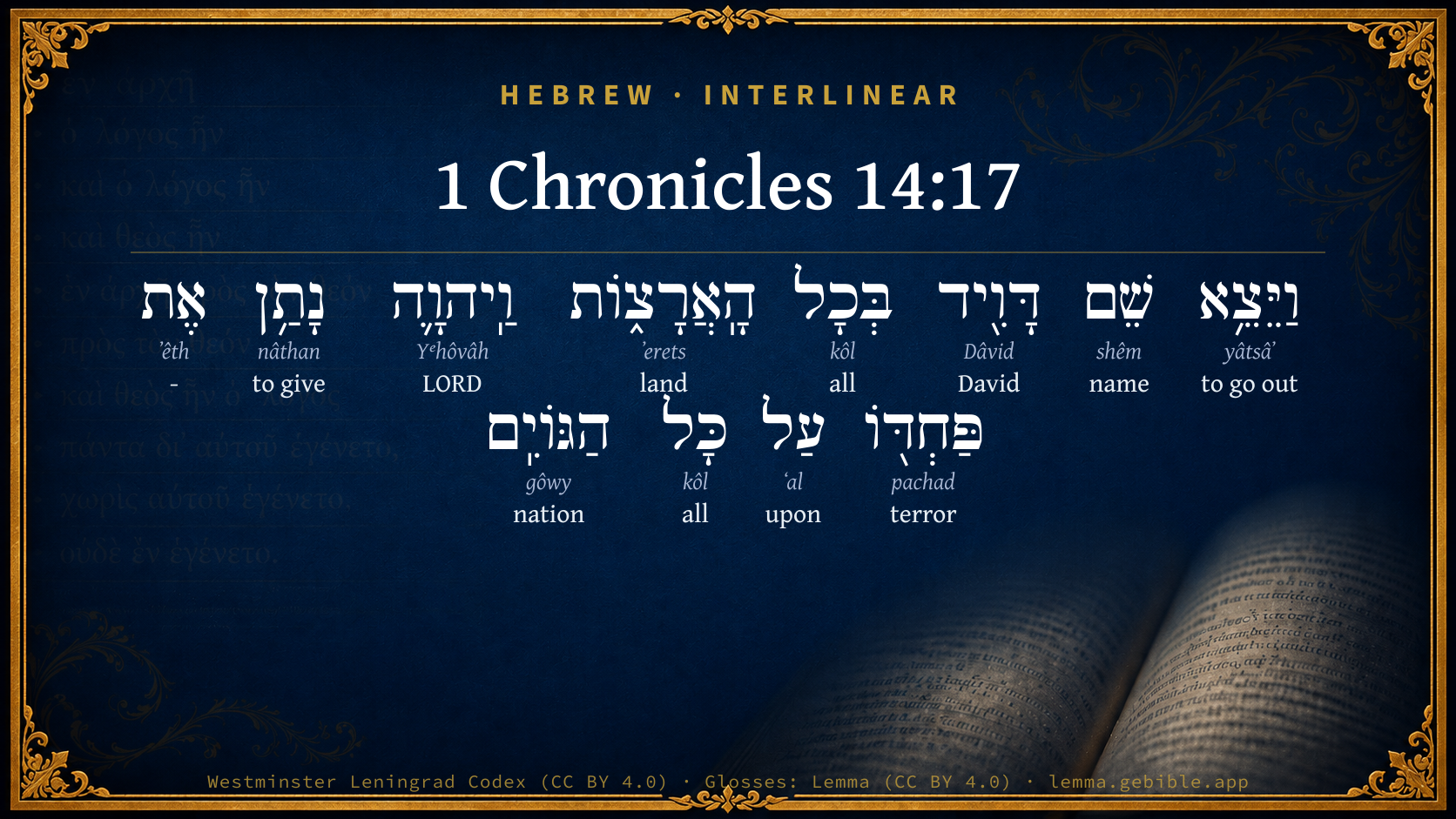
  1. וַיֵּצֵ֥א yâtsâʼ H3318 “and · to go out” Conjunction + Verb, Qal, Sequential Imperfect, 3rd Person, Masculine, Singular
  2. שֵׁם shêm H8034 “name of” Noun, Common, Masculine, Singular, Construct
  3. דָּוִ֖יד Dâvid H1732 “David” Noun, Proper
  4. בְּכָל kôl H3605 “in/at · all of” Preposition + Noun, Common, Masculine, Singular, Construct
  5. הָֽאֲרָצ֑וֹת ʼerets H776 “the · lands” Particle, Definite Article + Noun, Common, Both, Plural, Absolute
  6. וַֽיהוָ֛ה Yᵉhôvâh H3068 “and · LORD” Conjunction + Noun, Proper
  7. נָתַ֥ן nâthan H5414 “to give” Verb, Qal, Perfect, 3rd Person, Masculine, Singular
  8. אֶת ʼêth H853 “-” Particle, Direct Object
  9. עַל ʻal H5921 “upon” Preposition
  10. כָּל kôl H3605 “all of” Noun, Common, Masculine, Singular, Construct
  11. הַגּוֹיִֽם gôwy H1471 “the · nations” Particle, Definite Article + Noun, Common, Masculine, Plural, Absolute

About this verse

These counts appear in no published source. They are computed here, from the morphology-tagged text and Lemma’s own curated glosses. What Lemma adds →

12
words
11
distinct lemmas
Historical
section

Shared distinctive vocabulary

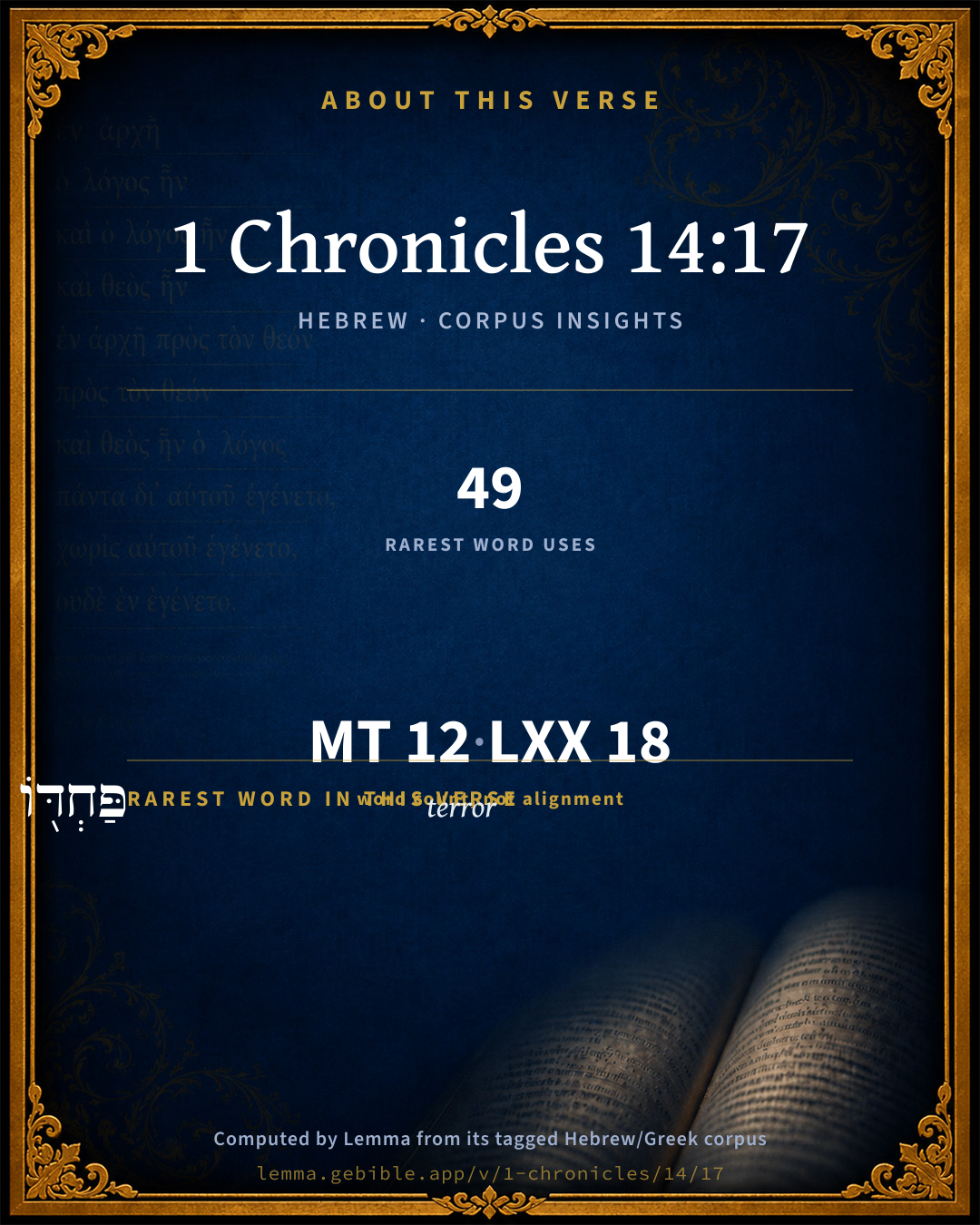
פַּחְדּ֖וֹ terror H6343 occurs in 48 verses of the Hebrew Bible. Also found in:

Grammatical profile

  • 2 verbs
  • 8 nouns
  • 1 preposition
  • 1 particle

Verb forms

  • וַיֵּצֵ֥א Qal · Sequential Imperfect
  • נָתַ֥ן Qal · Perfect

Repetition

A word recurs within this verse — often emphatic in Hebrew:

  • בְּכָל all H3605 ×2

Hebrew & Septuagint length

In English translation the verse runs 19 words from the Hebrew and 23 from the Septuagint (LXX English) — closely comparable.

A rough comparison of the two English renderings, which tokenize alike — not a word-level alignment.

Word counts can differ between the Hebrew and the Greek without any difference in meaning — e.g. the Hebrew direct-object marker אֵת has no separate Greek word, and Greek often adds the article ὁ.

In the original languages it is 12 Hebrew tokens and 18 Greek tokens — but the two are counted differently (Hebrew bundles its prefixes and suffixes into one token; the Greek is in lemma form), so that isn’t a like-for-like length.

Cross-references

8

Topical passages linked to 1 Chronicles 14:17 in the Treasury of Scripture Knowledge — connected by theme and wording, ordered by reader-vote popularity; previews shown in the World English Bible.

  • Deuteronomy 2:25 This day will I begin to put the dread of you and the fear of you on the peoples who are under the whole sky, who shall hear the report of you, and shall tremble, and be in anguish because of you.
  • Joshua 6:27 So Yahweh was with Joshua; and his fame was in all the land.
  • Exodus 15:14–16 The peoples have heard. They tremble. Pangs have taken hold on the inhabitants of Philistia.
  • Deuteronomy 11:25 There shall no man be able to stand before you: Yahweh your God shall lay the fear of you and the dread of you on all the land that you shall tread on, as he has spoken to you.
  • 2 Chronicles 26:8 The Ammonites gave tribute to Uzziah: and his name spread abroad even to the entrance of Egypt; for he grew exceeding strong.
  • Psalms 18:44 As soon as they hear of me they shall obey me. The foreigners shall submit themselves to me.
  • Joshua 2:9–11 and she said to the men, I know that Yahweh has given you the land, and that the fear of you is fallen on us, and that all the inhabitants of the land melt away before you.
  • Joshua 9:24 They answered Joshua, and said, Because it was certainly told your servants, how that Yahweh your God commanded his servant Moses to give you all the land, and to destroy all the inhabitants of the land from before you; therefore we were sore afraid for our lives because of you, and have done this thing.

Cross-references courtesy of OpenBible.info (CC BY 4.0).

Hebrew and Greek witnesses Masoretic Hebrew ↔ Greek Septuagint

The same verse in the two great witnesses to the Old Testament, shown verse-for-verse.

These are two independent witnesses, not word-aligned to each other, and the Septuagint is shown in lemma (dictionary) form.

Hebrew 1 Chronicles 14:17 Masoretic · Westminster Leningrad Codex

וַיֵּצֵ֥א שֵׁם דָּוִ֖יד בְּכָל הָֽאֲרָצ֑וֹת וַֽיהוָ֛ה נָתַ֥ן אֶת פַּחְדּ֖וֹ עַל כָּל הַגּוֹיִֽם

The fame of David went out into all lands; and Yahweh brought the fear of him on all nations.

World English Bible · Public Domain

Greek LXX 1 Chronicles 14:17 Septuagint · lemma form

καί γίγνομαι ὄνομα δαυίδ ἐν πᾶς ὁ γῆ καί κύριος δίδωμι ὁ φόβος αὐτός ἐπί πᾶς ὁ ἔθνος

And the name of David was famous in all the land; and the Lord put the terror of him on all the nations.

LXX2012 (modern English Septuagint) · Public Domain

Hebrew: Westminster Leningrad Codex (CC BY 4.0). Greek: Septuagint (public domain); English from LXX2012 (modern English Septuagint) (Public Domain). How the Septuagint differs from the Hebrew →

Commentary

Notes on 1 Chronicles 14:17 from classic Christian and Jewish commentators (each source and its license shown beneath its notes). The classic Christian expositions comment on the surrounding passage and are grouped to its opening verse, so a note may address several verses; the Jewish commentaries on the Tanakh (Rashi and others) are per-verse, so they appear only where the commentator wrote on this verse.

Lemma curates 59 commentaries, every one of them public domain or Creative Commons licensed, each selected and text-cleaned for this edition rather than reprinted as found. About our sources →

Trapp's Complete Commentary

John Trapp

1Ch 14:17 And the fame of David went out into all lands; and the LORD brought the fear of him upon all nations.

Ver. 17. And the Lord brought the fear of him.] He grew terrible to his enemies. So did Hunniades, Scanderbeg, Charles V, &c., ita et parentes liberis plorantibus silentium non aliter imperarent quam horum praesentiam minitando: so that mothers stilled their children by these men’s names.

John Trapp, A Commentary or Exposition upon All the Books of the Old and New Testament (1647–1656) — public domain. Text from a community e-Sword module.

Adam Clarke's Commentary

Verse 17. Into all lands] That is, all the surrounding or neighbouring lands and nations, for no others can possibly be intended.

Adam Clarke's Commentary on the Bible (1810–1826) — public domain. Text from a community e-Sword/MySword module.

Ellicott's Commentary for English Readers

(17) This verse is not in Samuel. It looks like a concluding reflection of the chronicler’s, similar to 2Ch_17:10; 2Ch_20:29.

The fame of David went out.—David’s name. The same phrase recurs in 2Ch_26:15.

All lands.—All the lands. (Comp. Psa_19:4.)

And the Lord brought the fear of him upon all nations.—Yet this fear was, as we should say, the natural effect of his victories. In the view of the chronicler, David’s success in arms, with all its consequences, was the work of Jehovah. The Hebrew phrase is similar to that in Est_8:17.

A Bible Commentary for English Readers, edited by Charles John Ellicott (1878–1897) — public domain. Text from a community e-Sword module.

Haydock's Catholic Bible Commentary

All countries and nations, in the vicinity. (Haydock)

George Leo Haydock (1774–1849), Haydock's Catholic Family Bible and Commentary, 1859 edition — public domain. Excludes Psalms (Douay-Rheims chapter numbering differs from Protestant) and Deuterocanonical books (Catholic canon only).

Matthew Poole's English Annotations

Into all lands, i.e. into all the neighbouring countries.

Matthew Poole's English Annotations on the Holy Bible (1683–1685) — public domain. Text from a community e-Sword/MySword module.

The Pulpit Commentary

Fame and fear.

David, notwithstanding his follies and sins, was "the man after God"s own heart." Devout, obedient, diligent, courageous, he was eminently adapted both to govern the nation, to lead the army, to promote the revival of true religion. Providence exalted him to a lofty position and enabled him to adorn the station to which he was raised. Hence so large a part of the historical books of the Old Testament are occupied with the events of his reign; and hence he is so frequently alluded to in the national annals, and so often quoted both by our Lord and by his inspired apostles.

I DAVID"S FAME. It was the fame of:

1. A successful warrior. A man of war from his youth, he owed his throne to his valour and generalship.

2. A powerful king. When he wielded the forces of a nation, God gave him victory over many enemies.

3. A pious man. His steadfastness in worshipping the true God, his liberality in providing for the services of the sanctuary, his habitual devotion, all were well known, and stamped David as a truly religious man.

4. A sacred poet and musician. It is as" the sweet singer of Israel" that he is held in lasting remembrance, and remembered with gratitude both widespread and sincere.

II DAVID"S FEAR.

1. His subjects held him in honour and had respect to his righteous laws.

2. His officers and troops were devoted to his person and obeyed his authoritative behests.

3. Traitors stood in awe of his vigour, promptness, and power.

4. His alliance was sought by neighbouring nations, who dreaded to have him as an enemy, and who courted his friendship.

5. His foes feared him, for he defeated their armies and held themselves in subjection and tribute.

PRACTICAL LESSONS.

1. All greatness is from God, to whom all praise is due.

2. The great are responsible for the use of their power to him who is "King of kings and Lord of lords. T.

The Pulpit Commentary (1880–1919), ed. H.D.M. Spence-Jones & Joseph S. Exell — public domain. Text from a community e-Sword module.

Lesson kit

Teaching starters — assembled from the data on this page, not authored interpretation. Every prompt links to the verse data it draws on. Edit before teaching.

1 Chronicles, in the Historical, opens this verse with 12 words (11 distinct Hebrew lemmas). Its most distinctive word is pachad (“terror”). A historical commentator’s framing appears above. Read the whole chapter for the surrounding context.

Discussion questions

  1. How does “terror” (pachad) shape what this verse is saying?
  2. Genesis 31:42 shares the word «terror» with this verse. How do the two illuminate each other?
  3. “all” occurs 2× in this one verse. What is the effect of the repetition?
  4. These translations render this verse differently; the difference is in the English rendering, not the original. What questions does that raise?
  5. The verb «וַיֵּצֵ֥א» is Qal Sequential Imperfect. How does its form color the action?
  6. Reading how Trapp's Complete Commentary and Adam Clarke's Commentary read this verse, where do the two commentators agree and where do they part?

Things to notice

Reading settings

Reading text

Shown beneath each verse's original-language words.

Old Testament
Old Testament edition

Read the OT as the Masoretic Hebrew (MT) or the Greek Septuagint (LXX).

English shown for the Greek Septuagint (in the Hebrew ↔ Greek comparison).

Comparing translations? Open the Compare panel on any verse page to stack up to four side by side.