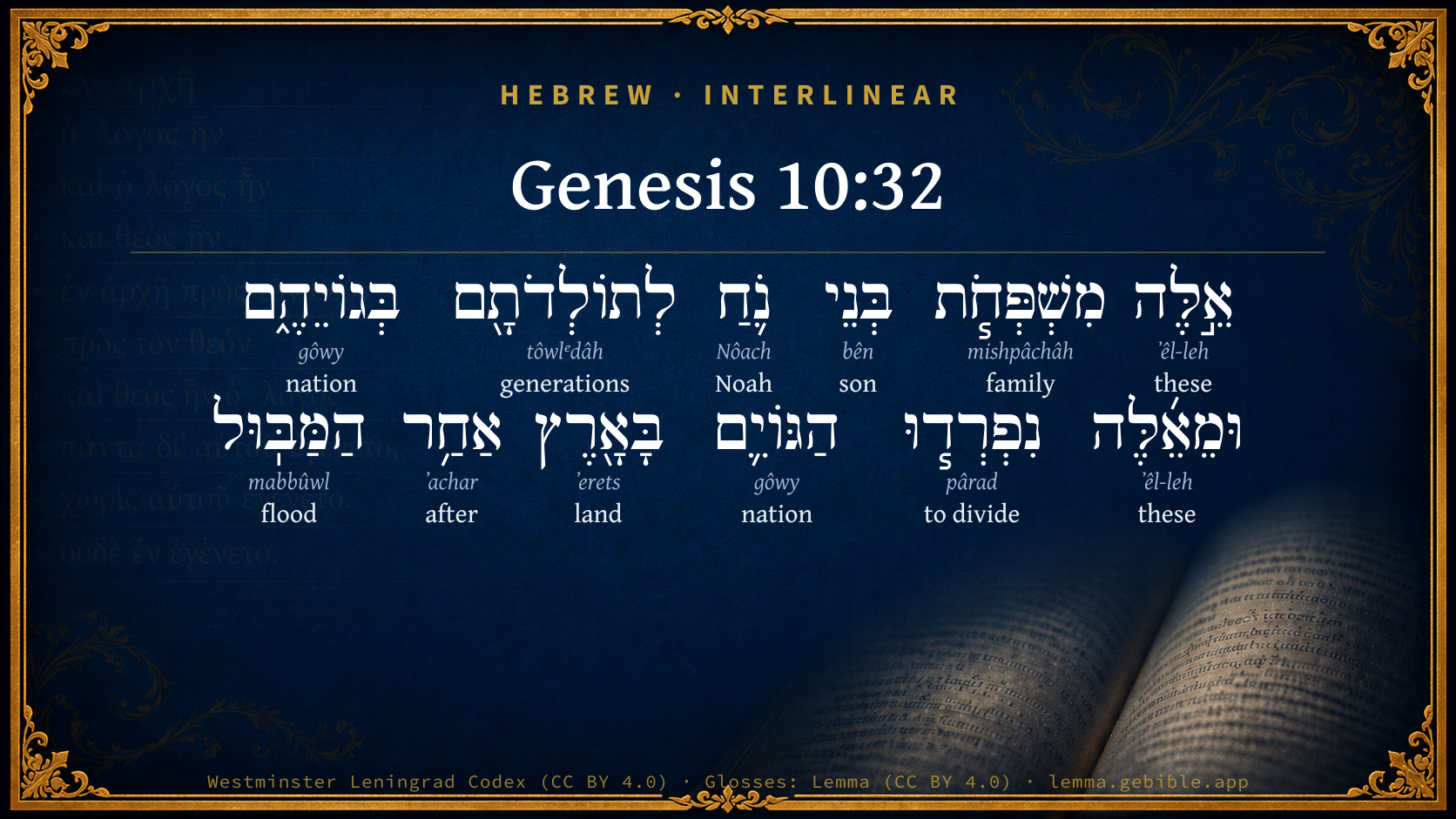
Genesis 10:32

Hebrew (Westminster Leningrad Codex) Genesis 10:32 appears in the Hebrew Old Testament. The text above is from the Westminster Leningrad Codex. Each word links to its Strong’s number, a concise gloss, and parsing drawn from the Open Scriptures Hebrew Bible morphology. Click any word for its full Brown-Driver-Briggs (BDB) entry.
Download image
Cite this verse

Genesis 10:32 (World English Bible). Public Domain. Lemma interlinear Bible study tool, https://lemma.gebible.app/v/genesis/10/32.

Show BibTeX & RIS
BibTeX
RIS
English Translation
These are the families of the sons of Noah, after their generations, in their nations. Of these were the nations divided in the earth after the flood.
World English Bible · Public Domain
Download a study sheet

One document with this verse’s original text, its word-by-word gloss line, the meaning frame, cross-references with their text, attributed commentary, and full source and license credits — printable, and it pastes into notes with its structure intact.

This verse Autodidact and up

Study sheet (.html) Plain text (.txt)

A passage Seminary Student

Up to 50 verses in one chapter. A passage sheet keeps up to 6 commentary sources and 12 cross-references per verse, in the order this page ranks them, and says so on the sheet whenever that leaves anything out. Ask for a single verse and you get the Autodidact verse sheet above.

Everything on this page stays free to read, with no account — the sheet is a download of what is already on screen, not access to it.

Want to remove ads? Support Godless Engineer
Compare translations 3

The same verse in 3 English versions, stacked beneath the original-language interlinear above. Click any original word for its lexicon entry.

Each is an independent rendering of the whole verse — the interlinear is not word-aligned to these translations.

Highlighted words mark where these versions differ — a whole-verse word diff, not a word-by-word alignment.

  • World English Bible Public Domain
    These are the families of the sons of Noah, after their generations, in their nations. Of these were the nations divided in the earth after the flood.
  • King James Version Public Domain
    These are the families of the sons of Noah, after their generations, in their nations: and by these were the nations divided in the earth after the flood.
  • unfoldingWord Literal Text CC BY-SA 4.0
    Those the clans of the sons of Noah, according to their generations, in their nations. And from those the nations spread out on the earth after the flood.

unfoldingWord Literal Text — © unfoldingWord, licensed CC BY-SA 4.0. Word-aligned USFM3 via Door43 (git.door43.org/unfoldingWord/en_ult).

Versions to compare (up to 4)

3 of 4 selected

Show all 18 translations

Every available English version of this verse, each an independent rendering of the whole verse.

  • World English Bible Public Domain
    These are the families of the sons of Noah, after their generations, in their nations. Of these were the nations divided in the earth after the flood.
  • Berean Standard Bible Public Domain
    All these are the clans of Noah’s sons, according to their generations and nations. From these the nations of the earth spread out after the flood.
  • Majority Standard Bible Public Domain
    All these are the clans of Noah’s sons, according to their generations and nations. From these the nations of the earth spread out after the flood.
  • King James Version Public Domain
    These are the families of the sons of Noah, after their generations, in their nations: and by these were the nations divided in the earth after the flood.
  • American Standard Version (1901) Public Domain
    These are the families of the sons of Noah, after their generations, in their nations: and of these were the nations divided in the earth after the flood.
  • Revised Version (1885) Public Domain
    These are the families of the sons of Noah, after their generations, in their nations: and of these were the nations divided in the earth after the flood.
  • Geneva Bible (1599) Public Domain
    These are the families of the sonnes of Noah, after their generations among their people: and out of these were the nations diuided in the earth after the flood.
  • Douay-Rheims (1899) Public Domain
    These are the families of Noe, according to their peoples and nations. By these were the nations divided on the earth after the flood.
  • Young's Literal Translation Public Domain
    These `are' families of the sons of Noah, by their births, in their nations, and by these have the nations been parted in the earth after the deluge.
  • Literal Standard Version CC BY-SA 4.0
    These [are] families of the sons of Noah, by their generations, in their nations, and by these the nations have been parted in the earth after the flood.
  • Unlocked Literal Bible CC BY-SA 4.0
    These were the clans of the sons of Noah, according to their genealogies, by their nations. From these the nations separated and went over the earth after the flood.
  • unfoldingWord Literal Text CC BY-SA 4.0
    Those the clans of the sons of Noah, according to their generations, in their nations. And from those the nations spread out on the earth after the flood.
  • Darby Bible Public Domain
    These are the families of the sons of Noah, after their generations, in their nations. And from these came the distribution of the nations on the earth after the flood.
  • World Messianic Bible Public Domain
    These are the families of the sons of Noah, by their generations, according to their nations. The nations divided from these in the earth after the flood.
  • Webster's Bible Public Domain
    These are the families of the sons of Noah after their generations, in their nations: and by these were the nations divided in the earth after the flood.
  • Free Bible Version CC BY-SA 4.0
    These were all the tribes descended from Noah's sons, according to their genealogies and national groups. From these ancestors the different nations of the earth spread around the world after the flood.
  • Bible in Basic English Public Domain
    These are the families of the sons of Noah, in the order of their generations and their nations: from these came all the nations of the earth after the great flow of waters.
  • JPS Tanakh (1917) Public Domain
    These are the families of the sons of Noah, after their generations, in their nations; and of these were the nations divided in the earth after the flood.

Literal Standard Version (2020), Covenant Press — licensed CC BY-SA 4.0. Text via the HelloAO Bible API (eBible.org). Unlocked Literal Bible (unfoldingWord) — licensed CC BY-SA 4.0. Text via the HelloAO Bible API (eBible.org). unfoldingWord Literal Text — © unfoldingWord, licensed CC BY-SA 4.0. Word-aligned USFM3 via Door43 (git.door43.org/unfoldingWord/en_ult). Free Bible Version, Dr. Jonathan Gallagher — licensed CC BY-SA 4.0. Text via the HelloAO Bible API (eBible.org).

Word by word

More ways to search: Search by grammar → Find every occurrence → Compare this word →

Practice this passage: Drill this verse → Learn its vocabulary →

הַמַּבּֽוּל
mabbûwl
H3999
“the · flood”
Particle, Definite Article + Noun, Common, Masculine, Singular, Absolute
Part of Speech
Particle + Noun
Type
Common
Gender
Masculine
Number
Singular
State
Absolute
Full BDB Definition

Origin: from H2986 in the sense of flowing

TWOT: 1142

flood, deluge. - Noah's flood that submerged the entire planet earth under water for about a year
  1. אֵ֣לֶּה ʼêl-leh H428 “these” Pronoun, Demonstrative, Common, Plural
  2. מִשְׁפְּחֹ֧ת mishpâchâh H4940 “families of” Noun, Common, Feminine, Plural, Construct
  3. בְּנֵי bên H1121 “sons of” Noun, Common, Masculine, Plural, Construct
  4. נֹ֛חַ Nôach H5146 “Noah” Noun, Proper
  5. לְתוֹלְדֹתָ֖ם tôwlᵉdâh H8435 “to/for · generations · their” Preposition + Noun, Common, Feminine, Plural, Construct + Suffix, Personal, 3rd Person, Masculine, Plural
  6. בְּגוֹיֵהֶ֑ם gôwy H1471 “in/at · nations · their” Preposition + Noun, Common, Masculine, Plural, Construct + Suffix, Personal, 3rd Person, Masculine, Plural
  7. וּמֵאֵ֜לֶּה ʼêl-leh H428 “and · from · these” Conjunction + Preposition + Pronoun, Demonstrative, Common, Plural
  8. נִפְרְד֧וּ pârad H6504 “to divide” Verb, Niphal, Perfect, 3rd Person, Common, Plural
  9. הַגּוֹיִ֛ם gôwy H1471 “the · nations” Particle, Definite Article + Noun, Common, Masculine, Plural, Absolute
  10. בָּאָ֖רֶץ ʼerets H776 “in/at the · land” Preposition, Determined + Noun, Common, Both, Singular, Absolute
  11. אַחַ֥ר ʼachar H310 “after” Preposition

About this verse

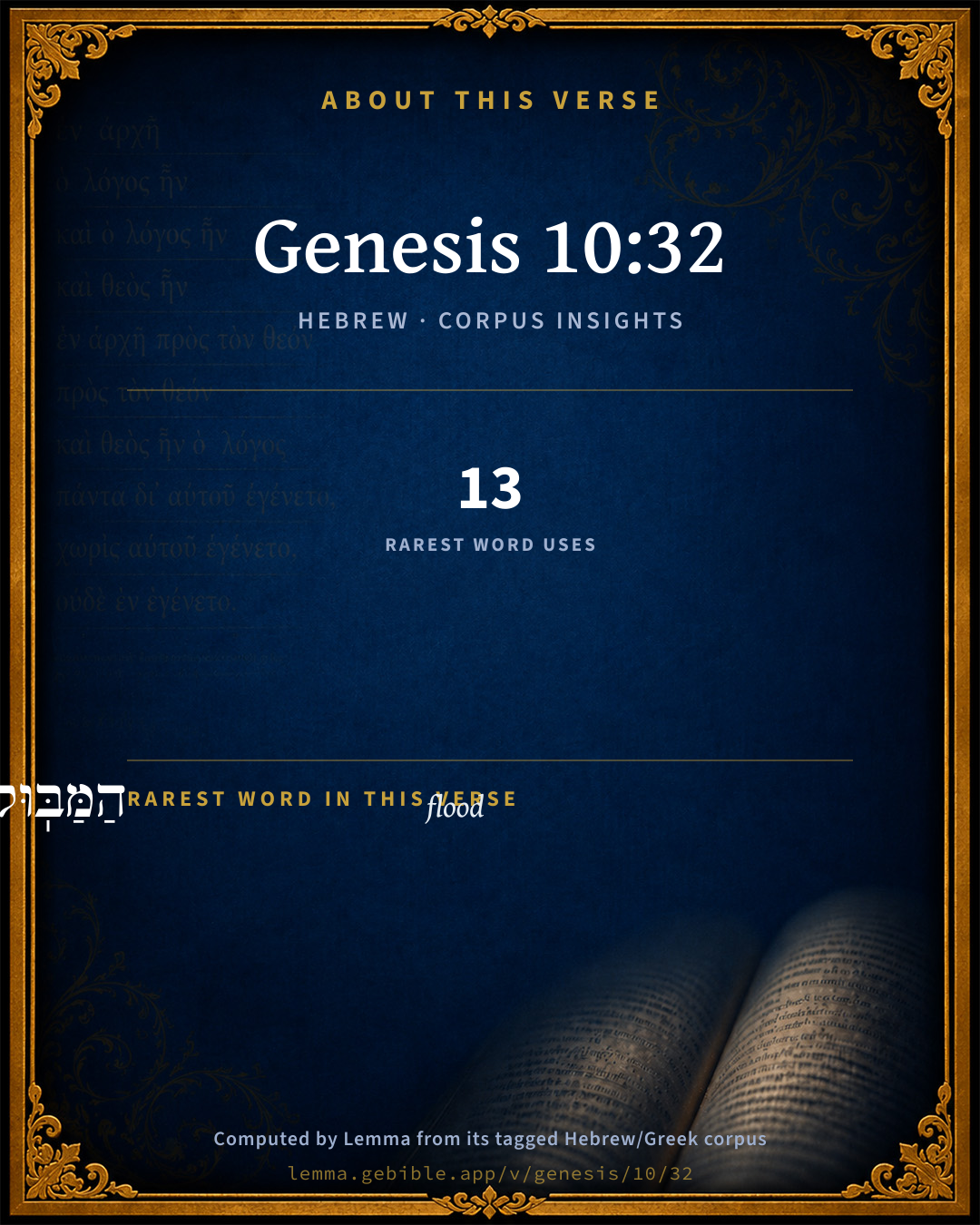
These counts appear in no published source. They are computed here, from the morphology-tagged text and Lemma’s own curated glosses. What Lemma adds →

12
words
10
distinct lemmas
Pentateuch
section

Notable vocabulary

The rarest word here is הַמַּבּֽוּל flood H3999 — appearing just 13 times in the whole Hebrew Bible.

Shared distinctive vocabulary

הַמַּבּֽוּל flood H3999 occurs in 12 verses of the Hebrew Bible. Also found in:

Grammatical profile

  • 1 verb
  • 8 nouns
  • 2 pronouns
  • 1 preposition

Verb forms

  • נִפְרְד֧וּ Niphal · Perfect

Repetition

Words recur within this verse — often emphatic in Hebrew:

  • בְּגוֹיֵהֶ֑ם nation H1471 ×2
  • אֵ֣לֶּה these H428 ×2

Hebrew & Septuagint length

In English translation the verse runs 27 words from the Hebrew and 32 from the Septuagint (LXX English) — closely comparable.

A rough comparison of the two English renderings, which tokenize alike — not a word-level alignment.

Word counts can differ between the Hebrew and the Greek without any difference in meaning — e.g. the Hebrew direct-object marker אֵת has no separate Greek word, and Greek often adds the article ὁ.

Cross-references

9

Topical passages linked to Genesis 10:32 in the Treasury of Scripture Knowledge — connected by theme and wording, ordered by reader-vote popularity; previews shown in the World English Bible.

  • Genesis 9:19 These three were the sons of Noah, and from these, the whole earth was populated.
  • Acts 17:26 He made from one blood every nation of men to dwell on all the surface of the earth, having determined appointed seasons, and the boundaries of their dwellings,
  • Genesis 10:1 Now this is the history of the generations of the sons of Noah and of Shem, Ham, and Japheth. Sons were born to them after the flood.
  • Genesis 5:29–31 and he named him Noah, saying, "This same will comfort us in our work and in the toil of our hands, because of the ground which Yahweh has cursed."
  • Genesis 9:1 God blessed Noah and his sons, and said to them, "Be fruitful, and multiply, and replenish the earth.
  • Genesis 9:7 Be fruitful, and multiply. Bring forth abundantly in the earth, and multiply in it."
  • Genesis 10:20 These are the sons of Ham, after their families, after their languages, in their lands, in their nations.
  • Genesis 10:25 To Eber were born two sons. The name of the one was Peleg, for in his days was the earth divided. His brother's name was Joktan.
  • Genesis 10:31 These are the sons of Shem, after their families, after their languages, in their lands, after their nations.

Cross-references courtesy of OpenBible.info (CC BY 4.0).

Hebrew and Greek witnesses Masoretic Hebrew ↔ Greek Septuagint

The same verse in the two great witnesses to the Old Testament, shown verse-for-verse.

These are two independent witnesses, not word-aligned to each other, and the Septuagint is shown in lemma (dictionary) form.

Hebrew Genesis 10:32 Masoretic · Westminster Leningrad Codex

אֵ֣לֶּה מִשְׁפְּחֹ֧ת בְּנֵי נֹ֛חַ לְתוֹלְדֹתָ֖ם בְּגוֹיֵהֶ֑ם וּמֵאֵ֜לֶּה נִפְרְד֧וּ הַגּוֹיִ֛ם בָּאָ֖רֶץ אַחַ֥ר הַמַּבּֽוּל

These are the families of the sons of Noah, after their generations, in their nations. Of these were the nations divided in the earth after the flood.

World English Bible · Public Domain

Greek LXX Genesis 10:32 Septuagint · lemma form

οὗτος ὁ φυλή υἱός νωε κατά γένεσις αὐτός κατά ὁ ἔθνος αὐτός ἀπό οὗτος διασπείρω νήσος ὁ ἔθνος ἐπί ὁ γῆ μετά ὁ κατακλυσμός

These are the tribes of the sons of Noe, according to their generations, according to their nations: of them were the islands of the Gentiles scattered over the earth after the flood.

LXX2012 (modern English Septuagint) · Public Domain

Hebrew: Westminster Leningrad Codex (CC BY 4.0). Greek: Septuagint (public domain); English from LXX2012 (modern English Septuagint) (Public Domain). How the Septuagint differs from the Hebrew →

Targum (Aramaic paraphrase)

2

The Targum is the ancient Jewish Aramaic paraphrase of the Hebrew Scriptures — an interpretive translation, not the Hebrew text itself. Onkelos (literal) and Pseudo-Jonathan (expansive) render the Torah, and Jonathan the Prophets. Coverage is partial: where no permissively-licensed English translation exists for a verse, only the Aramaic is shown. This is verse-level text, not a word-by-word alignment to the Hebrew.

  1. Targum Onkelos Torah (Genesis–Deuteronomy)
    אִלֵּין זַרְעֲיַת בְּנֵי נֹחַ לְתוּלְדָתְהוֹן בְּעַמְמֵיהוֹן וּמֵאִלֵּין אִתַּפְרָשׁוּ עַמְמַיָּא בְּאַרְעָא בָּתַר טוֹפָנָא

    These are the progenies of the sons of Noach, by their generations, in their peoples: and by them were the peoples outspread in the earth after the deluge.

    Targum Onkelos — Aramaic: “Onkelos Genesis” (public domain); “Onkelos Exodus” (public domain); “Onkelos Leviticus” (public domain); “Onkelos Numbers” (public domain); “Onkelos Deuteronomy” (public domain). English: “Sefaria Community Translation” (CC0 1.0 (public-domain dedication)); “J.W. Etheridge. The Targums of Onkelos and Jonathan Ben Uzziel on the Pentateuch. London: Longmans, Green, 1862” (public domain). Text via Sefaria.

  2. Targum Pseudo-Jonathan Torah (Genesis–Deuteronomy)
    אִלֵין יְחוּסֵי בְּנוֹי דְנחַ לְיִחוּסֵהוֹן בְּעַמְמֵיהוֹן וּמֵאִלֵין אִתְפָּרָשׁוּ עַמְמַיָא בְּאַרְעָא בָּתַר טוּבְעָנָא

    These are the houses of the sons of Noah, according to their houses in their peoples, and from them are the peoples distinguished in the earth after the deluge.

    Targum Pseudo-Jonathan — Aramaic: “Targum Jonathan on Genesis” (public domain); “Targum Jonathan on Exodus” (public domain); “Targum Jonathan on Leviticus” (public domain); “Targum Jonathan on Numbers” (public domain); “Targum Jonathan on Deuteronomy” (public domain). English: “The Targum of Jonathan ben Uzziel, trans. J. W. Etheridge, London, 1862” (public domain). Text via Sefaria.

Commentary

Notes on Genesis 10:32 from classic Christian and Jewish commentators (each source and its license shown beneath its notes). The classic Christian expositions comment on the surrounding passage and are grouped to its opening verse, so a note may address several verses; the Jewish commentaries on the Tanakh (Rashi and others) are per-verse, so they appear only where the commentator wrote on this verse.

Lemma curates 59 commentaries, every one of them public domain or Creative Commons licensed, each selected and text-cleaned for this edition rather than reprinted as found. About our sources →

Geneva Bible (1599)

Geneva Bible translators

Or, of these came divers nations.

Geneva Bible (1599) marginal notes — public domain. Text via Bolls.life.

Jamieson, Fausset & Brown

Robert Jamieson, A. R. Fausset & David Brown

These are the families of the sons of Noah, after their generations, in their nations, &c.--This division was made in the most orderly manner; and the inspired historian evidently intimates that the sons of Noah were ranged according to their nations, and every nation ranked by its families, so that every nation had its assigned territory, and in every nation the tribes, and in every tribe the families, were located by themselves.

Next: Genesis Chapter 11

Jamieson, Fausset & Brown — Commentary Critical and Explanatory on the Whole Bible (1871) — public domain (CC PDM 1.0). Text via the HelloAO Bible API.

Ellicott's Commentary for English Readers

(32) After their generations.—Heb., according to their Tôldôth. This makes it probable that each family preserved in some way an historical record of its descent; and as this table is called the Tôldôth of the Sons of Noah, it was probably formed by a comparison of numerous Tôldôth, each showing the descent of various members of the three great families into which the sons of Noah were divided.

A Bible Commentary for English Readers, edited by Charles John Ellicott (1878–1897) — public domain. Text from a community e-Sword module.

The Cambridge Bible for Schools and Colleges

gen. ed. J. J. S. Perowne

32. of these were the nations divided] Cf. Gen_10:1, Gen_9:19. The word rendered “divided” is different from that in Gen_10:25, but is the same as that which is found in Gen_10:5. Looking back we can discern the object of the compiler in demonstrating (1) the unity of the race through Noah; (2) the origin of the peoples through his sons; (3) the origin of Israel through Shem and Eber.

The Cambridge Bible for Schools and Colleges (gen. ed. J. J. S. Perowne; Cambridge University Press, 1878–1918) — public domain. Text from a community e-Sword module.

John Gill's Exposition

These are the families of the sons of Noah, after their generations, in their nations,.... This is the account of their families, from whom the several nations of the earth sprung:

and by these were the nations divided in the earth after the flood; not immediately, not till they were so increased as to form distinct nations; not till Peleg's time, when the division was made; not until the building of the city and tower of Babel, for unto that time these families were together, and then and not before were they dispersed abroad upon the face of the earth; and by degrees peopled all the known parts of the world, Asia, Africa, and Europe, and no doubt America, though the way of their passage thither is unknown to us; and to this partition of the earth by the three sons of Noah, Pindar (u) seems to have respect, when he says,"according to the ancients, Jupiter and the immortal ones parted the earth;''and he speaks of one man having three sons, who dwelt separate, the earth being divided into three parts.

(u) Olymp. Ode 7.

Next: Genesis Chapter 11

John Gill's Exposition of the Whole Bible (1746–1763) — public domain (CC PDM 1.0). Text via the HelloAO Bible API.

The Pulpit Commentary

Ver. 32.

The ethnological register.

I PROCLAIMS THE UNITY OF THE RACE.

1. It declares all the successive families of mankind to have sprung from a common stock. Diverse as they flow are in their geographical situations, ethnic relations, physical capabilities, national peculiarities, according to the doctrine of this genealogical table they all trace their origin to Noah and his sons.

1. It condemns all those theories which derive man from several pairs. Equally the heathen superstition which assigned to each particular region its own Autochthones, and the modern scientific dogma of varieties of species and distinct centers of propagation is here condemned. Even now ethnologists, archaeologists, and philologists of the highest repute lend their sanction to the sublime sentiment of the great Mars" hill preacher, that "God hath made of one blood all nations of men for to dwell upon all the face of the earth." The anatomical structure of the human frame, especially

2. of the brain and skull, the physiological properties and functions possessed by the body, the psychological nature of man, and the power of indefinite propagation, which are the same in all nations, with the ascertained results of comparative grammar, which have already traced back all existing languages to three primitive branches, tend in a powerful degree to confirm the doctrine which this table teaches.

3. It implies certain other truths on which Scripture with equal emphasis insists, such as the brotherhood of man, the universal corruption of the race, and the necessity and universality of Christ"s redemption.

II ATTESTS THE DIVISION of the RACE.

1. It asserts the fact of the division. It states that in the days of Peleg the earth"s population was divided. The means employed are described in the succeeding chapter.

2. It confirms the truth of this division. Had the confusion at Babel not occurred. and the subsequent dispersion not followed. this table could not have been written. Its existence as a literary document in the time of Moses authenticates the fact which it reports.

3. It defines the extent of this division. It shows that the scattered race were to be split up into nations, families, tongues.

III ILLUSTRATES THE DISTRIBUTION OF THE RACE. The geographical distribution of the earth"s population was

1. Effected in an orderly manner. They were neither scattered promiscuously nor suffered to wander and settle at hazard. Divided into tribes and nations according to their tongues and dialects of speech, they were allocated to distinct portions of the earth"s surface.

2. Specially adapted to the characters and destinies of the several nations. The operation of purely natural principles makes it impossible that tribes can permanently settle in countries that are either incapable of yielding to them a maintenance or affording an outlet to their powers. More extensive information would doubtless enable the suitability of each locality in this table to the occupying people to be exhibited; but in broad outline it is perceptible even here Japheth, whose destiny it was to spread abroad, being established on the coasts of the Euxine, the Caspian, and the Mediterranean; Ham finding rest in the warmer climates, whose enervating influences tended largely to develop his peculiar character, and ultimately to lay him open to subjection by the more vigorous races of the North; and Shem, whose function in the Divine economy it was to conserve religion and religious truth, being concentrated mainly in the Tigris and Euphrates valley.

3. The result of Divine appointment. Moses (Deu_32:8) and (Act_17:26) conspire to represent the allocation of territory to the different races of mankind as the handiwork of God (the special means employed for the breaking up of the originally united family of Noah"s sons is detailed in the ensuing chapter); the import of which is, that nations have a God-assigned title to the countries which they occupy.

4. The Divinely-ordered distribution of the earth"s population is capable of being disturbed by the sinful interference of man. Instances of this appear in the present table, e.g. the intrusion of the Cushite into Shinar, and of the Canaanite into what originally belonged to Skein.

IV PREDICTS THE FUTURE OF THE RACE. As it were, the separation of the earth"s population into races and the moving of them outward to their respective habitations was the starting of them on the lines along which it was designed they should accomplish their respective destinies and common work. They were meant to overspread the globe; and this was the initiation of a great movement which would only terminate in the complete occupation of their God-given heritage.

Lessons:

1. The equal rights of men.

2. The sinfulness of wars of aggression.

3. The hopefulness of emigration.

Nations.

I THEIR ROOTS. Individuals.

II THEIR RISE.

1. As to time, after the Flood.

2. As to cause, Divine impulse.

3. As to instrumentality, variation of speech.

III THEIR CHARACTERISTICS.

1. A common head.

2. A common tongue.

3. A common land.

IV THEIR DESTINIES. To overspread the earth. W.

The Pulpit Commentary (1880–1919), ed. H.D.M. Spence-Jones & Joseph S. Exell — public domain. Text from a community e-Sword module.

Keil & Delitzsch

C. F. Keil & F. Delitzsch

The words, "And by these were the nations of the earth divided in the earth after the flood," prepare the way for the description of that event which led to the division of the one race into many nations with different languages.

Keil & Delitzsch — Biblical Commentary on the Old Testament (1861–1891) — public domain (CC PDM 1.0). Text via the HelloAO Bible API. (Old Testament only.)

unfoldingWord translationNotes

Door43 World Missions Community

These were the clans

This refers back to all the people listed in Genesis 10:1-31.

according to

"listed by"

From these the nations separated and went over the earth

"From these clans the nations divided and spread over the earth" or "These clans divided from each other and formed the nations of the earth"

after the flood

This can be stated clearly or more explicitly. AT: "after the flood destroyed the earth" (See: Assumed Knowledge and Implicit Information)

translationWords

Noah

generation

unfoldingWord translationNotes — © Distant Shores Media and the Door43 World Missions Community, licensed CC BY-SA 4.0. Source: git.door43.org/Door43/en_tn.

Radak

Rabbi David Kimhi (Radak)

אלה..אחר המבול, what does the deluge have to do with this, seeing the people were not dispersed until after they built the Tower [approximately 300 years later. Ed.]? The meaning of this verse is that all these families of Noach’s children were born after the deluge, only to be scattered all over the globe, something which occurred after the building of the Tower.

Radak on the Tanakh — English translations: “Sefaria Community Translation” (CC0 1.0 (public-domain dedication)); “Eliyahu Munk, HaChut Hameshulash” (CC BY 4.0); “Rabbi Mike Feuer, Jerusalem Anthology” (CC BY 4.0); and “R. David Kimhi on the first book of Psalms, Translated by R.G. Finch, London, 1919” (public domain). Text via Sefaria.

Lesson kit

Teaching starters — assembled from the data on this page, not authored interpretation. Every prompt links to the verse data it draws on. Edit before teaching.

Genesis, in the Pentateuch, opens this verse with 12 words (10 distinct Hebrew lemmas). Its most distinctive word is mabbûwl (“flood”). A historical commentator’s framing appears above. Read the whole chapter for the surrounding context.

Discussion questions

  1. How does “flood” (mabbûwl) shape what this verse is saying?
  2. Genesis 6:17 shares the word «flood» with this verse. How do the two illuminate each other?
  3. “nation” occurs 2× in this one verse. What is the effect of the repetition?
  4. These translations render this verse differently; the difference is in the English rendering, not the original. What questions does that raise?
  5. The verb «נִפְרְד֧וּ» is Niphal Perfect. How does its form color the action?
  6. Reading how Geneva Bible (1599) and Jamieson, Fausset & Brown read this verse, where do the two commentators agree and where do they part?

Things to notice

Reading settings

Reading text

Shown beneath each verse's original-language words.

Old Testament
Old Testament edition

Read the OT as the Masoretic Hebrew (MT) or the Greek Septuagint (LXX).

English shown for the Greek Septuagint (in the Hebrew ↔ Greek comparison).

Comparing translations? Open the Compare panel on any verse page to stack up to four side by side.