

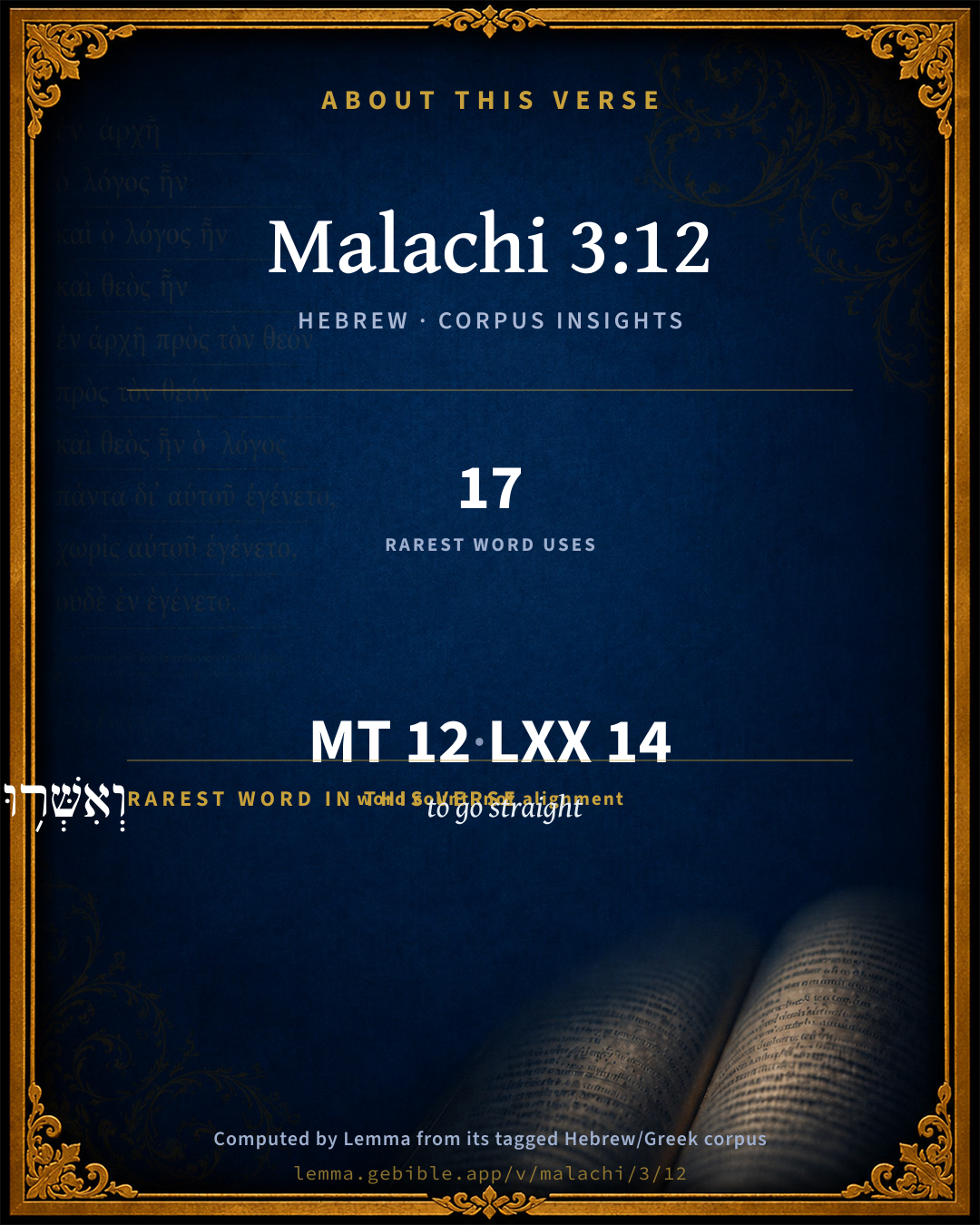
Malachi 3:12

Hebrew (Westminster Leningrad Codex) Malachi 3:12 appears in the Hebrew Old Testament. The text above is from the Westminster Leningrad Codex. Each word links to its Strong’s number, a concise gloss, and parsing drawn from the Open Scriptures Hebrew Bible morphology. Click any word for its full Brown-Driver-Briggs (BDB) entry.
Download image
Cite this verse

Malachi 3:12 (World English Bible). Public Domain. Lemma interlinear Bible study tool, https://lemma.gebible.app/v/malachi/3/12.

Show BibTeX & RIS
BibTeX
RIS
English Translation
"All nations shall call you blessed, for you will be a delightful land," says Yahweh of Hosts.
World English Bible · Public Domain
Download a study sheet

One document with this verse’s original text, its word-by-word gloss line, the meaning frame, cross-references with their text, attributed commentary, and full source and license credits — printable, and it pastes into notes with its structure intact.

This verse Autodidact and up

Study sheet (.html) Plain text (.txt)

A passage Seminary Student

Up to 50 verses in one chapter. A passage sheet keeps up to 6 commentary sources and 12 cross-references per verse, in the order this page ranks them, and says so on the sheet whenever that leaves anything out. Ask for a single verse and you get the Autodidact verse sheet above.

Everything on this page stays free to read, with no account — the sheet is a download of what is already on screen, not access to it.

Want to remove ads? Support Godless Engineer
Compare translations 3

The same verse in 3 English versions, stacked beneath the original-language interlinear above. Click any original word for its lexicon entry.

Each is an independent rendering of the whole verse — the interlinear is not word-aligned to these translations.

Highlighted words mark where these versions differ — a whole-verse word diff, not a word-by-word alignment.

  • World English Bible Public Domain
    "All nations shall call you blessed, for you will be a delightful land," says Yahweh of Hosts.
  • King James Version Public Domain
    And all nations shall call you blessed: for ye shall be a delightsome land, saith the LORD of hosts.
  • unfoldingWord Literal Text CC BY-SA 4.0
    “And all of the nations will bless you, for you will be a land of delight,” says Yahweh of Armies.

unfoldingWord Literal Text — © unfoldingWord, licensed CC BY-SA 4.0. Word-aligned USFM3 via Door43 (git.door43.org/unfoldingWord/en_ult).

Versions to compare (up to 4)

3 of 4 selected

Show all 18 translations

Every available English version of this verse, each an independent rendering of the whole verse.

  • World English Bible Public Domain
    "All nations shall call you blessed, for you will be a delightful land," says Yahweh of Hosts.
  • Berean Standard Bible Public Domain
    “Then all the nations will call you blessed, for you will be a land of delight,” says the LORD of Hosts.
  • Majority Standard Bible Public Domain
    “Then all the nations will call you blessed, for you will be a land of delight,” says the LORD of Hosts.
  • King James Version Public Domain
    And all nations shall call you blessed: for ye shall be a delightsome land, saith the LORD of hosts.
  • American Standard Version (1901) Public Domain
    And all nations shall call you happy; for ye shall be a delightsome land, saith Jehovah of hosts.
  • Revised Version (1885) Public Domain
    And all nations shall call you happy: for ye shall he a delightsome land, saith the LORD of hosts.
  • Geneva Bible (1599) Public Domain
    And all nations shall call you blessed: for ye shall be a pleasant lande, sayeth the Lord of hostes.
  • Douay-Rheims (1899) Public Domain
    And all nations shall call you blessed: for you shall be a delightful land, saith the Lord of hosts.
  • Young's Literal Translation Public Domain
    And declared you happy have all the nations, For ye are a delightful land, said Jehovah of Hosts.
  • Literal Standard Version CC BY-SA 4.0
    “And all the nations have declared you blessed, || For you are a delightful land,” said YHWH of Hosts.
  • Unlocked Literal Bible CC BY-SA 4.0
    “All the nations will call you blessed, for you will be a land of delight,” says Yahweh of hosts.
  • unfoldingWord Literal Text CC BY-SA 4.0
    “And all of the nations will bless you, for you will be a land of delight,” says Yahweh of Armies.
  • Darby Bible Public Domain
    And all nations shall call you blessed; for ye shall be a delightsome land, saith Jehovah of hosts.
  • World Messianic Bible Public Domain
    “All nations shall call you blessed, for you will be a delightful land,” says the LORD of Hosts.
  • Webster's Bible Public Domain
    And all nations shall call you blessed: for ye shall be a delightsome land, saith the LORD of hosts.
  • Free Bible Version CC BY-SA 4.0
    All nations will call you blessed because you live in such a wonderful land, says the Lord Almighty.
  • Bible in Basic English Public Domain
    And you will be named happy by all nations: for you will be a land of delight, says the Lord of armies.
  • JPS Tanakh (1917) Public Domain
    And all nations shall call you happy; for ye shall be a delightsome land, saith the LORD of hosts.

Literal Standard Version (2020), Covenant Press — licensed CC BY-SA 4.0. Text via the HelloAO Bible API (eBible.org). Unlocked Literal Bible (unfoldingWord) — licensed CC BY-SA 4.0. Text via the HelloAO Bible API (eBible.org). unfoldingWord Literal Text — © unfoldingWord, licensed CC BY-SA 4.0. Word-aligned USFM3 via Door43 (git.door43.org/unfoldingWord/en_ult). Free Bible Version, Dr. Jonathan Gallagher — licensed CC BY-SA 4.0. Text via the HelloAO Bible API (eBible.org).

Word by word

More ways to search: Search by grammar → Find every occurrence → Compare this word →

Practice this passage: Drill this verse → Learn its vocabulary →

וְאִשְּׁר֥וּ
ʼâshar
H833
“and · to go straight”
Conjunction + Verb, Piel, Sequential Perfect, 3rd Person, Common, Plural
Part of Speech
Conjunction + Verb
Stem
Piel
Form
Sequential Perfect
Person
3rd Person
Gender
Common
Number
Plural
Full BDB Definition

Origin: a primitive root

TWOT: 183

to go straight, walk, go on, advance, make progress - (Qal) to go straight on, make progress - (Piel) - to go straight on, advance - to lead on (causative) - to set right, righten - to pronounce happy, call blessed - (Pual) - to be advanced, be led on - to be made happy, be blessed
  1. אֶתְכֶ֖ם ʼêth H853 “- · you” Particle, Direct Object + Suffix, Personal, 2nd Person, Masculine, Plural
  2. כָּל kôl H3605 “all of” Noun, Common, Masculine, Singular, Construct
  3. הַגּוֹיִ֑ם gôwy H1471 “the · nations” Particle, Definite Article + Noun, Common, Masculine, Plural, Absolute
  4. כִּֽי kîy H3588 “that” Conjunction
  5. תִהְי֤וּ hâyâh H1961 “to be” Verb, Qal, Imperfect, 2nd Person, Masculine, Plural
  6. אַתֶּם֙ ʼattâh H859 “you” Pronoun, Personal, 2nd Person, Masculine, Plural
  7. אֶ֣רֶץ ʼerets H776 “land of” Noun, Common, Both, Singular, Construct
  8. חֵ֔פֶץ chêphets H2656 “delight” Noun, Common, Masculine, Singular, Absolute
  9. אָמַ֖ר ʼâmar H559 “to say” Verb, Qal, Perfect, 3rd Person, Masculine, Singular
  10. יְהוָ֥ה Yᵉhôvâh H3068 “LORD” Noun, Proper
  11. צְבָאֽוֹת tsâbâʼ H6635 “armies” Noun, Common, Both, Plural, Absolute

About this verse

These counts appear in no published source. They are computed here, from the morphology-tagged text and Lemma’s own curated glosses. What Lemma adds →

12
words
12
distinct lemmas
Prophets
section

Notable vocabulary

The rarest word here is וְאִשְּׁר֥וּ to go straight H833 — appearing just 17 times in the whole Hebrew Bible.

Shared distinctive vocabulary

וְאִשְּׁר֥וּ to go straight H833 occurs in 15 verses of the Hebrew Bible. Also found in:

Grammatical profile

  • 3 verbs
  • 6 nouns
  • 1 pronoun
  • 1 conjunction
  • 1 particle

Verb forms

  • וְאִשְּׁר֥וּ Piel · Sequential Perfect
  • תִהְי֤וּ Qal · Imperfect
  • אָמַ֖ר Qal · Perfect

Hebrew & Septuagint length

In English translation the verse runs 17 words from the Hebrew and 18 from the Septuagint (LXX English) — closely comparable.

A rough comparison of the two English renderings, which tokenize alike — not a word-level alignment.

Word counts can differ between the Hebrew and the Greek without any difference in meaning — e.g. the Hebrew direct-object marker אֵת has no separate Greek word, and Greek often adds the article ὁ.

In the original languages it is 12 Hebrew tokens and 14 Greek tokens — but the two are counted differently (Hebrew bundles its prefixes and suffixes into one token; the Greek is in lemma form), so that isn’t a like-for-like length.

Cross-references

13

Topical passages linked to Malachi 3:12 in the Treasury of Scripture Knowledge — connected by theme and wording, ordered by reader-vote popularity; previews shown in the World English Bible.

  • Isaiah 61:9 Their seed shall be known among the nations, and their offspring among the peoples; all who see them shall acknowledge them, that they are the seed which Yahweh has blessed.
  • Isaiah 62:4 You shall no more be termed Forsaken; neither shall your land any more be termed Desolate: but you shall be called Hephzibah, and your land Beulah; for Yahweh delights in you, and your land shall be married.
  • Zechariah 8:23 Thus says Yahweh of Hosts: "In those days, ten men will take hold, out of all the languages of the nations, they will take hold of the skirt of him who is a Jew, saying, 'We will go with you, for we have heard that God is with you.'"
  • Luke 1:48 For he has looked at the humble state of his handmaid. For behold, from now on, all generations will call me blessed.
  • Jeremiah 33:9 [This city] shall be to me for a name of joy, for a praise and for a glory, before all the nations of the earth, which shall hear all the good that I do to them, and shall fear and tremble for all the good and for all the peace that I procure to it.
  • Deuteronomy 4:6–7 Keep therefore and do them; for this is your wisdom and your understanding in the sight of the peoples, who shall hear all these statutes, and say, Surely this great nation is a wise and understanding people.
  • Deuteronomy 8:7–10 For Yahweh your God brings you into a good land, a land of brooks of water, of springs and springs, flowing forth in valleys and hills;
  • Deuteronomy 11:12 a land which Yahweh your God cares for: the eyes of Yahweh your God are always on it, from the beginning of the year even to the end of the year.
  • 2 Chronicles 32:23 Many brought gifts to Yahweh to Jerusalem, and precious things to Hezekiah king of Judah; so that he was exalted in the sight of all nations from thenceforth.
  • Psalms 72:17 His name endures forever. His name continues as long as the sun. Men shall be blessed by him. All nations will call him blessed.
  • Daniel 8:9 Out of one of them came forth a little horn, which grew exceeding great, toward the south, and toward the east, and toward the glorious [land].
  • Daniel 11:41 He shall enter also into the glorious land, and many [countries] shall be overthrown; but these shall be delivered out of his hand: Edom, and Moab, and the chief of the children of Ammon.
  • Zephaniah 3:19–20 Behold, at that time I will deal with all those who afflict you, and I will save those who are lame, and gather those who were driven away. I will give them praise and honor, whose shame has been in all the earth.

Cross-references courtesy of OpenBible.info (CC BY 4.0).

Hebrew and Greek witnesses Masoretic Hebrew ↔ Greek Septuagint

The same verse in the two great witnesses to the Old Testament, shown verse-for-verse.

These are two independent witnesses, not word-aligned to each other, and the Septuagint is shown in lemma (dictionary) form.

Hebrew Malachi 3:12 Masoretic · Westminster Leningrad Codex

וְאִשְּׁר֥וּ אֶתְכֶ֖ם כָּל הַגּוֹיִ֑ם כִּֽי תִהְי֤וּ אַתֶּם֙ אֶ֣רֶץ חֵ֔פֶץ אָמַ֖ר יְהוָ֥ה צְבָאֽוֹת

"All nations shall call you blessed, for you will be a delightful land," says Yahweh of Hosts.

World English Bible · Public Domain

Greek LXX Malachi 3:12 Septuagint · lemma form

καί μακαρίζω σύ πᾶς ὁ ἔθνος διότι εἰμί σύ γῆ θελητός λέγω κύριος παντοκράτωρ

And all nations shall call you blessed: for you⌃ shall be a desirable land, says the Lord Almighty.

LXX2012 (modern English Septuagint) · Public Domain

On this verse, The Cambridge Bible for Schools and Colleges discusses the Septuagint’s reading. Read the note in Commentary ↓

Hebrew: Westminster Leningrad Codex (CC BY 4.0). Greek: Septuagint (public domain); English from LXX2012 (modern English Septuagint) (Public Domain). How the Septuagint differs from the Hebrew →

Targum (Aramaic paraphrase)

1

The Targum is the ancient Jewish Aramaic paraphrase of the Hebrew Scriptures — an interpretive translation, not the Hebrew text itself. Onkelos (literal) and Pseudo-Jonathan (expansive) render the Torah, and Jonathan the Prophets. Coverage is partial: where no permissively-licensed English translation exists for a verse, only the Aramaic is shown. This is verse-level text, not a word-by-word alignment to the Hebrew.

  1. Targum Jonathan Prophets (Joshua–Malachi)
    וִישַׁבְּחוּן יַתְכוֹן כָּל עַמְמַיָא אֲרֵי תְהוֹן אַתּוּן יָתְבִין בַּאֲרַע בֵּית שְׁכִנְתִּי וְעָבְדִין בָּהּ רְעוּתִי אֲמַר יְיָ צְבָאוֹת:

    (no public-domain English translation for this verse)

    Targum Jonathan — Aramaic: “Mikraot Gedolot” (public domain). English: “Sefaria Community Translation” (CC0 1.0 (public-domain dedication)); “London "Chaldee Paraphrase," 1871” (public domain). Text via Sefaria.

Commentary

Notes on Malachi 3:12 from classic Christian and Jewish commentators (each source and its license shown beneath its notes). The classic Christian expositions comment on the surrounding passage and are grouped to its opening verse, so a note may address several verses; the Jewish commentaries on the Tanakh (Rashi and others) are per-verse, so they appear only where the commentator wrote on this verse.

Lemma curates 59 commentaries, every one of them public domain or Creative Commons licensed, each selected and text-cleaned for this edition rather than reprinted as found. About our sources →

Trapp's Complete Commentary

John Trapp

Mal 3:12 And all nations shall call you blessed: for ye shall be a delightsome land, saith the LORD of hosts.

Ver. 12. And all nations shall call you blessed] viz. For the abundance of outward comforts and commodities, by the which the nations measured man’s happiness, saying, "Blessed is the people that is in such a case," Psa 144:15. Cyprus was for this cause anciently called Macaria, that is, the blessed country, as having a sufficiency of all things within itself; and England was called Regnum Dei, the kingdom of God, or the Fortunate island, and Englishmen Deires, as that were set safe, de ira Dei, from the wrath of God. In the time of Pope Clement VI (as Robert of Avesbury testifieth), when Lewis of Spain was chosen prince of the Fortunate Islands, and for the conquest thereof was to raise an army in France and Italy; the English agent at Rome, together with his company, departed and got home, as conceiving that the prince was bound for England, than the which they thought there was not a more fortunate island in the world. Of the island of Lycia, Solinus saith that all the day long the sky is never cloudy but that the sun may be seen there, Lyciam Horatius claram dicit. Semper in sole sita est Rhodes, The Rhodes is ever in the sunshine, saith Aeneas Sylvius. And of Alexandria in Egypt, Ammianus Marcellinus observeth, that once in the day the sun hath been seen to shine over it. I confess the same cannot be said of England. I remember also what I have read of a certain Frenchman, who returning home out of England, and being asked by a countryman of his that was bound for England, what service he would command him into this country? Nothing but this, said the other; when you see the sun have me commended to him; for I have been there two months and could never see him in all that time: Per duos enim menses quibus ibi fui, Solem mihi videre non licuit (Garincieres de tabe Anglica, p. 84). Likely he was here in the deep of winter. For at summer solstice Tacitus, in the Life of Agricola, hath observed that the sun shineth continually in Brittany, and neither setteth nor riseth there; but passeth so lightly by us by night that you can scarce say we have any night at all, Ut finem atque initium lucis exiguo discrimine internoscas. But if we speak of the sunshine of God’s grace and favour, either for spirituals or temporals, as Delos is said by Solinus to have been the first country that had the sun shining upon it after the general deluge, and there hence to have had its name, Nomenque ex eo sortitam (Polyb. c. 17), so was England one of the first islands that both received Christ and that shook off Antichrist. And for temporal blessings, all nations shall call us blessed, and count us a delightsome land indeed, a land of desires, such as all men would desire to dwell in, for the exceeding fruitfulness and pleasantness of it; it being the court of Queen Ceres, the granary of the Western world, as foreign writers have termed it, the paradise of pleasure and garden of God, as our own chronicler. The truth is, we may well say of England, as the Italians do of Venice, by way of proverb: He that hath not seen it cannot believe what a dainty place it is, and he that hath not lived there some good time cannot understand the worth of it. Our Mr Ascham, schoolmaster to Queen Elizabeth, had lived there some time, and had soon enough of it; for though he admired the place, he utterly disliked the people for their loose living. And the like, alas, may be too truly affirmed of us. We live in God’s good land, but not by God’s good laws; we eat the fat and drink the sweet, but we sanctify not the Lord God in our hearts, we live not as becometh Christians. Our hearts, like our climate, have much more light than heat, light of knowledge than heat of zeal; our lukewarmness is like to be our bane, our sins our snuffs, that dim our candlestick, and threaten the removal of it. O si fiat id in nobis (saith one) quod in sole videtur, qui quibus affulserit, iis etiam calorem et colorem impertire solet! Oh that the Sun of righteousness would so shine upon us, as to warm us, and transform us into the same image from glory to glory, as by his Spirit! Oh that he would set up his own kingdom here more and more among us! Then should we be more happy than the Israelites were under the reign of King Solomon, or the Spaniards under their Ferdinand III, who reigned thirty-five years, in all which time there was neither famine nor pestilence in the land.

John Trapp, A Commentary or Exposition upon All the Books of the Old and New Testament (1647–1656) — public domain. Text from a community e-Sword module.

The Biblical Illustrator

Joseph S. Exell

Mal_3:12

Ye shall be a delightsome land, saith the Lord of hosts.

The delightsome land

It is not necessary to inquire minutely into the original application of these words. Enough that Christianity belongs to countries as well as individuals; and that the Church acts mightily upon every land to make it delightsome. It is more pertinent to observe that the promise follows a description of the efficacy of prayer, and includes the full blessing which God can pour out upon any people. What then are some of the heavenly and spiritual blessings in Christ Jesus necessary to make this land of ours delightsome in the eyes of the Lord of hosts?

I. A land is delightsome that is purely and adequately supplied with Christs gospel. It is a delightsome land to the tourist, if the scenery be fine and the air pure; to the economist, if trade and commerce flourish, and social arrangements tend to the accumulation of capital; to the worldly philanthropist, where employment is good, pauperism low, laws reasonably fair and equal, and the refinements of civilisation widely spread over the surface of the people. To the disciple of Jesus Christ a different standard everywhere presents itself. The spiritual aspect of every community first engrosses his attention and sympathies. To him the radical want is the Gospel--the Gospel with its humbling discoveries of mans fallen and lost estate by nature, and with its blessed proclamation of recovery by Christ. Without this there is no pardon for the peoples sins, no comfort for their sorrows, no return to the image of God, or meetness for death, judgment, and eternity. A delightsome land we shall not be till the famine of the Word of God has everywhere come to an end--till not only in city and town and hamlet, all that have ears to hear may hear, but may rest assured of hearing the same glad tidings of great joy.

II. That rightly prizes Christs ordinances. While it is certainly true that in proportion to the multiplication of Gospel agencies spiritual blessing follows as a general rule, it by no means follows to the degree that ought to-have been witnessed. There is sad neglect of the great salvation, neglect which only the Spirit of God can overcome--neglect which expresses and registers itself b-y mans treatment of the ordinances of salvation. Who Can follow the outwardly devout to their dwellings, and record what proportion refuse to honour God there? Who can pursue them to their closets, and see how many or how few walk with God and live in the presence of Christ?

III. That multiplies examples of Christs converting grace. Take away conversion and you take away Christianity. The two watchwords of evangelical religion are--the atonement and the new birth. With regard to the mode of conversion, it is confessedly various. The time may come, which some anticipate, when conversion shall be generally noiseless and gradual, effected in the early dawn of life, as the result of pious training, when the Spirit of God shall copiously descend as morning dew, and leave a blessing for all the coming day. But to some conversion must come as a wave of the sea, with a shock and an agitation. There must be a struggle between the old and the new--between self and Christ. The soul in such a conflict may be expected to be shaken to its centre, with fear, and shame, and sadness, ere faith come to its relief, and love toward the Crucified One gain the victory. The conversions which are going on within the circle of Christian influence make up the true history of the world. They are the events which are noted in the register of God, where the ordinary incidents of human history have no place. It is not the first birth of any man that glorifies God or satisfies Christ. Without the second it is an abortion and a catastrophe.

IV. That maintains a high and general standard of conformity to the image of Christ. Conversion is nothing save as a step to sanctification. And sanctification is resemblance to Christ. The ultimate design of Christs mission was to multiply Himself; to stamp Himself upon the minds, the hearts, and the lives of men! Such a conformity is indeed defective in every case: still, under the training of the Spirit, forms of moral loveliness have appeared, and are appearing, which differ radically from those which the world saw before Christ, or which it is capable of producing where His name is disowned. Would it not be a result of incalculable blessedness, were the higher standard of Christian life found in some to be more widely diffused, still more were a marked and decisive impress of Christian piety to become universal, or to approach to universality? The transformation of the professing Church into a visibly living body would certainly act on the world as life from the dead. Regenerate character to Gods noblest work.

V. That assists in bringing other lands to Christ. This was one attraction of ancient Israel to God. He saw in it the focus of blessing; the central point whence the light of His glory was everywhere to spread till the whole dark orb was illuminated. Such is Christian light that like that of the sun, it cannot be seen but by its own diffused and propagated rays. How can Africa, India, China, the South Seas ever call us blessed, unless we teach them our blessedness, and make them share it? (John Cairns, D. D.)

A delightsome land

Apply to our own land, which the people of all other lands deem blessed, and which in itself is delightsome. Different views of a country are taken by the tourist, artist, naturalist, economist, philanthropist, and Christian. Compare our land with others in regard to its spiritual condition and privileges.

1. An adequate supply of pure Gospel ordinances.

2. An appreciative attendance on the faithful administration of them.

3. A gratifying result in the conversion of sinners and the edification of believers.

4. An earnest effort to supply the whole land with them.

5. A zealous endeavour to extend to all lands the full blessings of them. (Wm. Ormiston, D. D.)

The Biblical Illustrator, edited by Joseph S. Exell (c. 1880s–1900s) — public domain. Text from a community e-Sword module.

Tyndale Open Study Notes

Tyndale Open Resources

3:12 all nations will call you blessed: Abundant yields of produce would once again show the world the Lord’s favor toward Israel.

Tyndale Open Study Notes — © Tyndale Open Resources, licensed CC BY-SA 4.0. Text via the HelloAO Bible API.

Jamieson, Fausset & Brown

Robert Jamieson, A. R. Fausset & David Brown

Fulfilling the blessing (Deu 33:29; Zac 8:13).

delightsome land-- (Dan 8:9).

Jamieson, Fausset & Brown — Commentary Critical and Explanatory on the Whole Bible (1871) — public domain (CC PDM 1.0). Text via the HelloAO Bible API.

Adam Clarke's Commentary

Verse 12. All nations shall call you blessed] They shall see that a peculiar blessing of God rests upon you, and your land shall be delightsome; like Paradise, the garden of the Lord.

Adam Clarke's Commentary on the Bible (1810–1826) — public domain. Text from a community e-Sword/MySword module.

John Calvin's Commentaries

This verse is taken from the law, in which among other things God promises so happy a state to his chosen people, that the nations themselves would acknowledge in them the blessing of God. There is yet a contrast to be understood, — that having fallen into such misery, they were become as it were detestable to all nations, according to what the law also declares concerning them,

“If thou shalt keep my precepts, all nations shall call thee blessed; but if thou wilt despise me, thou shalt be a sport to all nations, all shall shake the head and move the lips; yea, they shall be astonished at the sight of thy misery, and whosoever shall hear his ears will tingle.” (Deuteronomy 28:1, 15.)

As then the Jews were consumed as it were in their miseries, the Prophet says, “If you turn to God, that happiness which he has promised you shall not be withheld; he has it as it were ready in his hand, like a treasure that is hidden, according to what is said in Psalm 31:19, ‘How great is the abundance of thy goodness! but it is laid up for them who fear thee.’” God then means, that he will not prostitute his blessing to dogs and swine, but that it is always in reserve for his children, who are teachable and obedient. The nations then shall call you blessed, for ye shall be a land of desire

This promise also is taken from the law, in which God says, that he had not in vain separated that land from the rest, because it was to be an example or a representation of his kindness through the whole world. We indeed know that God has ever been bountiful even to all nations, so as to satisfy them abundantly with provisions; but the land of Israel is called the land of desire, or a desirable land, because it was the special scene of God’s bounty, not only as to meat and drink, but also as to other more excellent blessings. He now adds —

John Calvin's Commentaries (1540-1563) — public domain. Text from the Calvin Translation Society English edition (1840s-50s) via the Christian Classics Ethereal Library (ccel.org). Calvin's coverage is partial (roughly two-thirds of the Bible); uncommented books and verses are honest gaps, never fabricated. The 19th-century editor's footnotes and remarks are omitted so the notes are faithfully Calvin's own voice.

Ellicott's Commentary for English Readers

(12) Comp. Zec_7:14; Zec_8:13-23; also Isa_62:4; Dan_11:16.

A Bible Commentary for English Readers, edited by Charles John Ellicott (1878–1897) — public domain. Text from a community e-Sword module.

The Cambridge Bible for Schools and Colleges

gen. ed. J. J. S. Perowne

12. call you blessed] or happy, R.V., as in Mal_3:15. μακαριοῦσιν ὑμᾶς, LXX. Comp. μακαριοῦσι με, Luk_1:48, and Jas_5:11.

The Cambridge Bible for Schools and Colleges (gen. ed. J. J. S. Perowne; Cambridge University Press, 1878–1918) — public domain. Text from a community e-Sword module.

John Gill's Exposition

And all nations shall call you blessed,.... When they shall see the land freed from the devouring locust, and other hurtful creatures; the former and the latter rains given in their season, and the earth yielding a large increase:

for ye shall be a delightsome land, saith the Lord of hosts; or a desirable (n) one; not only pleasant to themselves, being fruitful, but wished for by others, by their neighbouring nations, who, seeing their prosperity, could not but desire to dwell with them; or delightsome to the Lord of hosts: thus Jarchi interprets it, the land that I delight in; and so Aben Ezra; to which agrees the Targum,

"and all nations shall praise you, because you dwell in the land of the house of my Shechinah or majesty, and do my will in it;''

and the Syriac version renders it, "the land of my delight": see Isa 62:4.

(n) "terra desiderabilis", V. L. Pagninus, Drusius; "terra beneplaciti", Montanus, Vatablus, Burkius; "oblectationis", Junius & Tremellius, Piscator.

John Gill's Exposition of the Whole Bible (1746–1763) — public domain (CC PDM 1.0). Text via the HelloAO Bible API.

Albert Barnes' Notes on the Bible

All nations shall call you blessed - The promise goes beyond the temporal prosperity of their immediate obedience. Few could know or think much of the restored prolificalness of Judaea; none could know of its antecedents. A people, as well as individuals, may starve, and none know of it. Had the whole population of Judah died out, their Persian masters would not have cared for it, but would have sent fresh colonists to replace them and pay the tribute to the great king. The only interest, which all nations could have in them, was as being the people of God, from whom He should come, “the Desire of all nations, in whom all the families of the earth would be blessed.” Of this, God’s outward favor was the earnest; they should have again the blessings which He had promised to His people.

And ye shall be called a delightsome land - , literally “a land of good pleasure.” It was not so much the land as the people; ye shall be called. The land stands for the people upon it, in whom its characteristics lay. The river Jordan was not so bright as Abana and Pharpar: “the aspect of the shore” is the same, when the inhabitants are spiritually or morally dead; only the more beautiful, in contrast with the lifeless “spirit of man.” So Isaiah says Isa 62:2-4, “The nations shall see thy righteousness, and all kings thy glory; and thou shrill be called by a name, which the mouth of the Lord shall name Thou shalt no more be called Forsaken, nor shall thy land be called Desolate, but thou shalt be called My-delight-is-in-her, and thy land Married: for the Lord delighteth in thee and thy land shall be married.” God and man should delight in her.

Albert Barnes' Notes on the Bible (1834–1885) — public domain. Text from a community e-Sword/MySword module.

Matthew Poole's English Annotations

All nations, all that are about you, that know you, and see God’s dealings with you, shall call you blessed; praise the state and condition you are in, and pronounce you to be a very happy people, whose God is the Lord, and whose mercies come thus from God.

Ye shall be a delightsome land; of delights, or desirable for its pleasantness; a land so good man would desire it; and when purged, it will be a land the Lord will delight in, and give it the name Hephzibah.

Saith the Lord of hosts; added as an assurance that it shall be according to this promise, forasmuch as he who is Lord of hosts hath engaged his word to do it, and his word will do it, can make all creatures co-operate for that purpose.

Matthew Poole's English Annotations on the Holy Bible (1683–1685) — public domain. Text from a community e-Sword/MySword module.

Whedon's Commentary on the Bible

Daniel D. Whedon

12. The prosperity of the people will become so marked that all the nations will call them blessed (Zec_8:13; Zec_8:23).

A delightsome land — A land where joy and felicity reign (Zec_7:14; Isa_62:4). In Mal_3:1-5, the prophet states how Jehovah will manifest himself as a God of judgment by destroying the evil doers; in Mal_3:6-12, how he will do it by rewarding the good.

Daniel D. Whedon (gen. ed.), Commentary on the Old and New Testaments (1874–1909) — public domain. Text from a community e-Sword module.

The Pulpit Commentary

Shall call you blessed; or, happy, as ver. 15. (comp. Deu_33:29 Zec_8:13, Zec_8:23) A delightsome land; gh yelhth (Septuagint); literally, a land of good pleasure a land in which God is well pleased. (comp. Isa_62:4 Jer_3:19)

The Pulpit Commentary (1880–1919), ed. H.D.M. Spence-Jones & Joseph S. Exell — public domain. Text from a community e-Sword module.

John Wesley's Explanatory Notes

All nations - All that are about you. A delightsome land - The revival of religion in a land, will make it delight-some, both to God, and to all good men.

John Wesley, Explanatory Notes Upon the Whole Bible (1754–1765) — public domain. Text via the GEBible commentary corpus.

Rashi

Rabbi Shlomo Yitzchaki (Rashi)

a desirable land A land that I desire.

Rashi on the Tanakh — English translations: “The Judaica Press complete Tanach with Rashi, translated by A. J. Rosenberg” (CC BY 4.0); “Pentateuch with Rashi's commentary by M. Rosenbaum and A.M. Silbermann, 1929-1934” (public domain); “The Metsudah Tanach series, Lakewood, N.J” (CC BY 4.0); and “The Book of Joshua, Metsudah Publications, 1997” (CC BY 4.0). Text via Sefaria.

Lesson kit

Teaching starters — assembled from the data on this page, not authored interpretation. Every prompt links to the verse data it draws on. Edit before teaching.

Malachi, in the Prophets, opens this verse with 12 words (12 distinct Hebrew lemmas). Its most distinctive word is ʼâshar (“to go straight”). A historical commentator’s framing appears above. Read the whole chapter for the surrounding context.

Discussion questions

  1. How does “to go straight” (ʼâshar) shape what this verse is saying?
  2. How does Genesis 30:13, which shares the word «to go straight», read alongside this verse?
  3. The translations on this page render this verse differently — a whole-verse word diff, not a word-by-word alignment. What might account for the different wordings?
  4. «וְאִשְּׁר֥וּ» is a Piel Sequential Perfect verb. How does that grammatical form shape the action described?
  5. Compare how Trapp's Complete Commentary and The Biblical Illustrator read this verse. Where do they agree or differ?

Things to notice

Reading settings

Reading text

Shown beneath each verse's original-language words.

Old Testament
Old Testament edition

Read the OT as the Masoretic Hebrew (MT) or the Greek Septuagint (LXX).

English shown for the Greek Septuagint (in the Hebrew ↔ Greek comparison).

Comparing translations? Open the Compare panel on any verse page to stack up to four side by side.