
Nehemiah 5:17

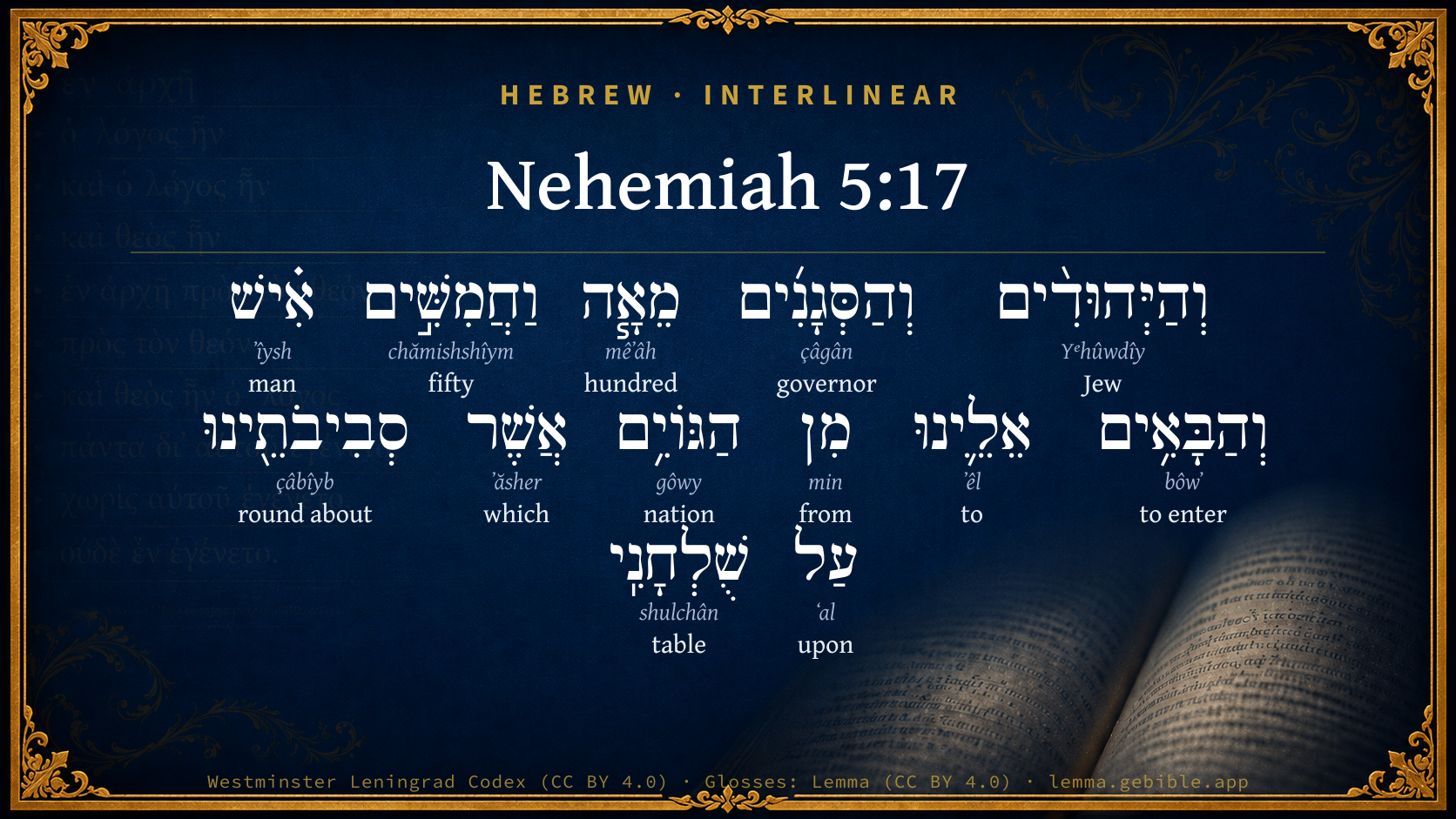
Hebrew (Westminster Leningrad Codex) Nehemiah 5:17 appears in the Hebrew Old Testament. The text above is from the Westminster Leningrad Codex. Each word links to its Strong’s number, a concise gloss, and parsing drawn from the Open Scriptures Hebrew Bible morphology. Click any word for its full Brown-Driver-Briggs (BDB) entry.
Download image
Cite this verse

Nehemiah 5:17 (World English Bible). Public Domain. Lemma interlinear Bible study tool, https://lemma.gebible.app/v/nehemiah/5/17.

Show BibTeX & RIS
BibTeX
RIS
English Translation
Moreover there were at my table, of the Jews and the rulers, one hundred fifty men, besides those who came to us from among the nations that were round about us.
World English Bible · Public Domain
Download a study sheet

One document with this verse’s original text, its word-by-word gloss line, the meaning frame, cross-references with their text, attributed commentary, and full source and license credits — printable, and it pastes into notes with its structure intact.

This verse Autodidact and up

Study sheet (.html) Plain text (.txt)

A passage Seminary Student

Up to 50 verses in one chapter. A passage sheet keeps up to 6 commentary sources and 12 cross-references per verse, in the order this page ranks them, and says so on the sheet whenever that leaves anything out. Ask for a single verse and you get the Autodidact verse sheet above.

Everything on this page stays free to read, with no account — the sheet is a download of what is already on screen, not access to it.

Want to remove ads? Support Godless Engineer
Compare translations 3

The same verse in 3 English versions, stacked beneath the original-language interlinear above. Click any original word for its lexicon entry.

Each is an independent rendering of the whole verse — the interlinear is not word-aligned to these translations.

Highlighted words mark where these versions differ — a whole-verse word diff, not a word-by-word alignment.

  • World English Bible Public Domain
    Moreover there were at my table, of the Jews and the rulers, one hundred fifty men, besides those who came to us from among the nations that were round about us.
  • King James Version Public Domain
    Moreover there were at my table an hundred and fifty of the Jews and rulers, beside those that came unto us from among the heathen that are about us.
  • unfoldingWord Literal Text CC BY-SA 4.0
    Now the Jews and the prefects were 150 men at my table, with the ones coming to us from the nations that were around us.

unfoldingWord Literal Text — © unfoldingWord, licensed CC BY-SA 4.0. Word-aligned USFM3 via Door43 (git.door43.org/unfoldingWord/en_ult).

Versions to compare (up to 4)

3 of 4 selected

Show all 18 translations

Every available English version of this verse, each an independent rendering of the whole verse.

  • World English Bible Public Domain
    Moreover there were at my table, of the Jews and the rulers, one hundred fifty men, besides those who came to us from among the nations that were round about us.
  • Berean Standard Bible Public Domain
    There were 150 Jews and officials at my table, besides the guests from the surrounding nations.
  • Majority Standard Bible Public Domain
    There were 150 Jews and officials at my table, besides the guests from the surrounding nations.
  • King James Version Public Domain
    Moreover there were at my table an hundred and fifty of the Jews and rulers, beside those that came unto us from among the heathen that are about us.
  • American Standard Version (1901) Public Domain
    Moreover there were at my table, of the Jews and the rulers, a hundred and fifty men, besides those that came unto us from among the nations that were round about us.
  • Revised Version (1885) Public Domain
    Moreover there were at my table of the Jews and the rulers an hundred and fifty men, beside those that came unto us from among the heathen that were round about us.
  • Geneva Bible (1599) Public Domain
    Moreouer there were at my table an hundreth and fiftie of the Iewes, and rulers, which came vnto vs from among the heathen that are about vs.
  • Douay-Rheims (1899) Public Domain
    The Jews also and the magistrates to the number of one hundred and fifty men, were at my table, besides them that came to us from among the nations that were round about us.
  • Young's Literal Translation Public Domain
    and of the Jews, and of the prefects, a hundred and fifty men, and those coming in unto us of the nations that `are' round about us, `are' at my table;
  • Literal Standard Version CC BY-SA 4.0
    and of the Jews, and of the prefects, one hundred and fifty men, and those coming to us of the nations that [are] around us, [are] at my table;
  • Unlocked Literal Bible CC BY-SA 4.0
    At my table were the Jews and the officials, 150 men, besides those who came to us from among the nations who were around us.
  • unfoldingWord Literal Text CC BY-SA 4.0
    Now the Jews and the prefects were 150 men at my table, with the ones coming to us from the nations that were around us.
  • Darby Bible Public Domain
    And there were at my table a hundred and fifty of the Jews and the rulers, besides those that came to us from among the nations that were about us.
  • World Messianic Bible Public Domain
    Moreover there were at my table, of the Jews and the rulers, one hundred fifty men, in addition to those who came to us from among the nations that were around us.
  • Webster's Bible Public Domain
    Moreover, there were at my table a hundred and fifty of the Jews and rulers, besides those that came to us from among the heathen that were about us.
  • Free Bible Version CC BY-SA 4.0
    I had 150 Jews and officials eating at my table, as well as visitors from nearby countries.
  • Bible in Basic English Public Domain
    And more than this, a hundred and fifty of the Jews and the rulers were guests at my table, in addition to those who came to us from the nations round about us.
  • JPS Tanakh (1917) Public Domain
    Moreover there were at my table of the Jews and the rulers a hundred and fifty men, beside those that came unto us from among the nations that were round about us.

Literal Standard Version (2020), Covenant Press — licensed CC BY-SA 4.0. Text via the HelloAO Bible API (eBible.org). Unlocked Literal Bible (unfoldingWord) — licensed CC BY-SA 4.0. Text via the HelloAO Bible API (eBible.org). unfoldingWord Literal Text — © unfoldingWord, licensed CC BY-SA 4.0. Word-aligned USFM3 via Door43 (git.door43.org/unfoldingWord/en_ult). Free Bible Version, Dr. Jonathan Gallagher — licensed CC BY-SA 4.0. Text via the HelloAO Bible API (eBible.org).

Word by word

More ways to search: Search by grammar → Find every occurrence → Compare this word →

Practice this passage: Drill this verse → Learn its vocabulary →

וְהַסְּגָנִ֜ים
çâgân
H5461
“and · the · governors”
Conjunction + Particle, Definite Article + Noun, Common, Masculine, Plural, Absolute
Part of Speech
Conjunction + Particle + Noun
Type
Common
Gender
Masculine
Number
Plural
State
Absolute
Full BDB Definition

Origin: from an unused root meaning to superintend

TWOT: 1461

ruler, prefect, governor, a subordinate ruler - prefects (of Assyria and Babylon) - petty rulers or officials
  1. וְהַיְּהוּדִ֨ים Yᵉhûwdîy H3064 “and · the · Jews” Conjunction + Particle, Definite Article + Noun, Gentilic, Masculine, Plural, Absolute
  2. מֵאָ֧ה mêʼâh H3967 “hundred” Adjective, Cardinal number, Both, Singular, Absolute
  3. וַחֲמִשִּׁ֣ים chămishshîym H2572 “and · fifty” Conjunction + Adjective, Cardinal number, Both, Plural, Absolute
  4. אִ֗ישׁ ʼîysh H376 “man” Noun, Common, Masculine, Singular, Absolute
  5. וְהַבָּאִ֥ים bôwʼ H935 “and · the · entering” Conjunction + Particle, Definite Article + Verb, Qal, Participle Active, Masculine, Plural, Absolute
  6. אֵלֵ֛ינוּ ʼêl H413 “to · us” Preposition + Suffix, Personal, 1st Person, Common, Plural
  7. מִן min H4480 “from” Preposition
  8. הַגּוֹיִ֥ם gôwy H1471 “the · nations” Particle, Definite Article + Noun, Common, Masculine, Plural, Absolute
  9. אֲשֶׁר ʼăsher H834 “which” Particle, Relative
  10. סְבִיבֹתֵ֖ינוּ çâbîyb H5439 “surroundings · our” Noun, Common, Both, Plural, Construct + Suffix, Personal, 1st Person, Common, Plural
  11. עַל ʻal H5921 “upon” Preposition
  12. שֻׁלְחָנִֽי shulchân H7979 “table · my” Noun, Common, Masculine, Singular, Construct + Suffix, Personal, 1st Person, Common, Singular

About this verse

These counts appear in no published source. They are computed here, from the morphology-tagged text and Lemma’s own curated glosses. What Lemma adds →

13
words
13
distinct lemmas
Historical
section

Notable vocabulary

The rarest word here is וְהַסְּגָנִ֜ים governor H5461 — appearing just 17 times in the whole Hebrew Bible.

Shared distinctive vocabulary

וְהַסְּגָנִ֜ים governor H5461 occurs in 16 verses of the Hebrew Bible. Also found in:

Grammatical profile

  • 1 verb
  • 6 nouns
  • 2 adjectives
  • 3 prepositions
  • 1 particle

Verb forms

  • וְהַבָּאִ֥ים Qal · Participle Active

Cross-references

6

Topical passages linked to Nehemiah 5:17 in the Treasury of Scripture Knowledge — connected by theme and wording, ordered by reader-vote popularity; previews shown in the World English Bible.

  • 1 Kings 18:19 Now therefore send, and gather to me all Israel to Mount Carmel, and the prophets of Baal four hundred fifty, and the prophets of the Asherah four hundred, who eat at Jezebel's table.
  • 2 Samuel 9:7 David said to him, "Don't be afraid of him; for I will surely show you kindness for Jonathan your father's sake, and will restore you all the land of Saul your father; and you shall eat bread at my table continually."
  • 1 Peter 4:9–10 Be hospitable one to another without grumbling.
  • 2 Samuel 9:13 So Mephibosheth lived in Jerusalem; for he ate continually at the king's table. He was lame in both his feet.
  • Isaiah 32:8 But the noble devises noble things; and in noble things shall he continue.
  • Romans 12:13 contributing to the needs of the saints; given to hospitality.

Cross-references courtesy of OpenBible.info (CC BY 4.0).

Hebrew and Greek witnesses Masoretic Hebrew ↔ Greek Septuagint

The same verse in the two great witnesses to the Old Testament, shown verse-for-verse.

These are two independent witnesses, not word-aligned to each other, and the Septuagint is shown in lemma (dictionary) form.

Hebrew Nehemiah 5:17 Masoretic · Westminster Leningrad Codex

וְהַיְּהוּדִ֨ים וְהַסְּגָנִ֜ים מֵאָ֧ה וַחֲמִשִּׁ֣ים אִ֗ישׁ וְהַבָּאִ֥ים אֵלֵ֛ינוּ מִן הַגּוֹיִ֥ם אֲשֶׁר סְבִיבֹתֵ֖ינוּ עַל שֻׁלְחָנִֽי

Moreover there were at my table, of the Jews and the rulers, one hundred fifty men, besides those who came to us from among the nations that were round about us.

World English Bible · Public Domain

Greek LXX Structure differs

The Septuagint has no separate book of Nehemiah. Its Greek text is the second half of Esdras B (2 Esdras), chapters 11–23; Ezra is the first half (1–10).

A verse-for-verse comparison isn’t shown here because the chapters and verses don’t line up. Switch to the LXX edition with the MT / LXX toggle above to read the Greek directly.

Hebrew: Westminster Leningrad Codex (CC BY 4.0). Greek: Septuagint (public domain); English from a public-domain English Septuagint. How the Septuagint differs from the Hebrew →

Commentary

Notes on Nehemiah 5:17 from classic Christian and Jewish commentators (each source and its license shown beneath its notes). The classic Christian expositions comment on the surrounding passage and are grouped to its opening verse, so a note may address several verses; the Jewish commentaries on the Tanakh (Rashi and others) are per-verse, so they appear only where the commentator wrote on this verse.

Lemma curates 59 commentaries, every one of them public domain or Creative Commons licensed, each selected and text-cleaned for this edition rather than reprinted as found. About our sources →

Trapp's Complete Commentary

John Trapp

Neh 5:17 Moreover [there were] at my table an hundred and fifty of the Jews and rulers, beside those that came unto us from among the heathen that [are] about us.

Ver. 17. Moreover there were at my table, &c.] He did not eat his morsels alone, as that Pamphagus Nabal; and as many misers today, who, like little children, though they have their hands full and their mouths full, yet will part with none.

Ecce Deo similis vir dapsilis, atque benignus - Palingen.

Beside those that came unto me from among the heathen] Either as state agents, or upon other occasions. Nehemiah entertained them, that they might not lie upon the public charge. And herein he trod in the footsteps of hospitable Abraham, whom Synesius calleth θεου εστιατορα, God’s host. The primitive Christians likewise won much upon the heathens by their hospitality towards all, as Julian, the apostate, confessed: all that he could say against them for it was, that they did it all in hypocrisy and vain glory; which was an envious and false charge (πεπλασμενην κατα Aνδρονικ. Chrysost. in Joan. Epist.).

John Trapp, A Commentary or Exposition upon All the Books of the Old and New Testament (1647–1656) — public domain. Text from a community e-Sword module.

Joseph Benson's Commentary

Neh 5:17. There were at my table a hundred and fifty of the Jews and rulers — Not only Jews of the inferior sort, for whom meaner provisions might have sufficed; but also their rulers, for whom better provision was to be made; who resorted to him upon all occasions, either to pour out their complaints to him, or to receive his orders. Besides those that came from among the heathen — Strangers, who came about business, and perhaps brought him intelligence concerning the state of the neighbouring people, and of their designs.

Joseph Benson's Commentary on the Old and New Testaments (1811–1818) — public domain. Text from a community e-Sword module.

Jamieson, Fausset & Brown

Robert Jamieson, A. R. Fausset & David Brown

Moreover there were at my table an hundred and fifty of the Jews--In the East it has been always customary to calculate the expense of a king's or grandee's establishment, not by the amount of money disbursed, but by the quantity of provisions consumed (see Kg1 4:22; Kg1 18:19; Ecc 5:11).

Next: Nehemiah Chapter 6

Jamieson, Fausset & Brown — Commentary Critical and Explanatory on the Whole Bible (1871) — public domain (CC PDM 1.0). Text via the HelloAO Bible API.

Adam Clarke's Commentary

Verse 17. A hundred and fifty of the Jews] He kept open house, entertained all comers; besides having one hundred and fifty Jews who had their food constantly at his table, and at his expense. To be able to bear all these expenses, no doubt Nehemiah had saved money while he was cup-bearer to the Persian king in Susa.

Adam Clarke's Commentary on the Bible (1810–1826) — public domain. Text from a community e-Sword/MySword module.

Ellicott's Commentary for English Readers

(17) At my table.—The charge on the governor’s free hospitality was heavy: “of the Jews a hundred and fifty rulers, besides those that came” occasionally from the country.

Because the bondage.—Rather, because the service of building was heavy.

The bondage.—Rather, the service was heavy.

A Bible Commentary for English Readers, edited by Charles John Ellicott (1878–1897) — public domain. Text from a community e-Sword module.

The Cambridge Bible for Schools and Colleges

gen. ed. J. J. S. Perowne

17. Moreover] Nehemiah mentions another proof of his generosity as governor. He regularly entertained over 150 officials, and welcomed Jewish strangers to his table.

an hundred and fifty of the Jews and rulers, besides those that came unto us, &c.] The English rendering which seems here to distinguish between ‘the Jews’ and ‘rulers’ (or ‘deputies’), and to speak of three classes (1) the Jews, (2) rulers, (3) strangers from outside Judæa, may be supported by the traditional interpretation preserved in the Hebrew accents.

From the position here assigned to ‘the Jews,’ the word, if taken to express a distinct class of the community, must be used of ‘the heads of the great Jewish houses or families’ (cf. Ezra 2) as distinct from the administrative officers (see Neh_2:16). According to this explanation the heads of the houses and the rulers together numbered one hundred and fifty.

It may be questioned whether the expression ‘the Jews’ would ever be assigned to a section or class of the community. The word is used in Neh_5:1 and Neh_5:8 without any such limitation of meaning.

It is perhaps better to take ‘the Jews’ as the subject of the whole verse. ‘Moreover the Jews—I regularly entertained two classes, i.e. the 150 officials and those who had recently left their homes to join their countrymen at Jerusalem.’ This is the rendering of the Vulgate, ‘Judæi quoque et magistratus centum quinquaginta viri et veniebant ad nos de gentibus.’ The repetition of the copula in the Hebrew with ‘Jews,’ ‘rulers,’ and ‘those’ admits of this rendering as in Neh_4:11.

The large number of the ‘rulers’ is not an insurmountable objection to this rendering. The central organization of the administration required a great deal of subdivision; and as all the officials were under the governor, he extended his hospitality to all alike.

besides those that came unto us, &c.] By this seems to be intended the somewhat numerous class of Jews, who, having resided among the neighbouring nations detached themselves from time to time, and came to join their brethren in or near Jerusalem. These were Jews, whose forefathers had never been carried captive to Babylon, but had settled in foreign lands either for purposes of trade or from fear of the invader. See note on Ezr_6:21.

that are about us] R.V. that were round about us. The past tense is required by the narrative style, which Nehemiah employs.

The Cambridge Bible for Schools and Colleges (gen. ed. J. J. S. Perowne; Cambridge University Press, 1878–1918) — public domain. Text from a community e-Sword module.

John Gill's Exposition

Now that which was prepared for me daily was one ox and six choice sheep,.... Or fat ones; of beef and mutton a considerable quantity, abundantly sufficient for his guests and servants, and shows what a good table he kept:

also fowls were prepared for me; what number is not said:

and once in ten days store of all sorts of wine; the country afforded; that is, either once in ten days his stock of wine was renewed, or a more liberal entertainment was made, a banquet of wine, Est 5:6,

yet for all this required not I the bread of the governor; the salary that used to be given him, but did this at his own expense, out of his own estate in Judea; or what he had got by his office as cupbearer to the king of Persia, the salary of which perhaps was continued:

because the bondage was heavy upon the people; the tribute of the king of Persia, and their labour and expense in building the walls of the city.

John Gill's Exposition of the Whole Bible (1746–1763) — public domain (CC PDM 1.0). Text via the HelloAO Bible API.

Haydock's Catholic Bible Commentary

Men, my brethren, not (Calmet) Persians. (Grotius) --- Them; ambassadors. (Menochius) --- If Nehemias behaved with such generosity for twelve years, he must have been very rich; or he received a great pension from the king, or voluntary and abundant contributions from the rich.

George Leo Haydock (1774–1849), Haydock's Catholic Family Bible and Commentary, 1859 edition — public domain. Excludes Psalms (Douay-Rheims chapter numbering differs from Protestant) and Deuterocanonical books (Catholic canon only).

Matthew Poole's English Annotations

An hundred and fifty of the Jews and rulers; not only Jews of the inferior sort, for whom meaner provisions might suffice, but also their rulers, such as there were in many places, for whom better provision was fit; who resorted to him upon all occasions, either to pour out their complaints, as here they did; or to give him notice of the enemy’s designs; or to receive his orders and directions.

Matthew Poole's English Annotations on the Holy Bible (1683–1685) — public domain. Text from a community e-Sword/MySword module.

Whedon's Commentary on the Bible

Daniel D. Whedon

17. At my table — As courtly guests. Here was a great expense, which his official position involved, but which he would not tax the people to bear.

Jews and rulers — Holding official relations to the government, and so belonging to the court of the governor.

Those that came unto us from among the heathen — Ambassadors and persons on official business, who would, of course, be entertained at the governor’s table.

Daniel D. Whedon (gen. ed.), Commentary on the Old and New Testaments (1874–1909) — public domain. Text from a community e-Sword module.

The Pulpit Commentary

A hundred and fifty of the Jews and rulers. The "hundred and fifty" were, all of them, "rulers." Nehemiah means to say that he entertained continually at his table 150 of the Jewish chief men or "rulers" (segdnim), and also an indefinite number of foreign Jews, who came on short visits to Jerusalem.

The Pulpit Commentary (1880–1919), ed. H.D.M. Spence-Jones & Joseph S. Exell — public domain. Text from a community e-Sword module.

John Wesley's Explanatory Notes

Rulers - Not only Jews of the inferior sort, for whom meaner provisions might suffice, but also their rulers, for whom better provision was fit; who resorted to him upon all occasions, to give him notice of the enemies designs; or to receive his orders.

John Wesley, Explanatory Notes Upon the Whole Bible (1754–1765) — public domain. Text via the GEBible commentary corpus.

Rashi

Rabbi Shlomo Yitzchaki (Rashi)

one hundred and fifty men were eating at my table, in addition to the proselytes who came to us from the gentiles, for they too were eating at my table.

Rashi on the Tanakh — English translations: “The Judaica Press complete Tanach with Rashi, translated by A. J. Rosenberg” (CC BY 4.0); “Pentateuch with Rashi's commentary by M. Rosenbaum and A.M. Silbermann, 1929-1934” (public domain); “The Metsudah Tanach series, Lakewood, N.J” (CC BY 4.0); and “The Book of Joshua, Metsudah Publications, 1997” (CC BY 4.0). Text via Sefaria.

Lesson kit

Teaching starters — assembled from the data on this page, not authored interpretation. Every prompt links to the verse data it draws on. Edit before teaching.

Nehemiah, in the Historical, opens this verse with 13 words (13 distinct Hebrew lemmas). Its most distinctive word is çâgân (“governor”). A historical commentator’s framing appears above. Read the whole chapter for the surrounding context.

Discussion questions

  1. The word çâgân carries the sense “governor.” How does it shape the verse?
  2. Ezra 9:2 shares the word «governor» with this verse. How do the two illuminate each other?
  3. These translations render this verse differently. What is at stake in choosing one wording over another?
  4. The verb «וְהַבָּאִ֥ים» is Qal Participle Active. How does its form color the action?
  5. Reading how Trapp's Complete Commentary and Joseph Benson's Commentary read this verse, where do the two commentators agree and where do they part?

Things to notice

Reading settings

Reading text

Shown beneath each verse's original-language words.

Old Testament
Old Testament edition

Read the OT as the Masoretic Hebrew (MT) or the Greek Septuagint (LXX).

English shown for the Greek Septuagint (in the Hebrew ↔ Greek comparison).

Comparing translations? Open the Compare panel on any verse page to stack up to four side by side.