
Genesis 25:23

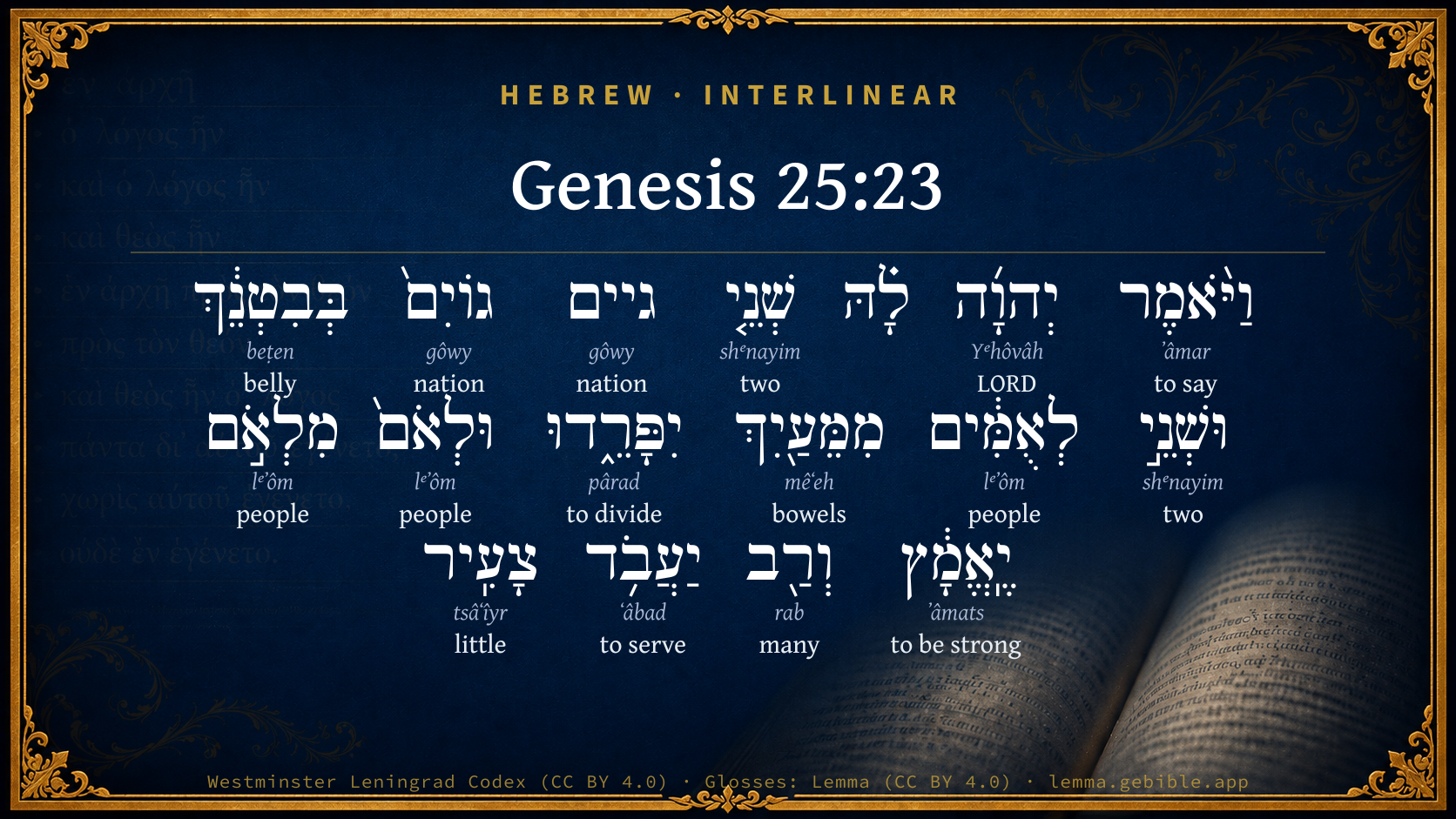
Hebrew (Westminster Leningrad Codex) Genesis 25:23 appears in the Hebrew Old Testament. The text above is from the Westminster Leningrad Codex. Each word links to its Strong’s number, a concise gloss, and parsing drawn from the Open Scriptures Hebrew Bible morphology. Click any word for its full Brown-Driver-Briggs (BDB) entry.
Download image
Cite this verse

Genesis 25:23 (World English Bible). Public Domain. Lemma interlinear Bible study tool, https://lemma.gebible.app/v/genesis/25/23.

Show BibTeX & RIS
BibTeX
RIS
English Translation
Yahweh said to her, Two nations are in your womb, Two peoples will be separated from your body. The one people will be stronger than the other people. The elder will serve the younger.
World English Bible · Public Domain
Highlights
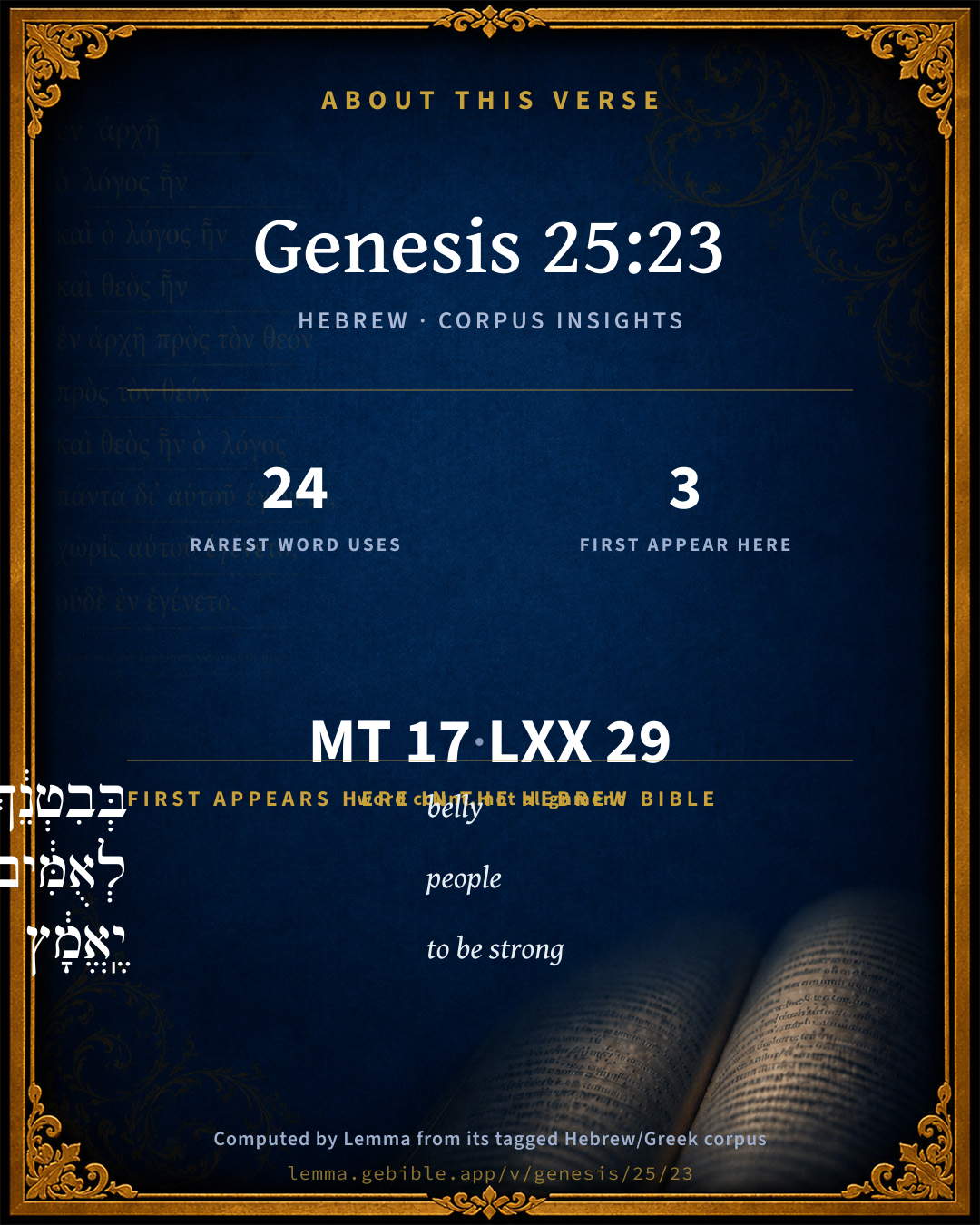
  • 3 first appearances in the Hebrew Bible
Full analysis ↓
Download a study sheet

One document with this verse’s original text, its word-by-word gloss line, the meaning frame, cross-references with their text, attributed commentary, and full source and license credits — printable, and it pastes into notes with its structure intact.

This verse Autodidact and up

Study sheet (.html) Plain text (.txt)

A passage Seminary Student

Up to 50 verses in one chapter. A passage sheet keeps up to 6 commentary sources and 12 cross-references per verse, in the order this page ranks them, and says so on the sheet whenever that leaves anything out. Ask for a single verse and you get the Autodidact verse sheet above.

Everything on this page stays free to read, with no account — the sheet is a download of what is already on screen, not access to it.

Want to remove ads? Support Godless Engineer
Compare translations 3

The same verse in 3 English versions, stacked beneath the original-language interlinear above. Click any original word for its lexicon entry.

Each is an independent rendering of the whole verse — the interlinear is not word-aligned to these translations.

Highlighted words mark where these versions differ — a whole-verse word diff, not a word-by-word alignment.

  • World English Bible Public Domain
    Yahweh said to her, Two nations are in your womb, Two peoples will be separated from your body. The one people will be stronger than the other people. The elder will serve the younger.
  • King James Version Public Domain
    And the LORD said unto her, Two nations are in thy womb, and two manner of people shall be separated from thy bowels; and the one people shall be stronger than the other people; and the elder shall serve the younger.
  • unfoldingWord Literal Text CC BY-SA 4.0
    And Yahweh said to her, “Two nations inside your womb, and two peoples will be divided from inside your womb. And one people will be stronger than the other people, and the older will serve the younger.”

unfoldingWord Literal Text — © unfoldingWord, licensed CC BY-SA 4.0. Word-aligned USFM3 via Door43 (git.door43.org/unfoldingWord/en_ult).

Versions to compare (up to 4)

3 of 4 selected

Show all 18 translations

Every available English version of this verse, each an independent rendering of the whole verse.

  • World English Bible Public Domain
    Yahweh said to her, Two nations are in your womb, Two peoples will be separated from your body. The one people will be stronger than the other people. The elder will serve the younger.
  • Berean Standard Bible Public Domain
    and He declared to her: “Two nations are in your womb, and two peoples from within you will be separated; one people will be stronger than the other, and the older will serve the younger.”
  • Majority Standard Bible Public Domain
    and He declared to her: “Two nations are in your womb, and two peoples from within you will be separated; one people will be stronger than the other, and the older will serve the younger.”
  • King James Version Public Domain
    And the LORD said unto her, Two nations are in thy womb, and two manner of people shall be separated from thy bowels; and the one people shall be stronger than the other people; and the elder shall serve the younger.
  • American Standard Version (1901) Public Domain
    And Jehovah said unto her, Two nations are in thy womb, And two peoples shall be separated from thy bowels. And the one people shall be stronger than the other people. And the elder shall serve the younger.
  • Revised Version (1885) Public Domain
    And the LORD said unto her, Two nations are in thy womb, And two peoples shall be separated even from thy bowels: And the one people shall be stronger than the other people; And the elder shall serve the younger.
  • Geneva Bible (1599) Public Domain
    And the Lord sayd to her, Two nations are in thy wombe, and two maner of people shalbe diuided out of thy bowels, and the one people shall be mightier then the other, and the elder shall serue the yonger.
  • Douay-Rheims (1899) Public Domain
    And he answering said: Two nations are in thy womb, and two peoples shall be divided out of thy womb, and one people shall overcome the other, and the elder shall serve the younger.
  • Young's Literal Translation Public Domain
    And Jehovah saith to her, `Two nations `are' in thy womb, and two peoples from thy bowels are parted; and the `one' people than the `other' people is stronger; and the elder doth serve the younger.'
  • Literal Standard Version CC BY-SA 4.0
    And YHWH says to her, “Two nations [are] in your womb, and two peoples from your bowels are parted; and the [one] people is stronger than the [other] people; and the older serves the younger.”
  • Unlocked Literal Bible CC BY-SA 4.0
    Yahweh said to her, “Two nations are in your womb, and two peoples will be separated from within you. One people will be stronger than the other, and the older will serve the younger.”
  • unfoldingWord Literal Text CC BY-SA 4.0
    And Yahweh said to her, “Two nations inside your womb, and two peoples will be divided from inside your womb. And one people will be stronger than the other people, and the older will serve the younger.”
  • Darby Bible Public Domain
    And Jehovah said to her, Two nations are in thy womb, And two peoples shall be separated from thy bowels; And one people shall be stronger than the other people, And the elder shall serve the younger.
  • World Messianic Bible Public Domain
    The LORD said to her, “Two nations are in your womb. Two peoples will be separated from your body. The one people will be stronger than the other people. The elder will serve the younger.”
  • Webster's Bible Public Domain
    And the LORD said to her, Two nations are in thy womb, and two manner of people shall be separated from thy bowels: and the one people shall be stronger than the other people; and the elder shall serve the younger.
  • Free Bible Version CC BY-SA 4.0
    “You have two nations inside you,” the Lord replied. “You're going to give birth to two peoples who will compete against each other. One will be stronger than the other; the older one will be the servant of the younger one.”
  • Bible in Basic English Public Domain
    And the Lord said to her, Two nations are in your body, and two peoples will come to birth from you: the one will be stronger than the other, and the older will be the servant of the younger.
  • JPS Tanakh (1917) Public Domain
    And the LORD said unto her: Two nations are in thy womb, and two peoples shall be separated from thy bowels; and the one people shall be stronger than the other people; and the elder shall serve the younger.

Literal Standard Version (2020), Covenant Press — licensed CC BY-SA 4.0. Text via the HelloAO Bible API (eBible.org). Unlocked Literal Bible (unfoldingWord) — licensed CC BY-SA 4.0. Text via the HelloAO Bible API (eBible.org). unfoldingWord Literal Text — © unfoldingWord, licensed CC BY-SA 4.0. Word-aligned USFM3 via Door43 (git.door43.org/unfoldingWord/en_ult). Free Bible Version, Dr. Jonathan Gallagher — licensed CC BY-SA 4.0. Text via the HelloAO Bible API (eBible.org).

Word by word

More ways to search: Search by grammar → Find every occurrence → Compare this word →

Practice this passage: Drill this verse → Learn its vocabulary →

צָעִֽיר
tsâʻîyr
H6810
“little”
Adjective, Adjective, Masculine, Singular, Absolute
Part of Speech
Adjective
Type
Adjective
Gender
Masculine
Number
Singular
State
Absolute
Full BDB Definition

Origin: from H6819

TWOT: 1948a

little, insignificant, young - little, insignificant - insignificant, mean - young, younger, youngest
  1. וַיֹּ֨אמֶר ʼâmar H559 “and · to say” Conjunction + Verb, Qal, Sequential Imperfect, 3rd Person, Masculine, Singular
  2. יְהוָ֜ה Yᵉhôvâh H3068 “LORD” Noun, Proper
  3. שְׁנֵ֤י shᵉnayim H8147 “two” Adjective, Cardinal number, Masculine, Dual, Construct
  4. גיים gôwy H1471 “nations” Noun, Common, Masculine, Plural, Absolute
  5. גוֹיִם֙ gôwy H1471 “nations” Noun, Common, Masculine, Plural, Absolute
  6. בְּבִטְנֵ֔ךְ beṭen H990 “in/at · belly · your” Preposition + Noun, Common, Feminine, Singular, Construct + Suffix, Personal, 2nd Person, Feminine, Singular
  7. וּשְׁנֵ֣י shᵉnayim H8147 “and · two” Conjunction + Adjective, Cardinal number, Masculine, Dual, Construct
  8. לְאֻמִּ֔ים lᵉʼôm H3816 “peoples” Noun, Common, Masculine, Plural, Absolute
  9. מִמֵּעַ֖יִךְ mêʻeh H4578 “from · bowels · your” Preposition + Noun, Common, Masculine, Plural, Construct + Suffix, Personal, 2nd Person, Feminine, Singular
  10. יִפָּרֵ֑דוּ pârad H6504 “to divide” Verb, Niphal, Imperfect, 3rd Person, Masculine, Plural
  11. וּלְאֹם֙ lᵉʼôm H3816 “and · people” Conjunction + Noun, Common, Masculine, Singular, Absolute
  12. מִלְאֹ֣ם lᵉʼôm H3816 “from · people” Preposition + Noun, Common, Masculine, Singular, Absolute
  13. יֶֽאֱמָ֔ץ ʼâmats H553 “to be strong” Verb, Qal, Imperfect, 3rd Person, Masculine, Singular
  14. וְרַ֖ב rab H7227 “and · many” Conjunction + Adjective, Adjective, Masculine, Singular, Absolute
  15. יַעֲבֹ֥ד ʻâbad H5647 “to serve” Verb, Qal, Imperfect, 3rd Person, Masculine, Singular

About this verse

These counts appear in no published source. They are computed here, from the morphology-tagged text and Lemma’s own curated glosses. What Lemma adds →

17
words
12
distinct lemmas
Pentateuch
section

Notable vocabulary

The rarest word here is צָעִֽיר little H6810 — appearing just 24 times in the whole Hebrew Bible.

First appearance in Scripture

These words make their first canonical appearance in the Hebrew Bible here:

  • בְּבִטְנֵ֔ךְ belly H990
  • לְאֻמִּ֔ים people H3816
  • יֶֽאֱמָ֔ץ to be strong H553

Shared distinctive vocabulary

צָעִֽיר little H6810 occurs in 22 verses of the Hebrew Bible. Also found in:

Grammatical profile

  • 4 verbs
  • 8 nouns
  • 4 adjectives
  • 1 preposition

Verb forms

  • וַיֹּ֨אמֶר Qal · Sequential Imperfect
  • יִפָּרֵ֑דוּ Niphal · Imperfect
  • יֶֽאֱמָ֔ץ Qal · Imperfect
  • יַעֲבֹ֥ד Qal · Imperfect

Repetition

Words recur within this verse — often emphatic in Hebrew:

  • לְאֻמִּ֔ים people H3816 ×3
  • שְׁנֵ֤י two H8147 ×2
  • גיים nation H1471 ×2

Hebrew & Septuagint length

In English translation the verse runs 34 words from the Hebrew and 36 from the Septuagint (LXX English) — closely comparable.

A rough comparison of the two English renderings, which tokenize alike — not a word-level alignment.

Word counts can differ between the Hebrew and the Greek without any difference in meaning — e.g. the Hebrew direct-object marker אֵת has no separate Greek word, and Greek often adds the article ὁ.

In the original languages it is 17 Hebrew tokens and 29 Greek tokens — but the two are counted differently (Hebrew bundles its prefixes and suffixes into one token; the Greek is in lemma form), so that isn’t a like-for-like length.

Cross-references

25

Topical passages linked to Genesis 25:23 in the Treasury of Scripture Knowledge — connected by theme and wording, ordered by reader-vote popularity; previews shown in the World English Bible.

  • Romans 9:10–13 Not only so, but Rebecca also conceived by one, by our father Isaac.
  • Genesis 27:40 By your sword will you live, and you will serve your brother. It will happen, when you will break loose, That you shall shake his yoke from off your neck."
  • Genesis 27:29 Let peoples serve you, Nations bow down to you. Be lord over your brothers, Let your mother's sons bow down to you. Cursed be everyone who curses you, Blessed be everyone who blesses you."
  • 2 Samuel 8:14 He put garrisons in Edom; throughout all Edom put he garrisons, and all the Edomites became servants to David. Yahweh gave victory to David wherever he went.
  • Malachi 1:2–5 "I have loved you," says Yahweh. Yet you say, "How have you loved us?" "Wasn't Esau Jacob's brother?" says Yahweh, "Yet I loved Jacob;
  • Genesis 17:16 I will bless her, and moreover I will give you a son by her. Yes, I will bless her, and she will be a mother of nations. Kings of peoples will come from her."
  • Genesis 24:60 They blessed Rebekah, and said to her, "Our sister, may you be the mother of thousands of ten thousands, and let your seed possess the gate of those who hate them."
  • 1 Chronicles 18:13 He put garrisons in Edom; and all the Edomites became servants to David. Yahweh gave victory to David wherever he went.
  • Ezekiel 25:12–14 Thus says the Lord Yahweh: Because Edom has dealt against the house of Judah by taking vengeance, and has greatly offended, and revenged himself on them;
  • Numbers 20:14 Moses sent messengers from Kadesh to the king of Edom, Thus says your brother Israel, You know all the travail that has happened to us:
  • Psalms 60:8–9 Moab is my wash basin. I will throw my shoe on Edom. I shout in triumph over Philistia."
  • Isaiah 34:1–17 Come near, you nations, to hear; and listen, you peoples: let the earth hear, and the fullness of it; the world, and all things that come forth from it.
  • Jeremiah 49:7–22 Of Edom. Thus says Yahweh of Hosts: Is wisdom no more in Teman? is counsel perished from the prudent? is their wisdom vanished?
  • Amos 1:11–12 Thus says Yahweh: "For three transgressions of Edom, yes, for four, I will not turn away its punishment; Because he pursued his brother with the sword, And cast off all pity, And his anger raged continually, And he kept his wrath forever;
  • Obadiah 1:1–16 The vision of Obadiah. This is what the Lord Yahweh says about Edom. We have heard news from Yahweh, and an ambassador is sent among the nations, saying, "Arise, and let's rise up against her in battle.
  • Genesis 17:4 "As for me, behold, my covenant is with you. You will be the father of a multitude of nations.
  • Genesis 25:27 The boys grew. Esau was a skillful hunter, a man of the field. Jacob was a quiet man, living in tents.
  • Genesis 33:3 He himself passed over in front of them, and bowed himself to the ground seven times, until he came near to his brother.
  • Genesis 36:31 These are the kings who reigned in the land of Edom, before any king reigned over the children of Israel.
  • 1 Kings 22:47 There was no king in Edom: a deputy was king.
  • 2 Chronicles 25:11–12 Amaziah took courage, and led forth his people, and went to the Valley of Salt, and struck of the children of Seir ten thousand.
  • Psalms 83:5–15 For they have conspired together with one mind. They form an alliance against you.
  • Isaiah 63:1–6 Who is this who comes from Edom, with dyed garments from Bozrah? this who is glorious in his clothing, marching in the greatness of his strength? I who speak in righteousness, mighty to save.
  • Genesis 32:6 The messengers returned to Jacob, saying, "We came to your brother Esau. Not only that, but he comes to meet you, and four hundred men with him."

Cross-references courtesy of OpenBible.info (CC BY 4.0).

Hebrew and Greek witnesses Masoretic Hebrew ↔ Greek Septuagint

The same verse in the two great witnesses to the Old Testament, shown verse-for-verse.

These are two independent witnesses, not word-aligned to each other, and the Septuagint is shown in lemma (dictionary) form.

Hebrew Genesis 25:23 Masoretic · Westminster Leningrad Codex

וַיֹּ֨אמֶר יְהוָ֜ה לָ֗הּ שְׁנֵ֤י גיים גוֹיִם֙ בְּבִטְנֵ֔ךְ וּשְׁנֵ֣י לְאֻמִּ֔ים מִמֵּעַ֖יִךְ יִפָּרֵ֑דוּ וּלְאֹם֙ מִלְאֹ֣ם יֶֽאֱמָ֔ץ וְרַ֖ב יַעֲבֹ֥ד צָעִֽיר

Yahweh said to her, Two nations are in your womb, Two peoples will be separated from your body. The one people will be stronger than the other people. The elder will serve the younger.

World English Bible · Public Domain

Greek LXX Genesis 25:23 Septuagint · lemma form

καί εἶπον κύριος αὐτός δύο ἔθνος ἐν ὁ γαστήρ σύ εἰμί καί δύο λαός ἐκ ὁ κοιλία σύ διαστέλλω καί λαός λαός ὑπερἔχω καί ὁ μέγας δουλεύω ὁ ἐλαχύς

And the Lord said to her, There are two nations in your womb, and two peoples shall be separated from your belly, and one people shall excel the other, and the elder shall serve the younger.

LXX2012 (modern English Septuagint) · Public Domain

Hebrew: Westminster Leningrad Codex (CC BY 4.0). Greek: Septuagint (public domain); English from LXX2012 (modern English Septuagint) (Public Domain). How the Septuagint differs from the Hebrew →

Targum (Aramaic paraphrase)

2

The Targum is the ancient Jewish Aramaic paraphrase of the Hebrew Scriptures — an interpretive translation, not the Hebrew text itself. Onkelos (literal) and Pseudo-Jonathan (expansive) render the Torah, and Jonathan the Prophets. Coverage is partial: where no permissively-licensed English translation exists for a verse, only the Aramaic is shown. This is verse-level text, not a word-by-word alignment to the Hebrew.

  1. Targum Onkelos Torah (Genesis–Deuteronomy)
    וַאֲמַר יְיָ לַהּ תְּרֵין עַמְמִין בִּמְעַיְכִי וְתַרְתֵּין מַלְכְּוָן מִמֵעַיְכִי יִתְפָּרְשָׁן וּמַלְכוּ מִמַלְכוּ יִתְקַף וְרַבָּא יִשְׁתַּעֲבֵּיד לִזְעֵירָא

    (no public-domain English translation for this verse)

    Targum Onkelos — Aramaic: “Onkelos Genesis” (public domain); “Onkelos Exodus” (public domain); “Onkelos Leviticus” (public domain); “Onkelos Numbers” (public domain); “Onkelos Deuteronomy” (public domain). English: “Sefaria Community Translation” (CC0 1.0 (public-domain dedication)); “J.W. Etheridge. The Targums of Onkelos and Jonathan Ben Uzziel on the Pentateuch. London: Longmans, Green, 1862” (public domain). Text via Sefaria.

  2. Targum Pseudo-Jonathan Torah (Genesis–Deuteronomy)
    וַאֲמַר יְיָ לָהּ תְּרֵין עַמְמִין בִּמְעַיְיכִי וּתְרֵין מַלְכְּוָן מִמַעַיְיכִי יִתְפַּרְשׁוּן וּמַלְכוּ מִמַלְכוּ יְיהִי אַלִים וְרַבָּא יֶהֱוֵי מִשְׁתַּעֲבֵּיד לִזְעֵירָא אִם בְּנוֹי דִזְעֵירָא נַטְרִין פִּקוּדַיָא דְאוֹרַיְתָא

    And the Lord said to her, Two peoples are in thy womb, and two kingdoms from thy womb shall be separated; and one kingdom shall be stronger than the other, and the elder shall serve the younger, if the children of the younger will keep the commandments of the Law.

    Targum Pseudo-Jonathan — Aramaic: “Targum Jonathan on Genesis” (public domain); “Targum Jonathan on Exodus” (public domain); “Targum Jonathan on Leviticus” (public domain); “Targum Jonathan on Numbers” (public domain); “Targum Jonathan on Deuteronomy” (public domain). English: “The Targum of Jonathan ben Uzziel, trans. J. W. Etheridge, London, 1862” (public domain). Text via Sefaria.

Commentary

Notes on Genesis 25:23 from classic Christian and Jewish commentators (each source and its license shown beneath its notes). The classic Christian expositions comment on the surrounding passage and are grouped to its opening verse, so a note may address several verses; the Jewish commentaries on the Tanakh (Rashi and others) are per-verse, so they appear only where the commentator wrote on this verse.

Lemma curates 59 commentaries, every one of them public domain or Creative Commons licensed, each selected and text-cleaned for this edition rather than reprinted as found. About our sources →

Trapp's Complete Commentary

John Trapp

Gen 25:23 And the LORD said unto her, Two nations [are] in thy womb, and two manner of people shall be separated from thy bowels; and [the one] people shall be stronger than [the other] people; and the elder shall serve the younger.

Ver. 23. And the Lord said unto her.] Either by an angel, or a prophet, or some divine answer in her own heart.

Two nations are in thy womb.] So, what can a man "see in the Shulamite," in every sanctified soul, but "as it were the company of two armies"? {Son 6:13} Every good man is a divided man; every new man, two men.

John Trapp, A Commentary or Exposition upon All the Books of the Old and New Testament (1647–1656) — public domain. Text from a community e-Sword module.

Joseph Benson's Commentary

Gen 25:23. Two nations are in thy womb — The fathers of two nations, namely, of the Edomites and Israelites; two manner of people, which should not only greatly differ from each other in religion, laws, manners, but should contend with each other, and the issue of the contest should be, that the elder should serve the younger, which was fulfilled in the subjection of the Edomites, for many ages, to the house of David.

Joseph Benson's Commentary on the Old and New Testaments (1811–1818) — public domain. Text from a community e-Sword module.

Tyndale Open Study Notes

Tyndale Open Resources

25:23 rivals: Jacob and Esau fought in the womb, and their descendants (Israel and Edom) fought continuously throughout their history. In their many conflicts, Israel achieved supremacy over Edom. • your older son will serve your younger son: God’s choice of the younger son over the elder ran against natural order (cp. 48:12-14; see Mal 1:1-3; Rom 9:11-16).

Tyndale Open Study Notes — © Tyndale Open Resources, licensed CC BY-SA 4.0. Text via the HelloAO Bible API.

Adam Clarke's Commentary

Verse 23. Two nations are in thy womb] "We have," says Bishop Newton, "in the prophecies delivered respecting the sons of Isaac, ample proof that these prophecies were not meant so much of single persons as of whole nations descended from them; for what was predicted concerning Esau and Jacob was not verified in themselves, but in their posterity. The Edomites were the offspring of Esau, the Israelites were of Jacob; and who but the Author and Giver of life could foresee that two children in the womb would multiply into two nations? Jacob had twelve sons, and their descendants were all united and incorporated into one nation; and what an overruling providence was it that two nations should arise from the two sons only of Isaac! and that they should be two such different nations! The Edomites and Israelites have been from the beginning two such different people in their manners, customs, and religion, as to be at perpetual variance among themselves. The children struggled together in the womb, which was an omen of their future disagreement; and when they grew up to manhood, they manifested very different inclinations. Esau was a cunning hunter, and delighted in the sports of the field; Jacob was a plain man, dwelling in tents - minding his sheep and his cattle. The religion of the Jews is well known; but whatever the Edomites were at first, in process of time they became idolaters. When Amaziah king of Judah overthrew them, he brought their gods, and set them up to be his gods. The king of Edom having refused a passage to the Israelites through his territories on their return from Egypt, the history of the Edomites afterwards is little more than the history of their wars with the Jews."

The one people shall be stronger than the other people] The same author continues to observe, that "for some time the family of Esau was the more powerful of the two, there having been dukes and kings in Edom before there was any king in Israel; but David and his captains made an entire conquest of the Edomites, slew several thousands of them, and compelled the rest to become tributaries, and planted garrisons among them to secure their obedience. In this state of servitude they continued about one hundred and fifty years, without a king of their own, being governed by deputies or viceroys appointed by the kings of Judah; but in the days of Jehoram they revolted, recovered their liberties, and set up a king of their own. Afterwards Amaziah, king of Judah, gave them a total overthrow in the valley of Salt; and Azariah took Elath, a commodious harbour on the Red Sea, from them. Judas Maccabeus also attacked and defeated them with a loss of more than twenty thousand at two different times, and took their chief city Hebron. At last Hyrcanus his nephew took other cities from them, and reduced them to the necessity of leaving their country or embracing the Jewish religion; on which they submitted to be circumcised, and become proselytes to the Jewish religion, and were ever afterwards incorporated into the Jewish Church and nation."

The elder shall serve the younger.] "This passage," says Dr. Dodd, "serves for a key to explain the ninth chapter of the Epistle to the Romans, where the words are quoted; for it proves to a demonstration that this cannot be meant of God's arbitrary predestination of particular persons to eternal happiness or misery, without any regard to their merit or demerit - a doctrine which some have most impiously fathered on God, who is the best of beings, and who cannot possibly hate, far less absolutely doom to misery, any creature that he has made: but that it means only his bestowing greater external favours, or, if you please, higher opportunities for knowing and doing their duty, upon some men, than he does upon others; and that merely according to his own wise purpose, without any regard to their merits or demerits, as having a right to confer greater or smaller degrees or perfection on whom he pleases."

The doctrine of unconditional predestination to eternal life and eternal death cannot be supported by the example of God's dealings with Esau and Jacob, or with the Edomites and Israelites. After long reprobation the Edomites were incorporated among the Jews, and have ever since been undistinguishable members in the Jewish Church. The Jews, on the contrary, the elect of God, have been cut off and reprobated, and continue so to this day. If a time should ever come when the Jews shall all believe in Christ Jesus, which is a general opinion, then the Edomites, which are now absorbed among them, shall also become the elect. And even now Isaac finds both his children within the pale of the Jewish Church, equally entitled to the promises of salvation by Christ Jesus, of whom he was the most expressive and the most illustrious type. See the account of Abraham's offering, Ge 22:2-14.

Adam Clarke's Commentary on the Bible (1810–1826) — public domain. Text from a community e-Sword/MySword module.

John Calvin's Commentaries

23. Two nations. In the first place, God answers that the contention between the twin-brothers had reference to something far beyond their own persons; for in this way he shows that there would be discord between their posterities. When he says, there are two nations, the expression is emphatical; for since they were brothers and twins, and therefore of one blood, the mother did not suppose that they would be so far disjoined as to become the heads of distinct nations; yet God declares that dissension should take place between those who were by nature joined together. Secondly, he describes their different conditions, namely, that victory would belong to one of these nations, forasmuch as this was the cause of the contest, that they could not be equal, but one was chosen and the other rejected. For since the reprobate give way reluctantly, it follows of necessity that the children of God have to undergo many troubles and contests on account of their adoption. Thirdly, the Lord affirms that the order of nature being inverted, the younger, who was inferior, should be the victor.

We must now see what this victory implies. They who restrict it to earthly riches and wealth coldly trifle. Undoubtedly by this oracle Isaac and Rebekah were taught that the covenant of salvation would not be common to the two people, but would be reserved only for the posterity of Jacob. In the beginning, the promise was apparently general, as comprehending the whole seed: now, it is restricted to one part of the seed. This is the reason of the conflict, that God divides the seed of Jacob (of which the condition appeared to be one and the same) in such a manner that he adopts one part and rejects the other: that one part obtains the name and privilege of the Church, the rest are reckoned strangers; with one part resides the blessing of which the other is deprived; as it afterwards actually occurred: for we know that the Idumaeans were cut off from the body of the Church; but the covenant of grace was deposited in the family of Jacob. If we seek the cause of this distinction, it will not be found in nature; for the origin of both nations was the same. It will not be found in merit; because the heads of both nations were yet enclosed in their mother’s womb when the contention began. Moreover God, in order to humble the pride of the flesh, determined to take away from men all occasion of confidence and of boasting. He might have brought forth Jacob first from the womb; but he made the other the firstborn, who, at length, was to become the inferior. Why does he thus, designedly, invert the order appointed by himself, except to teach us that, without regard to dignity, Jacob, who was to be the heir of the promised benediction, was gratuitously elected? The sum of the whole, then, is, that the preference which God gave to Jacob over his brother Esau, by making him the father of the Church, was not granted as a reward for his merits, neither was obtained by his own industry, but proceeded from the mere grace of God himself. But when an entire people is the subject of discourse, reference is made not to the secret election, which is confirmed to few, but the common adoption, which spreads as widely as the external preaching of the word. Since this subject, thus briefly stated, may be somewhat obscure, the readers may recall to memory what I have said above in expounding the seventeenth chapter (Genesis 17:1) namely, that God embraced, by the grace of his adoption, all the sons of Abraham, because he made a covenant with all; and that it was not in vain that he appointed the promise of salvation to be offered promiscuously to all, and to be attested by the sign of circumcision in their flesh; but that there was a special chosen seed from the whole people, and these should at length be accounted the legitimate sons of Abraham, who by the secret counsel of God are ordained unto salvation. Faith, indeed, is that which distinguishes the spiritual from the carnal seed; but the question now under consideration is the principle on which the distinction is made, not the symbol or mark by which it is attested. God, therefore, chose the whole seed of Jacob without exception, as the Scripture in many places testifies; because he has conferred on all alike the same testimonies of his grace, namely, in the word and sacraments. But another and peculiar election has always flourished, which comprehended a certain definite number of men, in order that, in the common destruction, God might save those whom he would.

A question is here suggested for our consideration. Whereas Moses here treats of the former kind of election, Paul turns his words to the latter. For while he attempts to prove, that not all who are Jews by natural descent are heirs of life; and not all who are descended from Jacob according to the flesh are to be accounted true Israelites; but that God chooses whom he will, according to his own good pleasure, he adduces this testimony, the elder shall serve the younger. (Romans 9:7,8,12.) They who endeavor to extinguish the doctrine of gratuitous election, desire to persuade their readers that the words of Paul also are to be understood only of external vocation; but his whole discourse is manifestly repugnant to their interpretation; and they prove themselves to be not only infatuated, but impudent in their attempt to bring darkness or smoke over this light which shines so clearly. They allege that the dignity of Esau is transferred to his younger brother, lest he should glory in the flesh; inasmuch as a new promise is here given to the latter. I confess there is some force in what they say; but I contend that they omit the principal point in the case, by explaining the difference here stated, of the external vocation. But unless they intend to make the covenant of God of none effect, they must concede that Esau and Jacob were alike partakers of the external calling; whence it appears, that they to whom a common vocation had been granted, were separated by the secret counsel of God. The nature and object of Paul’s argument is well known. For when the Jews, inflated with the title of the Church, rejected the Gospel, the faith of the simple was shaken, by the consideration that it was improbable that Christ, and the salvation promised through him, could possibly be rejected by an elect people, a holy nation, and the genuine sons of God. Here, therefore, Paul contends that not all who descend from Jacob, according to the flesh, are true Israelites, because God, of his own good pleasure, may choose whom he will, as heirs of eternal salvation. Who does not see that Paul descends from a general to a particular adoption, in order to teach us, that not all who occupy a place in the Church are to be accounted as true members of the Church? It is certain that he openly excludes from the rank of children those to whom (he elsewhere says) pertaineth the adoption; whence it is assuredly gathered, that in proof of this position, he adduces the testimony of Moses, who declares that God chose certain from among the sons of Abraham to himself, in whom he might render the grace of adoption firm and efficacious. How, therefore, shall we reconcile Paul with Moses? I answer, although the Lord separates the whole seed of Jacob from the race of Esau, it was done with a view to the Church, which was included in the posterity of Jacob. And, doubtless, the general election of the people had reference to this end, that God might have a Church separated from the rest of the world. What absurdity, then, is there in supposing that Paul applies to special election the words of Moses, by which it is predicted that the Church shall spring from the seed of Jacob? And an instance in point was exhibited in the condition of the heads themselves of these two nations. For Jacob was not only called by the external voice of the Lord, but, while his brother was passed by, he was chosen an heir of life. That good pleasure of God, which Moses commends in the person of Jacob alone, Paul properly extends further: and lest any one should suppose, that after the two nations had been rendered distinct by this oracle, the election should pertain indiscriminately to all the sons of Jacob, Paul brings, on the opposite side, another oracle, I will have mercy on whom I will have mercy; where we see a certain number severed from the promiscuous race of Jacob’s sons, in the salvation of whom the special election of God might triumph. Whence it appears that Paul wisely considered the counsel of God, which was, in truth, that he had transferred the honor of primogeniture from the elder to the younger, in order that he might choose to himself a Church, according to his own will, out of the seed of Jacob; not on account of the merits of men, but as a matter of meres grace. And although God designed that the means by which the Church was to be collected should be common to the whole people, yet the end which Paul had in view is chiefly to be regarded; namely, that there might always be a body of men in the world which should call upon God with a pure faith, and should be kept even to the end. Let it therefore remain as a settled point of doctrine, that among men some perish, some obtain salvation; but the cause of this depends on the secret will of God. For whence does it arise that they who are born of Abraham are not all possessed of the same privilege? The disparity of condition certainly cannot be ascribed either to the virtue of the one, or to the vice of the other, seeing they were not yet born. Since the common feeling of mankind rejects this doctrine, there have been found, in all ages, acute men, who have fiercely disputed against the election of God. It is not my present purpose to refute or to weaken their calumnies: let it suffice us to hold fast what we gather from Paul’s interpretation; that whereas the whole human race deserves the same destruction, and is bound under the same sentence of condemnation, some are delivered by gratuitous mercy, others are justly left in their own destruction: and that those whom God has chosen are not preferred to others, because God foresaw they would be holy, but in order that they might be holy. But if the first origin of holiness is the election of God, we seek in vain for that difference in men, which rests solely in the will of God. If any one desires a mystical interpretation of the subject, we may give the following: whereas many hypocrites, who are for a time enclosed in the womb of the Church, pride themselves upon an empty title, and, with insolent boastings, exult over the true sons of God; internal conflicts will hence arise, which will grievously torment the mother herself.

John Calvin's Commentaries (1540-1563) — public domain. Text from the Calvin Translation Society English edition (1840s-50s) via the Christian Classics Ethereal Library (ccel.org). Calvin's coverage is partial (roughly two-thirds of the Bible); uncommented books and verses are honest gaps, never fabricated. The 19th-century editor's footnotes and remarks are omitted so the notes are faithfully Calvin's own voice.

Ellicott's Commentary for English Readers

(23) And the Lord said unto her.—Not by the mouth of Abraham, nor in a dream, but directly, as He spake of old to Adam and Eve. We read of no appearance, as in Gen_17:1, nor must we invent one. The manner in which Jehovah thus spake has not been revealed, and it is enough for us to know that Jehovah did speak of old to men. The answer is in the form of poverty:—

“Two nations are in thy womb;

And two peoples from thy bowels shall be separated;

And people shall be mightier than people;

And the great shall serve the small.”

The second line shows that even in their earliest childhood her sons would be unlike in character and unfriendly in disposition; upon this follows their development into hostile nations, and the prediction that the son who started with the advantages of the birthright, the stronger physical nature, and superior strength in men and arms (Gen_32:6), would, nevertheless, finally hold the inferior position. There can be no doubt that the secondary cause of the vaster development of Jacob was his being placed by Joseph in the fruitful Delta, where the Israelites were constantly joined by a stream of Semitic immigrants, whose movement towards Egypt is a perfectly authenticated fact of the history of those times. (See Gen_12:15.)

A Bible Commentary for English Readers, edited by Charles John Ellicott (1878–1897) — public domain. Text from a community e-Sword module.

The Cambridge Bible for Schools and Colleges

gen. ed. J. J. S. Perowne

23. And the Lord said] How the Divine answer was granted, whether by priest or soothsayer, by dream or by vision, we are not told. It is in the form of a rhythmic oracle, in four stichoi, or lines. The oracle proclaims, that (1) there are two children who shall be two nations; (2) from the first there shall be separation and discord between the two; (3) one shall overmaster the other; (4) the younger shall be the lord of the elder. The historic rivalry between Israel and Edom is thus prefigured.

separated … bowels] The English is ambiguous, as in Gal_1:15, “the good pleasure of God who separated me even from my mother’s womb.” The meaning is, “even from birth” the destinies of the two men and of their descendants will be divergent: cf. Gen_13:11, “and they separated themselves the one from the other.”

the elder shall serve the younger] The subjugation of the Edomites by the Israelites took place in the days of David, 2Sa_8:14. The same event is predicted by Jacob in Gen_27:40, where the additional prediction is made, that the subjugation will be only temporary. Israel, whose settlement in Palestine was later than that of the Edomites in the country of Seir, was regarded as the younger of the brother peoples. Edom was already a monarchy before Israel had settled down. But, occupying a richer country, Israel attained a higher civilization, and became a more powerful nation. For the hostility of Israel and Edom, see the prophet Obadiah. For St Paul’s use of the present passage, see Rom_9:10-12.

The Cambridge Bible for Schools and Colleges (gen. ed. J. J. S. Perowne; Cambridge University Press, 1878–1918) — public domain. Text from a community e-Sword module.

John Gill's Exposition

And the Lord said unto her,.... Either by one or other of the above persons she acquainted with this affair, and entreated to seek the Lord for her; or by an impulse upon her own mind:

two nations are in thy womb; or two persons, from whom two nations will spring, the Edomites and Israelites, the one from Esau, the other from Jacob:

and two manner of people shall be separated from thy bowels; different in their bodies, complexions, manner of life, religion, as well as place of abode:

and the one people shall be stronger than the other people: the Edomites, the posterity of Esau, were a very potent people, and had a succession of dukes and kings, before the Israelites, the posterity of Jacob, made any figure in the world, and while they were slaves in Egypt, see Gen 36:1; though in later times the Israelites became the stronger:

and the elder, or "greater":

shall serve the younger, or "lesser": the offspring of Esau, the eldest, should become tributary to the posterity of Jacob, the younger; which was verified in the times of David, when the Edomites were subdued by him, Sa2 8:14; and still more in the times of Hyrcanus, when the Edomites or Idumeans became one people with the Jews, and embraced their religion (e), rather than to be dispossessed of their country; and will have a further accomplishment in the latter day, when the prophecies in Oba 1:18 shall be fulfilled. Of the use which the Apostle Paul makes of this passage; see Gill on Rom 9:11, Rom 9:12.

(e) Joseph. Antiqu. l. 13. c. 9. sect. 1.

John Gill's Exposition of the Whole Bible (1746–1763) — public domain (CC PDM 1.0). Text via the HelloAO Bible API.

Haydock's Catholic Bible Commentary

The younger. The Idumeans shall be subdued by the arms of David: and the Jews themselves shall yield to the Christian Church. (St. Augustine, City of God xvi. 35.) St. Paul, Romans ix, draws another very important truth from this history, shewing the mercy of God to be gratuitous in choosing his saints. (Worthington)

George Leo Haydock (1774–1849), Haydock's Catholic Family Bible and Commentary, 1859 edition — public domain. Excludes Psalms (Douay-Rheims chapter numbering differs from Protestant) and Deuterocanonical books (Catholic canon only).

Matthew Poole's English Annotations

The Lord spoke, either by inward inspiration, in a dream or vision; or by the ministry of an angel or prophet.

Two nations, i.e. the roots, heads, or parents of two distinct nations, one opposite to the other; the one blessed, the other cursed, namely, the Israelites and Edomites.

Shall be separated; not only separated from thee, but one separated or greatly differing from the other in their frame of body, temper of mind, course of life, profession and practice of religion.

The elder, or, the greater, namely Esau, who was, as older, so of a stronger constitution of body, and of greater power and dignity in the world than Jacob; and Esau’s posterity were great princes for a long time, when Jacob’s seed were strangers in Canaan, slaves in Egypt, and poor afflicted wanderers in the wilderness. But, saith he, Esau and his shall not always be stronger and mightier than Jacob and his posterity, the tables shall be turned, and the children of Israel shall be uppermost and subdue the Edomites, which was literally accomplished in David’s time, 2Sa 8:14; and afterwards, 2Ch 25:11,12; and after that by the Maccabees; but much more eminently in a spiritual sense under the gospel, when one of Jacob’s children, even Jesus Christ, shall obtain the dominion, and shall rule the Edomites no less than other heathen nations with his iron rod, and make them serviceable one way or other to his glory, and to the felicity of his true Israel.

Matthew Poole's English Annotations on the Holy Bible (1683–1685) — public domain. Text from a community e-Sword/MySword module.

Whedon's Commentary on the Bible

Daniel D. Whedon

23. The Lord said — Here, too, we have a poetic strain:

Then said Jehovah to her, Two nations are in thy womb, And two peoples from thy bowels shall be separated.

And people than people shall be stronger, And the great shall serve the small.

What immediate effect this oracle had on Rebekah we are not told, but it probably served, in the subsequent time, to give her an intuitive partiality for the younger son. The subsequent history of the Israelites and the Edomites show how truly this prophecy was fulfilled. The descendants of Esau were strong, and fortified themselves in Mount Seir. They refused the Israelites a passage through their territory. Num_20:18. But Saul vexed them with his wars, (1Sa_14:47,) and David subdued them, and put garrisons throughout their land, (2Sa_8:14,) and they remained in such subjection till the days of Joram. 2Ki_8:20. Then, according to Isaac’s prophecy, Esau broke his brother’s yoke from off his neck. Gen_27:40.

Daniel D. Whedon (gen. ed.), Commentary on the Old and New Testaments (1874–1909) — public domain. Text from a community e-Sword module.

The Pulpit Commentary

And the Lord said unto her, in a dream (Havernick), a form of revelation peculiar to primitive times; (Gen_15:1 Gen_20:6 Gen_28:12 Gen_37:5 Psa_90:5 Psa_91:1 Psa_96:2; cf. Job_4:13 Job_33:15) but whether communicated directly to herself, or spoken through the medium of a prophet, the Divine response to her interrogation assumed an antistrophic and poetical form, in which she was informed that her unborn sons were to be the founders of two mighty nations, who, "unequal in power, should be divided rivalry and antagonism from their youthTwo nations are in thy womb (i.e. the ancestors and founders of two nations, vie., the Israelites and Idumeans), and two manner of people shall be separated from thy bowels; literally, and two peoples from thy bowels (or womb) are separated, i.e. proceeding from thy womb, they shall be divided from and against each otherand the one people shall be stronger than the other people (literally, and people shall be stronger than people, i.e. the one shall prevail over the other); and the elder shall serve the younger i.e. the descendants of the elder shall be subject to those of the younger. Vide inspired comments on this oracle in Mal_1:2, 3 and Rom_9:12-33.

The Pulpit Commentary (1880–1919), ed. H.D.M. Spence-Jones & Joseph S. Exell — public domain. Text from a community e-Sword module.

John Wesley's Explanatory Notes

Two nations are in thy womb - She was now big not only with two children, but two nations, which should not only in their manners greatly differ from each other, but in their interest contend with each other, and the issue of the contest should be that the elder should serve the younger, which was fulfilled in the subjection of the Edomites for many ages to the house of David.

John Wesley, Explanatory Notes Upon the Whole Bible (1754–1765) — public domain. Text via the GEBible commentary corpus.

unfoldingWord translationNotes

Door43 World Missions Community

said to her

"said to Rebekah"

Two nations ... serve the younger

This is poetic language. If your language has a way to indicate poetry, you could use it here. (See: Poetry)

Two nations are in your womb

Here "two nations" stands for the two children. Each child will be the father of a nation. AT: "Two nations will come from the twins within you" (See: Metonymy)

two peoples will be separated from within you

Here "two peoples" stands for the two children. Each child will be the father of a people. This can be translated with an active verb. AT: "when you give birth to these two children they will be rivals" (See: Metonymy and Active or Passive)

the older will serve the younger

Possible meanings are 1) "the older son will serve the younger son" or 2) "the descendants of the older son will serve the descendants of the younger son." If possible, translate it so that people could understand either meaning.

translationWords

Yahweh

nation

people group

womb

servant

unfoldingWord translationNotes — © Distant Shores Media and the Door43 World Missions Community, licensed CC BY-SA 4.0. Source: git.door43.org/Door43/en_tn.

Rashi

Rabbi Shlomo Yitzchaki (Rashi)

ויאמר ה' לה AND THE ETERNAL SAID UNTO HER through a messenger: it was told to Shem by holy inspiration and he told it to her (Genesis Rabbah 63:7).

שני גויים בבטנך TWO NATIONS ARE IN THY WOMB —The word is written גיים (exalted, noble persons), an allusion to Antoninus and Rabbi (Rabbi Judah the Prince) from whose table neither radish nor lettuce was absent neither in summer nor in winter (Avodah Zarah 11a)

ושני לאמים AND TWO RACES — The word לאם always denotes a people that has all the characteristics of a kingdom (Avodah Zarah 2b)

ממעיך יפרדו SHALL BE PARTED FROM THY BOWELS —as soon as they leave thy body they will take each a different course — one to his wicked ways, the other to his plain life (Genesis 5:27)

מלאם יאמץ SHALL BE STRONGER THAN THE OTHER RACE —They will never be equally great at the same time: when one rises the other will fall. Thus it says, (Ezekiel 26:2) “[Because Tyre (colonised by Esau) says about Jerusalem] I shall be filled with her that is laid waste” — Tyre became full (powerful) only through the ruin of Jerusalem (Megillah 6a).

Rashi on the Tanakh — English translations: “The Judaica Press complete Tanach with Rashi, translated by A. J. Rosenberg” (CC BY 4.0); “Pentateuch with Rashi's commentary by M. Rosenbaum and A.M. Silbermann, 1929-1934” (public domain); “The Metsudah Tanach series, Lakewood, N.J” (CC BY 4.0); and “The Book of Joshua, Metsudah Publications, 1997” (CC BY 4.0). Text via Sefaria.

Ramban (Nachmanides)

Rabbi Moshe ben Nachman (Ramban / Nachmanides)

TWO NATIONS ARE IN THY WOMB. The intent of this is that He informed her that she should not fear, for the reason that the struggle in her womb is that she is pregnant with twins, this being the customary way among women who are pregnant with twins.It is possible that He is also saying that since they are destined to be two peoples, hating and warring with each other, at the very beginning of their creation they initiated a quarrel, thus intimating at the situation which will ultimately exist between them. But He assured her that now they will rest, and she will find rest and quiet for herself.

Ramban (Nachmanides) on the Tanakh — English translation: “Commentary on the Torah by Ramban (Nachmanides). Translated and annotated by Charles B. Chavel. New York, Shilo Pub. House, 1971-1976” (CC BY 4.0). Text via Sefaria.

Radak

Rabbi David Kimhi (Radak)

ויאמר ה' לה, by means of the prophet who was either Shem or Avraham.

שני גויים, the word is written with two letters י and a letter ו which is read but does not appear in the text, something which has been explained in the Talmud Avodah Zarah 11 as affording us the opportunity to read it as גיים, or גאים, a reference to both the Roman Emperor Antoninus as well as Rabbi Yehudah Hanassi, who both occupied lofty positions and were so wealthy that vegetables which have a limited season were never absent from their table all year round. The reading of the text (as opposed to the spelling) would represent the plain meaning then, i.e. peoples.

ושני לאומים, in view of this word here, i.e. a second word referring to nations, it is possible that the spelling of the word גיים is parallel to a plural ending as found in the word איים, from אי, “wild beasts.” The problem is that we do not find לאומיים spelled with two letters י anywhere so that we cannot use it as describing the nature of Esau and the Romans descended from him. Our sages in Yevamot 76 view the spelling as teaching that marriage, i.e. weddings in the accepted sense are not legally possible when only one party to such a union is Jewish, i.e. has already converted. The word גיות is also understood in the sense of widowhood during the lifetime of their husbands. (Samuel II 20,3) The prophet told Rivkah that the strange phenomenon she was experiencing in her womb was a sign that two totally different nations would develop from the twins she was about to give birth to. Most children born by the same father and mother will grow up as part of one and the same nation. Not so in the case of Rivkah’s children. The proof that this interpretation was correct was the very fact that they were already quarrelling with one another even before having been born into this world.

ושני לאומים, we have already mentioned several times (21,1) that it is the practice of the Torah when repeating something to use different words to say basically the same thing.

ממעיך יפרדו, as soon as they come out of your womb they will each develop in a different way, even physically. One would be hairy, his skin reddish looking, whereas the other would have smooth skin like normal babies. They would be different in their deeds and choice of occupations as soon as they would be old enough to make such choices. The Torah testifies to this by describing Esau as כי ציד בפיו, being a hunter, whereas Yaakov is described as יושב אהלים, a dweller of tents, i.e. studious bookish type. They would also hate one another as a matter of course.

ולאם מלאם יאמץ, they will never be evenly matched in strength, one of them always being stronger or weaker than the other. (Megillah 6) The letter ל in the word לאם is “weak,” spelled without the dagesh it ought to have. There are numerous such anomalies in Scripture, as for instance Judges 8,2 מבציר אביעזר, where the letter ב in the word mivtzir is unaccountably written without the dagesh. A similar anomaly exists in Ezekiel 32,30 מגבורים בושים, where the letter ג in the word מגבורים should have had a dagesh in it. There are other examples of this phenomenon.

ורב יעבוד צעיר, the word את which we would have expected before the word צעיר is missing. It is not clear who will serve whom, i.e. the predicate in such a construction as is before us. The only clue we have to determine who is meant as serving whom, is the fact that normally the active subject is written first in any verse. In other words, there is a hint that the senior brother (Esau) will eventually be subservient to the junior one (Yaakov). In some verses similarly constructed there is no doubt as to who is the active party. For instance in Job 14,19 אבנים שחקו מים, “water wears away stone,” there is no question that the stone does not wear away water, i.e. that the first subject mentioned is the active one. Similarly, in Isaiah 64,1 מים תבעה אש, “water drowned fire,” there can also be no doubt as to which subject is the active one. The reason we face the problem of meaning in our verse is that the future of the two peoples is not spelled out clearly, in the prophecy, seeing that history teaches that the Jewish people enjoyed distinct periods in which it was in the ascendancy, whereas over the last 1000 years plus the opposite is the case. The only part of the prophecy which is clear is that during most of history Esau was indeed subservient to Israel, hence Esau is mentioned first in this part of the verse, seeing that it is the principally active subject. Not only this, but after the arrival of the Messiah this situation will be restored with Edom/Esau serving his junior brother Israel. The word רב being applied to the older of the twins refers to his seniority at the time of birth, seeing he emerged first from Rivkah’s womb. It follows that the one who emerged last must be referred to as the צעיר, the younger one. We find another examples of the word רב or at least its plural רבים referring to chronological seniority in Job 32,9 לא רבים יחכמו, “it is not the seniors who are wise.”

Radak on the Tanakh — English translations: “Sefaria Community Translation” (CC0 1.0 (public-domain dedication)); “Eliyahu Munk, HaChut Hameshulash” (CC BY 4.0); “Rabbi Mike Feuer, Jerusalem Anthology” (CC BY 4.0); and “R. David Kimhi on the first book of Psalms, Translated by R.G. Finch, London, 1919” (public domain). Text via Sefaria.

Lesson kit

Teaching starters — assembled from the data on this page, not authored interpretation. Every prompt links to the verse data it draws on. Edit before teaching.

Genesis, in the Pentateuch, opens this verse with 17 words (12 distinct Hebrew lemmas). Its most distinctive word is tsâʻîyr (“little”). A historical commentator’s framing appears above. Read the whole chapter for the surrounding context.

Discussion questions

  1. What does “little” (tsâʻîyr) contribute to the verse as a whole?
  2. 3 words here appear for the first time in Scripture. What is being introduced at this debut?
  3. Genesis 19:31 shares the word «little» with this verse. How do the two illuminate each other?
  4. “people” occurs 3× in this one verse. What is the effect of the repetition?
  5. The translations on this page render this verse differently — a whole-verse word diff, not a word-by-word alignment. What might account for the different wordings?
  6. The verb «וַיֹּ֨אמֶר» is Qal Sequential Imperfect. How does its form color the action?
  7. Reading how Trapp's Complete Commentary and Joseph Benson's Commentary read this verse, where do the two commentators agree and where do they part?

Things to notice

Reading settings

Reading text

Shown beneath each verse's original-language words.

Old Testament
Old Testament edition

Read the OT as the Masoretic Hebrew (MT) or the Greek Septuagint (LXX).

English shown for the Greek Septuagint (in the Hebrew ↔ Greek comparison).

Comparing translations? Open the Compare panel on any verse page to stack up to four side by side.