

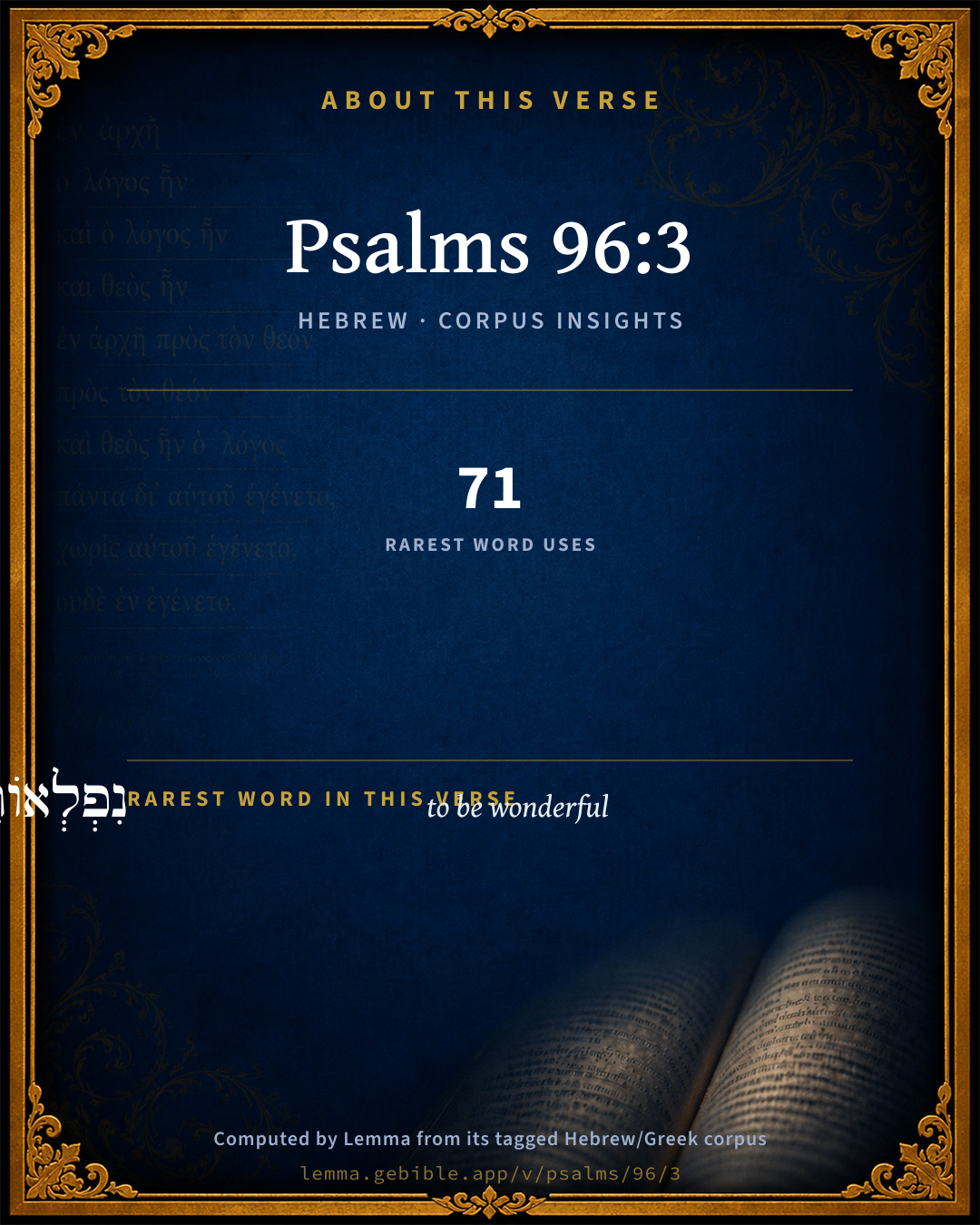
Psalms 96:3

Hebrew (Westminster Leningrad Codex) Psalms 96:3 appears in the Hebrew Old Testament. The text above is from the Westminster Leningrad Codex. Each word links to its Strong’s number, a concise gloss, and parsing drawn from the Open Scriptures Hebrew Bible morphology. Click any word for its full Brown-Driver-Briggs (BDB) entry.
Download image
Cite this verse

Psalms 96:3 (World English Bible). Public Domain. Lemma interlinear Bible study tool, https://lemma.gebible.app/v/psalms/96/3.

Show BibTeX & RIS
BibTeX
RIS
English Translation
Declare his glory among the nations, His marvelous works among all the peoples.
World English Bible · Public Domain
Download a study sheet

One document with this verse’s original text, its word-by-word gloss line, the meaning frame, cross-references with their text, attributed commentary, and full source and license credits — printable, and it pastes into notes with its structure intact.

This verse Autodidact and up

Study sheet (.html) Plain text (.txt)

A passage Seminary Student

Up to 50 verses in one chapter. A passage sheet keeps up to 6 commentary sources and 12 cross-references per verse, in the order this page ranks them, and says so on the sheet whenever that leaves anything out. Ask for a single verse and you get the Autodidact verse sheet above.

Everything on this page stays free to read, with no account — the sheet is a download of what is already on screen, not access to it.

Want to remove ads? Support Godless Engineer
Compare translations 3

The same verse in 3 English versions, stacked beneath the original-language interlinear above. Click any original word for its lexicon entry.

Each is an independent rendering of the whole verse — the interlinear is not word-aligned to these translations.

Highlighted words mark where these versions differ — a whole-verse word diff, not a word-by-word alignment.

  • World English Bible Public Domain
    Declare his glory among the nations, His marvelous works among all the peoples.
  • King James Version Public Domain
    Declare his glory among the heathen, his wonders among all people.
  • unfoldingWord Literal Text CC BY-SA 4.0
    Recount his glory among the nations, his marvelous deeds among all the peoples.

unfoldingWord Literal Text — © unfoldingWord, licensed CC BY-SA 4.0. Word-aligned USFM3 via Door43 (git.door43.org/unfoldingWord/en_ult).

Versions to compare (up to 4)

3 of 4 selected

Show all 18 translations

Every available English version of this verse, each an independent rendering of the whole verse.

  • World English Bible Public Domain
    Declare his glory among the nations, His marvelous works among all the peoples.
  • Berean Standard Bible Public Domain
    Declare His glory among the nations, His wonderful deeds among all peoples.
  • Majority Standard Bible Public Domain
    Declare His glory among the nations, His wonders among all peoples.
  • King James Version Public Domain
    Declare his glory among the heathen, his wonders among all people.
  • American Standard Version (1901) Public Domain
    Declare his glory among the nations, His marvellous works among all the peoples.
  • Revised Version (1885) Public Domain
    Declare his glory among the nations, his marvelous works among all the peoples.
  • Geneva Bible (1599) Public Domain
    Declare his glory among all nations, and his wonders among all people.
  • Douay-Rheims (1899) Public Domain
    Declare his glory among the Gentiles: his wonders among all people.
  • Young's Literal Translation Public Domain
    Declare among nations His honour, Among all the peoples His wonders.
  • Literal Standard Version CC BY-SA 4.0
    Declare His glory among nations, || His wonders among all the peoples.
  • Unlocked Literal Bible CC BY-SA 4.0
    Declare his glory among the nations, his marvelous deeds among all the nations.
  • unfoldingWord Literal Text CC BY-SA 4.0
    Recount his glory among the nations, his marvelous deeds among all the peoples.
  • Darby Bible Public Domain
    Declare his glory among the nations, his wondrous works among all the peoples.
  • World Messianic Bible Public Domain
    Declare his glory among the nations, his marvelous works among all the peoples.
  • Webster's Bible Public Domain
    Declare his glory among the heathen, his wonders among all people.
  • Free Bible Version CC BY-SA 4.0
    Declare his glorious acts among the nations, the amazing things he does among all peoples.
  • Bible in Basic English Public Domain
    Make clear his glory to the nations, and his wonders to all the peoples.
  • JPS Tanakh (1917) Public Domain
    Declare His glory among the nations, His marvellous works among all the peoples.

Literal Standard Version (2020), Covenant Press — licensed CC BY-SA 4.0. Text via the HelloAO Bible API (eBible.org). Unlocked Literal Bible (unfoldingWord) — licensed CC BY-SA 4.0. Text via the HelloAO Bible API (eBible.org). unfoldingWord Literal Text — © unfoldingWord, licensed CC BY-SA 4.0. Word-aligned USFM3 via Door43 (git.door43.org/unfoldingWord/en_ult). Free Bible Version, Dr. Jonathan Gallagher — licensed CC BY-SA 4.0. Text via the HelloAO Bible API (eBible.org).

Word by word

More ways to search: Search by grammar → Find every occurrence → Compare this word →

Practice this passage: Drill this verse → Learn its vocabulary →

נִפְלְאוֹתָֽיו
pâlâʼ
H6381
“being wonderful · him”
Verb, Niphal, Participle Active, Feminine, Plural, Construct + Suffix, Personal, 3rd Person, Masculine, Singular
Part of Speech
Verb
Stem
Niphal
Form
Participle Active
Gender
Feminine
Number
Plural
State
Construct
Full BDB Definition

Origin: a primitive root

TWOT: 1768

to be marvellous, be wonderful, be surpassing, be extraordinary, separate by distinguishing action - (Niphal) - to be beyond one's power, be difficult to do - to be difficult to understand - to be wonderful, be extraordinary - marvellous (participle) - (Piel) to separate (an offering) - (Hiphil) - to do extraordinary or hard or difficult thing - to make wonderful, do wondrously - (Hithpael) to show oneself wonderful or marvellous
  1. סַפְּר֣וּ çâphar H5608 “count” Verb, Piel, Imperative, 2nd Person, Masculine, Plural
  2. בַגּוֹיִ֣ם gôwy H1471 “in/at the · nations” Preposition, Determined + Noun, Common, Masculine, Plural, Absolute
  3. כְּבוֹד֑וֹ kâbôwd H3519 “glory · his” Noun, Common, Both, Singular, Construct + Suffix, Personal, 3rd Person, Masculine, Singular
  4. בְּכָל kôl H3605 “in/at · all of” Preposition + Noun, Common, Masculine, Singular, Construct
  5. הָֽ֝עַמִּ֗ים ʻam H5971 “the · peoples” Particle, Definite Article + Noun, Common, Masculine, Plural, Absolute

About this verse

These counts appear in no published source. They are computed here, from the morphology-tagged text and Lemma’s own curated glosses. What Lemma adds →

6
words
6
distinct lemmas
Wisdom
section

Grammatical profile

  • 2 verbs
  • 4 nouns

Verb forms

  • סַפְּר֣וּ Piel · Imperative
  • נִפְלְאוֹתָֽיו Niphal · Participle Active

Hebrew & Septuagint length

In English translation the verse runs 13 words from the Hebrew and 12 from the Septuagint (LXX English) — closely comparable.

A rough comparison of the two English renderings, which tokenize alike — not a word-level alignment.

Word counts can differ between the Hebrew and the Greek without any difference in meaning — e.g. the Hebrew direct-object marker אֵת has no separate Greek word, and Greek often adds the article ὁ.

Cross-references

12

Topical passages linked to Psalms 96:3 in the Treasury of Scripture Knowledge — connected by theme and wording, ordered by reader-vote popularity; previews shown in the World English Bible.

  • Psalms 22:27 All the ends of the earth shall remember and turn to Yahweh. All the relatives of the nations shall worship before you.
  • Daniel 4:1–3 Nebuchadnezzar the king, to all the peoples, nations, and languages, who dwell in all the earth: Peace be multiplied to you.
  • Luke 24:47 and that repentance and remission of sins should be preached in his name to all the nations, beginning at Jerusalem.
  • Isaiah 19:23–25 In that day shall there be a highway out of Egypt to Assyria, and the Assyrian shall come into Egypt, and the Egyptian into Assyria; and the Egyptians shall worship with the Assyrians.
  • Isaiah 49:6 yes, he says, It is too light a thing that you should be my servant to raise up the tribes of Jacob, and to restore the preserved of Israel: I will also give you for a light to the Gentiles, that you may be my salvation to the end of the earth.
  • Psalms 72:18–19 Praise be to Yahweh God, the God of Israel, Who alone does marvelous deeds.
  • Psalms 117:1–2 Praise Yahweh, all you nations! Extol him, all you peoples!
  • Micah 4:2 Many nations will go and say, "Come, and let us go up to the mountain of Yahweh, And to the house of the God of Jacob; And he will teach us of his ways, And we will walk in his paths." For out of Zion will go forth the law, And the word of Yahweh from Jerusalem;
  • Zechariah 9:10 I will cut off the chariot from Ephraim, And the horse from Jerusalem; And the battle bow will be cut off; And he will speak peace to the nations: And his dominion will be from sea to sea, And from the River to the ends of the earth.
  • Matthew 28:19 Therefore go, and make disciples of all nations, baptizing them in the name of the Father and of the Son and of the Holy Spirit,
  • Daniel 6:26–27 I make a decree, that in all the dominion of my kingdom men tremble and fear before the God of Daniel; for he is the living God, and steadfast forever, His kingdom that which shall not be destroyed; and his dominion shall be even to the end.
  • Revelation 14:6–7 I saw an angel flying in mid heaven, having an eternal Gospel to proclaim to those who dwell on the earth, and to every nation, tribe, language, and people.

Cross-references courtesy of OpenBible.info (CC BY 4.0).

Hebrew and Greek witnesses Masoretic Hebrew ↔ Greek Septuagint

The same verse in the two great witnesses to the Old Testament, shown verse-for-verse.

You’re reading Greek Psalm 95 (Hebrew Psalm 96). The Septuagint counts the superscription, so verse numbers can differ from the Hebrew — chapter-level alignment, not verse-by-verse. Numbering follows Rahlfs.

These are two independent witnesses, not word-aligned to each other, and the Septuagint is shown in lemma (dictionary) form.

Hebrew Psalms 96:3 Masoretic · Westminster Leningrad Codex

סַפְּר֣וּ בַגּוֹיִ֣ם כְּבוֹד֑וֹ בְּכָל הָֽ֝עַמִּ֗ים נִפְלְאוֹתָֽיו

Declare his glory among the nations, His marvelous works among all the peoples.

World English Bible · Public Domain

Greek LXX Greek Psalm 95:3 Septuagint · lemma form

ἀναἀγγέλλω ἐν ὁ ἔθνος ὁ δόξα αὐτός ἐν πᾶς ὁ λαός ὁ θαυμάσιος αὐτός

Publish his glory among the Gentiles, his wonderful works among all people.

LXX2012 (modern English Septuagint) · Public Domain

Hebrew: Westminster Leningrad Codex (CC BY 4.0). Greek: Septuagint (public domain); English from LXX2012 (modern English Septuagint) (Public Domain). How the Septuagint differs from the Hebrew →

Commentary

Notes on Psalms 96:3 from classic Christian and Jewish commentators (each source and its license shown beneath its notes). The classic Christian expositions comment on the surrounding passage and are grouped to its opening verse, so a note may address several verses; the Jewish commentaries on the Tanakh (Rashi and others) are per-verse, so they appear only where the commentator wrote on this verse.

Lemma curates 59 commentaries, every one of them public domain or Creative Commons licensed, each selected and text-cleaned for this edition rather than reprinted as found. About our sources →

Trapp's Complete Commentary

John Trapp

Psa 96:3 Declare his glory among the heathen, his wonders among all people.

Ver. 3. Declare his glory] Heb. Cipher it up in the particulars, that God be no loser by you.

His wonders among all people] There is a world of wonders in the work of man’s redemption by Christ; and all other mercies meet in this, as the lines in the centre, streams in the fountain.

John Trapp, A Commentary or Exposition upon All the Books of the Old and New Testament (1647–1656) — public domain. Text from a community e-Sword module.

J. A. Alexander on Psalms

Joseph Addison Alexander

3. (Psa 96:3) Recount among the nations his glory, among all the peoples his wonders. The use of glory, to denote the special manifestation of God's attributes, is a characteristic feature of Isaiah's later prophecies. To preclude all doubt as to the extent of the invitation, the ambiguous expression all the earth, in ver. 1, is here explained to mean the nations, and then still more absolutely all the peoples. The only variation of the parallel passage (1Ch 16:24) is the insertion of the objective particle in the first clause.

Joseph Addison Alexander, The Psalms Translated and Explained (1850) — public domain. Text from a community e-Sword module.

Adam Clarke's Commentary

Verse 3. Declare his glory among the heathen.] The heathen do not know the true God: as his being and attributes are at the foundation of all religion, these are the first subjects of instruction for the Gentile world. Declare, ספרו sapperu, detail, number out his glory, כבודו kebodo, his splendour and excellence.

His wonders among all people.] Declare also to the Jews his wonders, נפלאותיו niphleothaiv, his miracles. Dwell on the works which he shall perform in Judea. The miracles which Christ wrought among the Jews were full proof that he was not only the Messiah, but the mighty power of God.

Adam Clarke's Commentary on the Bible (1810–1826) — public domain. Text from a community e-Sword/MySword module.

John Calvin's Commentaries

3 Declare his glory among the heathen Additional terms are adduced to commend the salvation spoken of. It is called his glory and his wonders; which is equivalent to saying that it was glorious and admirable. By such titles the Psalmist would distinguish it from any deliverances which had formerly been granted, as indeed there can be but one opinion, that when God appeared as Redeemer of all the world, he gave a display of his mercy and of his favor, such as he never vouchsafed before. This salvation it was impossible, as I have said, that the Gentile nations could have celebrated, had they been left without it. The words teach us that we can never be said to have rightly apprehended the redemption wrought out by Christ, unless our minds have been raised to the discovery of something incomparably wonderful about it.

John Calvin's Commentaries (1540-1563) — public domain. Text from the Calvin Translation Society English edition (1840s-50s) via the Christian Classics Ethereal Library (ccel.org). Calvin's coverage is partial (roughly two-thirds of the Bible); uncommented books and verses are honest gaps, never fabricated. The 19th-century editor's footnotes and remarks are omitted so the notes are faithfully Calvin's own voice.

The Cambridge Bible for Schools and Colleges

gen. ed. J. J. S. Perowne

3. Tell of his glory among the nations,

His marvellous works among all the peoples.

Cp. Isa_66:18; and see note on Psa_9:1.

The Cambridge Bible for Schools and Colleges (gen. ed. J. J. S. Perowne; Cambridge University Press, 1878–1918) — public domain. Text from a community e-Sword module.

John Gill's Exposition

Declare his glory among the Heathen,.... What a glorious Person the Messiah is; the brightness of his Father's glory; having all the perfections of deity in him; how the glory of God appears in him, and in all that he has done; and especially in the work of redemption, in which the glory of divine wisdom, power, justice, truth, and faithfulness, love, grace, and mercy, is richly displayed; say what glory he is advanced unto, having done his work, being highly exalted, set at the right hand of God, and crowned with glory and honour; and what a fulness of grace there is in him, for the supply of his people; and what a glory is on him, which they shall behold to all eternity:

his wonders among all people: what a wonderful person he is, God manifest in the flesh; what wonderful love he has shown in his incarnation, obedience, sufferings, and death; what amazing miracles he wrought, and what a wonderful work he performed; the work of our redemption, the wonder of men and angels; declare his wonderful resurrection from the dead, his ascension to heaven, sitting at the right hand of God, and intercession for his people; the wonderful effusion of his Spirit, and the conquests of his grace, and the enlargement of his kingdom in the world; as also what wonders will be wrought by him when he appears a second time; how the dead will be raised and all will be judged.

John Gill's Exposition of the Whole Bible (1746–1763) — public domain (CC PDM 1.0). Text via the HelloAO Bible API.

Albert Barnes' Notes on the Bible

Declare his glory among the heathen - Among the nations; the people who are not Hebrews. The meaning is, Let it be proclaimed in all lands, among all people. Let it not be confined to those who are professedly his people, but let it be announced everywhere. This is copied literally from 1Ch 16:24.

His wonders among all people - His “marvelous works;” those things which are suited to produce astonishment in the mind. The reference is to those works and doings of God which lie so far beyond the power of any created being, and which by their vastness, their wisdom, and their benevolence, are suited to produce a deep impression on the human mind.

Albert Barnes' Notes on the Bible (1834–1885) — public domain. Text from a community e-Sword/MySword module.

Matthew Poole's English Annotations

You who shall be called out of all the heathen nations to the knowledge of God and Christ, publish this glorious and wonderful work amongst all the heathen nations to whom you belong or may come.

Matthew Poole's English Annotations on the Holy Bible (1683–1685) — public domain. Text from a community e-Sword/MySword module.

The Treasury of David

Charles H. Spurgeon

Ver. 3. Declare his glory among the heathen. His salvation is his glory, the word of the gospel glorifies him; and this should be published far and wide, till the remotest nations of the earth have known it. England has spent much blood and treasure to keep up her own prestige among barbarians; when will she be equally anxious to maintain the honour of her religion, the glory of her Lord? It is to be feared that too often the name of the Lord Jesus has been dishonoured among the heathen by the vices and cruelties of those who call themselves Christians; may this fact excite true believers to greater diligence in causing the gospel to be proclaimed as with a trumpet in all quarters of the habitable globe.

His wonders among all people. The gospel is a mass of wonders, its history is full of wonders, and it is in itself far more marvellous than miracles themselves. In the person of his Son the Lord has displayed wonders of love, wisdom, grace, and power. All glory be unto his name; who can refuse to tell out the story of redeeming grace and dying love? All the nations need to hear of God's marvellous works; and a really living, self denying church would solemnly resolve that right speedily they fill shall hear thereof. The tribes which are dying out are not to be excluded from gospel teaching any more than the great growing families which, like the fat kine of Pharaoh, are eating up other races: Red Indians as well as Anglo Saxons are to hear of the wonders of redeeming love. None are too degraded, none too cultured, none too savage, and none too refined.

Ver. 3. Declare. The corresponding word is a book;and the participle is often rendered a scribe, a writer. Ps 45:1. The verb is rendered, tell, show forth, declare. The variety of verbs used in Ps 96:1-3, proves that we are to employ all proper means for making known the Saviour. One of these methods is by writing. W. S. Plumer.

Ver. 3. Declare his glory what a glorious person the Messiah is; the brightness of his Father's glory; having all the perfections of Deity in him; how the glory of God appears in him, and in all that he has done; and especially in the work of redemption, in which the glory of divine wisdom, power, justice, truth, and faithfulness, love, grace, and mercy, is richly displayed; say what glory he is advanced unto, having done his work, being highly exalted, set at the right hand of God, and crowned with glory and honour, and what a fulness of grace there is in him, for the supply of his people; and what a glory is on him, which they shall behold to all eternity. John Gill.

Ver. 3. His glory shines from every ray of light that reaches us from a thousand stars; it sparkles from the mountain tops that reflect the earliest and retain the last rays of the rising and the setting sun; it spreads over the expanse of the sea, and speaks in the murmur of its restless waves; it girdles the earth with a zone of light, and flings over it an aureole of beauty. In the varied forms of animal tribes; in the relations of our world to other worlds, in the revolutions of planets, in the springing of flowers, in the fall of waters, and in the flight of birds; in the sea, the rivers, and the air; in heights and depths, in wonders and mysteries, Christ wears the crown, sways the sceptre, and receives from all a tribute to his sovereignty. We cannot augment it; we cannot add one ray of light to the faintness of a distant star nor give wings to an apterous insect, nor change a white hair into black. We can unfold, but not create; we can adore, but not increase; we can recognise the footprints of Deity, but not add to them. John Cumming in "From Patmos to Paradise, "1873.

Ver. 3. Declare his glory among the heathen, etc. It is a part of the commission given to the ministers of the gospel, not only to teach their congregations concerning Christ, but also to have a care that they who never did hear of him, may know what he is, what he hath done and suffered, and what good may be had by his mediation. Nothing so glorious to God, nothing so wonderful in itself, as is the salvation of man by Christ; to behold God saving his enemies by the incarnation, sufferings, and obedience of Christ the eternal Son of God: Declare his glory among the heathen, his wonders among all people. David Dickson.

Ver. 3. Declare his glory. It is his glory which should be proclaimed, not the learning, ability, and eloquence of the orator who professes to speak for Him; it is his glory, the loving beauty, the attractiveness of his gospel, the lavish promises to repentant sinners, the blessedness of heaven, which should be the chief themes of discourse; not threats, menaces, sermons on hell or torment to affright men, and at best make them God's trembling slaves, not his loving friends. The preaching is to be unto all people, in obscure country districts, amongst unpolished and illiterate congregations, and not to be confined, as fashionable preachers like to confine it, to the cultivated and critical audiences of the capital. Hugo, quoted by Neale and Littledale.

Ver. 3. His glory. What he had before called salvation, he now names glory, and afterwards wonders. And since this salvation, whereby the human race is redeemed from eternal death and damnation, is glorious and full of wonders, it is therefore worthy of admiration and praise. Mollerus.

Ver. 3. His wonders. What a wonderful person he is, for he is God manifest in the flesh; what wonderful love he has shown in his incarnation, obedience, sufferings, and death; what amazing miracles he wrought, and what a wonderful work he performed; the work of our redemption, the wonder of men and angels; declare his wonderful resurrection from the dead, his ascension to heaven, sitting at the right hand of God, and intercession for his people; the wonderful effusion of his Spirit, and the conquests of his grace, and the enlargement of his kingdom in the world; as also what wonders will be wrought by him when he appears a second time; how the dead will be raised and all will be judged. John Gill.

Ver. 3 (first clause).

1. Declare among the heathen the glory of God's perfections, that they may acknowledge him as the true God.

2. Declare the glory of his salvation, that they may accept him as their only Redeemer.

3. Declare the glory of his providence, that they may confide in him as their faithful guardian.

4. Declare the glory of his word, that they may prize it as their chief treasure.

3. Declare the glory of his service, that they may choose it as their noblest occupation.

4. Declare the glory of his residence, that they may seek it as their best home. William Jackson.

Verse 3.

1. What the gospel is, "God's glory, ""his wonders."

2. What shall we do with itdeclare it.

3. To whom. "Among the heathen, "all people.

Ver. 3 (last clause). His wonders among the people.

1. The wonders of his Being, to inspire them with awe.

2. The wonders of his creation, to fill them with amazement.

3. The wonders of his judgments, to restrain them with fear.

4. The wonders of his grace, to allure them with love. W. Jackson.

Psalms 96:4*

Charles H. Spurgeon's The Treasury of David (1869–1885) — public domain. Psalms only. Text from a community e-Sword/MySword module.

The Pulpit Commentary

Declare his glory among the heathen. Publish God"s praise, not only in Israel, but to the ends of the earth. Let all mankind hear the joyful news. (comp. Psa_2:8 Psa_47:1, 8 138:4) His wonders among all people; rather, among all the peoples; i.e. "all the nations of the earth" (see ver. 7).

The spirit of missionary work.

Amongst the brighter signs of the times in which we live must be reckoned the universal anxiety, now in so many ways manifested, on the part of Christian people for the spread of the message of Christ"s salvation both at home and abroad. The whole psalm overflows with thankfulness and delight, and in it is found this summons to missionary work. Now, in a human composition we should say that it was unskilled and lacking in true art if there were introduced an idea which marred the unity of the whole, which was out of harmony with its spirit and incongruous with its main intent. But in an inspired composition like this psalm we can be quite sure that there would be no such incongruity. But then it follows that this summons to missionary service must be in keeping with the spirit of this psalm, or it would not be found where it is. Therefore we note

I THE SPIRIT OF SONG IS IN HARMONY WITH MISSIONARY SERVICE. For think of what this service is. It is:

1. To preach. Not to amuse by gaudy ceremonial. Men are not so won to Christ. And not to conjure as by mystic sacramental grace. But to preach. This is what Christ commanded, what the text bids, what such as Paul gloried in, what God ever blesses. And it is a joyful service. True preachers own this as they feel that those to whom they speak are moved and touched, and are conscious in their own souls of the inspiration of their theme a theme with which none other can compare. For:

2. It is to preach God"s salvation. That which the text calls "his glory," "his wonders." Now, we know how pleasant it is to be the bearer of happy tidings say, to a distressed household, a heart trembling with fear. And such is the work of the preacher of the salvation of God. He goes to the consciously guilty, and tells them of free forgiveness in Christ; to the sin enslaved, and tells them of complete deliverance from the accursed tyranny under which they groan; to the Sorrow-stricken, and tells them of him who shall wipe away all tears; to the dying, and tells them of him who, when he had overcome the sharpness of death, opened the kingdom of heaven to all believers. Such is the missionary"s joyous task.

3. And to preach this to all. None are to be left out. One who had been the means of rescuing many from a watery grave through the breaking of a sheet of ice on which they had been joyously skating, tells how all his joy was marred by the fact that he had been compelled to leave many unsaved. So if we were limited, and not suffered to go to all with the glad tidings of God"s salvation, we should feel our joy marred indeed. But because it is for all, therefore is our joy great.

4. Thus he is a coworker with Christ. In fellowship with him. This is an enhancement of the gladness of the work. A regiment is honoured by distinction won by one of its soldiers; a whole family, if one member wins high place. How much more the missionary when Christ is coworker with him! And:

5. It is a work which has not been in vain. What glorious results have been achieved! what trophies won! Therefore we say this service is in harmony with glad song.

II AND THIS SPIRIT OF GLAD SONG IS NEEDED FOR SUCH SERVICE. For:

1. Men will not care for that which, so far as they can see, does you little or no good. But when they see that the faith of Christ is the sunshine of our lives, then they will more ready to believe. Do we let men see this? And:

2. It alone is strong enough for the work. Let me tell you a parable. There was a tyrant who sought to oppress the inhabitants of a certain land. The better to do this he built a strong castle, built it deep and high, and placed it at the entrance of a valley which led to the land he sought to oppress. A little stream ran along that valley near the foundation of his fortress; but he heeded not that, sure it could do no harm. Many who loved that land felt very sad as they saw the oppressor"s power; but yet they hoped that somehow his power would be overthrown. And so it came to pass. The summer went on and the autumn rains came, and the little rivulet became a rapid stream, and began to gnaw away at the foundations of that grim castle; but it could not do much harm. But the winter storms came, and the stream swelled into a strong river, and began to be dangerous to the tyrant"s fortress, so that he, at length, did feel fear. But matters grew worse; the winter was over, and the snow high up on the mountains which shut in the valley began to melt, and the river went on increasing in its might till, one wild night, the great reservoirs of waters that had been gathering all the winter through suddenly burst, and with a rush and a roar raged all down the valley, the waters bearing with them a vast mass of timber, stones, trees, earth, and all kinds of material; and they came down upon the tyrant"s castle and overwhelmed it, sapping its foundations and tearing down its walls till it had perished out of sight. Such the parable. The interpretation is not far to seek. Heathendom is that fortress, and the prince of darkness he who built it. The rill, the stream, the river, the torrent, represent respectively the force of the motives which assail the strength of heathendom. The sense of fear, of duty, of pity, of glad joy in God. It is this last which alone avails; the others do but little, though some much more than the rest. "The joy of the Lord is our strength.

III THE SPIRIT OF SONG SHALL BE GIVEN TO THOSE WHO ENGAGE IN THIS SERVICE. For joy comes in the service of the Lord true joy. Be not content until you know this joy, for not till then will you effectually serve. S.C.

The law of Christian missions.

The "heathen" of the Old Testament match the "Gentiles" of the New Testament. "Gentiles," as our Lord used the term, means "those who do not know of God as the Father in heaven." And "heathen" means "those who do not know God as the One, the Spiritual, and the Holy." But in referring such an expression as this to missions, we are using for our purpose the language, not precisely discerning the psalmist"s meaning. In desiring that God"s glory should be declared among the heathen, the returned exile did not think of, or wish for, the conversion of the heathen to the faith and service of Jehovah. He only wanted everybody to know of his new liberty and dignity, and of the great things his God was doing for him. It was as if Englishmen went everywhere to tell what great things God had done, and was doing, for England. Active effort to convert the world to Judaism has never been made, and is not being made now. The truly missionary idea is introduced by Christianity. There is a sense in which the exclusiveness of the Jews was broken down by the Captivity. Jews were then scattered over the earth; but they were only silent missionaries wherever they went. They witnessed for Jehovah by what they were, rather than by what they said. Wherever they went they found a sort of belief in one God, clouded over by an active belief in many gods. This is the characteristic of all heathenism; and we too readily miss seeing the idea of one supreme God, which is really the root religious idea of man everywhere; the idea to which the higher revelation makes its appeal. The law of Christian missions, and missions in all ages, is this If any man has a higher and better view of God than his neighbour, he is bound to tell it to his neighbour.

I THE JEW HAD A BETTER VIEW OF GOD THAN HIS NEIGHBOURS. Take especially the Jew of the Restoration, to whom the primary truths concerning God seemed as if freshly revealed. He knew of three truths that are fundamental to right conceptions of God.

1. The unity of God.

2. The spirituality of God.

3. The holiness of God.

Show that these were higher views of God than were entertained in either Babylon or among the neighbouring Samaritans, Ammonites, etc. What responsibility, then, rested on the Jew, specially to show that good doctrine bears good fruit?

II THE CHRISTIAN HAS A BETTER VIEW OF GOD THAN HIS NEIGHBOURS. He knows God in the face of Jesus, through the Sonship of Jesus as the Father, as the Forgiver of sin, and as the Forgiver on the basis of one ever-acceptable sacrifice for sin. R.T.

The Pulpit Commentary (1880–1919), ed. H.D.M. Spence-Jones & Joseph S. Exell — public domain. Text from a community e-Sword module.

unfoldingWord translationNotes

Door43 World Missions Community

Declare his glory among the nations

"Tell all the people in every nation about his great glory"

Yahweh is great and is to be praised greatly

This can be translated in active form. AT: "Yahweh is great. Praise him greatly" or "Yahweh is great, and people should praise him greatly" (See: Active or Passive)

He is to be feared above all other gods

This can be translated in active form. AT: "Fear him above all other gods" (See: Active or Passive)

translationWords

declare

glory

nation

amazed

works

praise

fear

false god

unfoldingWord translationNotes — © Distant Shores Media and the Door43 World Missions Community, licensed CC BY-SA 4.0. Source: git.door43.org/Door43/en_tn.

Lesson kit

Teaching starters — assembled from the data on this page, not authored interpretation. Every prompt links to the verse data it draws on. Edit before teaching.

Psalms, in the Wisdom, opens this verse with 6 words (6 distinct Hebrew lemmas). Its most distinctive word is pâlâʼ (“to be wonderful”). A historical commentator’s framing appears above. Read the whole chapter for the surrounding context.

Discussion questions

  1. How does “to be wonderful” (pâlâʼ) shape what this verse is saying?
  2. Psalms 22:27 shares this passage’s theme. How do the two illuminate each other?
  3. These translations render this verse differently; the difference is in the English rendering, not the original. What questions does that raise?
  4. The verb «סַפְּר֣וּ» is Piel Imperative. How does its form color the action?
  5. Reading how Trapp's Complete Commentary and J. A. Alexander on Psalms read this verse, where do the two commentators agree and where do they part?

Things to notice

Reading settings

Reading text

Shown beneath each verse's original-language words.

Old Testament
Old Testament edition

Read the OT as the Masoretic Hebrew (MT) or the Greek Septuagint (LXX).

English shown for the Greek Septuagint (in the Hebrew ↔ Greek comparison).

Comparing translations? Open the Compare panel on any verse page to stack up to four side by side.