

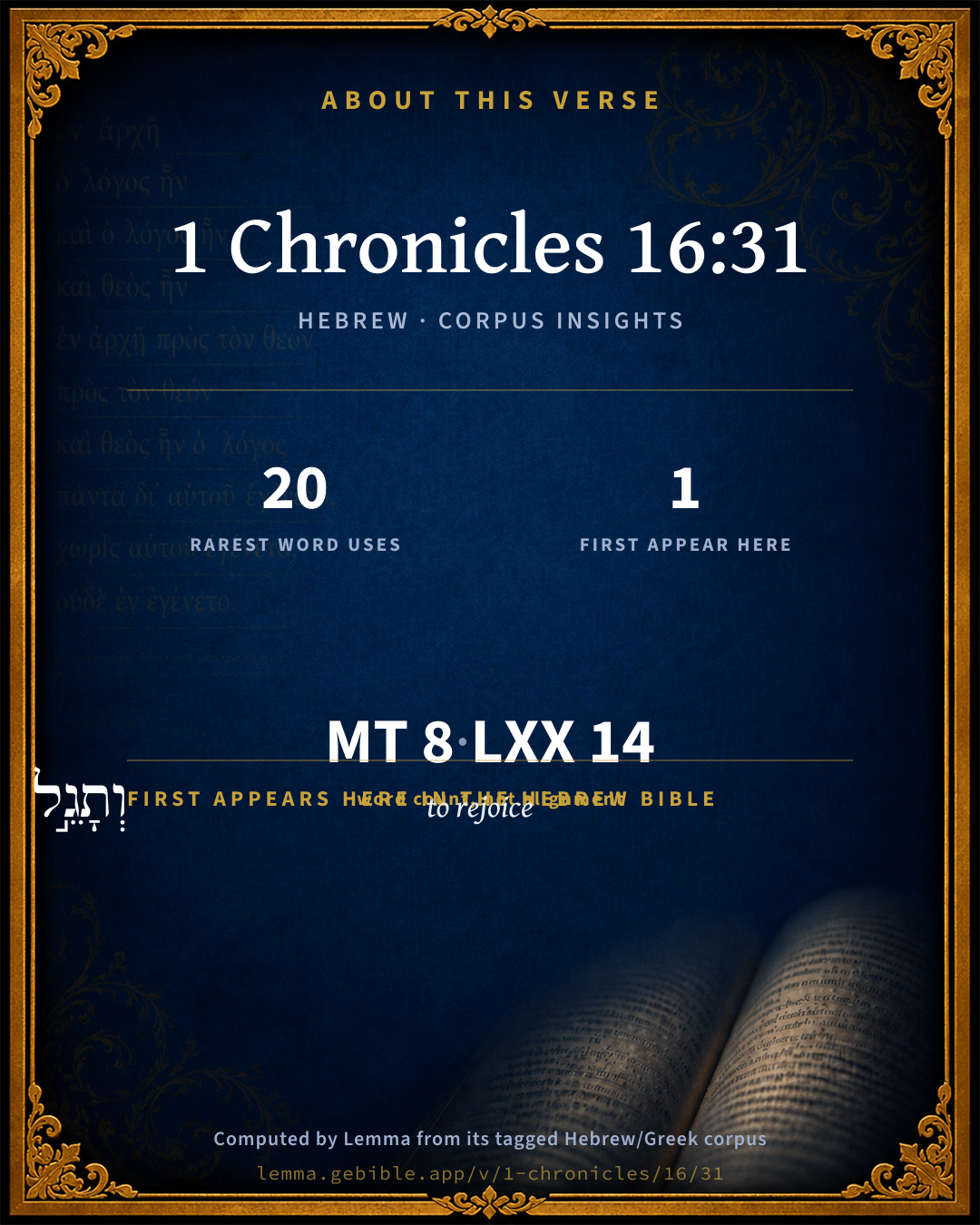
1 Chronicles 16:31

Hebrew (Westminster Leningrad Codex) 1 Chronicles 16:31 appears in the Hebrew Old Testament. The text above is from the Westminster Leningrad Codex. Each word links to its Strong’s number, a concise gloss, and parsing drawn from the Open Scriptures Hebrew Bible morphology. Click any word for its full Brown-Driver-Briggs (BDB) entry.
Download image
Cite this verse

1 Chronicles 16:31 (World English Bible). Public Domain. Lemma interlinear Bible study tool, https://lemma.gebible.app/v/1-chronicles/16/31.

Show BibTeX & RIS
BibTeX
RIS
English Translation
Let the heavens be glad, and let the earth rejoice; Let them say among the nations, Yahweh reigns.
World English Bible · Public Domain
Highlights
  • 1 first appearance in the Hebrew Bible
Full analysis ↓
Download a study sheet

One document with this verse’s original text, its word-by-word gloss line, the meaning frame, cross-references with their text, attributed commentary, and full source and license credits — printable, and it pastes into notes with its structure intact.

This verse Autodidact and up

Study sheet (.html) Plain text (.txt)

A passage Seminary Student

Up to 50 verses in one chapter. A passage sheet keeps up to 6 commentary sources and 12 cross-references per verse, in the order this page ranks them, and says so on the sheet whenever that leaves anything out. Ask for a single verse and you get the Autodidact verse sheet above.

Everything on this page stays free to read, with no account — the sheet is a download of what is already on screen, not access to it.

Want to remove ads? Support Godless Engineer
Compare translations 3

The same verse in 3 English versions, stacked beneath the original-language interlinear above. Click any original word for its lexicon entry.

Each is an independent rendering of the whole verse — the interlinear is not word-aligned to these translations.

Highlighted words mark where these versions differ — a whole-verse word diff, not a word-by-word alignment.

  • World English Bible Public Domain
    Let the heavens be glad, and let the earth rejoice; Let them say among the nations, Yahweh reigns.
  • King James Version Public Domain
    Let the heavens be glad, and let the earth rejoice: and let men say among the nations, The LORD reigneth.
  • unfoldingWord Literal Text CC BY-SA 4.0
    Let the heavens rejoice, and let the earth be glad, and let them say among the nations, “Yahweh reigns!”

unfoldingWord Literal Text — © unfoldingWord, licensed CC BY-SA 4.0. Word-aligned USFM3 via Door43 (git.door43.org/unfoldingWord/en_ult).

Versions to compare (up to 4)

3 of 4 selected

Show all 18 translations

Every available English version of this verse, each an independent rendering of the whole verse.

  • World English Bible Public Domain
    Let the heavens be glad, and let the earth rejoice; Let them say among the nations, Yahweh reigns.
  • Berean Standard Bible Public Domain
    Let the heavens be glad, and the earth rejoice. Let them say among the nations, ‘The LORD reigns!’
  • Majority Standard Bible Public Domain
    Let the heavens be glad, and the earth rejoice. Let them say among the nations, ‘The LORD reigns!’
  • King James Version Public Domain
    Let the heavens be glad, and let the earth rejoice: and let men say among the nations, The LORD reigneth.
  • American Standard Version (1901) Public Domain
    Let the heavens be glad, and let the earth rejoice; And let them say among the nations, Jehovah reigneth.
  • Revised Version (1885) Public Domain
    Let the heavens be glad, and let the earth rejoice; and let them say among the nations, The LORD reigneth.
  • Geneva Bible (1599) Public Domain
    Let the heauens reioyce, and let the earth be glad, and let them say among the nations, The Lord reigneth.
  • Douay-Rheims (1899) Public Domain
    Let the heavens rejoice, and the earth be glad: and let them say among the nations: The Lord hath reigned.
  • Young's Literal Translation Public Domain
    Also, established is the world, It is not moved! The heavens rejoice, and the earth is glad, And they say among nations: Jehovah hath reigned.
  • Literal Standard Version CC BY-SA 4.0
    The heavens rejoice, and the earth is glad, || And they say among nations, YHWH has reigned!
  • Unlocked Literal Bible CC BY-SA 4.0
    Let the heavens be glad, and let the earth rejoice; let them say among the nations, “Yahweh reigns.”
  • unfoldingWord Literal Text CC BY-SA 4.0
    Let the heavens rejoice, and let the earth be glad, and let them say among the nations, “Yahweh reigns!”
  • Darby Bible Public Domain
    Let the heavens rejoice, and let the earth be glad; And let them say among the nations, Jehovah reigneth!
  • World Messianic Bible Public Domain
    Let the heavens be glad, and let the earth rejoice! Let them say among the nations, “The LORD reigns!”
  • Webster's Bible Public Domain
    Let the heavens be glad, and let the earth rejoice: and let men say among the nations, The LORD reigneth.
  • Free Bible Version CC BY-SA 4.0
    Let the heavens sing for joy, let the earth be happy. Tell the nations, “The Lord is in charge!”
  • Bible in Basic English Public Domain
    Let the heavens have joy and let the earth be glad; let them say among the nations, The Lord is King.
  • JPS Tanakh (1917) Public Domain
    Let the heavens be glad, and let the earth rejoice; and let them say among the nations: 'The LORD reigneth.'

Literal Standard Version (2020), Covenant Press — licensed CC BY-SA 4.0. Text via the HelloAO Bible API (eBible.org). Unlocked Literal Bible (unfoldingWord) — licensed CC BY-SA 4.0. Text via the HelloAO Bible API (eBible.org). unfoldingWord Literal Text — © unfoldingWord, licensed CC BY-SA 4.0. Word-aligned USFM3 via Door43 (git.door43.org/unfoldingWord/en_ult). Free Bible Version, Dr. Jonathan Gallagher — licensed CC BY-SA 4.0. Text via the HelloAO Bible API (eBible.org).

Word by word

More ways to search: Search by grammar → Find every occurrence → Compare this word →

Practice this passage: Drill this verse → Learn its vocabulary →

About this verse

These counts appear in no published source. They are computed here, from the morphology-tagged text and Lemma’s own curated glosses. What Lemma adds →

8
words
8
distinct lemmas
Historical
section

Notable vocabulary

The rarest word here is יִשְׂמְח֤וּ joyful H8056 — appearing just 20 times in the whole Hebrew Bible.

First appearance in Scripture

This word makes its first canonical appearance in the Hebrew Bible here:

  • וְתָגֵ֣ל to rejoice H1523

Shared distinctive vocabulary

יִשְׂמְח֤וּ joyful H8056 occurs in 20 verses of the Hebrew Bible. Also found in:

Grammatical profile

  • 4 verbs
  • 4 nouns

Verb forms

  • יִשְׂמְח֤וּ Qal · Imperfect
  • וְתָגֵ֣ל Qal · Jussive
  • וְיֹאמְר֥וּ Qal · Imperfect
  • מָלָֽךְ Qal · Perfect

Hebrew & Septuagint length

In English translation the verse runs 18 words from the Hebrew and 19 from the Septuagint (LXX English) — closely comparable.

A rough comparison of the two English renderings, which tokenize alike — not a word-level alignment.

Word counts can differ between the Hebrew and the Greek without any difference in meaning — e.g. the Hebrew direct-object marker אֵת has no separate Greek word, and Greek often adds the article ὁ.

In the original languages it is 8 Hebrew tokens and 14 Greek tokens — but the two are counted differently (Hebrew bundles its prefixes and suffixes into one token; the Greek is in lemma form), so that isn’t a like-for-like length.

Cross-references

17

Topical passages linked to 1 Chronicles 16:31 in the Treasury of Scripture Knowledge — connected by theme and wording, ordered by reader-vote popularity; previews shown in the World English Bible.

  • Psalms 96:10 Say among the nations, "Yahweh reigns." The world is also established. It can't be moved. He will judge the peoples with equity.
  • Psalms 97:1 Yahweh reigns! Let the earth rejoice! Let the multitude of islands be glad!
  • Psalms 99:1 Yahweh reigns! Let the peoples tremble. He sits enthroned among the cherubim. Let the earth be moved.
  • Revelation 19:6 I heard something like the voice of a great multitude, and like the voice of many waters, and like the voice of mighty thunders, saying, "Hallelujah! For the Lord our God, the Almighty, reigns!
  • Psalms 93:1–2 Yahweh reigns! He is clothed with majesty! Yahweh is armed with strength. The world also is established. It can't be moved.
  • Psalms 98:4 Make a joyful noise to Yahweh, all the earth! Burst out and sing for joy, yes, sing praises!
  • Isaiah 49:13 Sing, heavens; and be joyful, earth; and break forth into singing, mountains: for Yahweh has comforted his people, and will have compassion on his afflicted.
  • Psalms 19:1 The heavens declare the glory of God. The expanse shows his handiwork.
  • Psalms 89:5 The heavens will praise your wonders, Yahweh; Your faithfulness also in the assembly of the holy ones.
  • Psalms 145:1 I will exalt you, my God, the King. I will praise your name forever and ever.
  • Psalms 148:1–4 Praise Yah! Praise Yahweh from the heavens! Praise him in the heights!
  • Isaiah 33:22 For Yahweh is our judge, Yahweh is our lawgiver, Yahweh is our king; he will save us.
  • Isaiah 44:23 Sing, you heavens, for Yahweh has done it; shout, you lower parts of the earth; break forth into singing, you mountains, O forest, and every tree therein: for Yahweh has redeemed Jacob, and will glorify himself in Israel.
  • Matthew 6:13 Bring us not into temptation, but deliver us from the evil one. For yours is the Kingdom, the power, and the glory forever. Amen.'
  • Luke 2:10 The angel said to them, "Don't be afraid, for behold, I bring you good news of great joy which will be to all the people.
  • Luke 2:13–14 Suddenly, there was with the angel a multitude of the heavenly host praising God, and saying,
  • Luke 15:10 Even so, I tell you, there is joy in the presence of the angels of God over one sinner repenting."

Cross-references courtesy of OpenBible.info (CC BY 4.0).

Hebrew and Greek witnesses Masoretic Hebrew ↔ Greek Septuagint

The same verse in the two great witnesses to the Old Testament, shown verse-for-verse.

These are two independent witnesses, not word-aligned to each other, and the Septuagint is shown in lemma (dictionary) form.

Hebrew 1 Chronicles 16:31 Masoretic · Westminster Leningrad Codex

יִשְׂמְח֤וּ הַשָּׁמַ֨יִם֙ וְתָגֵ֣ל הָאָ֔רֶץ וְיֹאמְר֥וּ בַגּוֹיִ֖ם יְהוָ֥ה מָלָֽךְ

Let the heavens be glad, and let the earth rejoice; Let them say among the nations, Yahweh reigns.

World English Bible · Public Domain

Greek LXX 1 Chronicles 16:31 Septuagint · lemma form

εὐφραίνω ὁ οὐρανός καί ἀγαλλιάομαι ὁ γῆ καί εἶπον ἐν ὁ ἔθνος κύριος βασιλεύω

Let the heavens rejoice, and let the earth exult; and let them say among the nations, The Lord reigns.

LXX2012 (modern English Septuagint) · Public Domain

Hebrew: Westminster Leningrad Codex (CC BY 4.0). Greek: Septuagint (public domain); English from LXX2012 (modern English Septuagint) (Public Domain). How the Septuagint differs from the Hebrew →

Commentary

Notes on 1 Chronicles 16:31 from classic Christian and Jewish commentators (each source and its license shown beneath its notes). The classic Christian expositions comment on the surrounding passage and are grouped to its opening verse, so a note may address several verses; the Jewish commentaries on the Tanakh (Rashi and others) are per-verse, so they appear only where the commentator wrote on this verse.

Lemma curates 59 commentaries, every one of them public domain or Creative Commons licensed, each selected and text-cleaned for this edition rather than reprinted as found. About our sources →

The Biblical Illustrator

Joseph S. Exell

1Ch_16:31

And let men say among the nations, the Lord reigneth.

Pessimism

I. Now, what is the prevalent tendency of opinion, as illustrated in our day, in science, in art, in journalism, in literature, in social speculation? It may certainly be summed up in the one word pessimism--that is, unbelief and hopelessness. The illustrations of the tendency are manifold, they come from every side. If we turn to philosophy, we find, as a consequence of unbelief, the revival of the old doctrine that life is not worth living, that man is a failure, just as Pyrrho, the ancient sceptic, compared mankind to swine pent up in a foundering, wrecked, and rudderless vessel in the midst of a hurricane. Since the human race, says Schopenhauer, always tends from bad to worse, there is no prospect but ever-deepening confusion and wretchedness. Existence, says Von Hartmann, is unspeakably wretched, and society will grow worse and worse. More dreary, barren, base and ugly, said Carlyle, seem to me the aspects of this poor, diminished, quack world, doomed to speedy death, which he can only wish to be speedy. A wave of doubt, desolation, and despondency has passed over the world, says an English poet, Mr. Alfred Austin, in a lecture before the Royal Institution. One by one all the fondly cherished theories of life, society, and empire have been abandoned; we no longer seem to know whither we are marching, and many appear to think that we are travelling to perdition. This pessimistic spirit, he said, pervades all society and all thought.

II. I will speak mainly of the supposed connection of science with this pessimistic tendency. To science many attribute its growth and its spread. Science, says M. Zola, the French novelist, in his speech, hath emptied nations, and is incapable of re-peopling them; it has ravished happiness from our human souls, and is incapable of restoring it; in proportion as science advances the ideal slips away. Now I believe science to be beneficent, and I believe pessimism to be destructive, and, desiring to combat the predominant pessimism, I shall try to prove to you that science gives no ground for it at all. Science is part of revelation. Religion on one side is nothing but a knowledge of God, and science deepens our knowledge of God. Religion on the other side is nothing but morality. It is a good mind and a good life. There is not one law of morality which science does not repromulgate and emphasise in thunders louder than those of Sinai. Science is one of the Bibles of God by which, as St. Paul boldly says, the invisible things of Him are rendered visible; it is Gods revelation to the mind of man through the works of Nature, and whatever may be the voice in which God speak to us, it is impossible for Him to lie. If we are faithless, He abideth faithful; He is not able to deny Himself. The supposed antagonism between science and religion is merely due to the passion and ignorance of men. And science has been to men a boon unspeakable, an archangel of beneficence as well as an archangel of power. She has prolonged life, she has mitigated disease, she has minimised torture, she has exorcised superstitious terrors; she has given to feeble humanity the eyes of Argus and the arms of Briareus, she has opened to mens thoughts unimaginable realms of faerie, and has made fire, flood, and air the vassals of His will

III. Does science tend to unbelief? And it is not true that science leads to unbelief. Whose name stands first in the modern era of science? The name of Sir Isaac Newton. Was he an unbeliever? He was one of the whitest, purest, simplest, most believing souls that ever lived. Whose name stands first in science in our own generation? The name of Michael Faraday. Was he an atheist? His friend found him one day bathed in tears, and asked if he was ill. No, he said, it is not that; but pointing to his Bible, he said, While men have this blessed book to teach them, why will they go astray? It has been sometimes assumed that Charles Darwin was an unbeliever; yet he wrote in his book on the descent of man: The question whether there is a Creator and Ruler of the Universe has been answered in the affirmative by the highest intellects that ever lived. There have been scientific atheists, but such men have not been atheists as a necessary consequence of their science, but because they have committed the very fault which they scorn so utterly in priests: it is because they have tried to soar into the secrets of the Deity on the waxen wings of the understanding; it is because they have pushed their science to untenable conclusions and mingled it with alien inquiries. H unbelief were a necessary result of science, no benefit which science could possibly bestow could equipoise its curse, for religion means that by which the spirit of man can live. The destruction of religion would be first the triumph of despair, and next the destruction of morality. Once persuade man that he is no better than the beasts that perish, and he will live like the beasts that perish; he will cease to recognise the intangible grandeur of the moral law, and will abandon himself to the struggles of mad selfishness. All religion is based on three primary convictions, of God, of righteousness, and of morality, and these convictions science strengthens and does not destroy. (Dean Farrar.)

Gods rule the saints comfort

John Wesley used to say, I dare no more fret than curse and swear. A friend of his said, I never saw him fretful or discontented under any of his trials, and to be in the company of persons of this spirit always occasioned him great trouble. He said one day, To have persons around me murmuring and fretting at anything that happens is like having the flesh torn from my bones. I know that God sits upon the throne ruling all things! (R. Newton.)

The Biblical Illustrator, edited by Joseph S. Exell (c. 1880s–1900s) — public domain. Text from a community e-Sword module.

Geneva Bible (1599)

Geneva Bible translators

He exhorteth the dumb creatures to rejoice with him in considering the greatness of the grace of God.

Geneva Bible (1599) marginal notes — public domain. Text via Bolls.life.

Adam Clarke's Commentary

Verse 31. Let the heavens be glad] "Let the supreme angels be glad, and the inhabitants of the earth rejoice." - T. In this place the Targumist uses the Greek word αγγελοι, angels, in Hebrew letters thus, אנגלי angeley.

Adam Clarke's Commentary on the Bible (1810–1826) — public domain. Text from a community e-Sword/MySword module.

The Cambridge Bible for Schools and Colleges

gen. ed. J. J. S. Perowne

31. and let men say] Psa_96:10, say [ye]. The clause is displaced in Chron.; cp. note on 1Ch_16:30.

The Lord reigneth] i.e. the Lord is claiming His kingdom over the earth by coming to judge the earth; cp. 1Ch_16:33. Contrast Hab_1:14, where the prophet complains that Jehovah is not asserting Himself as ruler of men.

The Cambridge Bible for Schools and Colleges (gen. ed. J. J. S. Perowne; Cambridge University Press, 1878–1918) — public domain. Text from a community e-Sword module.

The Pulpit Commentary

God"s present reign.

Lord reigneth," or "Jehovah is king." David saw, in the restoration of the ark, a new and solemn resumption of his direct government by Jehovah; and of this glorious fact he bids the people make acknowledgment and render witness. Explain fully the Jewish conception of the theocracy, and show how it was connected with a present and abiding outward symbol at first the pillar-cloud, and then the ark. The importance of the theocratic idea, and the actual influence of it on mind and heart, depended on the differing religious dispositions of the people. To the worldly minded Jew it would be a vague notion, a sort of sublime, but impractical, philosophical conception a sort of hereditary national sentiment, and nothing more. To the truly spiritually minded man it was the first, most impressive, and most practical of all truths. It was the thought that put glorious meaning into commonplace life and labour. Life has its holy issues, and it might well have its shrouded mysteries, for "the Lord reigneth." This Jewish notion passes over into Christianity, and we realize Jehovah"s present spiritual reign in the administration of the Lord Jesus Christ. In the Maccabean times there was a tendency to lose the idea that "the Lord doth reign," and to substitute for it a phrase which indicated a great outlooking for a coming Deliverer and a golden age, "the Lord shall reign." And a similar evil tendency still affects the Christian Church; failing to realize Christ"s present rule, some sections of the Church keep looking on to some fancied near time, when Christ shall come again and take to himself his great power and reign. And the antidote is full and faithful teaching on the point of which the psalmist makes so much the present direct, and every way practical, present reign over the earth and the Church, of Jehovah, apprehended in the person of the Lord Jesus Christ. Keeping the present reign in Christ before our minds, it may be instructive to show

I THAT CHRIST"S LIFE ON EARTH HELPS OUR APPREHENSION OF THE REIGN. The reign of God the Spirit must ever seem to man an unreal, intangible thing, unless it can take some outward and material shape; and yet that shape and form must be such as will in no sense imperil the spiritual character of the reign. No merely human sovereignty could be satisfactory, for none could be worthy of that sublime royalty which it presumed to represent. Christ"s life on earth was the theocracy materialized for human apprehension. Our Lord"s humanity sets God before our thought in human terms and figures such as we can understand. And the kingship of Jesus was felt and acknowledged by friend and foe, wherever he went, and not exclusively by those disciples who knew him most intimately. His teaching was given "with authority;" his personal relations were a rule. It can be no wonder that people should cast their garments in his way, and wave palm branches, and shout, saying, "Hosanna to the King that cometh in the Name of the Lord!" His life is the earth-picture of the Divine reign over the hearts and lives of men.

II THAT CHRIST"S GLORY IN HEAVEN MAKES US REALIZE THE REIGN AS A SPIRITUAL REIGN. It takes all the merely carnal features out of it. The reign is such a one as our exalted, glorified, ascended, spiritual Lord and Saviour may have, who is "Lord of lambs the lowly, King of saints the holy." The risen, heavenly Christ we feel must have, as the sphere for his rule, not our bodily actions only, but our wills, our choices, our affections; gaining, as he must, his beginnings in our souls, and extending his holy authorities over all the relations we sustain.

Explain and impress how, in our common, everyday life, we can realize the theocratic conception, and practically live in the joy and impulse of being daily "in the great Taskmaker"s eye. R.T.

The Pulpit Commentary (1880–1919), ed. H.D.M. Spence-Jones & Joseph S. Exell — public domain. Text from a community e-Sword module.

Rashi

Rabbi Shlomo Yitzchaki (Rashi)

The heavens will rejoice and the earth will exult, and they will say among the nations, “The Lord has reigned” When a flesh and blood [monarch] reigns, all are sad, because they do not know whether he will judge harshly, but when the Holy One, blessed be He, will reign, the heavens and earth will rejoice, and all the upright will say, “Now the Lord has reigned,” for He has restored the Ark to us.

Rashi on the Tanakh — English translations: “The Judaica Press complete Tanach with Rashi, translated by A. J. Rosenberg” (CC BY 4.0); “Pentateuch with Rashi's commentary by M. Rosenbaum and A.M. Silbermann, 1929-1934” (public domain); “The Metsudah Tanach series, Lakewood, N.J” (CC BY 4.0); and “The Book of Joshua, Metsudah Publications, 1997” (CC BY 4.0). Text via Sefaria.

Lesson kit

Teaching starters — assembled from the data on this page, not authored interpretation. Every prompt links to the verse data it draws on. Edit before teaching.

1 Chronicles, in the Historical, opens this verse with 8 words (8 distinct Hebrew lemmas). Its most distinctive word is sâmêach (“joyful”). A historical commentator’s framing appears above. Read the whole chapter for the surrounding context.

Discussion questions

  1. What does “joyful” (sâmêach) contribute to the verse as a whole?
  2. The word “to rejoice” first appears here in Scripture. What is being introduced at this debut?
  3. Deuteronomy 16:15 shares the word «joyful» with this verse. How do the two illuminate each other?
  4. The translations on this page render this verse differently — a whole-verse word diff, not a word-by-word alignment. What might account for the different wordings?
  5. The verb «יִשְׂמְח֤וּ» is Qal Imperfect. How does its form color the action?
  6. Reading how The Biblical Illustrator and Geneva Bible (1599) read this verse, where do the two commentators agree and where do they part?

Things to notice

Reading settings

Reading text

Shown beneath each verse's original-language words.

Old Testament
Old Testament edition

Read the OT as the Masoretic Hebrew (MT) or the Greek Septuagint (LXX).

English shown for the Greek Septuagint (in the Hebrew ↔ Greek comparison).

Comparing translations? Open the Compare panel on any verse page to stack up to four side by side.