
Numbers 24:8

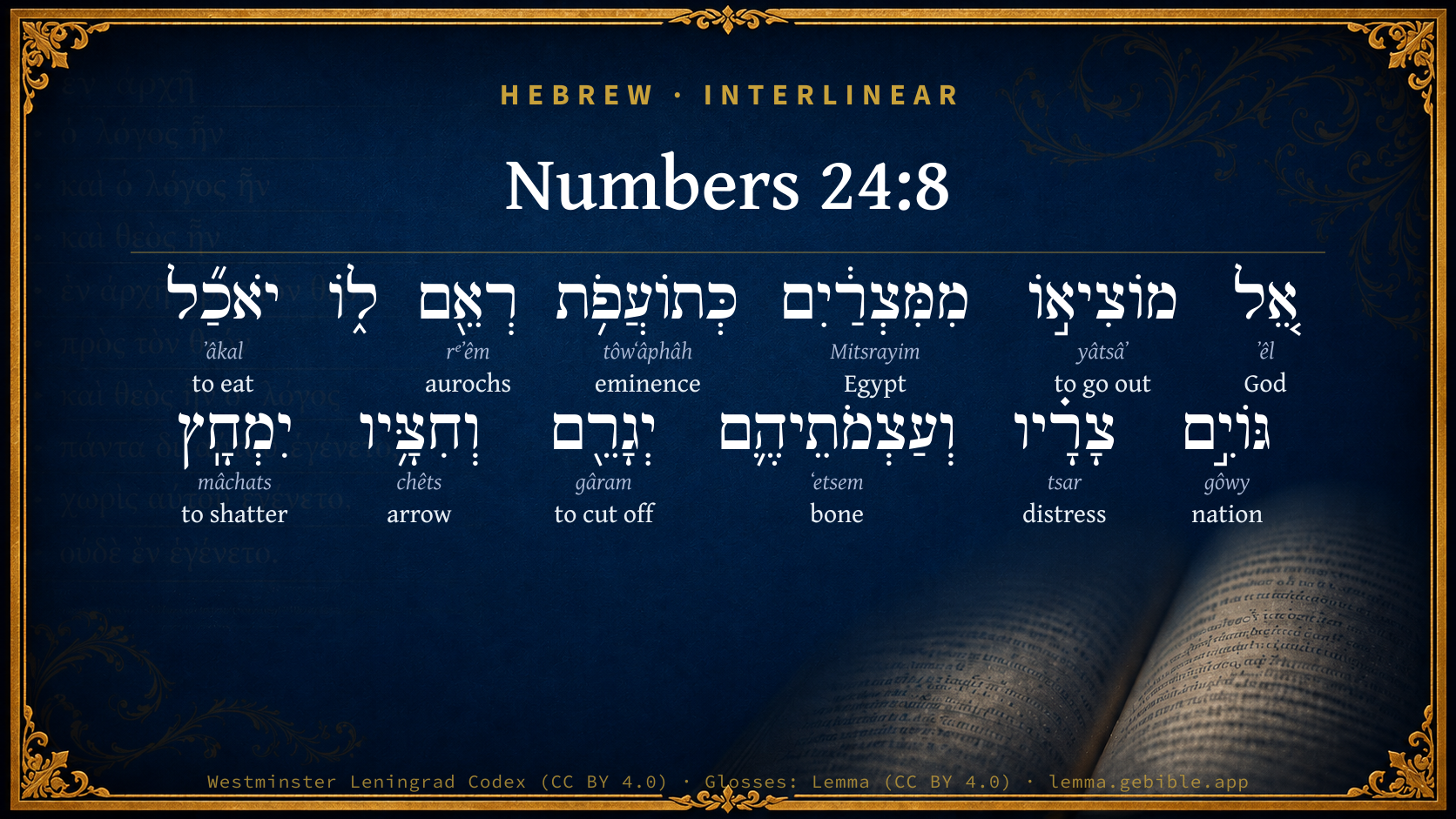
Hebrew (Westminster Leningrad Codex) Numbers 24:8 appears in the Hebrew Old Testament. The text above is from the Westminster Leningrad Codex. Each word links to its Strong’s number, a concise gloss, and parsing drawn from the Open Scriptures Hebrew Bible morphology. Click any word for its full Brown-Driver-Briggs (BDB) entry.
Download image
Cite this verse

Numbers 24:8 (World English Bible). Public Domain. Lemma interlinear Bible study tool, https://lemma.gebible.app/v/numbers/24/8.

Show BibTeX & RIS
BibTeX
RIS
English Translation
God brings him forth out of Egypt; He has as it were the strength of the wild-ox: He shall eat up the nations his adversaries, Shall break their bones in pieces, Smite [them] through with his arrows.
World English Bible · Public Domain
Highlights
  • 2 first appearances in the Hebrew Bible
Full analysis ↓
Download a study sheet

One document with this verse’s original text, its word-by-word gloss line, the meaning frame, cross-references with their text, attributed commentary, and full source and license credits — printable, and it pastes into notes with its structure intact.

This verse Autodidact and up

Study sheet (.html) Plain text (.txt)

A passage Seminary Student

Up to 50 verses in one chapter. A passage sheet keeps up to 6 commentary sources and 12 cross-references per verse, in the order this page ranks them, and says so on the sheet whenever that leaves anything out. Ask for a single verse and you get the Autodidact verse sheet above.

Everything on this page stays free to read, with no account — the sheet is a download of what is already on screen, not access to it.

Want to remove ads? Support Godless Engineer
Compare translations 3

The same verse in 3 English versions, stacked beneath the original-language interlinear above. Click any original word for its lexicon entry.

Each is an independent rendering of the whole verse — the interlinear is not word-aligned to these translations.

Highlighted words mark where these versions differ — a whole-verse word diff, not a word-by-word alignment.

  • World English Bible Public Domain
    God brings him forth out of Egypt; He has as it were the strength of the wild-ox: He shall eat up the nations his adversaries, Shall break their bones in pieces, Smite [them] through with his arrows.
  • King James Version Public Domain
    God brought him forth out of Egypt; he hath as it were the strength of an unicorn: he shall eat up the nations his enemies, and shall break their bones, and pierce them through with his arrows.
  • unfoldingWord Literal Text CC BY-SA 4.0
    God is bringing him out from Egypt, like the horns of a wild ox for him. He will eat the nations, his enemies. And he will break their bones. And he will strike his arrows.

unfoldingWord Literal Text — © unfoldingWord, licensed CC BY-SA 4.0. Word-aligned USFM3 via Door43 (git.door43.org/unfoldingWord/en_ult).

Versions to compare (up to 4)

3 of 4 selected

Show all 18 translations

Every available English version of this verse, each an independent rendering of the whole verse.

  • World English Bible Public Domain
    God brings him forth out of Egypt; He has as it were the strength of the wild-ox: He shall eat up the nations his adversaries, Shall break their bones in pieces, Smite [them] through with his arrows.
  • Berean Standard Bible Public Domain
    God brought him out of Egypt with strength like a wild ox, to devour hostile nations and crush their bones, to pierce them with arrows.
  • Majority Standard Bible Public Domain
    God brought him out of Egypt with strength like a wild ox, to devour hostile nations and crush their bones, to pierce them with arrows.
  • King James Version Public Domain
    God brought him forth out of Egypt; he hath as it were the strength of an unicorn: he shall eat up the nations his enemies, and shall break their bones, and pierce them through with his arrows.
  • American Standard Version (1901) Public Domain
    God bringeth him forth out of Egypt; He hath as it were the strength of the wild-ox: He shall eat up the nations his adversaries, And shall break their bones in pieces, And smite `them' through with his arrows.
  • Revised Version (1885) Public Domain
    God bringeth him forth out of Egypt; He hath as it were the strength of the wild-ox: He shall eat up the nations his adversaries, And shall break their bones in pieces, And smite them through with his arrows.
  • Geneva Bible (1599) Public Domain
    God brought him out of Egypt: his strength shalbe as an vnicorne: he shall eate the nations his enemies, and bruise their bones, and shoote them through with his arrowes.
  • Douay-Rheims (1899) Public Domain
    God hath brought him out of Egypt, whose strength is like to the rhinoceros. They shall devour the nations that are his enemies, and break their bones, and pierce them with arrows.
  • Young's Literal Translation Public Domain
    God is bringing him out of Egypt; As the swiftness of a Reem is to him, He eateth up nations his adversaries, And their bones he breaketh, And `with' his arrows he smiteth,
  • Literal Standard Version CC BY-SA 4.0
    God is bringing him out of Egypt, || As the swiftness of a wild ox for him, || He eats up nations—his adversaries, || And he breaks their bones, || And he strikes [with] his arrows.
  • Unlocked Literal Bible CC BY-SA 4.0
    God brings him out of Egypt, with strength like a wild ox. He will eat up the nations who fight against him. He will break their bones to pieces. He will shoot them with his arrows.
  • unfoldingWord Literal Text CC BY-SA 4.0
    God is bringing him out from Egypt, like the horns of a wild ox for him. He will eat the nations, his enemies. And he will break their bones. And he will strike his arrows.
  • Darby Bible Public Domain
    ùGod brought him out of Egypt; he hath as it were the strength of a buffalo. He shall consume the nations his enemies, and break their bones, and with his arrows shall smite [them] in pieces.
  • World Messianic Bible Public Domain
    God brings him out of Egypt. He has as it were the strength of the wild ox. He shall consume the nations his adversaries, shall break their bones in pieces, and pierce them with his arrows.
  • Webster's Bible Public Domain
    God brought him forth from Egypt; he hath as it were the strength of a unicorn: he shall eat up the nations his enemies, and shall break their bones, and pierce them through with his arrows.
  • Free Bible Version CC BY-SA 4.0
    God led them out of Egypt with great power, as strong as an ox, destroying enemy nations, breaking their bones, piercing them with arrows.
  • Bible in Basic English Public Domain
    It is God who has taken him out of Egypt; his horns are like those of the mountain ox; the nations warring against him will be his food, their bones will be broken, they will be wounded with his arrows.
  • JPS Tanakh (1917) Public Domain
    God who brought him forth out of Egypt is for him like the lofty horns of the wild-ox; he shall eat up the nations that are his adversaries, and shall break their bones in pieces, and pierce them through with his arrows.

Literal Standard Version (2020), Covenant Press — licensed CC BY-SA 4.0. Text via the HelloAO Bible API (eBible.org). Unlocked Literal Bible (unfoldingWord) — licensed CC BY-SA 4.0. Text via the HelloAO Bible API (eBible.org). unfoldingWord Literal Text — © unfoldingWord, licensed CC BY-SA 4.0. Word-aligned USFM3 via Door43 (git.door43.org/unfoldingWord/en_ult). Free Bible Version, Dr. Jonathan Gallagher — licensed CC BY-SA 4.0. Text via the HelloAO Bible API (eBible.org).

Word by word

More ways to search: Search by grammar → Find every occurrence → Compare this word →

Practice this passage: Drill this verse → Learn its vocabulary →

יְגָרֵ֖ם
gâram
H1633
“to cut off”
Verb, Piel, Imperfect, 3rd Person, Masculine, Singular
Part of Speech
Verb
Stem
Piel
Form
Imperfect
Person
3rd Person
Gender
Masculine
Number
Singular
Full BDB Definition

Origin: a primitive root

TWOT: 382b

to cut off, reserve, lay aside, leave, save - (Qal) to reserve - (Piel) to break bones, gnaw bones, break
  1. אֵ֚ל ʼêl H410 “God” Noun, Common, Masculine, Singular, Absolute
  2. מוֹצִיא֣וֹ yâtsâʼ H3318 “going out · him” Verb, Hiphil, Participle Active, Masculine, Singular, Construct + Suffix, Personal, 3rd Person, Masculine, Singular
  3. מִמִּצְרַ֔יִם Mitsrayim H4714 “from · Egypt” Preposition + Noun, Proper
  4. כְּתוֹעֲפֹ֥ת tôwʻâphâh H8443 “like/as · eminence of” Preposition + Noun, Common, Feminine, Plural, Construct
  5. רְאֵ֖ם rᵉʼêm H7214 “aurochs” Noun, Common, Masculine, Singular, Absolute
  6. יֹאכַ֞ל ʼâkal H398 “to eat” Verb, Qal, Imperfect, 3rd Person, Masculine, Singular
  7. גּוֹיִ֣ם gôwy H1471 “nations” Noun, Common, Masculine, Plural, Absolute
  8. צָרָ֗יו tsar H6862 “distresses · his” Noun, Common, Masculine, Plural, Construct + Suffix, Personal, 3rd Person, Masculine, Singular
  9. וְעַצְמֹתֵיהֶ֛ם ʻetsem H6106 “and · bones · their” Conjunction + Noun, Common, Feminine, Plural, Construct + Suffix, Personal, 3rd Person, Masculine, Plural
  10. וְחִצָּ֥יו chêts H2671 “and · arrows · his” Conjunction + Noun, Common, Masculine, Plural, Construct + Suffix, Personal, 3rd Person, Masculine, Singular
  11. יִמְחָֽץ mâchats H4272 “to shatter” Verb, Qal, Imperfect, 3rd Person, Masculine, Singular

About this verse

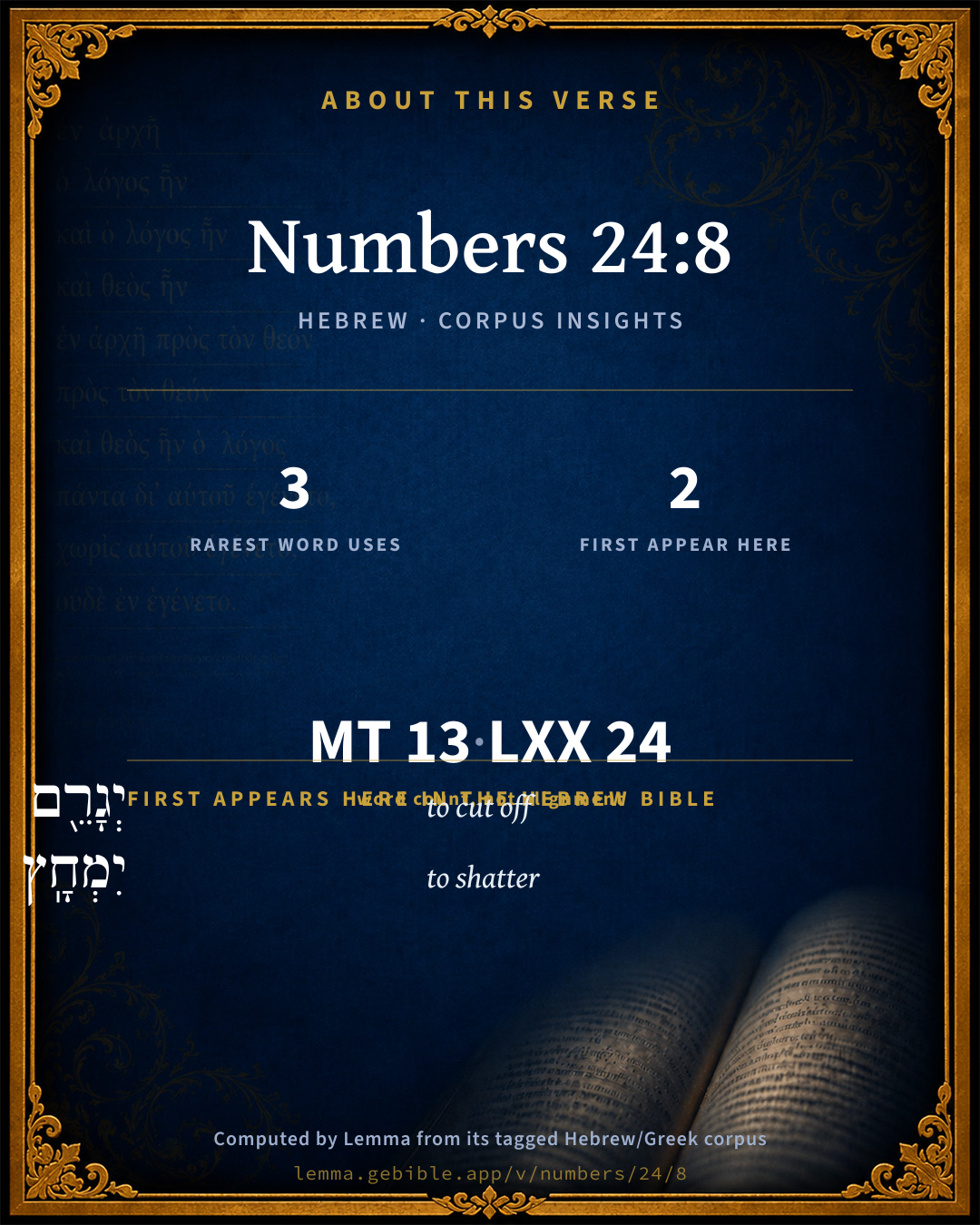
These counts appear in no published source. They are computed here, from the morphology-tagged text and Lemma’s own curated glosses. What Lemma adds →

13
words
12
distinct lemmas
Pentateuch
section

Notable vocabulary

The rarest word here is יְגָרֵ֖ם to cut off H1633 — appearing just 3 times in the whole Hebrew Bible.

First appearance in Scripture

These words make their first canonical appearance in the Hebrew Bible here:

  • יְגָרֵ֖ם to cut off H1633
  • יִמְחָֽץ to shatter H4272

Shared distinctive vocabulary

יְגָרֵ֖ם to cut off H1633 occurs in 3 verses of the Hebrew Bible. Also found in:

Grammatical profile

  • 4 verbs
  • 8 nouns
  • 1 preposition

Verb forms

  • מוֹצִיא֣וֹ Hiphil · Participle Active
  • יֹאכַ֞ל Qal · Imperfect
  • יְגָרֵ֖ם Piel · Imperfect
  • יִמְחָֽץ Qal · Imperfect

Hebrew & Septuagint length

In English translation the verse runs 37 words from the Hebrew and 40 from the Septuagint (LXX English) — closely comparable.

A rough comparison of the two English renderings, which tokenize alike — not a word-level alignment.

Word counts can differ between the Hebrew and the Greek without any difference in meaning — e.g. the Hebrew direct-object marker אֵת has no separate Greek word, and Greek often adds the article ὁ.

In the original languages it is 13 Hebrew tokens and 24 Greek tokens — but the two are counted differently (Hebrew bundles its prefixes and suffixes into one token; the Greek is in lemma form), so that isn’t a like-for-like length.

Cross-references

14

Topical passages linked to Numbers 24:8 in the Treasury of Scripture Knowledge — connected by theme and wording, ordered by reader-vote popularity; previews shown in the World English Bible.

  • Psalms 45:5 Your arrows are sharp. The nations fall under you, with arrows in the heart of the king's enemies.
  • Numbers 14:9 Only don't rebel against Yahweh, neither fear the people of the land; for they are bread for us: their defense is removed from over them, and Yahweh is with us: don't fear them.
  • Numbers 23:22 God brings them forth out of Egypt; He has as it were the strength of the wild-ox.
  • Numbers 23:24 Behold, the people rises up as a lioness, As a lion does he lift himself up: He shall not lie down until he eat of the prey, Drink the blood of the slain.
  • Psalms 2:9 You shall break them with a rod of iron. You shall dash them in pieces like a potter's vessel."
  • Jeremiah 50:17 Israel is a hunted sheep; the lions have driven him away: first, the king of Assyria devoured him; and now at last Nebuchadrezzar king of Babylon has broken his bones.
  • Isaiah 38:13 I quieted [myself] until morning; as a lion, so he breaks all my bones: From day even to night will you make an end of me.
  • Jeremiah 50:9 For, behold, I will stir up and cause to come up against Babylon a company of great nations from the north country; and they shall set themselves in array against her; from there she shall be taken: their arrows shall be as of an expert mighty man; none shall return in vain.
  • Numbers 21:5 The people spoke against God, and against Moses, Why have you brought us up out of Egypt to die in the wilderness? for there is no bread, and there is no water; and our soul loathes this light bread.
  • Deuteronomy 7:1 When Yahweh your God shall bring you into the land where you go to possess it, and shall cast out many nations before you, the Hittite, and the Girgashite, and the Amorite, and the Canaanite, and the Perizzite, and the Hivite, and the Jebusite, seven nations greater and mightier than you;
  • Deuteronomy 32:23 I will heap evils on them; I will spend my arrows on them:
  • Deuteronomy 32:42 I will make my arrows drunk with blood, My sword shall devour flesh; With the blood of the slain and the captives, From the head of the leaders of the enemy.
  • Psalms 21:12 For you will make them turn their back, When you aim drawn bows at their face.
  • Daniel 6:24 The king commanded, and they brought those men who had accused Daniel, and they cast them into the den of lions, them, their children, and their wives; and the lions had the mastery of them, and broke all their bones in pieces, before they came to the bottom of the den.

Cross-references courtesy of OpenBible.info (CC BY 4.0).

Hebrew and Greek witnesses Masoretic Hebrew ↔ Greek Septuagint

The same verse in the two great witnesses to the Old Testament, shown verse-for-verse.

These are two independent witnesses, not word-aligned to each other, and the Septuagint is shown in lemma (dictionary) form.

Hebrew Numbers 24:8 Masoretic · Westminster Leningrad Codex

אֵ֚ל מוֹצִיא֣וֹ מִמִּצְרַ֔יִם כְּתוֹעֲפֹ֥ת רְאֵ֖ם ל֑וֹ יֹאכַ֞ל גּוֹיִ֣ם צָרָ֗יו וְעַצְמֹתֵיהֶ֛ם יְגָרֵ֖ם וְחִצָּ֥יו יִמְחָֽץ

God brings him forth out of Egypt; He has as it were the strength of the wild-ox: He shall eat up the nations his adversaries, Shall break their bones in pieces, Smite [them] through with his arrows.

World English Bible · Public Domain

Greek LXX Numbers 24:8 Septuagint · lemma form

θεός ὁδηγέω αὐτός ἐκ αἴγυπτος ὡς δόξα μονόκερως αὐτός ἐσθίω ἔθνος ἐχθρός αὐτός καί ὁ πάχος αὐτός ἐκμυελίζω καί ὁ βολίς αὐτός κατατοξεύω ἐχθρός

God led him out of Egypt; he has as it were the glory of a unicorn: he shall consume the nations of his enemies, and he shall drain their marrow, and with his darts he shall shoot through the enemy.

LXX2012 (modern English Septuagint) · Public Domain

On this verse, The Pulpit Commentary discusses the Septuagint’s reading. Read the note in Commentary ↓

Hebrew: Westminster Leningrad Codex (CC BY 4.0). Greek: Septuagint (public domain); English from LXX2012 (modern English Septuagint) (Public Domain). How the Septuagint differs from the Hebrew →

Targum (Aramaic paraphrase)

2

The Targum is the ancient Jewish Aramaic paraphrase of the Hebrew Scriptures — an interpretive translation, not the Hebrew text itself. Onkelos (literal) and Pseudo-Jonathan (expansive) render the Torah, and Jonathan the Prophets. Coverage is partial: where no permissively-licensed English translation exists for a verse, only the Aramaic is shown. This is verse-level text, not a word-by-word alignment to the Hebrew.

  1. Targum Onkelos Torah (Genesis–Deuteronomy)
    אֱלָהָא דְאַפֵּקִינוּן מִמִצְרַיִם תּוּקְפָא וְרוּמָא דִילֵיהּ יֵיכְלוּן בְּנֵי יִשְׂרָאֵל נִכְסֵי עַמְמַיָא סַנְאֵיהוֹן וּבְבִזַת מַלְכֵּיהוֹן יִתְפַּנְקוּן וְאַרְעֲתְהוֹן יַחְסְנוּן

    (no public-domain English translation for this verse)

    Targum Onkelos — Aramaic: “Onkelos Genesis” (public domain); “Onkelos Exodus” (public domain); “Onkelos Leviticus” (public domain); “Onkelos Numbers” (public domain); “Onkelos Deuteronomy” (public domain). English: “Sefaria Community Translation” (CC0 1.0 (public-domain dedication)); “J.W. Etheridge. The Targums of Onkelos and Jonathan Ben Uzziel on the Pentateuch. London: Longmans, Green, 1862” (public domain). Text via Sefaria.

  2. Targum Pseudo-Jonathan Torah (Genesis–Deuteronomy)
    אֱלָהָא דְאַפֵּיקִינוּן פְּרִיקִין מִמִצְרַיִם תּוּקְפָא וְרוֹמָא תּוּשְׁבַּחְתָּא גְבוּרְתָּא דִילֵיהּ יְשֵׁיצֵי יַת אוּמַיָא בַּעֲלֵי דְבָבֵיהוֹן וְתוּקְפְהוֹן יִתְבַּר וְגִירֵי מְחַוַות פּוּרְעָנוּתֵיהּ יְגָרֵי בְהוֹן וִישֵׁיצוּנוּן

    Unto Eloha, who brought them out free from Mizraim, belong might, and exaltation, and glory, and power. He will destroy the nations of their adversaries, and break down their strength and will send forth the plague-arrows of His vengeance among them, and destroy them.

    Targum Pseudo-Jonathan — Aramaic: “Targum Jonathan on Genesis” (public domain); “Targum Jonathan on Exodus” (public domain); “Targum Jonathan on Leviticus” (public domain); “Targum Jonathan on Numbers” (public domain); “Targum Jonathan on Deuteronomy” (public domain). English: “The Targum of Jonathan ben Uzziel, trans. J. W. Etheridge, London, 1862” (public domain). Text via Sefaria.

Commentary

Notes on Numbers 24:8 from classic Christian and Jewish commentators (each source and its license shown beneath its notes). The classic Christian expositions comment on the surrounding passage and are grouped to its opening verse, so a note may address several verses; the Jewish commentaries on the Tanakh (Rashi and others) are per-verse, so they appear only where the commentator wrote on this verse.

Lemma curates 59 commentaries, every one of them public domain or Creative Commons licensed, each selected and text-cleaned for this edition rather than reprinted as found. About our sources →

Trapp's Complete Commentary

John Trapp

Num 24:8 God brought him forth out of Egypt; he hath as it were the strength of an unicorn: he shall eat up the nations his enemies, and shall break their bones, and pierce [them] through with his arrows.

Ver. 8. God brought him forth out of Egypt.] This he tells Balak, in answer to that complaint of his. {Num 20:5} Behold, there is a people come out of Egypt, q.d., Come they are indeed, but not of themselves, but by God, who said, "Out of Egypt have I called my son."

John Trapp, A Commentary or Exposition upon All the Books of the Old and New Testament (1647–1656) — public domain. Text from a community e-Sword module.

Joseph Benson's Commentary

Num 24:8-9. He shall eat up the nations, &c. — The expressions in these verses are intended to signify the victories which the Israelites should gain over their enemies, and particularly the Canaanites, and the secure and quiet possession they should have of the land afterward, all which was fulfilled especially in the days of David and Solomon. He couched, he lay down as a lion — It is remarkable that God here put into the mouth of Balaam nearly the same expressions which Jacob had used concerning Judah, (Gen 49:9,) and Isaac concerning Jacob, Gen 27:29. And what wonder, considering that all these prophecies proceeded from one and the same spirit?

Joseph Benson's Commentary on the Old and New Testaments (1811–1818) — public domain. Text from a community e-Sword module.

Keil & Delitzsch

C. F. Keil & F. Delitzsch

In Num 24:8 and Num 24:9, Balaam proclaims still further: "God leads him out of Egypt; his strength is as that of a buffalo: he will devour nations his enemies, and crush their bones, and dash them in pieces with his arrows. He has encamped, he lies down like a lion, and like a lioness: who can drive him up? Blessed be they who bless thee, and cursed they who curse thee!" The fulness of power that dwelt in the people of Israel was apparent in the force and prowess with which their God brought them out of Egypt. This fact Balaam repeats from the previous saying (Num 23:22), for the purpose of linking on to it the still further announcement of the manner in which the power of the nation would show itself upon its foes in time to come. The words, "he will devour nations," call up the image of a lion, which is employed in Num 24:9 to depict the indomitable heroic power of Israel, in words taken from Jacob's blessing in Gen 49:9. The Piel גּרם is a denom. verb from גּרם, with the meaning to destroy, crush the bones, like שׁרשׁ, to root out (cf. Ges. 52, 2; Ewald, 120, e.). הצּיו is not the object to ימחץ; for מחץ, to dash to pieces, does not apply to arrows, which may be broken in pieces, but not dashed to pieces; and the singular suffix in חצּיו can only apply to the singular idea in the verse, i.e., to Israel, and not to its enemies, who are spoken of in the plural. Arrows are singled out as representing weapons in general.

(Note: The difficulty which many feel in connection with the word חצּיו cannot be removed by alterations of the text. The only possible conjecture חלציו (his loins) is wrecked upon the singular suffix, for the dashing to pieces of the loins of Israel is not for a moment to be thought of. Knobel's proposal, viz., to read קמיו, has no support in Deu 33:11, and is much too violent to reckon upon any approval.)

Balaam closes this utterance, as he had done the previous one, with a quotation from Jacob's blessing, which he introduces to show to Balak, that, according to words addressed by Jehovah to the Israelites through their own tribe-father, they were to overcome their foes so thoroughly, that none of them should venture to rise up against them again. To this he also links on the words with which Isaac had transferred to Jacob in Gen 27:29 the blessing of Abraham in Gen 12:3, for the purpose of warning Balak to desist from his enmity against the chosen people of God.

Keil & Delitzsch — Biblical Commentary on the Old Testament (1861–1891) — public domain (CC PDM 1.0). Text via the HelloAO Bible API. (Old Testament only.)

Adam Clarke's Commentary

Verse 8. God brought him forth out of Egypt] They were neither expelled thence, nor came voluntarily away. God alone, with a high hand and uplifted arm, brought them forth. Concerning the unicorn, See Clarke on Nu 23:22.

Adam Clarke's Commentary on the Bible (1810–1826) — public domain. Text from a community e-Sword/MySword module.

Ellicott's Commentary for English Readers

(8) God brought him forth out of Egypt.—(Comp. Num_23:22, and Note.)

A Bible Commentary for English Readers, edited by Charles John Ellicott (1878–1897) — public domain. Text from a community e-Sword module.

The Cambridge Bible for Schools and Colleges

gen. ed. J. J. S. Perowne

8. The first two lines are identical (with the exception of ‘him’ for ‘them’) with Num_23:22 (E ); and in both traditions the words follow a reference to Israel’s king, and precede the metaphor of the lion and lioness.

And smite them through with his arrows] lit. ‘and (as for) his arrows he shall smite.’ ‘His arrows’ (חִצָּיו) should perhaps be either ‘his oppressors’ (להֲצָיו) or ‘his loins’ (חֲלָצָיו). For the latter cf. Deu_33:11.

The Cambridge Bible for Schools and Colleges (gen. ed. J. J. S. Perowne; Cambridge University Press, 1878–1918) — public domain. Text from a community e-Sword module.

John Gill's Exposition

God brought him forth out of Egypt, he hath as it were the strength of an unicorn,.... Here he repeats what he had said in a former prophecy; see Gill on Num 23:22, he shall eat up the nations his enemies: the seven nations of Canaan, which should be subdued by Israel, and that with as much ease as a lion devours its prey; nor would the Canaanites be able to make any more resistance to them than a creature in the paws of a lion; and the phrase denotes the utter destruction of them:

and shall break their bones; as the lion breaks the bones of such creatures that fall a prey to him; signifying that all their strength should be taken from them, their mighty men slain, and their fortified cities taken:

and pierce them through with his arrows: slay them utterly.

John Gill's Exposition of the Whole Bible (1746–1763) — public domain (CC PDM 1.0). Text via the HelloAO Bible API.

Haydock's Catholic Bible Commentary

Lioness. See ver. 22, 24, of the preceeding chapter. (Haydock) --- This prediction was accomplished under the reigns of David and of Solomon. (Menochius)

George Leo Haydock (1774–1849), Haydock's Catholic Family Bible and Commentary, 1859 edition — public domain. Excludes Psalms (Douay-Rheims chapter numbering differs from Protestant) and Deuterocanonical books (Catholic canon only).

Matthew Poole's English Annotations

Shall break their bones, or, unbone, or, take out, i.e. shall eat the flesh to the very bones, and then break them also.

Matthew Poole's English Annotations on the Holy Bible (1683–1685) — public domain. Text from a community e-Sword/MySword module.

Whedon's Commentary on the Bible

Daniel D. Whedon

8. Unicorn — This comparison is only an amplification of that in chap. xxiii, 22. See note.

Eat up the nations — Destroy them. As an illustration take the seven nations of Canaan. Num_14:9; Deu_7:1. So all nations shall be utterly wasted or conquered by spiritual Israel. Isa_60:12.

Break their bones — Literally, unmarrow their fat bones — weakening them beyond recovery.

Arrows — The chief missiles of ancient war. They are figurative of the piercing words of inspiration. Psa_45:5; Psa_64:4.

Daniel D. Whedon (gen. ed.), Commentary on the Old and New Testaments (1874–1909) — public domain. Text from a community e-Sword module.

The Pulpit Commentary

And shall break their bones. (cf. Eze_23:34) seems to mean "crush" or "smash." The Septuagint has ekmueliei , "shall suck out," i.e., the marrow, but the word does not seem to bear this meaning. Pierce them through with his arrows, or, "dash in pieces his arrows," i.e., the arrows shot at him. xjmiy wyXji. The difficulty is the possessive suffix to "arrows," which is in the singular; otherwise this rendering gives a much better sense, and more in keeping with the rest of the passage The image in Balaam"s mind is evidently that of a terrible wild beast devouring his enemies, stamping them underfoot, and dashing to pieces in his fury the arrows or darts which they vainly launch against him. (compare the imagery in Dan_7:7)

The Pulpit Commentary (1880–1919), ed. H.D.M. Spence-Jones & Joseph S. Exell — public domain. Text from a community e-Sword module.

unfoldingWord translationNotes

Door43 World Missions Community

General Information:

Balaam continues to prophesy under the control of the Spirit of God.

God brings him

"God brings the Israelites"

with strength like a wild ox

This simile emphasizes that the Israelites have great strength. (See: Simile)

He will eat up the nations

Balaam speaks of the Israelites as if they are wild animals that eat their enemies. This means they will destroy their enemies. (See: Metaphor)

translationWords

God

Egypt

strength

cow

nation

bow and arrow

unfoldingWord translationNotes — © Distant Shores Media and the Door43 World Missions Community, licensed CC BY-SA 4.0. Source: git.door43.org/Door43/en_tn.

Rashi

Rabbi Shlomo Yitzchaki (Rashi)

אל מוציאו ממצרים GOD WHO BROUGHT THEM OUT OF EGYPT — Who was the cause of all this greatness? God who brought them out from Egypt; by his strength and his sublimity HE EATS UP (יאכל) THE NATIONS (גוים) who are (צריו) HIS ADVERSARIES.

ועצמתיהם AND THEIR BONES — those of the adversaries.

יגרם — Menachem ben Seruk explained it in the sense of “breaking to pieces”, similar to, (Zephaniah 3:3) “who have not broken to pieces (גרמו) in the morning”, and similar to, (Ezekiel 23:34) “and thou shalt crunch (תגרמי) the sherds thereof”. I, however, say that it has the meaning of “bone” (גרם in Aramaic corresponds to Hebrew עצם) — it means that one pulls away the flesh with his teeth from around the bone, and the marrow from inside, and brings the bone into its original bare condition (i.e., as it was before flesh grew upon it).

וחציו ימחץ AND PIERCE THEM THROUGH WITH HIS ARROWS — Onkelos translated this as meaning, the חצים of the adversaries, taking it in the sense of “their postion of land”, similar to (Genesis 44:23) בעלי חצים, which he translated by מרי פלנותא “those who part (differ) from him”. So, too, according to the Targum ימחץ denotes “dividing” having the same meaning as in (Judges 5:26): “She divided (מחצה) and struck through his temples”. The meaning therefore is, that they will divide amongst themselves their (the adversaries’) land (Hence the translation of Onkelos: “they shall take possession of their land”). — But it can also be explained as meaning חצים literally (i.e., arrows): the arrows of the Holy One, blessed be He, He will ימחץ in the blood of the adversaries — i.e., he will dip and thus dye the arrows in their blood. Similar is, (Psalms 68:24) “In order that thou mayest colour thy foot (תמחץ) by the blood”. However, even in this sense it does not lose the usual meaning of “wounding”, as in (Deuteronomy 32:39): “I wound (מחצתי)”, for what is dyed by blood, looks as though it were wounded and stricken.

Rashi on the Tanakh — English translations: “The Judaica Press complete Tanach with Rashi, translated by A. J. Rosenberg” (CC BY 4.0); “Pentateuch with Rashi's commentary by M. Rosenbaum and A.M. Silbermann, 1929-1934” (public domain); “The Metsudah Tanach series, Lakewood, N.J” (CC BY 4.0); and “The Book of Joshua, Metsudah Publications, 1997” (CC BY 4.0). Text via Sefaria.

Lesson kit

Teaching starters — assembled from the data on this page, not authored interpretation. Every prompt links to the verse data it draws on. Edit before teaching.

Numbers, in the Pentateuch, opens this verse with 13 words (12 distinct Hebrew lemmas). Its most distinctive word is gâram (“to cut off”). A historical commentator’s framing appears above. Read the whole chapter for the surrounding context.

Discussion questions

  1. What does “to cut off” (gâram) contribute to the verse as a whole?
  2. 2 words here appear for the first time in Scripture. What is being introduced at this debut?
  3. Ezekiel 23:34 shares the word «to cut off» with this verse. How do the two illuminate each other?
  4. These translations render this verse differently; the difference is in the English rendering, not the original. What questions does that raise?
  5. The verb «מוֹצִיא֣וֹ» is Hiphil Participle Active. How does its form color the action?
  6. Reading how Trapp's Complete Commentary and Joseph Benson's Commentary read this verse, where do the two commentators agree and where do they part?

Things to notice

Reading settings

Reading text

Shown beneath each verse's original-language words.

Old Testament
Old Testament edition

Read the OT as the Masoretic Hebrew (MT) or the Greek Septuagint (LXX).

English shown for the Greek Septuagint (in the Hebrew ↔ Greek comparison).

Comparing translations? Open the Compare panel on any verse page to stack up to four side by side.