
Deuteronomy 17:14

Hebrew (Westminster Leningrad Codex) Deuteronomy 17:14 appears in the Hebrew Old Testament. The text above is from the Westminster Leningrad Codex. Each word links to its Strong’s number, a concise gloss, and parsing drawn from the Open Scriptures Hebrew Bible morphology. Click any word for its full Brown-Driver-Briggs (BDB) entry.
Download image
Cite this verse

Deuteronomy 17:14 (World English Bible). Public Domain. Lemma interlinear Bible study tool, https://lemma.gebible.app/v/deuteronomy/17/14.

Show BibTeX & RIS
BibTeX
RIS
English Translation
When you are come to the land which Yahweh your God gives you, and shall possess it, and shall dwell therein, and shall say, I will set a king over me, like all the nations that are round about me;
World English Bible · Public Domain
Download a study sheet

One document with this verse’s original text, its word-by-word gloss line, the meaning frame, cross-references with their text, attributed commentary, and full source and license credits — printable, and it pastes into notes with its structure intact.

This verse Autodidact and up

Study sheet (.html) Plain text (.txt)

A passage Seminary Student

Up to 50 verses in one chapter. A passage sheet keeps up to 6 commentary sources and 12 cross-references per verse, in the order this page ranks them, and says so on the sheet whenever that leaves anything out. Ask for a single verse and you get the Autodidact verse sheet above.

Everything on this page stays free to read, with no account — the sheet is a download of what is already on screen, not access to it.

Want to remove ads? Support Godless Engineer
Compare translations 3

The same verse in 3 English versions, stacked beneath the original-language interlinear above. Click any original word for its lexicon entry.

Each is an independent rendering of the whole verse — the interlinear is not word-aligned to these translations.

Highlighted words mark where these versions differ — a whole-verse word diff, not a word-by-word alignment.

  • World English Bible Public Domain
    When you are come to the land which Yahweh your God gives you, and shall possess it, and shall dwell therein, and shall say, I will set a king over me, like all the nations that are round about me;
  • King James Version Public Domain
    When thou art come unto the land which the LORD thy God giveth thee, and shalt possess it, and shalt dwell therein, and shalt say, I will set a king over me, like as all the nations that are about me;
  • unfoldingWord Literal Text CC BY-SA 4.0
    When you have come to the land that Yahweh your God is giving to you, and you take possession of it and live in it, and you say, ‘I shall set a king over myself, like all the nations that surround me,’

unfoldingWord Literal Text — © unfoldingWord, licensed CC BY-SA 4.0. Word-aligned USFM3 via Door43 (git.door43.org/unfoldingWord/en_ult).

Versions to compare (up to 4)

3 of 4 selected

Show all 18 translations

Every available English version of this verse, each an independent rendering of the whole verse.

  • World English Bible Public Domain
    When you are come to the land which Yahweh your God gives you, and shall possess it, and shall dwell therein, and shall say, I will set a king over me, like all the nations that are round about me;
  • Berean Standard Bible Public Domain
    When you enter the land that the LORD your God is giving you and have taken possession of it and settled in it, and you say, “Let us set a king over us like all the nations around us,”
  • Majority Standard Bible Public Domain
    When you enter the land that the LORD your God is giving you and have taken possession of it and settled in it, and you say, “Let us set a king over us like all the nations around us,”
  • King James Version Public Domain
    When thou art come unto the land which the LORD thy God giveth thee, and shalt possess it, and shalt dwell therein, and shalt say, I will set a king over me, like as all the nations that are about me;
  • American Standard Version (1901) Public Domain
    When thou art come unto the land which Jehovah thy God giveth thee, and shalt possess it, and shalt dwell therein, and shalt say, I will set a king over me, like all the nations that are round about me;
  • Revised Version (1885) Public Domain
    When thou art come unto the land which the LORD thy God giveth thee, and shalt possess it, and shalt dwell therein; and shalt say, I will set a king over me, like as all the nations that are round about me;
  • Geneva Bible (1599) Public Domain
    Whe thou shalt come vnto ye land which the Lord thy God giueth thee, and shalt possesse it, and dwell therein, if thou say, I will set a King ouer me, like as all the nations that are about me,
  • Douay-Rheims (1899) Public Domain
    When thou art come into the land, which the Lord thy God will give thee, and possessest it, and shalt say: I will set a king over me, as all nations have that are round about:
  • Young's Literal Translation Public Domain
    `When thou comest in unto the land which Jehovah thy God is giving to thee, and hast possessed it, and dwelt in it, and thou hast said, Let me set over me a king like all the nations which `are' round about me, --
  • Literal Standard Version CC BY-SA 4.0
    When you come into the land which your God YHWH is giving to you, and have possessed it, and dwelt in it, and you have said, Let me set a king over me like all the nations which [are] around me—
  • Unlocked Literal Bible CC BY-SA 4.0
    When you have come to the land that Yahweh your God gives you, and when you take possession of it and begin to live in it, and then you say, 'I will set a king over myself, like all the nations that are round about me,'
  • unfoldingWord Literal Text CC BY-SA 4.0
    When you have come to the land that Yahweh your God is giving to you, and you take possession of it and live in it, and you say, ‘I shall set a king over myself, like all the nations that surround me,’
  • Darby Bible Public Domain
    When thou comest unto the land which Jehovah thy God giveth thee, and shalt possess it, and shalt dwell therein, and shalt say, I will set a king over me, like all the nations that are about me;
  • World Messianic Bible Public Domain
    When you have come to the land which the LORD your God gives you, and possess it and dwell in it, and say, “I will set a king over me, like all the nations that are around me,”
  • Webster's Bible Public Domain
    When thou art come into the land which the LORD thy God giveth thee, and shalt possess it, and shalt dwell in it, and shalt say, I will set a king over me, like as all the nations that are about me;
  • Free Bible Version CC BY-SA 4.0
    After you've entered the land that the Lord your God is giving you, and have taken it over and settled in it, and you decide, “Let's have a king to rule over us like all the other nations around us do,”
  • Bible in Basic English Public Domain
    When you have come into the land which the Lord your God is giving you, and have taken it for a heritage and are living in it, if it is your desire to have a king over you, like the other nations round about you;
  • JPS Tanakh (1917) Public Domain
    When thou art come unto the land which the LORD thy God giveth thee, and shalt possess it, and shalt dwell therein; and shalt say: 'I will set a king over me, like all the nations that are round about me';

Literal Standard Version (2020), Covenant Press — licensed CC BY-SA 4.0. Text via the HelloAO Bible API (eBible.org). Unlocked Literal Bible (unfoldingWord) — licensed CC BY-SA 4.0. Text via the HelloAO Bible API (eBible.org). unfoldingWord Literal Text — © unfoldingWord, licensed CC BY-SA 4.0. Word-aligned USFM3 via Door43 (git.door43.org/unfoldingWord/en_ult). Free Bible Version, Dr. Jonathan Gallagher — licensed CC BY-SA 4.0. Text via the HelloAO Bible API (eBible.org).

Word by word

More ways to search: Search by grammar → Find every occurrence → Compare this word →

Practice this passage: Drill this verse → Learn its vocabulary →

וִֽירִשְׁתָּ֖הּ
yârash
H3423
“and · to inherit · her”
Conjunction + Verb, Qal, Sequential Perfect, 2nd Person, Masculine, Singular + Suffix, Personal, 3rd Person, Feminine, Singular
Part of Speech
Conjunction + Verb
Stem
Qal
Form
Sequential Perfect
Person
2nd Person
Gender
Masculine
Number
Singular
Full BDB Definition

Origin: a primitive root

TWOT: 920

to seize, dispossess, take possession off, inherit, disinherit, occupy, impoverish, be an heir - (Qal) - to take possession of - to inherit - to impoverish, come to poverty, be poor - (Niphal) to be dispossessed, be impoverished, come to poverty - (Piel) to devour - (Hiphil) - to cause to possess or inherit - to cause others to possess or inherit - to impoverish - to dispossess - to destroy, bring to ruin, disinherit
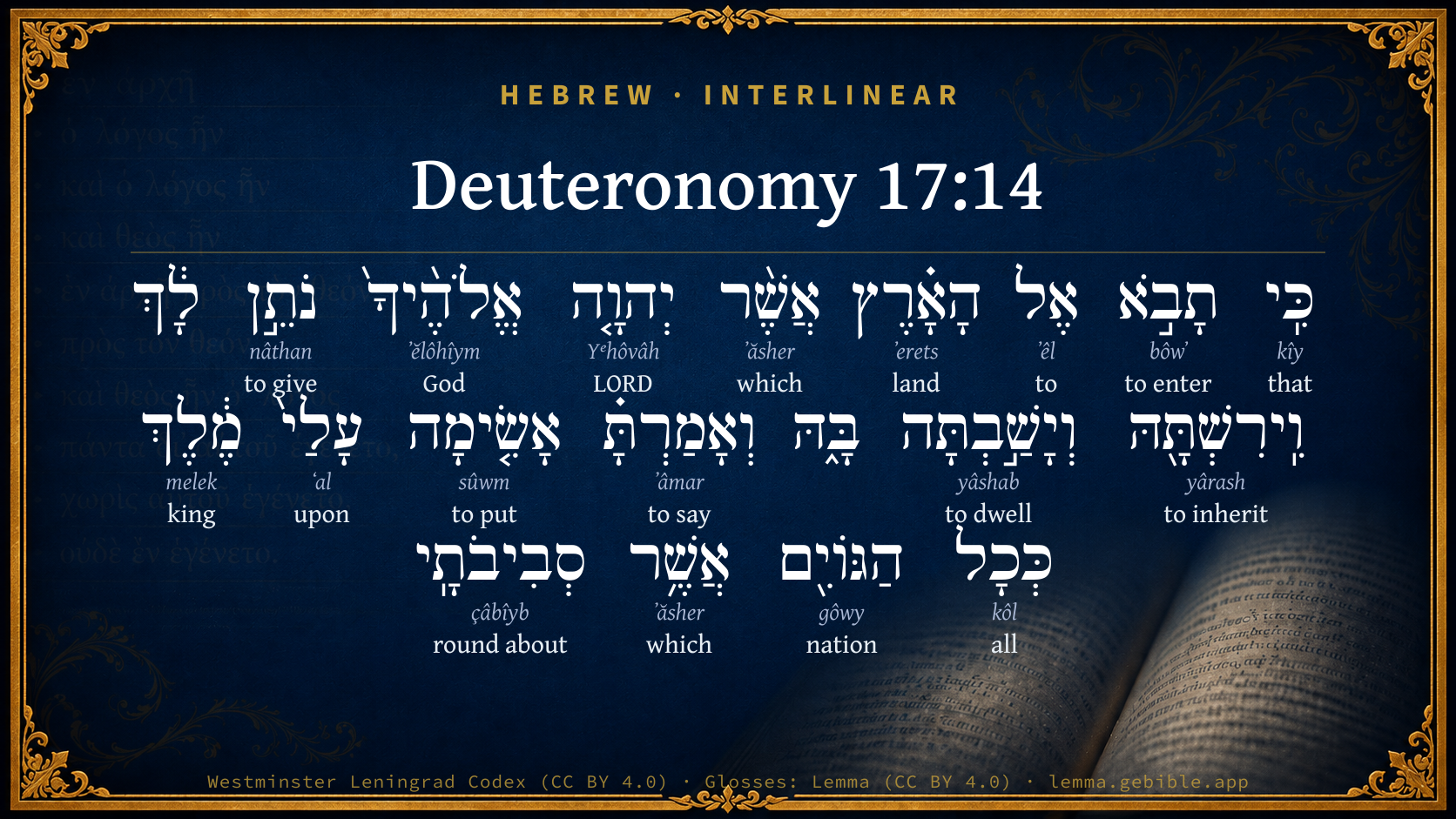
  1. כִּֽי kîy H3588 “that” Conjunction
  2. תָבֹ֣א bôwʼ H935 “to enter” Verb, Qal, Imperfect, 2nd Person, Masculine, Singular
  3. אֶל ʼêl H413 “to” Preposition
  4. הָאָ֗רֶץ ʼerets H776 “the · land” Particle, Definite Article + Noun, Common, Both, Singular, Absolute
  5. אֲשֶׁ֨ר ʼăsher H834 “which” Particle, Relative
  6. יְהוָ֤ה Yᵉhôvâh H3068 “LORD” Noun, Proper
  7. אֱלֹהֶ֨יךָ֙ ʼĕlôhîym H430 “God(s) · your” Noun, Common, Masculine, Plural, Construct + Suffix, Personal, 2nd Person, Masculine, Singular
  8. נֹתֵ֣ן nâthan H5414 “giving” Verb, Qal, Participle Active, Masculine, Singular, Absolute
  9. וְיָשַׁ֣בְתָּה yâshab H3427 “and · to dwell” Conjunction + Verb, Qal, Sequential Perfect, 2nd Person, Masculine, Singular
  10. וְאָמַרְתָּ֗ ʼâmar H559 “and · to say” Conjunction + Verb, Qal, Sequential Perfect, 2nd Person, Masculine, Singular
  11. אָשִׂ֤ימָה sûwm H7760 “to put” Verb, Qal, Cohortative, 1st Person, Common, Singular
  12. עָלַי֙ ʻal H5921 “upon · me” Preposition + Suffix, Personal, 1st Person, Common, Singular
  13. מֶ֔לֶךְ melek H4428 “king” Noun, Common, Masculine, Singular, Absolute
  14. כְּכָל kôl H3605 “like/as · all of” Preposition + Noun, Common, Masculine, Singular, Construct
  15. הַגּוֹיִ֖ם gôwy H1471 “the · nations” Particle, Definite Article + Noun, Common, Masculine, Plural, Absolute
  16. אֲשֶׁ֥ר ʼăsher H834 “which” Particle, Relative
  17. סְבִיבֹתָֽי çâbîyb H5439 “surroundings · my” Noun, Common, Both, Plural, Construct + Suffix, Personal, 1st Person, Common, Singular

About this verse

These counts appear in no published source. They are computed here, from the morphology-tagged text and Lemma’s own curated glosses. What Lemma adds →

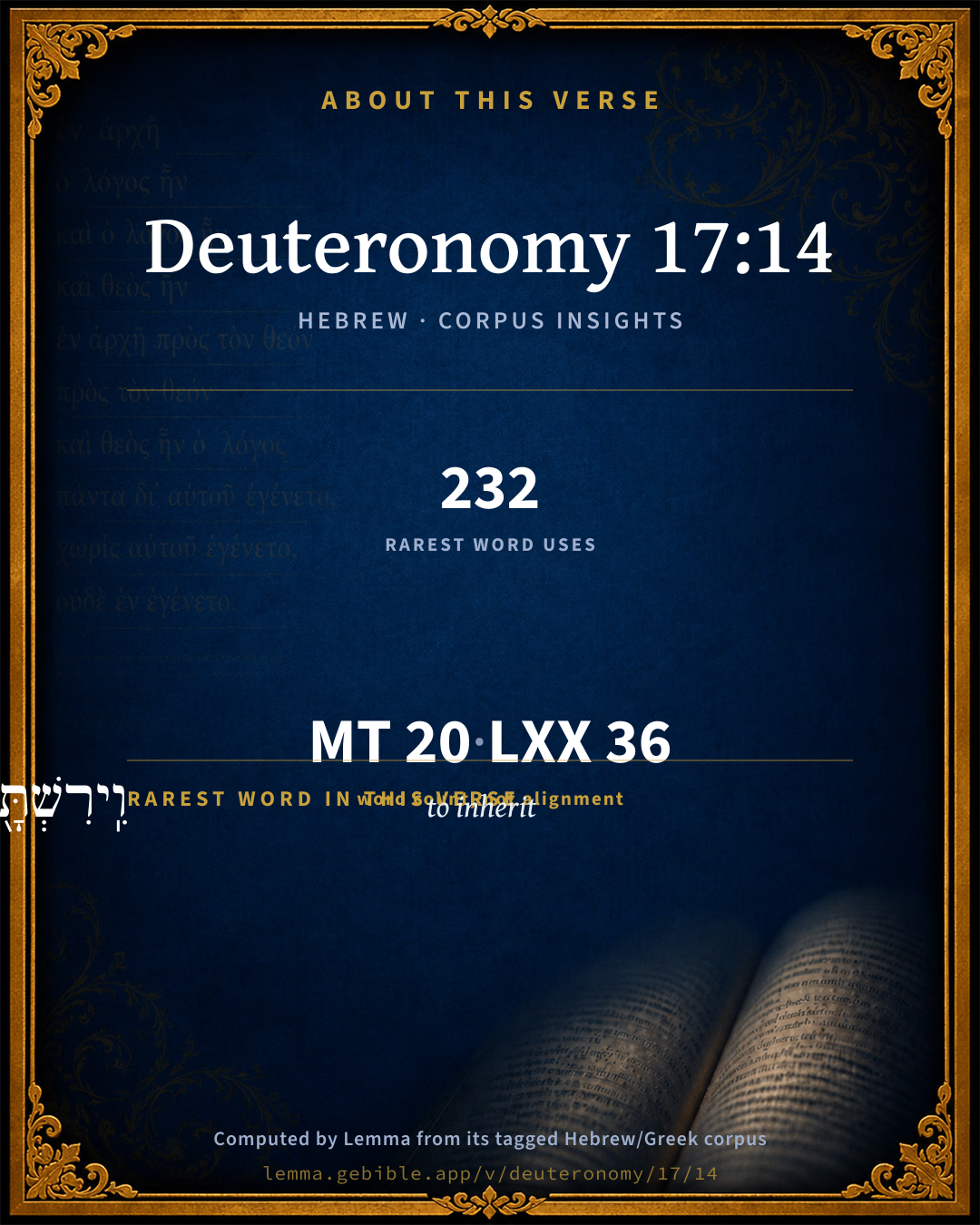
20
words
17
distinct lemmas
Pentateuch
section

Grammatical profile

  • 6 verbs
  • 7 nouns
  • 4 prepositions
  • 1 conjunction
  • 2 particles

Verb forms

  • תָבֹ֣א Qal · Imperfect
  • נֹתֵ֣ן Qal · Participle Active
  • וִֽירִשְׁתָּ֖הּ Qal · Sequential Perfect
  • וְיָשַׁ֣בְתָּה Qal · Sequential Perfect
  • וְאָמַרְתָּ֗ Qal · Sequential Perfect
  • אָשִׂ֤ימָה Qal · Cohortative

Repetition

A word recurs within this verse — often emphatic in Hebrew:

  • אֲשֶׁ֨ר which H834 ×2

Hebrew & Septuagint length

In English translation the verse runs 40 words from the Hebrew and 41 from the Septuagint (LXX English) — closely comparable.

A rough comparison of the two English renderings, which tokenize alike — not a word-level alignment.

Word counts can differ between the Hebrew and the Greek without any difference in meaning — e.g. the Hebrew direct-object marker אֵת has no separate Greek word, and Greek often adds the article ὁ.

In the original languages it is 20 Hebrew tokens and 36 Greek tokens — but the two are counted differently (Hebrew bundles its prefixes and suffixes into one token; the Greek is in lemma form), so that isn’t a like-for-like length.

Cross-references

11

Topical passages linked to Deuteronomy 17:14 in the Treasury of Scripture Knowledge — connected by theme and wording, ordered by reader-vote popularity; previews shown in the World English Bible.

  • 1 Samuel 8:19–20 But the people refused to listen to the voice of Samuel; and they said, No: but we will have a king over us,
  • Joshua 1:13 Remember the word which Moses the servant of Yahweh commanded you, saying, Yahweh your God gives you rest, and will give you this land.
  • 1 Samuel 12:19 All the people said to Samuel, Pray for your servants to Yahweh your God, that we not die; for we have added to all our sins [this] evil, to ask us a king.
  • Deuteronomy 7:1 When Yahweh your God shall bring you into the land where you go to possess it, and shall cast out many nations before you, the Hittite, and the Girgashite, and the Amorite, and the Canaanite, and the Perizzite, and the Hivite, and the Jebusite, seven nations greater and mightier than you;
  • Deuteronomy 11:31 For you are to pass over the Jordan to go in to possess the land which Yahweh your God gives you, and you shall possess it, and dwell therein.
  • Deuteronomy 12:9–10 for you haven't yet come to the rest and to the inheritance, which Yahweh your God gives you.
  • Deuteronomy 18:9 When you are come into the land which Yahweh your God gives you, you shall not learn to do after the abominations of those nations.
  • Deuteronomy 26:1 It shall be, when you are come in to the land which Yahweh your God gives you for an inheritance, and possess it, and dwell therein,
  • Deuteronomy 26:9 and he has brought us into this place, and has given us this land, a land flowing with milk and honey.
  • 1 Samuel 8:5–7 and they said to him, Behold, you are old, and your sons don't walk in your ways: now make us a king to judge us like all the nations.
  • Leviticus 14:34 "When you have come into the land of Canaan, which I give to you for a possession, and I put a spreading mildew in a house in the land of your possession,

Cross-references courtesy of OpenBible.info (CC BY 4.0).

Hebrew and Greek witnesses Masoretic Hebrew ↔ Greek Septuagint

The same verse in the two great witnesses to the Old Testament, shown verse-for-verse.

These are two independent witnesses, not word-aligned to each other, and the Septuagint is shown in lemma (dictionary) form.

Hebrew Deuteronomy 17:14 Masoretic · Westminster Leningrad Codex

כִּֽי תָבֹ֣א אֶל הָאָ֗רֶץ אֲשֶׁ֨ר יְהוָ֤ה אֱלֹהֶ֨יךָ֙ נֹתֵ֣ן לָ֔ךְ וִֽירִשְׁתָּ֖הּ וְיָשַׁ֣בְתָּה בָּ֑הּ וְאָמַרְתָּ֗ אָשִׂ֤ימָה עָלַי֙ מֶ֔לֶךְ כְּכָל הַגּוֹיִ֖ם אֲשֶׁ֥ר סְבִיבֹתָֽי

When you are come to the land which Yahweh your God gives you, and shall possess it, and shall dwell therein, and shall say, I will set a king over me, like all the nations that are round about me;

World English Bible · Public Domain

Greek LXX Deuteronomy 17:14 Septuagint · lemma form

ἐάν δέ εἰςἔρχομαι εἰς ὁ γῆ ὅς κύριος ὁ θεός σύ δίδωμι σύ ἐν κλῆρος καί κληρονομέω αὐτός καί καταοἰκέω ἐπί αὐτός καί εἶπον καταἵστημι ἐπί ἐμαυτοῦ ἄρχων καθά καί ὁ λοιπός ἔθνος ὁ κύκλος ἐγώ

And when you shall enter into the land which the Lord your God gives you, and shall inherit it and dwell in it, and shall say, I will set a ruler over me, as also the other nations round about me;

LXX2012 (modern English Septuagint) · Public Domain

Hebrew: Westminster Leningrad Codex (CC BY 4.0). Greek: Septuagint (public domain); English from LXX2012 (modern English Septuagint) (Public Domain). How the Septuagint differs from the Hebrew →

Targum (Aramaic paraphrase)

2

The Targum is the ancient Jewish Aramaic paraphrase of the Hebrew Scriptures — an interpretive translation, not the Hebrew text itself. Onkelos (literal) and Pseudo-Jonathan (expansive) render the Torah, and Jonathan the Prophets. Coverage is partial: where no permissively-licensed English translation exists for a verse, only the Aramaic is shown. This is verse-level text, not a word-by-word alignment to the Hebrew.

  1. Targum Onkelos Torah (Genesis–Deuteronomy)
    אֲרֵי תֵעוֹל לְאַרְעָא דַיְיָ אֱלָהָךְ יָהֵב לָךְ וְתֵירְתַהּ וְתֵיתֵב בַּהּ וְתֵימַר אֱמַנִי עֲלַי מַלְכָּא כְּכָל עַמְמַיָא דִי בְסַחֲרָנָי

    (no public-domain English translation for this verse)

    Targum Onkelos — Aramaic: “Onkelos Genesis” (public domain); “Onkelos Exodus” (public domain); “Onkelos Leviticus” (public domain); “Onkelos Numbers” (public domain); “Onkelos Deuteronomy” (public domain). English: “Sefaria Community Translation” (CC0 1.0 (public-domain dedication)); “J.W. Etheridge. The Targums of Onkelos and Jonathan Ben Uzziel on the Pentateuch. London: Longmans, Green, 1862” (public domain). Text via Sefaria.

  2. Targum Pseudo-Jonathan Torah (Genesis–Deuteronomy)
    אֲרוּם תֵּיעָלוּן לְאַרְעָא דַיְיָ אֱלָהָכוֹן יָהֵיב לְכוֹן וְתֵרְתוּן יָתָהּ וְתֵיתְבוּן בָּהּ וְתֵמְרוּן נְמַנֵי עֲלָן מַלְכָּא כְּכָל עַמְמַיָא דִבְחַזְרָנוּתָי

    When you enter the land which the Lord your God giveth you, and possess, and dwell in it, and you say, Let us appoint a king over us, like all the nations about me,

    Targum Pseudo-Jonathan — Aramaic: “Targum Jonathan on Genesis” (public domain); “Targum Jonathan on Exodus” (public domain); “Targum Jonathan on Leviticus” (public domain); “Targum Jonathan on Numbers” (public domain); “Targum Jonathan on Deuteronomy” (public domain). English: “The Targum of Jonathan ben Uzziel, trans. J. W. Etheridge, London, 1862” (public domain). Text via Sefaria.

Commentary

Notes on Deuteronomy 17:14 from classic Christian and Jewish commentators (each source and its license shown beneath its notes). The classic Christian expositions comment on the surrounding passage and are grouped to its opening verse, so a note may address several verses; the Jewish commentaries on the Tanakh (Rashi and others) are per-verse, so they appear only where the commentator wrote on this verse.

Lemma curates 59 commentaries, every one of them public domain or Creative Commons licensed, each selected and text-cleaned for this edition rather than reprinted as found. About our sources →

Matthew Henry's Commentary

After the laws which concerned subjects fitly followed the laws which concern kings; for those that rule others must themselves remember that they are under command. Here are laws given,

I. To the electors of the empire, what rules they must go by in making their choice, Deu 17:14, Deu 17:15. 1. It is here supposed that the people would, in process of time, be desirous of a king, whose royal pomp and power would be thought to make their nation look great among their neighbours. Their having a king is neither promised as a mercy nor commanded as a duty (nothing could be better for them than the divine regimen they were under), but it is permitted them if they desired it. If they would but take care to have the ends of government answered, and God's laws duly observed and put in execution, they should not be tied to any one form of government, but should be welcome to have a king. Though something irregular is supposed to be the principle of the desire, that they might be like the nations (whereas God in many ways distinguished them from the nations), yet God would indulge them in it, because he intended to serve his own purposes by it, in making the regal government typical of the kingdom of the Messiah. 2. They are directed in their choice. If they will have a king over them, as God foresaw they would (though it does not appear that ever the motion was made till almost 400 years after), then they must, (1.) Ask counsel at God's mouth, and make him king whom God shall choose; and happy it was for them that they had an oracle to consult in so weighty an affair, and a God to choose for them who knows infallibly what every man is and will be. Kings are God's viceregents, and therefore it is fit that he should have the choosing of them: God had himself been in a particular manner Israel's King, and if they set another over them, under him, it was necessary that he should nominate the person. Accordingly, when the people desired a king, they applied to Samuel a prophet of the Lord; and afterwards David, Solomon, Jeroboam, Jehu, and others, were chosen by the prophets; and the people are reproved for not observing this law, Hos 8:4 : They have set up kings but not by me. In all cases God's choice, if we can but know it, should direct, determine, and overrule ours. (2.) They must not choose a foreigner under pretence of strengthening their alliances, or of the extraordinary fitness of the person, lest a strange king should introduce strange customs of usages, contrary to those that were established by the divine law; but he must be one from among thy brethren, that he may be a type of Christ, who is bone of our bone, Heb 2:14.

II. Laws are here given to the prince that should be elected for the due administration of the government.

1. He must carefully avoid every thing that would divert him from God and religion. Riches, honours, and pleasures are the three great hindrances of godliness (the lusts of the flesh, the lusts of the eye, and the pride of life), especially to those in high stations: against these therefore the king is here warned. (1.) He must not gratify the love of honour by multiplying horses, Deu 17:16. He that rode upon a horse (a stately creature) in a country where asses and mules were generally used looked very great; and therefore though he might have horses for his own saddle, and chariots, yet he must not set servants on horseback (Ecc 10:7) nor have many horses for his officers and guards (when God was their King, his judges rode on asses, Jdg 5:10; Jdg 12:14), nor must he multiply horses for war, lest he should trust too much to them, Psa 20:7; Psa 33:17; Hos 14:3. The reason here given against his multiplying horses is because it would produce a greater correspondence with Egypt (which furnished Canaan with horses, Kg1 10:28, Kg1 10:29) than it was fit the Israel of God should have, who were brought thence with such a high hand: You shall return no more that way, for fear of being infected with the idolatries of Egypt (Lev 18:3), to which they were very prone. Note, We should take heed of that commerce or conversation by which we are in danger of being drawn into sin. If Israel must not return to Egypt, they must not trade with Egypt; Solomon got no good by it. (2.) He must not gratify the love of pleasure by multiplying wives (Deu 17:17), as Solomon did to his undoing (Kg1 11:1), that his heart, being set upon them, turn not away from business, and every thing that is serious, and especially from the exercise of piety and devotion, to which nothing is a greater enemy than the indulgence of the flesh. (3.) He must not gratify the love of riches by greatly multiplying silver and gold. A competent treasure is allowed him, and he is not forbidden to be good husband of it, but, [1.] He must not greatly multiply money, so as to oppress his people by raising it (as Solomon seems to have done, Kg1 12:4), nor so as to deceive himself, by trusting to it, and setting his heart upon it, Psa 62:10. [2.] He must not multiply it to himself. David multiplied silver and gold, but it was for the service of God (Ch1 29:4), not for himself; for his people, not for his own family.

2. He must carefully apply himself to the law of God, and make that his rule. This must be to him better than all riches, honours, and pleasures, than many horses or many wives, better than thousands of gold and silver.

(1.) He must write himself a copy of the law out of the original, which was in the custody of the priests that attended the sanctuary, Deu 17:18. Some think that he was to write only this book of Deuteronomy, which is an abstract of the law, and the precepts of which, being mostly moral and judicial, concerned the king more than the laws in Leviticus and Numbers, which, being ceremonial, concerned chiefly the priests. Others think that he was to transcribe all the five books of Moses, which are called the law, and which were preserved together as the foundation of their religion. Now, [1.] Though the king might be presumed to have very fair copies by him from his ancestors, yet, besides those, he must have one of his own: it might be presumed that theirs were worn with constant use; he must have a fresh one to begin the world with. [2.] Though he had secretaries about him whom he might employ to write this copy, and who perhaps could write a better hand than he, yet he must do it himself, with his own hand, for the honour of the law, and that he might think no act of religion below him, to inure himself to labour and study, and especially that he might thereby be obliged to take particular notice of every part of the law and by writing it might imprint it in his mind. Note, It is of great use for each of us to write down what we observe as most affecting and edifying to us, out of the scriptures and good books, and out of the sermons we hear. A prudent pen may go far towards making up the deficiencies of the memory, and the furnishing of the treasures of the good householder with things new and old. [3.] He must do this even when he sits upon the throne of his kingdom, provided that he had not done it before. When he begins to apply himself to business, he must apply himself to this in the first place. He that sits upon the throne of a kingdom cannot but have his hands full. The affairs of his kingdom both at home and abroad call for a large share of his time and thoughts, and yet he must write himself a copy of the law. Let not those who call themselves men of business think that this will excuse them from making religion their business; nor let great men think it any disparagement to them to write for themselves those great things of God's law which he hath written to them, Hos 8:12.

(2.) Having a Bible by him of his own writing, he must not think it enough to keep it in his cabinet, but he must read therein all the days of his life, Deu 17:19. It is not enough to have Bibles, but we must use them, use them daily, as the duty and necessity of everyday require: our souls must have their constant meals of that manna; and, if well digested, it will be true nourishment and strength to them. As the body is receiving benefit by its food continually, and not only when it is eating, so is the soul, by the word of God, if it meditate therein day and night, Psa 1:2. And we must persevere in the use of the written word of God as long as we live. Christ's scholars never learn above their Bibles, but will have a constant occasion for them till they come to that world where knowledge and love will both be made perfect.

(3.) His writing and reading were all nothing if he did not reduce to practice what he wrote and read, Deu 17:19, Deu 17:20. The word of God is not designed merely to be and entertaining subject of speculation, but to be a commanding rule of conversation. Let him know, [1.] What dominion his religion must have over him, and what influence it must have upon him. First, It must possess him with a very reverent and awful regard to the divine majesty and authority. He must learn (and thus the most learned must by ever learning) to fear the Lord his God; and, as high as he is, he must remember that God is above him, and, whatever fear his subjects owe to him, that, and much more, he owes to God as his King. Secondly, It must engage him to a constant observance of the law of God, and a conscientious obedience to it, as the effect of that fear. He must keep all the words of this law (he is custos utriusque tabulae - the keeper of both tables), not only take care that others do them, but do them himself as a humble servant to the God of heaven and a good example to his inferiors. Thirdly, It must keep him humble. How much soever he is advanced, let him keep his spirit low, and let the fear of his God prevent the contempt of his brethren; and let not his heart be lifted up above them, so as to carry himself haughtily or disdainfully towards them, and to trample upon them. Let him not conceit himself better than they because he is greater and makes a fairer show; but let him remember that he is the minister of God to them for good (major singulis, but minor universis - greater than any one, but less than the whole). It must prevent his errors, either on he right hand or on the left (for there are errors on both hands), and keep him right, in all instances, to his God and to his duty. [2.] What advantage his religion would be of to him. Those that fear God and keep his commandments will certainly fare the better for it in this world. The greatest monarch in the world may receive more benefit by religion than by all the wealth and power of his monarchy. It will be of advantage, First, To his person: He shall prolong his days in his kingdom. We find in the history of the kings of Judah that, generally, the best reigns were the longest, except when God shortened them for the punishment of the people, as Josiah's. Secondly, To his family: his children shall also prosper. Entail religion upon posterity, and God will entail a blessing upon it.

Matthew Henry's Commentary on the Whole Bible (1708–1710) — public domain (CC PDM 1.0). Text via the HelloAO Bible API.

Jamieson, Fausset & Brown

Robert Jamieson, A. R. Fausset & David Brown

THE ELECTION AND DUTY OF A KING. (Deu 17:14-20)

When thou . . . shalt say, I will set a king over me--In the following passage Moses prophetically announces a revolution which should occur at a later period in the national history of Israel. No sanction or recommendation was indicated; on the contrary, when the popular clamor had effected that constitutional change on the theocracy by the appointment of a king, the divine disapproval was expressed in the most unequivocal terms (Sa1 8:7). Permission at length was granted, God reserving to Himself the nomination of the family and the person who should be elevated to the regal dignity (Sa1 9:15; Sa1 10:24; Sa1 16:12; Ch1 28:4). In short, Moses foreseeing that his ignorant and fickle countrymen, insensible to their advantages as a peculiar people, would soon wish to change their constitution and be like other nations, provides to a certain extent for such an emergency and lays down the principles on which a king in Israel must act. He was to possess certain indispensable requisites. He was to be an Israelite, of the same race and religion, to preserve the purity of the established worship, as well as be a type of Christ, a spiritual king, one of their brethren.

Jamieson, Fausset & Brown — Commentary Critical and Explanatory on the Whole Bible (1871) — public domain (CC PDM 1.0). Text via the HelloAO Bible API.

Ellicott's Commentary for English Readers

Deu_17:14-20. THE LAW OF THE KINGDOM.

(14) When thou art come unto the land.—These are not the words of a legislator who is already in the land. Those who say that this law dates from later times must be prepared to assert that this clause is expressly framed to suit the lips of Moses, and is thus far a deliberate forgery.

And shalt possess it, and dwell therein—i.e., shalt complete the conquest and settle. It is not contemplated that the king would be desired immediately after the conquest.

I will set a king over me, like as all the nations.—There is an evident allusion to this phrase in 1Sa_8:20, “That we also may be like all the nations.” It is noticeable that Moses in this place says nothing in disapproval of the design. In fact his words might easily have been cited by the people in support of their proposal. Moses said we should need a king; why should we not ask for on? Looked at this way, the citation of the words of Deuteronomy in Samuel is perfectly natural. The people confirm their request by presenting it in the very words of Moses. But if we suppose (with some modern writers) that the passage in Deuteronomy was constructed from that in Samuel, there are several difficulties—(1) Why is there no disapproval here of the plan, which Samuel so strongly disapproved? (2) How does the writer in Deuteronomy contrive to be so wholly unconscious either of the royal tribe, or of the royal family? Precisely the same unconsciousness of the locality of the place which Jehovah should choose in Palestine appears in every reference to it in this book. In Moses this is perfectly natural. But that any later writer should be so totally regardless of the claims of Judah, David, and Jerusalem, and say nothing either for or against them, is inconceivable. Samuel could hardly have written about the king without betraying disapproval of Israel’s desire for him. No later writer could have avoided some allusion to the choice of David’s family, and the promises to David’s son.

(15) Whom the Lord thy God shall choose . . . from among thy brethren.—This precept seems almost needless from the standpoint of later history. As years passed by, the Israelites were less and less tempted to accept the supremacy of foreign princes.[4] But Moses can never have forgotten that for two-thirds of his own lifetime the Israelites had been subject to the kings of Egypt; and that even since the exodus they had proposed to make a captain to return thither; whom we know not, but very possibly an Egyptian. The chief thing dreaded by Moses was a return to Egypt, as appears by the next verse.

[4] But see note on Deu_31:11 for an incident that illustrates the feeling.

(16,17) He shall not multiply horses . . . wives . . . neither shall he greatly multiply . . . silver and gold.—It is not a little remarkable that these are the very things which Solomon did multiply; and that under him the monarchy attained its greatest glory. But the prophecy avenged itself by its literal fulfilment: “When Solomon was old . . . his wives turned away his heart” (1Ki_11:4). Yet it is easier to read the words as prophecy than as later history. What Israelite could have written this sentence after the time of Solomon without some passing allusion to the glories of his reign? Compare the recorded allusion in Neh_13:26 : “Did not Solomon, king of Israel, sin by these things? yet among many nations was there no king like him, who was beloved of his God, and God made him king over all Israel; nevertheless even him did outlandish women cause to sin.”

The question, how Solomon came to transgress these orders, may easily be met by another—How came David to attempt the removal of the ark of God in a cart? The wealth which Solomon had is represented as the special gift of Jehovah. His many marriages may be partly accounted for by the fact that only one son is mentioned, and he was born before his father became king. The question, “Who knoweth whether he shall be a wise man or a fool?” is singularly applicable to this individual. And one of the Psalms, which is by its title ascribed to Solomon, pursues a similar line of thought (Ps. cxxvii).

The caution against multiplying horses marks the profound wisdom of the writer. The Israelitish infantry was Israel’s strength. The conquest of Canaan was entirely effected by infantry. There are not many battle-fields in Canaan suited for chariots and cavalry. An army of infantry can choose its own ground.

A Bible Commentary for English Readers, edited by Charles John Ellicott (1878–1897) — public domain. Text from a community e-Sword module.

The Cambridge Bible for Schools and Colleges

gen. ed. J. J. S. Perowne

14. When thou art come, etc.] Similarly Deu_18:9, Deu_26:1; cp. Deu_6:10, Deu_7:1.

I will set a king … like as all the nations, etc.] 1Sa_8:5 : make us (the same verb) a king to judge us like all the nations. Cp. 1Sa_12:12, where the example of the Ammonites is given as the motive of Israel’s desire, although Jehovah your God is your King. Evidently D is doubtful of the advantages of the monarchy. Like so much else in the code this law is a concession to existing facts.

14–20. Of the King

When Israel elect to have a King like other nations, he must be chosen of God, an Israelite and no foreigner (Deu_17:14 f.). He must not multiply horses, wives nor silver and gold (Deu_17:16 f.). He shall write a copy of the Law and always study it, that he may fear God, with a heart not uplifted above his brethren, to the prolonging of his own and his children’s days (Deu_17:18-20). Peculiar to D, and in the Sg address, except in Deu_17:16 b where unto you is due to the attraction of the Pl. in the quotation. The obvious references to Solomon and the echo of the prophet’s protests against Egyptian alliances confirm the other evidence which D furnishes for a date under the later monarchy.

Some take the law as even later than the body of the Code, because, like Deu_31:9, it represents the whole Law as written and canonical. So e.g. Cornill Einl.3 25 f. and Berth, who compares Deu_17:16 with Eze_17:15 and considers Zedekiah’s reign as probable a date therefore as the Exile. But it is difficult to conceive the original Code with no law of the King; and Deu_17:16 may well have been contained in the Law-Book discovered under Josiah. For the relation of this law to the two accounts of the institution of the Kingdom in 1 Sam.—the older sympathetic (1Sa_9:1 to 1Sa_10:16, 1Sa_10:27 b, 1Sa_11:1-11; 1Sa_11:15; 1Sa_11:13-14), and the younger hostile (1Sa_7:2-17; 1Sa_7:8, 1Sa_10:17-22 a, 1Sa_10:12) to the monarchy—see Driver’s Deut. 212 f. For the Babylonian ideals of a King see Prologue to the Code of Ḫammurabi and further Johns Bab. & Ass. Laws, etc., 192 f.

The Cambridge Bible for Schools and Colleges (gen. ed. J. J. S. Perowne; Cambridge University Press, 1878–1918) — public domain. Text from a community e-Sword module.

Trapp's Complete Commentary

John Trapp

Deu 17:14 When thou art come unto the land which the LORD thy God giveth thee, and shalt possess it, and shalt dwell therein, and shalt say, I will set a king over me, like as all the nations that [are] about me;

Ver. 14. And shalt say, I will set a king.] A king then they might choose, so they did it orderly. Zuinglius in ea fuit sententia, regna omnia esse electiva, nulla propre successiva et haereditaria. In quo non negamus eum errasse in facto, ut loquuntur. {a}

{a} Rivet. Jesuita Vap.

John Trapp, A Commentary or Exposition upon All the Books of the Old and New Testament (1647–1656) — public domain. Text from a community e-Sword module.

Whedon's Commentary on the Bible

Daniel D. Whedon

THE CHOICE OF A KING, AND RULES FOR HIS CONDUCT, Deu_17:14-20.

14. I will set a king over me — Moses does not direct nor advise the people to have a king for their ruler. He foresees that they will act as the nations around them, and will decide to set a king over them. Some directions, then, both as to the choice of a supreme ruler and as to his conduct, would seem most appropriate in these last words of the great leader and lawgiver. It is not improbable that at times during the forty years’ wandering the people longed for a king to lead their armies, and to be the head of the nation. Moses sees that in the future that desire will become still more imperious. He seeks to control it — to keep it within proper bounds. That Moses “should have anticipated the rise of the kingdom, and spoken accordingly — that he should speak of these things with prophetic certainty — can only be a stumbling-block to those who deny the possibility of a divine revelation of the future.” — CURTISS’S Levitical Priests, p. 152.

Daniel D. Whedon (gen. ed.), Commentary on the Old and New Testaments (1874–1909) — public domain. Text from a community e-Sword module.

Keil & Delitzsch

C. F. Keil & F. Delitzsch

Choice and Right of the King. - Deu 17:14, Deu 17:15. If Israel, when dwelling in the land which was given it by the Lord for a possession, should wish to appoint a king, like all the nations round about, it was to appoint the man whom Jehovah its God should choose, and that from among its brethren, i.e., from its own people, not a foreigner or non-Israelite. The earthly kingdom in Israel was not opposed to the theocracy, i.e., to the rule of Jehovah as king over the people of His possession, provided no one was made king but the person whom Jehovah should choose. The appointment of a king is not commanded, like the institution of judges (Deu 16:18), because Israel could exist under the government of Jehovah, even without an earthly king; it is simply permitted, in case the need should arise for a regal government. There was no necessity to describe more minutely the course to be adopted, as the people possessed the natural provision for the administration of their national affairs in their well-organized tribes, by whom this point could be decided. Moses also omits to state more particularly in what way Jehovah would make known the choice of the king to be appointed. The congregation, no doubt, possessed one means of asking the will of the Lord in the Urim and Thummim of the high priest, provided the Lord did not reveal His will in a different manner, namely through a prophet, as He did in the election of Saul and David (1 Sam 8-9, and 16). The commandment not to choose a foreigner, acknowledged the right of the nation to choose. Consequently the choice on the part of the Lord may have consisted simply in His pointing out to the people, in a very evident manner, the person they were to elect, or in His confirming the choice by word and act, as in accordance with His will.

Three rules are laid down for the king himself in Deu 17:16-20. In the first place, he was not to keep many horses, or lead back the people to Egypt, to multiply horses, because Jehovah had forbidden the people to return thither by that way. The notion of modern critics, that there is an allusion in this prohibition to the constitution of the kingdom under Solomon, is so far from having any foundation, that the reason assigned - namely, the fear lest the king should lead back the people to Egypt from his love of horses, "to the end that he should multiply horses" - really precludes the time of Solomon, inasmuch as the time had then long gone by when any thought could have been entertained of leading back the people to Egypt. But such a reason would be quite in its place in Moses' time, and only then, "when it would not seem impossible to reunite the broken band, and when the people were ready to express their longing, and even their intention, to return to Egypt on the very slightest occasion; whereas the reason assigned for the prohibition might have furnished Solomon with an excuse for regarding the prohibition itself as merely a temporary one, which was no longer binding" (Oehler in Herzog's Cyclopaedia: vid., Hengstenberg's Dissertations).

(Note: When Riehm objects to this, that if such a prohibition had been unnecessary in a future age, in which the people had reached the full consciousness of its national independence, and every thought of the possibility of a reunion with the Egyptians had disappeared, Moses would never have issued it, since he must have foreseen the national independence of the people; the force of this objection rests simply upon his confounding foreseeing with assuming, and upon a thoroughly mistaken view of the prophet's vision of the future. Even if Moses, as "a great prophet," did foresee the future national independence of Israel, he had also had such experience of the fickle character of the people, that he could not regard the thought of returning to Egypt as absolutely an impossible one, even after the conquest of Canaan, or reject it as inconceivable. Moreover, the prophetic foresight of Moses was not, as Riehm imagines it, a foreknowledge of all the separate points in the historical development of the nation, much less a foreknowledge of the thoughts and desires of the heart, which might arise in the course of time amidst the changes that would take place in the nation. A foresight of the development of Israel into national independence, so far as we may attribute it to Moses as a prophet, was founded not upon the character of the people, but upon the divine choice and destination of Israel, which by no means precluded the possibility of their desiring to return to Egypt, even at some future time, since God Himself had threatened the people with dispersion among the heathen as the punishment for continued transgression of His covenant, and yet, notwithstanding this dispersion, had predicted the ultimate realization of His covenant of grace. And when Riehm still further observes, that the taste for horses, which lay at the foundation of this fear, evidently points to a later time, when the old repugnance to cavalry which existed in the nation in the days of the judges, and even under David, had disappeared; this supposed repugnance to cavalry is a fiction of the critic himself, without any historical foundation. For nothing more is related in the history, than that before the time of Solomon the Israelites had not cultivated the rearing of horses, and that David only kept 100 of the war-horses taken from the Syrians for himself, and had the others put to death (Sa2 8:4). And so long as horses were neither reared nor possessed by the Israelites, there can be no ground for speaking of the old repugnance to cavalry. On the other hand, the impossibility of tracing this prohibition to the historical circumstances of the time of Solomon, or even a later age, is manifest in the desperate subterfuge to which Riehm has recourse, when he connects this passage with the threat in Deu 28:68, that if all the punishments suspended over them should be ineffectual, God would carry them back in ships to Egypt, and that they should there be sold to their enemies as men-servants and maid-servants, and then discovers a proof in this, that the Egyptian king Psammetichus, who sought out foreign soldiers and employed them, had left king Manasseh some horses, solely on the condition that he sent him some Israelitish infantry, and placed them at his disposal. But this is not expounding Scripture; it is putting hypotheses into it. As Oehler has already observed, this hypothesis has no foundation whatever in the Old Testament, nor (we may add) in the accounts of Herodotus and Diodorus Siculus concerning Psammetichus. According to Diod. (i. 66), Psammetichus hired soldiers from Arabia, Caria, and Ionia; and according to Herodotus (i. 152), he hired Ionians and Carians armed with brass, that he might conquer his rival kings with their assistance. But neither of these historians says anything at all about Israelitish infantry. And even if it were conceivable that any king of Israel or Judah could carry on such traffic in men, as to sell his own subjects to the Egyptians for horses, it is very certain that the prophets, who condemned every alliance with foreign kings, and were not silent with regard to Manasseh's idolatry, would not have passed over such an abomination as this without remark or without reproof.)

The second admonition also, that the king was not to take to himself many wives, and turn away his heart (sc., from the Lord), nor greatly multiply to himself silver and gold, can be explained without the hypothesis that there is an allusion to Solomon's reign, although this king did transgress both commands (Kg1 10:14. Deu 11:1.). A richly furnished harem, and the accumulation of silver and gold, were inseparably connected with the luxury of Oriental monarchs generally; so that the fear was a very natural one, that the future king of Israel might follow the general customs of the heathen in these respects.

Keil & Delitzsch — Biblical Commentary on the Old Testament (1861–1891) — public domain (CC PDM 1.0). Text via the HelloAO Bible API. (Old Testament only.)

The Expositor's Bible

THE SPEAKERS FOR GOD -

I. THE KING

Deu_17:14-20

IN approaching the main section of the legislation it will be necessary, in accordance with the expository character of the series to which this volume belongs, to abandon the consecutive character of the comment. It would lead us too far into archaeology to discuss the meaning and origin of all the legal provisions which follow. Moreover nothing short of an extensive commentary would do them justice, and for our purpose we must endeavor to group the prescriptions of the code, and discuss them so. As it stands there is no arrangement traceable. So utterly without order is it, that it can hardly he thought that it is in the exact shape in which it left its authors hands. Transpositions and misplacements must, one thinks, have taken place to some extent. We are thus left free to make our own arrangements, and it would appear most fitting to discuss the code under the five heads of National Life, Economic Life, and three fundamental qualities of a healthy national life-Purity, Justice, and the Treatment of the Poor. Every phase of the laws which remain for discussion can easily be brought under these heads, and this chapter will discuss the first of them, the organization of the national life.

It is a striking instance of the accuracy of the national memory that there is a clear and conscious testimony to the fact that for long there was no king in Israel. Had the later historians been at the mercy of a tradition so deeply influenced by later times as it pleases some critics to suppose, it would seem inexplicable that Moses should not have been represented as a king, and especially that the conquest should not have been represented as a kings work.

Evidently there was a perfectly clear national consciousness of the earlier circumstances of the nation, and it presents us with an outline of the original constitution which is very simple and credible. According to this the tribes whom Moses led were ruled in the main by their own sheikhs or elders. Under these again were the clans or fathers houses similarly governed; and lastly, there were the families in the wider sense, made up of the individual households and governed by their heads. So far as can be gathered, Moses did not interfere with this fundamental organization at all.

He added to it only his own supremacy, as the mediator and means of communication between Yahweh and His people. As such, his decision was final in all matters too difficult for the sheikhs and judges. But the fundamental point never lost sight of was that Yahweh alone was their ruler, their legislator, their leader in war, and the doer of justice among His people. From the very first moment of Israels national existence therefore, from the moment that it passed the Red Sea, Yahweh was acknowledged as King, and Moses was simply His representative. That is the cardinal fact in this nations life, and amid all the difficulties and changes of its later history that was always held to. Even when kings were appointed, they were regarded only as the viceroys of Yahweh. In this way the whole of the national affairs received a religious color; and those who look at them from a religious standpoint have a justification which would have been less manifest under other circumstances.

It is, therefore, no delusion of later times which finds in Israelite institutions a deep religious meaning. Nor is the persistence with which the Scriptural historians regard only the religious aspects of national life to be laid as a fault to their charge. It is nothing to the purpose to say that the bulk of the people had no thoughts of that kind, that the whole fabric of the national institutions appeared to them in a different light. We have no right to lower the meaning of things to the gross materialism of the populace. One would almost think, to hear some Old Testament critics speak, that in this most ideal realm of religion we can be safe from illusion only when ideal points of view are abandoned, that only in the commonest light of common day have we any security that we are not deceiving ourselves. But most of these same men would resent it bitterly if that standard were applied to the history of the lands they themselves love. What Englishman would think that Great Britains career and destiny were rightly estimated if imperial sentiment and humanitarian aims were thrust aside in favor of purely material considerations? Why then should it be supposed that the views and opinions of the multitude are the only safe criterion to be applied to the institutions of Gods ancient people?

In truth, there is no reason why we should think so. The Divine kingship made it impossible that the higher minds should be content with the low aims of the opportunists of their day, whether these were of the multitude or not. Even the entrance into Canaan, which to the mass of the people was, in the first place, a mere acquisition of territory and wealth, was idealized for the leaders of the people by the thought that it was the land promised by Yahweh to their fathers, the land in which they should live in communion with Him. Generally, it may be said that the desire for communion with God was the impelling and formative power in Israel. The thoughts of even the dullest and most earthly were touched by that ideal at times; and no leader, whether royal, or priestly, or prophetic, ever really succeeded among this people who did not keep that persistently in view as the true goal of his efforts. Moreover this gave its depth of meaning to the whole movement of history in Israel. Every triumph and defeat, every lapse and every reform had, owing to this direction of the peoples efforts, as significance far beyond itself. These were not merely incidents in the history of an obscure people; they were the pulsations and movements of the worlds advance to the full revelation of God. All that would have been wholly national or tribal in the institutions and arrangements of an ordinary people was in Israel lifted up into the religious sphere; and the orders of men who spoke for the invisible King-the earthly king, the priest, and the prophet-became naturally the organs of the national life.

The kings position was entirely dependent upon Yahweh. He was to be chosen by Yahweh, he was to act for Yahweh, and no king could rightly fill his place in Israel who was not loyal to that conception. It is in this sense that David was the man after Gods own heart. He, in contrast to Saul and to many of the later kings, accepted with entire loyalty, notwithstanding his great natural powers, the position of viceroy for Yahweh. It is, therefore, an essential truth which underlies the Scriptural judgment that the kings who made themselves, or attempted to make themselves, independent of Yahweh, were false to Israel and to their true calling. And this is why Samuel, when the people demanded a king, regarded the movement with stern disapproval, and why he received an oracle denouncing the movement as a falling away from Yahweh. For, in the first place, the motive for the peoples request, their desire to be like other nations, was in itself a rejection of their God. It repudiated, in part at least, the position of Israel as His peculiar people, and implied that an earthly king would do more for them than Yahweh had done; whereas if they had been faithful and united enough in spirit they would have found victory easy. In the second, the request in itself was a confession of unfitness for their high national calling; it was a confession of failure under the conditions which had been Divinely appointed for them. Not only in the eyes of the Biblical historian therefore, but as a plain matter of fact, the demand was an expression of dissatisfaction on the peoples part with their invisible King. They needed something less spiritual than Yahwehs invisible presence and the prophetic word to guide them. But since they had declared themselves thus unfaithful, Yahweh had to deal with them at that level, and granted their request as a concession to their unbelief and hardness of heart.

That is the representation of the Books of Samuel; and the absence of any similar law from the codes before Deuteronomy confirms the view that the earthly kingship was not an essential part of the polity of Israel, but a mere episode. Nowhere in legislation save here in Deuteronomy is the king ever mentioned, and nowhere, not even here, is any provision made for his maintenance. No civil taxes are appointed by any law, while the most ample provision is made for the presentation direct to Yahweh, as Lord paramount, of tithes and first fruits.

The history and the law alike agree therefore in regarding the kingship as somewhat of an excrescence upon the national polity; and this law, where alone the kings existence is recognized, confines itself strictly to securing the theocratic character of the constitution. He must be chosen by Yahweh; he must be a born worshipper of Yahweh, not a foreigner; and he must rule in accordance with the law given by Yahweh. Further, the ideal Israelite king must be on his guard against the grossly voluptuous luxury which Oriental sovereigns have never been able to resist, either in ancient or modern times; and also against the lust for war and conquest which was the ruling passion of Assyrian and Egyptian kings. Evidently too the ideal king of Israel was, like Bedouin sheikhs now, expected to be rich, able to maintain his state out of his own revenues. The tribute paid by subject peoples, together with the booty taken in war and the profits of trade, were his only legitimate sources of income beyond his own wealth.

Every other exaction was more or less of an oppression. He had no right to make any claims upon the land, for that was held direct of Yahweh. Nor were there any regular taxes, so far as the Old Testament informs us. The only approach to that would appear to be that the presents with which his subjects voluntarily approached the king were sometimes and by some rulers made permanent demands; at least that would seem to be the meaning of the somewhat obscure statement in 1Sa_17:25 that King Saul would reward the slayer of Goliath by making "his fathers house free in Israel." Some kind of regular exaction from which the victorious champions family should be free must here be referred to; but it would not be safe, in the absence of all other evidence, to suppose that regular taxes in the modern sense are referred to. More probably something of the nature of the "benevolences" which Edward IV introduced into England as a source of revenue is; meant. If a popular and powerful king of Israel was in want of money, he could always secure it by ordering those able to afford handsome presents to appear yearly before him with such gifts as a loyal subject should offer. For the convenience of all parties an indication of how much would be expected might be made, and then he would have what to all intents and purposes would be a tax. Along with this he might also enforce the corvee; but such things were always regarded as excesses of despotic power. That Samuel in his mishpat hammelekh {1Sa_8:15} warns the people that the king would demand of them a tithe of their cereal crops and of the fruit of their vineyards and of their sheep, does not contradict this reading of the passage in 1 Samuel 17. For though chapter 8 belongs to the later portion of 1 Samuel and may therefore represent what the kings had actually claimed, yet it in no way endorses such demands. On the contrary, it indicates that such exactions would bring the people into slavery to the king by the phrase "And ye shall be to him for slaves." All that is mentioned there, consequently, is part of the evil the kingship would bring with it, and cannot in any way be regarded as a legal provision for the maintenance of royalty.

It is not probable, therefore, that in these prescriptions the author of Deuteronomy is repeating a more ancient law. No such law has come down to us. Dillmann supposes the provision that the king should always be an Israelite to be ancient; and indeed at first sight it is difficult to see why such a provision should be introduced for the first time in the last days of the Southern Kingdom, where the kingship had so long been confined, not only to Israelites, but to the Davidic line. But Jer_30:21 -"Their potentate shall be of themselves, and their governor shall proceed from the midst of them"-shows that, whatever the cause might be, there was in the first years of the sixth century a longing for a native king similar to that here expressed. In any case, as the obvious intention here is to make entire submission to Yahweh the condition of any legitimate kingship, it was only consistent to require expressly that the king should be one of Yahwehs people. That motive would be quite sufficient to account for raising what had been the invariable practice into a formulated law; and no other of the prescriptions need have been ancient. On the other hand, the curious phrase "Only he shall not multiply horses to himself, nor cause the people to return to Egypt to the end that he should multiply horses; forasmuch as Yahweh hath said unto you, Ye shall henceforth return no more that way," can hardly belong to the Mosaic time. There was no doubt then much danger that the people should wish to return to Egypt; but that a king should cause them to return for horses, is too much of a subordinate detail to have been portion of a Mosaic prophecy. If, as is most probable, the phrase condemns the sending of Israelites into Egypt to buy horses and chariots, it can have been written only after Solomons days. Before that time Israel, as an almost exclusively mountain people, regarded horses and chariots with dislike, and usually destroyed them when they fell into their hands. With the extension of their power over the plains and the growth of a lust for conquest, they sought after chariots eagerly. To procure them they entered into alliances with Egypt which the prophets denounced, and which brought to the nation nothing but evil. It was natural, therefore, that the Deuteronomist should specially mention this detail, and should support it by reference to a Divine promise, which does not appear in our Bible, but which probably was found in either the Yahwistic or the Elohistic narrative.

But whether the whole is Deuteronomic or not, there can be no question that the command that the king shall have "a copy of this law" prepared for him and shall read constantly therein is so; and perhaps of all the prescriptions this is the most important. In purely Eastern states there is no legislature at all, and the greater part of the criminal jurisdiction especially is carried on without any reference to fixed law save in cases affecting religion. This was the case in the Mahratta states in India so long as they were independent. The ruler and the officers he appointed administered justice, solely according to custom and their own notions of rectitude, "without advertence to any law except the popular notions of customary law." Now in Israel the state of things was entirely similar, save in so far as the fundamental principles of Yahwistic religion had been formulated. In all other respects customary law ruled everything. But it was the religious influence that gave its highest and best developments to the life of Israel. It was this, too, which brought to such early maturity in Israel the principles of justice, mercy, and freedom. Elsewhere these were of exceedingly slow growth. In Israel, the influence of the lofty religious ideas implanted in the nation by Moses did for them what the influence of the higher political and social ideas of the governing Englishmen are said to do, under favorable circumstances, for the Indian peoples. Without disturbing the general harmony which must subsist between all parts of the organism of the State if the nations life is to be healthy, and without putting it out of relation with its surroundings, that influence has been, and is still, moving the more backward Indian societies along the natural paths of human progress at a greatly accelerated speed. In a similar way the Israelite people was moved by the Mosaic influence, in its aspirations at least, with an elsewhere unexampled speed and certainty, towards an ideal of national life which no nation since has even endeavored to realize. But whenever the kings threw off the yoke of Yahweh and plunged into idolatry, then the evils of despotic Oriental rule made their appearance unchecked. These evils have been enumerated in the following words by one well acquainted with Oriental states: "Cruelty, superstition, callous indifference to the security of the weaker and poorer classes, avarice, corruption, disorder in all public affairs, and open brigandage." With the exception perhaps of the last, these are precisely the sins which the prophets are continually denouncing. Long before Hezekiah they were rampant, especially in the Northern Kingdom, and in the evil days between Hezekiah and Josiah, when we suppose Deuteronomy to have been written, they were indulged in without shame or compunction.

The result was that an inarticulate cry, like that we hear today from Persia in the articulate form of newspaper articles, must have filled the hearts of all righteous men and the multitude of the oppressed. What it would be we may learn from the following extract from a letter written from Persia to the Kamin, i.e., "Law," a Persian newspaper published in London, and translated by Arminius Vambery in the Deutsche Rundschau for October, 1893: "Oh, brothers, behold how deeply we have sunk into the sea of ignominy and shame. Tyranny, famine, disease, poverty, calamity, decay of character, and all the misery in the world has overflowed our country. The cause of all this misfortune lies in this, that we have no laws; only in this, that our conscienceless and foolish great ones have willfully and purposely rejected, trodden under foot, and destroyed the laws of the sacred code…We are men, and would have laws! It is not new laws we ask for, but we desire that our secular and spiritual heads should assemble and press for the enforcement of the holy laws of the sacred code. Therefore we ask of you this one thing, that you should proclaim: We are men, and would have laws.'" The East is so perennially the same, that the two thousand five hundred years which separate that pathetic cry from the prayers of the true Israel in Manassehs and Amons days make no radical difference. The situation was the same, and the need was the same. Hence came this prophetic and priestly redaction of the Law of the Covenant. "They were men, and would have laws." They sought to be freed from the greed, the cruelty, and the lawlessness of their rulers; and having produced their revised code, they wished to secure that it should not disappear from memory, as the more ancient law had been suffered to do. It must be kept continually before the kings mind. "It shall be with him, and he shall read therein all the days of his life; that he may learn to fear Yahweh his God, to keep all the words of this law and these statutes to do them." In this way it was thought that future "great ones" would be prevented from "rejecting, treading under foot, and destroying the laws of the sacred code."

But the king of Israel was not only to be a law-abiding and a law-enforcing king. He was to learn from this new law even a deeper lesson. He was to read daily in the law, "that his heart might not be lifted up above his brethren." Oriental despots either openly claim that they are of higher and purer blood than their subjects, or they deal with these latter as if they had nothing in common with them. In the laws of Manu it is said, "Even an infant king must not be despised (from an idea) that he is a (mere) mortal; for he is a great deity in human form." It was not to be so in Israel. His subjects were the Israelite kings "brethren." They all stood in the same relation to their God. All equally had shared Yahwehs favor in being delivered from the bondage of Egypt. Each had the same rights, the same privileges, the same claims to justice and consideration as the king himself had. That, this law was to teach the king; and when he had learned the lesson, it is taken for granted that the root from which the other evils spring would be destroyed.

Such, then, the ruler of Israel was to be. He was to feel, first of all his responsibility to God. Then he was to deny himself to the lust of conquest, to the voluptuous pleasures of the flesh, to the most devouring lust of all, the love of money. Last of all, and above all, he was to acknowledge his equality with the poorest of the people in the sight of God. Could there be even yet a nobler ideal set before the kings of the world than this? The reign of only one king of Israel, Josiah, promised its realization. That seemed, indeed, to be "the fair beginning of a time." But it was not so; it proved to be only an afterglow, a mere prelude to the night. None of his successors made even an attempt to imitate him, and the destruction of the Jewish State put an end to all hope of the appearance of the Yahwistic king in Israel. Elsewhere, before the coming of Christ, he did not appear. Since Christs coming, here and there, at rare intervals, such rulers have been found. But in the East perhaps the only rulers who can be said to have made any attempt in this direction are the best of the great uncrowned kings of India, the British viceroys.

Such, for example, was Lord Lawrences aim, and his reward. From the beginning to the end of his Indian career he lived a pure and simple life, labored with untiring energy for the good of the people, and kept in his mind, as his aspirations for his Punjaub peasantry show, the Old Testament ideal of both ruler and ruled. He was, too, entirely free from the lust of conquest, as some Indian viceroys have not perhaps been; and he did all his work under a solemn sense of responsibility to God. To a large extent, the Biblical ideal made him what he was as a ruler, and the life and power of that ideal now, in such men, sufficiently show the truth of the prophetic and priestly insight which is embodied here. Many who have disregarded these rules have done great things for the world; but we are only the more sure, after two thousand five hundred years, that on these lines alone can the ruler attain his highest and purest eminence. All the aspirations of men today are towards a state of things in which rulers, whether they be any longer kings or no, shall stand on a level of brotherhood with their subjects, and shall set the good of the ruled before them as their sole aim. All men are dreaming now of a future in which personal ambition shall have little scope, in which none will be for himself or for a party, but "all will be for the State." If ever that good dream be realized, rulers of the Deuteronomic type will be universal; and the depth of wisdom embodied in the laws of this small and obscure Oriental people, so many ages ago, will be manifested in a general political and social happiness such as has never yet been seen, on any large scale at least, in the history of men.

William Robertson Nicoll, ed., The Expositor's Bible (London: Hodder & Stoughton, 1887–1910) — public domain. 65 of 66 books (1 Corinthians is not separately keyed, as that volume carries no machine-parseable verse references); section-level commentary keyed to the opening verse. Introductory and overview sections not keyed to a specific passage are excluded.

John Gill's Exposition

When thou art come unto the land which the Lord thy God giveth thee,.... The land of Canaan:

and shalt possess it, and shalt dwell therein; be entirely in the possession of it, and settled in it; it seems to denote some time of continuance in it, as it was, before they thought of setting a king over them, about which are the following instructions:

and shalt say, I will set a king over me, like as all the nations that are round about me; which was what would and did lead them to such a thought and resolution; observing that the neighbouring nations had kings over them, they were desirous of being like them as to the form of their civil government, and have a king as they had.

John Gill's Exposition of the Whole Bible (1746–1763) — public domain (CC PDM 1.0). Text via the HelloAO Bible API.

Albert Barnes' Notes on the Bible

No encouragement is given to the desire, natural in an Oriental people, for monarchical government; but neither is such desire blamed, as appears from the fact that conditions are immediately laid down upon which it may be satisfied. Compare the marginal references.

Albert Barnes' Notes on the Bible (1834–1885) — public domain. Text from a community e-Sword/MySword module.

Haydock's Catholic Bible Commentary

King. The Rabbins observe, that one was to be elected before the place for the temple was fixed upon, that the tribes might not contend about that honour. (Grotius) --- God foresees that the people will insist upon having a king, and gives his consent, reserving to himself the choice, and appointing laws for him, that he may not forget that he is the only lieutenant of the most high. Yet God testified his displeasure, when the Israelites demanded a king, because they did it in a seditious manner, so as to reject the prophet Samuel, whom he had given them for a ruler, in whom they could discover no fault. (Calmet) (1 Kings viii. 7., and x. 19.)

George Leo Haydock (1774–1849), Haydock's Catholic Family Bible and Commentary, 1859 edition — public domain. Excludes Psalms (Douay-Rheims chapter numbering differs from Protestant) and Deuterocanonical books (Catholic canon only).

Matthew Poole's English Annotations

He only foresees and foretells what they would do, but doth not seem to approve of it, because when they did this thing for this very reason here alleged, he declares his utter dislike of it, 1Sa 8:7.

Matthew Poole's English Annotations on the Holy Bible (1683–1685) — public domain. Text from a community e-Sword/MySword module.

The Pulpit Commentary

Vers. 14-20. Israel, being under a theocracy, did not need an earthly king; but neither was this thereby precluded, provided the king chosen by the people were one whom Jehovah would approve as his vicegerent. In case, then, of their coming to desire to have a king over them like the nations around them, Moses gives instructions here as to the choice of a king, and as to the duties and obligations resting upon those who might be elevated to that office. The form in which these are conveyed clearly indicates that, at the time this was uttered, the existence of a king in Israel was contemplated as only a distant possibility.

When thou art come unto the land, etc. This phraseology, which is common to the laws which respect the affairs of the Hebrews after they should be settled in Canaan, implies that this law was given whilst they were yet outside the Promised Land. It is plain also, from the tenor of the whole statement in this verse, that the legislator in this case is providing for what he supposes may happen, is likely to happen, but which he by no means desires should happen. Moses foresaw that the people would wish to be as the nations around them governed by a king and he legislates accordingly, without approving of that wish.

Vers. 14-20. Kings subject to the King of kings.

In this paragraph we have directions to be attended to in case Israel should, in the course of time, desire a king. As things were, the Lord God was their King; and it would be a sinful discontent with the Divine arrangements if they wished any change in that respect in their national constitution. It would show an envious desire to be like unto the nations round about, and a craving after the pomp and display of the heathen world. Still, if such a wish should spring up, they are not to be violently coerced into the maintenance of the theocracy. They are to have their way. A dangerous permission this, but maybe it is a necessary one, to educate the people out of their perversity. The permission, however, is not left without its restrictions. Here are rules for the people, and also rules for their king whenever they should have one. The people are told that they must defer to the will of the Lord their God as to who should be their king; and also that they might not set one over them of an alien nation (ver. 15). And as for the king who should be chosen, for him there are four prohibitions and four commands. The prohibitions are these:

(1) the king is not to take them back to Egypt;

(2) nor to multiply cavalry;

(3) nor to amass wealth;

(4) nor to multiply wives to himself.

The commands are these:

(1) The Law of God is to be written,

(2) retained,

(3) read,

(4) obeyed by him; and only as this is the case is there any promise of the stability of his throne.

(For a grand commentary on all this, read 1Sa 12) The history of the Hebrew nation continuously discloses the folly and danger of people and kings departing from the Law of God. Hence we have a fine homiletic theme for the preacher, when called on to preach a sermon on national affairs. It is this: Obedience to the Law of God the only stability of thrones.

I IT IS BY RIGHTEOUSNESS THAT THRONES ARE FIRM. Righteousness according to the root of the word is acting according to relation. Such is the significance of dikh. It is acting in harmony with the relations between man and man, and between man and God. When a scepter is swayed rightly, the throne is established.

1. God has created man with power to perceive a distinction between right and wrong, and with a faculty which approves one and condemns the other.

2. When the right is manifestly done, the people are content.

3. Content of the people gives cohesion to the nation and support to the throne.

4. God"s blessing is promised to the righteous. The signs of that blessing are seen in continuance and prosperity.

II THE ONLY AUTHORITATIVE EXPOSITION OF RIGHT FOR THE WORLD IS IN THE WRITTEN LAW OF GOD. (See preceding Homily, Div. II) Dr. Matthew Arnold speaks of the force pervading the Old Testament as" a power, not ourselves, that makes for righteousness?" This is the peculiarity of Hebrew literature. Their kings are always estimated according to whether they did right "in the sight of the Lord.

III CONSEQUENTLY, IT IS BY OBEDIENCE TO GOD"S WRITTEN LAW THAT THRONES ARE MADE SECURE. This grand old Book is the charter of the people"s liberties, because it demands that kings rule righteously. It is the monarch"s best safeguard, because it insists on a method of government which will ensure the loyalty of a grateful people, and the blessing of the monarch"s God! With regard to kings and nations, it is true, "Great peace have they which love thy Law, and nothing shall offend them." Earthly kings will ever find it true, "Them that honor me, I will honor.

Vers. 14-20. The king in Israel

We have here

I THE DESIRE OF A KING ANTICIPATED. (Ver. 14.) Moses anticipates that, when settled in the land, the people would desire a king, that they might be like other nations. This was:

1. A desire springing from a wrong motive.

(1) As involving a low estimate of their privilege in being ruled directly by Jehovah. It was the glory and distinction of their nation that they had God so nigh them, and were under his immediate care and sovereignty. But they could not rise to the sublimity of this thought. They deemed it a grander thing to have a mortal as their king, to be like other nations, and be led, judged, and ruled by a visible monarch. Their demand was a substantial rejection of God, that he should not reign over them. (1Sa_8:7)

(2) As involving the idea of a king modeled on the pattern of the kings around them. The king they wished for was one who would embody for them their own ideas of splendor and prowess, and these were of a purely carnal type. Saul, their first king, had many of the qualities which answered to their notion of a king, while David, ruling in humble subordination to the will and authority of Heaven, answered to the Divine idea. Piety and submission at every point to the will of God are not elements that bulk largely in the common conception of a monarch.

(3) As involving self-willedness. The people did not humbly present their case to God, and entreat him for a king. They took the law into their own hands, and demanded one, or rather they declared their intention of setting one over them, irrespective of whether God wished it or not.

2. A desire in some respects natural. The spiritual government of an invisible Ruler was an idea difficult to grasp. The mind craved for some concrete and visible embodiment of that authority under which they lived. It probably lay in God"s purpose ultimately to give them a king, but it was necessary that they should be made first distinctly to feel their need of it. The need in human nature to which this points is adequately supplied in the Messianic King, Christ Jesus. The central idea of the Kingship of Christ is the personal indwelling of the Divine in the human. In Christ, moreover, is realized the three things which ancient nations sought for in their kings.

(1) An ideal of personal excellence. "Heroic kingship depended partly on divinely given prerogative, and partly on the possession of supereminent strength, courage, and wisdom" (Maine).

(2) A leader inspiring them with personal devotion.

(3) A bond of unity in the State, the monarch representing, as he does still, the whole system of law and authority which is centralized and embodied in his person. "The king is the dot on the i" (Hegel). The kingship in Israel typified that of Christ.

II THE ELECTION OF A KING PROVIDED FOR. (Ver. 15.) The position of king in Israel was essentially different from that of the monarch of any other nation. While discharging the same general functions as other kings (ruling, judging, leading in battle), his authority was checked and limited in ways that theirs was not. He was no irresponsible despot, whose will was law and who governed as he listed. He filled the throne, not as absolute and independent sovereign, but only as the deputy of Jehovah, and ruled simply in the name and in subordination to the will of God in this respect affording another marked type of God"s true king, whom he has set on his holy hill of Zion. This fact gave rise to a second peculiarity, that he had no authority to make laws, but only to administer the Law already given. The manner of his election corresponded to these peculiarities of his position.

1. He was chosen under Divine guidance (cf. 1Sa_10:20, 21).

2. The Divine choice was ratified by the free election of the people. (1Sa_10:24) From which we learn

(1) that the throne is strong only when it rests on the free choice, and on the loyal affection of the body of the people

(2) That kingly like all other authority, is derived from God. This is a truth of general application, though it was in a peculiar sense true of Israel. The Scripture gives no sanction to the "right Divine of kings to govern wrong." But popular sentiment has always recognized that a certain "divinity doth hedge a king." Ancient nations (Egypt, etc.) held him to be the representative of God on earth. The state and style with which a monarch is surrounded, and the homage paid to him, are expressions of the same idea. He embodies the functions of government, and has honor, majesty, and high-sounding titles bestowed on him on that ground. But this is simply to say that in certain respects he represents Deity. To constitute perfect Divine right," it would be necessary:

(a) That a monarch should occupy the throne with perfect Divine sanction. Most rulers, on ascending the throne, try to make out, however weakly, some shadow of right to it.

(b) That he should govern in perfect accordance with the Divine will. The only perfect case of ruling by Divine fight is the reign of Christ.

III THE CHARACTER OF THE KING DELINEATED. (Vers. 15-20.) He was to be an Israelite one of themselves. Then:

1. He was not to multiply horses to himself, that is:

(1) He was not to be ambitious of military distinction.

(2) He was not to place his main reliance for the defense of the nation on extravagant military preparations.

(3) He was not, for the sake of supposed material advantage, to lead the people into ensnaring alliances.

2. He was not to multiply wives to himself. That is:

(1) He was to avoid enervating luxury.

(2) His court was to be chaste and pure. Cf. Tennyson, "To the Queen:" "Her court was pure; her life serene," etc.; and "Dedication" to the Idyls

Who reverenced his conscience as his king; Whose glory was, redressing human wrong; Who spake no slander, no, nor listened to it; Who loved one only, and who clave to her," etc.

1. He was not to multiply to himself silver and gold; that is, he was not to affect the dazzle of imperial splendor, but to be simple and unostentatious in his manner of life. But:

2. He was to be a diligent student of the Word of God.

(1) He was to write out with his own hand a copy of the Law.

(2) He was to read in it diligently all the days of his life; the result of which would be:

(a) That he would be kept in the way of obedience;

(b) that his heart would be preserved humble towards God and his brethren; and

(c) he and his seed would enjoy prosperity on the throne. What a noble sketch of the model king, yet how contrary to current ideas of royal greatness! We have happily been taught in our own country to appreciate the advantages of a pure court, and to feel its wholesome influence on the general tone of morals, and we are able to understand, also, the beneficial effect of uprightness and piety in a sovereign in adding to the love, esteem, and reverence with which the sovereign is regarded; but how far are we from dissociating the greatness of a reign from its external splendor, its military conquests, the wealth and luxury of its aristocracy, the figure it displays in the eyes of other nations, and the terror with which it can inspire them! Nor do we look in sovereigns generally for all the virtues which we find in our own, but are apt to condone want of piety, and even acts of great iniquity, if they but prove themselves to be bold, energetic, and enterprising rulers. The character of the sovereign is in some respects of less moment than it once was, but its influence for good or evil is still very great, and the evil fruits reaped from the court life, say of a Charles II or a George IV, are not exhausted in one or a few generations. Piety upon the throne will lead to piety in the court and throughout the nation, and will give an impulse to everything else that is good. Whereas an evil and corrupting example sows seeds of mischief, which may involve the nation in the greatest losses and disasters (see Massillon"s sermon, "Des Exemples des Grands"). J.O.

Vers. 14-20. The limitations of monarchy.

We have here provision made for the probable demand of the people for a visible king like the other nations. The unseen King did not make the same sensation in their view, and hence Moses is inspired to anticipate the unbelieving demand. And here notice

I THE UNSEEN KING MUST HAVE THE SELECTION OF THE VISIBLE ONE. It is in this way that the monarchy, when it came, was kept under the control of God. The theocracy was still the fountainhead of power. The people were not to choose their king. He was to have Divine right.

It is noticeable that, in giving them Saul, the Lord made emphatic the sensationalism that lay under the demand, for the visible king was head and shoulders above his brethren. David was also a big man, else Saul would never have offered him his armor, when proposing to fight the giant. And it is noticeable how the sensationalism is rebuked in the enemies of Israel producing Goliath as a champion, before whom it is evident that the big Saul feared and quaked.

II THEY ARE NOT TO EXPECT OR TO THINK OF A STRANGER KING. Thus the patriotism of the people is fostered. It is one of themselves that is to have the kingship when it comes. It is interesting to notice this deliverance after the reservation already noticed. God"s choice is thus guaranteed to Israel. He will stand to the nation, if the nation will be faithful to him.

III THE KING IS NOT TO RELY UPON THE CAVALRY ARM. Palestine, being mountainous, did not require cavalry. Infantry would be more effective. Cavalry, if raised and relied on, would necessitate an alliance with a cattle-breeding country like Egypt, and would be the precursor of a "spirited foreign policy," such as proves ruinous to a pastoral people such as Israel was meant to be. There was thus a wise restraint laid upon the foreign policy of the nation; as God desired their separation from surrounding nations, and their religious stability upon the mountain ridges of Palestine, he warns them against this danger. Besides, the cavalry arm until recently was the most powerful in the service, and the charge of cavalry is something to be proud of or to fear. Now, of course, artillery has put cavalry out of its vaunted position. The temptation was to "trust in horses and in chariots," and not in the Lord. Hence the warning.

IV THE KING IS NOT TO HAVE A SERAGLIO. For through the wives he will surely be unmanned and have his heart turned away from God. It is the spiritual disasters of polygamy which are here insisted upon.

A divided heart socially must entail a divided heart spiritually. No wonder the Psalmist prayed, "Unite my heart to fear thy Name.

V NOR IS THE KING TO AIM AT GREAT RICHES. For wealth is a great snare, and it competes with God for the heart. Money, like cavalry, is a most natural foundation of trust. A too wealthy monarch is likely to be worldly minded and unspiritual.

VI THE KING IS TO MAKE A SPECIAL STUDY OF THE DIVINE LAW. He is to get a copy for himself he is to have it daily read to him and he is to allow its humiliating influence to be exercised over him soas to be obedient always. And if obedient, he is promised a hereditary interest in the throne. He was thus to be kept in subjection to the unseen King.

And though we may not aspire to kingships, we can profit by the warnings here prophetically addressed to the coming kings of Israel. For it is surely for us to allow nothing seen and temporal to threaten our faith in God. It may not be horses and chariots; it may not be money; it may be men in whom we are tempted to trust. Whatever it be, whether persons or things, that tempts us from our trust in God, it must be avoided. Better is it to be friendless, to be poor, to be solitary, than to be skeptical. Worldly success is where skepticism is born. The idols multiply as wealth and luxuries increase. There is something, we think, to hold by in the strain of life.

And whatever our position in this world, let us feel always not only our trust in God, but our subordination in all things to him. If he is King of kings, he is certainly Lord over us. Let us live under the theocracy, and serve him with our whole hearts. R.M.E.

Vers. 14-20. Limitations round about a king.

A king is the creation of a nation"s will. The nation does not exist for the king, but the king exists for the nation. His proper aim is not personal glory, but the widest public good.

I KINGS ARE THE PRODUCT OF A DEGENERATE AGE. Since the King of heaven is willing to give his counsel and aid to men, it is for our honor and advantage to live under the direct administration of God; and it is only when piety and faith decline that men clamor for a human king. The conquests of Canaan by Israel had been most complete when Israel most carefully followed the commands of God. To sensitive minds, it would have been a dagger-thrust to imitate the practices of the degenerate heathen.

II DIVINE LIMITATIONS ABOUT THE CHOICE OF A KING. In condescension to human infirmity, God will allow the elevation of a man to the throne. Through our own caprices, God ofttimes punishes us. Yet God kindly sets barriers about our capricious wills. For martial purposes, foolish men would often choose a stalwart giant, some Goliath, to be their king, though he be of foreign birth; or some successful warrior to lead them forth to battle. This is prohibited. The nation is to be self-contained. All the elements of prosperity may be found within its own borders. The will of God must be respected. God himself will select the man, point him out by unmistakable methods, and the nation can do no more than gratefully accept God"s wise decision, He will choose; they must anoint.

III DIVINE LIMITATIONS ABOUT THE CONDUCT OF A KING. To him does not belong the privilege to gratify every taste and temper. The very contrary. He is under greater obligations than any other man to restrain himself. Temptation will surround him on every side; but he must meet temptation with vigilance, patience, firmness. To be a true king, he must first conquer himself. He must restrain carnal ambition. He must restrain love of display. He must restrain the passion for conquest. He must restrain sensual pleasure. He must restrain his avarice. His real distinction is not to have many horses, many wives, or great riches. His distinction is to be wise administrator of righteousness, the protector of public liberty and peace. To fulfill faithfully the functions of a king, he must walk circumspectly in the narrow way be a loyal subject to the King of heaven.

IV LIMITATIONS ABOUT THE PRIVATE LIFE OF A KING, His first concern must be respecting his personal fitness for such responsible office. No pains must he spare to obtain complete equipment. He must count no labor severe or menial by which he may qualify himself for kingly duties. His first duty is to obtain completest acquaintance with the will of God. To this end he must possess a copy of God"s written Law, and in this Law he must meditate day and night. The spirit of this Law must animate his being and breathe in all his speech. God"s Word must be his vade mecum, his daily compass and chart. He must move among his courtiers and governors as a visible embodiment of truth and purity, a living transcript of the Divine will. This is a true pattern of a king a man who excels in wisdom, having learnt of God; a man who is eminent for pious obedience, and writes in largest characters the model of a noble life. Such a man shall live. "Though lie die, his influence and rule shall live. D.

The Pulpit Commentary (1880–1919), ed. H.D.M. Spence-Jones & Joseph S. Exell — public domain. Text from a community e-Sword module.

Kretzmann's Popular Commentary

Paul E. Kretzmann

Of the office of an Eventual King

v. 14. When thou art come unto the land which the Lord, thy God, giveth thee, and shalt possess it, and shalt dwell therein, and shalt say, I will set a king over me, like as all the nations that are about me, a thing which actually came to pass afterward, 1Sa 8:5,

v. 15. thou shalt in any wise, by all means, set him king over thee whom the Lord, thy God, shall choose, 1Sa 9:15; one from among thy brethren shalt thou set king over thee; thou mayest not set a stranger over thee, which is not thy brother. The ideal which God had in mind for Israel was a theocracy, a direct government of the people by the Lord; but He was willing to modify that to the extent of letting a man chosen by Him, from among the children of Israel, be king as His representative.

v. 16. But he shall not multiply horses to himself, make their raising his special avocation or even vocation, nor cause the people to return to Egypt, to the end that he should multiply horses, for the Egyptian lowlands were much better fitted for the rearing of horses than the mountainous Palestine; forasmuch as the Lord hath said unto you, Ye shall henceforth return no more that way, Deu 28:68.

v. 17. Neither shall he (the king) multiply wives to himself, after the manner of the luxury-loving, voluptuous Oriental monarchs, that his heart turn not away, as that of Solomon in after-years, when his wives seduced him to idolatry, 1Ki 11:3-4; neither shall he greatly multiply to himself silver and gold, another dangerous practice of the Oriental kings.

v. 18. and it shall be, when he sitteth upon the throne of his kingdom, having reached the summit of human greatness, where everything would be moving according to his will, that he shall write him a copy of this Law in a book out of that which is before the priests, the Levites, made for him by the priests of the tribe of Levi;

v. 19. and it shall be with him, and he shall read therein all the days of his life, thus keeping the will of the Most High before him, as his aim and standard, that he may learn to fear the Lord, his God, to keep all the words of this Law and these statutes, to do them, bound by the laws and institutions of the Lord and of the nation which was God’s covenant people;

v. 20. that his heart be not lifted up above his brethren, in unwarranted pride and haughtiness, and that he turn not aside from the commandment to the right hand or to the left, making it his aim at all times to adhere to the Law of God, a copy of which was in his possession, with the utmost strictness; to the end that he may prolong his days in his kingdom, he and his children, in the midst of Israel; for the Lord rewards obedience to His Law with earthly blessings. We Christians pray for our government and for all those that are in authority, that we may lead a quiet and peaceable life in all godliness and honesty, 1Ti 2:2.

Paul E. Kretzmann, Popular Commentary of the Bible (1921–1924) — public domain. Text from a community e-Sword module.

unfoldingWord translationNotes

Door43 World Missions Community

General Information:

Moses continues speaking to the people of Israel.

When you have come to the land

The word "come to" can be translated as "gone to" or "entered." (See: Go and Come)

then you say, 'I will set a king over myself, like all the nations that are round about me,' then

This has a quotation within a quotation. A direct quotation can be stated as an indirect quotation. AT: "then you decide that you want a king just like the peoples of the nations that surround you have kings, then" (See: Quotes Within Quotes and Direct and Indirect Quotations)

I will set a king over myself ... round about me

Moses has the people speaking as if they were one person. It may be more natural to translate this with plural pronouns. AT: "We will set over ourselves ... round about us" (See: Pronouns)

set a king over myself

Giving someone the authority to rule as king in Israel is spoken of as if the people were setting the person in a place above them. (See: Metaphor)

all the nations that are round about me

"all the surrounding nations"

all the nations

Here "nations" represent the people who live in the nations. (See: Metonymy)

someone from among your brothers

"one of your fellow Israelites"

a foreigner, who is not your brother, over yourself

Both of these phrases mean the same thing. They both refer to a person who is not an Israelite. Yahweh is emphasizing that the people of Israel should not let a foreigner rule over them. AT: "a foreigner over yourself" or "a non-Israelite over yourself" (See: Doublet)

translationWords

possess

life

king

nation

brother

alien

unfoldingWord translationNotes — © Distant Shores Media and the Door43 World Missions Community, licensed CC BY-SA 4.0. Source: git.door43.org/Door43/en_tn.

Ramban (Nachmanides)

Rabbi Moshe ben Nachman (Ramban / Nachmanides)

AND THOU SHALT SAY: ‘I WILL SET A KING OVER ME.’ In the opinion of our Rabbis [who say that “The Israelites were obliged to fulfill three commandments upon their entry into the Land: to appoint a king etc.”] this verse is like “and thou shalt surely say ‘I will set a king over me.’” This is a positive commandment, for He has obligated us to say so after conquering and settling [in the Land]. The expression is similar to and thou shalt make a parapet for thy roof [which is also a matter of obligation and not one of choice], and other verses besides these. He mentioned and thou shalt say because it is commanded that the people come before the priests of the tribe of Levi, and to the judge and say to them, “It is our wish that we set a king over us.”It is my further opinion that this is also one of his [Moses’] allusions to future events, for so it happened when the people asked for Saul, saying to Samuel, Now make us a king to judge us like all nations, and similarly it is written there, that we also may be like all the nations, and that our king may judge us etc., Verse 20. For what reason is there that the Torah should say in connection with a commandment [‘I will set a king over me] like all the nations that are round about me’ when it is not proper for Israel to learn their ways. and neither be envious against the workers of evil. But this is an allusion to what will be, and therefore the section is written in an intermediate tense [and not in the form of a command] as I have already explained.

Ramban (Nachmanides) on the Tanakh — English translation: “Commentary on the Torah by Ramban (Nachmanides). Translated and annotated by Charles B. Chavel. New York, Shilo Pub. House, 1971-1976” (CC BY 4.0). Text via Sefaria.

Lesson kit

Teaching starters — assembled from the data on this page, not authored interpretation. Every prompt links to the verse data it draws on. Edit before teaching.

Deuteronomy, in the Pentateuch, opens this verse with 20 words (17 distinct Hebrew lemmas). Its most distinctive word is yârash (“to inherit”). A historical commentator’s framing appears above. Read the whole chapter for the surrounding context.

Discussion questions

  1. How does “to inherit” (yârash) shape what this verse is saying?
  2. 1 Samuel 8:19–20 shares this passage’s theme. How do the two illuminate each other?
  3. “which” occurs 2× in this one verse. What is the effect of the repetition?
  4. The translations on this page render this verse differently — a whole-verse word diff, not a word-by-word alignment. What might account for the different wordings?
  5. The verb «תָבֹ֣א» is Qal Imperfect. How does its form color the action?
  6. Reading how Matthew Henry's Commentary and Jamieson, Fausset & Brown read this verse, where do the two commentators agree and where do they part?

Things to notice

Reading settings

Reading text

Shown beneath each verse's original-language words.

Old Testament
Old Testament edition

Read the OT as the Masoretic Hebrew (MT) or the Greek Septuagint (LXX).

English shown for the Greek Septuagint (in the Hebrew ↔ Greek comparison).

Comparing translations? Open the Compare panel on any verse page to stack up to four side by side.