
2 Chronicles 32:13

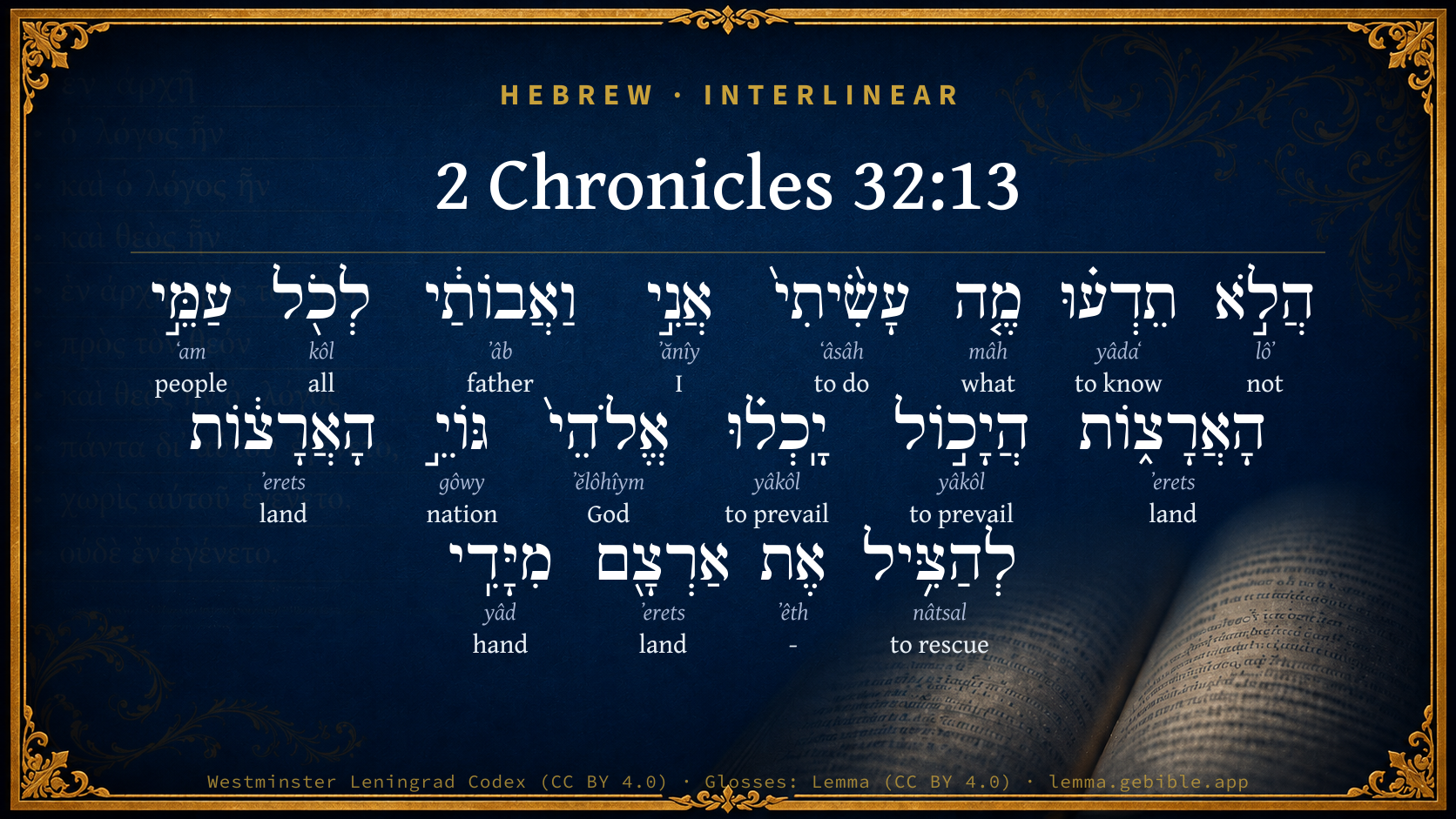
Hebrew (Westminster Leningrad Codex) 2 Chronicles 32:13 appears in the Hebrew Old Testament. The text above is from the Westminster Leningrad Codex. Each word links to its Strong’s number, a concise gloss, and parsing drawn from the Open Scriptures Hebrew Bible morphology. Click any word for its full Brown-Driver-Briggs (BDB) entry.
Download image
Cite this verse

2 Chronicles 32:13 (World English Bible). Public Domain. Lemma interlinear Bible study tool, https://lemma.gebible.app/v/2-chronicles/32/13.

Show BibTeX & RIS
BibTeX
RIS
English Translation
Don't you know what I and my fathers have done to all the peoples of the lands? Were the gods of the nations of the lands in any wise able to deliver their land out of my hand?
World English Bible · Public Domain
Download a study sheet

One document with this verse’s original text, its word-by-word gloss line, the meaning frame, cross-references with their text, attributed commentary, and full source and license credits — printable, and it pastes into notes with its structure intact.

This verse Autodidact and up

Study sheet (.html) Plain text (.txt)

A passage Seminary Student

Up to 50 verses in one chapter. A passage sheet keeps up to 6 commentary sources and 12 cross-references per verse, in the order this page ranks them, and says so on the sheet whenever that leaves anything out. Ask for a single verse and you get the Autodidact verse sheet above.

Everything on this page stays free to read, with no account — the sheet is a download of what is already on screen, not access to it.

Want to remove ads? Support Godless Engineer
Compare translations 3

The same verse in 3 English versions, stacked beneath the original-language interlinear above. Click any original word for its lexicon entry.

Each is an independent rendering of the whole verse — the interlinear is not word-aligned to these translations.

Highlighted words mark where these versions differ — a whole-verse word diff, not a word-by-word alignment.

  • World English Bible Public Domain
    Don't you know what I and my fathers have done to all the peoples of the lands? Were the gods of the nations of the lands in any wise able to deliver their land out of my hand?
  • King James Version Public Domain
    Know ye not what I and my fathers have done unto all the people of other lands? were the gods of the nations of those lands any ways able to deliver their lands out of mine hand?
  • unfoldingWord Literal Text CC BY-SA 4.0
    Do you all not know what I have done, I and my fathers, to all the peoples of the lands? Were the gods of the nations of the lands surely able to deliver their land from my hand?

unfoldingWord Literal Text — © unfoldingWord, licensed CC BY-SA 4.0. Word-aligned USFM3 via Door43 (git.door43.org/unfoldingWord/en_ult).

Versions to compare (up to 4)

3 of 4 selected

Show all 18 translations

Every available English version of this verse, each an independent rendering of the whole verse.

  • World English Bible Public Domain
    Don't you know what I and my fathers have done to all the peoples of the lands? Were the gods of the nations of the lands in any wise able to deliver their land out of my hand?
  • Berean Standard Bible Public Domain
    Do you not know what I and my fathers have done to all the peoples of the lands? Have the gods of these nations ever been able to deliver their land from my hand?
  • Majority Standard Bible Public Domain
    Do you not know what I and my fathers have done to all the peoples of the lands? Have the gods of these nations ever been able to deliver their land from my hand?
  • King James Version Public Domain
    Know ye not what I and my fathers have done unto all the people of other lands? were the gods of the nations of those lands any ways able to deliver their lands out of mine hand?
  • American Standard Version (1901) Public Domain
    Know ye not what I and my fathers have done unto all the peoples of the lands? Were the gods of the nations of the lands in any wise able to deliver their land out of my hand?
  • Revised Version (1885) Public Domain
    Know ye not what I and my fathers have done unto all the peoples of the lands? Were the gods of the nations of the lands any ways able to deliver their land out of mine hand?
  • Geneva Bible (1599) Public Domain
    Knowe ye not what I and my fathers haue done vnto all the people of other countreyes? were the gods of the nations of other landes able to deliuer their land out of mine hande?
  • Douay-Rheims (1899) Public Domain
    Know you not what I and my fathers have done to all the people of the lands? have the gods of any nations and lands been able to deliver their country out of my hand?
  • Young's Literal Translation Public Domain
    `Do ye not know what I have done -- I and my fathers -- to all peoples of the lands? Were the gods of the nations of the lands at all able to deliver their land out of my hand?
  • Literal Standard Version CC BY-SA 4.0
    Do you not know what I have done—I and my fathers—to all peoples of the lands? Were the gods of the nations of the lands at all able to deliver their land out of my hand?
  • Unlocked Literal Bible CC BY-SA 4.0
    Do you not know what I and my ancestors have done to all the peoples of the other lands? Were the gods of the peoples of the surrounding lands able in any way to rescue their land from my power?
  • unfoldingWord Literal Text CC BY-SA 4.0
    Do you all not know what I have done, I and my fathers, to all the peoples of the lands? Were the gods of the nations of the lands surely able to deliver their land from my hand?
  • Darby Bible Public Domain
    Do ye not know what I and my fathers have done to all the peoples of the countries? Were the gods of the nations of the countries in any wise able to deliver their country out of my hand?
  • World Messianic Bible Public Domain
    Don’t you know what I and my fathers have done to all the peoples of the lands? Were the gods of the nations of those lands in any way able to deliver their land out of my hand?
  • Webster's Bible Public Domain
    Know ye not what I and my fathers have done to all the people of other lands? were the gods of the nations of those lands any ways able to deliver their lands out of my hand?
  • Free Bible Version CC BY-SA 4.0
    Don't you know what I and my fathers have done to all the nations of the earth? None of their gods could save them or their lands from me!
  • Bible in Basic English Public Domain
    Have you no knowledge of what I and my fathers have done to all the peoples of every land? were the gods of the nations of those lands able to keep their land from falling into my hands?
  • JPS Tanakh (1917) Public Domain
    Know ye not what I and my fathers have done unto all the peoples of the lands? Were the gods of the nations of the lands in any wise able to deliver their land out of my hand?

Literal Standard Version (2020), Covenant Press — licensed CC BY-SA 4.0. Text via the HelloAO Bible API (eBible.org). Unlocked Literal Bible (unfoldingWord) — licensed CC BY-SA 4.0. Text via the HelloAO Bible API (eBible.org). unfoldingWord Literal Text — © unfoldingWord, licensed CC BY-SA 4.0. Word-aligned USFM3 via Door43 (git.door43.org/unfoldingWord/en_ult). Free Bible Version, Dr. Jonathan Gallagher — licensed CC BY-SA 4.0. Text via the HelloAO Bible API (eBible.org).

Word by word

More ways to search: Search by grammar → Find every occurrence → Compare this word →

Practice this passage: Drill this verse → Learn its vocabulary →

הֲיָכ֣וֹל
yâkôl
H3201
“to prevail”
Particle, Interrogative + Verb, Qal, Infinitive Absolute
Part of Speech
Particle + Verb
Stem
Qal
Form
Infinitive Absolute
Full BDB Definition

Origin: a primitive root

TWOT: 866

to prevail, overcome, endure, have power, be able - (Qal) - to be able, be able to gain or accomplish, be able to endure, be able to reach - to prevail, prevail over or against, overcome, be victor - to have ability, have strength
  1. הֲלֹ֣א lôʼ H3808 “not” Particle, Interrogative + Particle, Negative
  2. תֵדְע֗וּ yâdaʻ H3045 “to know” Verb, Qal, Imperfect, 2nd Person, Masculine, Plural
  3. מֶ֤ה mâh H4100 “what” Particle, Interrogative
  4. עָשִׂ֨יתִי֙ ʻâsâh H6213 “to do” Verb, Qal, Perfect, 1st Person, Common, Singular
  5. אֲנִ֣י ʼănîy H589 “I” Pronoun, Personal, 1st Person, Common, Singular
  6. וַאֲבוֹתַ֔י ʼâb H1 “and · fathers · my” Conjunction + Noun, Common, Masculine, Plural, Construct + Suffix, Personal, 1st Person, Common, Singular
  7. לְכֹ֖ל kôl H3605 “to/for · all of” Preposition + Noun, Common, Masculine, Singular, Construct
  8. עַמֵּ֣י ʻam H5971 “peoples of” Noun, Common, Masculine, Plural, Construct
  9. הָאֲרָצ֑וֹת ʼerets H776 “the · lands” Particle, Definite Article + Noun, Common, Both, Plural, Absolute
  10. יָֽכְל֗וּ yâkôl H3201 “to prevail” Verb, Qal, Perfect, 3rd Person, Common, Plural
  11. אֱלֹהֵי֙ ʼĕlôhîym H430 “God(s) of” Noun, Common, Masculine, Plural, Construct
  12. גּוֹיֵ֣ gôwy H1471 “nations of” Noun, Common, Masculine, Plural, Construct
  13. הָאֲרָצ֔וֹת ʼerets H776 “the · lands” Particle, Definite Article + Noun, Common, Both, Plural, Absolute
  14. לְהַצִּ֥יל nâtsal H5337 “to rescue” Preposition + Verb, Hiphil, Infinitive Construct
  15. אֶת ʼêth H853 “-” Particle, Direct Object
  16. אַרְצָ֖ם ʼerets H776 “land · their” Noun, Common, Both, Singular, Construct + Suffix, Personal, 3rd Person, Masculine, Plural
  17. מִיָּדִֽי yâd H3027 “from · hand · my” Preposition + Noun, Common, Both, Singular, Construct + Suffix, Personal, 1st Person, Common, Singular

About this verse

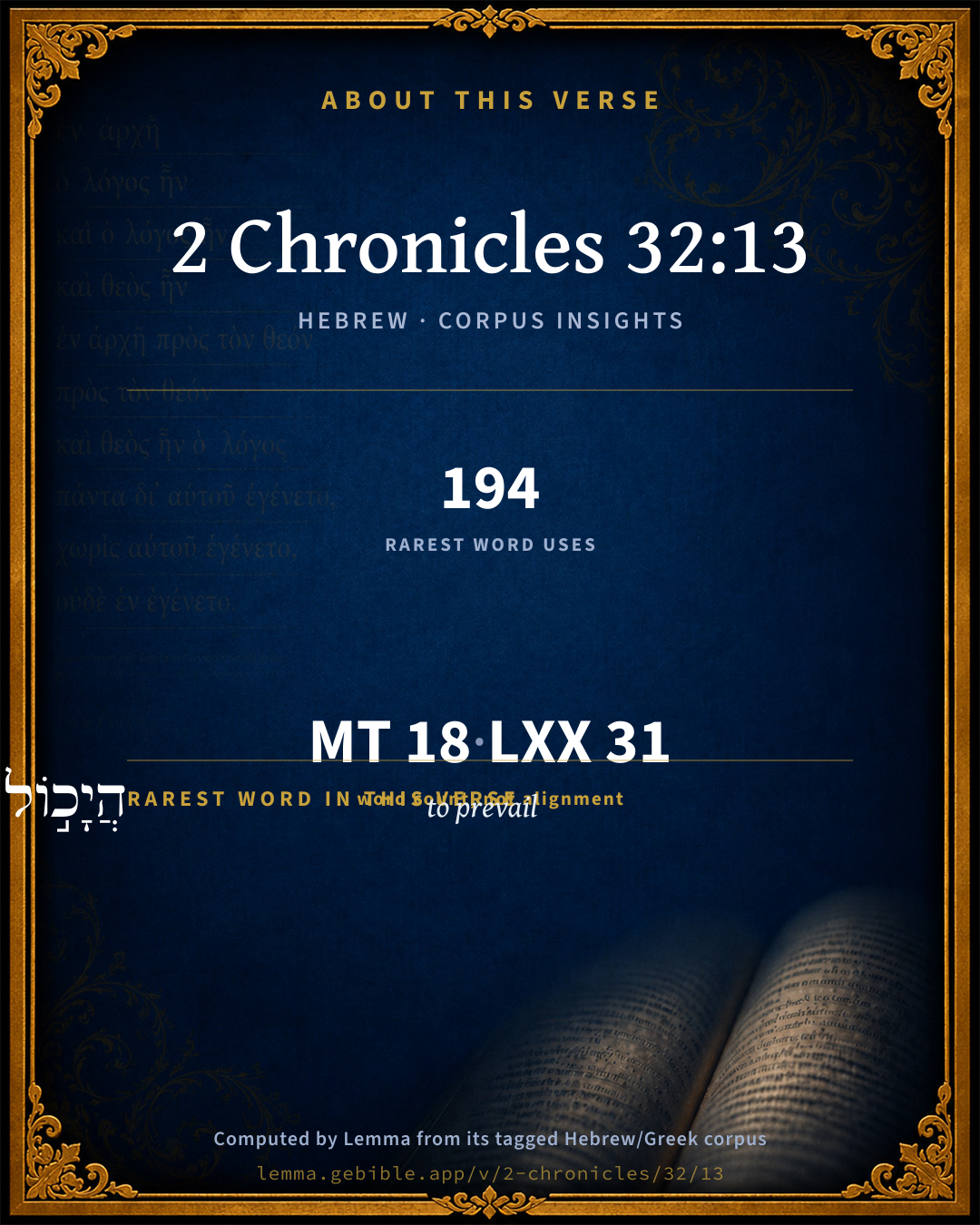
These counts appear in no published source. They are computed here, from the morphology-tagged text and Lemma’s own curated glosses. What Lemma adds →

18
words
15
distinct lemmas
Historical
section

Grammatical profile

  • 5 verbs
  • 9 nouns
  • 1 pronoun
  • 3 particles

Verb forms

  • תֵדְע֗וּ Qal · Imperfect
  • עָשִׂ֨יתִי֙ Qal · Perfect
  • הֲיָכ֣וֹל Qal · Infinitive Absolute
  • יָֽכְל֗וּ Qal · Perfect
  • לְהַצִּ֥יל Hiphil · Infinitive Construct

Repetition

Words recur within this verse — often emphatic in Hebrew:

  • הָאֲרָצ֑וֹת land H776 ×3
  • הֲיָכ֣וֹל to prevail H3201 ×2

Hebrew & Septuagint length

In English translation the verse runs 38 words from the Hebrew and 36 from the Septuagint (LXX English) — closely comparable.

A rough comparison of the two English renderings, which tokenize alike — not a word-level alignment.

Word counts can differ between the Hebrew and the Greek without any difference in meaning — e.g. the Hebrew direct-object marker אֵת has no separate Greek word, and Greek often adds the article ὁ.

In the original languages it is 18 Hebrew tokens and 31 Greek tokens — but the two are counted differently (Hebrew bundles its prefixes and suffixes into one token; the Greek is in lemma form), so that isn’t a like-for-like length.

Cross-references

19

Topical passages linked to 2 Chronicles 32:13 in the Treasury of Scripture Knowledge — connected by theme and wording, ordered by reader-vote popularity; previews shown in the World English Bible.

  • 2 Kings 18:33–35 Has any of the gods of the nations ever delivered his land out of the hand of the king of Assyria?
  • 2 Kings 15:29 In the days of Pekah king of Israel came Tiglath Pileser king of Assyria, and took Ijon, and Abel Beth Maacah, and Janoah, and Kedesh, and Hazor, and Gilead, and Galilee, all the land of Naphtali; and he carried them captive to Assyria.
  • 2 Kings 17:5–6 Then the king of Assyria came up throughout all the land, and went up to Samaria, and besieged it three years.
  • 2 Kings 19:11–13 Behold, you have heard what the kings of Assyria have done to all lands, by destroying them utterly: and shall you be delivered?
  • 2 Kings 19:17–19 Of a truth, Yahweh, the kings of Assyria have laid waste the nations and their lands,
  • 2 Chronicles 32:19 They spoke of the God of Jerusalem, as of the gods of the peoples of the earth, which are the work of men's hands.
  • Psalms 115:3–8 But our God is in the heavens. He does whatever he pleases.
  • Isaiah 10:9–10 Isn't Calno as Carchemish? Isn't Hamath as Arpad? Isn't Samaria as Damascus?
  • Isaiah 10:14 and my hand has found as a nest the riches of the peoples; and as one gathers eggs that are forsaken, have I gathered all the earth: and there was none that moved the wing, or that opened the mouth, or chirped.
  • Isaiah 37:12–13 Have the gods of the nations delivered them, which my fathers have destroyed, Gozan, and Haran, and Rezeph, and the children of Eden who were in Telassar?
  • Isaiah 37:18–20 Of a truth, Yahweh, the kings of Assyria have laid waste all the countries, and their land,
  • Isaiah 44:8–10 Don't fear, neither be afraid: haven't I declared to you of old, and shown it? You are my witnesses. Is there a God besides me? Indeed, there is not. I don't know any Rock.
  • Jeremiah 10:11–12 Thus shall you say to them, The gods that have not made the heavens and the earth, these shall perish from the earth, and from under the heavens.
  • Jeremiah 10:16 The portion of Jacob is not like these; for he is the former of all things; and Israel is the tribe of his inheritance: Yahweh of Hosts is his name.
  • Daniel 4:30 The king spoke and said, Is not this great Babylon, which I have built for the royal dwelling-place, by the might of my power and for the glory of my majesty?
  • Daniel 4:37 Now I, Nebuchadnezzar, praise and extol and honor the King of heaven; for all his works are truth, and his ways justice; and those who walk in pride he is able to abase.
  • Daniel 5:19 and because of the greatness that he gave him, all the peoples, nations, and languages trembled and feared before him: whom he would he killed, and whom he would he kept alive; and whom he would he raised up, and whom he would he put down.
  • 1 Corinthians 8:4 Therefore concerning the eating of things sacrificed to idols, we know that no idol is anything in the world, and that there is no other God but one.
  • Acts 19:26 You see and hear, that not at Ephesus alone, but almost throughout all Asia, this Paul has persuaded and turned away many people, saying that they are no gods, that are made with hands.

Cross-references courtesy of OpenBible.info (CC BY 4.0).

Hebrew and Greek witnesses Masoretic Hebrew ↔ Greek Septuagint

The same verse in the two great witnesses to the Old Testament, shown verse-for-verse.

These are two independent witnesses, not word-aligned to each other, and the Septuagint is shown in lemma (dictionary) form.

Hebrew 2 Chronicles 32:13 Masoretic · Westminster Leningrad Codex

הֲלֹ֣א תֵדְע֗וּ מֶ֤ה עָשִׂ֨יתִי֙ אֲנִ֣י וַאֲבוֹתַ֔י לְכֹ֖ל עַמֵּ֣י הָאֲרָצ֑וֹת הֲיָכ֣וֹל יָֽכְל֗וּ אֱלֹהֵי֙ גּוֹיֵ֣ הָאֲרָצ֔וֹת לְהַצִּ֥יל אֶת אַרְצָ֖ם מִיָּדִֽי

Don't you know what I and my fathers have done to all the peoples of the lands? Were the gods of the nations of the lands in any wise able to deliver their land out of my hand?

World English Bible · Public Domain

Greek LXX 2 Chronicles 32:13 Septuagint · lemma form

οὐ γιγνώσκω ὅς τις ποιέω ἐγώ καί ὁ πατήρ ἐγώ πᾶς ὁ λαός ὁ χώρα μή δύναμαι δύναμαι θεός ὁ ἔθνος πᾶς ὁ γῆ σώζω ὁ λαός αὐτός ἐκ χείρ ἐγώ

Know you⌃ not what I and my fathers have done to all the nations of the countries? Could the gods of the nations of all the earth at all rescue their people out of my hand?

LXX2012 (modern English Septuagint) · Public Domain

Hebrew: Westminster Leningrad Codex (CC BY 4.0). Greek: Septuagint (public domain); English from LXX2012 (modern English Septuagint) (Public Domain). How the Septuagint differs from the Hebrew →

Commentary

Notes on 2 Chronicles 32:13 from classic Christian and Jewish commentators (each source and its license shown beneath its notes). The classic Christian expositions comment on the surrounding passage and are grouped to its opening verse, so a note may address several verses; the Jewish commentaries on the Tanakh (Rashi and others) are per-verse, so they appear only where the commentator wrote on this verse.

Lemma curates 59 commentaries, every one of them public domain or Creative Commons licensed, each selected and text-cleaned for this edition rather than reprinted as found. About our sources →

Trapp's Complete Commentary

John Trapp

2Ch 32:13 Know ye not what I and my fathers have done unto all the people of [other] lands? were the gods of the nations of those lands any ways able to deliver their lands out of mine hand?

Ver. 13. Know you not.] See 2Ki 19:11-12.

John Trapp, A Commentary or Exposition upon All the Books of the Old and New Testament (1647–1656) — public domain. Text from a community e-Sword module.

Ellicott's Commentary for English Readers

(13) What I and my fathers have done.—The Assyrian kings are fond of such references to their predecessors.

The people of other lands.—Rather, the peoples of the countries.

Those lands.—The countries.

Their lands.—Their country. The chronicler omits the names of the vanquished states given in 2Ki_18:34, some of which had probably become obscure by lapse of time.

Assurbanipal relates that in his eighth campaign he carried off the gods of Elam with the other spoils: “His gods, his goddesses, his furniture, his goods, people small and great, I carried off to Assyria;” and he adds the names of nineteen of these deities.

A Bible Commentary for English Readers, edited by Charles John Ellicott (1878–1897) — public domain. Text from a community e-Sword module.

The Cambridge Bible for Schools and Colleges

gen. ed. J. J. S. Perowne

13. the people of other lands] R.V. the peoples of the lands. In 2Ki_18:34 the lands are specified and include Samaria.

of those lands … their lands] R.V. of the lands … their land.

The Cambridge Bible for Schools and Colleges (gen. ed. J. J. S. Perowne; Cambridge University Press, 1878–1918) — public domain. Text from a community e-Sword module.

The Pulpit Commentary

Some of these deeds of Sennacherib and his fathers, i.e. predecessors in the kingdom of Assyria, are mentioned in detail in 2Ki 17., passim.

The Pulpit Commentary (1880–1919), ed. H.D.M. Spence-Jones & Joseph S. Exell — public domain. Text from a community e-Sword module.

unfoldingWord translationNotes

Door43 World Missions Community

Do you not know what ... lands?

Sennacherib uses a rhetorical question to cause the people of Jerusalem to think about their situation. It can be translated as a statement. AT: "You know very well what ... lands!" (See: Rhetorical Question)

Were the gods ... power?

Sennacherib uses a rhetorical question to cause the people of Jerusalem to think about their situation. It can be translated as a statement. AT: "There was no god ... power!" (See: Rhetorical Question)

Among all the gods ... was there any god who ... hand?

Sennacherib uses a rhetorical question to cause the people of Jerusalem to think about their situation. It can be translated as a statement. AT: "There was no god among all the gods ... who ... hand!" (See: Rhetorical Question)

out of my hand

Here "hand" represents power or control. AT: "from my power" or "from me" (See: Metonymy)

Why should your God be able ... power?

Sennacherib uses a rhetorical question to cause the people of Jerusalem to think about their situation. It can be translated as a statement. AT: "There is no reason your God should be able ... power!" (See: Rhetorical Question)

Now

Here the word "now" is used to draw attention to the important point that follows.

How much less will your God rescue you from my hand?

Sennacherib uses a rhetorical question to cause the people of Jerusalem to think about their situation. It can be translated as a statement. AT: "Your God will certainly not be able to rescue you from my hand!" (See: Rhetorical Question)

translationWords

people group

false god

power

deceive

believe

nation

kingdom

unfoldingWord translationNotes — © Distant Shores Media and the Door43 World Missions Community, licensed CC BY-SA 4.0. Source: git.door43.org/Door43/en_tn.

Lesson kit

Teaching starters — assembled from the data on this page, not authored interpretation. Every prompt links to the verse data it draws on. Edit before teaching.

2 Chronicles, in the Historical, opens this verse with 18 words (15 distinct Hebrew lemmas). Its most distinctive word is yâkôl (“to prevail”). A historical commentator’s framing appears above. Read the whole chapter for the surrounding context.

Discussion questions

  1. What does “to prevail” (yâkôl) contribute to the verse as a whole?
  2. How does 2 Kings 18:33–35, which shares this passage’s theme, read alongside this verse?
  3. What does the repetition of “land” (3× in this one verse) do in this verse?
  4. These translations render this verse differently. What is at stake in choosing one wording over another?
  5. «תֵדְע֗וּ» is a Qal Imperfect verb. How does that grammatical form shape the action described?
  6. Compare how Trapp's Complete Commentary and Ellicott's Commentary for English Readers read this verse. Where do they agree or differ?

Things to notice

Reading settings

Reading text

Shown beneath each verse's original-language words.

Old Testament
Old Testament edition

Read the OT as the Masoretic Hebrew (MT) or the Greek Septuagint (LXX).

English shown for the Greek Septuagint (in the Hebrew ↔ Greek comparison).

Comparing translations? Open the Compare panel on any verse page to stack up to four side by side.