
2 Kings 17:11

Hebrew (Westminster Leningrad Codex) 2 Kings 17:11 appears in the Hebrew Old Testament. The text above is from the Westminster Leningrad Codex. Each word links to its Strong’s number, a concise gloss, and parsing drawn from the Open Scriptures Hebrew Bible morphology. Click any word for its full Brown-Driver-Briggs (BDB) entry.
Download image
Cite this verse

2 Kings 17:11 (World English Bible). Public Domain. Lemma interlinear Bible study tool, https://lemma.gebible.app/v/2-kings/17/11.

Show BibTeX & RIS
BibTeX
RIS
English Translation
and there they burnt incense in all the high places, as did the nations whom Yahweh carried away before them; and they worked wicked things to provoke Yahweh to anger;
World English Bible · Public Domain
Download a study sheet

One document with this verse’s original text, its word-by-word gloss line, the meaning frame, cross-references with their text, attributed commentary, and full source and license credits — printable, and it pastes into notes with its structure intact.

This verse Autodidact and up

Study sheet (.html) Plain text (.txt)

A passage Seminary Student

Up to 50 verses in one chapter. A passage sheet keeps up to 6 commentary sources and 12 cross-references per verse, in the order this page ranks them, and says so on the sheet whenever that leaves anything out. Ask for a single verse and you get the Autodidact verse sheet above.

Everything on this page stays free to read, with no account — the sheet is a download of what is already on screen, not access to it.

Want to remove ads? Support Godless Engineer
Compare translations 3

The same verse in 3 English versions, stacked beneath the original-language interlinear above. Click any original word for its lexicon entry.

Each is an independent rendering of the whole verse — the interlinear is not word-aligned to these translations.

Highlighted words mark where these versions differ — a whole-verse word diff, not a word-by-word alignment.

  • World English Bible Public Domain
    and there they burnt incense in all the high places, as did the nations whom Yahweh carried away before them; and they worked wicked things to provoke Yahweh to anger;
  • King James Version Public Domain
    And there they burnt incense in all the high places, as did the heathen whom the LORD carried away before them; and wrought wicked things to provoke the LORD to anger:
  • unfoldingWord Literal Text CC BY-SA 4.0
    And they burned incense there in all of the high places, like the nations that Yahweh had exiled from their faces. And they did evil things, making Yahweh angry.

unfoldingWord Literal Text — © unfoldingWord, licensed CC BY-SA 4.0. Word-aligned USFM3 via Door43 (git.door43.org/unfoldingWord/en_ult).

Versions to compare (up to 4)

3 of 4 selected

Show all 18 translations

Every available English version of this verse, each an independent rendering of the whole verse.

  • World English Bible Public Domain
    and there they burnt incense in all the high places, as did the nations whom Yahweh carried away before them; and they worked wicked things to provoke Yahweh to anger;
  • Berean Standard Bible Public Domain
    They burned incense on all the high places like the nations that the LORD had driven out before them. They did wicked things, provoking the LORD to anger.
  • Majority Standard Bible Public Domain
    They burned incense on all the high places like the nations that the LORD had driven out before them. They did wicked things, provoking the LORD to anger.
  • King James Version Public Domain
    And there they burnt incense in all the high places, as did the heathen whom the LORD carried away before them; and wrought wicked things to provoke the LORD to anger:
  • American Standard Version (1901) Public Domain
    and there they burnt incense in all the high places, as did the nations whom Jehovah carried away before them; and they wrought wicked things to provoke Jehovah to anger;
  • Revised Version (1885) Public Domain
    and there they burnt incense in all the high places, as did the nations whom the LORD carried away before them; and wrought wicked things to provoke the LORD to anger:
  • Geneva Bible (1599) Public Domain
    And there burnt incense in all the hie places, as did the heathen, whom the Lord had taken away before them, and wrought wicked things to anger the Lord,
  • Douay-Rheims (1899) Public Domain
    And they burnt incense there upon altars after the manner of the nations which the Lord had removed from their face: and they did wicked things, provoking the Lord.
  • Young's Literal Translation Public Domain
    and make perfume there in all high places, like the nations that Jehovah removed from their presence, and do evil things to provoke Jehovah,
  • Literal Standard Version CC BY-SA 4.0
    and make incense there in all high places, like the nations that YHWH removed from their presence, and do evil things to provoke YHWH,
  • Unlocked Literal Bible CC BY-SA 4.0
    There they burned incense in all the high places, as the nations had done, those whom Yahweh had carried away before them. The Israelites performed wicked things to provoke Yahweh to anger;
  • unfoldingWord Literal Text CC BY-SA 4.0
    And they burned incense there in all of the high places, like the nations that Yahweh had exiled from their faces. And they did evil things, making Yahweh angry.
  • Darby Bible Public Domain
    and there they burned incense on all the high places, as did the nations that Jehovah had carried away from before them, and they wrought wicked things to provoke Jehovah to anger;
  • World Messianic Bible Public Domain
    and there they burned incense in all the high places, as the nations whom the LORD carried away before them did; and they did wicked things to provoke the LORD to anger;
  • Webster's Bible Public Domain
    And there they burnt incense on all the high places, as did the heathen whom the LORD carried away before them; and wrought wicked things to provoke the LORD to anger:
  • Free Bible Version CC BY-SA 4.0
    They offered sacrifices on all the high places, just like the nations the Lord drove out before them. They did evil things, angering the Lord.
  • Bible in Basic English Public Domain
    Burning their offerings in all the high places, as those nations did whom the Lord sent away from before them; they did evil things, moving the Lord to wrath;
  • JPS Tanakh (1917) Public Domain
    and there they offered in all the high places, as did the nations whom the LORD carried away before them; and wrought wicked things to provoke the LORD;

Literal Standard Version (2020), Covenant Press — licensed CC BY-SA 4.0. Text via the HelloAO Bible API (eBible.org). Unlocked Literal Bible (unfoldingWord) — licensed CC BY-SA 4.0. Text via the HelloAO Bible API (eBible.org). unfoldingWord Literal Text — © unfoldingWord, licensed CC BY-SA 4.0. Word-aligned USFM3 via Door43 (git.door43.org/unfoldingWord/en_ult). Free Bible Version, Dr. Jonathan Gallagher — licensed CC BY-SA 4.0. Text via the HelloAO Bible API (eBible.org).

Word by word

More ways to search: Search by grammar → Find every occurrence → Compare this word →

Practice this passage: Drill this verse → Learn its vocabulary →

לְהַכְעִ֖יס
kaʻaç
H3707
“to be angry”
Preposition + Verb, Hiphil, Infinitive Construct
Part of Speech
Preposition + Verb
Stem
Hiphil
Form
Infinitive Construct
Full BDB Definition

Origin: a primitive root

TWOT: 1016

to be angry, be vexed, be indignant, be wroth, be grieved, provoke to anger and wrath - (Qal) - to be vexed, be indignant - to be angry - (Piel) to provoke to anger - (Hiphil) - to vex - to vex, provoke to anger
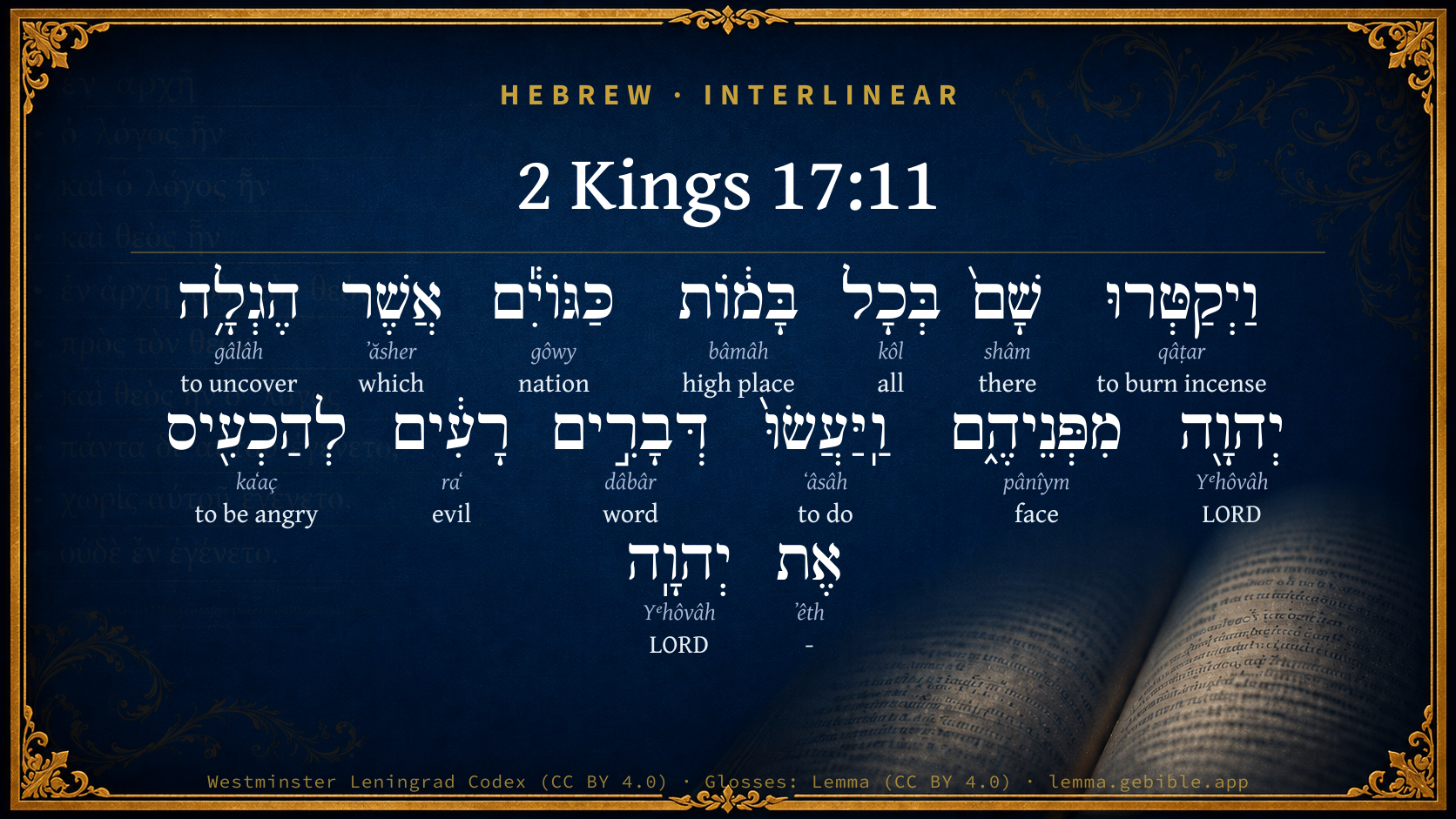
  1. וַיְקַטְּרוּ qâṭar H6999 “and · to burn incense” Conjunction + Verb, Piel, Sequential Imperfect, 3rd Person, Masculine, Plural
  2. שָׁם֙ shâm H8033 “there” Adverb
  3. בְּכָל kôl H3605 “in/at · all of” Preposition + Noun, Common, Masculine, Singular, Construct
  4. בָּמ֔וֹת bâmâh H1116 “high places” Noun, Common, Feminine, Plural, Absolute
  5. כַּגּוֹיִ֕ם gôwy H1471 “like/as the · nations” Preposition, Determined + Noun, Common, Masculine, Plural, Absolute
  6. אֲשֶׁר ʼăsher H834 “which” Particle, Relative
  7. הֶגְלָ֥ה gâlâh H1540 “to uncover” Verb, Hiphil, Perfect, 3rd Person, Masculine, Singular
  8. יְהוָ֖ה Yᵉhôvâh H3068 “LORD” Noun, Proper
  9. מִפְּנֵיהֶ֑ם pânîym H6440 “from · face(s) · their” Preposition + Noun, Common, Both, Plural, Construct + Suffix, Personal, 3rd Person, Masculine, Plural
  10. וַֽיַּעֲשׂוּ֙ ʻâsâh H6213 “and · to do” Conjunction + Verb, Qal, Sequential Imperfect, 3rd Person, Masculine, Plural
  11. דְּבָרִ֣ים dâbâr H1697 “words” Noun, Common, Masculine, Plural, Absolute
  12. רָעִ֔ים raʻ H7451 “evil” Adjective, Adjective, Masculine, Plural, Absolute
  13. אֶת ʼêth H853 “-” Particle, Direct Object
  14. יְהוָֽה Yᵉhôvâh H3068 “LORD” Noun, Proper

About this verse

These counts appear in no published source. They are computed here, from the morphology-tagged text and Lemma’s own curated glosses. What Lemma adds →

15
words
14
distinct lemmas
Historical
section

Shared distinctive vocabulary

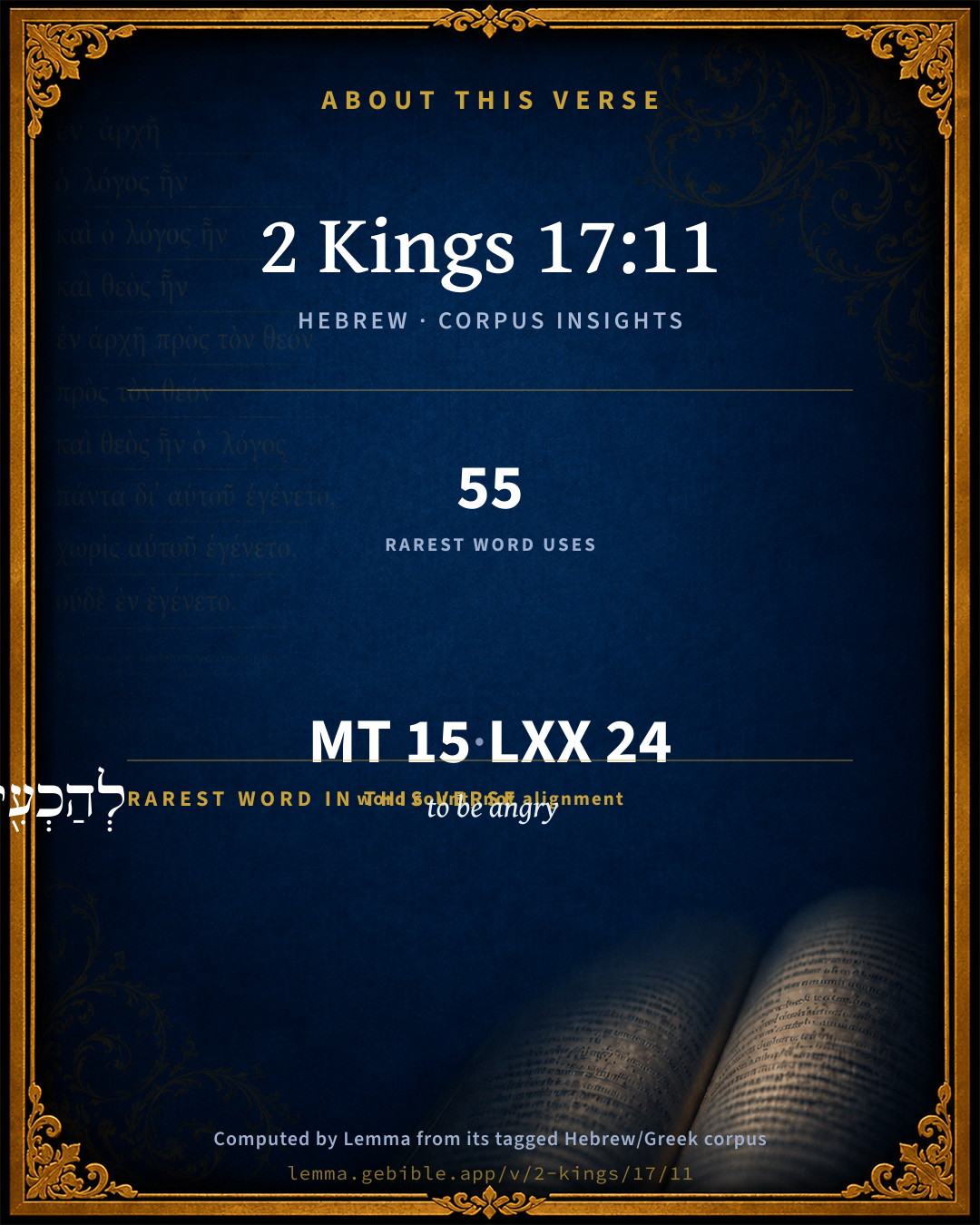
לְהַכְעִ֖יס to be angry H3707 occurs in 53 verses of the Hebrew Bible. Also found in:

Grammatical profile

  • 4 verbs
  • 7 nouns
  • 1 adjective
  • 1 adverb
  • 2 particles

Verb forms

  • וַיְקַטְּרוּ Piel · Sequential Imperfect
  • הֶגְלָ֥ה Hiphil · Perfect
  • וַֽיַּעֲשׂוּ֙ Qal · Sequential Imperfect
  • לְהַכְעִ֖יס Hiphil · Infinitive Construct

Repetition

A word recurs within this verse — often emphatic in Hebrew:

  • יְהוָ֖ה LORD H3068 ×2

Hebrew & Septuagint length

In English translation the verse runs 30 words from the Hebrew and 34 from the Septuagint (LXX English) — closely comparable.

A rough comparison of the two English renderings, which tokenize alike — not a word-level alignment.

Word counts can differ between the Hebrew and the Greek without any difference in meaning — e.g. the Hebrew direct-object marker אֵת has no separate Greek word, and Greek often adds the article ὁ.

In the original languages it is 15 Hebrew tokens and 24 Greek tokens — but the two are counted differently (Hebrew bundles its prefixes and suffixes into one token; the Greek is in lemma form), so that isn’t a like-for-like length.

Cross-references

5

Topical passages linked to 2 Kings 17:11 in the Treasury of Scripture Knowledge — connected by theme and wording, ordered by reader-vote popularity; previews shown in the World English Bible.

  • 1 Kings 13:1 Behold, there came a man of God out of Judah by the word of Yahweh to Beth El: and Jeroboam was standing by the altar to burn incense.
  • 2 Kings 21:6 He made his son to pass through the fire, and practiced sorcery, and used enchantments, and dealt with those who had familiar spirits, and with wizards: he worked much evil in the sight of Yahweh, to provoke him to anger.
  • 2 Chronicles 28:25 In every city of Judah he made high places to burn incense to other gods, and provoked to anger Yahweh, the God of his fathers.
  • Psalms 78:56–58 Yet they tempted and rebelled against the Most High God, And didn't keep his testimonies;
  • Jeremiah 44:17 But we will certainly perform every word that is gone forth out of our mouth, to burn incense to the queen of the sky, and to pour out drink-offerings to her, as we have done, we and our fathers, our kings and our princes, in the cities of Judah, and in the streets of Jerusalem; for then had we plenty of food, and were well, and saw no evil.

Cross-references courtesy of OpenBible.info (CC BY 4.0).

Hebrew and Greek witnesses Masoretic Hebrew ↔ Greek Septuagint

The same verse in the two great witnesses to the Old Testament, shown verse-for-verse.

These are two independent witnesses, not word-aligned to each other, and the Septuagint is shown in lemma (dictionary) form.

Hebrew 2 Kings 17:11 Masoretic · Westminster Leningrad Codex

וַיְקַטְּרוּ שָׁם֙ בְּכָל בָּמ֔וֹת כַּגּוֹיִ֕ם אֲשֶׁר הֶגְלָ֥ה יְהוָ֖ה מִפְּנֵיהֶ֑ם וַֽיַּעֲשׂוּ֙ דְּבָרִ֣ים רָעִ֔ים לְהַכְעִ֖יס אֶת יְהוָֽה

and there they burnt incense in all the high places, as did the nations whom Yahweh carried away before them; and they worked wicked things to provoke Yahweh to anger;

World English Bible · Public Domain

Greek LXX 2 Kings 17:11 Septuagint · lemma form

καί θυμιάζω ἐκεῖ ἐν πᾶς ὑψηλός καθώς ὁ ἔθνος ὅς ἀποοἰκίζω κύριος ἐκ πρόσωπον αὐτός καί ποιέω κοινωνός καί χαράσσω ὁ παραὀργίζω ὁ κύριος

And burned incense there on all high places, as the nations did whom the Lord removed from before them, and dealt with familiar spirits, and they carved images to provoke the Lord to anger.

LXX2012 (modern English Septuagint) · Public Domain

Hebrew: Westminster Leningrad Codex (CC BY 4.0). Greek: Septuagint (public domain); English from LXX2012 (modern English Septuagint) (Public Domain). How the Septuagint differs from the Hebrew →

Targum (Aramaic paraphrase)

1

The Targum is the ancient Jewish Aramaic paraphrase of the Hebrew Scriptures — an interpretive translation, not the Hebrew text itself. Onkelos (literal) and Pseudo-Jonathan (expansive) render the Torah, and Jonathan the Prophets. Coverage is partial: where no permissively-licensed English translation exists for a verse, only the Aramaic is shown. This is verse-level text, not a word-by-word alignment to the Hebrew.

  1. Targum Jonathan Prophets (Joshua–Malachi)
    וְאַסִיקוּ בוּסְמִין תַּמָן עַל כָּל בָּמָתָא בְּעַמְמַיָא דְאַגְלֵי יְיָ מִן קֳדָמֵיהוֹן וַעֲבַדוּ קֳדָמוֹהִי פִּתְגָמִין בִּישִׁין לְאַרְגָזָא קֳדָם יְיָ:

    (no public-domain English translation for this verse)

    Targum Jonathan — Aramaic: “Mikraot Gedolot” (public domain). English: “Sefaria Community Translation” (CC0 1.0 (public-domain dedication)); “London "Chaldee Paraphrase," 1871” (public domain). Text via Sefaria.

Commentary

Notes on 2 Kings 17:11 from classic Christian and Jewish commentators (each source and its license shown beneath its notes). The classic Christian expositions comment on the surrounding passage and are grouped to its opening verse, so a note may address several verses; the Jewish commentaries on the Tanakh (Rashi and others) are per-verse, so they appear only where the commentator wrote on this verse.

Lemma curates 59 commentaries, every one of them public domain or Creative Commons licensed, each selected and text-cleaned for this edition rather than reprinted as found. About our sources →

Trapp's Complete Commentary

John Trapp

2Ki 17:11 And there they burnt incense in all the high places, as [did] the heathen whom the LORD carried away before them; and wrought wicked things to provoke the LORD to anger:

Ver. 11. To provoke the Lord to anger.] As if they had done all this expressly and on purpose.

John Trapp, A Commentary or Exposition upon All the Books of the Old and New Testament (1647–1656) — public domain. Text from a community e-Sword module.

Joseph Benson's Commentary

2Ki 17:11. They burned incense, as did the heathen — Namely, in high places; and that not only to the Lord, which, though an irregularity, was practised and tolerated sometimes, even in the kingdom of Judah, but also to the idols of the heathen. Whom the Lord carried away before them — For the same sins; by whose example they ought to have taken warning. To provoke the Lord to anger — That is, in despite and contempt of God, and his authority and command, as the next verse shows.

Joseph Benson's Commentary on the Old and New Testaments (1811–1818) — public domain. Text from a community e-Sword module.

Tyndale Open Study Notes

Tyndale Open Resources

17:11 arousing the Lord’s anger: When God becomes angry, he is not vindictive or bad tempered. Instead, human evil angers him because people have rebelled against God and done evil to one another. God responds to human evil with his justice in dealing with sin and evil (see also 13:3; 17:17-18; 21:6; 22:13, 17; 23:26-27; 24:20; Rom 3:23; 6:23; 14:10; 2 Cor 5:10; Col 3:6; 1 Jn 1:8-10).

Tyndale Open Study Notes — © Tyndale Open Resources, licensed CC BY-SA 4.0. Text via the HelloAO Bible API.

Ellicott's Commentary for English Readers

(11) Wrought wicked things.—Not merely idolatrous rites, but also the hideous immoralities which constituted a recognised part of the nature - worships of Canaan.

A Bible Commentary for English Readers, edited by Charles John Ellicott (1878–1897) — public domain. Text from a community e-Sword module.

The Cambridge Bible for Schools and Colleges

gen. ed. J. J. S. Perowne

11. as did the heathen] R.V. the nations. And so again in verse 15. When a distinction is to be marked between God’s people and idolaters, ‘heathen’ is a fair rendering for goyim. But here when there is no such marked severance ‘nations’ is the better translation.

The Cambridge Bible for Schools and Colleges (gen. ed. J. J. S. Perowne; Cambridge University Press, 1878–1918) — public domain. Text from a community e-Sword module.

John Gill's Exposition

And there they burnt incense in all the high places,.... As even the tribe of Judah did, which is observed in all the preceding reigns:

as did the Heathen whom the Lord carried away before them: the Canaanites, and therefore they might justly expect to be carried captive also:

and wrought wicked things to provoke the Lord to anger: by their several immoralities, but especially their idolatries.

John Gill's Exposition of the Whole Bible (1746–1763) — public domain (CC PDM 1.0). Text via the HelloAO Bible API.

Albert Barnes' Notes on the Bible

The burning of incense was a common religious practice among the Egyptians and the Babylonians; and from the present passage we gather that the Canaanite nations practiced it as one of their ordinary sacred rites. The Israelites are frequently reproached with it Hos 2:13; Hos 4:13; Isa 65:3.

Albert Barnes' Notes on the Bible (1834–1885) — public domain. Text from a community e-Sword/MySword module.

Haydock's Catholic Bible Commentary

Removed by the sword, (Menochius) or by flight. (Haydock)

George Leo Haydock (1774–1849), Haydock's Catholic Family Bible and Commentary, 1859 edition — public domain. Excludes Psalms (Douay-Rheims chapter numbering differs from Protestant) and Deuterocanonical books (Catholic canon only).

Matthew Poole's English Annotations

As did the heathen; not only to the Lord, which was practised and tolerated sometimes in the kingdom of Judah; but also to the idols or Baals of the heathen.

Whom the Lord carried away before them for the same sins; by whose example they should have taken warning.

To provoke the Lord to anger, i.e. in despite and contempt of God, and his authority and command, as the next verse shows.

Matthew Poole's English Annotations on the Holy Bible (1683–1685) — public domain. Text from a community e-Sword/MySword module.

The Pulpit Commentary

And there they burnt incense in all the high places. (comp. 1Ki_3:3 1Ki_22:43; 2Ki_12:3 2Ki_14:4 2Ki_15:4, 35 16:4) Incense symbolized prayer, (Psa_141:2) and ought to have been burnt only on the golden altar of incense within the veil. As did the heathen whom the Lord carried away before them. The offering of incense to their gods by the Canaanitish nations had not been previously mentioned; but the use of incense in religious worship was so widely spread in the ancient world, that their employment of it might have been assumed as almost certain. The Egyptians used incense largely in the worship of Ammon ("Records of the Past," vol. 10. p. 19). The Babylonians burnt a thousand talents" weight of it every year at the great festival of Bel-Merodach (Herod., 1:183). The Greeks and Romans offered it with every sacrifice. And wrought wicked things to provoke the Lord to anger (see below, vers. 15-17).

The Pulpit Commentary (1880–1919), ed. H.D.M. Spence-Jones & Joseph S. Exell — public domain. Text from a community e-Sword module.

unfoldingWord translationNotes

Door43 World Missions Community

General Information:

The narrative continues to summarize Yahweh's judgment on Israel.

performed wicked things to provoke Yahweh to anger

Possible ways to render this: 1) "did many wicked things that caused Yahweh to become angry" or 2) "did many sinful things that made Yahweh angry"

about which Yahweh had said to them

"about which Yahweh had warned them"

translationWords

incense

nation

evil

anger

worship

false god

unfoldingWord translationNotes — © Distant Shores Media and the Door43 World Missions Community, licensed CC BY-SA 4.0. Source: git.door43.org/Door43/en_tn.

Lesson kit

Teaching starters — assembled from the data on this page, not authored interpretation. Every prompt links to the verse data it draws on. Edit before teaching.

2 Kings, in the Historical, opens this verse with 15 words (14 distinct Hebrew lemmas). Its most distinctive word is kaʻaç (“to be angry”). A historical commentator’s framing appears above. Read the whole chapter for the surrounding context.

Discussion questions

  1. The word kaʻaç carries the sense “to be angry.” How does it shape the verse?
  2. Deuteronomy 4:25 shares the word «to be angry» with this verse. How do the two illuminate each other?
  3. “LORD” occurs 2× in this one verse. What is the effect of the repetition?
  4. These translations render this verse differently; the difference is in the English rendering, not the original. What questions does that raise?
  5. The verb «וַיְקַטְּרוּ» is Piel Sequential Imperfect. How does its form color the action?
  6. Reading how Trapp's Complete Commentary and Joseph Benson's Commentary read this verse, where do the two commentators agree and where do they part?

Things to notice

Reading settings

Reading text

Shown beneath each verse's original-language words.

Old Testament
Old Testament edition

Read the OT as the Masoretic Hebrew (MT) or the Greek Septuagint (LXX).

English shown for the Greek Septuagint (in the Hebrew ↔ Greek comparison).

Comparing translations? Open the Compare panel on any verse page to stack up to four side by side.