
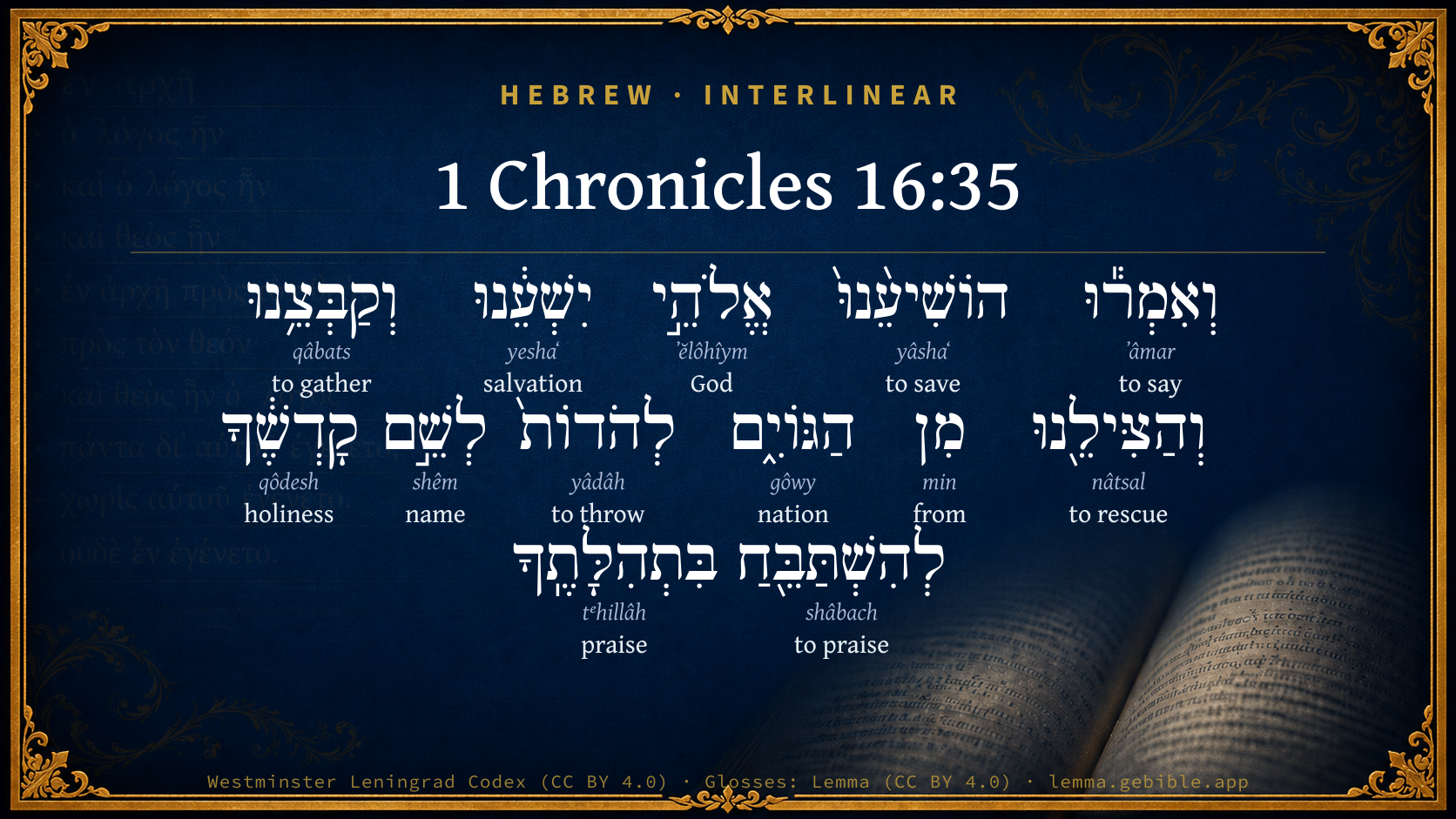
1 Chronicles 16:35

Hebrew (Westminster Leningrad Codex) 1 Chronicles 16:35 appears in the Hebrew Old Testament. The text above is from the Westminster Leningrad Codex. Each word links to its Strong’s number, a concise gloss, and parsing drawn from the Open Scriptures Hebrew Bible morphology. Click any word for its full Brown-Driver-Briggs (BDB) entry.
Download image
Cite this verse

1 Chronicles 16:35 (World English Bible). Public Domain. Lemma interlinear Bible study tool, https://lemma.gebible.app/v/1-chronicles/16/35.

Show BibTeX & RIS
BibTeX
RIS
English Translation
Say you, Save us, God of our salvation, Gather us together and deliver us from the nations, To give thanks to your holy name, To triumph in your praise.
World English Bible · Public Domain
Highlights
  • 1 first appearance in the Hebrew Bible
Full analysis ↓
Download a study sheet

One document with this verse’s original text, its word-by-word gloss line, the meaning frame, cross-references with their text, attributed commentary, and full source and license credits — printable, and it pastes into notes with its structure intact.

This verse Autodidact and up

Study sheet (.html) Plain text (.txt)

A passage Seminary Student

Up to 50 verses in one chapter. A passage sheet keeps up to 6 commentary sources and 12 cross-references per verse, in the order this page ranks them, and says so on the sheet whenever that leaves anything out. Ask for a single verse and you get the Autodidact verse sheet above.

Everything on this page stays free to read, with no account — the sheet is a download of what is already on screen, not access to it.

Want to remove ads? Support Godless Engineer
Compare translations 3

The same verse in 3 English versions, stacked beneath the original-language interlinear above. Click any original word for its lexicon entry.

Each is an independent rendering of the whole verse — the interlinear is not word-aligned to these translations.

Highlighted words mark where these versions differ — a whole-verse word diff, not a word-by-word alignment.

  • World English Bible Public Domain
    Say you, Save us, God of our salvation, Gather us together and deliver us from the nations, To give thanks to your holy name, To triumph in your praise.
  • King James Version Public Domain
    And say ye, Save us, O God of our salvation, and gather us together, and deliver us from the heathen, that we may give thanks to thy holy name, and glory in thy praise.
  • unfoldingWord Literal Text CC BY-SA 4.0
    And say, “Save us, God of our salvation, and gather us and deliver us from the nations, to give thanks to the name of your holiness, to glory ourselves in your praise.”

unfoldingWord Literal Text — © unfoldingWord, licensed CC BY-SA 4.0. Word-aligned USFM3 via Door43 (git.door43.org/unfoldingWord/en_ult).

Versions to compare (up to 4)

3 of 4 selected

Show all 18 translations

Every available English version of this verse, each an independent rendering of the whole verse.

  • World English Bible Public Domain
    Say you, Save us, God of our salvation, Gather us together and deliver us from the nations, To give thanks to your holy name, To triumph in your praise.
  • Berean Standard Bible Public Domain
    Then cry out: ‘Save us, O God of our salvation; gather and deliver us from the nations, that we may give thanks to Your holy name, that we may glory in Your praise.’
  • Majority Standard Bible Public Domain
    Then cry out: ‘Save us, O God of our salvation; gather and deliver us from the nations, that we may give thanks to Your holy name, that we may glory in Your praise.’
  • King James Version Public Domain
    And say ye, Save us, O God of our salvation, and gather us together, and deliver us from the heathen, that we may give thanks to thy holy name, and glory in thy praise.
  • American Standard Version (1901) Public Domain
    And say ye, Save us, O God of our salvation, And gather us together and deliver us from the nations, To give thanks unto thy holy name, And to triumph in thy praise.
  • Revised Version (1885) Public Domain
    And say ye, Save us, O God of our salvation, and gather us together and deliver us from the nations, to give thanks unto thy holy name, and to triumph in thy praise.
  • Geneva Bible (1599) Public Domain
    And say ye, Saue vs, O God, our saluation, and gather vs, and deliuer vs from the heathen, that we may prayse thine holy Name, and glorie in thy praise.
  • Douay-Rheims (1899) Public Domain
    And say ye: Save us, O God our saviour: and gather us together, and deliver us from the nations, that we may give glory to thy holy name, and may rejoice in singing thy praises.
  • Young's Literal Translation Public Domain
    And say, Save us, O God of our salvation, And gather us, and deliver us from the nations, To give thanks to Thy holy name, To triumph in Thy praise.
  • Literal Standard Version CC BY-SA 4.0
    And say, Save us, O God of our salvation, || And gather us, and deliver us from the nations, || To give thanks to Your Holy Name, || To triumph in Your praise.
  • Unlocked Literal Bible CC BY-SA 4.0
    Then say, “Save us, God of our salvation. Gather us together and rescue us from the other nations, so that we may give thanks to your holy name and glory in your praises.”
  • unfoldingWord Literal Text CC BY-SA 4.0
    And say, “Save us, God of our salvation, and gather us and deliver us from the nations, to give thanks to the name of your holiness, to glory ourselves in your praise.”
  • Darby Bible Public Domain
    And say, Save us, O God of our salvation, And gather us, and deliver us from the nations, To give thanks unto thy holy name, To triumph in thy praise.
  • World Messianic Bible Public Domain
    Say, “Save us, God of our salvation! Gather us together and deliver us from the nations, to give thanks to your holy name, to triumph in your praise.”
  • Webster's Bible Public Domain
    And say ye, Save us, O God of our salvation, and gather us together, and deliver us from the heathen, that we may give thanks to thy holy name, and glory in thy praise.
  • Free Bible Version CC BY-SA 4.0
    Shout out, “Save us, Lord, our God! Bring us back together from among the nations, rescue us, so we can thank you and praise how magnificent and holy you are.”
  • Bible in Basic English Public Domain
    And say, Be our saviour, O God of our salvation, and let us come back, and give us salvation from the nations, so that we may give honour to your holy name and have glory in your praise.
  • JPS Tanakh (1917) Public Domain
    And say ye: 'Save us, O God of our salvation, and gather us together and deliver us from the nations, that we may give thanks unto Thy holy name, that we may triumph in Thy praise.'

Literal Standard Version (2020), Covenant Press — licensed CC BY-SA 4.0. Text via the HelloAO Bible API (eBible.org). Unlocked Literal Bible (unfoldingWord) — licensed CC BY-SA 4.0. Text via the HelloAO Bible API (eBible.org). unfoldingWord Literal Text — © unfoldingWord, licensed CC BY-SA 4.0. Word-aligned USFM3 via Door43 (git.door43.org/unfoldingWord/en_ult). Free Bible Version, Dr. Jonathan Gallagher — licensed CC BY-SA 4.0. Text via the HelloAO Bible API (eBible.org).

Word by word

More ways to search: Search by grammar → Find every occurrence → Compare this word →

Practice this passage: Drill this verse → Learn its vocabulary →

לְהִשְׁתַּבֵּ֖חַ
shâbach
H7623
“to praise”
Preposition + Verb, Hithpael, Infinitive Construct
Part of Speech
Preposition + Verb
Stem
Hithpael
Form
Infinitive Construct
Full BDB Definition

Origin: a primitive root

TWOT: 2312 , 2313

to soothe, still, stroke - (Piel) to soothe, still - (Hiphil) stilling (participle) - to laud, praise, commend - (Piel) - to laud, praise (God) - to commend, congratulate (the dead) - (Hithpael) to boast
  1. וְאִמְר֕וּ ʼâmar H559 “and · say” Conjunction + Verb, Qal, Imperative, 2nd Person, Masculine, Plural
  2. הוֹשִׁיעֵ֨נוּ֙ yâshaʻ H3467 “save · us” Verb, Hiphil, Imperative, 2nd Person, Masculine, Singular + Suffix, Personal, 1st Person, Common, Plural
  3. אֱלֹהֵ֣י ʼĕlôhîym H430 “God(s) of” Noun, Common, Masculine, Plural, Construct
  4. יִשְׁעֵ֔נוּ yeshaʻ H3468 “salvation · our” Noun, Common, Masculine, Singular, Construct + Suffix, Personal, 1st Person, Common, Plural
  5. וְקַבְּצֵ֥נוּ qâbats H6908 “and · gather · us” Conjunction + Verb, Piel, Imperative, 2nd Person, Masculine, Singular + Suffix, Personal, 1st Person, Common, Plural
  6. וְהַצִּילֵ֖נוּ nâtsal H5337 “and · rescue · us” Conjunction + Verb, Hiphil, Imperative, 2nd Person, Masculine, Singular + Suffix, Personal, 1st Person, Common, Plural
  7. מִן min H4480 “from” Preposition
  8. הַגּוֹיִ֑ם gôwy H1471 “the · nations” Particle, Definite Article + Noun, Common, Masculine, Plural, Absolute
  9. לְהֹדוֹת֙ yâdâh H3034 “to throw” Preposition + Verb, Hiphil, Infinitive Construct
  10. לְשֵׁ֣ם shêm H8034 “to/for · name of” Preposition + Noun, Common, Masculine, Singular, Construct
  11. קָדְשֶׁ֔ךָ qôdesh H6944 “holiness · your” Noun, Common, Masculine, Singular, Construct + Suffix, Personal, 2nd Person, Masculine, Singular
  12. בִּתְהִלָּתֶֽךָ tᵉhillâh H8416 “in/at · praise · your” Preposition + Noun, Common, Feminine, Singular, Construct + Suffix, Personal, 2nd Person, Masculine, Singular

About this verse

These counts appear in no published source. They are computed here, from the morphology-tagged text and Lemma’s own curated glosses. What Lemma adds →

13
words
13
distinct lemmas
Historical
section

Notable vocabulary

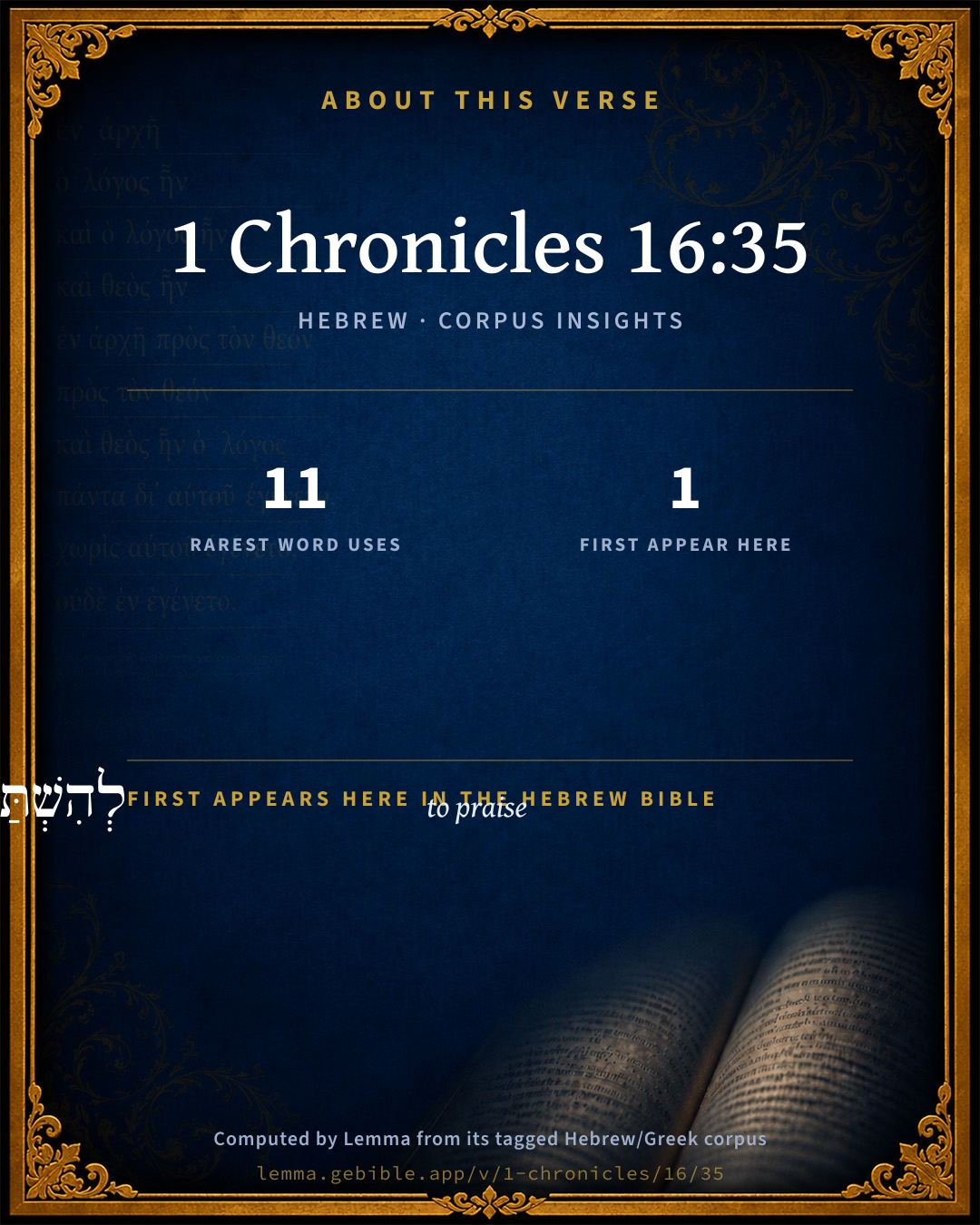
The rarest word here is לְהִשְׁתַּבֵּ֖חַ to praise H7623 — appearing just 11 times in the whole Hebrew Bible.

First appearance in Scripture

This word makes its first canonical appearance in the Hebrew Bible here:

  • לְהִשְׁתַּבֵּ֖חַ to praise H7623

Shared distinctive vocabulary

לְהִשְׁתַּבֵּ֖חַ to praise H7623 occurs in 11 verses of the Hebrew Bible. Also found in:

Grammatical profile

  • 6 verbs
  • 6 nouns
  • 1 preposition

Verb forms

  • וְאִמְר֕וּ Qal · Imperative
  • הוֹשִׁיעֵ֨נוּ֙ Hiphil · Imperative
  • וְקַבְּצֵ֥נוּ Piel · Imperative
  • וְהַצִּילֵ֖נוּ Hiphil · Imperative
  • לְהֹדוֹת֙ Hiphil · Infinitive Construct
  • לְהִשְׁתַּבֵּ֖חַ Hithpael · Infinitive Construct

Hebrew & Septuagint length

In English translation the verse runs 29 words from the Hebrew and 32 from the Septuagint (LXX English) — closely comparable.

A rough comparison of the two English renderings, which tokenize alike — not a word-level alignment.

Word counts can differ between the Hebrew and the Greek without any difference in meaning — e.g. the Hebrew direct-object marker אֵת has no separate Greek word, and Greek often adds the article ὁ.

Cross-references

13

Topical passages linked to 1 Chronicles 16:35 in the Treasury of Scripture Knowledge — connected by theme and wording, ordered by reader-vote popularity; previews shown in the World English Bible.

  • Psalms 106:47–48 Save us, Yahweh, our God, Gather us from among the nations, To give thanks to your holy name, To triumph in your praise!
  • 1 Peter 2:9 But you are a chosen race, a royal priesthood, a holy nation, a people for God's own possession, that you may show forth the excellencies of him who called you out of darkness into his marvelous light:
  • Psalms 79:9–10 Help us, God of our salvation, for the glory of your name. Deliver us, and forgive our sins, for your name's sake.
  • Psalms 14:7 Oh that the salvation of Israel would come out of Zion! When Yahweh restores the fortunes of his people, Then Jacob shall rejoice, and Israel shall be glad.
  • Isaiah 43:21 the people which I formed for myself, that they might set forth my praise.
  • 1 Peter 2:5 You also, as living stones, are built up as a spiritual house, to be a holy priesthood, to offer up spiritual sacrifices, acceptable to God through Jesus Christ.
  • 1 Chronicles 16:9–10 Sing to him, sing praises to him; Talk you of all his marvelous works.
  • Psalms 44:8 In God we have made our boast all day long, We will give thanks to your name forever. Selah.
  • Psalms 53:6 Oh that the salvation of Israel would come out of Zion! When God brings back the captivity of his people, Then Jacob shall rejoice. Israel shall be glad.
  • Psalms 105:45 That they might keep his statutes, And observe his laws. Praise Yah!
  • Isaiah 45:25 In Yahweh shall all the seed of Israel be justified, and shall glory.
  • 1 Corinthians 1:31 that, according as it is written, "He who boasts, let him boast in the Lord."
  • Ephesians 1:12 to the end that we should be to the praise of his glory, we who had before hoped in Christ:

Cross-references courtesy of OpenBible.info (CC BY 4.0).

Hebrew and Greek witnesses Masoretic Hebrew ↔ Greek Septuagint

The same verse in the two great witnesses to the Old Testament, shown verse-for-verse.

These are two independent witnesses, not word-aligned to each other, and the Septuagint is shown in lemma (dictionary) form.

Hebrew 1 Chronicles 16:35 Masoretic · Westminster Leningrad Codex

וְאִמְר֕וּ הוֹשִׁיעֵ֨נוּ֙ אֱלֹהֵ֣י יִשְׁעֵ֔נוּ וְקַבְּצֵ֥נוּ וְהַצִּילֵ֖נוּ מִן הַגּוֹיִ֑ם לְהֹדוֹת֙ לְשֵׁ֣ם קָדְשֶׁ֔ךָ לְהִשְׁתַּבֵּ֖חַ בִּתְהִלָּתֶֽךָ

Say you, Save us, God of our salvation, Gather us together and deliver us from the nations, To give thanks to your holy name, To triumph in your praise.

World English Bible · Public Domain

Greek LXX 1 Chronicles 16:35 Septuagint · lemma form

καί εἶπον σώζω ἐγώ ὁ θεός ὁ σωτηρία ἐγώ καί ἐκαἱρέω ἐγώ ἐκ ὁ ἔθνος ὁ αἰνέω ὁ ὄνομα ὁ ἅγιος σύ καί καυχάομαι ἐν ὁ αἴνεσις σύ

And say you⌃, Save us, O God of our salvation, and gather us, and rescue us from among the heathen, that we may praise your holy name, and glory in your praises.

LXX2012 (modern English Septuagint) · Public Domain

Hebrew: Westminster Leningrad Codex (CC BY 4.0). Greek: Septuagint (public domain); English from LXX2012 (modern English Septuagint) (Public Domain). How the Septuagint differs from the Hebrew →

Commentary

Notes on 1 Chronicles 16:35 from classic Christian and Jewish commentators (each source and its license shown beneath its notes). The classic Christian expositions comment on the surrounding passage and are grouped to its opening verse, so a note may address several verses; the Jewish commentaries on the Tanakh (Rashi and others) are per-verse, so they appear only where the commentator wrote on this verse.

Lemma curates 59 commentaries, every one of them public domain or Creative Commons licensed, each selected and text-cleaned for this edition rather than reprinted as found. About our sources →

Ellicott's Commentary for English Readers

(35, 36) See Psa_106:47-48.

(35) And say ye.—Not in Psa_106:47. The compiler or interpolator has added it here in order to connect 1Ch_16:34 (Psa_106:1) with 1Ch_16:35 (Psa_106:47). It was doubtless suggested by Psa_96:10 : “Say ye among the nations, The Lord reigneth.”

O God of our salvation.—The psalm has “Jehovah our God.”

Gather us.—The phrase used in Jer_32:37, and many other places, of Israel’s restoration from exile.

And deliver us.—Not in the psalm, where the words “gather us from among the heathen” certainly refer to the dispersion. This reference is eliminated by the compiler’s insertion.

Glory in thy praise.—“Glory” (hishtabbçah) is a common Aramaic word, found only here (and in Psalms 106) in the Old Testament.

(36) Blessed be the Lord God of Israel.—The Bĕrâchâh or benedictory close of the fourth book of the Psalter. This doxology did not form part of the original psalm, which closed with 1Ch_16:35 (Psa_106:47). After the psalms had been edited in their present arrangement of five books, each concluding with a doxology, these doxologies came in time to be sung in liturgical service as integral parts of the psalms to which they were appended.

And all the people said, Amen.—Psa_106:48 has, “And let all the people say, Amen. Hallelujah.” The chronicler, or rather the interpolator of his work has altered a liturgical direction, or rubric, into a historical statement suitable to the occasion to which his long ode is assigned. Instances of a like free handling of fixed formulas may be seen in 2Ch_5:13 and Ezr_3:11.

Those who hold the chronicler himself responsible for this thanksgiving ode, find in it a weighty indication of the fact that the Psalter already existed in its present shape at his epoch. The historian might, of course, have inserted such a composition in his work, as fairly and freely as such writers as Thucydides and Livy have put ideal speeches into the mouths of their leading-characters; but, for reasons already stated, we do not think that the ode should be ascribed to his pen.

A Bible Commentary for English Readers, edited by Charles John Ellicott (1878–1897) — public domain. Text from a community e-Sword module.

Trapp's Complete Commentary

John Trapp

1Ch 16:35 And say ye, Save us, O God of our salvation, and gather us together, and deliver us from the heathen, that we may give thanks to thy holy name, [and] glory in thy praise.

Ver. 35. Save us, O God of our salvation.] Pitch upon fit attributes in prayer: this will both strengthen faith and excite affection.

That we may give thanks.] Which we both pray that we may, and promise that we will do.

John Trapp, A Commentary or Exposition upon All the Books of the Old and New Testament (1647–1656) — public domain. Text from a community e-Sword module.

Joseph Benson's Commentary

1Ch 16:35. Deliver us from the heathen — This might seem an improper and unseasonable prayer for David’s time, when the Israelites were not scattered among the heathen, but indeed it was not so: 1st, Because they had already been sadly divided by a civil war among themselves; and though they were now externally and visibly united under David, yet he might justly think that there were some who yet retained in their hearts their old leaven, their hatred of him, and their affection to Saul, which might hereafter break forth when occasion was offered, as it did, 2Sa 16:8; and therefore he justly prays that they might be gathered and united together in hearty love, as well as in outward show; and, 2d, Because this psalm or prayer was made by David for the use of the church, not only in that present time, but in future ages, in which David foresaw, by the spirit of prophecy, the Israelites would forsake God, and for their apostacy be dispersed among the heathen. In the midst of our praises, we must not forget to pray for those servants of God that are in distress. When we are rejoicing in God’s favours, we should remember our afflicted brethren, and pray for their deliverance as our own. We are members one of another.

Joseph Benson's Commentary on the Old and New Testaments (1811–1818) — public domain. Text from a community e-Sword module.

Geneva Bible (1599)

Geneva Bible translators

He esteemeth this to be the chiefest felicity of man.

Geneva Bible (1599) marginal notes — public domain. Text via Bolls.life.

Adam Clarke's Commentary

Verse 35. Save us, O God of our salvation] As he is the saving God, so we may pray to him to save us. To pray to God under the attribute the influence of which we need, serves to inspire much confidence. I am weak; Almighty God, help me! I am ignorant; O thou Father of lights, teach me! I am lost; O merciful God, save me; &c. See the notes on Psa. 96 and 105.

Adam Clarke's Commentary on the Bible (1810–1826) — public domain. Text from a community e-Sword/MySword module.

The Cambridge Bible for Schools and Colleges

gen. ed. J. J. S. Perowne

35. gather us together] From this prayer one would judge that Psalms 106 is not Davidic but post-exilic; and such no doubt is the case.

the heathen] R.V. the nations.

that we may give thanks … And glory] R.V. to give thanks … And to triumph (as Psa_106:47).

The Cambridge Bible for Schools and Colleges (gen. ed. J. J. S. Perowne; Cambridge University Press, 1878–1918) — public domain. Text from a community e-Sword module.

John Gill's Exposition

The Levites, the brethren of Asaph and Obededom, these were left before the ark to minister there:

Obededom also the son of Jeduthun; or Ethan, which some take to be another Obededom; but the "vau" may be explanative, "even Obededom":

and Hosah to be porters; these he left to be doorkeepers of the ark.

John Gill's Exposition of the Whole Bible (1746–1763) — public domain (CC PDM 1.0). Text via the HelloAO Bible API.

Haydock's Catholic Bible Commentary

And say, &c., is not in the psalm; and it seems not to agree with the flourishing state of David’s kingdom: yet he might speak with the spirit of prophecy, or with that all his subjects might live in happiness and concord under him. (Calmet) --- Others think that Esdras inserted these verses to be sung in the second temple, (Lyranus; Estius) when many still remained in captivity. Yet them may refer to the time of Christ. (Du Hamel)

George Leo Haydock (1774–1849), Haydock's Catholic Family Bible and Commentary, 1859 edition — public domain. Excludes Psalms (Douay-Rheims chapter numbering differs from Protestant) and Deuterocanonical books (Catholic canon only).

Matthew Poole's English Annotations

Deliver us from the heathen: this might seem an improper and unseasonable prayer for David’s time, when the Israelites were not yet scattered amongst the heathen, but indeed it was not so; partly because they had already been sadly divided by a civil war among themselves; and though they were now externally and visibly united under David, yet he might justly think that there were some who yet retained in their hearts their old leaven, their hatred of him, and their affection to Saul, which might hereafter break forth when occasion was offered, as it did, 2Sa 16:8; and therefore he justly prays that they may be gathered and united together in hearty love, as well as in outward show: and partly because this psalm or prayer was made by David for the use of the church, not only in that present time, but in future ages, in which David foresaw by the Spirit of prophecy, or by consideration of those ancient and sacred predictions, Deu 31, Deu 32, that the Israelites would one time or other forsake God, and for their apostacy be dispersed among the heathens, when they should have great and particular need of this prayer.

Matthew Poole's English Annotations on the Holy Bible (1683–1685) — public domain. Text from a community e-Sword/MySword module.

John Wesley's Explanatory Notes

From the Heathen - This psalm or prayer was made by David for the use of the church, not only in that present time, but in future ages, in which David foresaw by the spirit of prophecy, the Israelites would forsake God, and for their apostacy be dispersed among the Heathens. In the midst of our praises, we must not forget to pray for those servants of God that are in distress. When we are rejoicing in God's favours, we should remember our afflicted brethren, and pray for their deliverance as our own. We are members one of another.

John Wesley, Explanatory Notes Upon the Whole Bible (1754–1765) — public domain. Text via the GEBible commentary corpus.

Keil & Delitzsch

C. F. Keil & F. Delitzsch

The Levites, the brethren of Asaph and Obededom, these were left before the ark to minister there:

Obededom also the son of Jeduthun; or Ethan, which some take to be another Obededom; but the "vau" may be explanative, "even Obededom":

and Hosah to be porters; these he left to be doorkeepers of the ark.

Keil & Delitzsch — Biblical Commentary on the Old Testament (1861–1891) — public domain (CC PDM 1.0). Text via the HelloAO Bible API. (Old Testament only.)

Rashi

Rabbi Shlomo Yitzchaki (Rashi)

And say, “Save us At the end of the Psalm (106:42), which speaks about captivity: “And their foes oppressed them, and they were humbled under their hand,” it is written thereafter, (ibid. verse 46): “And He caused them to be pitied by their captors.” Now, it is appropriate to say, “Save us, O Lord our God, and gather us from the nations,” as You have done to them. In Psalms, it does not say, “And say, save us” but only, “Save us,” because that is the appropriate wording. For the following reason, David recited these two psalms when he brought the Ark: It is explained in Genesis Rabbah (54:4): “since the cows, when they sang, recited these two psalms.” Rabbi Samuel the son of Nahmani said: (I Sam. 6:12): ‘And the cows sang.’ What song did they sing? ‘Give thanks to the Lord, call out in His name.’ Rabbi Eleazar says: ‘Sing to the Lord, all the earth, etc.’” Therefore, David instituted them to recite them before the Ark, one psalm in the morning and one psalm in the evening. Quoted from Rabbi Eleazar the son of Meshullam of blessed memory.

Rashi on the Tanakh — English translations: “The Judaica Press complete Tanach with Rashi, translated by A. J. Rosenberg” (CC BY 4.0); “Pentateuch with Rashi's commentary by M. Rosenbaum and A.M. Silbermann, 1929-1934” (public domain); “The Metsudah Tanach series, Lakewood, N.J” (CC BY 4.0); and “The Book of Joshua, Metsudah Publications, 1997” (CC BY 4.0). Text via Sefaria.

Lesson kit

Teaching starters — assembled from the data on this page, not authored interpretation. Every prompt links to the verse data it draws on. Edit before teaching.

1 Chronicles, in the Historical, opens this verse with 13 words (13 distinct Hebrew lemmas). Its most distinctive word is shâbach (“to praise”). A historical commentator’s framing appears above. Read the whole chapter for the surrounding context.

Discussion questions

  1. The word shâbach carries the sense “to praise.” How does it shape the verse?
  2. The word “to praise” first appears here in Scripture. What is being introduced at this debut?
  3. Psalms 63:3 shares the word «to praise» with this verse. How do the two illuminate each other?
  4. The translations on this page render this verse differently — a whole-verse word diff, not a word-by-word alignment. What might account for the different wordings?
  5. The verb «וְאִמְר֕וּ» is Qal Imperative. How does its form color the action?
  6. Reading how Ellicott's Commentary for English Readers and Trapp's Complete Commentary read this verse, where do the two commentators agree and where do they part?

Things to notice

Reading settings

Reading text

Shown beneath each verse's original-language words.

Old Testament
Old Testament edition

Read the OT as the Masoretic Hebrew (MT) or the Greek Septuagint (LXX).

English shown for the Greek Septuagint (in the Hebrew ↔ Greek comparison).

Comparing translations? Open the Compare panel on any verse page to stack up to four side by side.