
2 Kings 17:41

Hebrew (Westminster Leningrad Codex) 2 Kings 17:41 appears in the Hebrew Old Testament. The text above is from the Westminster Leningrad Codex. Each word links to its Strong’s number, a concise gloss, and parsing drawn from the Open Scriptures Hebrew Bible morphology. Click any word for its full Brown-Driver-Briggs (BDB) entry.
Download image
Cite this verse

2 Kings 17:41 (World English Bible). Public Domain. Lemma interlinear Bible study tool, https://lemma.gebible.app/v/2-kings/17/41.

Show BibTeX & RIS
BibTeX
RIS
English Translation
So these nations feared Yahweh, and served their engraved images; their children likewise, and their children's children, as did their fathers, so do they to this day.
World English Bible · Public Domain
Download a study sheet

One document with this verse’s original text, its word-by-word gloss line, the meaning frame, cross-references with their text, attributed commentary, and full source and license credits — printable, and it pastes into notes with its structure intact.

This verse Autodidact and up

Study sheet (.html) Plain text (.txt)

A passage Seminary Student

Up to 50 verses in one chapter. A passage sheet keeps up to 6 commentary sources and 12 cross-references per verse, in the order this page ranks them, and says so on the sheet whenever that leaves anything out. Ask for a single verse and you get the Autodidact verse sheet above.

Everything on this page stays free to read, with no account — the sheet is a download of what is already on screen, not access to it.

Want to remove ads? Support Godless Engineer
Compare translations 3

The same verse in 3 English versions, stacked beneath the original-language interlinear above. Click any original word for its lexicon entry.

Each is an independent rendering of the whole verse — the interlinear is not word-aligned to these translations.

Highlighted words mark where these versions differ — a whole-verse word diff, not a word-by-word alignment.

  • World English Bible Public Domain
    So these nations feared Yahweh, and served their engraved images; their children likewise, and their children's children, as did their fathers, so do they to this day.
  • King James Version Public Domain
    So these nations feared the LORD, and served their graven images, both their children, and their children's children: as did their fathers, so do they unto this day.
  • unfoldingWord Literal Text CC BY-SA 4.0
    For these nations are fearing Yahweh, but they are serving their idols. Both their sons and the sons of their sons, just as their fathers acted, they are acting to this day.

unfoldingWord Literal Text — © unfoldingWord, licensed CC BY-SA 4.0. Word-aligned USFM3 via Door43 (git.door43.org/unfoldingWord/en_ult).

Versions to compare (up to 4)

3 of 4 selected

Show all 18 translations

Every available English version of this verse, each an independent rendering of the whole verse.

  • World English Bible Public Domain
    So these nations feared Yahweh, and served their engraved images; their children likewise, and their children's children, as did their fathers, so do they to this day.
  • Berean Standard Bible Public Domain
    So these nations worshiped the LORD but also served their idols, and to this day their children and grandchildren continue to do as their fathers did.
  • Majority Standard Bible Public Domain
    So these nations worshiped the LORD but also served their idols, and to this day their children and grandchildren continue to do as their fathers did.
  • King James Version Public Domain
    So these nations feared the LORD, and served their graven images, both their children, and their children's children: as did their fathers, so do they unto this day.
  • American Standard Version (1901) Public Domain
    So these nations feared Jehovah, and served their graven images; their children likewise, and their children's children, as did their fathers, so do they unto this day.
  • Revised Version (1885) Public Domain
    So these nations feared the LORD, and served their graven images; their children likewise, and their children’s children, as did their fathers, so do they unto this day.
  • Geneva Bible (1599) Public Domain
    So these nations feared the Lord, and serued their images also: so did their children, and their childrens children: as did their fathers, so do they vnto this day.
  • Douay-Rheims (1899) Public Domain
    So these nations feared the Lord, but nevertheless served also their idols: their children also and grandchildren, as their fathers did, so do they unto this day.
  • Young's Literal Translation Public Domain
    and these nations are fearing Jehovah, and their graven images they have served, both their sons and their sons' sons; as their fathers did, they are doing unto this day.
  • Literal Standard Version CC BY-SA 4.0
    and these nations are fearing YHWH, and they have served their carved images, both their sons and their sons’ sons; as their fathers did, they are doing to this day.
  • Unlocked Literal Bible CC BY-SA 4.0
    So these nations feared Yahweh and they also worshiped their carved figures, and their children did the same—as did their children's children. They continue to do what their ancestors did, up to this day.
  • unfoldingWord Literal Text CC BY-SA 4.0
    For these nations are fearing Yahweh, but they are serving their idols. Both their sons and the sons of their sons, just as their fathers acted, they are acting to this day.
  • Darby Bible Public Domain
    And these nations feared Jehovah, and served their graven images, both their children and their children's children: as did their fathers, so do they, unto this day.
  • World Messianic Bible Public Domain
    So these nations feared the LORD, and also served their engraved images. Their children did likewise, and so did their children’s children. They do as their fathers did to this day.
  • Webster's Bible Public Domain
    So these nations feared the LORD, and served their graven images, both their children, and their children's children: as did their fathers, so do they to this day.
  • Free Bible Version CC BY-SA 4.0
    Even while these people from different nations were worshiping the Lord, they were actually worshiping their idols. Their children and grandchildren continue to do as their forefathers did to this day.
  • Bible in Basic English Public Domain
    So these nations, worshipping the Lord, still were servants to the images they had made; their children and their children's children did the same; as their fathers did, so do they, to this day.
  • JPS Tanakh (1917) Public Domain
    So these nations feared the LORD, and served their graven images; their children likewise, and their children's children, as did their fathers, so do they unto this day.

Literal Standard Version (2020), Covenant Press — licensed CC BY-SA 4.0. Text via the HelloAO Bible API (eBible.org). Unlocked Literal Bible (unfoldingWord) — licensed CC BY-SA 4.0. Text via the HelloAO Bible API (eBible.org). unfoldingWord Literal Text — © unfoldingWord, licensed CC BY-SA 4.0. Word-aligned USFM3 via Door43 (git.door43.org/unfoldingWord/en_ult). Free Bible Version, Dr. Jonathan Gallagher — licensed CC BY-SA 4.0. Text via the HelloAO Bible API (eBible.org).

Word by word

More ways to search: Search by grammar → Find every occurrence → Compare this word →

Practice this passage: Drill this verse → Learn its vocabulary →

פְּסִֽילֵיהֶ֖ם
pᵉçîyl
H6456
“idols · their”
Noun, Common, Masculine, Plural, Construct + Suffix, Personal, 3rd Person, Masculine, Plural
Part of Speech
Noun
Type
Common
Gender
Masculine
Number
Plural
State
Construct
Full BDB Definition

Origin: from H6458

TWOT: 1788b

image, idol, graven image
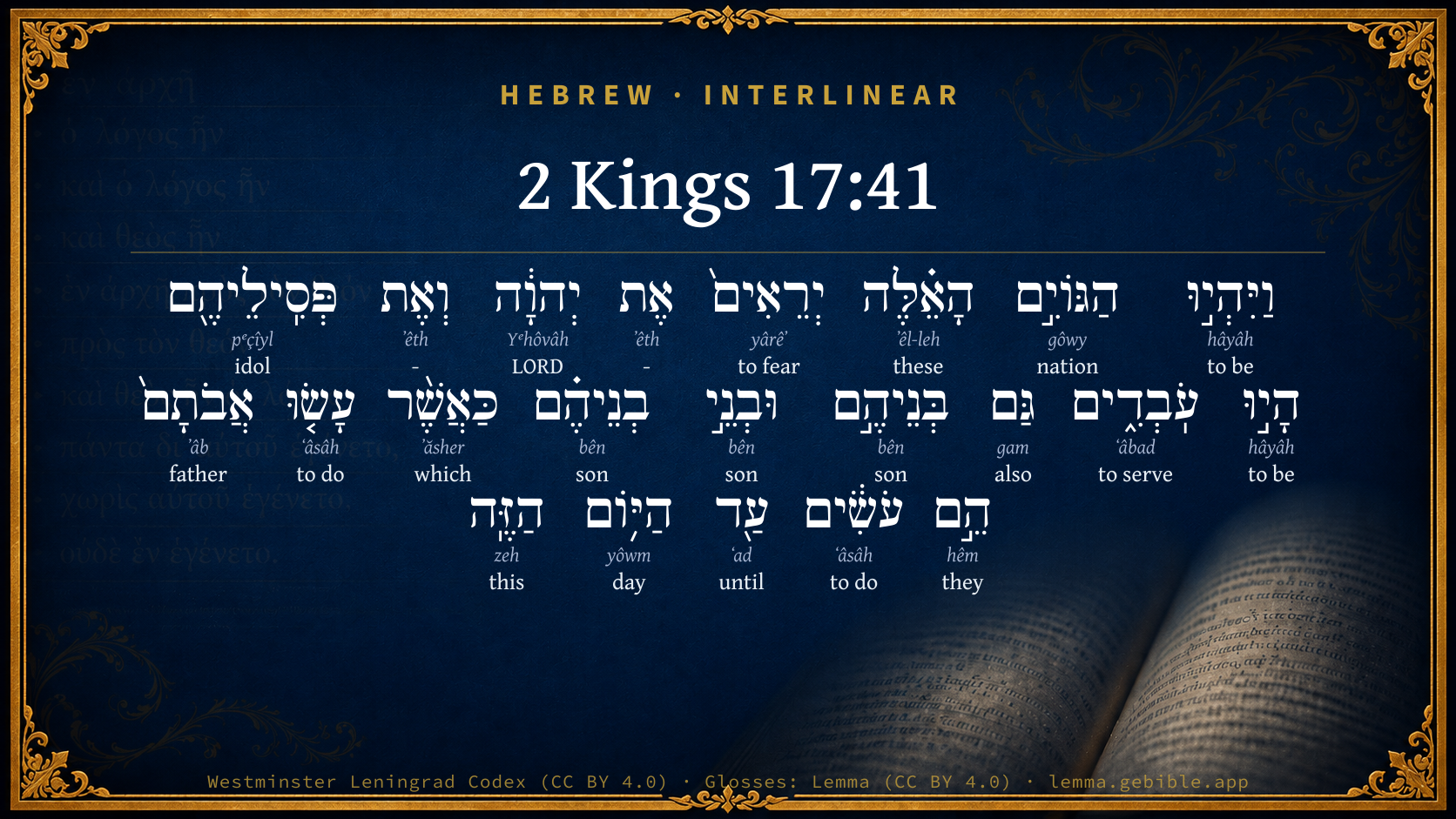
  1. וַיִּהְי֣וּ hâyâh H1961 “and · to be” Conjunction + Verb, Qal, Sequential Imperfect, 3rd Person, Masculine, Plural
  2. הַגּוֹיִ֣ם gôwy H1471 “the · nations” Particle, Definite Article + Noun, Common, Masculine, Plural, Absolute
  3. הָאֵ֗לֶּה ʼêl-leh H428 “the · these” Particle, Definite Article + Pronoun, Demonstrative, Common, Plural
  4. יְרֵאִים֙ yârêʼ H3372 “fearing” Adjective, Adjective, Masculine, Plural, Absolute
  5. אֶת ʼêth H853 “-” Particle, Direct Object
  6. יְהוָ֔ה Yᵉhôvâh H3068 “LORD” Noun, Proper
  7. וְאֶת ʼêth H853 “and · -” Conjunction + Particle, Direct Object
  8. הָי֣וּ hâyâh H1961 “to be” Verb, Qal, Perfect, 3rd Person, Common, Plural
  9. עֹֽבְדִ֑ים ʻâbad H5647 “serving” Verb, Qal, Participle Active, Masculine, Plural, Absolute
  10. גַּם gam H1571 “also” Particle, Accusative
  11. בְּנֵיהֶ֣ם bên H1121 “sons · their” Noun, Common, Masculine, Plural, Construct + Suffix, Personal, 3rd Person, Masculine, Plural
  12. וּבְנֵ֣י bên H1121 “and · sons of” Conjunction + Noun, Common, Masculine, Plural, Construct
  13. בְנֵיהֶ֗ם bên H1121 “sons · their” Noun, Common, Masculine, Plural, Construct + Suffix, Personal, 3rd Person, Masculine, Plural
  14. כַּאֲשֶׁ֨ר ʼăsher H834 “like/as · which” Preposition + Particle, Relative
  15. עָשׂ֤וּ ʻâsâh H6213 “to do” Verb, Qal, Perfect, 3rd Person, Common, Plural
  16. אֲבֹתָם֙ ʼâb H1 “fathers · their” Noun, Common, Masculine, Plural, Construct + Suffix, Personal, 3rd Person, Masculine, Plural
  17. הֵ֣ם hêm H1992 “they” Pronoun, Personal, 3rd Person, Masculine, Plural
  18. עֹשִׂ֔ים ʻâsâh H6213 “doing” Verb, Qal, Participle Active, Masculine, Plural, Absolute
  19. עַ֖ד ʻad H5704 “until” Preposition
  20. הַיּ֥וֹם yôwm H3117 “the · day” Particle, Definite Article + Noun, Common, Masculine, Singular, Absolute
  21. הַזֶּֽה zeh H2088 “the · this” Particle, Definite Article + Pronoun, Demonstrative, Masculine, Singular

About this verse

These counts appear in no published source. They are computed here, from the morphology-tagged text and Lemma’s own curated glosses. What Lemma adds →

22
words
17
distinct lemmas
Historical
section

Notable vocabulary

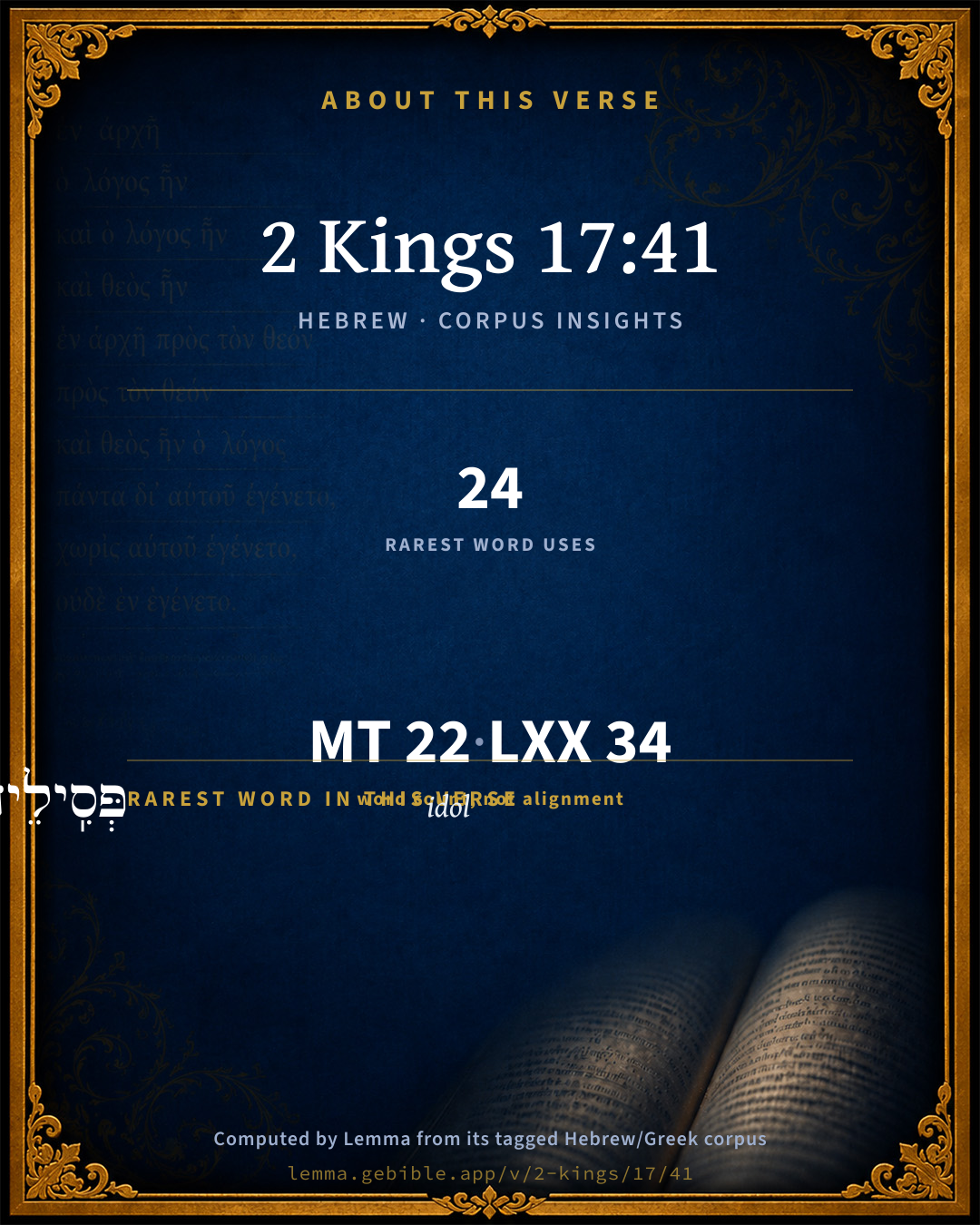
The rarest word here is פְּסִֽילֵיהֶ֖ם idol H6456 — appearing just 24 times in the whole Hebrew Bible.

Shared distinctive vocabulary

פְּסִֽילֵיהֶ֖ם idol H6456 occurs in 24 verses of the Hebrew Bible. Also found in:

Grammatical profile

  • 5 verbs
  • 8 nouns
  • 1 adjective
  • 3 pronouns
  • 1 preposition
  • 4 particles

Verb forms

  • וַיִּהְי֣וּ Qal · Sequential Imperfect
  • הָי֣וּ Qal · Perfect
  • עֹֽבְדִ֑ים Qal · Participle Active
  • עָשׂ֤וּ Qal · Perfect
  • עֹשִׂ֔ים Qal · Participle Active

Repetition

Words recur within this verse — often emphatic in Hebrew:

  • בְּנֵיהֶ֣ם son H1121 ×3
  • וַיִּהְי֣וּ to be H1961 ×2
  • עָשׂ֤וּ to do H6213 ×2

Hebrew & Septuagint length

In English translation the verse runs 27 words from the Hebrew and 27 from the Septuagint (LXX English) — the same length.

A rough comparison of the two English renderings, which tokenize alike — not a word-level alignment.

Word counts can differ between the Hebrew and the Greek without any difference in meaning — e.g. the Hebrew direct-object marker אֵת has no separate Greek word, and Greek often adds the article ὁ.

In the original languages it is 22 Hebrew tokens and 34 Greek tokens — but the two are counted differently (Hebrew bundles its prefixes and suffixes into one token; the Greek is in lemma form), so that isn’t a like-for-like length.

Cross-references

7

Topical passages linked to 2 Kings 17:41 in the Treasury of Scripture Knowledge — connected by theme and wording, ordered by reader-vote popularity; previews shown in the World English Bible.

  • Matthew 6:24 "No one can serve two masters, for either he will hate the one and love the other; or else he will be devoted to one and despise the other. You can't serve both God and Mammon.
  • 1 Kings 18:21 Elijah came near to all the people, and said, "How long will you waver between the two sides? If Yahweh is God, follow him; but if Baal, then follow him." The people answered him not a word.
  • Zephaniah 1:5 those who worship the host of the sky on the housetops, those who worship and swear by Yahweh and also swear by Malcam,
  • 2 Kings 17:32–33 So they feared Yahweh, and made to them from among themselves priests of the high places, who sacrificed for them in the houses of the high places.
  • Joshua 24:14–20 Now therefore fear Yahweh, and serve him in sincerity and in truth; and put away the gods which your fathers served beyond the River, and in Egypt; and serve you Yahweh.
  • Ezra 4:1–3 Now when the adversaries of Judah and Benjamin heard that the children of the captivity were building a temple to Yahweh, the God of Israel;
  • Revelation 3:15–16 "I know your works, that you are neither cold nor hot. I wish you were cold or hot.

Cross-references courtesy of OpenBible.info (CC BY 4.0).

Hebrew and Greek witnesses Masoretic Hebrew ↔ Greek Septuagint

The same verse in the two great witnesses to the Old Testament, shown verse-for-verse.

These are two independent witnesses, not word-aligned to each other, and the Septuagint is shown in lemma (dictionary) form.

Hebrew 2 Kings 17:41 Masoretic · Westminster Leningrad Codex

וַיִּהְי֣וּ הַגּוֹיִ֣ם הָאֵ֗לֶּה יְרֵאִים֙ אֶת יְהוָ֔ה וְאֶת פְּסִֽילֵיהֶ֖ם הָי֣וּ עֹֽבְדִ֑ים גַּם בְּנֵיהֶ֣ם וּבְנֵ֣י בְנֵיהֶ֗ם כַּאֲשֶׁ֨ר עָשׂ֤וּ אֲבֹתָם֙ הֵ֣ם עֹשִׂ֔ים עַ֖ד הַיּ֥וֹם הַזֶּֽה

So these nations feared Yahweh, and served their engraved images; their children likewise, and their children's children, as did their fathers, so do they to this day.

World English Bible · Public Domain

Greek LXX 2 Kings 17:41 Septuagint · lemma form

καί εἰμί ὁ ἔθνος οὗτος φοβέω ὁ κύριος καί ὁ γλυπτός αὐτός εἰμί δουλεύω καί γέ ὁ υἱός καί ὁ υἱός ὁ υἱός αὐτός καθά ποιέω ὁ πατήρ αὐτός ποιέω ἕως ὁ ἡμέρα οὗτος

So these nations feared the Lord, and served their graven images: yes, their sons and their son's sons do until this day even as their fathers did.

LXX2012 (modern English Septuagint) · Public Domain

On this verse, Adam Clarke's Commentary discusses the Septuagint’s reading. Read the note in Commentary ↓

Hebrew: Westminster Leningrad Codex (CC BY 4.0). Greek: Septuagint (public domain); English from LXX2012 (modern English Septuagint) (Public Domain). How the Septuagint differs from the Hebrew →

Targum (Aramaic paraphrase)

1

The Targum is the ancient Jewish Aramaic paraphrase of the Hebrew Scriptures — an interpretive translation, not the Hebrew text itself. Onkelos (literal) and Pseudo-Jonathan (expansive) render the Torah, and Jonathan the Prophets. Coverage is partial: where no permissively-licensed English translation exists for a verse, only the Aramaic is shown. This is verse-level text, not a word-by-word alignment to the Hebrew.

  1. Targum Jonathan Prophets (Joshua–Malachi)
    וַהֲווֹ עַמְמַיָא הָאִילֵין דַחֲלִין מִן קֳדָם יְיָ וְיַת צַלְמָנֵיהוֹן הֲווֹ פַלְחִין אַף בְּנֵיהוֹן וּבְנֵי בְנֵיהוֹן כְּמָא דַעֲבָדוּ אֲבָהַתְהוֹן אִינוּן עָבְדִין עַד יוֹמָא הָדֵין:

    (no public-domain English translation for this verse)

    Targum Jonathan — Aramaic: “Mikraot Gedolot” (public domain). English: “Sefaria Community Translation” (CC0 1.0 (public-domain dedication)); “London "Chaldee Paraphrase," 1871” (public domain). Text via Sefaria.

Commentary

Notes on 2 Kings 17:41 from classic Christian and Jewish commentators (each source and its license shown beneath its notes). The classic Christian expositions comment on the surrounding passage and are grouped to its opening verse, so a note may address several verses; the Jewish commentaries on the Tanakh (Rashi and others) are per-verse, so they appear only where the commentator wrote on this verse.

Lemma curates 59 commentaries, every one of them public domain or Creative Commons licensed, each selected and text-cleaned for this edition rather than reprinted as found. About our sources →

Joseph Benson's Commentary

2Ki 17:41. So these nations feared the Lord, &c. — Namely, the nations that came in the place of the Israelites. They followed their example, and acted as they had done, endeavouring to unite things perfectly irreconcilable, the worship of the true God and the worship of idols.

Joseph Benson's Commentary on the Old and New Testaments (1811–1818) — public domain. Text from a community e-Sword module.

Geneva Bible (1599)

Geneva Bible translators

That is, these strangers which were sent into Samaria by the Assyrians.

Geneva Bible (1599) marginal notes — public domain. Text via Bolls.life.

Adam Clarke's Commentary

Verse 41. So do they unto this day.] This must have been written before the Babylonish captivity; because, after that time, none of the Israelites ever lapsed into idolatry. But this may chiefly refer to the heathenish people who were sent to dwell among the remains of the ten tribes.

ON these nations and the objects of their worship, I present my readers with the following extracts from Dodd and Parkhurst.

Ver. 30. The men of Babylon made Succoth-benoth. We have here an account of the idols which were consecrated by the different nations, transplanted by the king of Assyria to Samaria. It is difficult, however, and has afforded a large field for conjecture, to give any satisfactory account concerning them. The reader will find in Selden, Vossius, and Jurieu, much upon the subject. Succoth-benoth may be literally translated, The Tabernacles of the Daughters, or Young Women; or if Benoth be taken as the name of a female idol, from בנה to build up, procreate children, then the words will express the tabernacles sacred to the productive powers feminine. And, agreeably to this latter exposition, the rabbins say that the emblem was a hen and chickens. But however this may be, there is no room to doubt that these succoth were tabernacles wherein young women exposed themselves to prostitution in honour of the Babylonish goddess Melitta. Herodotus, (lib. i., c. 199,) gives us a particular account of this detestable service. "Every young woman," says he, "of the country of Babylon must once in her life sit at the temple of Venus, [whom he afterwards tells us the Assyrians called Melitta,] and prostitute herself to some stranger. Those who are rich, and so disdain to mingle with the crowd, present themselves before the temple in covered chariots, attended by a great retinue. But the generality of the women sit near the temple, having crowns upon their heads, and holding a cord, some continually coming, others going. [See Baruch vi. 43.] The cords are held by them in such a manner as to afford a free passage among the women, that the strangers may choose whom they like. A woman who has once seated herself in this place must not return home till some stranger has cast money into her lap, and led her from the temple, and defiled her. The stranger who throws the money must say, 'I invoke the goddess Melitta for thee.' The money, however small a sum it may be, must not be refused, because it is appointed to sacred uses. [See De 23:18.] The woman must follow the first man that offers, and not reject him; and after prostitution, having now duly honoured the goddess, she is dismissed to her own house. In Cyprus," adds the historian, "they have the same custom." This abomination, implied by Succoth-benoth, the men of Babylon brought with them into the country of Samaria; and both the name of the idol Melitta, and the execrable service performed to her honour, show that by Melitta was originally intended the procreative or productive power of nature, the Venus of the Greeks and Romans. See the beginning of Lucretius's first book De Rerum Natura. Mr. Selden imagines that some traces of the Succoth-benoth may be found in Sicca Veneria, the name of a city of Numidia, not far from the borders of Africa Propria. The name itself bears a near allusion to the obscene custom above taken notice of, and seems to have been transported from Phoenicia: nor can this well be disputed, when we consider that here was a temple where women were obliged to purchase their marriage-money by the prostitution of their bodies. See Univ. Hist., vol. xvii., p. 295, and Parkhurst's Lexicon on the word סך.

The men of Cuth made Nergal. - Cuth was a province of Assyria, which, according to some, lies upon the Araxis: but others rather think it to be the same with Cush, which is said by Moses to be encompassed with the river Gihon; and must, therefore, be the same with the country which the Greeks call Susiana, and which to this day is called by the inhabitants Chusesta. Their idol, Nergal, seems to have been the sun, as the causer of the diurnal and annual revolutions of the planets; for it is naturally derived from נר ner, light, and by גל gal, to revolve. The rabbins say that the idol was represented in the shape of a cock; and probably they tell us the truth, for this seems a very proper emblem. Among the latter heathens we find the cock was sacred to Apollo or the sun, (see Pierii Hieroglyph., p. 223,) "because," says Heliodorus, speaking of the time when cocks crow, "by a natural sensation of the sun's revolution to us, they are incited to salute the god." AEthiop. lib. i. And perhaps under this name, Nergal, they meant to worship the sun, not only for the diurnal return of its light upon the earth, but also for its annual return or revolution. We may observe that the emblem, a cock, is affected by the latter as well as by the former, and is frequently crowing both day and night, when the days begin to lengthen. See Calmet's Dictionary under the word, and Parkhurst's Lexicon.

The men of Hamath made Ashima. - There are several cities and countries which go under the name of Hamath; but what we take to be here meant is that province of Syria which lies upon the Orontes, wherein there was a city of the same name; which when Shalmaneser had taken, he removed the inhabitants from thence into Samaria. Their idol Ashima signifies the atoner or expiator, from אשם asham. The word is in a Chaldee form, and seems to be the same as אשמת שמרון ashmath Shomeron, the sin of Samaria, mentioned Am 8:14, where ashmath is rendered by the LXX. propitiation. It is known to every one who has the least acquaintance with the mythology of the heathen, how strongly and universally they retained the tradition of an atonement or expiation for sin, although they expected it from a false object and wrong means. We find it expressed in very clear terms among the Romans even so late as the time of Horace, lib. i., ode 2: -

Cui dabit partes scelus expiandi Jupiter?

And whom, to expiate the horrid guilt, Will Jove appoint?

The answer is, "Apollo," the god of light. Some think that, as Asuman or Suman, [Persian] asman, in the Persian language, signifies heaven, the Syrians might from hence derive the name of this god; who, they suppose, was represented by a large stone pillar terminating in a conic or pyramidical figure, whereby they denoted fire. See Parkhurst on the word אשם asham, Calmet's Dictionary, and Tennison on Idolatry.

Ver. 31. The Avites made Nibhaz and Tartak. - It is uncertain who these Avites were. The most probable opinion seems to be that which Grotius has suggested by observing that there are a people in Bactriana, mentioned by Ptolemy, under the name of Avidia, who possibly might be those transported at this time into Palestine by Shalmaneser. Nibhaz, according to the rabbins, had the shape of a dog, much like the Anubis of the Egyptians. In Pierius's Hieroglyphics, p. 53, is the figure of a cunocephalus, a kind of ape, with a head like a dog, standing upon his hinder feet, and looking earnestly at the moon. Pierius there teaches us that the cunocephalus was an animal eminently sacred amongst the Egyptians, hieroglyphical of the moon, and kept in their temples to inform them of the moon's conjunction with the sun, at which time this animal is strangely affected, being deprived of sight, refusing food, and lying sick on the ground; but on the moon's appearance seeming to return thanks, and congratulate the return of light both to himself and her. See Johnston's Nat. Hist. de Quadruped., p. 100. This being observed, the נבחז nibchaz, (which may well be derived from נבח nabach, to bark, and חזה chazah, to see,) gives us reason to conclude that this idol was in the shape of a cunocephalus, or a dog looking, barking, or howling at the moon. It is obvious to common observation that dogs in general have this property; and an idol of the form just mentioned seems to have been originally designed to represent the power or influence of the moon on all sublunary bodies, with which the cunocephaluses and dogs are so eminently affected. So, as we have observed upon Nergal, the influence of the returning solar light was represented by a cock; and the generative power of the heavens by Dagon, a fishy idol. See Parkhurst on נבחז who is of opinion that Tartak תרתק is compounded of תר tar, to turn, go round, and רתק rathak, to chain, tether; and plainly denotes the heavens, considered as confining the planets in their respective orbits, as if they were tethered. The Jews have a tradition that the emblem of this idol was an ass; which, considering the propriety of that animal when tethered to represent this idol, is not improbable; and from this idolatrous worship of the Samaritans, joined perhaps with some confused account of the cherubim, seems to have sprung that stupid story by the heathens, that the Jews had an ass's head in their holy of holies, to which they paid religious worship. See Bochart, vol. ii., p. 221. Jurieu is of opinion that as the word Nibhaz, both in the Hebrew and Chaldee, with a small variation, denotes quick, swift, rapid; and tartak, in the same languages, signifies a chariot, these two idols may both together denominate the sun mounted on his car, as the fictions of the poets and the notions of the mythologists were wont to represent that luminary.

The Sepharvites burned their children - to Adrammelech and Anammelech. - As these Sepharvites probably came from the cities of the Medes, whither the Israelites were carried captive, and as Herodotus tells us that between Colchis and Media are found a people called Saspires, in all likelihood they were the same with those here named Sepharvites. Moloch, Milcom, and Melech, in the language of different nations, all signify a king, and imply the sun, which was called the king of heaven; and consequently the addition of אדר adar, which signifies powerful, illustrious, to the one, and of ענה anah, which implies to return, to answer, to the other, means no more than the mighty or the oracular Moloch. And as the children were offered to him, it appears that he was the same with the Moloch of the Ammonites. See Univ. Hist. and Calmet. Mr. Locke is also of opinion that these two names were expressive of one and the same deity. What they were, or in what form, and how worshipped, we have not light from antiquity to determine.

Adam Clarke's Commentary on the Bible (1810–1826) — public domain. Text from a community e-Sword/MySword module.

Ellicott's Commentary for English Readers

(41) So these nations feared . . . images.—A variation of 2Ki_17:33.

Their children, and their children’s children.—The captivity of Ephraim took place in 721 B.C. Two generations later bring us to the times of the exile of Judah—the age of the last Redactor of Kings.

A Bible Commentary for English Readers, edited by Charles John Ellicott (1878–1897) — public domain. Text from a community e-Sword module.

The Cambridge Bible for Schools and Colleges

gen. ed. J. J. S. Perowne

41. both their children] R.V. their children likewise. A change which makes a semicolon necessary at the end of the previous clause.

It would seem from this statement that the mixed population in Samaria adhered to their several forms of idolatry through several generations, though we know that on the return of the captive Jews from Babylon b.c. 534, their descendants claimed to be allowed to take part in the restoration of the temple. The concluding words of the verse ‘so do they unto this day’ may be, and most probably are, taken from a document of earlier date than the compilation of the books of Kings. These carry the history down to about b.c. 560. The time between that date and the earlier days, when the priest sent from Babylon began to teach them something about Jehovah, may be taken in round numbers at a century and a half or nearly so. In that period the document was written from which our compiler drew, and when its author wrote the Samaritans were still idolaters. Such changes as were wrought among them, till they were all agreed to accept as authoritative the five books of Moses, would come about very gradually. Yet even imperfect teaching about Jehovah produced its effect. The priest who came to them would be one of those who had ministered at Bethel or Dan. Yet from the calves he would teach them of the God who had led Israel from Egypt to Canaan, and even from such lessons they would be brought to see that Jehovah was more than any mere local divinity, and to desire to join with the people whom they saw Him bringing once more out of the land of their captivity.

The Cambridge Bible for Schools and Colleges (gen. ed. J. J. S. Perowne; Cambridge University Press, 1878–1918) — public domain. Text from a community e-Sword module.

Albert Barnes' Notes on the Bible

Their graven images - The Babylonians appear to have made a very sparing use of animal forms among their religious emblems. They represented the male Sun, Shamas, by a circle, plain or crossed; the female Sun, Anunit, by a six-rayed or eight-rayed star; Nebo by a single wedge or arrow-head, the fundamental element of their writing; the god of the atmosphere by a double or triple thunderbolt. The gods generally were represented under human forms. A few of them had, in addition, animal emblems - the lion, the bull, the eagle, or the serpent; but these seem never to have been set up for worship in temples. There was nothing intentionally grotesque in the Babylonian religion, as there was in the Egyptian and Phoenician.

So do they unto this day - The mixed worship, the union of professed reverence for Yahweh with the grossest idolatry, continued to the time of the composition of this book, which must have been as late as 561 B.C., or, at any rate, as late as 580 B.C. 2Ki 25:27. It did not, however, continue much longer. When the Samaritans wished to join the Jews in rebuilding the temple (about 537 B.C.), they showed that inclination to draw nearer to the Jewish cult which henceforth marked their religious progress. Long before the erection of a temple to Yahweh on Mount Gerizim (409 B.C.) they had laid aside all their idolatrous rites, and, admitting the binding authority of the Pentateuch, had taken upon them the observance of the entire Law.

Albert Barnes' Notes on the Bible (1834–1885) — public domain. Text from a community e-Sword/MySword module.

Matthew Poole's English Annotations

So, i.e. in like manner, and after their example. These nations, who came in their stead.

Matthew Poole's English Annotations on the Holy Bible (1683–1685) — public domain. Text from a community e-Sword/MySword module.

The Pulpit Commentary

So these nationsi.e. , the Babylonians, Cuthaeans, Hamathites, Avites, and Sepharvites settled in Samariafeared the Lord, and served their graven images. The rabbinical writers tell us that Nergal was worshipped under the form of a cock, Ashima under the form of a goat, Nibhaz under the form of a dog, Tartak under that of an ass, while Adrammelech and Anammelech were represented by a mule and a horse respectively. Not much confidence can be placed in these representations. The Babylonian gods were ordinarily figured in human forms. Animal ones as those of the bull and the lion, generally winged and human-headed, were in a few cases, but only in a few, used to represent the gods symbolically. Other emblems employed were the winged circle for Asshur; the disc plain or four-rayed for the male sun, six or eight-rayed for the female sun; the crescent for the moon-god Sin; the thunderbolt for the god of the atmosphere, Vul or Rimmon; the wedge or arrow-head, the fundamental element of writing, for Nebo. Images, however, were made of all the gods, and were no doubt set up by the several "nations" in their respective "cities." Both their children, and their children"s children i.e. their descendants to the time of the writer of Kingsas did their fathers, so do they unto this day.

The Pulpit Commentary (1880–1919), ed. H.D.M. Spence-Jones & Joseph S. Exell — public domain. Text from a community e-Sword module.

John Wesley's Explanatory Notes

So - In like manner, and after their example. These - Who came in their stead.

John Wesley, Explanatory Notes Upon the Whole Bible (1754–1765) — public domain. Text via the GEBible commentary corpus.

Scofield Reference Notes

C. I. Scofield

feared

(See Scofield "Psa 19:9").

The Scofield Reference Bible (1917 edition), notes by C. I. Scofield — public domain. Text from a community e-Sword module.

Lesson kit

Teaching starters — assembled from the data on this page, not authored interpretation. Every prompt links to the verse data it draws on. Edit before teaching.

2 Kings, in the Historical, opens this verse with 22 words (17 distinct Hebrew lemmas). Its most distinctive word is pᵉçîyl (“idol”). A historical commentator’s framing appears above. Read the whole chapter for the surrounding context.

Discussion questions

  1. The word pᵉçîyl carries the sense “idol.” How does it shape the verse?
  2. How does Deuteronomy 7:5, which shares the word «idol», read alongside this verse?
  3. What does the repetition of “son” (3× in this one verse) do in this verse?
  4. These translations render this verse differently. What is at stake in choosing one wording over another?
  5. «וַיִּהְי֣וּ» is a Qal Sequential Imperfect verb. How does that grammatical form shape the action described?
  6. Compare how Joseph Benson's Commentary and Geneva Bible (1599) read this verse. Where do they agree or differ?

Things to notice

Reading settings

Reading text

Shown beneath each verse's original-language words.

Old Testament
Old Testament edition

Read the OT as the Masoretic Hebrew (MT) or the Greek Septuagint (LXX).

English shown for the Greek Septuagint (in the Hebrew ↔ Greek comparison).

Comparing translations? Open the Compare panel on any verse page to stack up to four side by side.