
2 Chronicles 33:9

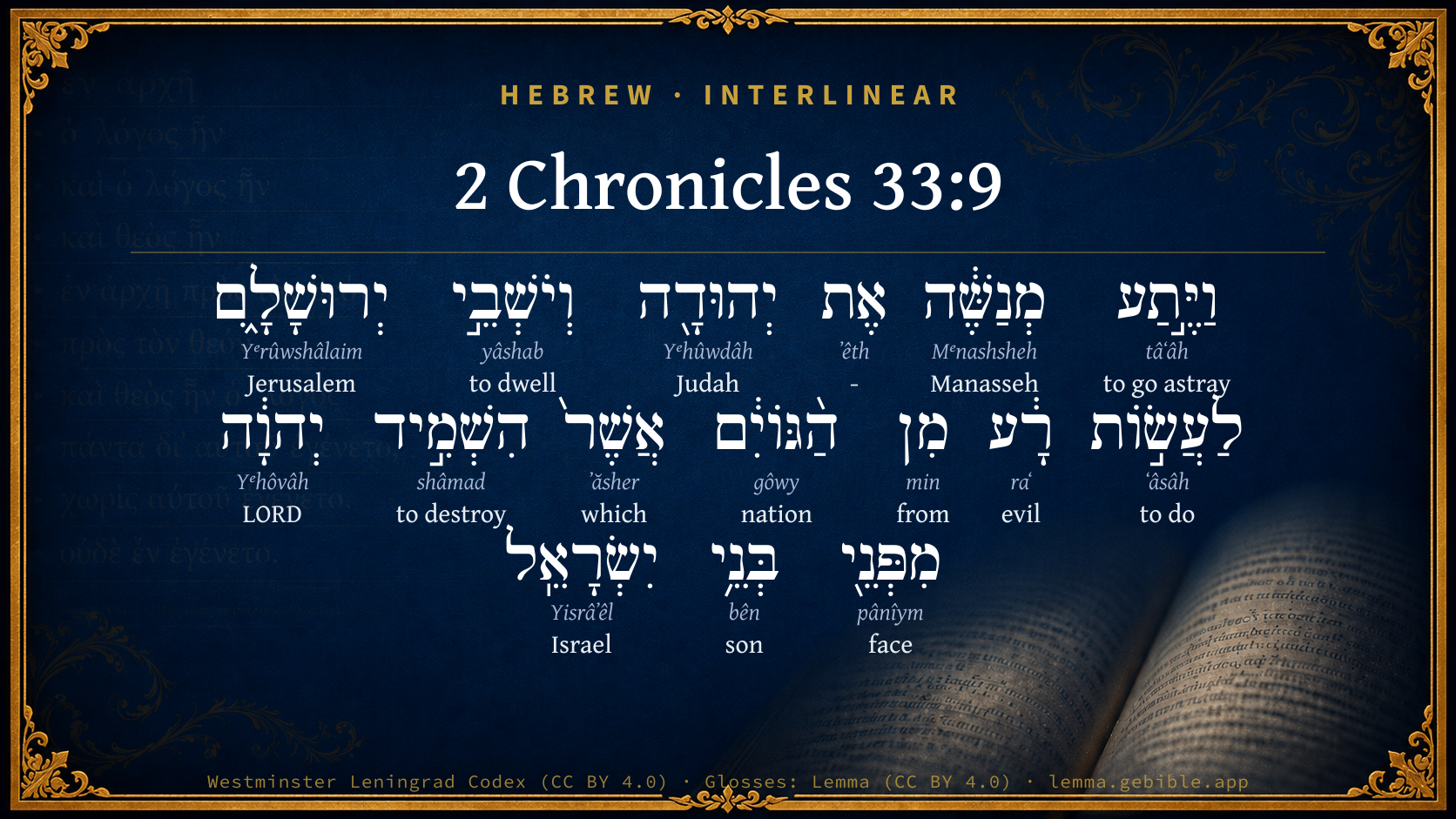
Hebrew (Westminster Leningrad Codex) 2 Chronicles 33:9 appears in the Hebrew Old Testament. The text above is from the Westminster Leningrad Codex. Each word links to its Strong’s number, a concise gloss, and parsing drawn from the Open Scriptures Hebrew Bible morphology. Click any word for its full Brown-Driver-Briggs (BDB) entry.
Download image
Cite this verse

2 Chronicles 33:9 (World English Bible). Public Domain. Lemma interlinear Bible study tool, https://lemma.gebible.app/v/2-chronicles/33/9.

Show BibTeX & RIS
BibTeX
RIS
English Translation
Manasseh seduced Judah and the inhabitants of Jerusalem, so that they did evil more than did the nations whom Yahweh destroyed before the children of Israel.
World English Bible · Public Domain
Download a study sheet

One document with this verse’s original text, its word-by-word gloss line, the meaning frame, cross-references with their text, attributed commentary, and full source and license credits — printable, and it pastes into notes with its structure intact.

This verse Autodidact and up

Study sheet (.html) Plain text (.txt)

A passage Seminary Student

Up to 50 verses in one chapter. A passage sheet keeps up to 6 commentary sources and 12 cross-references per verse, in the order this page ranks them, and says so on the sheet whenever that leaves anything out. Ask for a single verse and you get the Autodidact verse sheet above.

Everything on this page stays free to read, with no account — the sheet is a download of what is already on screen, not access to it.

Want to remove ads? Support Godless Engineer
Compare translations 3

The same verse in 3 English versions, stacked beneath the original-language interlinear above. Click any original word for its lexicon entry.

Each is an independent rendering of the whole verse — the interlinear is not word-aligned to these translations.

Highlighted words mark where these versions differ — a whole-verse word diff, not a word-by-word alignment.

  • World English Bible Public Domain
    Manasseh seduced Judah and the inhabitants of Jerusalem, so that they did evil more than did the nations whom Yahweh destroyed before the children of Israel.
  • King James Version Public Domain
    So Manasseh made Judah and the inhabitants of Jerusalem to err, and to do worse than the heathen, whom the LORD had destroyed before the children of Israel.
  • unfoldingWord Literal Text CC BY-SA 4.0
    And Manasseh led astray Judah and the inhabitants of Jerusalem, to do evil more than the nations that Yahweh had exterminated from before the sons of Israel.

unfoldingWord Literal Text — © unfoldingWord, licensed CC BY-SA 4.0. Word-aligned USFM3 via Door43 (git.door43.org/unfoldingWord/en_ult).

Versions to compare (up to 4)

3 of 4 selected

Show all 18 translations

Every available English version of this verse, each an independent rendering of the whole verse.

  • World English Bible Public Domain
    Manasseh seduced Judah and the inhabitants of Jerusalem, so that they did evil more than did the nations whom Yahweh destroyed before the children of Israel.
  • Berean Standard Bible Public Domain
    So Manasseh led the people of Judah and Jerusalem astray, so that they did greater evil than the nations that the LORD had destroyed before the Israelites.
  • Majority Standard Bible Public Domain
    So Manasseh led the people of Judah and Jerusalem astray, so that they did greater evil than the nations that the LORD had destroyed before the Israelites.
  • King James Version Public Domain
    So Manasseh made Judah and the inhabitants of Jerusalem to err, and to do worse than the heathen, whom the LORD had destroyed before the children of Israel.
  • American Standard Version (1901) Public Domain
    And Manasseh seduced Judah and the inhabitants of Jerusalem, so that they did evil more than did the nations whom Jehovah destroyed before the children of Israel.
  • Revised Version (1885) Public Domain
    And Manasseh made Judah and the inhabitants of Jerusalem to err, so that they did evil more than did the nations, whom the LORD destroyed before the children of Israel.
  • Geneva Bible (1599) Public Domain
    So Manasseh made Iudah and the inhabitants of Ierusalem to erre, and to doe worse then the heathen, whome the Lord had destroyed before the children of Israel.
  • Douay-Rheims (1899) Public Domain
    So Manasses seduced Juda, and the inhabitants of Jerusalem, to do evil beyond all the nations, which the Lord had destroyed before the face of the children of Israel.
  • Young's Literal Translation Public Domain
    And Manasseh maketh Judah and the inhabitants of Jerusalem to err, to do evil above the nations that Jehovah destroyed from the presence of the sons of Israel.
  • Literal Standard Version CC BY-SA 4.0
    And Manasseh causes Judah and the inhabitants of Jerusalem to err, to do evil above the nations that YHWH destroyed from the presence of the sons of Israel.
  • Unlocked Literal Bible CC BY-SA 4.0
    Manasseh led Judah and the inhabitants of Jerusalem to do evil even more than the nations that Yahweh had destroyed before the people of Israel.
  • unfoldingWord Literal Text CC BY-SA 4.0
    And Manasseh led astray Judah and the inhabitants of Jerusalem, to do evil more than the nations that Yahweh had exterminated from before the sons of Israel.
  • Darby Bible Public Domain
    And Manasseh led Judah and the inhabitants of Jerusalem astray, to do more evil than the nations that Jehovah had destroyed from before the children of Israel.
  • World Messianic Bible Public Domain
    Manasseh seduced Judah and the inhabitants of Jerusalem, so that they did more evil than did the nations whom the LORD destroyed before the children of Israel.
  • Webster's Bible Public Domain
    So Manasseh made Judah and the inhabitants of Jerusalem to err, and to do worse than the heathen, whom the LORD had destroyed before the children of Israel.
  • Free Bible Version CC BY-SA 4.0
    But Manasseh seduced Judah and the people of Jerusalem, leading them to commit even worse sins than the nations the Lord had destroyed before the Israelites occupied the land.
  • Bible in Basic English Public Domain
    And Manasseh made Judah and the people of Jerusalem go out of the true way, so that they did more evil than those nations whom the Lord gave up to destruction before the children of Israel.
  • JPS Tanakh (1917) Public Domain
    And Manasseh made Judah and the inhabitants of Jerusalem to err, so that they did evil more than did the nations, whom the LORD destroyed before the children of Israel.

Literal Standard Version (2020), Covenant Press — licensed CC BY-SA 4.0. Text via the HelloAO Bible API (eBible.org). Unlocked Literal Bible (unfoldingWord) — licensed CC BY-SA 4.0. Text via the HelloAO Bible API (eBible.org). unfoldingWord Literal Text — © unfoldingWord, licensed CC BY-SA 4.0. Word-aligned USFM3 via Door43 (git.door43.org/unfoldingWord/en_ult). Free Bible Version, Dr. Jonathan Gallagher — licensed CC BY-SA 4.0. Text via the HelloAO Bible API (eBible.org).

Word by word

More ways to search: Search by grammar → Find every occurrence → Compare this word →

Practice this passage: Drill this verse → Learn its vocabulary →

וַיֶּ֣תַע
tâʻâh
H8582
“and · to go astray”
Conjunction + Verb, Hiphil, Sequential Imperfect, 3rd Person, Masculine, Singular
Part of Speech
Conjunction + Verb
Stem
Hiphil
Form
Sequential Imperfect
Person
3rd Person
Gender
Masculine
Number
Singular
Full BDB Definition

Origin: a primitive root

TWOT: 2531

to err, wander, go astray, stagger - (Qal) to err - to wander about (physically) - of intoxication - of sin (ethically) - wandering (of the mind) - (Niphal) - to be made to wander about, be made to stagger (drunkard) - to be led astray (ethically) - (Hiphil) to cause to wander - to cause to wander about (physically) - to cause to wander (of intoxication) - to cause to err, mislead (mentally and morally)
  1. מְנַשֶּׁ֔ה Mᵉnashsheh H4519 “Manasseh” Noun, Proper
  2. אֶת ʼêth H853 “-” Particle, Direct Object
  3. יְהוּדָ֖ה Yᵉhûwdâh H3063 “Judah” Noun, Proper
  4. וְיֹשְׁבֵ֣י yâshab H3427 “and · dwelling” Conjunction + Verb, Qal, Participle Active, Masculine, Plural, Construct
  5. יְרוּשָׁלִָ֑ם Yᵉrûwshâlaim H3389 “Jerusalem” Noun, Proper
  6. לַעֲשׂ֣וֹת ʻâsâh H6213 “to do” Preposition + Verb, Qal, Infinitive Construct
  7. רָ֔ע raʻ H7451 “evil” Adjective, Adjective, Masculine, Singular, Absolute
  8. מִן min H4480 “from” Preposition
  9. הַ֨גּוֹיִ֔ם gôwy H1471 “the · nations” Particle, Definite Article + Noun, Common, Masculine, Plural, Absolute
  10. אֲשֶׁר֙ ʼăsher H834 “which” Particle, Relative
  11. הִשְׁמִ֣יד shâmad H8045 “to destroy” Verb, Hiphil, Perfect, 3rd Person, Masculine, Singular
  12. יְהוָ֔ה Yᵉhôvâh H3068 “LORD” Noun, Proper
  13. מִפְּנֵ֖י pânîym H6440 “from · face(s) of” Preposition + Noun, Common, Both, Plural, Construct
  14. בְּנֵ֥י bên H1121 “sons of” Noun, Common, Masculine, Plural, Construct
  15. יִשְׂרָאֵֽל Yisrâʼêl H3478 “Israel” Noun, Proper

About this verse

These counts appear in no published source. They are computed here, from the morphology-tagged text and Lemma’s own curated glosses. What Lemma adds →

16
words
16
distinct lemmas
Historical
section

Shared distinctive vocabulary

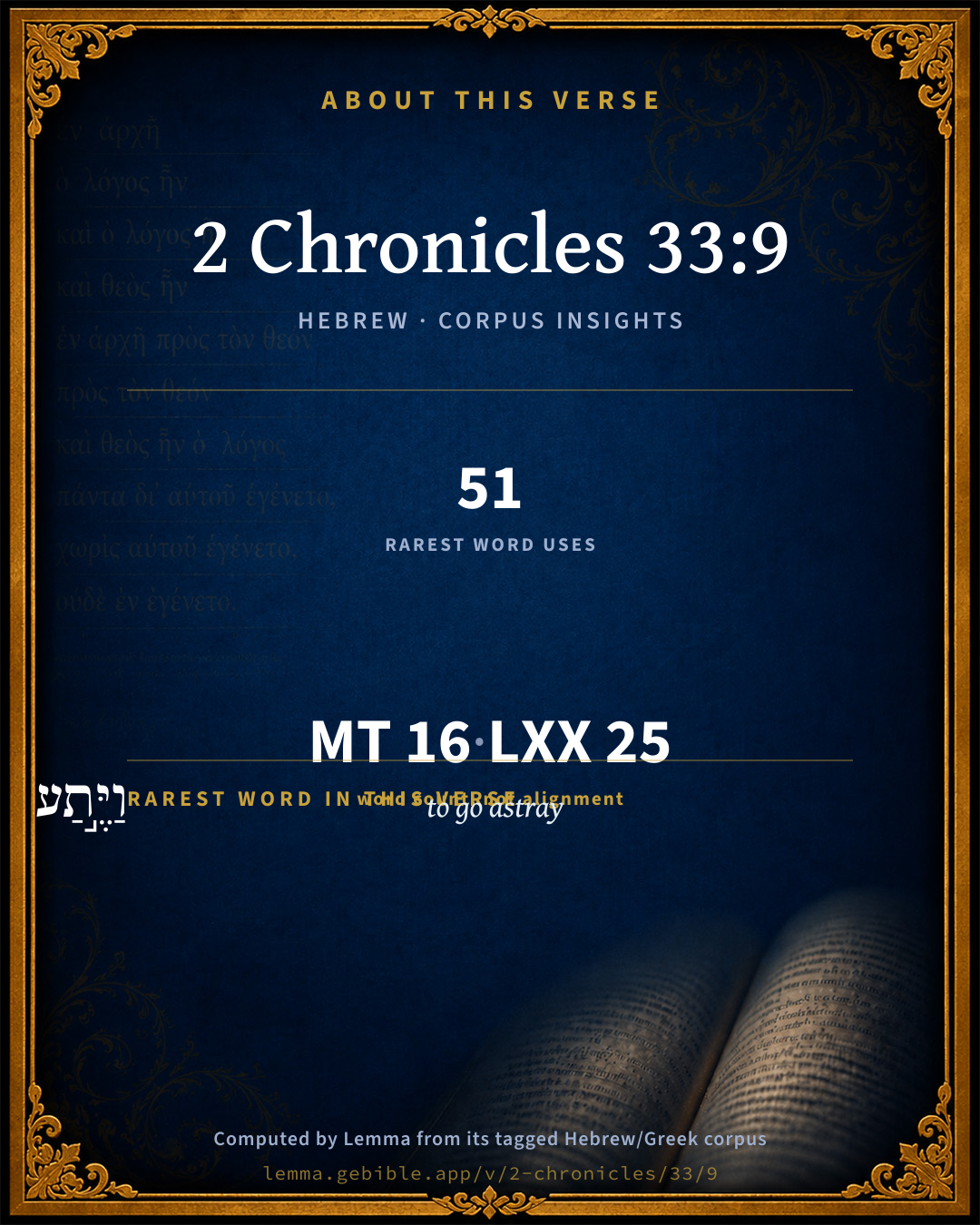
וַיֶּ֣תַע to go astray H8582 occurs in 45 verses of the Hebrew Bible. Also found in:

Grammatical profile

  • 4 verbs
  • 8 nouns
  • 1 adjective
  • 1 preposition
  • 2 particles

Verb forms

  • וַיֶּ֣תַע Hiphil · Sequential Imperfect
  • וְיֹשְׁבֵ֣י Qal · Participle Active
  • לַעֲשׂ֣וֹת Qal · Infinitive Construct
  • הִשְׁמִ֣יד Hiphil · Perfect

Hebrew & Septuagint length

In English translation the verse runs 26 words from the Hebrew and 28 from the Septuagint (LXX English) — closely comparable.

A rough comparison of the two English renderings, which tokenize alike — not a word-level alignment.

Word counts can differ between the Hebrew and the Greek without any difference in meaning — e.g. the Hebrew direct-object marker אֵת has no separate Greek word, and Greek often adds the article ὁ.

In the original languages it is 16 Hebrew tokens and 25 Greek tokens — but the two are counted differently (Hebrew bundles its prefixes and suffixes into one token; the Greek is in lemma form), so that isn’t a like-for-like length.

Cross-references

14

Topical passages linked to 2 Chronicles 33:9 in the Treasury of Scripture Knowledge — connected by theme and wording, ordered by reader-vote popularity; previews shown in the World English Bible.

  • 2 Kings 24:3–4 Surely at the commandment of Yahweh came this on Judah, to remove them out of his sight, for the sins of Manasseh, according to all that he did,
  • 2 Chronicles 33:2 He did that which was evil in the sight of Yahweh, after the abominations of the nations whom Yahweh cast out before the children of Israel.
  • Proverbs 29:12 If a ruler listens to lies, All of his officials are wicked.
  • Leviticus 18:24 "'Don't defile yourselves in any of these things: for in all these the nations which I am casting out before you were defiled.
  • Deuteronomy 2:21 a people great, and many, and tall, as the Anakim; but Yahweh destroyed them before them; and they succeeded them, and lived in their place;
  • Joshua 24:8 I brought you into the land of the Amorites, that lived beyond the Jordan: and they fought with you; and I gave them into your hand, and you possessed their land; and I destroyed them from before you.
  • 1 Kings 14:16 He will give Israel up because of the sins of Jeroboam, which he has sinned, and with which he has made Israel to sin.
  • 1 Kings 15:26 He did that which was evil in the sight of Yahweh, and walked in the way of his father, and in his sin with which he made Israel to sin.
  • 2 Kings 17:8–11 and walked in the statutes of the nations, whom Yahweh cast out from before the children of Israel, and of the kings of Israel, which they made.
  • 2 Kings 21:9–11 But they didn't listen: and Manasseh seduced them to do that which is evil more than did the nations whom Yahweh destroyed before the children of Israel.
  • 2 Kings 21:16 Moreover Manasseh shed innocent blood very much, until he had filled Jerusalem from one end to another; besides his sin with which he made Judah to sin, in doing that which was evil in the sight of Yahweh.
  • 2 Kings 23:26 Notwithstanding, Yahweh didn't turn from the fierceness of his great wrath, with which his anger was kindled against Judah, because of all the provocation with which Manasseh had provoked him.
  • Ezekiel 16:45–47 You are the daughter of your mother, who loathes her husband and her children; and you are the sister of your sisters, who loathed their husbands and their children: your mother was a Hittite, and your father an Amorite.
  • Micah 6:16 For the statutes of Omri are kept, And all the works of the house of Ahab. You walk in their counsels, That I may make you a ruin, And her inhabitants a hissing; And you will bear the reproach of my people."

Cross-references courtesy of OpenBible.info (CC BY 4.0).

Hebrew and Greek witnesses Masoretic Hebrew ↔ Greek Septuagint

The same verse in the two great witnesses to the Old Testament, shown verse-for-verse.

These are two independent witnesses, not word-aligned to each other, and the Septuagint is shown in lemma (dictionary) form.

Hebrew 2 Chronicles 33:9 Masoretic · Westminster Leningrad Codex

וַיֶּ֣תַע מְנַשֶּׁ֔ה אֶת יְהוּדָ֖ה וְיֹשְׁבֵ֣י יְרוּשָׁלִָ֑ם לַעֲשׂ֣וֹת רָ֔ע מִן הַ֨גּוֹיִ֔ם אֲשֶׁר֙ הִשְׁמִ֣יד יְהוָ֔ה מִפְּנֵ֖י בְּנֵ֥י יִשְׂרָאֵֽל

Manasseh seduced Judah and the inhabitants of Jerusalem, so that they did evil more than did the nations whom Yahweh destroyed before the children of Israel.

World English Bible · Public Domain

Greek LXX 2 Chronicles 33:9 Septuagint · lemma form

καί πλανάω μανασσής ὁ ἰούδας καί ὁ καταοἰκέω ἐν ἰερουσαλήμ ὁ ποιέω ὁ πονηρός ὑπέρ πᾶς ὁ ἔθνος ὅς ἐκαἴρω κύριος ἀπό πρόσωπον υἱός ἰσραήλ

So Manasses led astray Juda and the inhabitants of Jerusalem, to do evil beyond all the nations which the Lord cast out from before the children of Israel.

LXX2012 (modern English Septuagint) · Public Domain

Hebrew: Westminster Leningrad Codex (CC BY 4.0). Greek: Septuagint (public domain); English from LXX2012 (modern English Septuagint) (Public Domain). How the Septuagint differs from the Hebrew →

Commentary

Notes on 2 Chronicles 33:9 from classic Christian and Jewish commentators (each source and its license shown beneath its notes). The classic Christian expositions comment on the surrounding passage and are grouped to its opening verse, so a note may address several verses; the Jewish commentaries on the Tanakh (Rashi and others) are per-verse, so they appear only where the commentator wrote on this verse.

Lemma curates 59 commentaries, every one of them public domain or Creative Commons licensed, each selected and text-cleaned for this edition rather than reprinted as found. About our sources →

Trapp's Complete Commentary

John Trapp

2Ch 33:9 So Manasseh made Judah and the inhabitants of Jerusalem to err, [and] to do worse than the heathen, whom the LORD had destroyed before the children of Israel.

Ver. 9. So Manasseh made Judah.] The people follow their prince, as in a beast the body followoth the head: and as in a fish, putrefaction beginneth at the head: so here.

John Trapp, A Commentary or Exposition upon All the Books of the Old and New Testament (1647–1656) — public domain. Text from a community e-Sword module.

MacLaren's Expositions of Holy Scripture

Alexander MacLaren

2 Chronicles

MANASSEH’S SIN AND REPENTANCE

2Ch 33:9 - 2Ch 33:16.

The story of Manasseh’s sin and repentance may stand as a typical example. Its historical authenticity is denied on the ground that it appears only in this Book of Chronicles. I must leave others to discuss that matter; my purpose is to bring out the teaching contained in the story.

The first point in it is the stern indictment against Manasseh and his people. The experience which has saddened many a humbler home was repeated in the royal house, where a Hezekiah was followed by a Manasseh, who scorned all that his father had worshipped, and worshipped all that his father had loathed. Happily the father’s eyes were closed long before the idolatrous bias of his son could have disclosed itself. Succeeding to the throne at twelve years of age, he could not have begun his evil ways at once, and probably would have been preserved from them if his father had lived long enough to mould his character. A child of twelve, flung on to a throne, was likely to catch the infection of any sin that was in the atmosphere. The narrative specifies two points in which, as he matured in years, and was confirmed in his course of conduct, he went wrong: first, in his idolatry; and second, in his contempt of remonstrances and warnings. As to the former, the preceding context gives a terrible picture. He was smitten with a very delirium of idolatry, and wallowed in any and every sort of false worship. No matter what strange god was presented, there were hospitality, an altar, and an offering for him. Baal, Moloch, ‘the host of heaven,’ wizards, enchanters, anybody who pretended to have any sort of black art, all were welcome, and the more the better. No doubt, this eager acceptance of a miscellaneous multitude of deities was partly reaction from the monotheism of the former reign, but also it was the natural result of being surrounded by the worshippers of these various gods; and it was an unconscious confession of the insufficiency of each and all of them to fill the void in the heart, and satisfy the needs of the spirit. There are ‘gods many, and lords many,’ because they are insufficient; ‘the Lord our God is one Lord,’ because He, in His single Self, is more than all these, and is enough for any and every man.

We may note, too, that at the beginning of the chapter Manasseh is said to have done ‘like unto the abominations of the heathen,’ while in 2Ch 33:9 he is said to have done ‘evil more than did the nations.’ When a worshipper of Jehovah does like the heathen, he does worse than they. An apostate Christian is more guilty than one who has never ‘tasted the good word of God,’ and is likely to push his sins to a more flagrant wickedness. ‘The corruption of the best is the worst.’ We cannot do what the world does without being more deeply guilty than they.

The narrative lays stress on the fact that the king’s inclination to idolatry was agreeable to the people. The kings, who fought against it, had to resist the popular current, but at the least encouragement from those in high places the nation was ready to slide back. Rulers who wish to lower the standard of morality or religion have an easy task; but the people who follow their lead are not free from guilt, though they can plead that they only followed. The second count in the indictment is the refusal of king and people to listen to God’s remonstrances. 2Ki 21:1 - 2Ki 21:26, gives the prophets’ warnings at greater length. ‘They would not hearken’-can anything madder and sadder be said of any of us than that? Is it not the very sin of sins, and the climax of suicidal folly, that God should call and men stop their ears? And yet how many of us pay no more regard to His voice, in His providences, in our own consciences, in history, in Scripture, and, most penetrating and beseeching of all, in Christ, than to idle wind whistling through an archway! Our own evil deeds stop our ears, and the stopped ears make further evil deeds more easy.

The second step in this typical story is merciful chastisement, meant to secure a hearing for God’s voice. 2 Kings tells the threat, but not the fulfilment; Chronicles tells the fulfilment, but not the threat. We note how emphatically God’s hand is recognised behind the political complications which brought the Assyrians to Jerusalem, and how particularly it is stated that the invasion was not headed by Esarhaddon, but by his generals. The place of Manasseh’s captivity also is specified, not as Nineveh, as might have been expected, but as Babylon. These details, especially the last, look like genuine history. It is history which carries a lesson. Here is one conspicuous instance of the divine method, which is working to-day as it did then. God’s hand is behind the secondary causes of events. Our sorrows and ‘misfortunes’ are sent to us by Him, not hurled at us by human hands only, or occurring by the working of impersonal laws. They are meant to make us bethink ourselves, and drop evil things from our hands and hearts. It is best to be guided by His eye, and not need ‘bit and bridle’; but if we make ourselves stubborn as ‘the mule, which has no understanding,’ it is second best that we should taste the whip, that it may bring us to run in harness on the road which He wills. If we habitually looked at calamities as His loving chastisement, intended to draw us to Himself, we should not have to stand perplexed so often at what we call the mysteries of His providence.

The next step in the story is the yielding of the sinful heart when smitten. The worst affliction is an affliction wasted, which does us no good. And God has often to lament, ‘In vain have I smitten your children; they received no correction.’ Sorrow has in itself no power to effect the purpose for which it is sent; but all depends on how we take it. It sometimes makes us hard, bitter, obstinate in clinging to evil. A heart that has been disciplined by it, and still is undisciplined, is like iron hammered on an anvil, and made the more close-grained thereby. But this king took his chastisement wisely. An accepted sorrow is an angel in disguise, and nothing which drives us to God is a calamity. Manasseh praying was freer in his chains than ever he had been in his prosperity. Manasseh humbling himself greatly before God was higher than when, in the pride of his heart, he shut God out from it.

Affliction should clear our sight, that we may see ourselves as we are; and, if we do, there will be an end of high looks, and we shall ‘take the lowest room.’ Thus humbled, we shall pray as the self-confident and outwardly prosperous cannot do. Sorrow has done its best on us when, like some strong hand on our shoulders, it has brought us to our knees. No affliction has yielded its full blessing to us unless it has thus set us by Manasseh’s side.

The next step in the story is the loving answer to the humbled heart, and the restoration to the kingdom. ‘He was entreated of him.’ No doubt, political circumstances brought about Manasseh’s reinstatement, as they had brought about his captivity, but it was God that ‘brought him again to his kingdom.’ We may not receive again lost good things, but we may be quite sure that God never fails to hear the cry of the humble, and that, if there is one voice that more surely reaches His ear and moves His heart than another, it is the voice of His chastened children, who cry to Him out of the depths, and there have learned their own sin and sore need. He will be entreated of them, and, whether He gives back lost good or not, He will give Himself, in whom all good is comprehended. Manasseh’s experience may be repeated in us.

And the best part of it was, not that he received back his kingdom, but that ‘then Manasseh knew that the Lord He was God.’ The name had been but a name to him, but now it had become a reality. Our traditional, second-hand belief in God is superficial and largely unreal till it is deepened and vivified by experience. If we have cried to Him, and been lightened, then we have a ground of conviction that cannot be shaken. Formerly we could at most say, ‘I believe in God,’ or, ‘I think there is a God,’ but now we can say, ‘I know,’ and no criticism nor contradiction can shake that. Such knowledge is not the knowledge won by the understanding alone, but it is acquaintance with a living Person, like the knowledge which loving souls have of each other; and he who has that knowledge as the issue of his own experience may smile at doubts and questionings, and say with the Apostle of Love, ‘We know that we are of God, . . . and we know that the Son of God is come, and hath given us an understanding, that we may know Him that is true.’ Then, if we have that knowledge, we shall listen to the same Apostle’s commandment, ‘Keep yourselves from idols,’ even as the issue of Manasseh’s knowledge of God was that ‘he took away the strange gods, and the idol out of the house of the Lord.’

Alexander MacLaren, Expositions of Holy Scripture (1904–1910) — public domain. Text from a community e-Sword module.

Ellicott's Commentary for English Readers

(9) So Manasseh . . . heathen.—Literally, And Manasseh led Judah and the inhabitants of Jerusalem astray, to do evil more than the nations. Thenius thinks that the words and Manasseh. . . . astray, followed in the primary document immediately upon and he set the graven image in the house; the intermediate words being an addition by the editor of Kings.

A Bible Commentary for English Readers, edited by Charles John Ellicott (1878–1897) — public domain. Text from a community e-Sword module.

The Cambridge Bible for Schools and Colleges

gen. ed. J. J. S. Perowne

9. and to do worse than the heathen] R.V. so that they did evil more than did the nations. Cp. Jer_15:4, where the captivity itself is referred back for its cause to the evil deeds of Manasseh.

The Cambridge Bible for Schools and Colleges (gen. ed. J. J. S. Perowne; Cambridge University Press, 1878–1918) — public domain. Text from a community e-Sword module.

Haydock's Catholic Bible Commentary

Seduced. Using the arts of seduction, as well as open force. Heb. "Manasses made Juda....err," 4 K. xxi. 16. There is a fund of malice in the human heart, which easily prevails on people to yield, on such occasions, if the grace of God do not support them. Yet, as they are not still without a sense of duty and religion, many will readily comply with the invitations of a pious king, when he earnestly endeavours to reform his people. But these conversions too frequently prove false and unstable, C. xxix. 36. H.

George Leo Haydock (1774–1849), Haydock's Catholic Family Bible and Commentary, 1859 edition — public domain. Excludes Psalms (Douay-Rheims chapter numbering differs from Protestant) and Deuterocanonical books (Catholic canon only).

Lesson kit

Teaching starters — assembled from the data on this page, not authored interpretation. Every prompt links to the verse data it draws on. Edit before teaching.

2 Chronicles, in the Historical, opens this verse with 16 words (16 distinct Hebrew lemmas). Its most distinctive word is tâʻâh (“to go astray”). A historical commentator’s framing appears above. Read the whole chapter for the surrounding context.

Discussion questions

  1. The word tâʻâh carries the sense “to go astray.” How does it shape the verse?
  2. How does Genesis 20:13, which shares the word «to go astray», read alongside this verse?
  3. These translations render this verse differently. What is at stake in choosing one wording over another?
  4. «וַיֶּ֣תַע» is a Hiphil Sequential Imperfect verb. How does that grammatical form shape the action described?
  5. Compare how Trapp's Complete Commentary and MacLaren's Expositions of Holy Scripture read this verse. Where do they agree or differ?

Things to notice

Reading settings

Reading text

Shown beneath each verse's original-language words.

Old Testament
Old Testament edition

Read the OT as the Masoretic Hebrew (MT) or the Greek Septuagint (LXX).

English shown for the Greek Septuagint (in the Hebrew ↔ Greek comparison).

Comparing translations? Open the Compare panel on any verse page to stack up to four side by side.