
Psalms 44:11

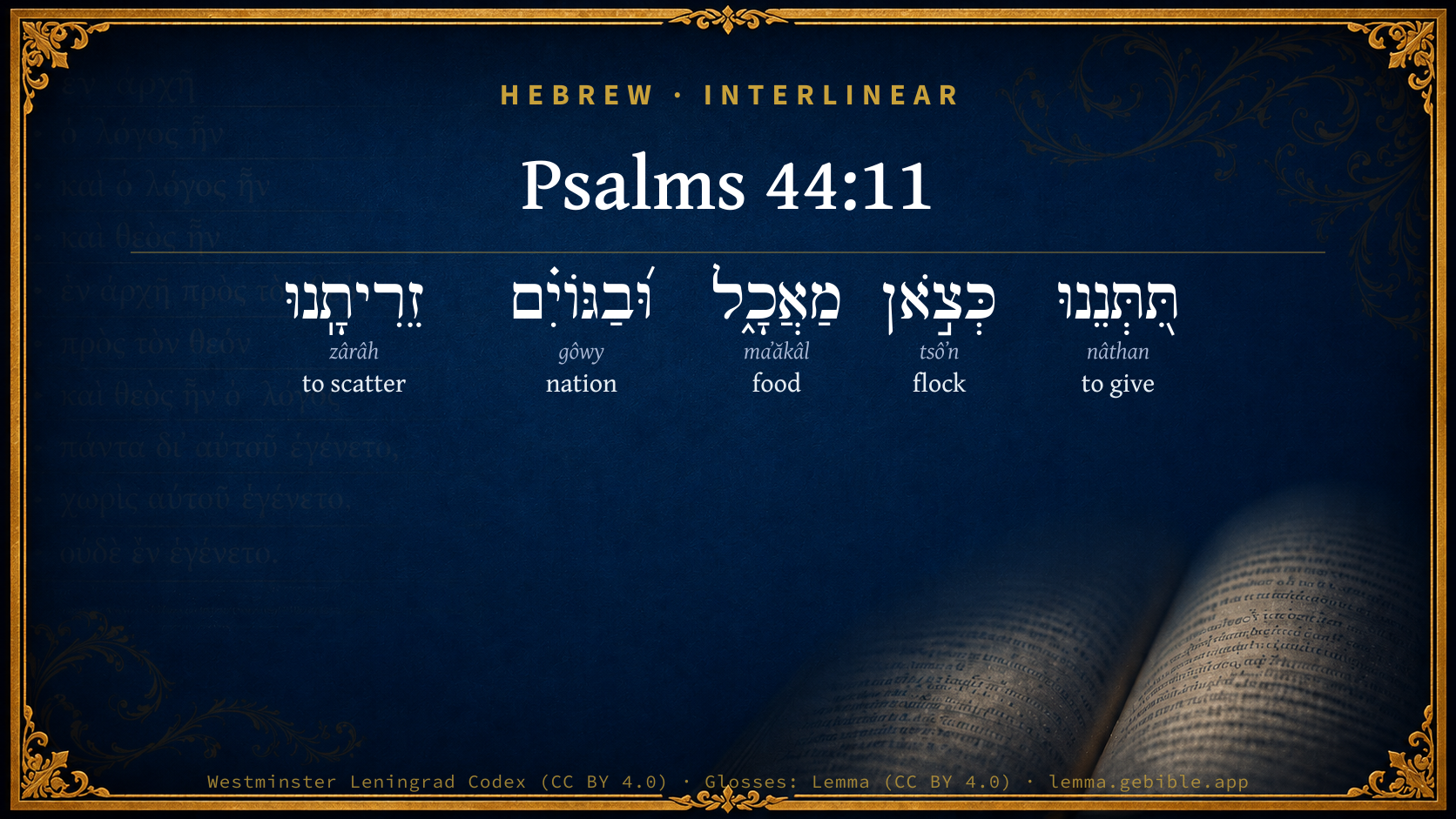
Hebrew (Westminster Leningrad Codex) Psalms 44:11 appears in the Hebrew Old Testament. The text above is from the Westminster Leningrad Codex. Each word links to its Strong’s number, a concise gloss, and parsing drawn from the Open Scriptures Hebrew Bible morphology. Click any word for its full Brown-Driver-Briggs (BDB) entry.
Download image
Cite this verse

Psalms 44:11 (World English Bible). Public Domain. Lemma interlinear Bible study tool, https://lemma.gebible.app/v/psalms/44/11.

Show BibTeX & RIS
BibTeX
RIS
English Translation
You have made us like sheep for food, And have scattered us among the nations.
World English Bible · Public Domain
Download a study sheet

One document with this verse’s original text, its word-by-word gloss line, the meaning frame, cross-references with their text, attributed commentary, and full source and license credits — printable, and it pastes into notes with its structure intact.

This verse Autodidact and up

Study sheet (.html) Plain text (.txt)

A passage Seminary Student

Up to 50 verses in one chapter. A passage sheet keeps up to 6 commentary sources and 12 cross-references per verse, in the order this page ranks them, and says so on the sheet whenever that leaves anything out. Ask for a single verse and you get the Autodidact verse sheet above.

Everything on this page stays free to read, with no account — the sheet is a download of what is already on screen, not access to it.

Want to remove ads? Support Godless Engineer
Compare translations 3

The same verse in 3 English versions, stacked beneath the original-language interlinear above. Click any original word for its lexicon entry.

Each is an independent rendering of the whole verse — the interlinear is not word-aligned to these translations.

Highlighted words mark where these versions differ — a whole-verse word diff, not a word-by-word alignment.

  • World English Bible Public Domain
    You have made us like sheep for food, And have scattered us among the nations.
  • King James Version Public Domain
    Thou hast given us like sheep appointed for meat; and hast scattered us among the heathen.
  • unfoldingWord Literal Text CC BY-SA 4.0
    You have made us like sheep of food, and you have scattered us among the nations.

unfoldingWord Literal Text — © unfoldingWord, licensed CC BY-SA 4.0. Word-aligned USFM3 via Door43 (git.door43.org/unfoldingWord/en_ult).

Versions to compare (up to 4)

3 of 4 selected

Show all 18 translations

Every available English version of this verse, each an independent rendering of the whole verse.

  • World English Bible Public Domain
    You have made us like sheep for food, And have scattered us among the nations.
  • Berean Standard Bible Public Domain
    You have given us up as sheep to be devoured; You have scattered us among the nations.
  • Majority Standard Bible Public Domain
    You have given us up as sheep to be devoured; You have scattered us among the nations.
  • King James Version Public Domain
    Thou hast given us like sheep appointed for meat; and hast scattered us among the heathen.
  • American Standard Version (1901) Public Domain
    Thou hast made us like sheep `appointed' for food, And hast scattered us among the nations.
  • Revised Version (1885) Public Domain
    Thou hast given us like sheep appointed for meat; and hast scattered us among the nations.
  • Geneva Bible (1599) Public Domain
    Thou giuest vs as sheepe to bee eaten, and doest scatter vs among the nations.
  • Douay-Rheims (1899) Public Domain
    Thou hast made us turn our back to our enemies: and they that hated us plundered for themselves.
  • Young's Literal Translation Public Domain
    Thou makest us food like sheep, And among nations Thou hast scattered us.
  • Literal Standard Version CC BY-SA 4.0
    You make us food like sheep, || And You have scattered us among nations.
  • Unlocked Literal Bible CC BY-SA 4.0
    You have made us like sheep to be slaughtered and have scattered us among the nations.
  • unfoldingWord Literal Text CC BY-SA 4.0
    You have made us like sheep of food, and you have scattered us among the nations.
  • Darby Bible Public Domain
    Thou hast given us over like sheep [appointed] for meat, and hast scattered us among the nations;
  • World Messianic Bible Public Domain
    You have made us like sheep for food, and have scattered us among the nations.
  • Webster's Bible Public Domain
    \\44:10\\Thou makest us to turn back from the enemy: and they who hate us plunder for themselves.
  • Free Bible Version CC BY-SA 4.0
    You have handed us over like sheep to be slaughtered; you have scattered us among the other nations.
  • Bible in Basic English Public Domain
    You have made us like sheep which are taken for meat; we are put to flight among the nations.
  • JPS Tanakh (1917) Public Domain
    (44-12) Thou hast given us like sheep to be eaten; and hast scattered us among the nations.

Literal Standard Version (2020), Covenant Press — licensed CC BY-SA 4.0. Text via the HelloAO Bible API (eBible.org). Unlocked Literal Bible (unfoldingWord) — licensed CC BY-SA 4.0. Text via the HelloAO Bible API (eBible.org). unfoldingWord Literal Text — © unfoldingWord, licensed CC BY-SA 4.0. Word-aligned USFM3 via Door43 (git.door43.org/unfoldingWord/en_ult). Free Bible Version, Dr. Jonathan Gallagher — licensed CC BY-SA 4.0. Text via the HelloAO Bible API (eBible.org).

Word by word

More ways to search: Search by grammar → Find every occurrence → Compare this word →

Practice this passage: Drill this verse → Learn its vocabulary →

About this verse

These counts appear in no published source. They are computed here, from the morphology-tagged text and Lemma’s own curated glosses. What Lemma adds →

5
words
5
distinct lemmas
Wisdom
section

Shared distinctive vocabulary

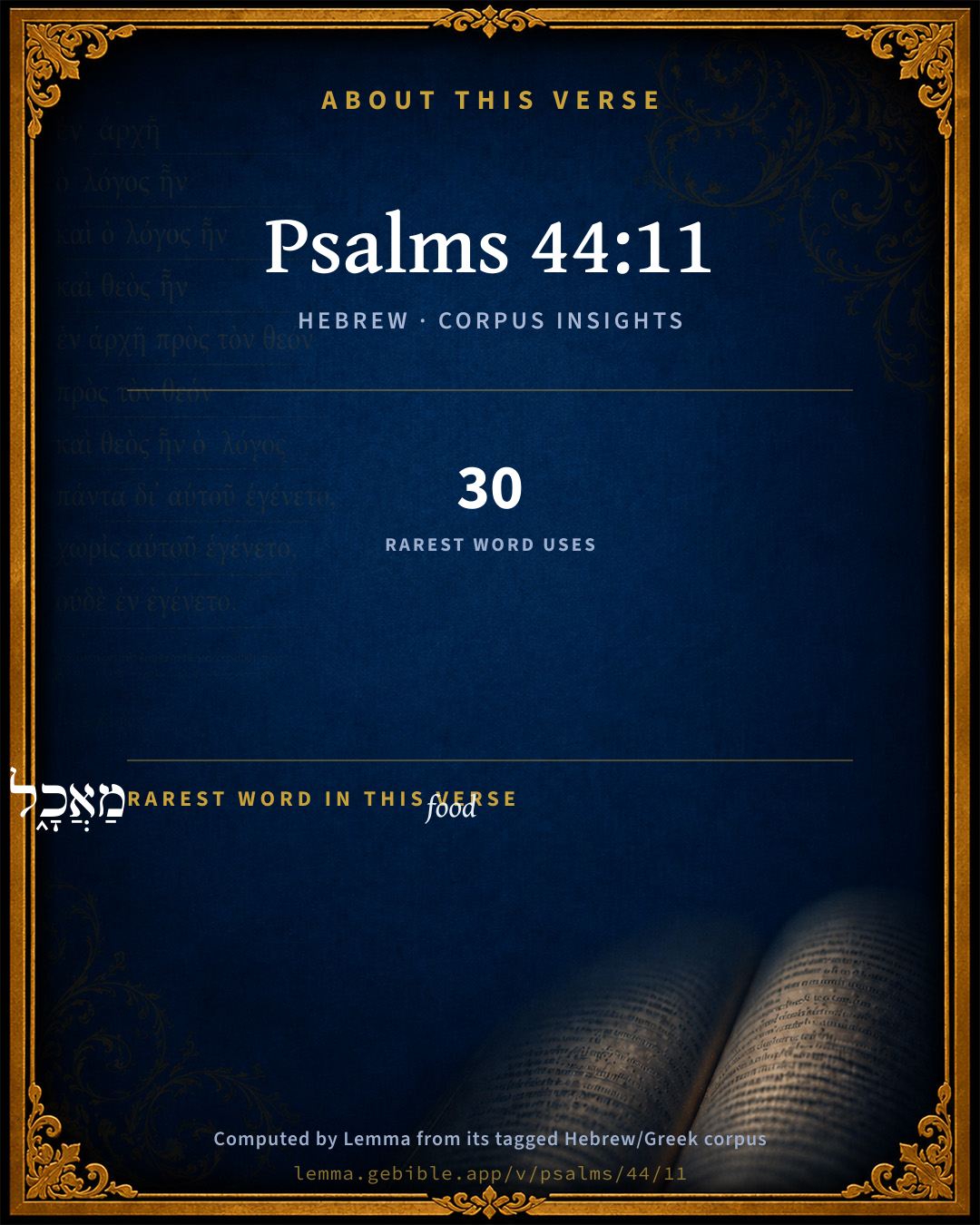
מַאֲכָ֑ל food H3978 occurs in 29 verses of the Hebrew Bible. Also found in:

Grammatical profile

  • 2 verbs
  • 3 nouns

Verb forms

  • תִּ֭תְּנֵנוּ Qal · Imperfect
  • זֵרִיתָֽנוּ Piel · Perfect

Hebrew & Septuagint length

In English translation the verse runs 15 words from the Hebrew and 14 from the Septuagint (LXX English) — closely comparable.

A rough comparison of the two English renderings, which tokenize alike — not a word-level alignment.

Word counts can differ between the Hebrew and the Greek without any difference in meaning — e.g. the Hebrew direct-object marker אֵת has no separate Greek word, and Greek often adds the article ὁ.

Cross-references

12

Topical passages linked to Psalms 44:11 in the Treasury of Scripture Knowledge — connected by theme and wording, ordered by reader-vote popularity; previews shown in the World English Bible.

  • Deuteronomy 4:27 Yahweh will scatter you among the peoples, and you shall be left few in number among the nations, where Yahweh shall lead you away.
  • Deuteronomy 28:64 Yahweh will scatter you among all peoples, from the one end of the earth even to the other end of the earth; and there you shall serve other gods, which you have not known, you nor your fathers, even wood and stone.
  • Ezekiel 34:12 As a shepherd seeks out his flock in the day that he is among his sheep that are scattered abroad, so will I seek out my sheep; and I will deliver them out of all places where they have been scattered in the cloudy and dark day.
  • Romans 8:36 Even as it is written, "For your sake we are killed all day long. We were accounted as sheep for the slaughter."
  • Isaiah 11:11–12 It shall happen in that day, that the Lord will set his hand again the second time to recover the remnant of his people, who shall remain, from Assyria, and from Egypt, and from Pathros, and from Cush, and from Elam, and from Shinar, and from Hamath, and from the islands of the sea.
  • Jeremiah 32:37 Behold, I will gather them out of all the countries, where I have driven them in my anger, and in my wrath, and in great indignation; and I will bring them again to this place, and I will cause them to dwell safely:
  • 2 Kings 17:6 In the ninth year of Hoshea the king of Assyria took Samaria, and carried Israel away to Assyria, and placed them in Halah, and on the Habor, the river of Gozan, and in the cities of the Medes.
  • Psalms 14:4 Have all the workers of iniquity no knowledge, Who eat up my people as they eat bread, And don't call on Yahweh?
  • Psalms 60:1 God, you have rejected us. You have broken us down. You have been angry. Restore us, again.
  • Psalms 106:27 That he would overthrow their seed among the nations, And scatter them in the lands.
  • Jeremiah 12:3 But you, Yahweh, know me; you see me, and try my heart toward you: pull them out like sheep for the slaughter, and prepare them for the day of slaughter.
  • Luke 21:24 They will fall by the edge of the sword, and will be led captive into all the nations. Jerusalem will be trampled down by the Gentiles, until the times of the Gentiles are fulfilled.

Cross-references courtesy of OpenBible.info (CC BY 4.0).

Hebrew and Greek witnesses Masoretic Hebrew ↔ Greek Septuagint

The same verse in the two great witnesses to the Old Testament, shown verse-for-verse.

You’re reading Greek Psalm 43 (Hebrew Psalm 44). The Septuagint counts the superscription, so verse numbers can differ from the Hebrew — chapter-level alignment, not verse-by-verse. Numbering follows Rahlfs.

These are two independent witnesses, not word-aligned to each other, and the Septuagint is shown in lemma (dictionary) form.

Hebrew Psalms 44:11 Masoretic · Westminster Leningrad Codex

תִּ֭תְּנֵנוּ כְּצֹ֣אן מַאֲכָ֑ל וּ֝בַגּוֹיִ֗ם זֵרִיתָֽנוּ

You have made us like sheep for food, And have scattered us among the nations.

World English Bible · Public Domain

Greek LXX Greek Psalm 43:11 Septuagint · lemma form

ἀποστρέφω ἐγώ εἰς ὁ ὀπίσω παρά ὁ ἐχθρός ἐγώ καί ὁ μισέω ἐγώ διαἁρπάζω ἑαυτοῦ

You made us as sheep for meat; and you scattered us among the nations.

LXX2012 (modern English Septuagint) · Public Domain

Hebrew: Westminster Leningrad Codex (CC BY 4.0). Greek: Septuagint (public domain); English from LXX2012 (modern English Septuagint) (Public Domain). How the Septuagint differs from the Hebrew →

Commentary

Notes on Psalms 44:11 from classic Christian and Jewish commentators (each source and its license shown beneath its notes). The classic Christian expositions comment on the surrounding passage and are grouped to its opening verse, so a note may address several verses; the Jewish commentaries on the Tanakh (Rashi and others) are per-verse, so they appear only where the commentator wrote on this verse.

Lemma curates 59 commentaries, every one of them public domain or Creative Commons licensed, each selected and text-cleaned for this edition rather than reprinted as found. About our sources →

Trapp's Complete Commentary

John Trapp

Psa 44:11 Thou hast given us like sheep [appointed] for meat; and hast scattered us among the heathen.

Ver. 11. Thou hast given us like sheep appointed for meat] Aliqui occisi, dispersi alii, et venundati gratias, Some of us are slain, others scattered here and there, and sold for nought (Aben-Ezra).

And hast scattered us, &c.] Oh the many miseries of such a banishment! The poet Tyrtaeus thus expresses it:

Est miserum, patria amissa laribusque vagare:

Mendiea et timida voce rogare cibos.

Cum natisque errare suis, et coniuge moesta,

Et cum matre pia, cumque parente sene.

John Trapp, A Commentary or Exposition upon All the Books of the Old and New Testament (1647–1656) — public domain. Text from a community e-Sword module.

Joseph Benson's Commentary

Psa 44:11-14. Thou hast given us like sheep, &c. — Some of us they killed in the pursuit, without any mercy, like sheep appointed for the shambles. And hast scattered us among the heathen — Those of us who were not slain have been carried into captivity, and dispersed in several places. Thou sellest thy people for naught — Sufferest them to be sold for slaves at very inconsiderable prices. The expression implies the low esteem in which they were with God. And dost not increase thy wealth by their price — “We are thus sadly handled, without the comfort of bringing in any honour to thee by our calamities; since thy church among us is defaced, and no other people taken instead of us, by whom thy name may be glorified.” — Hammond. Or, as Poole interprets the words, “Thou hast not advanced thy honour and service thereby; for thy enemies do not serve thee more than thy people, nor yet so much.” Thou makest us a scorn and derision, &c. — They contemn our persons, and sport themselves with our miseries. Thou makest us a by-word — Or a proverb, as משׁל, mashal, signifies. Thou hast brought upon us the curse pronounced by thy servant Moses, Deu 28:37. For we are become a by-word among the heathen, who, when they would express the wretchedness of any person, say, He is viler or more miserable than a Jew. A shaking of the head — When they say nothing, they signify their contempt and derision of us, by the scornful motion of their heads.

Joseph Benson's Commentary on the Old and New Testaments (1811–1818) — public domain. Text from a community e-Sword module.

J. A. Alexander on Psalms

Joseph Addison Alexander

12. (Psa 44:11). Thou wilt give us as sheep (for) food, and among the nations hast scattered us. The consecution of the tenses is the same as in the preceding verse. Sheep for food, or flocks of food, i. e. intended and accustomed to be eaten. Give may either mean place, render, constitute, or give up, abandon. The last clause has by some been understood to refer to the Babylonish exile, and regarded as a proof of later date. But in every war with the surrounding countries, there were partial deportations and dispersions. See Joe 3:2, Amo 1:6; Amo 1:9, and compare 1Ki 8:46.

Joseph Addison Alexander, The Psalms Translated and Explained (1850) — public domain. Text from a community e-Sword module.

Tyndale Open Study Notes

Tyndale Open Resources

44:11 scattered us among the nations: This probably refers to the Exile (see 51:18-19; 89:38-51; 106:40-47; 137).

Tyndale Open Study Notes — © Tyndale Open Resources, licensed CC BY-SA 4.0. Text via the HelloAO Bible API.

Geneva Bible (1599)

Geneva Bible translators

Knowing God to be author of this calamity, they murmur not, but seek remedy at his hands, who wounded them.

Geneva Bible (1599) marginal notes — public domain. Text via Bolls.life.

Jamieson, Fausset & Brown

Robert Jamieson, A. R. Fausset & David Brown

The Babylonian captivity not necessarily meant. There were others (compare Kg1 8:46).

Jamieson, Fausset & Brown — Commentary Critical and Explanatory on the Whole Bible (1871) — public domain (CC PDM 1.0). Text via the HelloAO Bible API.

Adam Clarke's Commentary

Verse 11. And hast scattered us among the heathen.] This most evidently alludes to the captivity. From the successful wars of the kings of Assyria and Chaldea against the kings of Israel and Judah, and the dispersion of the tribes under Tiglath-pileser, Shalmaneser, and Nebuchadnezzar, Jews have been found in every province of the east; there they settled, and there their successors may be found to the present day.

Adam Clarke's Commentary on the Bible (1810–1826) — public domain. Text from a community e-Sword/MySword module.

John Calvin's Commentaries

To the same purpose is that other comparison, (verse 11) in which they say that they were given as sheep for food By this the prophet intimates, that being already vanquished previous to the battle, they fell down, as it were, upon the earth before their enemies, ready to be devoured by them, and not fit for any thing else than to gratify their insatiable cruelty. It ought to be observed, that when the faithful represent God as the author of their calamities, it is not in the way of murmuring against him, but that they may with greater confidence seek relief, as it were, from the same hand which smote and wounded them. It is certainly impossible that those who impute their miseries to fortune can sincerely have recourse to God, or look for help and salvation from him. If, therefore, we would expect a remedy from God for our miseries, we must believe that they befall us not by fortune or mere chance, but that they are inflicted upon us properly by his hand. Having stated that they were thus abandoned to the will of their enemies, they add, at the same time, that they were scattered among the heathen: a dispersion which was a hundred times more grievous to them than death. The whole glory and felicity of that people consisted in this, that, being united under one God and one King, they formed one body; and that such being the case, it was a sign that the curse of God lay heavy upon them to be mingled among the heathen, and scattered hither and thither like broken members.

John Calvin's Commentaries (1540-1563) — public domain. Text from the Calvin Translation Society English edition (1840s-50s) via the Christian Classics Ethereal Library (ccel.org). Calvin's coverage is partial (roughly two-thirds of the Bible); uncommented books and verses are honest gaps, never fabricated. The 19th-century editor's footnotes and remarks are omitted so the notes are faithfully Calvin's own voice.

Ellicott's Commentary for English Readers

(11) Like sheep.—The image of the sheep appointed for the slaughter; and unable to resist, recalls Isa_53:6-7, but does not necessarily connect the Psalm with the exile period, since it was a figure likely to suggest itself in every time of helpless peril.

A Bible Commentary for English Readers, edited by Charles John Ellicott (1878–1897) — public domain. Text from a community e-Sword module.

The Cambridge Bible for Schools and Colleges

gen. ed. J. J. S. Perowne

11. Some of God’s people are butchered like sheep (cp. Psa_44:22); others are sold as slaves. It is evidently not a deportation of the nation that is meant, but the sale of prisoners of war for slaves. Cp. Joe_3:2; Joe_3:6; Amo_1:6; Amo_1:9. To the Israelite with his love of freedom and attachment to his own land such a fate seemed little better than death.

The Cambridge Bible for Schools and Colleges (gen. ed. J. J. S. Perowne; Cambridge University Press, 1878–1918) — public domain. Text from a community e-Sword module.

John Gill's Exposition

Thou hast given us like sheep appointed for meat,.... To be butchered, and then eaten as sheep are; and therefore are called "the flock of slaughter", Zac 11:4; as the church was, not only under the ten persecutions of Rome Pagan, but through the butcheries and massacres of Rome Papal; who have worried many of Christ's sheep, have eaten their flesh and drank their blood, and have become drunken with it; it has been their meat and drink to persecute the saints of the most High;

and hast scattered us among the Heathen: the Pagan world, as the first Christians were, who were scattered up and down in the Gentile world everywhere; see Pe1 1:1; or the Papacy, who are sometimes called Gentiles, Rev 11:2; because much of the Gentile idolatry is introduced into the Popish religion; and among these many of the true members of Christ and of his church have been carried captive and scattered; and such will be found there a little before the destruction of Babylon, and will be called out from thence; see Rev 13:10.

John Gill's Exposition of the Whole Bible (1746–1763) — public domain (CC PDM 1.0). Text via the HelloAO Bible API.

Albert Barnes' Notes on the Bible

Thou hast given us like sheep appointed for meat - Margin, as in Hebrew, “as sheep of meat.” That is, as sheep are killed for food, so thou hast allowed us to be put to death.

And hast scattered us among the heathen - Among the surrounding nations. See the notes at Psa 44:2. That is, they had been discomfited in war; many had fled into surrounding countries; many had been carried away captive. All this undoubtedly occurred at the time at which I have supposed that the psalm was written - the time immediately preceding the Babylonian captivity.

Albert Barnes' Notes on the Bible (1834–1885) — public domain. Text from a community e-Sword/MySword module.

Matthew Poole's English Annotations

Those of us who were not slain are carried into captivity, and dispersed in several places.

Matthew Poole's English Annotations on the Holy Bible (1683–1685) — public domain. Text from a community e-Sword/MySword module.

The Treasury of David

Charles H. Spurgeon

Ver. 11. Thou hast given us like sheep appointed for meat. As sheep are slaughtered for food, so were the people slain in flocks, with ease, and frequency. Not with dignity of sacrifice, but with the cruelty of the shambles, were they put to death. God appeared to give them up like sheep allotted to the butcher, to abandon them as the hireling abandons the flock to wolves. The complaint is bitterly eloquent. And hast scattered us among the heathen. Many were carried into captivity, far off from the public worship of the temple of God, to pine as exiles among idolaters. All this is ascribed to the Lord, as being allowed by him, and even appointed by his decree. It is well to trace the hand of God in our sorrows, for it is surely there.

Ver. 11. Like sheep appointed for meat. This very strongly and strikingly intimates the extent of the persecution and slaughter to which they were exposed; there being no creature in the world of which such vast numbers are constantly slaughtered as of sheep for the subsistence of man. The constancy of such slaughter is also mentioned in Ps 44:22 as illustrating the continual oppression to which the Hebrews were subject. Kitto's Pictorial Bible.

Ver. 11. Like sheep appointed for meat, and not reserved for breeding or for wool. Arthur Jackson.

None.

Psalms 44:12*

Charles H. Spurgeon's The Treasury of David (1869–1885) — public domain. Psalms only. Text from a community e-Sword/MySword module.

The Pulpit Commentary

Thou hast given us like sheep appointed for meat. "As sheep for the shambles" (Kay) a free translation, which well expresses the meaning. And hast scattered us among the heathen. Either "caused us to disperse ourselves among our heathen neighbours," or "to be sold for slaves among them by our captors." No general dispersion of the nation is intended.

The Pulpit Commentary (1880–1919), ed. H.D.M. Spence-Jones & Joseph S. Exell — public domain. Text from a community e-Sword module.

John Wesley's Explanatory Notes

Scattered - Those who were not slain are carried into captivity, and dispersed in several places.

John Wesley, Explanatory Notes Upon the Whole Bible (1754–1765) — public domain. Text via the GEBible commentary corpus.

Rashi

Rabbi Shlomo Yitzchaki (Rashi)

You make us retreat Heb. תשיבנו. This is a present tense.

plunder for themselves They plunder our property, each man for himself.

Rashi on the Tanakh — English translations: “The Judaica Press complete Tanach with Rashi, translated by A. J. Rosenberg” (CC BY 4.0); “Pentateuch with Rashi's commentary by M. Rosenbaum and A.M. Silbermann, 1929-1934” (public domain); “The Metsudah Tanach series, Lakewood, N.J” (CC BY 4.0); and “The Book of Joshua, Metsudah Publications, 1997” (CC BY 4.0). Text via Sefaria.

Lesson kit

Teaching starters — assembled from the data on this page, not authored interpretation. Every prompt links to the verse data it draws on. Edit before teaching.

Psalms, in the Wisdom, opens this verse with 5 words (5 distinct Hebrew lemmas). Its most distinctive word is maʼăkâl (“food”). A historical commentator’s framing appears above. Read the whole chapter for the surrounding context.

Discussion questions

  1. How does “food” (maʼăkâl) shape what this verse is saying?
  2. Genesis 2:9 shares the word «food» with this verse. How do the two illuminate each other?
  3. These translations render this verse differently; the difference is in the English rendering, not the original. What questions does that raise?
  4. The verb «תִּ֭תְּנֵנוּ» is Qal Imperfect. How does its form color the action?
  5. Reading how Trapp's Complete Commentary and Joseph Benson's Commentary read this verse, where do the two commentators agree and where do they part?

Things to notice

Reading settings

Reading text

Shown beneath each verse's original-language words.

Old Testament
Old Testament edition

Read the OT as the Masoretic Hebrew (MT) or the Greek Septuagint (LXX).

English shown for the Greek Septuagint (in the Hebrew ↔ Greek comparison).

Comparing translations? Open the Compare panel on any verse page to stack up to four side by side.