
Ezekiel 5:7

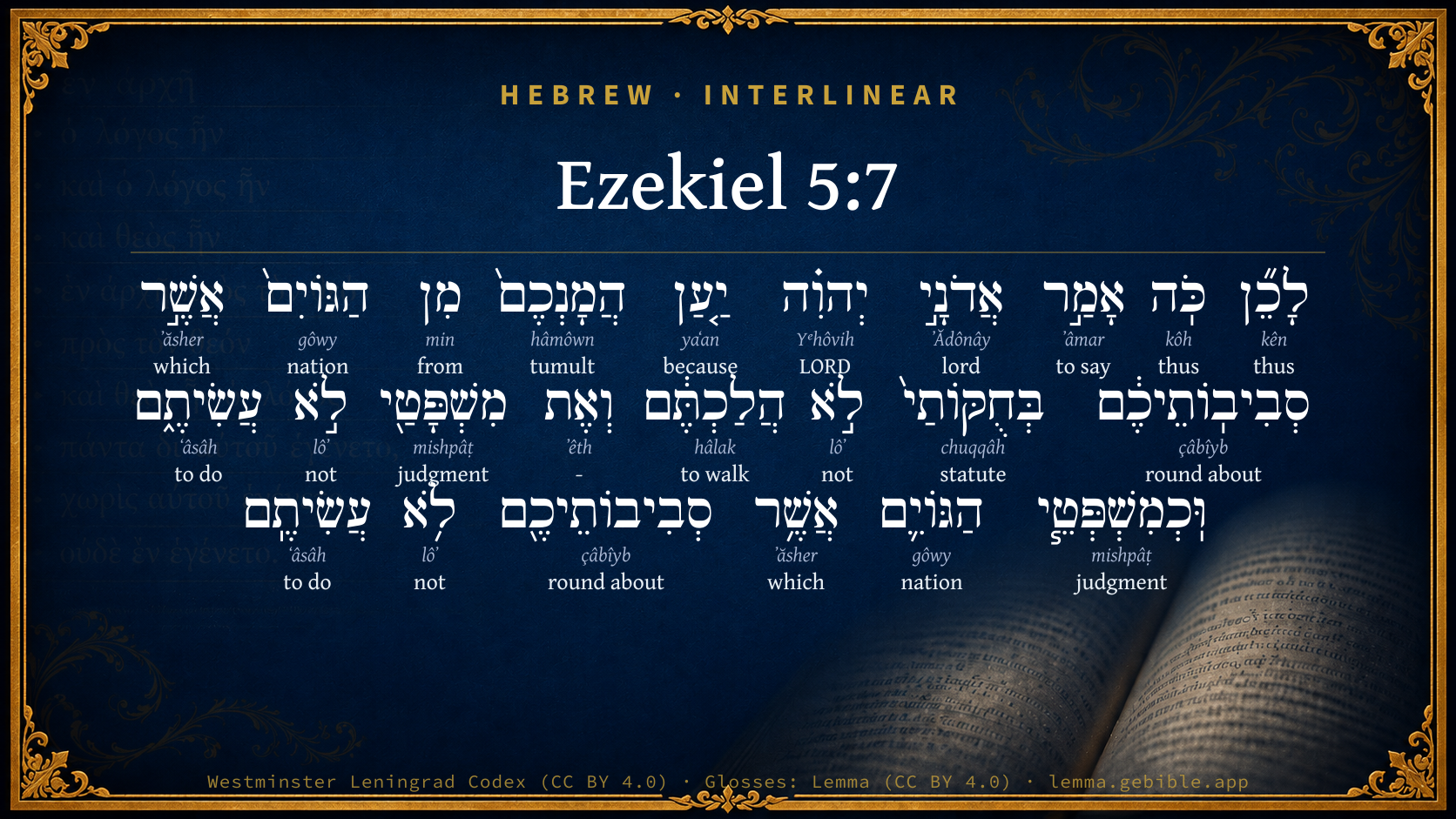
Hebrew (Westminster Leningrad Codex) Ezekiel 5:7 appears in the Hebrew Old Testament. The text above is from the Westminster Leningrad Codex. Each word links to its Strong’s number, a concise gloss, and parsing drawn from the Open Scriptures Hebrew Bible morphology. Click any word for its full Brown-Driver-Briggs (BDB) entry.
Download image
Cite this verse

Ezekiel 5:7 (World English Bible). Public Domain. Lemma interlinear Bible study tool, https://lemma.gebible.app/v/ezekiel/5/7.

Show BibTeX & RIS
BibTeX
RIS
English Translation
Therefore thus says the Lord Yahweh: Because you are turbulent more than the nations that are round about you, and have not walked in my statutes, neither have kept my ordinances, neither have done after the ordinances of the nations that are round about you;
World English Bible · Public Domain
Download a study sheet

One document with this verse’s original text, its word-by-word gloss line, the meaning frame, cross-references with their text, attributed commentary, and full source and license credits — printable, and it pastes into notes with its structure intact.

This verse Autodidact and up

Study sheet (.html) Plain text (.txt)

A passage Seminary Student

Up to 50 verses in one chapter. A passage sheet keeps up to 6 commentary sources and 12 cross-references per verse, in the order this page ranks them, and says so on the sheet whenever that leaves anything out. Ask for a single verse and you get the Autodidact verse sheet above.

Everything on this page stays free to read, with no account — the sheet is a download of what is already on screen, not access to it.

Want to remove ads? Support Godless Engineer
Compare translations 3

The same verse in 3 English versions, stacked beneath the original-language interlinear above. Click any original word for its lexicon entry.

Each is an independent rendering of the whole verse — the interlinear is not word-aligned to these translations.

Highlighted words mark where these versions differ — a whole-verse word diff, not a word-by-word alignment.

  • World English Bible Public Domain
    Therefore thus says the Lord Yahweh: Because you are turbulent more than the nations that are round about you, and have not walked in my statutes, neither have kept my ordinances, neither have done after the ordinances of the nations that are round about you;
  • King James Version Public Domain
    Therefore thus saith the Lord GOD; Because ye multiplied more than the nations that are round about you, and have not walked in my statutes, neither have kept my judgments, neither have done according to the judgments of the nations that are round about you;
  • unfoldingWord Literal Text CC BY-SA 4.0
    Therefore the Lord Yahweh says this, “Because you are more troublesome than the nations that surround you and have not walked in my statutes or acted according to my decrees, or even acted according to the decrees of the nations that surround you,”

unfoldingWord Literal Text — © unfoldingWord, licensed CC BY-SA 4.0. Word-aligned USFM3 via Door43 (git.door43.org/unfoldingWord/en_ult).

Versions to compare (up to 4)

3 of 4 selected

Show all 18 translations

Every available English version of this verse, each an independent rendering of the whole verse.

  • World English Bible Public Domain
    Therefore thus says the Lord Yahweh: Because you are turbulent more than the nations that are round about you, and have not walked in my statutes, neither have kept my ordinances, neither have done after the ordinances of the nations that are round about you;
  • Berean Standard Bible Public Domain
    Therefore this is what the Lord GOD says: ‘You have been more insubordinate than the nations around you; you have not walked in My statutes or kept My ordinances, nor have you even conformed to the ordinances of the nations around you.’
  • Majority Standard Bible Public Domain
    Therefore this is what the Lord GOD says: ‘You have been more insubordinate than the nations around you; you have not walked in My statutes or kept My ordinances, nor have you even conformed to the ordinances of the nations around you.’
  • King James Version Public Domain
    Therefore thus saith the Lord GOD; Because ye multiplied more than the nations that are round about you, and have not walked in my statutes, neither have kept my judgments, neither have done according to the judgments of the nations that are round about you;
  • American Standard Version (1901) Public Domain
    Therefore thus saith the Lord Jehovah: Because ye are turbulent more than the nations that are round about you, and have not walked in my statutes, neither have kept mine ordinances, neither have done after the ordinances of the nations that are round about you;
  • Revised Version (1885) Public Domain
    Therefore thus saith the Lord GOD: Because ye are turbulent more than the nations that are round about you, and have not walked in my statutes, neither have kept my judgments, neither have done after the ordinances of the nations that are round about you;
  • Geneva Bible (1599) Public Domain
    Therefore thus saith the Lord God, Because your multitude is greater then the nations that are rounde about you, and ye haue not walked in my statutes, neither haue ye kept my iudgements: no, ye haue not done according to the iudgements of the nations, that are rounde about you,
  • Douay-Rheims (1899) Public Domain
    Therefore thus saith the Lord God: Because you have surpassed the Gentiles that are round about you, and have not walked in my commandments, and have not kept my judgments, and have not done according to the judgments of the nations that are round about you:
  • Young's Literal Translation Public Domain
    Therefore, thus said the Lord Jehovah: Because of your multiplying above the nations that `are' around you, In My statutes ye have not walked, And My judgments ye have not done, According to the judgments of the nations That `are' round about you ye have not done.
  • Literal Standard Version CC BY-SA 4.0
    Therefore, thus said Lord YHWH: “Because of your multiplying above the nations that [are] around you, || You have not walked in My statutes, || And you have not done My judgments, || According to the judgments of the nations that [are] around you, you have not done.”
  • Unlocked Literal Bible CC BY-SA 4.0
    Therefore the Lord Yahweh says this, “Because you are more troublesome than the nations that surround you and have not walked in my statutes or acted according to my decrees, or even acted according to the decrees of the nations that surround you,”
  • unfoldingWord Literal Text CC BY-SA 4.0
    Therefore the Lord Yahweh says this, “Because you are more troublesome than the nations that surround you and have not walked in my statutes or acted according to my decrees, or even acted according to the decrees of the nations that surround you,”
  • Darby Bible Public Domain
    Therefore thus saith the Lord Jehovah: Because ye have been turbulent more than the nations that are round about you, [and] have not walked in my statutes, neither have kept mine ordinances, nor [even] have done according to the ordinances of the nations that are round about you;
  • World Messianic Bible Public Domain
    “Therefore the Lord GOD says: ‘Because you are more turbulent than the nations that are around you, and have not walked in my statutes, neither have kept my ordinances, neither have followed the ordinances of the nations that are around you;
  • Webster's Bible Public Domain
    Therefore thus saith the Lord GOD; Because ye multiplied more than the nations that are around you, and have not walked in my statutes, neither have kept my judgments, neither have done according to the judgments of the nations that are around you:
  • Free Bible Version CC BY-SA 4.0
    Consequently this is what the Lord God says: You have caused more trouble than the nations around you. You refused to follow my rules and keep my regulations. In fact you didn't even live up to the standards of the nations surrounding you.
  • Bible in Basic English Public Domain
    For this cause the Lord has said: Because you have been more uncontrolled than the nations round about you, and have not been guided by my rules or kept my orders, but have kept the orders of the nations round about you;
  • JPS Tanakh (1917) Public Domain
    Therefore thus saith the Lord GOD: Because ye have outdone the nations that are round about you, in that ye have not walked in My statutes, neither have kept Mine ordinances, neither have done after the ordinances of the nations that are round about you;

Literal Standard Version (2020), Covenant Press — licensed CC BY-SA 4.0. Text via the HelloAO Bible API (eBible.org). Unlocked Literal Bible (unfoldingWord) — licensed CC BY-SA 4.0. Text via the HelloAO Bible API (eBible.org). unfoldingWord Literal Text — © unfoldingWord, licensed CC BY-SA 4.0. Word-aligned USFM3 via Door43 (git.door43.org/unfoldingWord/en_ult). Free Bible Version, Dr. Jonathan Gallagher — licensed CC BY-SA 4.0. Text via the HelloAO Bible API (eBible.org).

Word by word

More ways to search: Search by grammar → Find every occurrence → Compare this word →

Practice this passage: Drill this verse → Learn its vocabulary →

הֲמָנְכֶם֙
hâmôwn
H1995
“tumult · your”
Noun, Common, Masculine, Singular, Construct + Suffix, Personal, 2nd Person, Masculine, Plural
Part of Speech
Noun
Type
Common
Gender
Masculine
Number
Singular
State
Construct
Full BDB Definition

Origin: from H1993

TWOT: 505a

(Qal) murmur, roar, crowd, abundance, tumult, sound - sound, murmur, rush, roar - tumult, confusion - crowd, multitude - great number, abundance - abundance, wealth
  1. לָכֵ֞ן kên H3651 “to/for · thus” Preposition + Adverb
  2. כֹּֽה kôh H3541 “thus” Adverb
  3. אָמַ֣ר ʼâmar H559 “to say” Verb, Qal, Perfect, 3rd Person, Masculine, Singular
  4. אֲדֹנָ֣י ʼĂdônây H136 “Lord · my” Noun, Common, Masculine, Plural, Construct + Suffix, Personal, 1st Person, Common, Singular
  5. יְהוִ֗ה Yᵉhôvih H3069 “LORD” Noun, Proper
  6. יַ֤עַן yaʻan H3282 “because” Conjunction
  7. מִן min H4480 “from” Preposition
  8. הַגּוֹיִם֙ gôwy H1471 “the · nations” Particle, Definite Article + Noun, Common, Masculine, Plural, Absolute
  9. אֲשֶׁ֣ר ʼăsher H834 “which” Particle, Relative
  10. סְבִיבֽוֹתֵיכֶ֔ם çâbîyb H5439 “surroundings · your” Noun, Common, Both, Plural, Construct + Suffix, Personal, 2nd Person, Masculine, Plural
  11. בְּחֻקּוֹתַי֙ chuqqâh H2708 “in/at · statutes · my” Preposition + Noun, Common, Both, Plural, Construct + Suffix, Personal, 1st Person, Common, Singular
  12. לֹ֣א lôʼ H3808 “not” Particle, Negative
  13. הֲלַכְתֶּ֔ם hâlak H1980 “to walk” Verb, Qal, Perfect, 2nd Person, Masculine, Plural
  14. וְאֶת ʼêth H853 “and · -” Conjunction + Particle, Direct Object
  15. מִשְׁפָּטַ֖י mishpâṭ H4941 “judgments · my” Noun, Common, Masculine, Plural, Construct + Suffix, Personal, 1st Person, Common, Singular
  16. לֹ֣א lôʼ H3808 “not” Particle, Negative
  17. עֲשִׂיתֶ֑ם ʻâsâh H6213 “to do” Verb, Qal, Perfect, 2nd Person, Masculine, Plural
  18. וּֽכְמִשְׁפְּטֵ֧י mishpâṭ H4941 “and · like/as · judgments of” Conjunction + Preposition + Noun, Common, Masculine, Plural, Construct
  19. הַגּוֹיִ֛ם gôwy H1471 “the · nations” Particle, Definite Article + Noun, Common, Masculine, Plural, Absolute
  20. אֲשֶׁ֥ר ʼăsher H834 “which” Particle, Relative
  21. סְבִיבוֹתֵיכֶ֖ם çâbîyb H5439 “surroundings · your” Noun, Common, Both, Plural, Construct + Suffix, Personal, 2nd Person, Masculine, Plural
  22. לֹ֥א lôʼ H3808 “not” Particle, Negative
  23. עֲשִׂיתֶֽם ʻâsâh H6213 “to do” Verb, Qal, Perfect, 2nd Person, Masculine, Plural

About this verse

These counts appear in no published source. They are computed here, from the morphology-tagged text and Lemma’s own curated glosses. What Lemma adds →

24
words
17
distinct lemmas
Prophets
section

Grammatical profile

  • 4 verbs
  • 10 nouns
  • 1 preposition
  • 1 conjunction
  • 2 adverbs
  • 6 particles

Verb forms

  • אָמַ֣ר Qal · Perfect
  • הֲלַכְתֶּ֔ם Qal · Perfect
  • עֲשִׂיתֶ֑ם Qal · Perfect
  • עֲשִׂיתֶֽם Qal · Perfect

Repetition

Words recur within this verse — often emphatic in Hebrew:

  • הַגּוֹיִם֙ nation H1471 ×2
  • סְבִיבֽוֹתֵיכֶ֔ם round about H5439 ×2
  • מִשְׁפָּטַ֖י judgment H4941 ×2
  • עֲשִׂיתֶ֑ם to do H6213 ×2
  • לֹ֣א not H3808 ×3
  • אֲשֶׁ֣ר which H834 ×2

Hebrew & Septuagint length

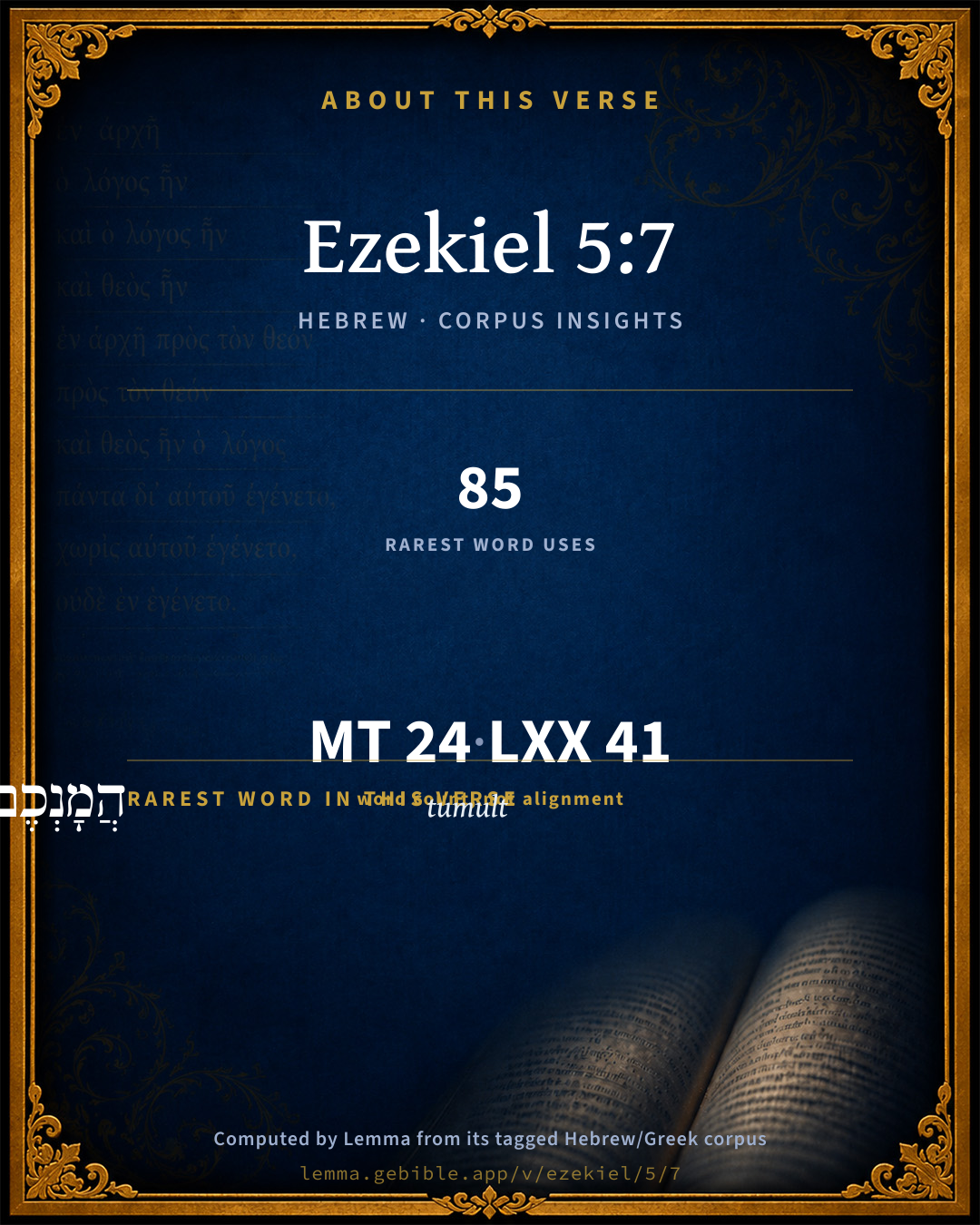
In English translation the verse runs 45 words from the Hebrew and 52 from the Septuagint (LXX English) — closely comparable.

A rough comparison of the two English renderings, which tokenize alike — not a word-level alignment.

Word counts can differ between the Hebrew and the Greek without any difference in meaning — e.g. the Hebrew direct-object marker אֵת has no separate Greek word, and Greek often adds the article ὁ.

In the original languages it is 24 Hebrew tokens and 41 Greek tokens — but the two are counted differently (Hebrew bundles its prefixes and suffixes into one token; the Greek is in lemma form), so that isn’t a like-for-like length.

Cross-references

6

Topical passages linked to Ezekiel 5:7 in the Treasury of Scripture Knowledge — connected by theme and wording, ordered by reader-vote popularity; previews shown in the World English Bible.

  • Jeremiah 2:10–11 For pass over to the isles of Kittim, and see; and send to Kedar, and consider diligently; and see if there has been such a thing.
  • 2 Kings 21:9–11 But they didn't listen: and Manasseh seduced them to do that which is evil more than did the nations whom Yahweh destroyed before the children of Israel.
  • 2 Chronicles 33:9 Manasseh seduced Judah and the inhabitants of Jerusalem, so that they did evil more than did the nations whom Yahweh destroyed before the children of Israel.
  • Ezekiel 5:11 Therefore, as I live, says the Lord Yahweh, surely, because you have defiled my sanctuary with all your detestable things, and with all your abominations, therefore will I also diminish [you]; neither shall my eye spare, and I also will have no pity.
  • Ezekiel 16:47–48 Yet have you not walked in their ways, nor done after their abominations; but, as [if that were] a very little [thing], you were more corrupt than they in all your ways.
  • Ezekiel 16:54 that you may bear your own shame, and may be ashamed because of all that you have done, in that you are a comfort to them.

Cross-references courtesy of OpenBible.info (CC BY 4.0).

Hebrew and Greek witnesses Masoretic Hebrew ↔ Greek Septuagint

The same verse in the two great witnesses to the Old Testament, shown verse-for-verse.

These are two independent witnesses, not word-aligned to each other, and the Septuagint is shown in lemma (dictionary) form.

Hebrew Ezekiel 5:7 Masoretic · Westminster Leningrad Codex

לָכֵ֞ן כֹּֽה אָמַ֣ר אֲדֹנָ֣י יְהוִ֗ה יַ֤עַן הֲמָנְכֶם֙ מִן הַגּוֹיִם֙ אֲשֶׁ֣ר סְבִיבֽוֹתֵיכֶ֔ם בְּחֻקּוֹתַי֙ לֹ֣א הֲלַכְתֶּ֔ם וְאֶת מִשְׁפָּטַ֖י לֹ֣א עֲשִׂיתֶ֑ם וּֽכְמִשְׁפְּטֵ֧י הַגּוֹיִ֛ם אֲשֶׁ֥ר סְבִיבוֹתֵיכֶ֖ם לֹ֥א עֲשִׂיתֶֽם

Therefore thus says the Lord Yahweh: Because you are turbulent more than the nations that are round about you, and have not walked in my statutes, neither have kept my ordinances, neither have done after the ordinances of the nations that are round about you;

World English Bible · Public Domain

Greek LXX Ezekiel 5:7 Septuagint · lemma form

διά οὗτος ὅδε λέγω κύριος ἀντί ὅς ὁ ἀφορμή σύ ἐκ ὁ ἔθνος ὁ κύκλος σύ καί ἐν ὁ νόμιμος ἐγώ οὐ πορεύομαι καί ὁ δικαίωμα ἐγώ οὐ ποιέω ἀλλά οὐδέ κατά ὁ δικαίωμα ὁ ἔθνος ὁ κύκλος σύ οὐ ποιέω

Therefore thus says the Lord, Because your occasion for sin has been taken from the nations round about you, and you⌃ have not walked in my statutes, nor kept my ordinances, nay, you⌃ have not even done according to the ordinances of the nations round about you; therefore thus says the Lord;

LXX2012 (modern English Septuagint) · Public Domain

On this verse, John Gill's Exposition discusses the Septuagint’s reading. Read the note in Commentary ↓

Hebrew: Westminster Leningrad Codex (CC BY 4.0). Greek: Septuagint (public domain); English from LXX2012 (modern English Septuagint) (Public Domain). How the Septuagint differs from the Hebrew →

Targum (Aramaic paraphrase)

1

The Targum is the ancient Jewish Aramaic paraphrase of the Hebrew Scriptures — an interpretive translation, not the Hebrew text itself. Onkelos (literal) and Pseudo-Jonathan (expansive) render the Torah, and Jonathan the Prophets. Coverage is partial: where no permissively-licensed English translation exists for a verse, only the Aramaic is shown. This is verse-level text, not a word-by-word alignment to the Hebrew.

  1. Targum Jonathan Prophets (Joshua–Malachi)
    בְּכֵן כִּדְנַן אֲמַר יְיָ אֱלֹהִים חֲלַף דְחַבְתּוּן מִן עַמְמַיָא דִי בְסַחֲרָנֵיכוֹן בִּקְיָמַי לָא הֲלֵכְתּוּן וְיַת דִינַי לָא עֲבַדְתּוּן וּכְנִימוּסֵי עַמְמַיָא דִי בְסַחְרָנֵיכוֹן לָא עֲבַדְתּוּן:

    (no public-domain English translation for this verse)

    Targum Jonathan — Aramaic: “Mikraot Gedolot” (public domain). English: “Sefaria Community Translation” (CC0 1.0 (public-domain dedication)); “London "Chaldee Paraphrase," 1871” (public domain). Text via Sefaria.

Commentary

Notes on Ezekiel 5:7 from classic Christian and Jewish commentators (each source and its license shown beneath its notes). The classic Christian expositions comment on the surrounding passage and are grouped to its opening verse, so a note may address several verses; the Jewish commentaries on the Tanakh (Rashi and others) are per-verse, so they appear only where the commentator wrote on this verse.

Lemma curates 59 commentaries, every one of them public domain or Creative Commons licensed, each selected and text-cleaned for this edition rather than reprinted as found. About our sources →

Ellicott's Commentary for English Readers

(7) Because ye multiplied.—Rather, Because ye have raged, as the same word is translated in Psa_2:1, and as its meaning is given in the lexicons. The meaning is, because they had shown more self-will and opposition to God.

Neither have done according to the judgments of the nations.—These words admit of either of two senses: “neither have kept those natural laws observed by the heathen,” and in this case the Israelites would have been represented as worse in their actual conduct than the surrounding heathen; or, “neither have kept your Divine laws as the heathen have observed those laws which they know by the light of nature and tradition.” The latter we conceive to be the true sense here. If Israel did precisely what the heathen did, they would be far more unfaithful (See Eze_11:12.) In Eze_16:47, also, they are distinctly charged with being even more corrupt than the heathen; and there, too, the thought is plainly that they had sinned against more grace. (See Excursus III.)

EXCURSUS C: ON CHAPTER 5:7.

The expression in this verse, and also that in Eze_16:47, are explained in the commentary as meaning that the Israelites were not absolutely worse than the heathen, but only relatively, in view of their opportunities and privileges; yet the language in both places, as well as in many other passages of the prophets, seems on its face to be absolute. The question may, therefore, be naturally asked whether it is justifiable to interpret it in a relative sense, and if so, on what grounds? The answer to these questions must be sought in a consideration of the whole character and history of Israel, which will show that what might be only a relatively greater wickedness in them according to a human standard, becomes, under the circumstances, an absolutely greater sin against God.

It certainly is not true that the Israelites as a nation habitually committed sins which were, in themselves considered, of greater enormity than the abominations of the heathen; nor is it to be supposed that they were originally chosen of God because they had a worse disposition than any other people. How, then, did they come to be regarded by Him as worse, and how did they come to have a greater proclivity to evil? The law of the moral government of the world, that responsibility is proportioned to privilege, is much insisted upon in Scripture; and hence the neglect or misuse of privilege leads to a severer condemnation than if the privilege had never been given. This law is in accordance with the fact of universal experience that grace, when resisted, hardens the heart and alienates it further from God. It is only in view of this fact that we can account for the rejection of our Lord by those among whom His mighty works were done. The same fact explains the strong terms in which the prophets continually reproach their people. The Gentiles, with less of grace and of religious privilege, could not fall into the same extreme hardness of heart by their rejection.

But this suggests the still more radical question, Why should the Israelites have been more prone to abuse their greater privileges than the Gentiles to slight those which were far inferior? The reason lies in the very nature of the privileges themselves; for the opposition of the natural heart was far more roused by the one than by the other. The various religions of the heathen were alike in imposing little check on the passions and selfishness and self-will of man; in fact, they often not only encouraged but deified the worst traits of human nature. The law of God, on the contrary, set before men as the object of their worship a Being of absolute purity and holiness, and made the devotion to Him of heart and soul and strength its first and most absolute command. If the privilege of the Israelite was far greater, it yet required of him a harder struggle against the evil of his nature to avail himself of its benefits; and the failure in this, as it led him away from a higher standard of holiness, necessarily precipitated him into a greater depth of sin. Hence arose the striking contrasts in Israel’s history between the saintliness of an Elijah, an Isaiah, or a Daniel, and the extreme wickedness of the people whom the prophet was now sent to rebuke. There is nothing therefore strange or abnormal in the history of Israel as compared with that of the Gentiles. The same old story is constantly repeated in the vices of Christian lands, and is seen everywhere in the greater faithfulness to their standards of the devotees of every false or corrupted religion. In passing, one cannot but remark upon that merciful providence of Almighty God by which His revelation has been ever progressive, rising only as men were in some degree prepared by the lower revelation to bear the higher.

Yet, while these results may thus be traced to the working of providential laws, the fault is without excuse, whether in ourselves or in the Israelites of old. Neither they nor we would willingly forego the privilege, and with this the responsibility for its improvement is inseparably joined. God gave then, as He gives now, sufficient grace to those that seek it; and freely pardons the sin of all that strive against its power.

A Bible Commentary for English Readers, edited by Charles John Ellicott (1878–1897) — public domain. Text from a community e-Sword module.

Trapp's Complete Commentary

John Trapp

Eze 5:7 Therefore thus saith the Lord GOD; Because ye multiplied more than the nations that [are] round about you, [and] have not walked in my statutes, neither have kept my judgments, neither have done according to the judgments of the nations that [are] round about you;

Ver. 7. Because ye multiplied,] scil., Your transgressions and superstitions, or because ye have abounded with blessings, and made me so ill a requital. Some render it Quia tumultuastis vos plus quam vicinae gentes; and indeed there were many murders committed among them, and many revolts from foreign princes whom they had sworn to serve.

Neither have done according to the judgment of the nations.] But have outsinned them, qui deos suos quamvis viles et multos non mutant, who change not their gods (as you have done me, Jer 2:10-11), but follow the natural light of reason (some of them at least do so, Rom 2:14), which you have debauched. See 1Co 5:1 Eze 16:46-48.

John Trapp, A Commentary or Exposition upon All the Books of the Old and New Testament (1647–1656) — public domain. Text from a community e-Sword module.

Joseph Benson's Commentary

Eze 5:7-9. Therefore, because ye multiplied more than the nations — Their multiplying, in the common sense of the word, was a blessing promised to them, and could not be alleged against them as a crime; therefore a word ought to be supplied here, as is done in many versions, namely, because ye multiplied your crimes, or wickedness, more than the nations, &c., neither have done according to the judgments [or manners] of the nations that are round about you — Namely, by persevering in the religion of your forefathers: you have not been so constant and zealous for the true religion as they have been for a false one. Or, as others interpret the clause, You have exceeded them in superstition and idolatry, and fallen short of them in moral duties. Therefore, behold, I, even I, am against thee — I will vindicate my laws from being contemned as they have been by you; for why should I suffer it to be said, See how they who profess to worship the true and only God, live immersed in wickedness, and without any virtue? And I will do in thee that which I have not done — As your sins have particular aggravations above those of other nations, so your punishment shall be proportionably greater. I will not do any more the like — The punishments you shall suffer shall be more remarkable for their greatness than those I shall at any time inflict upon other nations.

Joseph Benson's Commentary on the Old and New Testaments (1811–1818) — public domain. Text from a community e-Sword module.

Tyndale Open Study Notes

Tyndale Open Resources

5:7-13 The covenant between God and his people underlies Ezekiel’s messages. In stating the charges against his fellow Israelites, Ezekiel explicitly draws from the language of the covenant that was made on Mount Sinai and renewed in Deuteronomy. Israel’s refusal to obey God’s decrees and regulations, especially in their worship of detestable idols that defiled the Lord’s Temple, contravened God’s requirements (cp. Lev 26:1-2, 14-15). Consequently, the curses for disobeying the Lord (Lev 26:16-43; Deut 28:15-68) would now come into effect.

Tyndale Open Study Notes — © Tyndale Open Resources, licensed CC BY-SA 4.0. Text via the HelloAO Bible API.

Geneva Bible (1599)

Geneva Bible translators

Because your idols are in greater number, and your superstitions more than among the professed idolaters, read Isa. 65:11, or he condemneth their ingratitude in respect of his benefits.

Geneva Bible (1599) marginal notes — public domain. Text via Bolls.life.

Jamieson, Fausset & Brown

Robert Jamieson, A. R. Fausset & David Brown

multiplied--rather, "have been more abundantly outrageous"; literally, "to tumultuate"; to have an extravagant rage for idols.

neither have done according to the judgments of the nations--have not been as tenacious of the true religion as the nations have been of the false. The heathen "changed" not their gods, but the Jews changed Jehovah for idols (see Eze 5:6, "changed My judgments into wickedness," that is, idolatry, Jer 2:11). The Chaldean version and the Masora support the negative. Others omit it (as it is omitted in Eze 11:12), and translate, "but have done according to the judgments," &c. However, both Eze 11:12 and also this verse are true. They in one sense "did according to the heathen," namely, in all that was bad; in another, namely, in that which was good, zeal for religion, they did not. Eze 5:9 also proves the negative to be genuine; because in changing their religion, they have not done as the nations which have not changed theirs, "I (also) will do in thee that which I have not done."

Jamieson, Fausset & Brown — Commentary Critical and Explanatory on the Whole Bible (1871) — public domain (CC PDM 1.0). Text via the HelloAO Bible API.

John Calvin's Commentaries

This verse is variously expounded on account of the word המנכם, hemenekem: for some read it jointly in one context, as if through being multiplied they did not worship God; as if he meant that they were luxurious through their opulence, as horses are restive through too much food and fatness. That passage of Moses has been marked: Israel, when highly fed, kicked; therefore they think that this place is like it, and so they combine it together: because thou hast been multiplied beyond. all Gentiles which were around thee, thou hast despised my judgments, for thou hast become blind and drunken by prosperity. (Deuteronomy 32:15.) But I do not approve of this sense, for it is clearly too forced. Others derive it from המה, hemeh, which signifies to be agitated or disturbed, and elicit this sense, because ye are tumultuous beyond all nations — -that is, because your lasciviousness and licentiousness surpass that of all people, whilst your eagerness has drawn you on as it were without a bridle. But I fear that explanation is far-fetched, and so I take it simply for to be multiplied, or multiplication; for machor may be either a noun or a verb, but in the same sense. At the same time, I do not refer this to the number and multitude of the people, nor even to the abundance of goods, as the majority do; for they say that the number of persons was multiplied, which does not suit the sense; if it be referred to wealth, it is indeed true that God had acted liberally towards that city, but I take it actively, that they have multiplied beyond all nations: and Jerome, in my opinion, has not rendered it badly by translating, “because ye have surpassed the nations,” yet he has departed from the proper sense of the word: so it will be better to retain the verb “multiply” or the noun “multiplication,” yet actively, because they had wantoned intemperately in their superstitions, so that they surpassed all nations in evil doing. On account then of your multiplying, or on account of your multiplication beyond all nations, that is, because ye were not content with moderate impiety, but heaped together all kinds of wickedness, so that your impiety has arrived at the highest pitch whence a curse follows it: but before he comes to that he confirms what he had said before, namely, because they had not walked in his statutes, and had not kept his judgments This, therefore, is the meaning of to multiply, because when the law was delivered to them they despised it, and imitated the wickedness of the nations and the countries around them. These sentences then agree, because beyond all the nations they had been rebellious in impiety against God, and then because they had multiplied beyond all nations and countries. Again the reason is to be observed, because they did not walk in God’s statutes For the Gentiles held no course, hence it is not surprising that they wandered in their own oblique direction. But a way had been shown to the Jews: the language of Moses was not in vain. (Deuteronomy 30:19.) I call heaven and earth to witness that I have set before you life and death: choose ye therefore life. Since then God had thus laid down the doctrine of salvation for the Jews, he was the more indignant at their insolence and baseness in not walking according to his statutes. Life then had been set before them, as Moses says; it remained for them to walk therein, which the Gentiles could not do.

Now he adds, and according to the judgments of the Gentiles which are round about you Here the Prophet seems to blame what otherwise and in many places is praised. For the Jews ought to be separate from the Gentiles, so that they might worship God in purity, and the Prophets often expostulate with them because they followed the judgments or statutes of the Gentiles. On these words I have said nothing, because they occur often, and it has been already shown in many places why God calls his judgments laws. Some distinguish between judgments and statutes, because judgments belong to mortals, and statutes to ceremonies. But this distinction is not everywhere observed. But God, in very many places, commends the precepts of his law, since he shows that nothing necessary to a complete system of teaching was omitted. But. this name is sometimes transferred to perverse rites and vicious superstitions, so that to walk in the judgments of the Gentiles, is to corrupt oneself with their perverse morals. As I have said already, the Jews were often condemned by the Prophets because they gave themselves up to the corruptions of the Gentiles.

Here, therefore, the Prophet says, that they had not done according to the judgments of the Gentiles But he understands that in this particular, also, they had surpassed the madness of the Gentiles, because they had not embraced the law of God so as to remain constantly in obedience to it. For we saw in the second chapter of Jeremiah, (Jeremiah 2:10, 11,) that the Gentiles were obstinate in their madness. Although that was not praiseworthy, yet God deservedly blames his people because they held him in less honor than the Gentiles did their idols. For we know how obstinately the nations were fixed in their superstitions, for they did not change their religion except by some violent impulse, just as if heaven and earth were shaken together. Since, therefore, the religion of each was firm and fixed, God accuses the Jews of trifling deservedly, because they inclined towards the errors and madness of the heathen. This, therefore, is Ezekiel’s meaning when he says, the Jews had not done according to the statutes of the Gentiles: as if he had said, they should have looked at the Gentiles, and as they saw them obstinately worshipping idols, so they should have persisted in my law and in pure worship. But while the obstinacy of the Gentiles was so great that they could not be torn away from their own superstition, my people, says he, have perfidiously declined from me and my law by rash impulse, and without necessity for it. Now, therefore, we perceive why the Prophet adds this to their crimes, that the people had not walked after the judgments or manners of the Gentiles. Hence they might have perceived, that what men had once embraced they ought not lightly to have thrown away, because when we are suddenly and easily turned aside in the matter of the worship of God, it is certain that we have never put forth living roots. Since, then, the Gentiles instructed the Jews in their duty, their crime became more detestable.

John Calvin's Commentaries (1540-1563) — public domain. Text from the Calvin Translation Society English edition (1840s-50s) via the Christian Classics Ethereal Library (ccel.org). Calvin's coverage is partial (roughly two-thirds of the Bible); uncommented books and verses are honest gaps, never fabricated. The 19th-century editor's footnotes and remarks are omitted so the notes are faithfully Calvin's own voice.

The Cambridge Bible for Schools and Colleges

gen. ed. J. J. S. Perowne

7–17. Because she has surpassed the nations in evil, her chastisements shall be without example in severity.

Because ye multiplied] R.V. because ye are turbulent. Both renderings assume an otherwise unknown verb, supposed to be derived from the noun “multitude,” “tumult,” &c. The existence of such a verb is improbable. The suggestion of Boett. followed by Corn. because ye rebelled (hamroth) is perhaps best, as Eze_5:6 is then resumed. The sense of R.V. could be got by a very slight change (hamoth), cf. Eze_22:5, last words; Amo_3:9.

neither … according to the judgments] that is, the ordinances and practices of the nations. Others with Syr. would omit the neg.: but have done according to.… The charge of the prophet, however, is that Israel had exceeded the nations in wickedness; cf. Eze_16:47-48; Jer_2:10-11, “Hath a nation changed their gods, which yet are no gods?”

The Cambridge Bible for Schools and Colleges (gen. ed. J. J. S. Perowne; Cambridge University Press, 1878–1918) — public domain. Text from a community e-Sword module.

John Gill's Exposition

Therefore thus saith the Lord God,.... Having observed their sins, and which are still enlarged upon, the Lord proceeds to denounce his judgments against them:

because ye multiplied more than the nations that are round about you; not in numbers, nor in wealth and riches, or in blessings and privileges, and therefore grew wanton and forgetful; though this was true: but in sins and wickedness, which abounded among them, and in which they exceeded the nations round about them; and so the Targum paraphrases it,

"because that ye have sinned more than the people that are round about you:''

and have not walked in my statutes, neither have kept my judgments; which as repeated to show the certainty of fact, and how much the Lord resented it:

neither have done according to the judgments of the nations that are round about you. The Syriac version leaves out the negative particle and renders the words thus, "but ye have done the judgments of the nations which are round about you"; and it may be observed, that it is omitted in parallel text, Eze 11:12; and this is what the Jews are often reproved for, that they followed the laws and customs of the Gentiles, and worshipped their gods; and the opposition to the preceding clause seems to require this sense; but the retaining the negative particle is confirmed by the Targum, Masora, and the Septuagint and Arabic versions; and also by the Talmud (t), which reconciles the passage with the parallel text before mentioned, thus,

"according to those things which are right among them (the Gentiles) ye have not done; but according to what are corrupt among them ye have done;''

and the meaning is, either that they did not walk according to the law and light of nature, which the Gentiles had, and attended to, Rom 2:14; or that they did not follow them in their conduct and behaviour; they were not so zealous for the true God as the Heathens were for their idols; they were not so tenacious of the laws and worship the true God of Israel as the Gentiles were of their superstitious rites and ceremonies; the Gentiles did not change their gods, and manner of worship, but retained what, they received from their ancestors time immemorial; but the Jews changed their glory for that which did not profit, Jer 2:11.

(t) T. Bab. Sanhedrin, fol. 39, 9.

John Gill's Exposition of the Whole Bible (1746–1763) — public domain (CC PDM 1.0). Text via the HelloAO Bible API.

Albert Barnes' Notes on the Bible

Because ye multiplied - Some prefer: Because ye have raged tumultuously.”

Neither have done according to the judgments - (or, ordinances) of the nations The reproach is that the Israelites have not even been as faithful to their one true God as the nations have been to their false gods (compare 2Ki 17:33).

Albert Barnes' Notes on the Bible (1834–1885) — public domain. Text from a community e-Sword/MySword module.

Haydock's Catholic Bible Commentary

Surpassed. in numbers, (Symmachus) or rather in wickedness. (Chaldean) (Calmet) --- Septuagint, "because you have been incited by the," &c. (Haydock) --- Judgments. You have been less attached to my service than the Gentiles have been to their idols. Some think that not is here superfluous, as it is omitted [in] chap. xi. 12. But it is wrong to imitate the Gentiles, and worse to surpass them in crimes.

George Leo Haydock (1774–1849), Haydock's Catholic Family Bible and Commentary, 1859 edition — public domain. Excludes Psalms (Douay-Rheims chapter numbering differs from Protestant) and Deuterocanonical books (Catholic canon only).

Matthew Poole's English Annotations

Ye multiplied: there is some difficulty in assigning what it is they multiplied in, either numbers of people, benefits received from God, luxury, pride, tumultuousness, with increase of your riches; or in idols, superstitions, and appendant wickednesses. This last seems most agreeable with the text; the rest may not be excluded.

According to the judgments of the nations; while you have exceeded the nations in superstition and idolatry, you have fallen short of them in the moralities of their life, and done less good than they, taught by a far more imperfect law than-you, Rom 2:21-24.

Matthew Poole's English Annotations on the Holy Bible (1683–1685) — public domain. Text from a community e-Sword/MySword module.

Whedon's Commentary on the Bible

Daniel D. Whedon

7. Because ye multiplied — R.V., “Because ye are turbulent;” but Cornill’s emendation seems commendable: “because ye are rebellious.”

Neither have done according to the judgments of the nations — Not only have they failed to live up to the rules of right which Jehovah has approved and ordained, but they have even fallen below the heathen standard of righteousness (Eze_16:47-48; Jer_2:10-11).

Daniel D. Whedon (gen. ed.), Commentary on the Old and New Testaments (1874–1909) — public domain. Text from a community e-Sword module.

The Pulpit Commentary

Because ye multiplied, etc.; better, with the Revised Version, because ye are turbulent. The vereb is cognate with the noun translated "tumult" in 1Sa_4:14; Psa_65:7; Isa_33:3, though it is more commonly rendered "multitude." It is not (as stated by Currey and Gardiner) the verb rendered "rage" in Psa_2:1. The former meaning fits in fairly here, hot some critics (Smend) suppose that the text is corrupt. A conjectural emendation gives, "ye were counted with the nations." Neither have done according to the judgments; better, with the Revised Version, ordinances. Taking the words as they stand, the words find their explanation in Jer_2:10, Jer_2:11. In doing as the nations, (Eze_11:12 Eze_16:47) Jerusalem had not done as they did, for they were at least true to tile gods whom they worshipped, and she had rebelled against her God. Some Hebrew manuscripts and some versions omit the negative, but this is probably a correction made in order to bring about a verbal agreement with Eze_11:12.

The Pulpit Commentary (1880–1919), ed. H.D.M. Spence-Jones & Joseph S. Exell — public domain. Text from a community e-Sword module.

John Wesley's Explanatory Notes

Multiplied - In idols, superstitions, and wickedness. Neither - You have exceeded them in superstition and idolatry, and fallen short of them in moral virtues.

John Wesley, Explanatory Notes Upon the Whole Bible (1754–1765) — public domain. Text via the GEBible commentary corpus.

unfoldingWord translationNotes

Door43 World Missions Community

General Information:

Yahweh continues to speak to the people of Israel and Judah.

Lord Yahweh

See how you translated this in Ezekiel 2:4.

Because you are more troublesome than

"because your sinfulness is worse than" or "because you are more unruly than"

that surround you

"that are all around you."

have not walked in my statutes

Walking is a metaphor for the way a person lives. AT: "have not lived according to my statutes" or "have not obeyed my statutes" (See: Metaphor)

or acted according to my decrees

"or obeyed my decrees"

Behold!

"Look!" or "Listen!" or "Pay attention to what I am about to tell you!"

I will execute judgments within your midst

"I will judge you in various ways" or "I will punish you" .

translationWords

Lord Yahweh

unfoldingWord translationNotes — © Distant Shores Media and the Door43 World Missions Community, licensed CC BY-SA 4.0. Source: git.door43.org/Door43/en_tn.

Rashi

Rabbi Shlomo Yitzchaki (Rashi)

Because you have prepared yourselves Because you have prepared yourselves to be more profligate than the nations.

[The word] הֲמָנְכֶם is an expression of (Dan 1:5): “And the king allotted (וַיְמַן) [food] for them.” Menachem, though, interpreted it as an expression of stirring, like (Ps. 46: 7): “Nations have stirred (הָמוּ).”

and like the customs of the nations that were around you, you did not do For they did not exchange their gods, although they are not gods, but you exchanged My glory for something that avails not. Our Sages (Sanh. 39b) explained: You did not do as the virtuous ones among them, you did as the corrupt ones among them.

Rashi on the Tanakh — English translations: “The Judaica Press complete Tanach with Rashi, translated by A. J. Rosenberg” (CC BY 4.0); “Pentateuch with Rashi's commentary by M. Rosenbaum and A.M. Silbermann, 1929-1934” (public domain); “The Metsudah Tanach series, Lakewood, N.J” (CC BY 4.0); and “The Book of Joshua, Metsudah Publications, 1997” (CC BY 4.0). Text via Sefaria.

Lesson kit

Teaching starters — assembled from the data on this page, not authored interpretation. Every prompt links to the verse data it draws on. Edit before teaching.

Ezekiel, in the Prophets, opens this verse with 24 words (17 distinct Hebrew lemmas). Its most distinctive word is hâmôwn (“tumult”). A historical commentator’s framing appears above. Read the whole chapter for the surrounding context.

Discussion questions

  1. The word hâmôwn carries the sense “tumult.” How does it shape the verse?
  2. How does Jeremiah 2:10–11, which shares this passage’s theme, read alongside this verse?
  3. What does the repetition of “nation” (2× in this one verse) do in this verse?
  4. These translations render this verse differently; the difference is in the English rendering, not the original. What questions does that raise?
  5. «אָמַ֣ר» is a Qal Perfect verb. How does that grammatical form shape the action described?
  6. Compare how Ellicott's Commentary for English Readers and Trapp's Complete Commentary read this verse. Where do they agree or differ?

Things to notice

Reading settings

Reading text

Shown beneath each verse's original-language words.

Old Testament
Old Testament edition

Read the OT as the Masoretic Hebrew (MT) or the Greek Septuagint (LXX).

English shown for the Greek Septuagint (in the Hebrew ↔ Greek comparison).

Comparing translations? Open the Compare panel on any verse page to stack up to four side by side.