
Ezekiel 22:4

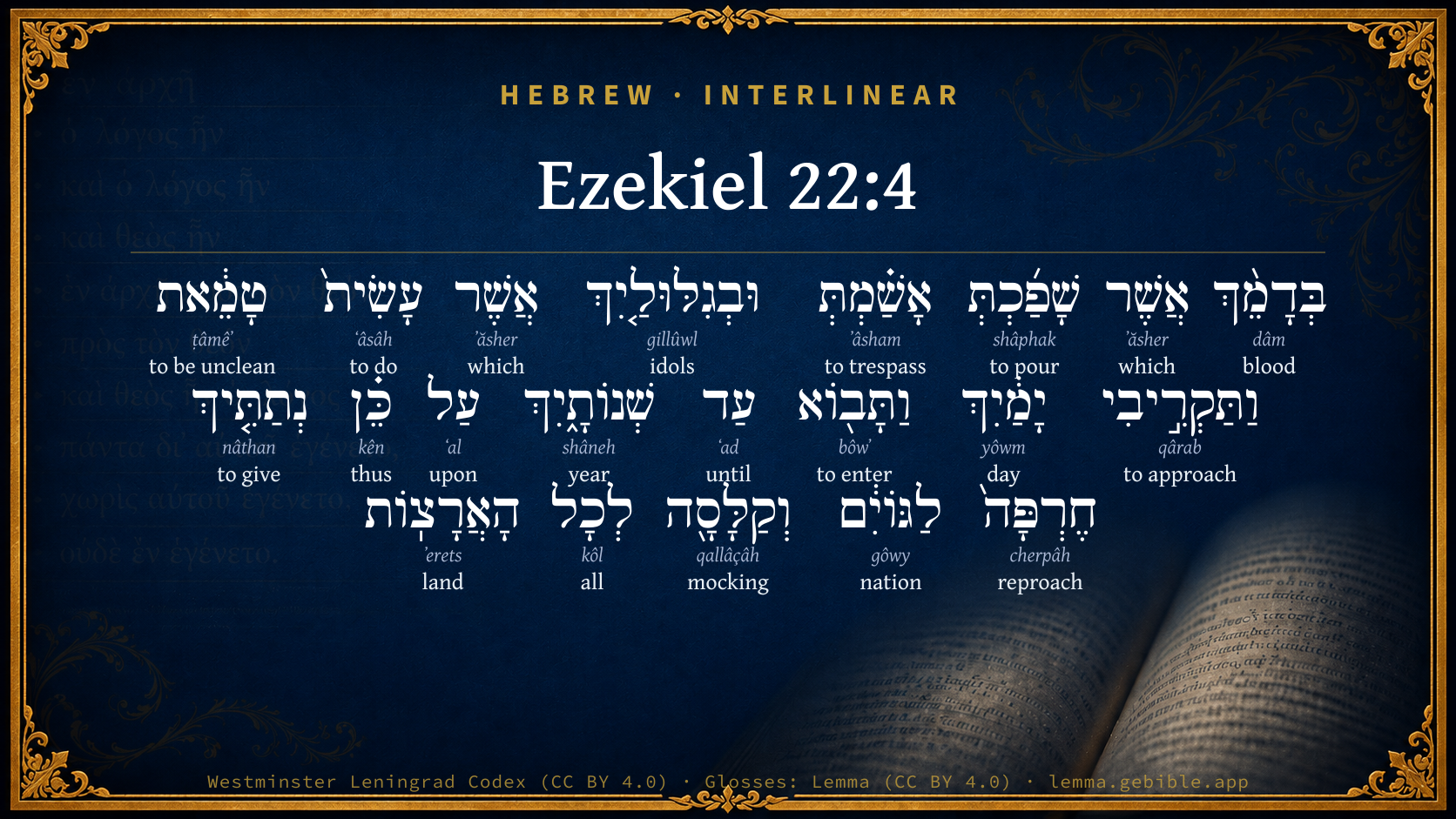
Hebrew (Westminster Leningrad Codex) Ezekiel 22:4 appears in the Hebrew Old Testament. The text above is from the Westminster Leningrad Codex. Each word links to its Strong’s number, a concise gloss, and parsing drawn from the Open Scriptures Hebrew Bible morphology. Click any word for its full Brown-Driver-Briggs (BDB) entry.
Download image
Cite this verse

Ezekiel 22:4 (World English Bible). Public Domain. Lemma interlinear Bible study tool, https://lemma.gebible.app/v/ezekiel/22/4.

Show BibTeX & RIS
BibTeX
RIS
English Translation
You have become guilty in your blood that you have shed, and are defiled in your idols which you have made; and you have caused your days to draw near, and are come even to your years: therefore have I made you a reproach to the nations, and a mocking to all the countries.
World English Bible · Public Domain
Highlights
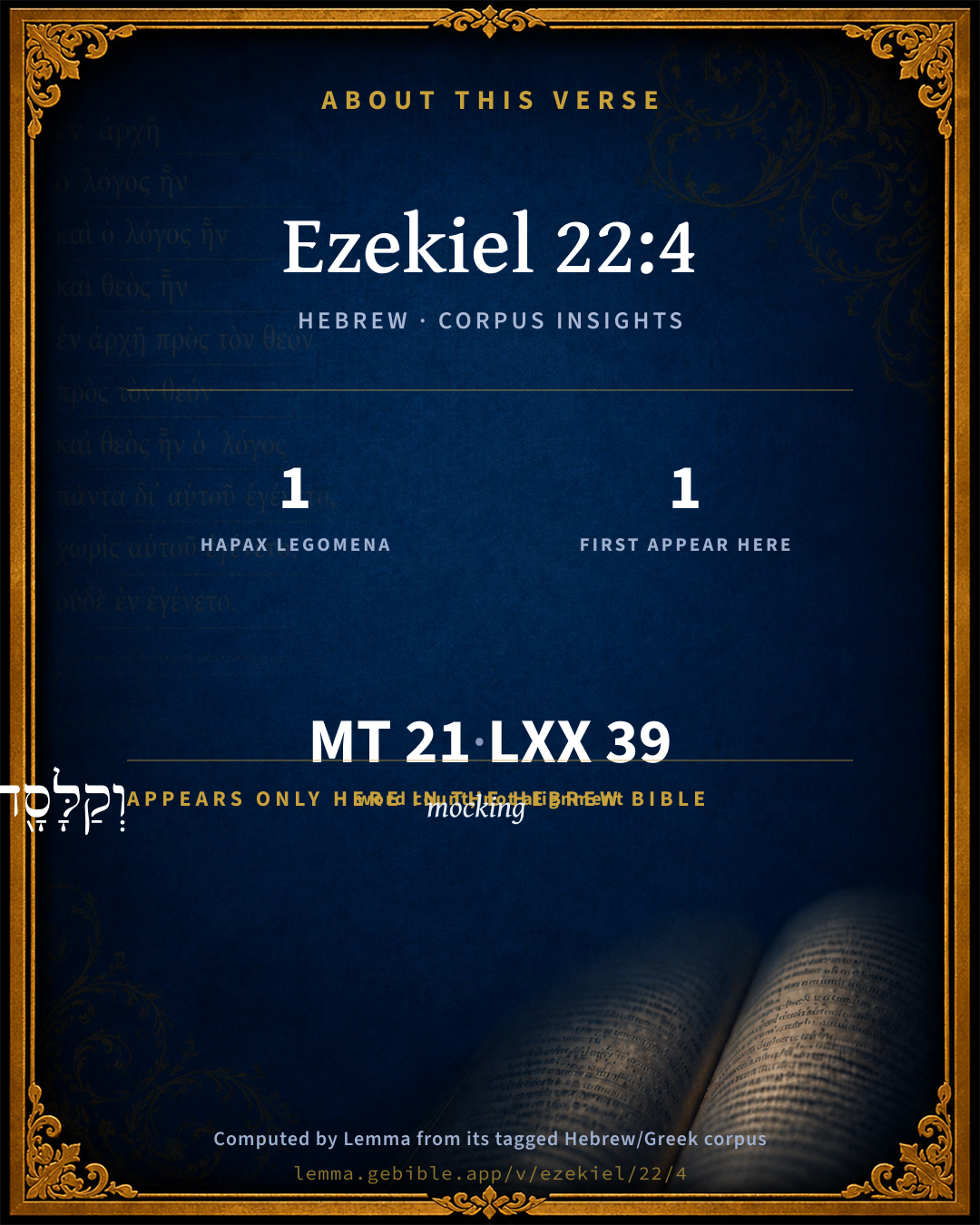
  • 1 hapax legomenon — only here in the Hebrew Bible
  • 1 first appearance in the Hebrew Bible
Full analysis ↓
Download a study sheet

One document with this verse’s original text, its word-by-word gloss line, the meaning frame, cross-references with their text, attributed commentary, and full source and license credits — printable, and it pastes into notes with its structure intact.

This verse Autodidact and up

Study sheet (.html) Plain text (.txt)

A passage Seminary Student

Up to 50 verses in one chapter. A passage sheet keeps up to 6 commentary sources and 12 cross-references per verse, in the order this page ranks them, and says so on the sheet whenever that leaves anything out. Ask for a single verse and you get the Autodidact verse sheet above.

Everything on this page stays free to read, with no account — the sheet is a download of what is already on screen, not access to it.

Want to remove ads? Support Godless Engineer
Compare translations 3

The same verse in 3 English versions, stacked beneath the original-language interlinear above. Click any original word for its lexicon entry.

Each is an independent rendering of the whole verse — the interlinear is not word-aligned to these translations.

Highlighted words mark where these versions differ — a whole-verse word diff, not a word-by-word alignment.

  • World English Bible Public Domain
    You have become guilty in your blood that you have shed, and are defiled in your idols which you have made; and you have caused your days to draw near, and are come even to your years: therefore have I made you a reproach to the nations, and a mocking to all the countries.
  • King James Version Public Domain
    Thou art become guilty in thy blood that thou hast shed; and hast defiled thyself in thine idols which thou hast made; and thou hast caused thy days to draw near, and art come even unto thy years: therefore have I made thee a reproach unto the heathen, and a mocking to all countries.
  • unfoldingWord Literal Text CC BY-SA 4.0
    You have become guilty by the blood that you have poured out, and you have become unclean by the idols that you have made. You have drawn your days to a close, and the end of your years has come. Therefore I will make you a reproach to the nations and a laughingstock to all the lands.

unfoldingWord Literal Text — © unfoldingWord, licensed CC BY-SA 4.0. Word-aligned USFM3 via Door43 (git.door43.org/unfoldingWord/en_ult).

Versions to compare (up to 4)

3 of 4 selected

Show all 18 translations

Every available English version of this verse, each an independent rendering of the whole verse.

  • World English Bible Public Domain
    You have become guilty in your blood that you have shed, and are defiled in your idols which you have made; and you have caused your days to draw near, and are come even to your years: therefore have I made you a reproach to the nations, and a mocking to all the countries.
  • Berean Standard Bible Public Domain
    you are guilty of the blood you have shed, and you are defiled by the idols you have made. You have brought your days to a close and have come to the end of your years. Therefore I have made you a reproach to the nations and a mockery to all the lands.
  • Majority Standard Bible Public Domain
    you are guilty of the blood you have shed, and you are defiled by the idols you have made. You have brought your days to a close and have come to the end of your years. Therefore I have made you a reproach to the nations and a mockery to all the lands.
  • King James Version Public Domain
    Thou art become guilty in thy blood that thou hast shed; and hast defiled thyself in thine idols which thou hast made; and thou hast caused thy days to draw near, and art come even unto thy years: therefore have I made thee a reproach unto the heathen, and a mocking to all countries.
  • American Standard Version (1901) Public Domain
    Thou art become guilty in thy blood that thou hast shed, and art defiled in thine idols which thou hast made; and thou hast caused thy days to draw near, and art come even unto thy years: therefore have I made thee a reproach unto the nations, and a mocking to all the countries.
  • Revised Version (1885) Public Domain
    Thou art become guilty in thy blood that thou hast shed, and art defiled in thine idols which thou hast made; and thou hast caused thy days to draw near, and art come even unto thy years: therefore have I made thee a reproach unto the nations, and a mocking to all the countries.
  • Geneva Bible (1599) Public Domain
    Thou hast offended in thy blood, that thou hast shed, and hast polluted thy selfe in thine idols, which thou hast made, and thou hast caused thy dayes to draw neere, and art come vnto thy terme: therefore haue I made thee a reproch to the heathen, and a mocking to all countreys.
  • Douay-Rheims (1899) Public Domain
    Thou art become guilty in thy blood which thou hast shed: and thou art defiled in thy idols which thou hast made: and thou hast made thy days to draw near, and hast brought on the time of thy years: therefore have I made thee a reproach to the Gentiles, and a mockery to all countries.
  • Young's Literal Translation Public Domain
    By thy blood that thou hast shed thou hast been guilty, And by thine idols that thou hast made thou hast been defiled, And thou causest thy days to draw near, And art come in unto thine years, Therefore I have given thee a reproach to nations, And a derision to all the lands.
  • Literal Standard Version CC BY-SA 4.0
    You have been guilty by your blood that you have shed, || And you have been defiled by your idols that you have made, || And you cause your days to draw near, || And have come to your years, || Therefore I have given you [for] a reproach to nations, || And a derision to all the lands.
  • Unlocked Literal Bible CC BY-SA 4.0
    You have become guilty by the blood that you have poured out, and you have become unclean by the idols that you have made. You have drawn your days to a close, and the end of your years has come. Therefore I will make you a reproach to the nations and a laughingstock to all the lands.
  • unfoldingWord Literal Text CC BY-SA 4.0
    You have become guilty by the blood that you have poured out, and you have become unclean by the idols that you have made. You have drawn your days to a close, and the end of your years has come. Therefore I will make you a reproach to the nations and a laughingstock to all the lands.
  • Darby Bible Public Domain
    Thou art become guilty by thy blood which thou hast shed, and hast defiled thyself with thine idols which thou hast made; and thou hast caused thy days to draw near, and art come unto thy years: therefore have I made thee a reproach unto the nations, and a mocking unto all countries.
  • World Messianic Bible Public Domain
    You have become guilty in your blood that you have shed, and are defiled in your idols which you have made! You have caused your days to draw near, and have come to the end of your years. Therefore I have made you a reproach to the nations, and a mocking to all the countries.
  • Webster's Bible Public Domain
    Thou art become guilty in thy blood that thou hast shed; and hast defiled thyself by thy idols which thou hast made; and thou hast caused thy days to draw near, and art come even to thy years: therefore have I made thee a reproach to the heathen, and a mocking to all countries.
  • Free Bible Version CC BY-SA 4.0
    You are guilty of murder, and you have made yourself unclean by the idols you've made. You have shortened your lives—your time is up! That's why other people taunt you—everyone mocks you.
  • Bible in Basic English Public Domain
    You are responsible for the blood drained out by you, and you are unclean through the images which you have made; and you have made your day come near, and the time of your judging has come; for this cause I have made you a name of shame to the nations and a cause of laughing to all countries.
  • JPS Tanakh (1917) Public Domain
    thou art become guilty in thy blood that thou hast shed, and art defiled in thine idols which thou hast made; and thou hast caused thy days to draw near, and art come even unto thy years; therefore have I made thee a reproach unto the nations, and a mocking to all the countries!

Literal Standard Version (2020), Covenant Press — licensed CC BY-SA 4.0. Text via the HelloAO Bible API (eBible.org). Unlocked Literal Bible (unfoldingWord) — licensed CC BY-SA 4.0. Text via the HelloAO Bible API (eBible.org). unfoldingWord Literal Text — © unfoldingWord, licensed CC BY-SA 4.0. Word-aligned USFM3 via Door43 (git.door43.org/unfoldingWord/en_ult). Free Bible Version, Dr. Jonathan Gallagher — licensed CC BY-SA 4.0. Text via the HelloAO Bible API (eBible.org).

Word by word

More ways to search: Search by grammar → Find every occurrence → Compare this word →

Practice this passage: Drill this verse → Learn its vocabulary →

וְקַלָּסָ֖ה
qallâçâh
H7048
“and · mocking”
Conjunction + Noun, Common, Feminine, Singular, Absolute
Part of Speech
Conjunction + Noun
Type
Common
Gender
Feminine
Number
Singular
State
Absolute
Full BDB Definition

Origin: intensive from H7046

TWOT: 2029b

mocking, derision
  1. בְּדָמֵ֨ךְ dâm H1818 “in/at · blood · your” Preposition + Noun, Common, Masculine, Singular, Construct + Suffix, Personal, 2nd Person, Feminine, Singular
  2. אֲשֶׁר ʼăsher H834 “which” Particle, Relative
  3. שָׁפַ֜כְתְּ shâphak H8210 “to pour” Verb, Qal, Perfect, 2nd Person, Feminine, Singular
  4. אָשַׁ֗מְתְּ ʼâsham H816 “to trespass” Verb, Qal, Perfect, 2nd Person, Feminine, Singular
  5. וּבְגִלּוּלַ֤יִךְ gillûwl H1544 “and · in/at · idols · your” Conjunction + Preposition + Noun, Common, Masculine, Plural, Construct + Suffix, Personal, 2nd Person, Feminine, Singular
  6. אֲשֶׁר ʼăsher H834 “which” Particle, Relative
  7. עָשִׂית֙ ʻâsâh H6213 “to do” Verb, Qal, Perfect, 2nd Person, Feminine, Singular
  8. טָמֵ֔את ṭâmêʼ H2930 “to be unclean” Verb, Qal, Perfect, 2nd Person, Feminine, Singular
  9. וַתַּקְרִ֣יבִי qârab H7126 “and · to approach” Conjunction + Verb, Hiphil, Sequential Imperfect, 2nd Person, Feminine, Singular
  10. יָמַ֔יִךְ yôwm H3117 “days · your” Noun, Common, Masculine, Plural, Construct + Suffix, Personal, 2nd Person, Feminine, Singular
  11. וַתָּב֖וֹא bôwʼ H935 “and · to enter” Conjunction + Verb, Qal, Sequential Imperfect, 3rd Person, Feminine, Singular
  12. עַד ʻad H5704 “until” Preposition
  13. שְׁנוֹתָ֑יִךְ shâneh H8141 “years · your” Noun, Common, Feminine, Plural, Construct + Suffix, Personal, 2nd Person, Feminine, Singular
  14. עַל ʻal H5921 “upon” Preposition
  15. כֵּ֗ן kên H3651 “thus” Particle, Demonstrative
  16. נְתַתִּ֤יךְ nâthan H5414 “to give · you” Verb, Qal, Perfect, 1st Person, Common, Singular + Suffix, Personal, 2nd Person, Feminine, Singular
  17. חֶרְפָּה֙ cherpâh H2781 “reproach” Noun, Common, Feminine, Singular, Absolute
  18. לַגּוֹיִ֔ם gôwy H1471 “to/for the · nations” Preposition, Determined + Noun, Common, Masculine, Plural, Absolute
  19. לְכָל kôl H3605 “to/for · all of” Preposition + Noun, Common, Masculine, Singular, Construct
  20. הָאֲרָצֽוֹת ʼerets H776 “the · lands” Particle, Definite Article + Noun, Common, Both, Plural, Absolute

About this verse

These counts appear in no published source. They are computed here, from the morphology-tagged text and Lemma’s own curated glosses. What Lemma adds →

21
words
20
distinct lemmas
Prophets
section

Notable vocabulary

1 hapax legomenon — a word that appears only here in the entire Hebrew Bible:

  • וְקַלָּסָ֖ה mocking H7048

First appearance in Scripture

This word makes its first canonical appearance in the Hebrew Bible here:

  • וְקַלָּסָ֖ה mocking H7048

Shared distinctive vocabulary

אָשַׁ֗מְתְּ to trespass H816 occurs in 32 verses of the Hebrew Bible. Also found in:

Grammatical profile

  • 7 verbs
  • 9 nouns
  • 2 prepositions
  • 3 particles

Verb forms

  • שָׁפַ֜כְתְּ Qal · Perfect
  • אָשַׁ֗מְתְּ Qal · Perfect
  • עָשִׂית֙ Qal · Perfect
  • טָמֵ֔את Qal · Perfect
  • וַתַּקְרִ֣יבִי Hiphil · Sequential Imperfect
  • וַתָּב֖וֹא Qal · Sequential Imperfect
  • נְתַתִּ֤יךְ Qal · Perfect

Repetition

A word recurs within this verse — often emphatic in Hebrew:

  • אֲשֶׁר which H834 ×2

Hebrew & Septuagint length

In English translation the verse runs 54 words from the Hebrew and 55 from the Septuagint (LXX English) — closely comparable.

A rough comparison of the two English renderings, which tokenize alike — not a word-level alignment.

Word counts can differ between the Hebrew and the Greek without any difference in meaning — e.g. the Hebrew direct-object marker אֵת has no separate Greek word, and Greek often adds the article ὁ.

In the original languages it is 21 Hebrew tokens and 39 Greek tokens — but the two are counted differently (Hebrew bundles its prefixes and suffixes into one token; the Greek is in lemma form), so that isn’t a like-for-like length.

Cross-references

21

Topical passages linked to Ezekiel 22:4 in the Treasury of Scripture Knowledge — connected by theme and wording, ordered by reader-vote popularity; previews shown in the World English Bible.

  • 2 Kings 21:16 Moreover Manasseh shed innocent blood very much, until he had filled Jerusalem from one end to another; besides his sin with which he made Judah to sin, in doing that which was evil in the sight of Yahweh.
  • Psalms 44:13–14 You make us a reproach to our neighbors, A scoffing and a derision to those who are around us.
  • Ezekiel 5:14–15 Moreover I will make you a desolation and a reproach among the nations that are round about you, in the sight of all that pass by.
  • Ezekiel 16:57 before your wickedness was uncovered, as at the time of the reproach of the daughters of Syria, and of all who are round about her, the daughters of the Philistines, who do despite to you round about.
  • Ezekiel 22:2 You, son of man, will you judge, will you judge the bloody city? then cause her to know all her abominations.
  • Leviticus 26:32 I will bring the land into desolation; and your enemies that dwell therein will be astonished at it.
  • Numbers 32:14 Behold, you are risen up in your fathers' place, an increase of sinful men, to augment yet the fierce anger of Yahweh toward Israel.
  • Deuteronomy 28:37 You shall become an astonishment, a proverb, and a byword, among all the peoples where Yahweh shall lead you away.
  • Deuteronomy 29:24 even all the nations shall say, Why has Yahweh done thus to this land? what means the heat of this great anger?
  • 1 Kings 9:7 then will I cut off Israel out of the land which I have given them; and this house, which I have made holy for my name, will I cast out of my sight; and Israel shall be a proverb and a byword among all peoples.
  • 2 Chronicles 7:20 then will I pluck them up by the roots out of my land which I have given them; and this house, which I have made holy for my name, will I cast out of my sight, and I will make it a proverb and a byword among all peoples.
  • Psalms 79:4 We have become a reproach to our neighbors, A scoffing and derision to those who are around us.
  • Psalms 89:41–42 All who pass by the way rob him. He has become a reproach to his neighbors.
  • Jeremiah 18:16 to make their land an astonishment, and a perpetual hissing; everyone who passes thereby shall be astonished, and shake his head.
  • Jeremiah 24:9 I will even give them up to be tossed back and forth among all the kingdoms of the earth for evil; to be a reproach and a proverb, a taunt and a curse, in all places where I shall drive them.
  • Jeremiah 44:8 in that you provoke me to anger with the works of your hands, burning incense to other gods in the land of Egypt, where you are gone to sojourn; that you may be cut off, and that you may be a curse and a reproach among all the nations of the earth?
  • Lamentations 2:15–16 All that pass by clap their hands at you; They hiss and wag their head at the daughter of Jerusalem, [saying], Is this the city that men called The perfection of beauty, The joy of the whole earth?
  • Ezekiel 21:28 You, son of man, prophesy, and say, Thus says the Lord Yahweh concerning the children of Ammon, and concerning their reproach; and say you, A sword, a sword is drawn, for the slaughter it is furbished, to cause it to devour, that it may be as lightning;
  • Daniel 9:16 Lord, according to all your righteousness, let your anger and please let your wrath be turned away from your city Jerusalem, your holy mountain; because for our sins, and for the iniquities of our fathers, Jerusalem and your people are become a reproach to all who are round about us.
  • Matthew 23:32–33 Fill up, then, the measure of your fathers.
  • 1 Thessalonians 2:16 forbidding us to speak to the Gentiles that they may be saved; to fill up their sins always. But wrath has come on them to the uttermost.

Cross-references courtesy of OpenBible.info (CC BY 4.0).

Hebrew and Greek witnesses Masoretic Hebrew ↔ Greek Septuagint

The same verse in the two great witnesses to the Old Testament, shown verse-for-verse.

These are two independent witnesses, not word-aligned to each other, and the Septuagint is shown in lemma (dictionary) form.

Hebrew Ezekiel 22:4 Masoretic · Westminster Leningrad Codex

בְּדָמֵ֨ךְ אֲשֶׁר שָׁפַ֜כְתְּ אָשַׁ֗מְתְּ וּבְגִלּוּלַ֤יִךְ אֲשֶׁר עָשִׂית֙ טָמֵ֔את וַתַּקְרִ֣יבִי יָמַ֔יִךְ וַתָּב֖וֹא עַד שְׁנוֹתָ֑יִךְ עַל כֵּ֗ן נְתַתִּ֤יךְ חֶרְפָּה֙ לַגּוֹיִ֔ם וְקַלָּסָ֖ה לְכָל הָאֲרָצֽוֹת

You have become guilty in your blood that you have shed, and are defiled in your idols which you have made; and you have caused your days to draw near, and are come even to your years: therefore have I made you a reproach to the nations, and a mocking to all the countries.

World English Bible · Public Domain

Greek LXX Ezekiel 22:4 Septuagint · lemma form

ἐν ὁ αἷμα αὐτός ὅς ἐκχέω παραπίπτω καί ἐν ὁ ἐνθύμημα σύ ὅς ποιέω μιαίνω καί ἐγγίζω ὁ ἡμέρα σύ καί ἄγω καιρός ἔτος σύ διά οὗτος δίδωμι σύ εἰς ὄνειδος ὁ ἔθνος καί εἰς ἐμπαιγμός πᾶς ὁ χώρα

in their blood which you have shed, you have transgressed; and in your devices which you have formed, you have polluted yourself; and you have brought near your days, and have brought on the time of your years: therefore have I made you a reproach to the Gentiles, and a mockery to all the countries,

LXX2012 (modern English Septuagint) · Public Domain

Hebrew: Westminster Leningrad Codex (CC BY 4.0). Greek: Septuagint (public domain); English from LXX2012 (modern English Septuagint) (Public Domain). How the Septuagint differs from the Hebrew →

Targum (Aramaic paraphrase)

1

The Targum is the ancient Jewish Aramaic paraphrase of the Hebrew Scriptures — an interpretive translation, not the Hebrew text itself. Onkelos (literal) and Pseudo-Jonathan (expansive) render the Torah, and Jonathan the Prophets. Coverage is partial: where no permissively-licensed English translation exists for a verse, only the Aramaic is shown. This is verse-level text, not a word-by-word alignment to the Hebrew.

  1. Targum Jonathan Prophets (Joshua–Malachi)
    בְּחוֹבַת דַם זַכַּאי דִאַשַׁדְתְּ חַבְתְּ וּבְּפוּלְחָן טַעֲוָתֵךְ דִפְלַחְתְּ אִסְתַּאַבְתְּ וְקָרֵיב יוֹם תַּבְרִיךְ וּמְטָא עִדַן בִּישְׁתִּיךְ עַל כֵּן יְהַבְתִּיךְ חִסוּדִין לְעַמְמַיָא וּלְעֵיב לְכָל מִדִינָתָא:

    (no public-domain English translation for this verse)

    Targum Jonathan — Aramaic: “Mikraot Gedolot” (public domain). English: “Sefaria Community Translation” (CC0 1.0 (public-domain dedication)); “London "Chaldee Paraphrase," 1871” (public domain). Text via Sefaria.

Commentary

Notes on Ezekiel 22:4 from classic Christian and Jewish commentators (each source and its license shown beneath its notes). The classic Christian expositions comment on the surrounding passage and are grouped to its opening verse, so a note may address several verses; the Jewish commentaries on the Tanakh (Rashi and others) are per-verse, so they appear only where the commentator wrote on this verse.

Lemma curates 59 commentaries, every one of them public domain or Creative Commons licensed, each selected and text-cleaned for this edition rather than reprinted as found. About our sources →

Trapp's Complete Commentary

John Trapp

Eze 22:4 Thou art become guilty in thy blood that thou hast shed; and hast defiled thyself in thine idols which thou hast made; and thou hast caused thy days to draw near, and art come [even] unto thy years: therefore have I made thee a reproach unto the heathen, and a mocking to all countries.

Ver. 4. Thou hast caused thy days.] Thou hast accelerated thy punishment, as the old world did.

John Trapp, A Commentary or Exposition upon All the Books of the Old and New Testament (1647–1656) — public domain. Text from a community e-Sword module.

Jamieson, Fausset & Brown

Robert Jamieson, A. R. Fausset & David Brown

thy days--the shorter period, namely, that of the siege.

thy years--the longer period of the captivity. The "days" and "years" express that she is ripe for punishment.

Jamieson, Fausset & Brown — Commentary Critical and Explanatory on the Whole Bible (1871) — public domain (CC PDM 1.0). Text via the HelloAO Bible API.

Adam Clarke's Commentary

Verse 4. Thou art become guilty in thy blood] Thou art guilty of blood.

Adam Clarke's Commentary on the Bible (1810–1826) — public domain. Text from a community e-Sword/MySword module.

Ellicott's Commentary for English Readers

(4) Thy days . . . thy years.—Viz., of judgment and visitation. The Rabbinical commentators interpret the days of the destruction of Jerusalem, and the years of the captivity in Babylon.

A mocking to all countries.—This is frequently spoken of in Ezekiel, and is the necessary result in all ages of the contrast between high professions and inconsistent performance. Israel’s law stood far above the legislation of any other nation of the period, but the habitual conduct of her people was in utter disregard of that law. The effect was the same as at a later day, when St. Paul said, “The name of God is blasphemed among the Gentiles through you” (Rom_2:24), just as the same evils and the same hindrances to the spread of the Gospel now result from the unworthy lives of Christians. But the Jews peculiarly exposed themselves to derision by their claim, as the chosen people of God, to universal and everlasting dominion, contrasted with their present overthrow and desolation; and this desolation was a punishment for the outrageous sins of a people whose whole national existence was based upon a call to peculiar holiness.

A Bible Commentary for English Readers, edited by Charles John Ellicott (1878–1897) — public domain. Text from a community e-Sword module.

The Cambridge Bible for Schools and Colleges

gen. ed. J. J. S. Perowne

4. The “blood” is not only that of her children sacrificed to the idols, but judicial and other murders, cf. Eze_22:6; Eze_22:9. Cf. Eze_23:37, Eze_24:6; Eze_24:9.

therefore have I made] prophetic perf., cf. “shall mock” Eze_22:5.

The Cambridge Bible for Schools and Colleges (gen. ed. J. J. S. Perowne; Cambridge University Press, 1878–1918) — public domain. Text from a community e-Sword module.

John Gill's Exposition

Thou art become guilty in thy blood that thou hast shed,.... Not only she contracted guilt by the innocent blood she shed, but she was tried and found guilty; her guilt was notorious, plain, and evident, as well as exceeding great, and much aggravated:

and hast defiled thyself in thine idols which thou hast made: she not only made them, in doing which she sinned; but polluted herself with them, by worshipping them; her mind and conscience were defiled with them; and which brought such a stain and pollution, as could not be removed by anything that she could do: there are both pollution and guilt in sin, and neither can be removed but by the blood of Christ; and, unless removed that way, punishment must follow:

and thou hast caused thy days to draw near, and art come even unto thy years; to full age, to ripeness for judgment; she had hastened by her sins her days of affliction and distress appointed for her, and was come to years of maturity to suffer for her sins; the years of her captivity, which would soon take place; years in which she would have no pleasure:

therefore have I made thee a reproach unto the Heathen, and a mocking to all countries; who, instead of praising them for their idolatry, would deride them for leaving the God of their fathers, which they did not; and insult over them in their affliction and distress, though they joined with them in idolatrous practices.

John Gill's Exposition of the Whole Bible (1746–1763) — public domain (CC PDM 1.0). Text via the HelloAO Bible API.

Albert Barnes' Notes on the Bible

Thy days, - i. e., of judgment; “thy years,” i. e., of visitation (compare Eze 20:25, Eze 20:39).

A reproach ... a mocking - Judah shall be like the Ammonites Eze 21:28.

Albert Barnes' Notes on the Bible (1834–1885) — public domain. Text from a community e-Sword/MySword module.

Matthew Poole's English Annotations

Guilty in thy blood; greatly or deeply guilty.

Thou has shed, in abundance, cruelly and perfidiously.

Defiled thy self; as a polluted thing, loathsome to be seen or touched

Thine idols; dunghill gods.

Caused thy days to draw near; . hastened the days of thy sorrows and punishment, of the desolation in Judea, and of thy captivity in Babylon; thou hast shortened thine own peace and my patience.

Came even unto thy years; grown up now to the eldest years in sin, beyond which thou wert not to go: it is the same h effect with that went before.

Therefore; for thy old sin, thou art given up to be a reproach.

A reproach; to be scorned by them, to be branded as a most perfidious, irreligious, unconscionable sort of people, not worthy to live Or else to be a taunt and by-word among all nations; thus it was Psa 44:13; Jer 24:9.

To all countries that were round about them, or, farther off, had heard of them.

Matthew Poole's English Annotations on the Holy Bible (1683–1685) — public domain. Text from a community e-Sword/MySword module.

Whedon's Commentary on the Bible

Daniel D. Whedon

4. Therefore — This is not God’s will, but hers. She has defiled herself, and by her sins hastened the day and the year of punishment which repentance could have postponed or averted.

Daniel D. Whedon (gen. ed.), Commentary on the Old and New Testaments (1874–1909) — public domain. Text from a community e-Sword module.

The Pulpit Commentary

Thou hast caused thy days to draw near, etc. As in Ver. 3, the days and the years are those of God"s judgments. The people had made no effort to avert their doom by repentance. They had, as it were, rushed upon their appointed fate. So, though in another sense, the righteous lives of the faithful are said, in 2Pe_3:12, to "hasten the coming of the day of God." Exceptional evil and exceptional good alike hasten the approach of the day which is to decide between the two.

The Pulpit Commentary (1880–1919), ed. H.D.M. Spence-Jones & Joseph S. Exell — public domain. Text from a community e-Sword module.

John Wesley's Explanatory Notes

Thy days - The days of thy sorrows, and punishment. Art come - Thou art grown up to the eldest years in sin, beyond which thou art not to go.

John Wesley, Explanatory Notes Upon the Whole Bible (1754–1765) — public domain. Text via the GEBible commentary corpus.

unfoldingWord translationNotes

Door43 World Missions Community

General Information:

Yahweh continues to speak through Ezekiel to the people of Jerusalem.

by the blood that you have poured out

This speaks of murdering people as pouring out blood. AT: "because you murdered innocent people" (See: Metaphor)

unclean

A person whom God considers spiritually unacceptable or defiled is spoken of as if the person were physically unclean. (See: Metaphor)

You have drawn your days to a close, and the end of your years has come

The images of days being brought to a close and years coming to an end are both idioms representing ending by death or by destruction. By saying that Jerusalem has brough her days to a close, Yahweh implies that Jerusalem would soon be destroyed because of the people's sin. AT: "Because of these things you have done, you are approaching the end of your time" or "You are bringing your existence to an end" (See: Idiom and Assumed Knowledge and Implicit Information )

have drawn your days to a close

"have brought your days to an end" or "have ended your life"

I will make you a reproach to the nations and a laughingstock to all the lands

This can be reworded so that the nouns "reproach" and "laughingstock" are expressed as verbs. AT: "I will make the nations reproach you and all the lands ridicule you" (See: Abstract Nouns)

a reproach

someone whom people disapprove of or rebuke

a laughingstock

a person whom people ridicule or mock

to all the lands

This generalization refers to the places who are familiar with Jerusalem and represents the people who live in these places. AT: "of the people of every nearby land" (See: Hyperbole and Generalization)

translationWords

guilt

reproach

nation

mock

unfoldingWord translationNotes — © Distant Shores Media and the Door43 World Missions Community, licensed CC BY-SA 4.0. Source: git.door43.org/Door43/en_tn.

Rashi

Rabbi Shlomo Yitzchaki (Rashi)

up to your years The decree of (Deut. 4:25): “and you will have grown old,” with its numerical value, which Moses said.

and [a subject of] gossip Heb. וְקַלָסָה, gossip, that everyone will speak about you, parlediz in Old French, [subject of] gossip.

Rashi on the Tanakh — English translations: “The Judaica Press complete Tanach with Rashi, translated by A. J. Rosenberg” (CC BY 4.0); “Pentateuch with Rashi's commentary by M. Rosenbaum and A.M. Silbermann, 1929-1934” (public domain); “The Metsudah Tanach series, Lakewood, N.J” (CC BY 4.0); and “The Book of Joshua, Metsudah Publications, 1997” (CC BY 4.0). Text via Sefaria.

Lesson kit

Teaching starters — assembled from the data on this page, not authored interpretation. Every prompt links to the verse data it draws on. Edit before teaching.

Ezekiel, in the Prophets, opens this verse with 21 words (20 distinct Hebrew lemmas). Its most distinctive word is qallâçâh (“mocking”). A historical commentator’s framing appears above. Read the whole chapter for the surrounding context.

Discussion questions

  1. The word qallâçâh carries the sense “mocking.” How does it shape the verse?
  2. 1 word here appears nowhere else in the Hebrew Bible. Why might the author reach for such rare wording?
  3. This is the first place “mocking” appears in Scripture (first appears here). What does its debut here establish?
  4. How does Leviticus 4:13, which shares the word «to trespass», read alongside this verse?
  5. What does the repetition of “which” (2× in this one verse) do in this verse?
  6. The translations on this page render this verse differently — a whole-verse word diff, not a word-by-word alignment. What might account for the different wordings?
  7. «שָׁפַ֜כְתְּ» is a Qal Perfect verb. How does that grammatical form shape the action described?
  8. Compare how Trapp's Complete Commentary and Jamieson, Fausset & Brown read this verse. Where do they agree or differ?

Things to notice

  • 1 word in this verse appears nowhere else in the Hebrew Bible.
  • 1 word makes its first canonical appearance in Scripture here.
  • This verse counts 21 Hebrew ↔ 39 Greek words.
  • These translations choose different wording for 24 words in this verse.
  • “which” occurs 2× in this single verse.

Reading settings

Reading text

Shown beneath each verse's original-language words.

Old Testament
Old Testament edition

Read the OT as the Masoretic Hebrew (MT) or the Greek Septuagint (LXX).

English shown for the Greek Septuagint (in the Hebrew ↔ Greek comparison).

Comparing translations? Open the Compare panel on any verse page to stack up to four side by side.