Deuteronomy 29:16

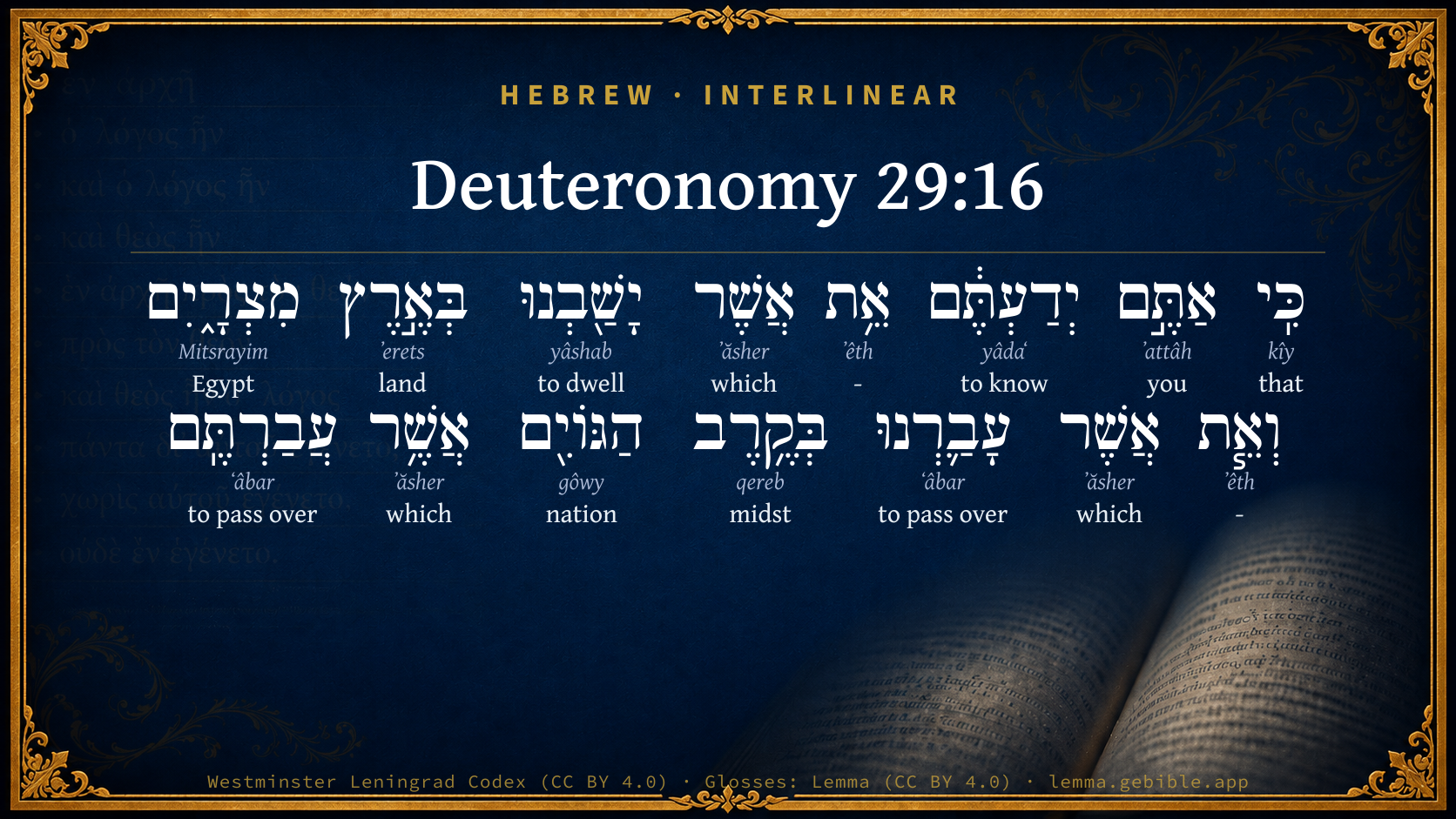
Hebrew (Westminster Leningrad Codex) Deuteronomy 29:16 appears in the Hebrew Old Testament. The text above is from the Westminster Leningrad Codex. Each word links to its Strong’s number, a concise gloss, and parsing drawn from the Open Scriptures Hebrew Bible morphology. Click any word for its full Brown-Driver-Briggs (BDB) entry.
Download image
Cite this verse

Deuteronomy 29:16 (World English Bible). Public Domain. Lemma interlinear Bible study tool, https://lemma.gebible.app/v/deuteronomy/29/16.

Show BibTeX & RIS
BibTeX
RIS
English Translation
(for you know how we lived in the land of Egypt, and how we came through the midst of the nations through which you passed;
World English Bible · Public Domain
Download a study sheet

One document with this verse’s original text, its word-by-word gloss line, the meaning frame, cross-references with their text, attributed commentary, and full source and license credits — printable, and it pastes into notes with its structure intact.

This verse Autodidact and up

Study sheet (.html) Plain text (.txt)

A passage Seminary Student

Up to 50 verses in one chapter. A passage sheet keeps up to 6 commentary sources and 12 cross-references per verse, in the order this page ranks them, and says so on the sheet whenever that leaves anything out. Ask for a single verse and you get the Autodidact verse sheet above.

Everything on this page stays free to read, with no account — the sheet is a download of what is already on screen, not access to it.

Want to remove ads? Support Godless Engineer
Compare translations 3

The same verse in 3 English versions, stacked beneath the original-language interlinear above. Click any original word for its lexicon entry.

Each is an independent rendering of the whole verse — the interlinear is not word-aligned to these translations.

Highlighted words mark where these versions differ — a whole-verse word diff, not a word-by-word alignment.

  • World English Bible Public Domain
    (for you know how we lived in the land of Egypt, and how we came through the midst of the nations through which you passed;
  • King James Version Public Domain
    (For ye know how we have dwelt in the land of Egypt; and how we came through the nations which ye passed by;
  • unfoldingWord Literal Text CC BY-SA 4.0
    For you know how we lived in the land of Egypt and how we went through in the midst of the nations which you passed through,

unfoldingWord Literal Text — © unfoldingWord, licensed CC BY-SA 4.0. Word-aligned USFM3 via Door43 (git.door43.org/unfoldingWord/en_ult).

Versions to compare (up to 4)

3 of 4 selected

Show all 18 translations

Every available English version of this verse, each an independent rendering of the whole verse.

  • World English Bible Public Domain
    (for you know how we lived in the land of Egypt, and how we came through the midst of the nations through which you passed;
  • Berean Standard Bible Public Domain
    For you yourselves know how we lived in the land of Egypt and how we passed through the nations on the way here.
  • Majority Standard Bible Public Domain
    For you yourselves know how we lived in the land of Egypt and how we passed through the nations on the way here.
  • King James Version Public Domain
    (For ye know how we have dwelt in the land of Egypt; and how we came through the nations which ye passed by;
  • American Standard Version (1901) Public Domain
    (for ye know how we dwelt in the land of Egypt, and how we came through the midst of the nations through which ye passed;
  • Revised Version (1885) Public Domain
    (for ye know how we dwelt in the land of Egypt; and how we came through the midst of the nations through which ye passed;
  • Geneva Bible (1599) Public Domain
    For ye knowe, how we haue dwelt in the land of Egypt, and how we passed thorowe the middes of the nations, which ye passed by.
  • Douay-Rheims (1899) Public Domain
    For you know how we dwelt in the land of Egypt, and how we have passed through the midst of nations, and passing through them,
  • Young's Literal Translation Public Domain
    for ye have known how ye dwelt in the land of Egypt, and how we passed by through the midst of the nations which ye have passed by;
  • Literal Standard Version CC BY-SA 4.0
    for you have known how you dwelt in the land of Egypt, and how we passed by through the midst of the nations which you have passed by;
  • Unlocked Literal Bible CC BY-SA 4.0
    You know how we lived in the land of Egypt, and how we came through the midst of the nations through which you passed.
  • unfoldingWord Literal Text CC BY-SA 4.0
    For you know how we lived in the land of Egypt and how we went through in the midst of the nations which you passed through,
  • Darby Bible Public Domain
    (for ye know how we dwelt in the land of Egypt, and how we came through the nations which ye passed;
  • World Messianic Bible Public Domain
    (for you know how we lived in the land of Egypt, and how we came through the middle of the nations through which you passed;
  • Webster's Bible Public Domain
    (For ye know how we have dwelt in the land of Egypt; and how we came through the nations which ye passed by;
  • Free Bible Version CC BY-SA 4.0
    You know very well what it was like when we lived in the land of Egypt and our experiences as we passed through the nations on the way here.
  • Bible in Basic English Public Domain
    (For you have in mind how we were living in the land of Egypt; and how we came through all the nations which were on your way;
  • JPS Tanakh (1917) Public Domain
    (29-15) for ye know how we dwelt in the land of Egypt; and how we came through the midst of the nations through which ye passed;

Literal Standard Version (2020), Covenant Press — licensed CC BY-SA 4.0. Text via the HelloAO Bible API (eBible.org). Unlocked Literal Bible (unfoldingWord) — licensed CC BY-SA 4.0. Text via the HelloAO Bible API (eBible.org). unfoldingWord Literal Text — © unfoldingWord, licensed CC BY-SA 4.0. Word-aligned USFM3 via Door43 (git.door43.org/unfoldingWord/en_ult). Free Bible Version, Dr. Jonathan Gallagher — licensed CC BY-SA 4.0. Text via the HelloAO Bible API (eBible.org).

Word by word

More ways to search: Search by grammar → Find every occurrence → Compare this word →

Practice this passage: Drill this verse → Learn its vocabulary →

בְּקֶ֥רֶב
qereb
H7130
“in/at · midst of”
Preposition + Noun, Common, Masculine, Singular, Construct
Part of Speech
Preposition + Noun
Type
Common
Gender
Masculine
Number
Singular
State
Construct
Full BDB Definition

Origin: from H7126

TWOT: 2066a

midst, among, inner part, middle - inward part - physical sense - as seat of thought and emotion - as faculty of thought and emotion - in the midst, among, from among (of a number of persons) - entrails (of sacrificial animals)
  1. כִּֽי kîy H3588 “that” Conjunction
  2. אַתֶּ֣ם ʼattâh H859 “you” Pronoun, Personal, 2nd Person, Masculine, Plural
  3. יְדַעְתֶּ֔ם yâdaʻ H3045 “to know” Verb, Qal, Perfect, 2nd Person, Masculine, Plural
  4. אֵ֥ת ʼêth H853 “-” Particle, Direct Object
  5. אֲשֶׁר ʼăsher H834 “which” Particle, Relative
  6. יָשַׁ֖בְנוּ yâshab H3427 “to dwell” Verb, Qal, Perfect, 1st Person, Common, Plural
  7. בְּאֶ֣רֶץ ʼerets H776 “in/at · land of” Preposition + Noun, Common, Both, Singular, Construct
  8. מִצְרָ֑יִם Mitsrayim H4714 “Egypt” Noun, Proper
  9. וְאֵ֧ת ʼêth H853 “and · -” Conjunction + Particle, Direct Object
  10. אֲשֶׁר ʼăsher H834 “which” Particle, Relative
  11. עָבַ֛רְנוּ ʻâbar H5674 “to pass over” Verb, Qal, Perfect, 1st Person, Common, Plural
  12. הַגּוֹיִ֖ם gôwy H1471 “the · nations” Particle, Definite Article + Noun, Common, Masculine, Plural, Absolute
  13. אֲשֶׁ֥ר ʼăsher H834 “which” Particle, Relative
  14. עֲבַרְתֶּֽם ʻâbar H5674 “to pass over” Verb, Qal, Perfect, 2nd Person, Masculine, Plural

About this verse

These counts appear in no published source. They are computed here, from the morphology-tagged text and Lemma’s own curated glosses. What Lemma adds →

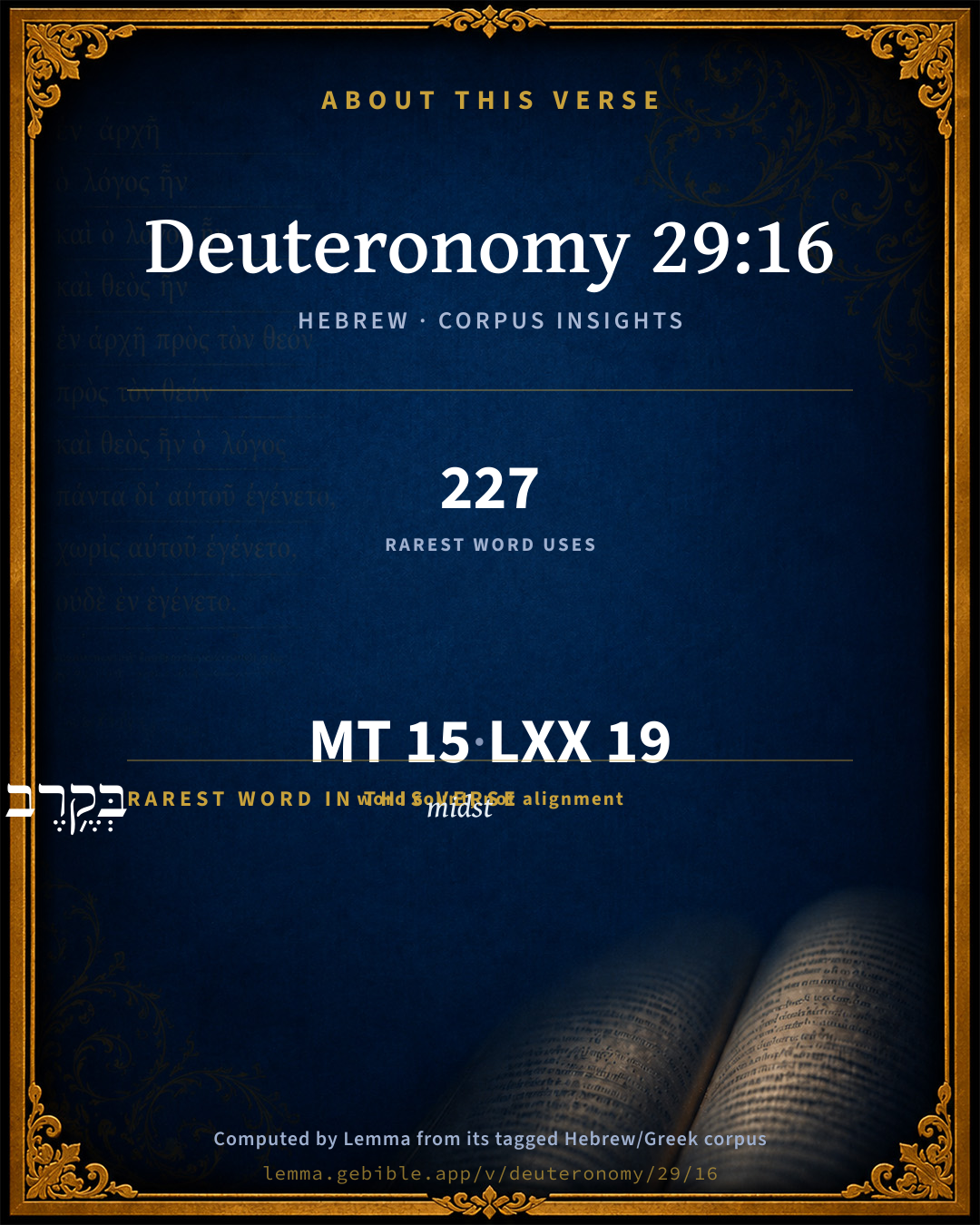
15
words
11
distinct lemmas
Pentateuch
section

Grammatical profile

  • 4 verbs
  • 4 nouns
  • 1 pronoun
  • 1 conjunction
  • 5 particles

Verb forms

  • יְדַעְתֶּ֔ם Qal · Perfect
  • יָשַׁ֖בְנוּ Qal · Perfect
  • עָבַ֛רְנוּ Qal · Perfect
  • עֲבַרְתֶּֽם Qal · Perfect

Repetition

Words recur within this verse — often emphatic in Hebrew:

  • עָבַ֛רְנוּ to pass over H5674 ×2
  • אֲשֶׁר which H834 ×3

Hebrew & Septuagint length

In English translation the verse runs 25 words from the Hebrew and 24 from the Septuagint (LXX English) — closely comparable.

A rough comparison of the two English renderings, which tokenize alike — not a word-level alignment.

Word counts can differ between the Hebrew and the Greek without any difference in meaning — e.g. the Hebrew direct-object marker אֵת has no separate Greek word, and Greek often adds the article ὁ.

In the original languages it is 15 Hebrew tokens and 19 Greek tokens — but the two are counted differently (Hebrew bundles its prefixes and suffixes into one token; the Greek is in lemma form), so that isn’t a like-for-like length.

Cross-references

5

Topical passages linked to Deuteronomy 29:16 in the Treasury of Scripture Knowledge — connected by theme and wording, ordered by reader-vote popularity; previews shown in the World English Bible.

  • Deuteronomy 2:4 Command you the people, saying, You are to pass through the border of your brothers the children of Esau, who dwell in Seir; and they will be afraid of you: take good heed to yourselves therefore;
  • Deuteronomy 2:9 Yahweh said to me, Don't bother Moab, neither contend with them in battle; for I will not give you of his land for a possession; because I have given Ar to the children of Lot for a possession.
  • Deuteronomy 2:19 and when you come near over against the children of Ammon, don't bother them, nor contend with them; for I will not give you of the land of the children of Ammon for a possession; because I have given it to the children of Lot for a possession.
  • Deuteronomy 2:24 Rise up, take your journey, and pass over the valley of the Arnon: behold, I have given into your hand Sihon the Amorite, king of Heshbon, and his land; begin to possess it, and contend with him in battle.
  • Deuteronomy 3:1–2 Then we turned, and went up the way to Bashan: and Og the king of Bashan came out against us, he and all his people, to battle at Edrei.

Cross-references courtesy of OpenBible.info (CC BY 4.0).

Hebrew and Greek witnesses Masoretic Hebrew ↔ Greek Septuagint

The same verse in the two great witnesses to the Old Testament, shown verse-for-verse.

These are two independent witnesses, not word-aligned to each other, and the Septuagint is shown in lemma (dictionary) form.

Hebrew Deuteronomy 29:16 Masoretic · Westminster Leningrad Codex

כִּֽי אַתֶּ֣ם יְדַעְתֶּ֔ם אֵ֥ת אֲשֶׁר יָשַׁ֖בְנוּ בְּאֶ֣רֶץ מִצְרָ֑יִם וְאֵ֧ת אֲשֶׁר עָבַ֛רְנוּ בְּקֶ֥רֶב הַגּוֹיִ֖ם אֲשֶׁ֥ר עֲבַרְתֶּֽם

(for you know how we lived in the land of Egypt, and how we came through the midst of the nations through which you passed;

World English Bible · Public Domain

Greek LXX Deuteronomy 29:16 Septuagint · lemma form

καί ὁράω ὁ βδέλυγμα αὐτός καί ὁ εἴδωλον αὐτός ξύλον καί λίθος ἀργύριον καί χρυσίον ὅς εἰμί παρά αὐτός

For you⌃ know how we lived in the land of Egypt, how we came through the midst of the nations through whom you⌃ came.

LXX2012 (modern English Septuagint) · Public Domain

Hebrew: Westminster Leningrad Codex (CC BY 4.0). Greek: Septuagint (public domain); English from LXX2012 (modern English Septuagint) (Public Domain). How the Septuagint differs from the Hebrew →

Targum (Aramaic paraphrase)

2

The Targum is the ancient Jewish Aramaic paraphrase of the Hebrew Scriptures — an interpretive translation, not the Hebrew text itself. Onkelos (literal) and Pseudo-Jonathan (expansive) render the Torah, and Jonathan the Prophets. Coverage is partial: where no permissively-licensed English translation exists for a verse, only the Aramaic is shown. This is verse-level text, not a word-by-word alignment to the Hebrew.

  1. Targum Onkelos Torah (Genesis–Deuteronomy)
    וַחֲזֵיתוּן יָת שִׁקוּצֵיהוֹן וְיָת טַעֲוָתְהוֹן אָעָא וְאַבְנָא כַּסְפָּא וְדַהֲבָא דִי עִמְהוֹן

    (no public-domain English translation for this verse)

    Targum Onkelos — Aramaic: “Onkelos Genesis” (public domain); “Onkelos Exodus” (public domain); “Onkelos Leviticus” (public domain); “Onkelos Numbers” (public domain); “Onkelos Deuteronomy” (public domain). English: “Sefaria Community Translation” (CC0 1.0 (public-domain dedication)); “J.W. Etheridge. The Targums of Onkelos and Jonathan Ben Uzziel on the Pentateuch. London: Longmans, Green, 1862” (public domain). Text via Sefaria.

  2. Targum Pseudo-Jonathan Torah (Genesis–Deuteronomy)
    וְחָמִתּוּן יַת מְרַחְקַתְהוֹן וְיַת טַעֲוָון דִלְהוֹן דְמִן קֵיסָא וְאַבְנָא דְרַמְיָין בְּאוֹשְׁקְקֵי וְטַעֲוָון דִכְסַף וּדְהַב דִיהִיבִין עִמְהוֹן בְּבָתַּיָא אַחֲדִין דָמִין בַּתְרֵיהוֹן דְלָא יִתְגַנְבוּן

    You have seen their abominations, and their idols of wood and stone which they have set forth in the streets, and the idols of silver and gold that they have placed with themselves in the houses, shutting the doors after them lest they should be stolen.

    Targum Pseudo-Jonathan — Aramaic: “Targum Jonathan on Genesis” (public domain); “Targum Jonathan on Exodus” (public domain); “Targum Jonathan on Leviticus” (public domain); “Targum Jonathan on Numbers” (public domain); “Targum Jonathan on Deuteronomy” (public domain). English: “The Targum of Jonathan ben Uzziel, trans. J. W. Etheridge, London, 1862” (public domain). Text via Sefaria.

Commentary

Notes on Deuteronomy 29:16 from classic Christian and Jewish commentators (each source and its license shown beneath its notes). The classic Christian expositions comment on the surrounding passage and are grouped to its opening verse, so a note may address several verses; the Jewish commentaries on the Tanakh (Rashi and others) are per-verse, so they appear only where the commentator wrote on this verse.

Lemma curates 59 commentaries, every one of them public domain or Creative Commons licensed, each selected and text-cleaned for this edition rather than reprinted as found. About our sources →

Trapp's Complete Commentary

John Trapp

Deu 29:16 (For ye know how we have dwelt in the land of Egypt; and how we came through the nations which ye passed by;

Ver. 16. How we have dwelt.] And how hard is it to pass through Ethiopia, how much more to dwell there, and not to be discoloured! Sin is catching, and by the senses, those five ports of the soul, that old serpent oft winds himself into the heart. Ye have seen their abominations; oh that you would say, Satis est vidisse, &c. Now therefore, lest there should be, &c., Deu 29:18.

John Trapp, A Commentary or Exposition upon All the Books of the Old and New Testament (1647–1656) — public domain. Text from a community e-Sword module.

Joseph Benson's Commentary

Deu 29:16. Egypt — Where you have seen their idolatries, and learned too much of them, as the golden calf showed, and therefore have need to renew your covenant with God; where also we were in dreadful bondage, whence God alone hath delivered us; to whom therefore we are deeply obliged, and have all reason to renew our covenant with him. We came through the nations — With what hazard, if God had not appeared for us!

Joseph Benson's Commentary on the Old and New Testaments (1811–1818) — public domain. Text from a community e-Sword module.

Keil & Delitzsch

C. F. Keil & F. Delitzsch

The summons to enter into the covenant of the Lord is explained by Moses first of all by an exposition of the evil results which would follow from apostasy from the Lord, or the breach of His covenant. This exposition he introduces with an allusion to the experience of the people with reference to the worthlessness of idols, both in Egypt itself, and upon their march through the nations, whose territory they passed through (Deu 29:16, Deu 29:17). The words, "for ye have learned how we dwelt in Egypt, and passed through the nations...and have seen their abominations and their idols" (gillulim: lit., clods, see Lev 26:30), have this signification: In our abode in Egypt, and upon our march through different lands, ye have become acquainted with the idols of these nations, that they are not gods, but only wood and stone (see at Deu 4:28), silver and gold. את־אשׁר, as in Deu 9:7, literally "ye know that which we dwelt,' i.e., know what our dwelling there showed, what experience we gained there of the nature of heathen idols.

Keil & Delitzsch — Biblical Commentary on the Old Testament (1861–1891) — public domain (CC PDM 1.0). Text via the HelloAO Bible API. (Old Testament only.)

Ellicott's Commentary for English Readers

(16, 17) These verses seem rightly placed in a parenthesis. (Comp. Eze_20:7-8; Eze_20:18.)

A Bible Commentary for English Readers, edited by Charles John Ellicott (1878–1897) — public domain. Text from a community e-Sword module.

The Cambridge Bible for Schools and Colleges

gen. ed. J. J. S. Perowne

16. for ye know, etc.] The necessity for such a covenant with Jehovah: viz. Israel’s experiences of the idolatry of other peoples, which otherwise might seduce them to itself. The Egyptian idolatry has not before been mentioned in Deut. Came through and passed are the same vb.: the idem per idem construction, see Deu_1:46.

The Cambridge Bible for Schools and Colleges (gen. ed. J. J. S. Perowne; Cambridge University Press, 1878–1918) — public domain. Text from a community e-Sword module.

John Gill's Exposition

And ye have seen their abominations and their idols,.... Or, "their abominations, even their idols"; for the same are meant by both: it is common in Scripture to call the idols of the Gentiles abominations, without any other explanation of them; see Kg1 11:5; because they are abominable to God, and ought to be so to men: the word for idols has the signification of dung, and may be rendered dunghill gods, either referring to such that were bred and lived in dung, as the beetle, worshipped by the Egyptians, as Bishop Patrick observes; or which were as much to be loathed and abhorred as the dung of any creature:

wood and stone, silver and gold; these are the materials of which the idols they had seen in the several countries they had been in, or passed through, were made of; some of wood, others of stone cut out of these, and carved; others more rich and costly were made of massive gold and silver, and were molten ones; or the images of wood were glided with gold and silver:

which were among them; now these being seen by them in as they passed along, they might run in their minds, or be called to remembrance by them, and so they be in danger of being drawn aside to make the like, and worship them.

John Gill's Exposition of the Whole Bible (1746–1763) — public domain (CC PDM 1.0). Text via the HelloAO Bible API.

Matthew Poole's English Annotations

In the land of Egypt, where you have seen their idolatries, and learned too much of them, as the golden calf showed, and therefore need to renew your covenant with God; where also we were in dreadful bondage, whence God alone hath delivered us, to whom therefore we are deeply obliged, and have all reason to renew our covenant with him.

How we came through the nations, i.e. with what hazards, if God had not appeared for us.

Matthew Poole's English Annotations on the Holy Bible (1683–1685) — public domain. Text from a community e-Sword/MySword module.

Whedon's Commentary on the Bible

Daniel D. Whedon

16-17. Ye know how we have dwelt — In this passage the reference is to the idol worship of Egypt and of the nations with whom they had been brought in contact on their journey. They are told in effect to remember what they have seen of the worthlessness and vileness of such worship. These verses are not parenthetical, as in our version, but are closely connected with the following verse.

Daniel D. Whedon (gen. ed.), Commentary on the Old and New Testaments (1874–1909) — public domain. Text from a community e-Sword module.

The Pulpit Commentary

Vers. 16-29. The summons to renew the covenant is enforced by a fresh exposition of the evil and danger of apostasy from the Lord. This is introduced by a reference to the experience which the people already had of idolatry in Egypt, and among the nations with whom they had come in contact during their march through the wilderness, from which they must have learned the utter worthlessness of all idols, that they were no gods, but only wood and stone,

Vers. 16, 17. These verses are not a parenthesis, as in the Authorized Version. Ver. 18 is connected, not with ver. 15, but with ver. 17; there should be a full stop at the end of ver. 15. Their idols; literally, their blocks or logs ( from llg to roll something too heavy to be carried), a term of contempt used frequently in Scripture of idols.

Vers. 16-21. The lying hope.

We have here

I INEXCUSABLE UNBELIEF. (Vers. 16-18.) The man who, turning from Jehovah, went after the gods by the nations, was doubly inexcusable.

1. The true God had been revealed to him.

2. The worthlessness of heathen idols had been demonstrated. He had the light, and could compare it with the darkness of the nations around. If not himself, a witness of God"s mighty works in Egypt and in the desert, he had heard of them from his forefathers, or could read of them in his Scriptures (ver. 20). The existence of the nation was a proof that such things had been done.

Unbelief is not less inexcusable in us:

1. With the Bible in our hands.

2. With so large a body of evidences of Divine truth.

3. With centuries of experience of the regenerative influence of Christianity.

4. With a wide knowledge of heathen nations, discovering to us by contrast our own advantages.

Unbelief may be:

1. Speculative.

2. Practical.

It is enough that our practice be shaped on the hypothesis of the untruth of God"s Word, to constitute us unbelievers. (1Ti_5:8)

II GROSS SELF-DECEIT. (Ver. 19.) The act of this wicked man is very remarkable. He blesses himself in his heart, and says, "I will have peace," at the very time that God"s curses are being read out to him. Yet his case is not a solitary one. He does no more than men do every day in the teeth of the threatenings of the Bible. Satan whispers, "Ye shall not surely die"; (Gen_3:4) "Be it far from thee: this shall rot be unto thee"; (Mat_16:22) and Satan, not God, is believed. We may explain this self-deceit:

1. From want of consideration. (cf. Isa_1:3) The wicked man does not really trouble himself about the curses. They are mere words to him. The mind makes no application, scarcely even asks the meaning, of what it hears. The oracle with which the wicked man consults is in his own heart, (Psa_36:1-5) and the oracles of God" get no attention.

1. From want of faith. God"s Word, even if attended to, could not compel belief in a heart already possessed by an opposite set of beliefs, and determined not to part with them.

2. From self-will. Will enters into the question of our beliefs; so long as it can twist evidence, resist unwelcome conclusions, find evasions and pretexts, it will not accept what is contrary to its ordinary bent. While, if the worst comes to the worst, it can cut the knot by a simple "I won"t," and obstinately refuse to believe aught but what it likes. The account of the sinner"s unbelief and self-deceit is therefore this:

1. He has not liked to retain God in his knowledge.

2. Unwelcome subjects have been banished from his mind.

3. Through unfamiliarity to his thoughts, the supersensual world has become less and less a reality to him.

4. He acquires the power of ignoring it, and ends by disbelief in it.

III UNUTTERABLE FOLLY. (Vers. 20, 21.) Unbelief, unhappily for the sinner, cannot alter the actual state of the case. God"s auger smokes against him, and will certainly destroy him. His sin, agreeable as it may appear at present, will yield at last gall and wormwood. Contending with the Almighty, he rushes on his ruin. The curses written in the Book will not fail to overtake him. It is easy for sinners to "laugh now", (Luk_6:25) but there awaits them a terrible undeceiving a day when they shall "mourn and weep. J.O.

The Pulpit Commentary (1880–1919), ed. H.D.M. Spence-Jones & Joseph S. Exell — public domain. Text from a community e-Sword module.

Rashi

Rabbi Shlomo Yitzchaki (Rashi)

ותראו את שקוציהם AND YE HAVE SEEN THEIR ABOMINABLE THINGS — Idols are so termed because they are loathsome like unclean things that are held in abomination.

גלליהם THEIR IDOLS — thus termed because they are detestable (lit., malodorous) and loathsome like dung (גלל).

עץ ואבן [AND YE HAVE SEEN … THEIR IDOLS] WOOD AND STONE — Those of wood and stone you have seen exposed openly, because the heathen was not afraid lest they might be stolen; those of gold and silver, however, ARE WITH THEM (עמהם), in their “marbled halls” (cf. Rashi on Ezekel 8:12 whence he borrowed this expression), because they were afraid they might be stolen (Midrash Tanchuma, Nitzavim 3).

Rashi on the Tanakh — English translations: “The Judaica Press complete Tanach with Rashi, translated by A. J. Rosenberg” (CC BY 4.0); “Pentateuch with Rashi's commentary by M. Rosenbaum and A.M. Silbermann, 1929-1934” (public domain); “The Metsudah Tanach series, Lakewood, N.J” (CC BY 4.0); and “The Book of Joshua, Metsudah Publications, 1997” (CC BY 4.0). Text via Sefaria.

Lesson kit

Teaching starters — assembled from the data on this page, not authored interpretation. Every prompt links to the verse data it draws on. Edit before teaching.

Deuteronomy, in the Pentateuch, opens this verse with 15 words (11 distinct Hebrew lemmas). Its most distinctive word is qereb (“midst”). A historical commentator’s framing appears above. Read the whole chapter for the surrounding context.

Discussion questions

  1. What does “midst” (qereb) contribute to the verse as a whole?
  2. How does Deuteronomy 2:4, which shares this passage’s theme, read alongside this verse?
  3. What does the repetition of “to pass over” (2× in this one verse) do in this verse?
  4. These translations render this verse differently. What is at stake in choosing one wording over another?
  5. «יְדַעְתֶּ֔ם» is a Qal Perfect verb. How does that grammatical form shape the action described?
  6. Compare how Trapp's Complete Commentary and Joseph Benson's Commentary read this verse. Where do they agree or differ?

Things to notice

Reading settings

Reading text

Shown beneath each verse's original-language words.

Old Testament
Old Testament edition

Read the OT as the Masoretic Hebrew (MT) or the Greek Septuagint (LXX).

English shown for the Greek Septuagint (in the Hebrew ↔ Greek comparison).

Comparing translations? Open the Compare panel on any verse page to stack up to four side by side.