2 Samuel 22:44

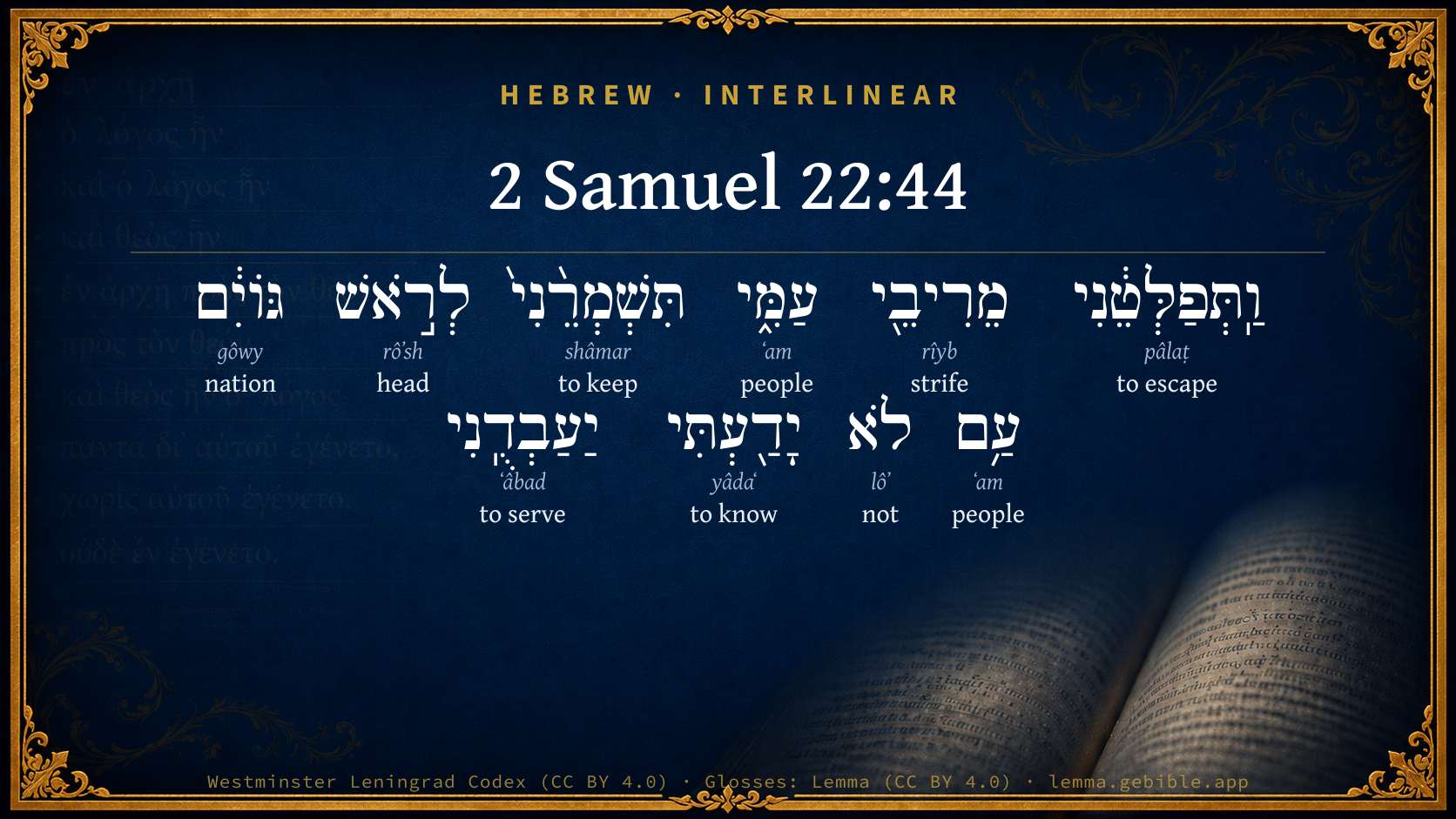
Hebrew (Westminster Leningrad Codex) 2 Samuel 22:44 appears in the Hebrew Old Testament. The text above is from the Westminster Leningrad Codex. Each word links to its Strong’s number, a concise gloss, and parsing drawn from the Open Scriptures Hebrew Bible morphology. Click any word for its full Brown-Driver-Briggs (BDB) entry.
Download image
Cite this verse

2 Samuel 22:44 (World English Bible). Public Domain. Lemma interlinear Bible study tool, https://lemma.gebible.app/v/2-samuel/22/44.

Show BibTeX & RIS
BibTeX
RIS
English Translation
You also have delivered me from the strivings of my people; You have kept me to be the head of the nations: A people whom I have not known shall serve me.
World English Bible · Public Domain
Download a study sheet

One document with this verse’s original text, its word-by-word gloss line, the meaning frame, cross-references with their text, attributed commentary, and full source and license credits — printable, and it pastes into notes with its structure intact.

This verse Autodidact and up

Study sheet (.html) Plain text (.txt)

A passage Seminary Student

Up to 50 verses in one chapter. A passage sheet keeps up to 6 commentary sources and 12 cross-references per verse, in the order this page ranks them, and says so on the sheet whenever that leaves anything out. Ask for a single verse and you get the Autodidact verse sheet above.

Everything on this page stays free to read, with no account — the sheet is a download of what is already on screen, not access to it.

Want to remove ads? Support Godless Engineer
Compare translations 3

The same verse in 3 English versions, stacked beneath the original-language interlinear above. Click any original word for its lexicon entry.

Each is an independent rendering of the whole verse — the interlinear is not word-aligned to these translations.

Highlighted words mark where these versions differ — a whole-verse word diff, not a word-by-word alignment.

  • World English Bible Public Domain
    You also have delivered me from the strivings of my people; You have kept me to be the head of the nations: A people whom I have not known shall serve me.
  • King James Version Public Domain
    Thou also hast delivered me from the strivings of my people, thou hast kept me to be head of the heathen: a people which I knew not shall serve me.
  • unfoldingWord Literal Text CC BY-SA 4.0
    And you rescue me from the disputes of my people. You keep me as the head of nations. People I did not know serve me.

unfoldingWord Literal Text — © unfoldingWord, licensed CC BY-SA 4.0. Word-aligned USFM3 via Door43 (git.door43.org/unfoldingWord/en_ult).

Versions to compare (up to 4)

3 of 4 selected

Show all 18 translations

Every available English version of this verse, each an independent rendering of the whole verse.

  • World English Bible Public Domain
    You also have delivered me from the strivings of my people; You have kept me to be the head of the nations: A people whom I have not known shall serve me.
  • Berean Standard Bible Public Domain
    You have delivered me from the strife of my people; You have preserved me as the head of nations; a people I had not known shall serve me.
  • Majority Standard Bible Public Domain
    You have delivered me from the strife of my people; You have preserved me as the head of nations; a people I had not known shall serve me.
  • King James Version Public Domain
    Thou also hast delivered me from the strivings of my people, thou hast kept me to be head of the heathen: a people which I knew not shall serve me.
  • American Standard Version (1901) Public Domain
    Thou also hast delivered me from the strivings of my people; Thou hast kept me to be the head of the nations: A people whom I have not known shall serve me.
  • Revised Version (1885) Public Domain
    Thou also hast delivered me from the strivings of my people; thou hast kept me to be the head of the nations: a people whom I have not known shall serve me.
  • Geneva Bible (1599) Public Domain
    Thou hast also deliuered me from the contentions of my people: thou hast preserued me to be the head ouer nations: the people which I knewe not, doe serue me.
  • Douay-Rheims (1899) Public Domain
    Thou wilt save me from the contradictions of my people: thou wilt keep me to be the head of the Gentiles: the people which I know not, shall serve me,
  • Young's Literal Translation Public Domain
    And -- Thou dost deliver me From the strivings of my people, Thou placest me for a head of nations; A people I have not known do serve me.
  • Literal Standard Version CC BY-SA 4.0
    And You deliver me || From the strivings of my people, || You place me for a head of nations; A people I have not known serve me.
  • Unlocked Literal Bible CC BY-SA 4.0
    You also have rescued me from the disputes of my own people. You have kept me as the head of nations. A people that I have not known serves me.
  • unfoldingWord Literal Text CC BY-SA 4.0
    And you rescue me from the disputes of my people. You keep me as the head of nations. People I did not know serve me.
  • Darby Bible Public Domain
    And thou hast delivered me from the strivings of my people, Thou hast kept me to be head of the nations: A people I knew not doth serve me:
  • World Messianic Bible Public Domain
    You also have delivered me from the strivings of my people. You have kept me to be the head of the nations. A people whom I have not known will serve me.
  • Webster's Bible Public Domain
    Thou also hast delivered me from the strivings of my people, thou hast kept me to be head of the heathen: a people which I knew not shall serve me.
  • Free Bible Version CC BY-SA 4.0
    You rescued me from rebellious people; you have kept me as ruler over nations—people I didn't know now serve me.
  • Bible in Basic English Public Domain
    You have made me free from the fightings of my people; you have made me the head of the nations: a people of whom I had no knowledge will be my servants.
  • JPS Tanakh (1917) Public Domain
    Thou also hast delivered me from the contentions of my people; Thou hast kept me to be the head of the nations; a people whom I have not known serve me.

Literal Standard Version (2020), Covenant Press — licensed CC BY-SA 4.0. Text via the HelloAO Bible API (eBible.org). Unlocked Literal Bible (unfoldingWord) — licensed CC BY-SA 4.0. Text via the HelloAO Bible API (eBible.org). unfoldingWord Literal Text — © unfoldingWord, licensed CC BY-SA 4.0. Word-aligned USFM3 via Door43 (git.door43.org/unfoldingWord/en_ult). Free Bible Version, Dr. Jonathan Gallagher — licensed CC BY-SA 4.0. Text via the HelloAO Bible API (eBible.org).

Word by word

More ways to search: Search by grammar → Find every occurrence → Compare this word →

Practice this passage: Drill this verse → Learn its vocabulary →

וַֽתְּפַלְּטֵ֔נִי
pâlaṭ
H6403
“and · to escape · me”
Conjunction + Verb, Piel, Sequential Imperfect, 2nd Person, Masculine, Singular + Suffix, Personal, 1st Person, Common, Singular
Part of Speech
Conjunction + Verb
Stem
Piel
Form
Sequential Imperfect
Person
2nd Person
Gender
Masculine
Number
Singular
Full BDB Definition

Origin: a primitive root

TWOT: 1774

to escape, save, deliver, slip away - (Qal) to escape - (Piel) - to bring into security, deliver - to cause to escape, cast forth - to be delivered - to slip away - (Hiphil) to bring into security, bring to safety
  1. מֵרִיבֵ֖י rîyb H7379 “from · disputes of” Preposition + Noun, Common, Both, Plural, Construct
  2. עַמִּ֑י ʻam H5971 “people · my” Noun, Common, Masculine, Singular, Construct + Suffix, Personal, 1st Person, Common, Singular
  3. תִּשְׁמְרֵ֨נִי֙ shâmar H8104 “to keep · me” Verb, Qal, Imperfect, 2nd Person, Masculine, Singular + Suffix, Personal, 1st Person, Common, Singular
  4. לְרֹ֣אשׁ rôʼsh H7218 “to/for · head of” Preposition + Noun, Common, Masculine, Singular, Construct
  5. גּוֹיִ֔ם gôwy H1471 “nations” Noun, Common, Masculine, Plural, Absolute
  6. עַ֥ם ʻam H5971 “people” Noun, Common, Masculine, Singular, Absolute
  7. לֹא lôʼ H3808 “not” Particle, Negative
  8. יָדַ֖עְתִּי yâdaʻ H3045 “to know” Verb, Qal, Perfect, 1st Person, Common, Singular
  9. יַעַבְדֻֽנִי ʻâbad H5647 “to serve · me” Verb, Qal, Imperfect, 3rd Person, Masculine, Plural + Suffix, Personal, 1st Person, Common, Singular

About this verse

These counts appear in no published source. They are computed here, from the morphology-tagged text and Lemma’s own curated glosses. What Lemma adds →

10
words
9
distinct lemmas
Historical
section

Notable vocabulary

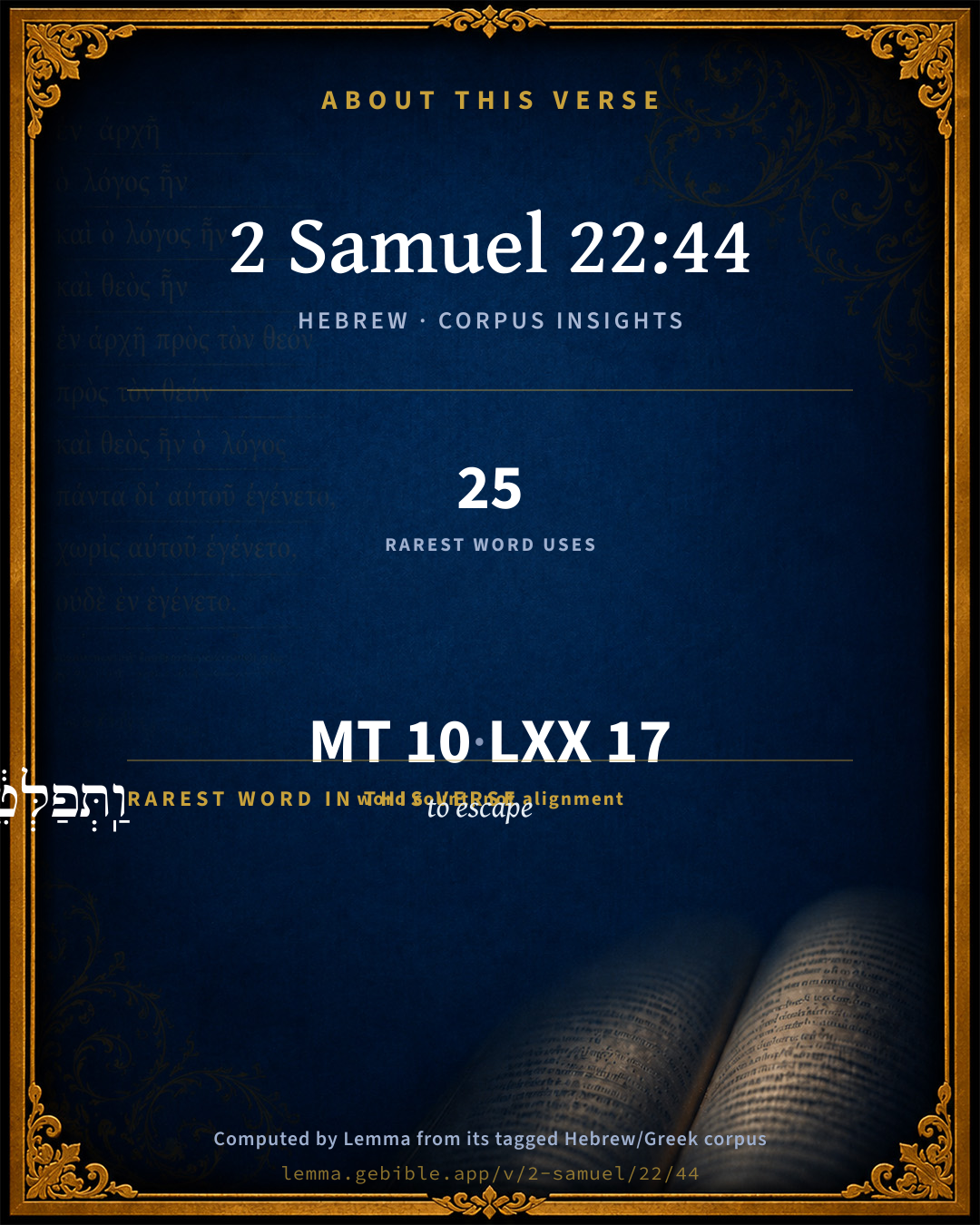
The rarest word here is וַֽתְּפַלְּטֵ֔נִי to escape H6403 — appearing just 25 times in the whole Hebrew Bible.

Shared distinctive vocabulary

וַֽתְּפַלְּטֵ֔נִי to escape H6403 occurs in 23 verses of the Hebrew Bible. Also found in:

Grammatical profile

  • 4 verbs
  • 5 nouns
  • 1 particle

Verb forms

  • וַֽתְּפַלְּטֵ֔נִי Piel · Sequential Imperfect
  • תִּשְׁמְרֵ֨נִי֙ Qal · Imperfect
  • יָדַ֖עְתִּי Qal · Perfect
  • יַעַבְדֻֽנִי Qal · Imperfect

Repetition

A word recurs within this verse — often emphatic in Hebrew:

  • עַמִּ֑י people H5971 ×2

Hebrew & Septuagint length

In English translation the verse runs 32 words from the Hebrew and 30 from the Septuagint (LXX English) — closely comparable.

A rough comparison of the two English renderings, which tokenize alike — not a word-level alignment.

Word counts can differ between the Hebrew and the Greek without any difference in meaning — e.g. the Hebrew direct-object marker אֵת has no separate Greek word, and Greek often adds the article ὁ.

In the original languages it is 10 Hebrew tokens and 17 Greek tokens — but the two are counted differently (Hebrew bundles its prefixes and suffixes into one token; the Greek is in lemma form), so that isn’t a like-for-like length.

Cross-references

25

Topical passages linked to 2 Samuel 22:44 in the Treasury of Scripture Knowledge — connected by theme and wording, ordered by reader-vote popularity; previews shown in the World English Bible.

  • 2 Samuel 8:1–14 After this it happened that David struck the Philistines, and subdued them: and David took the bridle of the mother city out of the hand of the Philistines.
  • Isaiah 55:5 Behold, you shall call a nation that you don't know; and a nation that didn't know you shall run to you, because of Yahweh your God, and for the Holy One of Israel; for he has glorified you.
  • 2 Samuel 3:1 Now there was long war between the house of Saul and the house of David: and David grew stronger and stronger, but the house of Saul grew weaker and weaker.
  • Deuteronomy 28:13 Yahweh will make you the head, and not the tail; and you shall be above only, and you shall not be beneath; if you shall listen to the commandments of Yahweh your God, which I command you this day, to observe and to do [them],
  • 2 Samuel 19:9 All the people were at strife throughout all the tribes of Israel, saying, The king delivered us out of the hand of our enemies, and he saved us out of the hand of the Philistines; and now he is fled out of the land from Absalom.
  • 2 Samuel 19:14 He bowed the heart of all the men of Judah, even as [the heart of] one man; so that they sent to the king, [saying], Return you, and all your servants.
  • 2 Samuel 5:1 Then came all the tribes of Israel to David to Hebron, and spoke, saying, Behold, we are your bone and your flesh.
  • 2 Samuel 18:6–8 So the people went out into the field against Israel: and the battle was in the forest of Ephraim.
  • 2 Samuel 20:1–2 There happened to be there a base fellow, whose name was Sheba, the son of Bichri, a Benjamite: and he blew the trumpet, and said, We have no portion in David, neither have we inheritance in the son of Jesse: every man to his tents, Israel.
  • 2 Samuel 20:22 Then the woman went to all the people in her wisdom. They cut off the head of Sheba the son of Bichri, and threw it out to Joab. He blew the trumpet, and they were dispersed from the city, every man to his tent. Joab returned to Jerusalem to the king.
  • Psalms 2:1–6 Why do the nations rage, And the peoples plot a vain thing?
  • Psalms 2:8 Ask of me, and I will give the nations for your inheritance, The uttermost parts of the earth for your possession.
  • Psalms 18:43 You have delivered me from the strivings of the people. You have made me the head of the nations. A people whom I have not known shall serve me.
  • Psalms 60:8–9 Moab is my wash basin. I will throw my shoe on Edom. I shout in triumph over Philistia."
  • Psalms 72:8–9 He shall have dominion also from sea to sea, From the River to the ends of the earth.
  • Psalms 110:6 He will judge among the nations. He will heap up dead bodies. He will crush the ruler of the whole earth.
  • Isaiah 60:12 For that nation and kingdom that will not serve you shall perish; yes, those nations shall be utterly wasted.
  • Isaiah 65:1 I am inquired of by those who didn't ask; I am found by those who didn't seek me: I said, See me, see me, to a nation that was not called by my name.
  • Daniel 7:14 There was given him dominion, and glory, and a kingdom, that all the peoples, nations, and languages should serve him: his dominion is an everlasting dominion, which shall not pass away, and his kingdom that which shall not be destroyed.
  • Hosea 2:23 I will sow her to me in the earth; And I will have mercy on her who had not obtained mercy; And I will tell those who were not my people, 'You are my people;' And they will say, 'My God!'"
  • Acts 4:25–28 who by the mouth of your servant, David, said, 'Why do the nations rage, And the peoples plot a vain thing?
  • Acts 5:30–31 The God of our fathers raised up Jesus, whom you killed, hanging him on a tree.
  • Romans 9:25 As he says also in Hosea, "I will call them 'my people,' which were not my people; And her 'beloved,' who was not beloved."
  • Romans 15:12 Again, Isaiah says, "There will be the root of Jesse, He who arises to rule over the Gentiles; On him will the Gentiles hope."
  • Revelation 11:15 The seventh angel sounded, and great voices in heaven followed, saying, "The kingdom of the world has become the Kingdom of our Lord, and of his Christ. He will reign forever and ever!"

Cross-references courtesy of OpenBible.info (CC BY 4.0).

Hebrew and Greek witnesses Masoretic Hebrew ↔ Greek Septuagint

The same verse in the two great witnesses to the Old Testament, shown verse-for-verse.

These are two independent witnesses, not word-aligned to each other, and the Septuagint is shown in lemma (dictionary) form.

Hebrew 2 Samuel 22:44 Masoretic · Westminster Leningrad Codex

וַֽתְּפַלְּטֵ֔נִי מֵרִיבֵ֖י עַמִּ֑י תִּשְׁמְרֵ֨נִי֙ לְרֹ֣אשׁ גּוֹיִ֔ם עַ֥ם לֹא יָדַ֖עְתִּי יַעַבְדֻֽנִי

You also have delivered me from the strivings of my people; You have kept me to be the head of the nations: A people whom I have not known shall serve me.

World English Bible · Public Domain

Greek LXX 2 Samuel 22:44 Septuagint · lemma form

καί ῥύομαι ἐγώ ἐκ μάχη λαός φυλάσσω ἐγώ εἰς κεφαλή ἔθνος λαός ὅς οὐ γιγνώσκω δουλεύω ἐγώ

And you shall deliver me from the striving of the peoples, you shall keep me to be the head of the Gentiles: a people which I knew not served me.

LXX2012 (modern English Septuagint) · Public Domain

Hebrew: Westminster Leningrad Codex (CC BY 4.0). Greek: Septuagint (public domain); English from LXX2012 (modern English Septuagint) (Public Domain). How the Septuagint differs from the Hebrew →

Targum (Aramaic paraphrase)

1

The Targum is the ancient Jewish Aramaic paraphrase of the Hebrew Scriptures — an interpretive translation, not the Hebrew text itself. Onkelos (literal) and Pseudo-Jonathan (expansive) render the Torah, and Jonathan the Prophets. Coverage is partial: where no permissively-licensed English translation exists for a verse, only the Aramaic is shown. This is verse-level text, not a word-by-word alignment to the Hebrew.

  1. Targum Jonathan Prophets (Joshua–Malachi)
    וּתְשֵׁיזְבִנַנִי מִפַּלְגוּת עַמָא תְּמַנַינִי רֵישָׁא לְעַמְמַיָא עַמָא דְלָא יְדָעִית יִפְלְחוּנָנִי:

    (no public-domain English translation for this verse)

    Targum Jonathan — Aramaic: “Mikraot Gedolot” (public domain). English: “Sefaria Community Translation” (CC0 1.0 (public-domain dedication)); “London "Chaldee Paraphrase," 1871” (public domain). Text via Sefaria.

Commentary

Notes on 2 Samuel 22:44 from classic Christian and Jewish commentators (each source and its license shown beneath its notes). The classic Christian expositions comment on the surrounding passage and are grouped to its opening verse, so a note may address several verses; the Jewish commentaries on the Tanakh (Rashi and others) are per-verse, so they appear only where the commentator wrote on this verse.

Lemma curates 59 commentaries, every one of them public domain or Creative Commons licensed, each selected and text-cleaned for this edition rather than reprinted as found. About our sources →

Geneva Bible (1599)

Geneva Bible translators

Meaning, of the Jews, who conspired against me.

Geneva Bible (1599) marginal notes — public domain. Text via Bolls.life.

The Cambridge Bible for Schools and Colleges

gen. ed. J. J. S. Perowne

44–46. The establishment of David’s dominion

44. from the strivings of my people] The reference seems to be to the civil wars and internal dissensions which had disturbed the early years of David’s reign, while Saul’s house still endeavoured to maintain its position. Through all these conflicts he had been safely brought, and preserved to exercise dominion over the heathen nations round. Cp. ch. 2Sa_8:1-14; Psa_2:8.

shall serve me] Served me. There is no reason for the sudden transition of the E. V. to the future here and in 2Sa_22:45-46. David is still recounting his past victories, with special reference in all probability to the subjugation of the Syrians, whom he might well describe as “a people he knew not.” Cp. ch. 2Sa_8:6, 2Sa_10:19.

The Cambridge Bible for Schools and Colleges (gen. ed. J. J. S. Perowne; Cambridge University Press, 1878–1918) — public domain. Text from a community e-Sword module.

Haydock's Catholic Bible Commentary

Me. Though David conquered some Gentiles, and some were converted to the true faith under the Old Testament, yet the fulness of the Gentiles belongs to the Church of Christ, the perpetual stability of which is here foretold, ver. 51. (Worthington)

George Leo Haydock (1774–1849), Haydock's Catholic Family Bible and Commentary, 1859 edition — public domain. Excludes Psalms (Douay-Rheims chapter numbering differs from Protestant) and Deuterocanonical books (Catholic canon only).

Whedon's Commentary on the Bible

Daniel D. Whedon

44. Feuds of my people — Such as the rebellions of Absalom and Sheba.

Head of the nations — David was the mightiest conqueror and king of his age.

People I do not know — Of whom Toi, king of Hamath, and his people were an example. 2Sa_8:10.

Daniel D. Whedon (gen. ed.), Commentary on the Old and New Testaments (1874–1909) — public domain. Text from a community e-Sword module.

The Pulpit Commentary

Vers. 44-46.

And thou hast delivered me from the strivings of my people; Thou hast protected me that I might be head of the nations. A people whom! knew not have become my servants; Children of strangers have submitted themselves to me; At the hearing of the ear they obeyed me. The children of the strangers faded away; They fled trembling out of their fastnesses.

People, in the singular, means the Jewish people as opposed to the nations, that is, the heathen world. The strivings here referred to are the long dissensions which followed Ishbosheth"s death, and delayed for many the appointment of David as king of Israel. He now feels that the watchful which had protected him during that dangerous period had a higher purpose than the union of the twelve tribes under one head. He was to be the founder also of that empire over the nations which symbolized the gift of the heathen world to Christ. And this empire had been extended to people previously unknown to David. Such might be the case with Hadarezer, King of Zobah, but it more especially referred to Toi, and the Hittite kingdom of Hamath. (2Sa_8:9) It was not from force of arms, but from the hearing of the ear, that is, from the wide extended fame of David"s conquests, that Toi sent ambassadors to offer allegiance and presents. They fled trembling. This is certainly the sense in Psa_18:45, where, however, there is a transposition of letters. Probably it is the sense here. But if we might go to the cognate languages for an explanation of a rare word, it would mean "came limping out of their fastnesses," as men worn out with fatigue and exhaustion.

Vers. 44, 45.

The head of the nations.

David once more records how God had delivered him in and from the contests in which he had been involved; and declares that he had thus kept him "to be the head of the nations" (Revised Version), not only Israel, but foreign peoples. He, or, if not he, the Spirit which spake by him, (2Sa_23:2) may have had in view the ultimate purpose of God respecting him and his posterity, viz. the exaltation of his great Son to be, in a wider sense than was applicable to David himself, "the Head of the nations." We may at least take the words as applicable to the Lord Jesus Christ.

I THE OPPOSITION HE ENCOUNTERS. Like David, he has to withstand many "strivings of the people.

1. In his life on earth he was much opposed. He endured the "contradiction of sinners against himself". (Heb_12:3) "He came unto his own, and his own received him not" (Joh_1:11) his own people, his own family. (Joh_7:5) All classes, with a few exceptions, rejected him Pharisees and Sadducees, elders and scribes, ecclesiastics and politicians, rulers and people. The multitude sought once to make him, (Joh_6:15) and, when he entered Jerusalem for the last time, welcomed him, in the hope that he was about to ascend the throne; but he would not be such a king as they desired, and they cared not to have such a King as he was to be. Hence they united with their superiors in saying, "We will not have this Man to reign over us"; (Luk_19:14) and, to put an end to his pretensions, put him to death. They did not know that they were thus very effectually promoting his victories and reign.

2. He has met with various and constant opposition ever since. His cause has advanced in spite of perpetual strivings against it. Jews and Gentiles, kings and subjects, rich and poor, the intellectual and the ignorant, the refined and the coarse, have "set themselves.., against the Lord, and against his Anointed". (Psa_2:2) He, too, can speak still of the "strivings of my people." As at first amongst the Jews, so since amongst Christians (so called), and amongst those in high positions in his Church, have been found his worst foes. Men are willing to bear his Name, to receive some of his doctrines, and even contend for them, to appropriate the comfort he gives; but to obey him, to let him rule in their minds and hearts and lives, in their homes, in their business, in their pleasures, in their social life, in their national affairs, that is quite another matter. And those who strive earnestly to obey him themselves, and to induce others to do so, must be prepared for opposite "strivings," and even persecution. Nor do they wonder, seeing they find, more or less, in their own nature, elements of opposition to the rule of the Christ which explain the hostility of others.

IX THE EXALTED POSITION HE NEVERTHELESS OCCUPIES. "Head of the nations." The answer of the Almighty to all the rebellious counsels and works of men is, "Yet have I set my King upon my holy hill of Zion". (Psa_2:6) The kingdom of Christ is the kingdom of Jehovah; vain, therefore, must be all strivings against it. Its opponents can only dash themselves to pieces, but "he must reign". (1Co_15:25)

1. The extent of his dominion. "The nations," in a wider sense than was true of David. "All nations shall serve him". (Psa_72:11) And not only all nations in existence at any one time, but all that may come into existence while the world endures.

2. The nature of his dominion.

(1) He is "Head of the nations" by right. By the appointment and gift of the Father (Psa_2:7, Psa_2:8; Mat_28:18) As the result and reward of his own righteousness and self-sacrificing love. (Php_2:8, 9) He redeemed men by his blood, to make them "a kingdom". (Rev_1:5, 6 5:9, 10, Revised Version) As truth, righteousness, and love are rightful rulers, however far they may be from actually ruling, so is it with our Lord.

(2) He actually rules over all nations. "He is Lord of all". (Act_10:36) All authority on earth, as well as in heaven, has been given to him. (Mat_28:18) Whether men know him or not, acknowledge him or not, he is their King; he so orders, controls, and directs the affairs of the nations as to make them subserve the advancement and ultimate universal establishment of his spiritual reign.

(3) He has already a vast multitude of willing and obedient subjects in many nations. "A people which he knew not," gathered from the Gentiles, serves him; as well as many from the people whom he knew.

(4) Many render him feigned obedience (ver. 45, margin). It is an evidence of his great power among the nations that many find it to their interest, or credit, or convenience, to profess his Name, who are still opposed to him in heart. They call him Lord, though they do not the things which he says. (Luk_6:46)

(5) All nations will at length own him as their Head, and heartily and lovingly submit to his sway. The prophecy will yet be fulfilled: "There followed great voices in heaven, and they said, The kingdom of the world is become the kingdom of our Lord, and of his Christ: and he shall reign forever and ever". (Rev_11:15, Revised Version) In the assurance of this, let his people labour and give and pray with joyful hope for the extension of his reign in the earth. G.W.

The Pulpit Commentary (1880–1919), ed. H.D.M. Spence-Jones & Joseph S. Exell — public domain. Text from a community e-Sword module.

Keil & Delitzsch

C. F. Keil & F. Delitzsch

44 And Thou rescuest me out of the strivings of my people,

Preservest me to be the head of the heathen.

People that I knew not serve me.

45 The sons of the stranger dissemble to me,

Upon hearsay they obey me.

46 The sons of the stranger despair,

And tremble out of their castles.

By "the strivings of my people" the more indefinite expression in the psalm, "strivings of the people," is explained. The words refer to the domestic conflicts of David, out of which the Lord delivered him, such as the opposition of Ishbosheth and the rebellions of Absalom and Sheba. These deliverances formed the prelude and basis of his dominion over the heathen. Consequently תּשׁמרני (Thou preservest me to be the head of the nations) occurs quite appropriately in the second clause; and תּשׂימני, "Thou settest me," which occurs in the psalm, is a far less pregnant expression. עם before ידעתּי לא is used indefinitely to signify foreign nations. Toi king of Hamath (Sa2 8:10) was an example, and his subjugation was a prelude of the future subjection of all the heathen to the sceptre of the Son of David, as predicted in Ps 72. In v. 45 the two clauses of the psalm are very appropriately transposed. The Hithpael יתכחשׁוּ, as compared with יכחשׁוּ, is the later form. In the primary passage (Deu 33:29) the Niphal is used to signify the dissembling of friendship, or of involuntary homage on the part of the vanquished towards the victor. אזן לשׁמוע, "by the hearing of the ear," i.e., by hearsay, is a simple explanation of אזן לשׁמע, at the rumour of the ears (vid., Job 42:5), i.e., at the mere rumour of David's victories. The foreign nations pine away, i.e., despair of ever being able to resist the victorious power of David. יחגּרוּ, "they gird themselves," does not yield any appropriate meaning, even if we should take it in the sense of equipping themselves to go out to battle. The word is probably a misspelling of יחרגוּ, which occurs in the psalm, חרג being a ἁπ. λεγ. in the sense of being terrified, or trembling: they tremble out of their castles, i.e., they come trembling out of their castles (for the thought itself, see Mic 7:17). It is by no means probable that the word חרג, which is so frequently met with in Hebrew, is used in this one passage in the sense of "to limp," according to Syriac usage.

In conclusion, the Psalmist returns to the praise of the Lord, who had so highly favoured him.

Keil & Delitzsch — Biblical Commentary on the Old Testament (1861–1891) — public domain (CC PDM 1.0). Text via the HelloAO Bible API. (Old Testament only.)

unfoldingWord translationNotes

Door43 World Missions Community

General Information:

David continues his song to Yahweh.

from the disputes of my own people

This refers to those among the Israelites who rebelled against King David.

You have kept me as the head of nations

"You placed me as ruler over the nations." Here "nations" refers to other nations besides Israel.

A people that I have not known

"A foreign people"

Foreigners were forced to bow to me

This can be stated in active form. AT: "Foreigners bowed down to me" (See: Active or Passive)

translationWords

people group

head

nation

know

servant

alien

bow

obey

tremble

stronghold

unfoldingWord translationNotes — © Distant Shores Media and the Door43 World Missions Community, licensed CC BY-SA 4.0. Source: git.door43.org/Door43/en_tn.

Rashi

Rabbi Shlomo Yitzchaki (Rashi)

Antagonists. From Doeg, Achitophel, Shaul and the Ziffites.

You preserved me to be a leader of nations. He kept me hidden for this purpose. The Midrash Aggadah [interprets our verse], "Dovid said, "Master of the universe, spare me from [potential] judgement concerning [the people of] Yisroel for if I shall cause [Yisroel] to turn away [from You] or I rule them harshly during the course of my service I will be punished [by You]. Rather, make me the leader of the Pelishtim and let them serve me [because] I will not be punished on their account.

Rashi on the Tanakh — English translations: “The Judaica Press complete Tanach with Rashi, translated by A. J. Rosenberg” (CC BY 4.0); “Pentateuch with Rashi's commentary by M. Rosenbaum and A.M. Silbermann, 1929-1934” (public domain); “The Metsudah Tanach series, Lakewood, N.J” (CC BY 4.0); and “The Book of Joshua, Metsudah Publications, 1997” (CC BY 4.0). Text via Sefaria.

Lesson kit

Teaching starters — assembled from the data on this page, not authored interpretation. Every prompt links to the verse data it draws on. Edit before teaching.

2 Samuel, in the Historical, opens this verse with 10 words (9 distinct Hebrew lemmas). Its most distinctive word is pâlaṭ (“to escape”). A historical commentator’s framing appears above. Read the whole chapter for the surrounding context.

Discussion questions

  1. What does “to escape” (pâlaṭ) contribute to the verse as a whole?
  2. How does 2 Samuel 22:2, which shares the word «to escape», read alongside this verse?
  3. What does the repetition of “people” (2× in this one verse) do in this verse?
  4. The translations on this page render this verse differently — a whole-verse word diff, not a word-by-word alignment. What might account for the different wordings?
  5. «וַֽתְּפַלְּטֵ֔נִי» is a Piel Sequential Imperfect verb. How does that grammatical form shape the action described?
  6. Compare how Geneva Bible (1599) and The Cambridge Bible for Schools and Colleges read this verse. Where do they agree or differ?

Things to notice

Reading settings

Reading text

Shown beneath each verse's original-language words.

Old Testament
Old Testament edition

Read the OT as the Masoretic Hebrew (MT) or the Greek Septuagint (LXX).

English shown for the Greek Septuagint (in the Hebrew ↔ Greek comparison).

Comparing translations? Open the Compare panel on any verse page to stack up to four side by side.