Deuteronomy 4:8

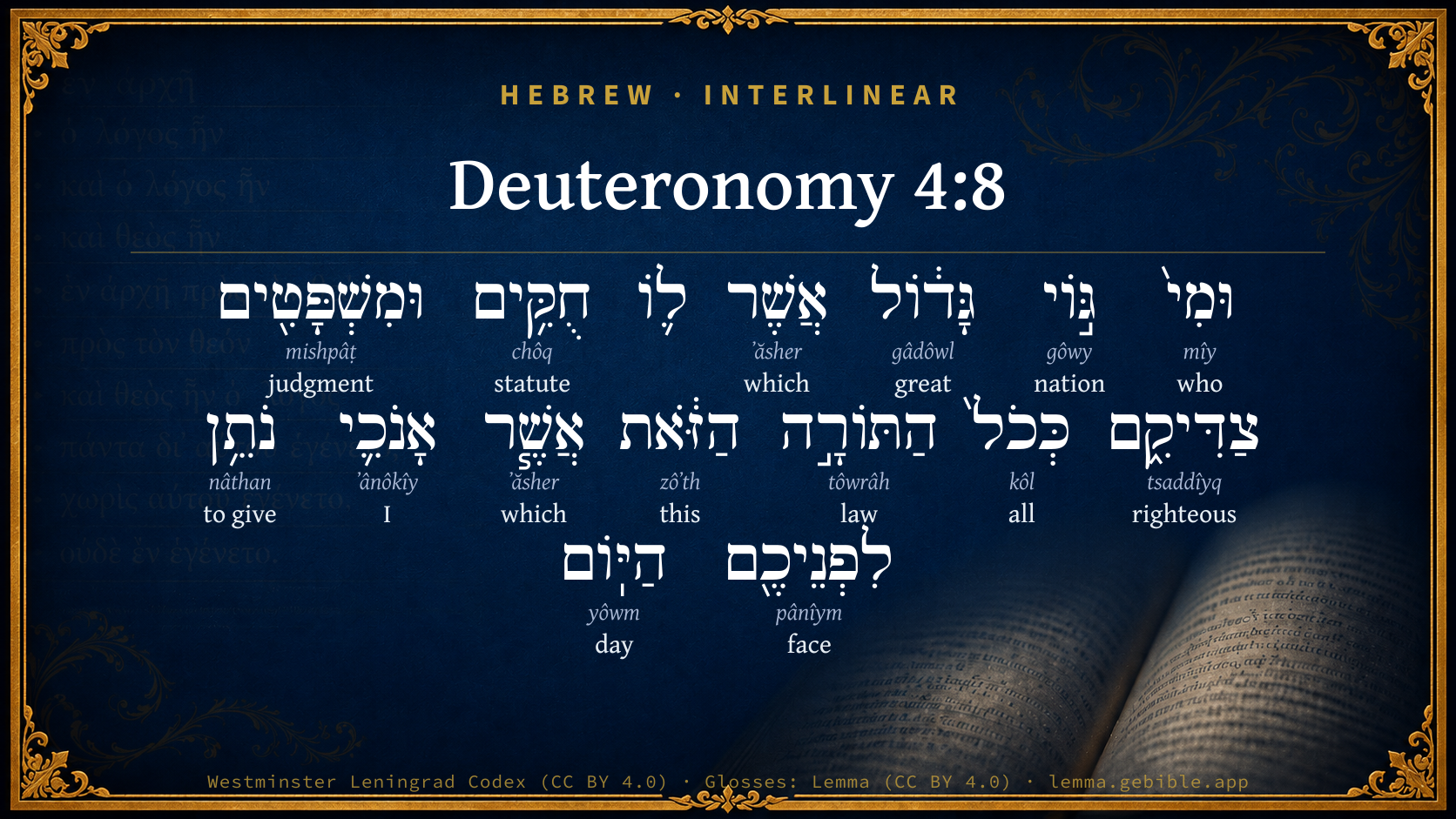
Hebrew (Westminster Leningrad Codex) Deuteronomy 4:8 appears in the Hebrew Old Testament. The text above is from the Westminster Leningrad Codex. Each word links to its Strong’s number, a concise gloss, and parsing drawn from the Open Scriptures Hebrew Bible morphology. Click any word for its full Brown-Driver-Briggs (BDB) entry.
Download image
Cite this verse

Deuteronomy 4:8 (World English Bible). Public Domain. Lemma interlinear Bible study tool, https://lemma.gebible.app/v/deuteronomy/4/8.

Show BibTeX & RIS
BibTeX
RIS
English Translation
What great nation is there, that has statutes and ordinances so righteous as all this law, which I set before you this day?
World English Bible · Public Domain
Download a study sheet

One document with this verse’s original text, its word-by-word gloss line, the meaning frame, cross-references with their text, attributed commentary, and full source and license credits — printable, and it pastes into notes with its structure intact.

This verse Autodidact and up

Study sheet (.html) Plain text (.txt)

A passage Seminary Student

Up to 50 verses in one chapter. A passage sheet keeps up to 6 commentary sources and 12 cross-references per verse, in the order this page ranks them, and says so on the sheet whenever that leaves anything out. Ask for a single verse and you get the Autodidact verse sheet above.

Everything on this page stays free to read, with no account — the sheet is a download of what is already on screen, not access to it.

Want to remove ads? Support Godless Engineer
Compare translations 3

The same verse in 3 English versions, stacked beneath the original-language interlinear above. Click any original word for its lexicon entry.

Each is an independent rendering of the whole verse — the interlinear is not word-aligned to these translations.

Highlighted words mark where these versions differ — a whole-verse word diff, not a word-by-word alignment.

  • World English Bible Public Domain
    What great nation is there, that has statutes and ordinances so righteous as all this law, which I set before you this day?
  • King James Version Public Domain
    And what nation is there so great, that hath statutes and judgments so righteous as all this law, which I set before you this day?
  • unfoldingWord Literal Text CC BY-SA 4.0
    And, which great nation that has statutes and ordinances righteous as all this law that I am giving to your faces today?

unfoldingWord Literal Text — © unfoldingWord, licensed CC BY-SA 4.0. Word-aligned USFM3 via Door43 (git.door43.org/unfoldingWord/en_ult).

Versions to compare (up to 4)

3 of 4 selected

Show all 18 translations

Every available English version of this verse, each an independent rendering of the whole verse.

  • World English Bible Public Domain
    What great nation is there, that has statutes and ordinances so righteous as all this law, which I set before you this day?
  • Berean Standard Bible Public Domain
    And what nation is great enough to have righteous statutes and ordinances like this entire law I set before you today?
  • Majority Standard Bible Public Domain
    And what nation is great enough to have righteous statutes and ordinances like this entire law I set before you today?
  • King James Version Public Domain
    And what nation is there so great, that hath statutes and judgments so righteous as all this law, which I set before you this day?
  • American Standard Version (1901) Public Domain
    And what great nation is there, that hath statutes and ordinances so righteous as all this law, which I set before you this day?
  • Revised Version (1885) Public Domain
    And what great nation is there, that hath statutes and judgments so righteous as all this law, which I set before you this day?
  • Geneva Bible (1599) Public Domain
    And what nation is so great, that hath ordinances and lawes so righteous, as all this Lawe, which I set before you this day?
  • Douay-Rheims (1899) Public Domain
    For what other nation is there so renowned that hath ceremonies, and just judgments, and all the law, which I will set forth this day before your eyes?
  • Young's Literal Translation Public Domain
    and which `is' the great nation which hath righteous statutes and judgments according to all this law which I am setting before you to-day?
  • Literal Standard Version CC BY-SA 4.0
    And which [is] the great nation which has righteous statutes and judgments according to all this law which I am setting before you today?
  • Unlocked Literal Bible CC BY-SA 4.0
    What other great nation is there that has laws and decrees so righteous as all this law that I am setting before you today?
  • unfoldingWord Literal Text CC BY-SA 4.0
    And, which great nation that has statutes and ordinances righteous as all this law that I am giving to your faces today?
  • Darby Bible Public Domain
    And what great nation is there that hath righteous statutes and ordinances, as all this law which I set before you this day?
  • World Messianic Bible Public Domain
    What great nation is there that has statutes and ordinances so righteous as all this law which I set before you today?
  • Webster's Bible Public Domain
    And what nation is there so great, that hath statutes and judgments so righteous as all this law, which I set before you this day?
  • Free Bible Version CC BY-SA 4.0
    What nation is as great as us, having such good rules and regulations like all these laws that I'm placing before you today?
  • Bible in Basic English Public Domain
    And what great nation has laws and decisions so right as all this law which I put before you today?
  • JPS Tanakh (1917) Public Domain
    And what great nation is there, that hath statutes and ordinances so righteous as all this law, which I set before you this day?

Literal Standard Version (2020), Covenant Press — licensed CC BY-SA 4.0. Text via the HelloAO Bible API (eBible.org). Unlocked Literal Bible (unfoldingWord) — licensed CC BY-SA 4.0. Text via the HelloAO Bible API (eBible.org). unfoldingWord Literal Text — © unfoldingWord, licensed CC BY-SA 4.0. Word-aligned USFM3 via Door43 (git.door43.org/unfoldingWord/en_ult). Free Bible Version, Dr. Jonathan Gallagher — licensed CC BY-SA 4.0. Text via the HelloAO Bible API (eBible.org).

Word by word

More ways to search: Search by grammar → Find every occurrence → Compare this word →

Practice this passage: Drill this verse → Learn its vocabulary →

חֻקִּ֥ים
chôq
H2706
“statutes”
Noun, Common, Masculine, Plural, Absolute
Part of Speech
Noun
Type
Common
Gender
Masculine
Number
Plural
State
Absolute
Full BDB Definition

Origin: from H2710

TWOT: 728a

statute, ordinance, limit, something prescribed, due - prescribed task - prescribed portion - action prescribed (for oneself), resolve - prescribed due - prescribed limit, boundary - enactment, decree, ordinance - specific decree - law in general - enactments, statutes - conditions - enactments - decrees - civil enactments prescribed by God
  1. וּמִי֙ mîy H4310 “and · who” Conjunction + Particle, Interrogative
  2. גּ֣וֹי gôwy H1471 “nation” Noun, Common, Masculine, Singular, Absolute
  3. גָּד֔וֹל gâdôwl H1419 “great” Adjective, Adjective, Masculine, Singular, Absolute
  4. אֲשֶׁר ʼăsher H834 “which” Particle, Relative
  5. וּמִשְׁפָּטִ֖ים mishpâṭ H4941 “and · judgments” Conjunction + Noun, Common, Masculine, Plural, Absolute
  6. צַדִּיקִ֑ם tsaddîyq H6662 “righteous” Adjective, Adjective, Masculine, Plural, Absolute
  7. כְּכֹל֙ kôl H3605 “like/as · all of” Preposition + Noun, Common, Masculine, Singular, Construct
  8. הַתּוֹרָ֣ה tôwrâh H8451 “the · law” Particle, Definite Article + Noun, Common, Feminine, Singular, Absolute
  9. הַזֹּ֔את zôʼth H2063 “the · this” Particle, Definite Article + Pronoun, Demonstrative, Feminine, Singular
  10. אֲשֶׁ֧ר ʼăsher H834 “which” Particle, Relative
  11. אָנֹכִ֛י ʼânôkîy H595 “I” Pronoun, Personal, 1st Person, Common, Singular
  12. נֹתֵ֥ן nâthan H5414 “giving” Verb, Qal, Participle Active, Masculine, Singular, Absolute
  13. לִפְנֵיכֶ֖ם pânîym H6440 “to/for · face(s) · your” Preposition + Noun, Common, Both, Plural, Construct + Suffix, Personal, 2nd Person, Masculine, Plural
  14. הַיּֽוֹם yôwm H3117 “the · day” Particle, Definite Article + Noun, Common, Masculine, Singular, Absolute

About this verse

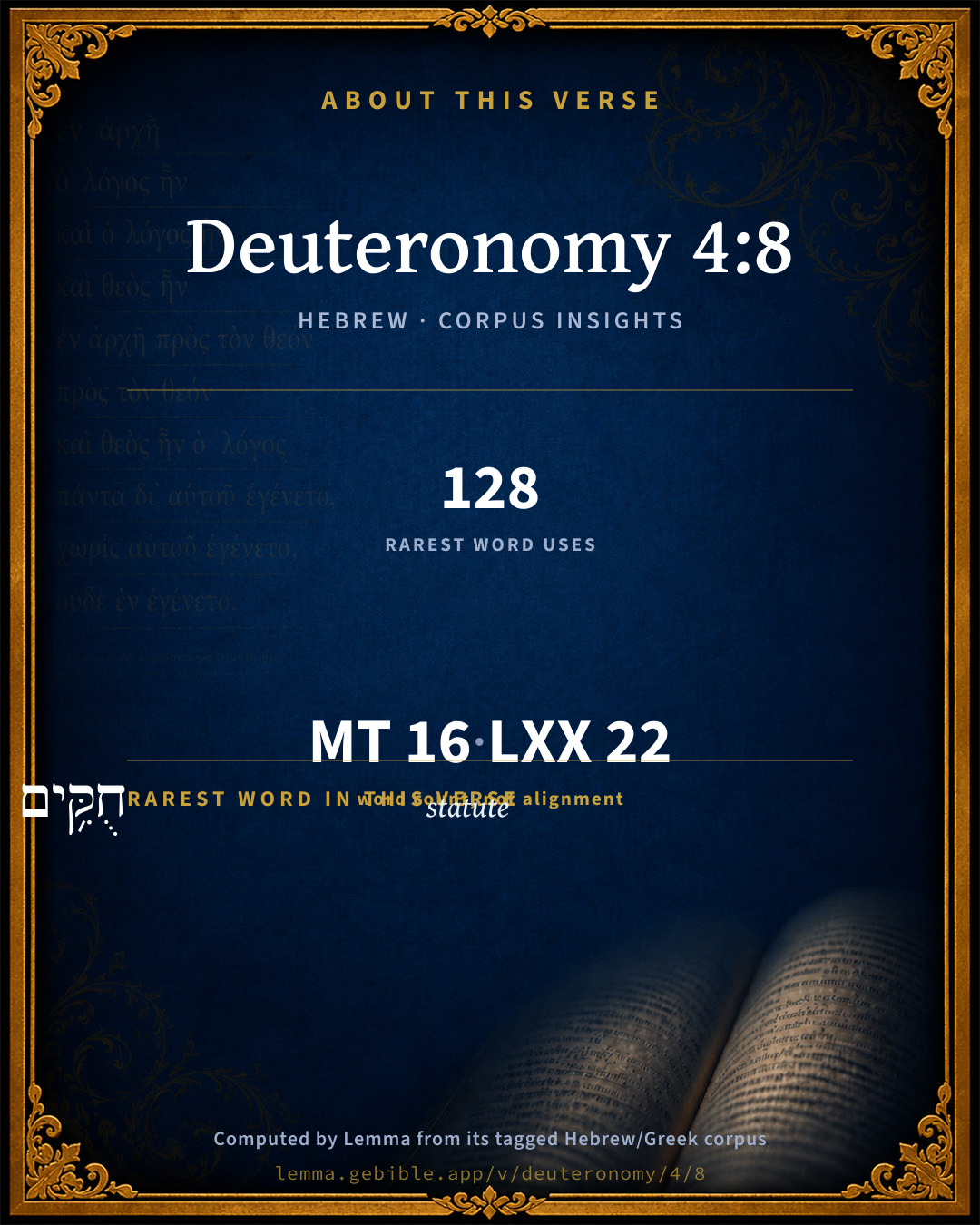
These counts appear in no published source. They are computed here, from the morphology-tagged text and Lemma’s own curated glosses. What Lemma adds →

16
words
14
distinct lemmas
Pentateuch
section

Grammatical profile

  • 1 verb
  • 7 nouns
  • 2 adjectives
  • 2 pronouns
  • 1 preposition
  • 3 particles

Verb forms

  • נֹתֵ֥ן Qal · Participle Active

Repetition

A word recurs within this verse — often emphatic in Hebrew:

  • אֲשֶׁר which H834 ×2

Hebrew & Septuagint length

In English translation the verse runs 23 words from the Hebrew and 26 from the Septuagint (LXX English) — closely comparable.

A rough comparison of the two English renderings, which tokenize alike — not a word-level alignment.

Word counts can differ between the Hebrew and the Greek without any difference in meaning — e.g. the Hebrew direct-object marker אֵת has no separate Greek word, and Greek often adds the article ὁ.

In the original languages it is 16 Hebrew tokens and 22 Greek tokens — but the two are counted differently (Hebrew bundles its prefixes and suffixes into one token; the Greek is in lemma form), so that isn’t a like-for-like length.

Cross-references

8

Topical passages linked to Deuteronomy 4:8 in the Treasury of Scripture Knowledge — connected by theme and wording, ordered by reader-vote popularity; previews shown in the World English Bible.

  • Psalms 147:19–20 He shows his word to Jacob; His statutes and his ordinances to Israel.
  • Romans 7:12–14 Therefore the law indeed is holy, and the commandment holy, and righteous, and good.
  • Deuteronomy 10:12–13 Now, Israel, what does Yahweh your God require of you, but to fear Yahweh your God, to walk in all his ways, and to love him, and to serve Yahweh your God with all your heart and with all your soul,
  • Psalms 19:7–11 Yahweh's law is perfect, restoring the soul. Yahweh's testimony is sure, making wise the simple.
  • Psalms 119:86 All of your commandments are faithful. They persecute me wrongfully. Help me!
  • Psalms 119:127–128 Therefore I love your commandments more than gold, Yes, more than pure gold.
  • 2 Timothy 3:16–17 Every writing inspired by God is profitable for teaching, for reproof, for correction, and for instruction which is in righteousness,
  • Psalms 119:96 I have seen a limit to all perfection, But your commands are boundless.

Cross-references courtesy of OpenBible.info (CC BY 4.0).

Hebrew and Greek witnesses Masoretic Hebrew ↔ Greek Septuagint

The same verse in the two great witnesses to the Old Testament, shown verse-for-verse.

These are two independent witnesses, not word-aligned to each other, and the Septuagint is shown in lemma (dictionary) form.

Hebrew Deuteronomy 4:8 Masoretic · Westminster Leningrad Codex

וּמִי֙ גּ֣וֹי גָּד֔וֹל אֲשֶׁר ל֛וֹ חֻקִּ֥ים וּמִשְׁפָּטִ֖ים צַדִּיקִ֑ם כְּכֹל֙ הַתּוֹרָ֣ה הַזֹּ֔את אֲשֶׁ֧ר אָנֹכִ֛י נֹתֵ֥ן לִפְנֵיכֶ֖ם הַיּֽוֹם

What great nation is there, that has statutes and ordinances so righteous as all this law, which I set before you this day?

World English Bible · Public Domain

Greek LXX Deuteronomy 4:8 Septuagint · lemma form

καί ποῖος ἔθνος μέγας ὅς εἰμί αὐτός δικαίωμα καί κρίμα δίκαιος κατά πᾶς ὁ νόμος οὗτος ὅς ἐγώ δίδωμι ἐνώπιον σύ σήμερον

And what manner of nation is so great, which has righteous ordinances and judgments according to all this law, which I set before you this day?

LXX2012 (modern English Septuagint) · Public Domain

Hebrew: Westminster Leningrad Codex (CC BY 4.0). Greek: Septuagint (public domain); English from LXX2012 (modern English Septuagint) (Public Domain). How the Septuagint differs from the Hebrew →

Targum (Aramaic paraphrase)

2

The Targum is the ancient Jewish Aramaic paraphrase of the Hebrew Scriptures — an interpretive translation, not the Hebrew text itself. Onkelos (literal) and Pseudo-Jonathan (expansive) render the Torah, and Jonathan the Prophets. Coverage is partial: where no permissively-licensed English translation exists for a verse, only the Aramaic is shown. This is verse-level text, not a word-by-word alignment to the Hebrew.

  1. Targum Onkelos Torah (Genesis–Deuteronomy)
    וּמָן עַם רַב דִי לֵהּ קְיָמִין וְדִינִין קַשִׁיטִין כְּכֹל אוֹרַיְתָא הָדָא דִי אֲנָא יָהֵב קֳדָמֵכוֹן יוֹמָא דֵין

    (no public-domain English translation for this verse)

    Targum Onkelos — Aramaic: “Onkelos Genesis” (public domain); “Onkelos Exodus” (public domain); “Onkelos Leviticus” (public domain); “Onkelos Numbers” (public domain); “Onkelos Deuteronomy” (public domain). English: “Sefaria Community Translation” (CC0 1.0 (public-domain dedication)); “J.W. Etheridge. The Targums of Onkelos and Jonathan Ben Uzziel on the Pentateuch. London: Longmans, Green, 1862” (public domain). Text via Sefaria.

  2. Targum Pseudo-Jonathan Torah (Genesis–Deuteronomy)
    וְהֵידָא אוּמָא רַבָּא דִילֵיהּ קְיָימִין וְדִינִין תְּרִיצִין כְּכָל אוֹרַיְיתָא הָדָא דַאֲנָא סְדַר קֳדָמֵיכוֹן יוֹמָא דֵין

    And what people have statutes and right judgments according to all this law which I order before you this day?

    Targum Pseudo-Jonathan — Aramaic: “Targum Jonathan on Genesis” (public domain); “Targum Jonathan on Exodus” (public domain); “Targum Jonathan on Leviticus” (public domain); “Targum Jonathan on Numbers” (public domain); “Targum Jonathan on Deuteronomy” (public domain). English: “The Targum of Jonathan ben Uzziel, trans. J. W. Etheridge, London, 1862” (public domain). Text via Sefaria.

Commentary

Notes on Deuteronomy 4:8 from classic Christian and Jewish commentators (each source and its license shown beneath its notes). The classic Christian expositions comment on the surrounding passage and are grouped to its opening verse, so a note may address several verses; the Jewish commentaries on the Tanakh (Rashi and others) are per-verse, so they appear only where the commentator wrote on this verse.

Lemma curates 59 commentaries, every one of them public domain or Creative Commons licensed, each selected and text-cleaned for this edition rather than reprinted as found. About our sources →

Trapp's Complete Commentary

John Trapp

Deu 4:8 And what nation [is there so] great, that hath statutes and judgments [so] righteous as all this law, which I set before you this day?

Ver. 8. So righteous.] {See Trapp on "Deu 1:1"}

John Trapp, A Commentary or Exposition upon All the Books of the Old and New Testament (1647–1656) — public domain. Text from a community e-Sword module.

Tyndale Open Study Notes

Tyndale Open Resources

4:8 Israel’s laws were righteous and fair because they originated with God.

Tyndale Open Study Notes — © Tyndale Open Resources, licensed CC BY-SA 4.0. Text via the HelloAO Bible API.

Ellicott's Commentary for English Readers

(8) What nation is there so great, that hath statutes and judgments so righteous?—These words direct our attention to the law of Moses, as distinctly in advance of the time when it was given.

A Bible Commentary for English Readers, edited by Charles John Ellicott (1878–1897) — public domain. Text from a community e-Sword module.

The Cambridge Bible for Schools and Colleges

gen. ed. J. J. S. Perowne

8. And what great nation … hath statutes … so righteous] This challenge is as just as the preceding. Other great codes and systems of ethics there undoubtedly were in Israel’s world (e.g. the Code of Ḫammurabi and various systems in Egypt). But the deuteronomic Torah is rightly exalted above them—because of its pure religious fervency, its revelation of the Divine character, and its enforcement, in the details of human conduct, of the example of God Himself. Moreover, the Law of no other nation in Israel’s world has exerted so practical an influence on the ethics of mankind. How necessary it was to impress Israel, both immediately before and during the Exile, with the distinction which the Law gave them among the nations is seen from such passages as Eze_20:32; Eze_25:8. The heathen said Israel is like all the nations, and Israelites were tempted to fall back upon the easier ethics of their neighbours, we will be as the heathen. This is the temptation of all recipients of high ideals and duties; none are more exposed to it than Christians; they must remind themselves, as this discourse insists, of the privilege and responsibility of those who having known the better dare not be content with the easier. The substance of these verses then is, Walk worthy of the vocation wherewith ye have been called. The abuse of such a conscience is the self-righteousness born of a merely formal fulfilment of the Law (Luk_18:11). ‘Pharisaism and Deuteronomy came into the world the same day’ (A. B. Davidson, Hastings DB. ii. 577).

set before you] Not prescribe or enforce; but offer for your decision and acceptance. So Deu_11:26; Deu_11:32; Deu_30:1; Deu_30:15; Deu_30:19. The affirmation of the people’s responsibility is characteristic of D.

The Cambridge Bible for Schools and Colleges (gen. ed. J. J. S. Perowne; Cambridge University Press, 1878–1918) — public domain. Text from a community e-Sword module.

John Gill's Exposition

And what nation is there so great, that hath statutes and judgments so righteous,.... Founded in justice and equity, and so agreeable to right reason, and so well calculated and adapted to lead persons in the ways of righteousness and truth, and keep them from doing any injury to each other's persons and properties, and to maintain good order, peace, and concord among them:

as all this law which I set before you this day? which he then repeated, afresh declared, explained and instructed them in; for otherwise it had been delivered to them near forty years ago. Now there was not any nation then in being, nor any since, to be compared with the nation of the Jews, for the wise and wholesome laws given unto them; no, not the more cultivated and civilized nations, as the Grecians and Romans, who had the advantage of such wise lawgivers as they were accounted, as Solon, Lycurgus, Numa, and others; and indeed the best laws that they had seem to be borrowed from the Jews.

John Gill's Exposition of the Whole Bible (1746–1763) — public domain (CC PDM 1.0). Text via the HelloAO Bible API.

Haydock's Catholic Bible Commentary

Eyes. Most of these laws had been already promulgated, so that the people could set a just value upon them. But Moses undertakes to place the in a more beautiful point of view, as it were altogether, and accompanied with some fresh regulations. How imperfect are all the codes of the ancient lawgivers, when compared with this of Moses! (Haydock)

George Leo Haydock (1774–1849), Haydock's Catholic Family Bible and Commentary, 1859 edition — public domain. Excludes Psalms (Douay-Rheims chapter numbering differs from Protestant) and Deuterocanonical books (Catholic canon only).

Matthew Poole's English Annotations

Whereby he implies that the true greatness of a nation doth not consist in pomp or power, or largeness of empire, as commonly men think, but in the righteousness of its laws.

Matthew Poole's English Annotations on the Holy Bible (1683–1685) — public domain. Text from a community e-Sword/MySword module.

John Wesley's Explanatory Notes

So righteous - Whereby he implies that the true greatness of a nation doth not consist in pomp or power, or largeness of empire, as commonly men think, but in the righteousness of its laws.

John Wesley, Explanatory Notes Upon the Whole Bible (1754–1765) — public domain. Text via the GEBible commentary corpus.

Rashi

Rabbi Shlomo Yitzchaki (Rashi)

חקים ומשפטים צדיקים STATUTES AND RIGHTEOUS JUDGMENTS — i.e. proper and acceptable ones.

Rashi on the Tanakh — English translations: “The Judaica Press complete Tanach with Rashi, translated by A. J. Rosenberg” (CC BY 4.0); “Pentateuch with Rashi's commentary by M. Rosenbaum and A.M. Silbermann, 1929-1934” (public domain); “The Metsudah Tanach series, Lakewood, N.J” (CC BY 4.0); and “The Book of Joshua, Metsudah Publications, 1997” (CC BY 4.0). Text via Sefaria.

Lesson kit

Teaching starters — assembled from the data on this page, not authored interpretation. Every prompt links to the verse data it draws on. Edit before teaching.

Deuteronomy, in the Pentateuch, opens this verse with 16 words (14 distinct Hebrew lemmas). Its most distinctive word is chôq (“statute”). A historical commentator’s framing appears above. Read the whole chapter for the surrounding context.

Discussion questions

  1. The word chôq carries the sense “statute.” How does it shape the verse?
  2. How does Psalms 147:19–20, which shares this passage’s theme, read alongside this verse?
  3. What does the repetition of “which” (2× in this one verse) do in this verse?
  4. These translations render this verse differently; the difference is in the English rendering, not the original. What questions does that raise?
  5. «נֹתֵ֥ן» is a Qal Participle Active verb. How does that grammatical form shape the action described?
  6. Compare how Trapp's Complete Commentary and Tyndale Open Study Notes read this verse. Where do they agree or differ?

Things to notice

Reading settings

Reading text

Shown beneath each verse's original-language words.

Old Testament
Old Testament edition

Read the OT as the Masoretic Hebrew (MT) or the Greek Septuagint (LXX).

English shown for the Greek Septuagint (in the Hebrew ↔ Greek comparison).

Comparing translations? Open the Compare panel on any verse page to stack up to four side by side.