
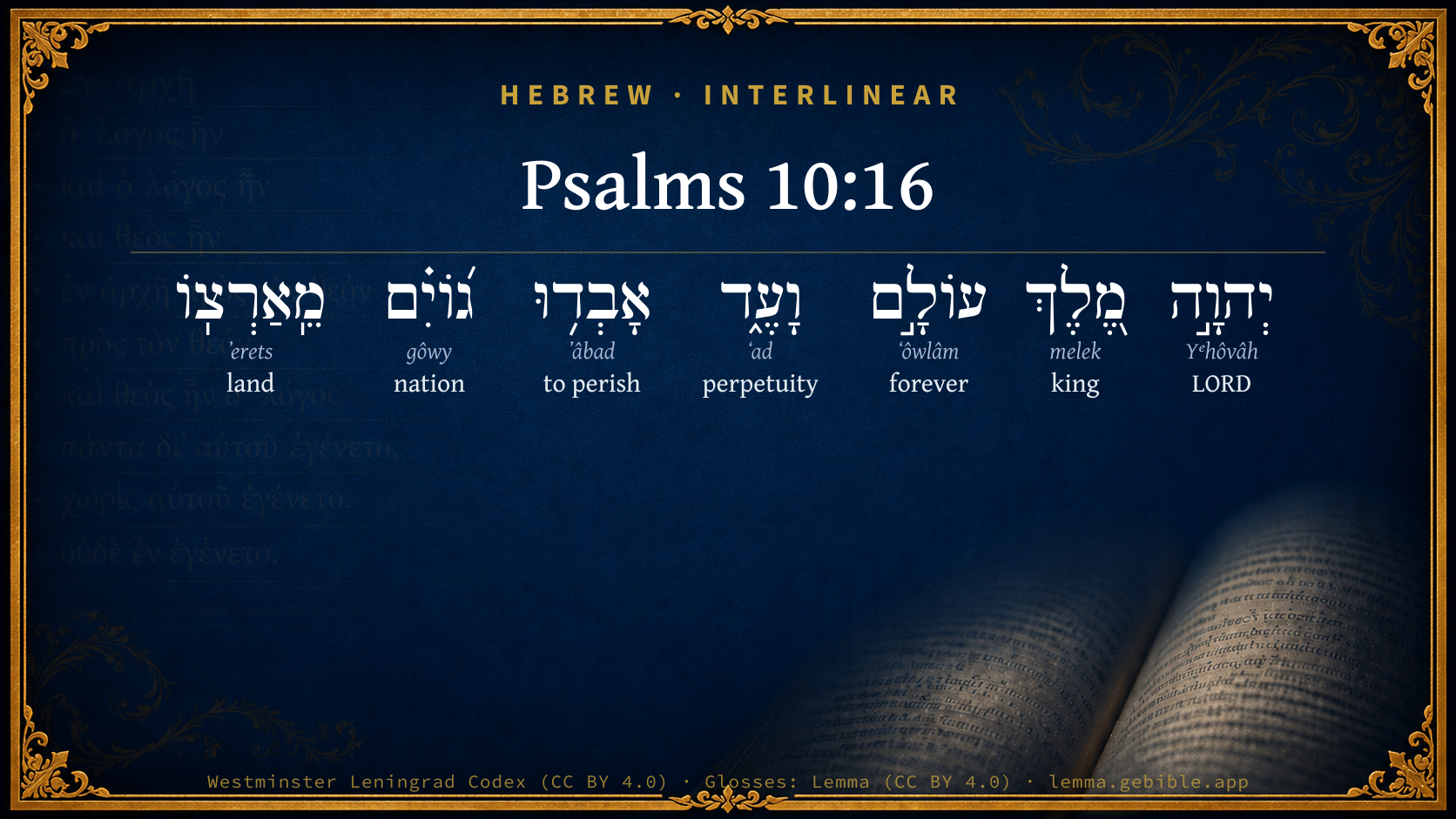
Psalms 10:16

Hebrew (Westminster Leningrad Codex) Psalms 10:16 appears in the Hebrew Old Testament. The text above is from the Westminster Leningrad Codex. Each word links to its Strong’s number, a concise gloss, and parsing drawn from the Open Scriptures Hebrew Bible morphology. Click any word for its full Brown-Driver-Briggs (BDB) entry.
Download image
Cite this verse

Psalms 10:16 (World English Bible). Public Domain. Lemma interlinear Bible study tool, https://lemma.gebible.app/v/psalms/10/16.

Show BibTeX & RIS
BibTeX
RIS
English Translation
Yahweh is King forever and ever! The nations will perish out of his land.
World English Bible · Public Domain
Download a study sheet

One document with this verse’s original text, its word-by-word gloss line, the meaning frame, cross-references with their text, attributed commentary, and full source and license credits — printable, and it pastes into notes with its structure intact.

This verse Autodidact and up

Study sheet (.html) Plain text (.txt)

A passage Seminary Student

Up to 50 verses in one chapter. A passage sheet keeps up to 6 commentary sources and 12 cross-references per verse, in the order this page ranks them, and says so on the sheet whenever that leaves anything out. Ask for a single verse and you get the Autodidact verse sheet above.

Everything on this page stays free to read, with no account — the sheet is a download of what is already on screen, not access to it.

Want to remove ads? Support Godless Engineer
Compare translations 3

The same verse in 3 English versions, stacked beneath the original-language interlinear above. Click any original word for its lexicon entry.

Each is an independent rendering of the whole verse — the interlinear is not word-aligned to these translations.

Highlighted words mark where these versions differ — a whole-verse word diff, not a word-by-word alignment.

  • World English Bible Public Domain
    Yahweh is King forever and ever! The nations will perish out of his land.
  • King James Version Public Domain
    The LORD is King for ever and ever: the heathen are perished out of his land.
  • unfoldingWord Literal Text CC BY-SA 4.0
    Yahweh is king forever and ever; the nations have perished from his land.

unfoldingWord Literal Text — © unfoldingWord, licensed CC BY-SA 4.0. Word-aligned USFM3 via Door43 (git.door43.org/unfoldingWord/en_ult).

Versions to compare (up to 4)

3 of 4 selected

Show all 17 translations

Every available English version of this verse, each an independent rendering of the whole verse.

  • World English Bible Public Domain
    Yahweh is King forever and ever! The nations will perish out of his land.
  • Berean Standard Bible Public Domain
    The LORD is King forever and ever; the nations perish from His land.
  • Majority Standard Bible Public Domain
    The LORD is King forever and ever; the nations perish from His land.
  • King James Version Public Domain
    The LORD is King for ever and ever: the heathen are perished out of his land.
  • American Standard Version (1901) Public Domain
    Jehovah is King for ever and ever: The nations are perished out of his land.
  • Revised Version (1885) Public Domain
    The LORD is King for ever and ever: the nations are perished out of his land.
  • Geneva Bible (1599) Public Domain
    The Lord is King for euer and euer: the heathen are destroyed foorth of his land.
  • Young's Literal Translation Public Domain
    Jehovah `is' king to the age, and for ever, The nations have perished out of His land!
  • Literal Standard Version CC BY-SA 4.0
    YHWH [is] King for all time and forever, || The nations have perished out of His land!
  • Unlocked Literal Bible CC BY-SA 4.0
    Yahweh is King forever and ever; the nations are driven out of his land.
  • unfoldingWord Literal Text CC BY-SA 4.0
    Yahweh is king forever and ever; the nations have perished from his land.
  • Darby Bible Public Domain
    Jehovah is King for ever and ever: the nations have perished out of his land.
  • World Messianic Bible Public Domain
    The LORD is King forever and ever! The nations will perish out of his land.
  • Webster's Bible Public Domain
    The LORD is King for ever and ever: the heathen have perished out of his land.
  • Free Bible Version CC BY-SA 4.0
    Lord, you are King forever and ever! The nations will vanish from their lands.
  • Bible in Basic English Public Domain
    The Lord is King for ever and ever; the nations are gone from his land.
  • JPS Tanakh (1917) Public Domain
    The LORD is King for ever and ever; the nations are perished out of His land.

Literal Standard Version (2020), Covenant Press — licensed CC BY-SA 4.0. Text via the HelloAO Bible API (eBible.org). Unlocked Literal Bible (unfoldingWord) — licensed CC BY-SA 4.0. Text via the HelloAO Bible API (eBible.org). unfoldingWord Literal Text — © unfoldingWord, licensed CC BY-SA 4.0. Word-aligned USFM3 via Door43 (git.door43.org/unfoldingWord/en_ult). Free Bible Version, Dr. Jonathan Gallagher — licensed CC BY-SA 4.0. Text via the HelloAO Bible API (eBible.org).

Word by word

More ways to search: Search by grammar → Find every occurrence → Compare this word →

Practice this passage: Drill this verse → Learn its vocabulary →

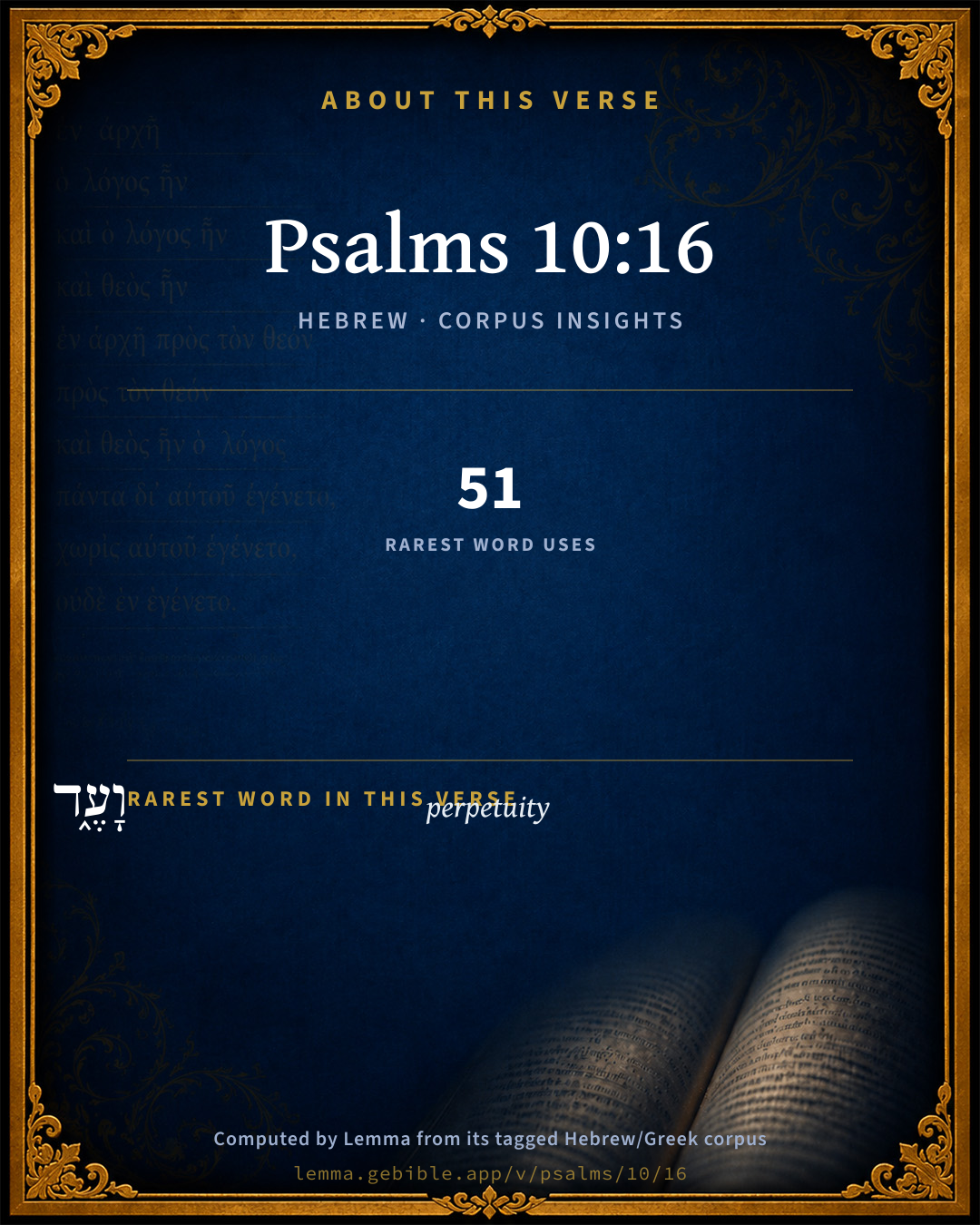
About this verse

These counts appear in no published source. They are computed here, from the morphology-tagged text and Lemma’s own curated glosses. What Lemma adds →

7
words
7
distinct lemmas
Wisdom
section

Shared distinctive vocabulary

וָעֶ֑ד perpetuity H5703 occurs in 49 verses of the Hebrew Bible. Also found in:

Grammatical profile

  • 1 verb
  • 6 nouns

Verb forms

  • אָבְד֥וּ Qal · Perfect

Hebrew & Septuagint length

In English translation the verse runs 14 words from the Hebrew and 21 from the Septuagint (LXX English) — closely comparable.

A rough comparison of the two English renderings, which tokenize alike — not a word-level alignment.

Word counts can differ between the Hebrew and the Greek without any difference in meaning — e.g. the Hebrew direct-object marker אֵת has no separate Greek word, and Greek often adds the article ὁ.

Cross-references

17

Topical passages linked to Psalms 10:16 in the Treasury of Scripture Knowledge — connected by theme and wording, ordered by reader-vote popularity; previews shown in the World English Bible.

  • Psalms 29:10 Yahweh sat enthroned at the Flood. Yes, Yahweh sits as King forever.
  • Jeremiah 10:10 But Yahweh is the true God; he is the living God, and an everlasting King: at his wrath the earth trembles, and the nations are not able to abide his indignation.
  • 1 Timothy 1:17 Now to the King eternal, immortal, invisible, to God who alone is wise, be honor and glory forever and ever. Amen.
  • Deuteronomy 8:20 As the nations that Yahweh makes to perish before you, so shall you perish; because you wouldn't listen to the voice of Yahweh your God.
  • Psalms 145:13 Your kingdom is an everlasting kingdom. Your dominion endures throughout all generations.
  • Daniel 4:34 At the end of the days I, Nebuchadnezzar, lifted up my eyes to heaven, and my understanding returned to me, and I blessed the Most High, and I praised and honored him who lives forever; for his dominion is an everlasting dominion, and his kingdom from generation to generation.
  • Daniel 6:26 I make a decree, that in all the dominion of my kingdom men tremble and fear before the God of Daniel; for he is the living God, and steadfast forever, His kingdom that which shall not be destroyed; and his dominion shall be even to the end.
  • Psalms 9:5 You have rebuked the nations. You have destroyed the wicked. You have blotted out their name forever and ever.
  • Psalms 9:15 The nations have sunk down in the pit that they made; In the net which they hid, their own foot is taken.
  • Psalms 18:43–45 You have delivered me from the strivings of the people. You have made me the head of the nations. A people whom I have not known shall serve me.
  • Psalms 44:2–3 You drove out the nations with your hand, But you planted them. You afflicted the peoples, But you spread them abroad.
  • Psalms 78:55 He also drove out the nations before them, Allotted them for an inheritance by line, And made the tribes of Israel to dwell in their tents.
  • Psalms 93:1 Yahweh reigns! He is clothed with majesty! Yahweh is armed with strength. The world also is established. It can't be moved.
  • Psalms 146:10 Yahweh will reign forever; Your God, O Zion, to all generations. Praise Yah!
  • Isaiah 33:22 For Yahweh is our judge, Yahweh is our lawgiver, Yahweh is our king; he will save us.
  • Lamentations 5:19 You, Yahweh, abide forever; Your throne is from generation to generation.
  • 1 Timothy 6:15–16 which in its own times he will show, who is the blessed and only Ruler, the King of kings, and Lord of lords;

Cross-references courtesy of OpenBible.info (CC BY 4.0).

Hebrew and Greek witnesses Masoretic Hebrew ↔ Greek Septuagint

The same verse in the two great witnesses to the Old Testament, shown verse-for-verse.

You’re reading Greek Psalm 9 (Hebrew Psalm 10). The Septuagint counts the superscription, so verse numbers can differ from the Hebrew — chapter-level alignment, not verse-by-verse. Numbering follows Rahlfs.

These are two independent witnesses, not word-aligned to each other, and the Septuagint is shown in lemma (dictionary) form.

Hebrew Psalms 10:16 Masoretic · Westminster Leningrad Codex

יְהוָ֣ה מֶ֭לֶךְ עוֹלָ֣ם וָעֶ֑ד אָבְד֥וּ ג֝וֹיִ֗ם מֵֽאַרְצֽוֹ

Yahweh is King forever and ever! The nations will perish out of his land.

World English Bible · Public Domain

Greek LXX Greek Psalm 9:16 Septuagint · lemma form

ἐνπήγνυμι ἔθνος ἐν διαφθορά ὅς ποιέω ἐν παγίς οὗτος ὅς κρύπτω συνλαμβάνω ὁ πούς αὐτός

The Lord is known as executing judgments: the sinner is taken in the works of his hands. A song of Pause.

LXX2012 (modern English Septuagint) · Public Domain

Hebrew: Westminster Leningrad Codex (CC BY 4.0). Greek: Septuagint (public domain); English from LXX2012 (modern English Septuagint) (Public Domain). How the Septuagint differs from the Hebrew →

Commentary

Notes on Psalms 10:16 from classic Christian and Jewish commentators (each source and its license shown beneath its notes). The classic Christian expositions comment on the surrounding passage and are grouped to its opening verse, so a note may address several verses; the Jewish commentaries on the Tanakh (Rashi and others) are per-verse, so they appear only where the commentator wrote on this verse.

Lemma curates 59 commentaries, every one of them public domain or Creative Commons licensed, each selected and text-cleaned for this edition rather than reprinted as found. About our sources →

Trapp's Complete Commentary

John Trapp

Psa 10:16 The LORD [is] King for ever and ever: the heathen are perished out of his land.

Ver. 16. The Lord is King for ever and ever] Therefore he will doubtless do whatsoever hath been before desired, and much more than we can ask or think. Many kings have been long lived, as was Artaxerxes Mnemon, who reigned 62 years; Augustus Caesar, 56; Queen Elizabeth, 44, &c.; but died at length, to the great grief of their subjects and servants, who are ready to wish (as once the Romans did concerning Augustus) that either they had never been or never died. But God is the King immortal, invisible, &c.

The heathen are perished out of his land] The enemies, whether Jews or Gentiles, are rid out of his Church; for that is God’s land by a specialty, his peculiar portion.

John Trapp, A Commentary or Exposition upon All the Books of the Old and New Testament (1647–1656) — public domain. Text from a community e-Sword module.

The Biblical Illustrator

Joseph S. Exell

Psa_10:16

The heathen are perished out of His land.

An encouragement to prayer

Does this sentence point back to the great instance of exterminating justice in the destruction of the Canaanite? It may do so, but it is rather to be taken as referring to the victories celebrated in the previous and companion Psalm. Note the recurrence of the words nations and perished, which are drawn from it. The connection between the two Psalms is thus witnessed, and the deliverance from foreign enemies, which is the theme of Psa_9:1-20, is urged as a plea with God, and taken as a ground of confidence by the Psalmist himself for the completion of the deliverance by making domestic oppressors powerless. This lofty height of faith is preserved in the closing stanza, in which the agitation of the first part and the yearning of the second are calmed into serene assurance that the Ecclesia pressa has not cried, and never can cry, in vain. Into the praying, trusting heart the peace of God which passeth understanding steals, and the answer is certified to faith long before it is manifest to sense. To pray and immediately to feel the thrilling consciousness Thou hast heard, is given to those who pray in faith. The wicked makes a boast of his desire; the humble makes a prayer of it, and so has it fulfilled. Desires which can be translated into petitions will be converted into fruition . . . The prayer of the humble, like a whisper amid the avalanches, has power to start the swift, white destruction on its downward path; and when once that gliding mass has way on it, nothing which it smites can stand. (A. Maclaren, D. D.)

The Biblical Illustrator, edited by Joseph S. Exell (c. 1880s–1900s) — public domain. Text from a community e-Sword module.

The Treasury of David

Charles H. Spurgeon

Ver. 16. The Lord is King for ever and ever: the heathen are perished out of his land. Such confidence and faith must appear to the world strange and unaccountable. It is like what his fellow citizens may be supposed to have felt (if the story be true) toward that man of whom it is recorded, that his powers of vision were so extraordinary, that he could distinctly see the fleet of the Carthaginians entering the harbour of Carthage, while he stood himself at Lilyboeum, in Sicily. A man seeing across an ocean, and able to tell of objects so far off! he could feast his vision on what others saw not. Even thus does faith now stand at its Lilyboeum, and see the long tossed fleet entering safely the desired haven, enjoying the bliss of that still distant day, as if it were already come. Andrew A. Bonar.

Ver. 16. The Eternal Kingship of Jehovah.

Ver. 16-18. See Psalms on "Ps 10:16" for further information.

Ver. 17.. There is a humbling act of faith put forth in prayer. Others style it praying in humility; give me leave to style it praying in faith. In faith which sets the soul in the presence of that mighty God, and by the sight of him, which faith gives us, it is that we see our own vileness, sinfulness, and abhor ourselves, and profess ourselves unworthy of any, much less of those mercies we are to seek for. Thus the sight of God had wrought in the prophet (Isa 6:5), "Then said I, Woe is me! for I am undone; because I am a man of unclean lips: for mine eyes have seen the King, the Lord of hosts." And holy Job speaks thus (Job 42:5-6), "Now mine eye seeth thee: wherefore I abhor myself, and repent in dust and ashes." This is as great a requisite to prayer as any other act; I may say of it alone, as the apostle (Jas 1:7), that without it we shall receive nothing at the hands of God! God loves to fill empty vessels, he looks to broken hearts. In the Psalms how often do we read that God hears the prayers of the humble; which always involves and includes faith in it. Ps 9:12, "He forgetteth not the cry of the humble, "and Ps 10:17, Lord, thou hast heard the desire of the humble: thou wilt prepare their heart, thou wilt cause thine ear to hear. To be deeply humbled is to have the heart prepared and fitted for God to hear the prayer; and therefore you find the psalmist pleading sub forma pauperis, often repeating, "I am poor and needy." And this prevents our thinking much if God do not grant the particular thing we do desire. Thus also Christ himself in his great distress (Ps 22:1-31), doth treat God (Ps 22:2), "O my God, I cry in the daytime, but thou hearest not; and in the night season am not silent. Our fathers trusted in thee. They cried unto thee, and were delivered. But I am a worm, and no man; reproached of men, and despised of the people; (Ps 22:6) "and he was "heard" in the end "in what he feared." And these deep humblings of ourselves, being joined with vehement implorations upon the mercy of God to obtain, is reckoned into the account of praying by faith, both by God and Christ. Mt 8:1-34. Thomas Goodwin.

Ver. 16-18. See Psalms on "Ps 10:18" for further information.

Ver. 18. To judge the fatherless and the oppressed, etc. The tears of the poor fall down upon their cheeks, et ascendunt ad coelum, and go up to heaven and cry for vengeance before God, the judge of widows, the father of widows and orphans. Poor people be oppressed even by laws. Woe worth to them that make evil laws against the poor, what shall be to them that hinder and mar good laws? What will ye do in the day of great vengeance when God shall visit you? he saith he will hear the tears of the poor women, when he goeth on visitation. For their sake he will hurt the judge, be he never so high, he will for widows' sakes change realms, bring them into temptation, pluck the judges' skins over their heads. Cambyses was a great emperor, such another as our master is, he had many lord deputies, lord presidents, and lieutenants under him. It is a great while ago since I read the history. It chanced he had under him in one of his dominions a briber, a gift taker, a gratifier of rich men; he followed gifts as fast as he that followed the pudding; a hand maker in his office, to make his son a great man, as the old saying is, "Happy is the child whose father goeth to the devil." The cry of the poor widow came to the emperor's ear, and caused him to slay the judge quick, and laid his skin in his chair of judgment, that all judges that should give judgment afterward, should sit in the same skin. Surely it was a goodly sign, a goodly monument, the sign of the judges skin. I pray God we may once see the sign of the skin in England. Ye will say, peradventure, that this is cruelly and uncharitably spoken. No, no; I do it charitably, for a love I bear to my country. God saith, "I will visit." God hath two visitations; the first is when he revealeth his word by preachers; and where the first is accepted, the second cometh not. The second visitation is vengeance. He went to visitation when he brought the judges skin over his ears. If this word be despised, he cometh with the second visitation with vengeance. Hugh Latimer, 1480-1555.

Charles H. Spurgeon's The Treasury of David (1869–1885) — public domain. Psalms only. Text from a community e-Sword/MySword module.

Joseph Benson's Commentary

Psa 10:16. The Lord is king — To whom it belongs to protect his subjects. Therefore thou wilt save the humble, and punish the oppressors; for ever and ever — Therefore his people’s case is never desperate, seeing he ever lives and reigns to help them, and, therefore, he will help them in his time, sooner or later. The heathen — Either, 1st, Those impious Israelites who oppressed David and other good men, whom, although they were reputed Israelites by themselves and others, yet he might call heathen for their heathenish opinions of God and his providence, and for their ungodly and unrighteous lives. Compare Isa 1:9, and Amo 9:7. Or, 2d, The Canaanites whom God, as king of the world, did expel or destroy, and gave their land to his people. By which great example David confirms his faith and hope for the future. Are perished out of his land — Out of Canaan, which God calls his land, Lev 25:23, because he chose it for them, Eze 20:6, and gave it to them, and fixed his presence and dwelling in it.

Joseph Benson's Commentary on the Old and New Testaments (1811–1818) — public domain. Text from a community e-Sword module.

Tyndale Open Study Notes

Tyndale Open Resources

10:16 As the true and just king, God will bring the wicked to an end, as he promises (1:6).

Tyndale Open Study Notes — © Tyndale Open Resources, licensed CC BY-SA 4.0. Text via the HelloAO Bible API.

Geneva Bible (1599)

Geneva Bible translators

The hypocrites or such as live not after God’s Law, shall be destroyed.

Geneva Bible (1599) marginal notes — public domain. Text via Bolls.life.

Jamieson, Fausset & Brown

Robert Jamieson, A. R. Fausset & David Brown

God reigns. The wicked, if for a time successful, shall be cut off. He hears and confirms the hearts of His suffering people (Psa 112:7), executes justice for the feeble, and represses the pride and violence of conceited, though frail, men (compare Psa 9:16).

Next: Psalms Chapter 11

Jamieson, Fausset & Brown — Commentary Critical and Explanatory on the Whole Bible (1871) — public domain (CC PDM 1.0). Text via the HelloAO Bible API.

Adam Clarke's Commentary

Verse 16. The Lord is king for ever] He has, and ever will have, the supreme power.

The heathen are perished out of his land.] They are all either cut off or converted. This may refer to the Canaanites. What a mercy that we can say this of our own country! Once it was entirely heathen; now not one heathen family in the whole land.

Adam Clarke's Commentary on the Bible (1810–1826) — public domain. Text from a community e-Sword/MySword module.

John Calvin's Commentaries

16. Jehovah is King for ever and ever. David now, as if he had obtained the desires of his heart, rises up to holy rejoicing and thanksgiving. When he calls God King for ever and ever, it is a token of his confidence and joy. By the title of King, he vindicates God’s claim to the government of the world, and when he describes him as King for ever and ever, this shows how absurd it is to think to shut him up within the narrow limits of time. As the course of human life is short, even those who sway the scepter over the greatest empires, being but mortal men, very often disappoint the expectations of their servants, “Bien souvent frustrent leurs serviteurs de leur attente.” — Fr.

“Put not your trust in princes, nor in the son of man, in whom there is no help. His breath goeth forth, he returneth to his earth; in that very day his thoughts perish.”

Often the power of giving assistance to others fails them, and while they are delaying to give it, the opportunity slips away from them. But we ought to entertain more exalted and honorable conceptions of our heavenly King; for although he does not immediately execute his judgments, yet he has always the full and the perfect power of doing so. In short, he reigns, not for himself in particular; it is for us that he reigns for ever and ever. As this, then, is the duration of his reign, it follows that a long delay cannot hinder him from stretching forth his hand in due season to succor his people, even when they are, as it were, dead, or in a condition which, to the eye of sense and reason, is hopeless. — The heathen are perished out of the land The meaning is, that the holy land was at length purged from the abominations and impurities with which it had been polluted. It was a dreadful profanation, when the land which had been given for an inheritance to the people of God, and allotted to those who purely worshipped him, nourished ungodly and wicked inhabitants. By the heathen he does not mean foreigners, and such as did not belong to the race of Abraham according to the flesh, “Et des personnes qui ne fussent de la race d’Abraham selon la chair.” — Fr.

“Thy father was an Amorite, and thy mother an Hittite,” (Ezekiel 16:3)

Many other similar passages are to be met with in Scripture. David, therefore, in applying the dishonorable name of heathen to the false and bastard children of Abraham, gives God thanks for having expelled such a corrupt class out of his Church. By this example we are taught, that it is no new thing if we see in our own day the Church of God polluted by profane and irreligious men. We ought, however, to beseech God quickly to purge his house, and not leave his holy temple exposed to the desecration of swine and dogs, as if it were a dunghill.

John Calvin's Commentaries (1540-1563) — public domain. Text from the Calvin Translation Society English edition (1840s-50s) via the Christian Classics Ethereal Library (ccel.org). Calvin's coverage is partial (roughly two-thirds of the Bible); uncommented books and verses are honest gaps, never fabricated. The 19th-century editor's footnotes and remarks are omitted so the notes are faithfully Calvin's own voice.

Ellicott's Commentary for English Readers

(16) The Lord is King.—If the psalm has hitherto been personal, it here swells out into a larger strain of national hope and faith.

A Bible Commentary for English Readers, edited by Charles John Ellicott (1878–1897) — public domain. Text from a community e-Sword module.

The Cambridge Bible for Schools and Colleges

gen. ed. J. J. S. Perowne

16. The second clause has been variously explained to refer (1) to the past, or (2) to the future (prophetic perfect). If (1) it refers to the past, the Psalmist finds the guarantee for the fulfilment of his prayers and hopes in the extermination of the Canaanites, or, it may be, in the repulse of ‘the nations’ referred to in Psa_9:5-6; Psa_9:15 ff. As the nations have been driven out before God’s people, so the wicked must ultimately give place to the godly, and Jehovah’s land will become in fact what it is in name, the Holy Land. Cp. the frequent warnings to Israel that the fate of the Canaanites might be theirs (Deu_8:19-20, &c.). If (2) the clause refers to the future, it is a confident anticipation (expressed as though it were already realised) of the ultimate destruction of the foreign oppressors of Israel, including, it may be supposed, all the godless of whom they are typical.

The first explanation suits the context best. The complaint and prayer of the psalm are directed against wicked oppressors within the nation of Israel, not against foreign enemies. An anticipation of the destruction of such external enemies is foreign to the line of thought. But an appeal to history as the ground of hope for the future is quite in place.

his land] Cp. Lev_25:13; Joe_2:18.

The Cambridge Bible for Schools and Colleges (gen. ed. J. J. S. Perowne; Cambridge University Press, 1878–1918) — public domain. Text from a community e-Sword module.

John Gill's Exposition

The Lord is King for ever and ever,.... Christ was King from everlasting, and during the Old Testament dispensation he was promised and prophesied of as King; and he had a kingdom when he was here on earth, though not of this world; nor was it with observation. At his ascension to heaven, and session at the right hand of God, he sat down upon the same throne with his Father, and was made or declared Lord and Christ, and appeared more visibly in his kingly office; and in the latter day it will be yet more manifest that he is King of saints, and when indeed he will be King over all the earth, and his kingdom will be an everlasting one: he will have no successor in it, nor will any usurper obtain any more; the devil, beast, and false prophet, will be cast into the lake of fire; all antichristian states will be destroyed, and all authority, rule, and power, put down; nor can his kingdom ever be subverted, he must reign till all enemies are put under his feet; he will reign to the end of the present world, and with the saints a thousand years in the new heaven and earth, and in the ultimate glory to all eternity; nor will his government cease when he shall have delivered up the kingdom to the Father, only the mode of the administration of it. Here begins the song of praise; the reign of Christ is matter of joy; see Psa 97:1;

the Heathen are perished out of his land: not the seven nations which were driven out of the land of Canaan, to make way for the people of Israel, that was long ago; nor the wicked and degenerate Jews, called the Heathen, Psa 2:1; compared with Act 4:27; on whom, and on whose temple, city, and nation, Christ's native land, wrath is come to the uttermost; and they are perished out of it: nor hypocrites out of churches, which are Christ's property; but the antichristian party out of the world, which is Christ's land by creation, as God, and by the gift of his father to him, as Mediator. The followers of antichrist are called Gentiles, and the nations of the earth, Rev 11:2; and these will be no more; they will be utterly destroyed, when the man of sin shall be consumed with the breath of Christ's mouth and the brightness of his coming. The seventh vial will clear the world of all the remains of Christ's enemies: this also is cause of rejoicing, Psa 132:16.

John Gill's Exposition of the Whole Bible (1746–1763) — public domain (CC PDM 1.0). Text via the HelloAO Bible API.

Albert Barnes' Notes on the Bible

The Lord is King forever and ever - That is, he reigns, and he will reign forever. This is one of the instances which frequently occur in the Psalms, where, though there is a desponding spirit, or an apprehension of danger expressed in the beginning of the poem, it ends with the language of exultation and triumph. The psalmist speaks here as if what he had desired was actually accomplished, and as if the enemies that had encompassed him, and all the enemies of the Lord, were actually overthrown, and God now reigned supreme. He was so confident that this would be so, that he speaks of it as if it were already done. Compare Rom 4:17; see also Psa 6:8-9; Psa 7:17; Psa 9:18.

The heathen are perished out of his land - That is, this would so certainly occur that he might speak of it as if it were actually done. The word “heathen” here refers to the enemies of God and of his cause, who are the principal subjects of the psalm. Compare Psa 9:5. The “land,” here, refers to the land of Palestine, or the holy land, regarded as a land sacred to God, or in the midst of which he himself dwelt.

Albert Barnes' Notes on the Bible (1834–1885) — public domain. Text from a community e-Sword/MySword module.

Matthew Poole's English Annotations

The Lord is King; to whom it belongs to protect his subjects. Therefore thou wilt save the humble, and punish the oppressors.

For ever and ever; therefore his people’s case is never desperate, seeing he ever lives and reigns to help them, and therefore he will help them in his time sooner or later.

The heathen; either,

1. Those impious Israelites who oppressed David and other good men, whom, although they were reputed Israelites by themselves and others, yet he might call them heathens for their heathenish opinions of God and his providence, and for their ungodly and unrighteous lives. Compare Isa 1:9; Amo 9:7. Or,

2. The Canaanites, whom God as King of the world did expel or destroy, and gave their land to his people; by which great example he confirms his faith and hope for the future.

Out of his land, i.e. out of Canaan, which God calls his land, Lev 25:23, because he spied it out for them, Eze 20:6, and gave it to them, and fixed his presence and dwelling in it.

Matthew Poole's English Annotations on the Holy Bible (1683–1685) — public domain. Text from a community e-Sword/MySword module.

Whedon's Commentary on the Bible

Daniel D. Whedon

16. The Lord is King—Strong faith in the government of God triumphs. It breaks through the darkness like the sun through the rifted cloud.

The heathen—The goyim, gentile nations, clearly designating who these wicked oppressors are. See Psa_9:5; Psa_9:15; Psa_9:19

Daniel D. Whedon (gen. ed.), Commentary on the Old and New Testaments (1874–1909) — public domain. Text from a community e-Sword module.

John Wesley's Explanatory Notes

Is king - To whom it belongs to protect his subjects. Therefore his peoples case is never desperate, seeing he ever lives to help them. The heathen - The Canaanites; whom God, as king of the world, expelled, and gave their land to his people. By which great example he confirms his faith and hope for the future. His land - Out of Canaan, which God calls his land, because he gave it to them, and fixed his presence and dwelling in it.

John Wesley, Explanatory Notes Upon the Whole Bible (1754–1765) — public domain. Text via the GEBible commentary corpus.

J. A. Alexander on Psalms

Joseph Addison Alexander

16. Jehovah (is) king! He is not dethroned, as his enemies imagine; he is still king, and will so remain, perpetuity and eternity, for ever and ever. Lost, perished, are nations, the heathen, i. e. hostile nations, from, out of, his land, the Holy Land, the Land of Israel, the land of which he is the king in a peculiar sense, distinct from that of providential ruler. The Psalmist sees Jehovah still enthroned, not only as the sovereign of the world, but as the sovereign of his people. (See Num 23:21, Deu 33:5). The nations or heathen of this verse may be either literal or spiritual gentiles (Jer 9:25, Eze 16:3). The psalm is so framed as to express the feelings of God's people in various emergencies. The preterite tense in the last clause represents the destruction of God's enemies as already past, not only on account of its absolute certainty, but because the process of destruction, although not completed, is begun and will infallibly continue. Here, as often elsewhere, earnest prayer is followed by the strongest expression of confidence and hope.

Joseph Addison Alexander, The Psalms Translated and Explained (1850) — public domain. Text from a community e-Sword module.

Rashi

Rabbi Shlomo Yitzchaki (Rashi)

The Lord is King forever and ever after the nations perish from His land.

Rashi on the Tanakh — English translations: “The Judaica Press complete Tanach with Rashi, translated by A. J. Rosenberg” (CC BY 4.0); “Pentateuch with Rashi's commentary by M. Rosenbaum and A.M. Silbermann, 1929-1934” (public domain); “The Metsudah Tanach series, Lakewood, N.J” (CC BY 4.0); and “The Book of Joshua, Metsudah Publications, 1997” (CC BY 4.0). Text via Sefaria.

Radak

Rabbi David Kimhi (Radak)

The Lord is King for ever and ever: – When Thou shalt execute judgment upon the wicked who oppress Israel in exile, then Thou shalt be King for ever and ever and none shall rebel against Thy word, as it says (Zech. 14:9), “And the Lord shall be King over all the earth ”; and then

The heathen are perished out of his land: – and the kingdom shall return to Israel.

Radak on the Tanakh — English translations: “Sefaria Community Translation” (CC0 1.0 (public-domain dedication)); “Eliyahu Munk, HaChut Hameshulash” (CC BY 4.0); “Rabbi Mike Feuer, Jerusalem Anthology” (CC BY 4.0); and “R. David Kimhi on the first book of Psalms, Translated by R.G. Finch, London, 1919” (public domain). Text via Sefaria.

Lesson kit

Teaching starters — assembled from the data on this page, not authored interpretation. Every prompt links to the verse data it draws on. Edit before teaching.

Psalms, in the Wisdom, opens this verse with 7 words (7 distinct Hebrew lemmas). Its most distinctive word is ʻad (“perpetuity”). A historical commentator’s framing appears above. Read the whole chapter for the surrounding context.

Discussion questions

  1. What does “perpetuity” (ʻad) contribute to the verse as a whole?
  2. Exodus 15:18 shares the word «perpetuity» with this verse. How do the two illuminate each other?
  3. The translations on this page render this verse differently — a whole-verse word diff, not a word-by-word alignment. What might account for the different wordings?
  4. The verb «אָבְד֥וּ» is Qal Perfect. How does its form color the action?
  5. Reading how Trapp's Complete Commentary and The Biblical Illustrator read this verse, where do the two commentators agree and where do they part?

Things to notice

Reading settings

Reading text

Shown beneath each verse's original-language words.

Old Testament
Old Testament edition

Read the OT as the Masoretic Hebrew (MT) or the Greek Septuagint (LXX).

English shown for the Greek Septuagint (in the Hebrew ↔ Greek comparison).

Comparing translations? Open the Compare panel on any verse page to stack up to four side by side.