Numbers 24:20

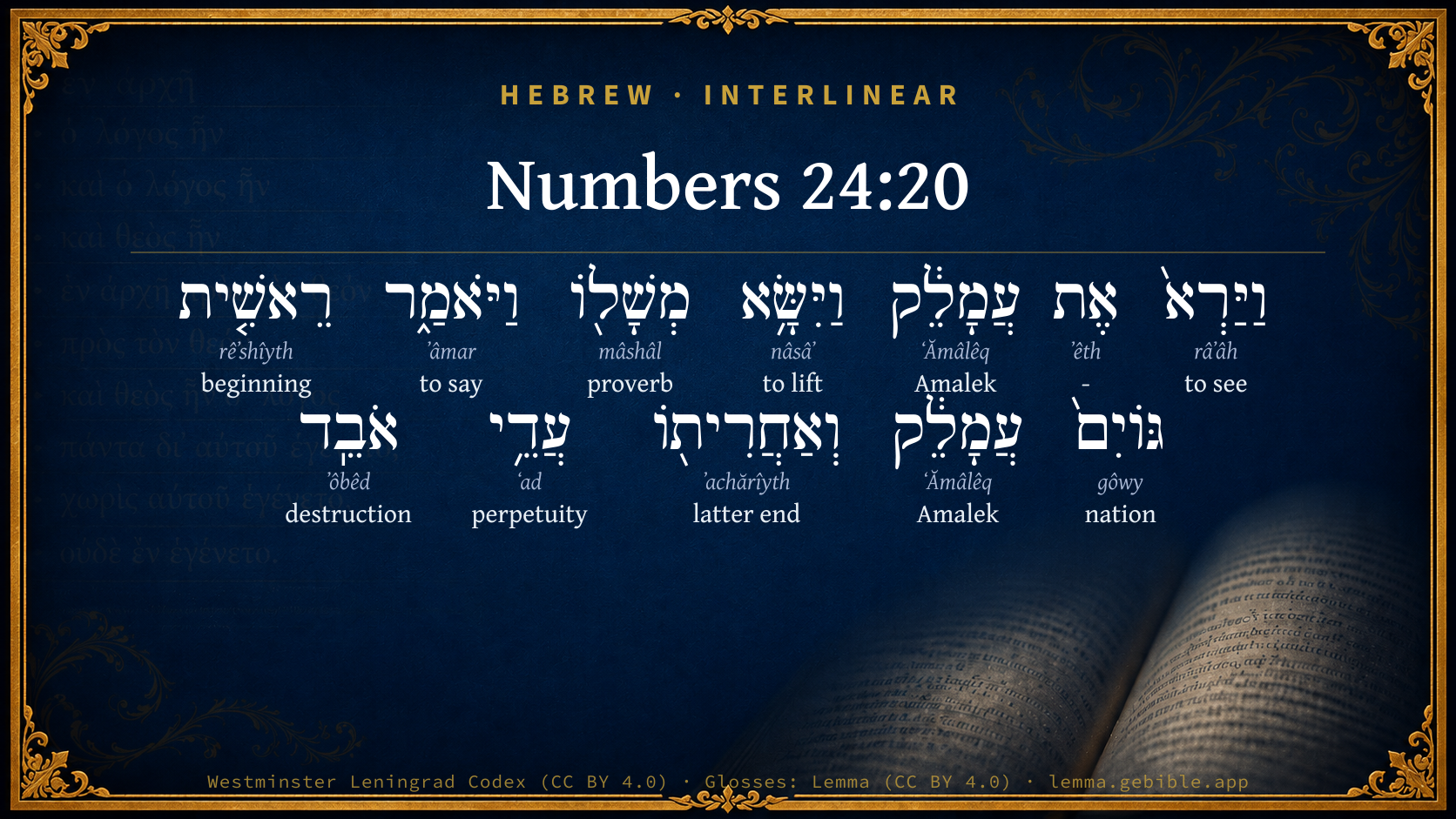
Hebrew (Westminster Leningrad Codex) Numbers 24:20 appears in the Hebrew Old Testament. The text above is from the Westminster Leningrad Codex. Each word links to its Strong’s number, a concise gloss, and parsing drawn from the Open Scriptures Hebrew Bible morphology. Click any word for its full Brown-Driver-Briggs (BDB) entry.
Download image
Cite this verse

Numbers 24:20 (World English Bible). Public Domain. Lemma interlinear Bible study tool, https://lemma.gebible.app/v/numbers/24/20.

Show BibTeX & RIS
BibTeX
RIS
English Translation
He looked at Amalek, and took up his parable, and said, Amalek was the first of the nations; But his latter end shall come to destruction.
World English Bible · Public Domain
Highlights
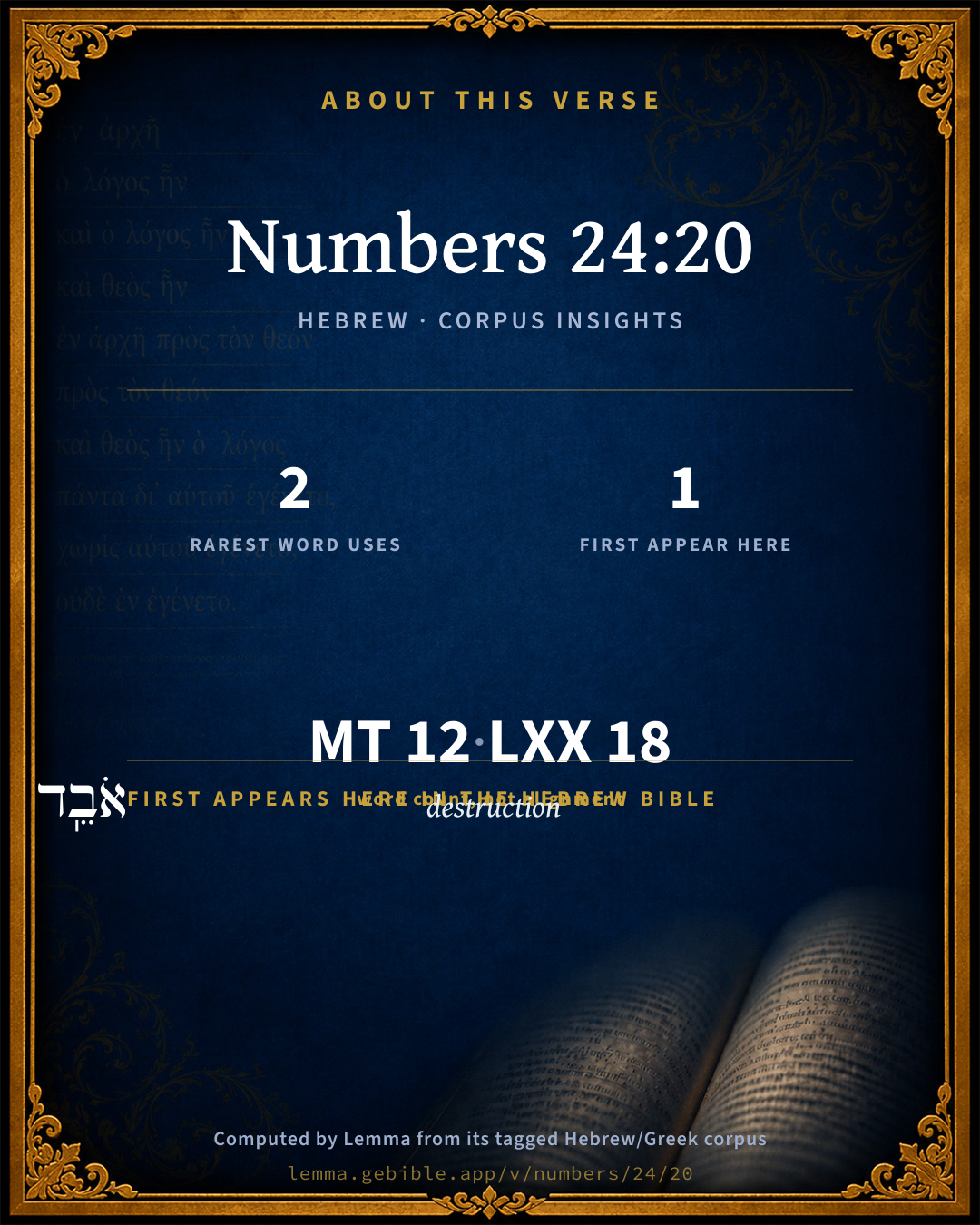
  • 1 first appearance in the Hebrew Bible
Full analysis ↓
Download a study sheet

One document with this verse’s original text, its word-by-word gloss line, the meaning frame, cross-references with their text, attributed commentary, and full source and license credits — printable, and it pastes into notes with its structure intact.

This verse Autodidact and up

Study sheet (.html) Plain text (.txt)

A passage Seminary Student

Up to 50 verses in one chapter. A passage sheet keeps up to 6 commentary sources and 12 cross-references per verse, in the order this page ranks them, and says so on the sheet whenever that leaves anything out. Ask for a single verse and you get the Autodidact verse sheet above.

Everything on this page stays free to read, with no account — the sheet is a download of what is already on screen, not access to it.

Want to remove ads? Support Godless Engineer
Compare translations 3

The same verse in 3 English versions, stacked beneath the original-language interlinear above. Click any original word for its lexicon entry.

Each is an independent rendering of the whole verse — the interlinear is not word-aligned to these translations.

Highlighted words mark where these versions differ — a whole-verse word diff, not a word-by-word alignment.

  • World English Bible Public Domain
    He looked at Amalek, and took up his parable, and said, Amalek was the first of the nations; But his latter end shall come to destruction.
  • King James Version Public Domain
    And when he looked on Amalek, he took up his parable, and said, Amalek was the first of the nations; but his latter end shall be that he perish for ever.
  • unfoldingWord Literal Text CC BY-SA 4.0
    And he saw Amalek and lifted up his discourse and said, “The first of the nations is Amalek, and his end will be up to destruction.”

unfoldingWord Literal Text — © unfoldingWord, licensed CC BY-SA 4.0. Word-aligned USFM3 via Door43 (git.door43.org/unfoldingWord/en_ult).

Versions to compare (up to 4)

3 of 4 selected

Show all 18 translations

Every available English version of this verse, each an independent rendering of the whole verse.

  • World English Bible Public Domain
    He looked at Amalek, and took up his parable, and said, Amalek was the first of the nations; But his latter end shall come to destruction.
  • Berean Standard Bible Public Domain
    Then Balaam saw Amalek and lifted up an oracle, saying: “Amalek was first among the nations, but his end is destruction.”
  • Majority Standard Bible Public Domain
    Then Balaam saw Amalek and lifted up an oracle, saying: “Amalek was first among the nations, but his end is destruction.”
  • King James Version Public Domain
    And when he looked on Amalek, he took up his parable, and said, Amalek was the first of the nations; but his latter end shall be that he perish for ever.
  • American Standard Version (1901) Public Domain
    And he looked on Amalek, and took up his parable, and said, Amalek was the first of the nations; But his latter end shall come to destruction.
  • Revised Version (1885) Public Domain
    And he looked on Amalek, and took up his parable, and said, Amalek was the first of the nations; But his latter end shall come to destruction.
  • Geneva Bible (1599) Public Domain
    And when he looked on Amalek, he vttered his parable, and sayd, Amalek was the first of the nations: but his latter ende shall come to destruction.
  • Douay-Rheims (1899) Public Domain
    And when he saw Amalec, he took up his parable, and said: Amalec the beginning of nations, whose latter ends shall be destroyed.
  • Young's Literal Translation Public Domain
    And he seeth Amalek, and taketh up his simile, and saith: `A beginning of the Goyim `is' Amalek; And his latter end -- for ever he perisheth.'
  • Literal Standard Version CC BY-SA 4.0
    And he sees Amalek, and takes up his allegory, and says: “Amalek [is] first [among] nations, || But his latter end—destruction forever.”
  • Unlocked Literal Bible CC BY-SA 4.0
    Then Balaam looked at Amalek and began his prophecy. He said, “Amalek was once the greatest of nations, but his final end will be destruction.”
  • unfoldingWord Literal Text CC BY-SA 4.0
    And he saw Amalek and lifted up his discourse and said, “The first of the nations is Amalek, and his end will be up to destruction.”
  • Darby Bible Public Domain
    And he saw Amalek, and took up his parable, and said, Amalek is the first of the nations, but his latter end shall be for destruction.
  • World Messianic Bible Public Domain
    He looked at Amalek, and took up his parable, and said, “Amalek was the first of the nations, but his latter end shall come to destruction.”
  • Webster's Bible Public Domain
    And when he looked on Amalek, he took up his parable, and said, Amalek was the first of the nations, but his latter end shall be that he shall perish for ever.
  • Free Bible Version CC BY-SA 4.0
    Balaam turned his attention to the Amalekites and gave this declaration about them, saying, “Amalek was first among the nations, but they will end up being destroyed.”
  • Bible in Basic English Public Domain
    Then, turning his eyes to Amalek, he went on with his story and said, Amalek was the first of the nations, but his part will be destruction for ever.
  • JPS Tanakh (1917) Public Domain
    And he looked on Amalek, and took up his parable, and said: Amalek was the first of the nations; but his end shall come to destruction.

Literal Standard Version (2020), Covenant Press — licensed CC BY-SA 4.0. Text via the HelloAO Bible API (eBible.org). Unlocked Literal Bible (unfoldingWord) — licensed CC BY-SA 4.0. Text via the HelloAO Bible API (eBible.org). unfoldingWord Literal Text — © unfoldingWord, licensed CC BY-SA 4.0. Word-aligned USFM3 via Door43 (git.door43.org/unfoldingWord/en_ult). Free Bible Version, Dr. Jonathan Gallagher — licensed CC BY-SA 4.0. Text via the HelloAO Bible API (eBible.org).

Word by word

More ways to search: Search by grammar → Find every occurrence → Compare this word →

Practice this passage: Drill this verse → Learn its vocabulary →

אֹבֵֽד
ʼôbêd
H8
“destruction”
Noun, Common, Masculine, Singular, Absolute
Part of Speech
Noun
Type
Common
Gender
Masculine
Number
Singular
State
Absolute
Full BDB Definition

Origin: active of participle of H6

TWOT: 2a

destruction
  1. וַיַּרְא֙ râʼâh H7200 “and · to see” Conjunction + Verb, Qal, Sequential Imperfect, 3rd Person, Masculine, Singular
  2. אֶת ʼêth H853 “-” Particle, Direct Object
  3. עֲמָלֵ֔ק ʻĂmâlêq H6002 “Amalek” Noun, Proper
  4. וַיִּשָּׂ֥א nâsâʼ H5375 “and · to lift” Conjunction + Verb, Qal, Sequential Imperfect, 3rd Person, Masculine, Singular
  5. מְשָׁל֖וֹ mâshâl H4912 “proverb · his” Noun, Common, Masculine, Singular, Construct + Suffix, Personal, 3rd Person, Masculine, Singular
  6. וַיֹּאמַ֑ר ʼâmar H559 “and · to say” Conjunction + Verb, Qal, Sequential Imperfect, 3rd Person, Masculine, Singular
  7. רֵאשִׁ֤ית rêʼshîyth H7225 “beginning of” Noun, Common, Feminine, Singular, Construct
  8. גּוֹיִם֙ gôwy H1471 “nations” Noun, Common, Masculine, Plural, Absolute
  9. עֲמָלֵ֔ק ʻĂmâlêq H6002 “Amalek” Noun, Proper
  10. וְאַחֲרִית֖וֹ ʼachărîyth H319 “and · latter end · his” Conjunction + Noun, Common, Feminine, Singular, Construct + Suffix, Personal, 3rd Person, Masculine, Singular
  11. עֲדֵ֥י ʻad H5703 “perpetuity” Preposition

About this verse

These counts appear in no published source. They are computed here, from the morphology-tagged text and Lemma’s own curated glosses. What Lemma adds →

12
words
11
distinct lemmas
Pentateuch
section

Notable vocabulary

The rarest word here is אֹבֵֽד destruction H8 — appearing just 2 times in the whole Hebrew Bible.

First appearance in Scripture

This word makes its first canonical appearance in the Hebrew Bible here:

  • אֹבֵֽד destruction H8

Shared distinctive vocabulary

אֹבֵֽד destruction H8 occurs in 2 verses of the Hebrew Bible. Also found in:

Grammatical profile

  • 3 verbs
  • 7 nouns
  • 1 preposition
  • 1 particle

Verb forms

  • וַיַּרְא֙ Qal · Sequential Imperfect
  • וַיִּשָּׂ֥א Qal · Sequential Imperfect
  • וַיֹּאמַ֑ר Qal · Sequential Imperfect

Repetition

A word recurs within this verse — often emphatic in Hebrew:

  • עֲמָלֵ֔ק Amalek H6002 ×2

Hebrew & Septuagint length

In English translation the verse runs 26 words from the Hebrew and 23 from the Septuagint (LXX English) — closely comparable.

A rough comparison of the two English renderings, which tokenize alike — not a word-level alignment.

Word counts can differ between the Hebrew and the Greek without any difference in meaning — e.g. the Hebrew direct-object marker אֵת has no separate Greek word, and Greek often adds the article ὁ.

In the original languages it is 12 Hebrew tokens and 18 Greek tokens — but the two are counted differently (Hebrew bundles its prefixes and suffixes into one token; the Greek is in lemma form), so that isn’t a like-for-like length.

Cross-references

13

Topical passages linked to Numbers 24:20 in the Treasury of Scripture Knowledge — connected by theme and wording, ordered by reader-vote popularity; previews shown in the World English Bible.

  • Exodus 17:14 Yahweh said to Moses, "Write this for a memorial in a book, and rehearse it in the ears of Joshua: that I will utterly blot out the memory of Amalek from under the sky."
  • Exodus 17:8 Then Amalek came and fought with Israel in Rephidim.
  • Exodus 17:16 He said, "Yah has sworn: 'Yahweh will have war with Amalek from generation to generation.'"
  • Judges 6:3 So it was, when Israel had sown, that the Midianites came up, and the Amalekites, and the children of the east; they came up against them;
  • 1 Samuel 14:48 He did valiantly, and struck the Amalekites, and delivered Israel out of the hands of those who despoiled them.
  • 1 Samuel 15:3–8 Now go and strike Amalek, and utterly destroy all that they have, and don't spare them; but kill both man and woman, infant and suckling, ox and sheep, camel and donkey.
  • 1 Samuel 27:8–9 David and his men went up, and made a raid on the Geshurites, and the Girzites, and the Amalekites; for those [nations] were the inhabitants of the land, who were of old, as you go to Shur, even to the land of Egypt.
  • 1 Samuel 30:1 It happened, when David and his men were come to Ziklag on the third day, that the Amalekites had made a raid on the South, and on Ziklag, and had struck Ziklag, and burned it with fire,
  • 1 Samuel 30:17 David struck them from the twilight even to the evening of the next day: and there not a man of them escaped, except four hundred young men, who rode on camels and fled.
  • 1 Chronicles 4:43 They struck the remnant of the Amalekites who escaped, and have lived there to this day.
  • Esther 3:1 After these things did king Ahasuerus promote Haman the son of Hammedatha the Agagite, and advanced him, and set his seat above all the princes who were with him.
  • Esther 7:9–10 Then said Harbonah, one of the chamberlains who were before the king, Behold also, the gallows fifty cubits high, which Haman has made for Mordecai, who spoke good for the king, stands in the house of Haman. The king said, Hang him thereon.
  • Esther 9:14 The king commanded it so to be done: and a decree was given out in Shushan; and they hanged Haman's ten sons.

Cross-references courtesy of OpenBible.info (CC BY 4.0).

Hebrew and Greek witnesses Masoretic Hebrew ↔ Greek Septuagint

The same verse in the two great witnesses to the Old Testament, shown verse-for-verse.

These are two independent witnesses, not word-aligned to each other, and the Septuagint is shown in lemma (dictionary) form.

Hebrew Numbers 24:20 Masoretic · Westminster Leningrad Codex

וַיַּרְא֙ אֶת עֲמָלֵ֔ק וַיִּשָּׂ֥א מְשָׁל֖וֹ וַיֹּאמַ֑ר רֵאשִׁ֤ית גּוֹיִם֙ עֲמָלֵ֔ק וְאַחֲרִית֖וֹ עֲדֵ֥י אֹבֵֽד

He looked at Amalek, and took up his parable, and said, Amalek was the first of the nations; But his latter end shall come to destruction.

World English Bible · Public Domain

Greek LXX Numbers 24:20 Septuagint · lemma form

καί ὁράω ὁ αμαληκ καί ἀναλαμβάνω ὁ παραβολή αὐτός εἶπον ἀρχή ἔθνος αμαληκ καί ὁ σπέρμα αὐτός ἀποὀλλύω

And having seen Amalec, he took up his parable and said, Amalec is the first of the nations; yet his seed shall perish.

LXX2012 (modern English Septuagint) · Public Domain

Hebrew: Westminster Leningrad Codex (CC BY 4.0). Greek: Septuagint (public domain); English from LXX2012 (modern English Septuagint) (Public Domain). How the Septuagint differs from the Hebrew →

Targum (Aramaic paraphrase)

2

The Targum is the ancient Jewish Aramaic paraphrase of the Hebrew Scriptures — an interpretive translation, not the Hebrew text itself. Onkelos (literal) and Pseudo-Jonathan (expansive) render the Torah, and Jonathan the Prophets. Coverage is partial: where no permissively-licensed English translation exists for a verse, only the Aramaic is shown. This is verse-level text, not a word-by-word alignment to the Hebrew.

  1. Targum Onkelos Torah (Genesis–Deuteronomy)
    וַחֲזָא יַת עֲמַלְקָאָה וּנְטַל מַתְלֵיהּ וַאַמַר רֵישׁ קְרָבַיָא דְיִשְׂרָאֵל הֲוָה עֲמַלְקָאָה וְסוֹפֵיהּ לְעָלְמָא יֵיבָד

    (no public-domain English translation for this verse)

    Targum Onkelos — Aramaic: “Onkelos Genesis” (public domain); “Onkelos Exodus” (public domain); “Onkelos Leviticus” (public domain); “Onkelos Numbers” (public domain); “Onkelos Deuteronomy” (public domain). English: “Sefaria Community Translation” (CC0 1.0 (public-domain dedication)); “J.W. Etheridge. The Targums of Onkelos and Jonathan Ben Uzziel on the Pentateuch. London: Longmans, Green, 1862” (public domain). Text via Sefaria.

  2. Targum Pseudo-Jonathan Torah (Genesis–Deuteronomy)
    וַחֲמָא יַת דְבֵית עֲמָלֵק וּנְטַל מְתַל נְבוּתֵיהּ וַאֲמַר שֵׁירוֹי אוּמַיָא דְאַגִיחוּ קְרָבָא בִּדְבֵית יִשְרָאֵל הִינוּן דְבֵית עֲמָלֵק וְסוֹפֵיהוֹן בְּיוֹמֵי מַלְכָּא מְשִׁיחָא לִמְסַדְרָא סִדְרֵי קְרָבָא עִם כָּל בְנֵי מַדִינְחָא עִם דְבֵית יִשְרָאֵל בְּרַם סוֹפֵיהוֹן דְאִלְיֵין וּדְאִילְיֵין עַד עַלְמָא יְהוֹן לְאוֹבְדָנָא

    And he looked on the house of Amalek, and took up the parable of his prophecy, and said: The first of the nations who made war with the house of Israel were those of the house of Amalek; and they at last, in the days of the King Meshiha, with all the children of the east, will make war against Israel; but all of them together will have eternal destruction in their end.

    Targum Pseudo-Jonathan — Aramaic: “Targum Jonathan on Genesis” (public domain); “Targum Jonathan on Exodus” (public domain); “Targum Jonathan on Leviticus” (public domain); “Targum Jonathan on Numbers” (public domain); “Targum Jonathan on Deuteronomy” (public domain). English: “The Targum of Jonathan ben Uzziel, trans. J. W. Etheridge, London, 1862” (public domain). Text via Sefaria.

Commentary

Notes on Numbers 24:20 from classic Christian and Jewish commentators (each source and its license shown beneath its notes). The classic Christian expositions comment on the surrounding passage and are grouped to its opening verse, so a note may address several verses; the Jewish commentaries on the Tanakh (Rashi and others) are per-verse, so they appear only where the commentator wrote on this verse.

Lemma curates 59 commentaries, every one of them public domain or Creative Commons licensed, each selected and text-cleaned for this edition rather than reprinted as found. About our sources →

Trapp's Complete Commentary

John Trapp

Num 24:20 And when he looked on Amalek, he took up his parable, and said, Amalek [was] the first of the nations; but his latter end [shall be] that he perish for ever.

Ver. 20. First of the nations.] Or, Principal See Num 24:7.

John Trapp, A Commentary or Exposition upon All the Books of the Old and New Testament (1647–1656) — public domain. Text from a community e-Sword module.

Joseph Benson's Commentary

Num 24:20. He looked upon Amalek — From the top of Pisgah, which was exceeding high, and gave him the prospect of part of all these kingdoms, he turned his eyes from the Moabites more to the south and west, and looked on their neighbours the Amalekites. Amalek was the first of the nations — Hebrew, the beginning, or first-fruits, so called, either because they were the first of all the neighbouring nations which were imbodied together in one government, or because they were the first who fought against Israel and were vanquished by them. That victory was an earnest and first-fruit of the large harvest of victories which the Israelites should, in due time, get over all their enemies. “The Amalekites appear to have been a very ancient nation. They are mentioned as early as the wars of Chedorlaomer, (Gen 14:7,) and therefore must have been a nation before the times of Abraham and Lot, and consequently much older than the Moabites or Edomites, or any of the nations descended from those patriarchs. But though they were the most ancient and powerful of the neighbouring nations, yet, says Balaam, their latter end shall be that they perish for ever — Here he confirms what God had before denounced by Moses: see Exo 17:14. Balaam had before declared that the king of Israel should prevail over the king of Amalek; but here the menace is carried further, and Amalek is consigned to utter destruction. And this sentence was in a great measure executed by Saul, 1Sa 15:7; afterward more fully by David, 1Sa 27:8-9; and 1Sa 30:1. And at last, in the days of Hezekiah, the sons of Simeon smote the rest of the Amalekites that were escaped, and dwelt in their habitations, 1Ch 4:41-43. And where is the name or nation of Amalek subsisting at this day? What history, what tradition of them is remaining anywhere? They are but just enough known and remembered to show that what God hath threatened he hath punctually fulfilled.” How incontrovertible is the argument arising from hence in favour not only of the truth of Balaam’s prophecy, but of the assurance which Moses had of its truth, and of the certainty of its accomplishment, inasmuch as he recorded it while Amalek was yet a very powerful nation, and thereby risked on its truth and fulfilment all his credit as an historian and his authority as a lawgiver and messenger of God!

Joseph Benson's Commentary on the Old and New Testaments (1811–1818) — public domain. Text from a community e-Sword module.

Geneva Bible (1599)

Geneva Bible translators

The Amalekites first made war against Israel, as Num. 14:45.

Geneva Bible (1599) marginal notes — public domain. Text via Bolls.life.

Jamieson, Fausset & Brown

Robert Jamieson, A. R. Fausset & David Brown

Amalek . . . his latter end shall be that he perish for ever--Their territory was seen at the remote extremity of the desert. (See on Exo 17:13; also 1Sa. 15:1-35).

Jamieson, Fausset & Brown — Commentary Critical and Explanatory on the Whole Bible (1871) — public domain (CC PDM 1.0). Text via the HelloAO Bible API.

Adam Clarke's Commentary

Verse 20. Amalek was the first of the nations] The most ancient and most powerful of all the nations or states then within the view of Balaam; but his latter end shall be that he perish for ever, or his posterity אחריתו acharitho, shall be destroyed, or shall utterly fail. This oracle began to be fulfilled by Saul, 1Sa 15:7-8, who overthrew the Amalekites, and took their king, Agag, prisoner. Afterwards they were nearly destroyed by David, 1Sa 27:8, and they were finally exterminated by the sons of Simeon in the days of Hezekiah, 1Ch 4:41-43; since that time they have ceased to exist as a people, and now no vestige of them remains on the face of the earth; so completely is their posterity cut off, according to this prophecy. The marginal reading does not appear to give the proper sense.

Adam Clarke's Commentary on the Bible (1810–1826) — public domain. Text from a community e-Sword/MySword module.

Ellicott's Commentary for English Readers

(20) And when he looked on Amalek . . . —From the. mountain of Peor, on which Balaam then stood, he had a view of the country of the Amalekites, which lay to the south of the land of Canaan (Num_13:29; Gen_36:12).

Amalek was the first of the nations.—The ancestor of the Amalekites was Eliphaz, the son of Esau (Gen_36:12). It has been supposed that the Amalekites separated themselves at a very early period from the rest of the Edomites. The word reshith, which is here rendered “first,” may denote priority in rank, but more frequently denotes priority in time. The corresponding word in the second clause of the verse, aharith (latter end), may be thought to denote that the reference is to time, not to rank. On the other hand, the reference in Num_24:7 to the kings of the Amalekites may be urged in favour of the reference to rank. Some understand the allusion to be to the fact that the Amalekites were the first nation which attacked Israel when they had come out of Egypt (Exo_17:8). It is possible, however, that there may be a reference both to time and to rank. (Comp. Amo_6:1.)

But his latter end shall be that he perish for ever.—Or, come to destruction. More literally, But his latter end shall be even to one perishing—i.e., he shall come to the position of one who is perishing. The destruction of the Amalekites began in the reign of Saul (1Sa_14:48; 1Sa_15:7), was continued by David (1Sa_27:8; 1Sa_30:17; 2Sa_8:12), and was completed by Hezekiah (1Ch_4:42-43).

A Bible Commentary for English Readers, edited by Charles John Ellicott (1878–1897) — public domain. Text from a community e-Sword module.

The Cambridge Bible for Schools and Colleges

gen. ed. J. J. S. Perowne

20. The utterance on Amalek.

And he saw Amalek] The country of the Amalekites and that of the Kenites (Num_24:21) might be just visible from the Moabite hills, lying far to the south and south-west.

the first of the nations] i.e. the choicest; Heb. rê’shîth. Cf. Num_18:12. There is no historical evidence that the Amalekites ever occupied a high position among the nations (see on Num_24:7).

The Cambridge Bible for Schools and Colleges (gen. ed. J. J. S. Perowne; Cambridge University Press, 1878–1918) — public domain. Text from a community e-Sword module.

John Gill's Exposition

And he looked on the Kenites,.... Not the family and posterity of Jethro, as Aben Ezra, Jarchi, and Abendana; for they were not a people by themselves, but were now encamped with Israel, and went with them into the land of Canaan, and were not carried captive with the ten tribes, though some might that dwelt in Naphtali, Jdg 9:4, for they after that remained with Judah under the name of Rechabites, Jer 35:2 and returned with the two tribes, being carried captive with them, Ch1 2:55 but they were a people, though of the same original and family Jethro descended from, which dwelt near, and afterwards among the Amalekites, and therefore were seen by Balaam, and taken notice of at the same time they were; see Sa1 15:6. Abarbinel takes them to be the same with those in Gen 15:19.

and took up his parable; or prophecy concerning them, and delivered it:

and said, strong is thy dwelling place, and thou puttest thy nest in a rock, they dwelling in craggy rocky places, where they thought themselves secure and out of danger; and this their habitation he calls "Ken", a nest, in allusion to their name Kenites.

John Gill's Exposition of the Whole Bible (1746–1763) — public domain (CC PDM 1.0). Text via the HelloAO Bible API.

Albert Barnes' Notes on the Bible

When he looked - i. e., in spirit, as he saw the Star Num 24:17.

Amalek was the first of the nations - Rather, is pre-eminent among the neighboring nations: compare the same expression in Amo 6:1. Hence, the force of the words Num 24:7 “higher than Agag,” i. e., than the king of this powerful nation (compare Num 14:45; Exo 17:8). This rank, due to the warlike prowess of the tribe, Balaam contrasts with its approaching downfall and extinction.

Albert Barnes' Notes on the Bible (1834–1885) — public domain. Text from a community e-Sword/MySword module.

Haydock's Catholic Bible Commentary

Nations, which rose up to attack the Hebrews. (Onkelos) --- Saul will punish them, 1 Kings xv. The Amalecites were a very ancient people, known in the days of Abraham, Genesis xiv. 7. But now they are no more. (Haydock)

George Leo Haydock (1774–1849), Haydock's Catholic Family Bible and Commentary, 1859 edition — public domain. Excludes Psalms (Douay-Rheims chapter numbering differs from Protestant) and Deuterocanonical books (Catholic canon only).

Matthew Poole's English Annotations

He looked from the top of Pisgah, which was exceeding high, and gave him the prospect of parts of all these kingdoms.

The first, Heb. the first-fruits; so called either,

1. Because they were the first of all the neighbouring nations which were embodied together in one government. Or,

2. Because they were the most powerful and eminent of them, as is implied above, Num 24:7, the best things in each kind being oft signified by the name of first-fruits. Or,

3. Because he was the first who fought against Israel, and was vanquished by them, in that famous battle Exo 17, which victory was an earnest and first-fruits of that large harvest of victories which the Israelites should in due time get over all their enemies, and, among others, over Amalek himself, 1Sa 15:3.

That he perish for ever: he began with God and with Israel. but God will end with him; and the firm purpose and will of God is, that he shall be utterly destroyed, Exo 17:14; so that Saul lost his kingdom for not executing this decree and God’s command pursuant thereunto, 1Sa 15.

Matthew Poole's English Annotations on the Holy Bible (1683–1685) — public domain. Text from a community e-Sword/MySword module.

Whedon's Commentary on the Bible

Daniel D. Whedon

20. Amalek was the first of the nations — Not (as the Chaldee) in age, power, and renown, but as the first of the Gentiles that came into conflict against Israel as the people of God. Exo_17:8-13. These first fruits of the wicked nations, like Jericho, the first Canaanite city, were devoted to destruction. Exo_17:14-16; Deu_25:17-19; 1Sa_15:3-7.

Daniel D. Whedon (gen. ed.), Commentary on the Old and New Testaments (1874–1909) — public domain. Text from a community e-Sword module.

The Pulpit Commentary

He looked on Amalek. This looking must have been an inward vision, because the haunts of the Amalekites were far away. (see on Gen_36:12 Exo_17:8 Num_14:25, Num_14:45) The first of the nations. Amalek was in no sense a leading nation, nor was it a very ancient nation. It was indeed the very first of the nations to attack Israel, but it is a most arbitrary treatment of the words to understand them in that sense. The prophet Amos (Amo_6:1) uses the same expression of the Jewish aristocracy of his day. As it was in no better position than Amalek to claim it in any true sense, we can but suppose that in either case there is a reference to the vainglorious vauntings of the people threatened; it would be quite in keeping with the Bedawin character if Amalek gave himself out be "the first of nations."

The Pulpit Commentary (1880–1919), ed. H.D.M. Spence-Jones & Joseph S. Exell — public domain. Text from a community e-Sword module.

John Wesley's Explanatory Notes

He looked on Amalek - From the top of Pisgah, which was exceeding high, and gave him the prospect of part of all these kingdoms. The first - Hebrew. the firstfruits; so called either, because they were the first of all the neighbouring nations which were embodied together in one government: or, because he was the first who fought against Israel and was vanquished by them. That victory was an earnest and first-fruit of the large harvest of victories which the Israelites should in due time get over all their enemies. He shall perish forever - He began with God and with Israel, but God will end with him, and the firm purpose of God is, that he shall be utterly destroyed; so that Saul lost his kingdom for not executing this decree, and God's command pursuant thereunto.

John Wesley, Explanatory Notes Upon the Whole Bible (1754–1765) — public domain. Text via the GEBible commentary corpus.

Keil & Delitzsch

C. F. Keil & F. Delitzsch

The second saying in this prophecy relates to the Amalekites. Balaam sees them, not with the eyes of his body, but in a state of ecstasy, like the star out of Jacob. "Beginning of the heathen is Amalek, and its end is destruction." Amalek is called the beginning of the nations, not "as belonging to the most distinguished and foremost of the nations in age, power, and celebrity" (Knobel), - for in all these respects this Bedouin tribe, which descended from a grandson of Esau, was surpassed by many other nations, - but as the first heathen nation which opened the conflict of the heathen nations against Israel as the people of God (see at Exo 17:8.). As its beginning had been enmity against Israel, its end would be "even to the perishing" (אבד עדי), i.e., reaching the position of one who was perishing, falling into destruction, which commenced under Saul and was completed under Hezekiah.

Keil & Delitzsch — Biblical Commentary on the Old Testament (1861–1891) — public domain (CC PDM 1.0). Text via the HelloAO Bible API. (Old Testament only.)

Scofield Reference Notes

C. I. Scofield

nations

Or, the first of the nations that warred against Isael. (See Scofield "Exo 17:8").

The Scofield Reference Bible (1917 edition), notes by C. I. Scofield — public domain. Text from a community e-Sword module.

unfoldingWord translationNotes

Door43 World Missions Community

Balaam looked at Amalek

Here "Amalek" is a metonym that refers to the people of Amalek. This continues Balaam's vision while turning to look in the direction of the Amalek nation, and then he prophecies about the Amalekites. (See: Metonymy)

his final end

A singular pronoun is used because the Amalekites are spoken of as a single person. (See: First, Second, or Third Person)

translationWords

Balaam

Amalek

prophet

nation

unfoldingWord translationNotes — © Distant Shores Media and the Door43 World Missions Community, licensed CC BY-SA 4.0. Source: git.door43.org/Door43/en_tn.

Rashi

Rabbi Shlomo Yitzchaki (Rashi)

וירא את עמלק AND HE SAW AMALEK — i.e. He perceived the retribution destined to befall Amalek.

ראשית גוים עמלק AMALEK WAS THE BEGINNING OF NATIONS — he was the first of them all to war against Israel; thus, too, does Onkelos translate it. ואחריתו BUT HIS LATTER END will be to be destroyed by their hands, as it is said, (Deuteronomy 25:19) “Thou shalt blot out the memory of Amalek”.

Rashi on the Tanakh — English translations: “The Judaica Press complete Tanach with Rashi, translated by A. J. Rosenberg” (CC BY 4.0); “Pentateuch with Rashi's commentary by M. Rosenbaum and A.M. Silbermann, 1929-1934” (public domain); “The Metsudah Tanach series, Lakewood, N.J” (CC BY 4.0); and “The Book of Joshua, Metsudah Publications, 1997” (CC BY 4.0). Text via Sefaria.

Ramban (Nachmanides)

Rabbi Moshe ben Nachman (Ramban / Nachmanides)

VAYAR’ (AND HE SAW) AMALEK. “He contemplated the punishment of Amalek and he said, Amalek was the first of the nations — he was the first of them all to wage war against Israel. And so did Onkelos translate it. But his end will be to be destroyed by their hands, [as it is said], thou shalt blot out the remembrance of Amalek.” This is Rashi’s language.It is possible that the word vayar is to be understood in its literal meaning [“and he saw,” and not, as Rashi explained it, “and he contemplated”], since Balaam was on the top of Peor, that looketh down upon the desert and so he looked towards the land of Amalek who dwelt in that hill-country., 14:45. Thus he said that Amalek is now ‘the first’ of the nations, meaning that he is considered a leader of the nations, because they were mighty men, and valiant men for the war; for were it not so, it would not have occurred to them to come and attack Israel, and Moses would not have had to choose a select number of men [to fight them], or to pray and lift up his hands [towards heaven] until he was weakened., Verses 11-12. He [Moses] also built an altar and called its name ‘Ado-nai nissi’ (the Eternal is my banner), Verse 15. because he considered [the defeat of Amalek] a great miracle. Therefore this [man Balaam] said that Amalek is the first of the nations, but his end shall come to destruction more than all the others, as He said, For I will utterly blot out the remembrance of Amalek from under heaven., Verse 14. Similarly, ‘the first’ oils means “the best” of them, which are counted first [in quality]. The same [usage is also found in these expressions]: ‘the first’ [i.e., “the best”] of the devoted things; ‘head’ and chief over them;. ‘the chief’ spices. See Ramban, Vol. II, p. 528.

Ramban (Nachmanides) on the Tanakh — English translation: “Commentary on the Torah by Ramban (Nachmanides). Translated and annotated by Charles B. Chavel. New York, Shilo Pub. House, 1971-1976” (CC BY 4.0). Text via Sefaria.

Lesson kit

Teaching starters — assembled from the data on this page, not authored interpretation. Every prompt links to the verse data it draws on. Edit before teaching.

Numbers, in the Pentateuch, opens this verse with 12 words (11 distinct Hebrew lemmas). Its most distinctive word is ʼôbêd (“destruction”). A historical commentator’s framing appears above. Read the whole chapter for the surrounding context.

Discussion questions

  1. How does “destruction” (ʼôbêd) shape what this verse is saying?
  2. The word “destruction” first appears here in Scripture. What is being introduced at this debut?
  3. Numbers 24:24 shares the word «destruction» with this verse. How do the two illuminate each other?
  4. “Amalek” occurs 2× in this one verse. What is the effect of the repetition?
  5. These translations render this verse differently; the difference is in the English rendering, not the original. What questions does that raise?
  6. The verb «וַיַּרְא֙» is Qal Sequential Imperfect. How does its form color the action?
  7. Reading how Trapp's Complete Commentary and Joseph Benson's Commentary read this verse, where do the two commentators agree and where do they part?

Things to notice

Reading settings

Reading text

Shown beneath each verse's original-language words.

Old Testament
Old Testament edition

Read the OT as the Masoretic Hebrew (MT) or the Greek Septuagint (LXX).

English shown for the Greek Septuagint (in the Hebrew ↔ Greek comparison).

Comparing translations? Open the Compare panel on any verse page to stack up to four side by side.