
Isaiah 43:9

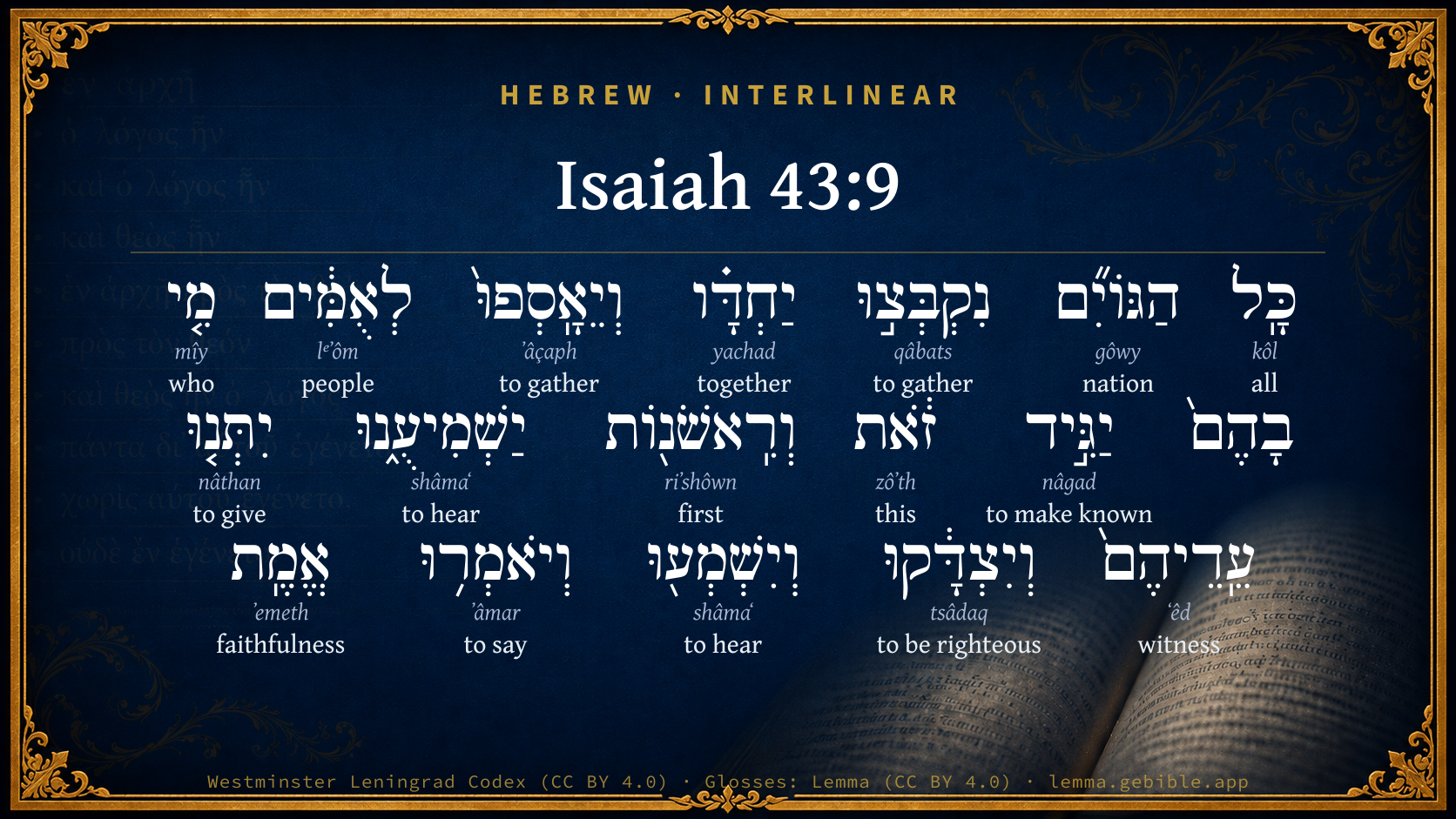
Hebrew (Westminster Leningrad Codex) Isaiah 43:9 appears in the Hebrew Old Testament. The text above is from the Westminster Leningrad Codex. Each word links to its Strong’s number, a concise gloss, and parsing drawn from the Open Scriptures Hebrew Bible morphology. Click any word for its full Brown-Driver-Briggs (BDB) entry.
Download image
Cite this verse

Isaiah 43:9 (World English Bible). Public Domain. Lemma interlinear Bible study tool, https://lemma.gebible.app/v/isaiah/43/9.

Show BibTeX & RIS
BibTeX
RIS
English Translation
Let all the nations be gathered together, and let the peoples be assembled: who among them can declare this, and show us former things? let them bring their witnesses, that they may be justified; or let them hear, and say, It is truth.
World English Bible · Public Domain
Download a study sheet

One document with this verse’s original text, its word-by-word gloss line, the meaning frame, cross-references with their text, attributed commentary, and full source and license credits — printable, and it pastes into notes with its structure intact.

This verse Autodidact and up

Study sheet (.html) Plain text (.txt)

A passage Seminary Student

Up to 50 verses in one chapter. A passage sheet keeps up to 6 commentary sources and 12 cross-references per verse, in the order this page ranks them, and says so on the sheet whenever that leaves anything out. Ask for a single verse and you get the Autodidact verse sheet above.

Everything on this page stays free to read, with no account — the sheet is a download of what is already on screen, not access to it.

Want to remove ads? Support Godless Engineer
Compare translations 3

The same verse in 3 English versions, stacked beneath the original-language interlinear above. Click any original word for its lexicon entry.

Each is an independent rendering of the whole verse — the interlinear is not word-aligned to these translations.

Highlighted words mark where these versions differ — a whole-verse word diff, not a word-by-word alignment.

  • World English Bible Public Domain
    Let all the nations be gathered together, and let the peoples be assembled: who among them can declare this, and show us former things? let them bring their witnesses, that they may be justified; or let them hear, and say, It is truth.
  • King James Version Public Domain
    Let all the nations be gathered together, and let the people be assembled: who among them can declare this, and shew us former things? let them bring forth their witnesses, that they may be justified: or let them hear, and say, It is truth.
  • unfoldingWord Literal Text CC BY-SA 4.0
    All of the nations are gathered together, and the peoples are assembled. Who among them declared this, and they made us hear the former? Let them bring their witnesses, that they may be righteous, and let them hear, that they may say, “True.”

unfoldingWord Literal Text — © unfoldingWord, licensed CC BY-SA 4.0. Word-aligned USFM3 via Door43 (git.door43.org/unfoldingWord/en_ult).

Versions to compare (up to 4)

3 of 4 selected

Show all 18 translations

Every available English version of this verse, each an independent rendering of the whole verse.

  • World English Bible Public Domain
    Let all the nations be gathered together, and let the peoples be assembled: who among them can declare this, and show us former things? let them bring their witnesses, that they may be justified; or let them hear, and say, It is truth.
  • Berean Standard Bible Public Domain
    All the nations gather together and the peoples assemble. Who among them can declare this, and proclaim to us the former things? Let them present their witnesses to vindicate them, so that others may hear and say, “It is true.”
  • Majority Standard Bible Public Domain
    All the nations gather together and the peoples assemble. Who among them can declare this, and proclaim to us the former things? Let them present their witnesses to vindicate them, so that others may hear and say, “It is true.”
  • King James Version Public Domain
    Let all the nations be gathered together, and let the people be assembled: who among them can declare this, and shew us former things? let them bring forth their witnesses, that they may be justified: or let them hear, and say, It is truth.
  • American Standard Version (1901) Public Domain
    Let all the nations be gathered together, and let the peoples be assembled: who among them can declare this, and show us former things? let them bring their witnesses, that they may be justified; or let them hear, and say, It is truth.
  • Revised Version (1885) Public Domain
    Let all the nations be gathered together, and let the peoples be assembled: who among them can declare this, and shew us former things? let them bring their witnesses, that they may be justified: or let them hear, and say, It is truth.
  • Geneva Bible (1599) Public Domain
    Let all the nations be gathered together, and let the people be assembled: who among them can declare this and shewe vs former things? let them bring foorth their witnesses, that they may be iustified: but let them heare, and say, It is truth.
  • Douay-Rheims (1899) Public Domain
    All the nations are assembled together, and the tribes are gathered: who among you can declare this, and shall make us hear the former things? let them bring forth their witnesses, let them be justified, and hear, and say: It is truth.
  • Young's Literal Translation Public Domain
    All the nations have been gathered together, And the peoples are assembled, Who among them declareth this, And former things causeth us to hear? They give their witnesses, And they are declared righteous, And they hear and say, `Truth.'
  • Literal Standard Version CC BY-SA 4.0
    All the nations have been gathered together, || And the peoples are assembled, || Who among them declares this, || And causes us to hear former things? They give their witnesses, || And they are declared righteous, || And they hear and say, “Truth.”
  • Unlocked Literal Bible CC BY-SA 4.0
    All the nations gather together, and the peoples assemble. Who among them could have declared this and announced to us earlier events? Let them bring their witnesses to prove themselves right, let them listen and affirm, 'It is true.'
  • unfoldingWord Literal Text CC BY-SA 4.0
    All of the nations are gathered together, and the peoples are assembled. Who among them declared this, and they made us hear the former? Let them bring their witnesses, that they may be righteous, and let them hear, that they may say, “True.”
  • Darby Bible Public Domain
    Let all the nations be gathered together, and let the peoples be assembled: who among them declareth this, or causeth us to hear former things? let them bring forth their witnesses, that they may be justified; or let them hear, and say, [It is] truth.
  • World Messianic Bible Public Domain
    Let all the nations be gathered together, and let the peoples be assembled. Who among them can declare this, and show us former things? Let them bring their witnesses, that they may be justified, or let them hear, and say, “That is true.”
  • Webster's Bible Public Domain
    Let all the nations be collected, and let the people be assembled: who among them can declare this, and show us former things? let them bring forth their witnesses, that they may be justified: or let them hear, and say, It is truth.
  • Free Bible Version CC BY-SA 4.0
    Have all the nations gather together! Have all the peoples assemble! Who among them could have said this, and predict what was going to happen? Have them bring their witnesses to prove that they're right. Then have them listen, and say, ‘It's true!’
  • Bible in Basic English Public Domain
    Let all the nations come together, and let the peoples be present: who among them is able to make this clear, and give us word of earlier things? let their witnesses come forward, so that they may be seen to be true, and that they may give ear, and say, It is true.
  • JPS Tanakh (1917) Public Domain
    All the nations are gathered together, and the peoples are assembled; who among them can declare this, and announce to us former things? Let them bring their witnesses, that they may be justified; and let them hear, and say: 'It is truth.'

Literal Standard Version (2020), Covenant Press — licensed CC BY-SA 4.0. Text via the HelloAO Bible API (eBible.org). Unlocked Literal Bible (unfoldingWord) — licensed CC BY-SA 4.0. Text via the HelloAO Bible API (eBible.org). unfoldingWord Literal Text — © unfoldingWord, licensed CC BY-SA 4.0. Word-aligned USFM3 via Door43 (git.door43.org/unfoldingWord/en_ult). Free Bible Version, Dr. Jonathan Gallagher — licensed CC BY-SA 4.0. Text via the HelloAO Bible API (eBible.org).

Word by word

More ways to search: Search by grammar → Find every occurrence → Compare this word →

Practice this passage: Drill this verse → Learn its vocabulary →

לְאֻמִּ֔ים
lᵉʼôm
H3816
“peoples”
Noun, Common, Masculine, Plural, Absolute
Part of Speech
Noun
Type
Common
Gender
Masculine
Number
Plural
State
Absolute
Full BDB Definition

Origin: from an unused root meaning to gather

TWOT: 1069a

a people, nation
  1. כָּֽל kôl H3605 “all of” Noun, Common, Masculine, Singular, Construct
  2. הַגּוֹיִ֞ם gôwy H1471 “the · nations” Particle, Definite Article + Noun, Common, Masculine, Plural, Absolute
  3. נִקְבְּצ֣וּ qâbats H6908 “to gather” Verb, Niphal, Perfect, 3rd Person, Common, Plural
  4. יַחְדָּ֗ו yachad H3162 “together” Adverb
  5. וְיֵאָֽסְפוּ֙ ʼâçaph H622 “and · to gather” Conjunction + Verb, Niphal, Imperfect, 3rd Person, Masculine, Plural
  6. מִ֤י mîy H4310 “who” Particle, Interrogative
  7. יַגִּ֣יד nâgad H5046 “to make known” Verb, Hiphil, Imperfect, 3rd Person, Masculine, Singular
  8. זֹ֔את zôʼth H2063 “this” Pronoun, Demonstrative, Feminine, Singular
  9. וְרִֽאשֹׁנ֖וֹת riʼshôwn H7223 “and · first” Conjunction + Adjective, Adjective, Feminine, Plural, Absolute
  10. יַשְׁמִיעֻ֑נוּ shâmaʻ H8085 “to hear · us” Verb, Hiphil, Imperfect, 3rd Person, Masculine, Plural + Suffix, Personal, 1st Person, Common, Plural
  11. יִתְּנ֤וּ nâthan H5414 “to give” Verb, Qal, Imperfect, 3rd Person, Masculine, Plural
  12. עֵֽדֵיהֶם֙ ʻêd H5707 “witnesses · their” Noun, Common, Masculine, Plural, Construct + Suffix, Personal, 3rd Person, Masculine, Plural
  13. וְיִצְדָּ֔קוּ tsâdaq H6663 “and · to be righteous” Conjunction + Verb, Qal, Imperfect, 3rd Person, Masculine, Plural
  14. וְיִשְׁמְע֖וּ shâmaʻ H8085 “and · to hear” Conjunction + Verb, Qal, Imperfect, 3rd Person, Masculine, Plural
  15. וְיֹאמְר֥וּ ʼâmar H559 “and · to say” Conjunction + Verb, Qal, Imperfect, 3rd Person, Masculine, Plural
  16. אֱמֶֽת ʼemeth H571 “faithfulness” Noun, Common, Feminine, Singular, Absolute

About this verse

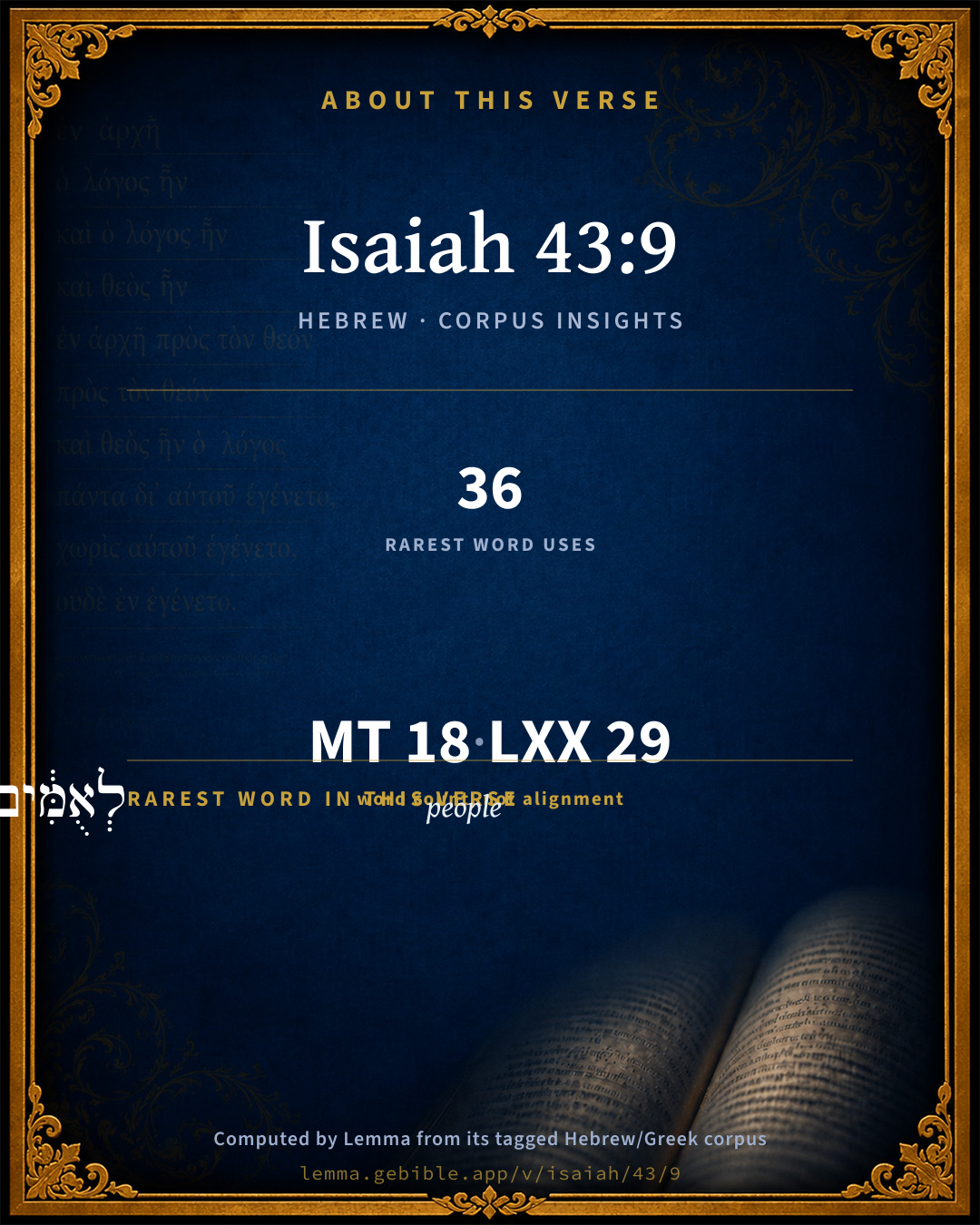
These counts appear in no published source. They are computed here, from the morphology-tagged text and Lemma’s own curated glosses. What Lemma adds →

18
words
16
distinct lemmas
Prophets
section

Shared distinctive vocabulary

לְאֻמִּ֔ים people H3816 occurs in 31 verses of the Hebrew Bible. Also found in:

Grammatical profile

  • 8 verbs
  • 5 nouns
  • 1 adjective
  • 1 pronoun
  • 1 preposition
  • 1 adverb
  • 1 particle

Verb forms

  • נִקְבְּצ֣וּ Niphal · Perfect
  • וְיֵאָֽסְפוּ֙ Niphal · Imperfect
  • יַגִּ֣יד Hiphil · Imperfect
  • יַשְׁמִיעֻ֑נוּ Hiphil · Imperfect
  • יִתְּנ֤וּ Qal · Imperfect
  • וְיִצְדָּ֔קוּ Qal · Imperfect
  • וְיִשְׁמְע֖וּ Qal · Imperfect
  • וְיֹאמְר֥וּ Qal · Imperfect

Repetition

A word recurs within this verse — often emphatic in Hebrew:

  • יַשְׁמִיעֻ֑נוּ to hear H8085 ×2

Hebrew & Septuagint length

In English translation the verse runs 43 words from the Hebrew and 46 from the Septuagint (LXX English) — closely comparable.

A rough comparison of the two English renderings, which tokenize alike — not a word-level alignment.

Word counts can differ between the Hebrew and the Greek without any difference in meaning — e.g. the Hebrew direct-object marker אֵת has no separate Greek word, and Greek often adds the article ὁ.

In the original languages it is 18 Hebrew tokens and 29 Greek tokens — but the two are counted differently (Hebrew bundles its prefixes and suffixes into one token; the Greek is in lemma form), so that isn’t a like-for-like length.

Cross-references

14

Topical passages linked to Isaiah 43:9 in the Treasury of Scripture Knowledge — connected by theme and wording, ordered by reader-vote popularity; previews shown in the World English Bible.

  • Isaiah 44:7–9 Who, as I, shall call, and shall declare it, and set it in order for me, since I established the ancient people? and the things that are coming, and that shall happen, let them declare.
  • Isaiah 46:10 declaring the end from the beginning, and from ancient times things that are not [yet] done; saying, My counsel shall stand, and I will do all my pleasure;
  • Isaiah 41:21–26 Produce your cause, says Yahweh; bring forth your strong reasons, says the King of Jacob.
  • Psalms 50:1 The Mighty One, God, Yahweh, speaks, And calls the earth from sunrise to sunset.
  • Isaiah 41:1 Keep silence before me, islands; and let the peoples renew their strength: let them come near; then let them speak; let us come near together to judgment.
  • Isaiah 43:26 Put me in remembrance; let us plead together: set you forth [your cause], that you may be justified.
  • Joel 3:11 Hurry and come, all you surrounding nations, And gather yourselves together." Cause your mighty ones to come down there, Yahweh.
  • Joshua 24:15–24 If it seem evil to you to serve Yahweh, choose you this day whom you will serve; whether the gods which your fathers served that were beyond the River, or the gods of the Amorites, in whose land you dwell: but as for me and my house, we will serve Yahweh.
  • 1 Kings 18:21–24 Elijah came near to all the people, and said, "How long will you waver between the two sides? If Yahweh is God, follow him; but if Baal, then follow him." The people answered him not a word.
  • 1 Kings 18:36–39 It happened at the time of the offering of the [evening] offering, that Elijah the prophet came near, and said, Yahweh, the God of Abraham, of Isaac, and of Israel, let it be known this day that you are God in Israel, and that I am your servant, and that I have done all these things at your word.
  • Psalms 49:1–2 Hear this, all you peoples. Listen, all you inhabitants of the world,
  • Isaiah 45:20–21 Assemble yourselves and come; draw near together, you who have escaped from the nations: they have no knowledge who carry the wood of their engraved image, and pray to a god that can't save.
  • Isaiah 48:5–6 therefore I have declared it to you from of old; before it came to pass I shown it you; lest you should say, My idol has done them, and my engraved image, and my molten image, has commanded them.
  • Isaiah 48:14 Assemble yourselves, all you, and hear; who among them has declared these things? He whom Yahweh loves shall perform his pleasure on Babylon, and his arm [shall be on] the Chaldeans.

Cross-references courtesy of OpenBible.info (CC BY 4.0).

Hebrew and Greek witnesses Masoretic Hebrew ↔ Greek Septuagint

The same verse in the two great witnesses to the Old Testament, shown verse-for-verse.

These are two independent witnesses, not word-aligned to each other, and the Septuagint is shown in lemma (dictionary) form.

Hebrew Isaiah 43:9 Masoretic · Westminster Leningrad Codex

כָּֽל הַגּוֹיִ֞ם נִקְבְּצ֣וּ יַחְדָּ֗ו וְיֵאָֽסְפוּ֙ לְאֻמִּ֔ים מִ֤י בָהֶם֙ יַגִּ֣יד זֹ֔את וְרִֽאשֹׁנ֖וֹת יַשְׁמִיעֻ֑נוּ יִתְּנ֤וּ עֵֽדֵיהֶם֙ וְיִצְדָּ֔קוּ וְיִשְׁמְע֖וּ וְיֹאמְר֥וּ אֱמֶֽת

Let all the nations be gathered together, and let the peoples be assembled: who among them can declare this, and show us former things? let them bring their witnesses, that they may be justified; or let them hear, and say, It is truth.

World English Bible · Public Domain

Greek LXX Isaiah 43:9 Septuagint · lemma form

πᾶς ὁ ἔθνος συνἄγω ἅμα καί συνἄγω ἄρχων ἐκ αὐτός τίς ἀναἀγγέλλω οὗτος ἤ ὁ ἐκ ἀρχή τίς ἀναἀγγέλλω σύ ἄγω ὁ μάρτυς αὐτός καί δικαιόω καί εἶπον ἀληθής

All the nations are gathered together, and princes shall be gathered out of them: who will declare these things? or who will declare to you things from the beginning? let them bring forth their witnesses, and be justified; and let them hear, and declare the truth.

LXX2012 (modern English Septuagint) · Public Domain

On this verse, John Gill's Exposition discusses the Septuagint’s reading. Read the note in Commentary ↓

Hebrew: Westminster Leningrad Codex (CC BY 4.0). Greek: Septuagint (public domain); English from LXX2012 (modern English Septuagint) (Public Domain). How the Septuagint differs from the Hebrew →

Targum (Aramaic paraphrase)

1

The Targum is the ancient Jewish Aramaic paraphrase of the Hebrew Scriptures — an interpretive translation, not the Hebrew text itself. Onkelos (literal) and Pseudo-Jonathan (expansive) render the Torah, and Jonathan the Prophets. Coverage is partial: where no permissively-licensed English translation exists for a verse, only the Aramaic is shown. This is verse-level text, not a word-by-word alignment to the Hebrew.

  1. Targum Jonathan Prophets (Joshua–Malachi)
    כָּל עַמְמַיָא יִתְכַּנְשׁוּן כַּחֲדָא וְיִתְקַרְבוּן מַלְכְּוָן מַן בְּהוֹן יְחַוֵי דָא וְקַדְמָיָתָא יְבַסְרוּנָנָא יִתְּנוּן סַהֲדֵיהוֹן וְיִזְכּוּן וְיִשְׁמְעוּן וְיֵימְרוּן קְשׁוֹט:

    Let all the nations be gathered together, let the kingdoms be brought together: who among them can declare this, and give us the joyful tidings of old? let them bring forth their witnesses, that they may be justified; let them hear, and let them speak the truth.

    Targum Jonathan — Aramaic: “Mikraot Gedolot” (public domain). English: “Sefaria Community Translation” (CC0 1.0 (public-domain dedication)); “London "Chaldee Paraphrase," 1871” (public domain). Text via Sefaria.

Commentary

Notes on Isaiah 43:9 from classic Christian and Jewish commentators (each source and its license shown beneath its notes). The classic Christian expositions comment on the surrounding passage and are grouped to its opening verse, so a note may address several verses; the Jewish commentaries on the Tanakh (Rashi and others) are per-verse, so they appear only where the commentator wrote on this verse.

Lemma curates 59 commentaries, every one of them public domain or Creative Commons licensed, each selected and text-cleaned for this edition rather than reprinted as found. About our sources →

Trapp's Complete Commentary

John Trapp

Isa 43:9 Let all the nations be gathered together, and let the people be assembled: who among them can declare this, and shew us former things? let them bring forth their witnesses, that they may be justified: or let them hear, and say, [It is] truth.

Ver. 9. Let all the nations.] See Isa 41:1.

And shew us former things.] Much less can they show us things future. Varro calleth all the time before the flood αδηλον, obscure, because the heathens had no certain relation of anything then done. And Diod. Siculus acknowledgeth that all that was written among them before the Theban and Trojan wars was little better than fabulous. The gods of the Gentiles had not so much as any solid knowledge of things past, neither could they orderly and perfectly set them forth by their secretaries.

It is truth,] scil., That there is but one true God. Phocylides did say so, εις μονος εστι Yεος, &c. Socrates suffered for holding this truth at Athens. Plato held the same, but dared not speak out. These are his words: It is neither easy to find out the maker of all things, nor safe to communicate to the common people what we have found out of him. Here, for fear of the people, he detained the truth in unrighteousness. And the like did Seneca, whom Augustine accuseth, quod colebat quod reprehendebat; agebat quod arguebat; quod culpabat, adorabat {a} that he worshipped those gods whom he disliked and decried.

{a} De Civit. Dei, lib. vi. cap. 10.

John Trapp, A Commentary or Exposition upon All the Books of the Old and New Testament (1647–1656) — public domain. Text from a community e-Sword module.

Geneva Bible (1599)

Geneva Bible translators

Showing, that the malice of the wicked hindereth them in the knowledge of the truth, because they will not hear when God speaketh by his word.

Signifying, that no power can resist him in doing this miraculous work, nor all their idols are able to do the like, as Isa. 41:22.

To prove that the things which are spoken of them, are true.

Geneva Bible (1599) marginal notes — public domain. Text via Bolls.life.

Jamieson, Fausset & Brown

Robert Jamieson, A. R. Fausset & David Brown

who . . . can declare this--who among the idolatrous soothsayers hath predicted this; that is, as to Cyrus being the deliverer of Israel?

former--predictions, as in Isa 42:9 [MAURER]. Or, things that shall first come to pass (see on Isa 41:21-22) [BARNES].

let them bring forth their witnesses--as I do mine (Isa 43:10).

justified--declared veracious in their pretended prophecies.

or--rather, "and"; let men hear their prediction and say, from the event, It is verified (see on Isa 41:26).

Jamieson, Fausset & Brown — Commentary Critical and Explanatory on the Whole Bible (1871) — public domain (CC PDM 1.0). Text via the HelloAO Bible API.

Adam Clarke's Commentary

Verse 9. Who among them] Seven MSS., three ancient, and the first edition, 1486, with the Syriac and Vulgate, read בכם bechem, who among you; the present reading is preferable.

Adam Clarke's Commentary on the Bible (1810–1826) — public domain. Text from a community e-Sword/MySword module.

Ellicott's Commentary for English Readers

(9) Who among them . . .—The challenge of Isa_41:22-23 is repeated. Who among their gods has foretold the “former things”? has predicted events that were then in the future, and have now come to pass?

A Bible Commentary for English Readers, edited by Charles John Ellicott (1878–1897) — public domain. Text from a community e-Sword module.

The Cambridge Bible for Schools and Colleges

gen. ed. J. J. S. Perowne

9. Let all the nations be gathered together] The form of the verb in Heb. presents difficulty. By some it is treated as a rare form of imperat., on the ground of two doubtful analogies (so R.V. marg., “Gather yourselves together &c.”). Others take it as a precative perf. (A.V. and R.V.) the existence of which in Heb. is also disputed (see Driver, Tenses, § 20). There seems, however, no reason why it should not be understood as a perf. in the ordinary sense: All the nations are gathered together. The assembling of the parties in the process naturally precedes the calling of witnesses; and this clause is descriptive of the scene presupposed by Isa_43:8. The following verb should then be pointed as a consecutive impf.: and the peoples are assembled.

who among them (the heathen gods, represented by their worshippers) can declare this] i.e. the contents of the prophecy, Isa_43:1-7.

former things] predictions of the events that have already taken place. If they profess to do this, then let them bring forth their witnesses, in support of their contention.

or let them hear, and say] The subject is the witnesses, who are supposed to hear the allegations of the false deities, and corroborate them.

be justified … It is truth] see on ch. Isa_41:26.

The Cambridge Bible for Schools and Colleges (gen. ed. J. J. S. Perowne; Cambridge University Press, 1878–1918) — public domain. Text from a community e-Sword module.

John Gill's Exposition

Ye are my witnesses, saith the Lord,.... The people of Israel, who could testify that the Lord had foretold their affliction in Egypt, their coming from thence, and settling in the land of Canaan, many hundreds of years before they came to pass, and which were exactly fulfilled; and so the apostles of Christ, and ministers of the word, and all Christian people in all nations, are witnesses of the prophecies concerning Christ, his birth, miracles, obedience, sufferings, death, resurrection, ascension to heaven, and session at the right hand of God, all which are exactly accomplished, Act 1:8,

and my servant whom I have chosen; meaning either the Prophet Isaiah, or the prophets in general; or rather the Messiah. So the Targum,

"and my servant the Messiah, in whom I am well pleased;''

and who is called the faithful witness, Rev 1:5, and to whom the characters of a servant, and the Lord's chosen, well agree, Isa 42:1,

that ye may know and believe me, and understand that I am he; by which testimonies and evident proofs of deity, from the prediction of future events, and the accomplishment of them, you may have a competent knowledge, a firm persuasion, and a clear perception of this important truth, that the God of Israel, and of all true Christians, is the one only Lord God:

before me there was no God formed, neither shall there be after me; intimating that idols were formed by the hands of men, and yet none of these were formed before him, and therefore could make no pretensions to deity, or to an equality with him; nor should any be formed afterwards, that could be put in competition with him. In short, the sense is, there is no other god beside him; as the Targum, Septuagint, and Arabic versions render it.

John Gill's Exposition of the Whole Bible (1746–1763) — public domain (CC PDM 1.0). Text via the HelloAO Bible API.

Albert Barnes' Notes on the Bible

Let all the nations be gathered together - Let them be assembled to give evidence, or to adduce proofs that their idols are worthy of confidence Isa 41:1.

Who among them can declare this? - Who among them hath predicted this state of things? Who has foretold the events which are now occurring? It is implied here, that Yahweh had done this, but none of the pagan gods had done it (see the note at Isa 41:21).

And show us former things - (see the note at Isa 41:22). The order of events, the manner in which one event shall succeed another. Not merely, who can declare one single event, but who can declare the succession, the order in which many events shall follow each other - a far more difficult thing than to declare one single future event. Neither had been done by the pagan; both had been done by God.

That they may be justified - That it may be demonstrated that they are what they pretend to be, and that they are worthy of the confidence of people. The word ‘justified’ here, is used in the sense of being right, or true; - let them in this manner show that their claims are just, and well founded.

Or let them hear, and say, It is truth - (See the note at Isa 41:26).

Albert Barnes' Notes on the Bible (1834–1885) — public domain. Text from a community e-Sword/MySword module.

Haydock's Catholic Bible Commentary

Former. The pagans were little acquainted with antiquity. Such researches lead to the knowledge of the true religion. (Haydock) --- Truth, if they can produce any true prophecy.

George Leo Haydock (1774–1849), Haydock's Catholic Family Bible and Commentary, 1859 edition — public domain. Excludes Psalms (Douay-Rheims chapter numbering differs from Protestant) and Deuterocanonical books (Catholic canon only).

Matthew Poole's English Annotations

Let the people be assembled, to plead the cause of their idols with me.

Who among them can declare this? this wonderful work of mine in bringing my people out of captivity, which I have already foretold, and shall further declare; and that so exactly, that I shall name the person by whom this work shall be begun, even Cyrus, who is yet unborn, and shall be so for above two hundred years: let any of your heathen gods do the like.

Former things, not things already past, but such things as shall happen long before the return from the captivity, which yet your blind idols cannot foresee. See Poole "Isa 41:22". Their witnesses, who can testify the truth and certainty of any such predictions of theirs.

That they may be justified; that they may be owned for true gods, which in that case I allow them to expect. But of this argument see on Isa 41:22,23. Or let them hear and say, It is truth; or if they can produce no evidence of any such thing, as I am well assured that they cannot, let them be silent, and hear me and my witnesses, as it follows in the next verse; and let them confess that what I say is truth, that I only am the true God, and that they are but vanity and falsehood.

Matthew Poole's English Annotations on the Holy Bible (1683–1685) — public domain. Text from a community e-Sword/MySword module.

The Pulpit Commentary

All the nations; rather, all ye nations. Israel is a witness on the one hand, a multitude of nations on the other, recalling the contention of Elijah with the four hundred priests of Baal. (1Ki_18:22) The people; rather, the Peoples. who among them can declare this? i.e. which of them can show any prediction made by their gods comparable to the one contained in vers. 1-77 And show us former things. "Exhibit the past history of the world in well-attested documents" (Kay); "Make mention of past events which they have correctly foretold" (Cheyne, Delitzsch). According to the former rendering, the contrast is between the solemn, serious history of early times in Genesis, and the grotesque and extravagant myths, in which the nations generally embodied their views of the primitive ages. (For a specimen of the contrast, see "Aids to Faith," Essay 6. pp. 275, 276.) Let them bring forth their witnesses. Witnesses that the prophecies were really delivered before the events happened, or that the accounts of past times are such as have really come down to them from their ancestors. Or let them hear and say, It is truth . It is uncertain whether we ought to translate the initial vau here by "and" or by "or." If the former, the sense is, "And then let them (i.e. the witnesses) give ear to the assertions made, and declare them true;" if the latter, we may render, with Dr. Kay, "Or, if they have no witnesses, let them listen to the sacred records, and confess them to be the truth. "

The Pulpit Commentary (1880–1919), ed. H.D.M. Spence-Jones & Joseph S. Exell — public domain. Text from a community e-Sword module.

John Wesley's Explanatory Notes

Assembled - To plead the cause of their idols with me. This - This wonderful work of mine in bringing my people out of captivity. Former things - Such things as shall happen long before the return from the captivity, which yet your blind idols cannot foresee. Witnesses - Who can testify the truth of any such predictions of theirs, that they may be owned for true gods; or if they can produce no evidence of any such thing, let them confess, that what I say is truth, that I only am the true God.

John Wesley, Explanatory Notes Upon the Whole Bible (1754–1765) — public domain. Text via the GEBible commentary corpus.

J. A. Alexander on Isaiah

Joseph Addison Alexander

“All the nations are gathered together, and the peoples are to be assembled. Who among them will declare this and let us hear the first things? Let them give (or produce) their witnesses and be justified; and (if they cannot do this) let them hear (my witnesses), and say, (It is) the truth.” The nations have been gathered, but the process is not yet completed. This gathering of the nations has been commonly explained as a judicial metaphor like that in Isa 41:1. In that case the verse describes the heathen as assembled at the judgment-seat to plead their cause against Jehovah. This agrees well with the forensic terms employed in the subsequent context. It is possible, however, that this first clause may have been intended to describe not the process but the subject of adjudication. The gathering of the nations will then denote their accession to the church, as predicted in vs. 5-7; and this, in the next clause, will refer to the same event. Who among them (i.e., the nations) could have foretold their own change of condition? On the other supposition, this must either be indefinite, or mean the restoration of the Jews from exile, of which, as we have seen, there is no specific mention in the foregoing context. In either case, the usual alternative is offered, viz. that of pointing out some previous instance of foreknowledge and prediction. The last clause admits of two constructions. It may either be read, ‘let them be just (or candid) and hear and say it is the truth’; or, ‘let them be justified (by the witnesses whom they produce), and (if not) let them hear (my witnesses) and say, it is the truth.’ The latter seems more natural.

Joseph Addison Alexander, The Prophecies of Isaiah (1846–1847; New York: Scribner, 1870–1878) — public domain. Text from a community e-Sword module.

Rashi

Rabbi Shlomo Yitzchaki (Rashi)

Were all the nations gathered If all the nations (of the peoples [Lublin;]) (of the heathens [Warsaw]; absent in all mss. and in K’li Paz) would gather together, who of them and of their prophets would tell the future, or the like, quoting their pagan Gods, or the first events, that have already passed, would they let us know, saying “We foretold them before they came about”?

Let them present their witnesses who heard that they prophesied concerning them prior to their occurrence, and they shall be deemed just. But I have witnesses, for you are My witnesses that I told Abraham your forefather about the exiles, and they came about.

Rashi on the Tanakh — English translations: “The Judaica Press complete Tanach with Rashi, translated by A. J. Rosenberg” (CC BY 4.0); “Pentateuch with Rashi's commentary by M. Rosenbaum and A.M. Silbermann, 1929-1934” (public domain); “The Metsudah Tanach series, Lakewood, N.J” (CC BY 4.0); and “The Book of Joshua, Metsudah Publications, 1997” (CC BY 4.0). Text via Sefaria.

Ibn Ezra

Rabbi Abraham ibn Ezra

Let all the nations be gathered together, etc. If some should say that the Israelites did not know these future events, for they were blind; but of other nations and their wise men, some knew them perhaps, the question is put, Who among them can declare this, viz. that which shall happen in days to come, and show us former things, past events, which they had announced before they took place.

Let them bring forth their witnesses, that they may hear it.

ויצדקו that they may be justified with regard to their words; and

let them hear, that is, let the witnesses hear the same,

and say, It is truth, it was so.

Ibn Ezra on the Tanakh — English translations: “Sefaria Community Translation” (CC0 1.0 (public-domain dedication)); “Yalkut, Sifsei Chachomim Chumash, Metsudah Publications, 2009” (CC BY 4.0); and “Commentary of Ibn Ezra on Isaiah - trans. by M. Friedlander, 1873” (public domain). Text via Sefaria.

Lesson kit

Teaching starters — assembled from the data on this page, not authored interpretation. Every prompt links to the verse data it draws on. Edit before teaching.

Isaiah, in the Prophets, opens this verse with 18 words (16 distinct Hebrew lemmas). Its most distinctive word is lᵉʼôm (“people”). A historical commentator’s framing appears above. Read the whole chapter for the surrounding context.

Discussion questions

  1. How does “people” (lᵉʼôm) shape what this verse is saying?
  2. How does Genesis 25:23, which shares the word «people», read alongside this verse?
  3. What does the repetition of “to hear” (2× in this one verse) do in this verse?
  4. These translations render this verse differently; the difference is in the English rendering, not the original. What questions does that raise?
  5. «נִקְבְּצ֣וּ» is a Niphal Perfect verb. How does that grammatical form shape the action described?
  6. Compare how Trapp's Complete Commentary and Geneva Bible (1599) read this verse. Where do they agree or differ?

Things to notice

Reading settings

Reading text

Shown beneath each verse's original-language words.

Old Testament
Old Testament edition

Read the OT as the Masoretic Hebrew (MT) or the Greek Septuagint (LXX).

English shown for the Greek Septuagint (in the Hebrew ↔ Greek comparison).

Comparing translations? Open the Compare panel on any verse page to stack up to four side by side.