Psalms 106:5

Hebrew (Westminster Leningrad Codex) Psalms 106:5 appears in the Hebrew Old Testament. The text above is from the Westminster Leningrad Codex. Each word links to its Strong’s number, a concise gloss, and parsing drawn from the Open Scriptures Hebrew Bible morphology. Click any word for its full Brown-Driver-Briggs (BDB) entry.
Download image
Cite this verse

Psalms 106:5 (World English Bible). Public Domain. Lemma interlinear Bible study tool, https://lemma.gebible.app/v/psalms/106/5.

Show BibTeX & RIS
BibTeX
RIS
English Translation
That I may see the prosperity of your chosen, That I may rejoice in the gladness of your nation, That I may glory with your inheritance.
World English Bible · Public Domain
Download a study sheet

One document with this verse’s original text, its word-by-word gloss line, the meaning frame, cross-references with their text, attributed commentary, and full source and license credits — printable, and it pastes into notes with its structure intact.

This verse Autodidact and up

Study sheet (.html) Plain text (.txt)

A passage Seminary Student

Up to 50 verses in one chapter. A passage sheet keeps up to 6 commentary sources and 12 cross-references per verse, in the order this page ranks them, and says so on the sheet whenever that leaves anything out. Ask for a single verse and you get the Autodidact verse sheet above.

Everything on this page stays free to read, with no account — the sheet is a download of what is already on screen, not access to it.

Want to remove ads? Support Godless Engineer
Compare translations 3

The same verse in 3 English versions, stacked beneath the original-language interlinear above. Click any original word for its lexicon entry.

Each is an independent rendering of the whole verse — the interlinear is not word-aligned to these translations.

Highlighted words mark where these versions differ — a whole-verse word diff, not a word-by-word alignment.

  • World English Bible Public Domain
    That I may see the prosperity of your chosen, That I may rejoice in the gladness of your nation, That I may glory with your inheritance.
  • King James Version Public Domain
    That I may see the good of thy chosen, that I may rejoice in the gladness of thy nation, that I may glory with thine inheritance.
  • unfoldingWord Literal Text CC BY-SA 4.0
    to look on the good of your chosen, to rejoice in the gladness of your nation, to boast with your inheritance.

unfoldingWord Literal Text — © unfoldingWord, licensed CC BY-SA 4.0. Word-aligned USFM3 via Door43 (git.door43.org/unfoldingWord/en_ult).

Versions to compare (up to 4)

3 of 4 selected

Show all 18 translations

Every available English version of this verse, each an independent rendering of the whole verse.

  • World English Bible Public Domain
    That I may see the prosperity of your chosen, That I may rejoice in the gladness of your nation, That I may glory with your inheritance.
  • Berean Standard Bible Public Domain
    that I may see the prosperity of Your chosen ones, and rejoice in the gladness of Your nation, and give glory with Your inheritance.
  • Majority Standard Bible Public Domain
    that I may see the prosperity of Your chosen ones, and rejoice in the gladness of Your nation, and give glory with Your inheritance.
  • King James Version Public Domain
    That I may see the good of thy chosen, that I may rejoice in the gladness of thy nation, that I may glory with thine inheritance.
  • American Standard Version (1901) Public Domain
    That I may see the prosperity of thy chosen, That I may rejoice in the gladness of thy nation, That I may glory with thine inheritance.
  • Revised Version (1885) Public Domain
    That I may see the prosperity of thy chosen, that I may rejoice in the gladness of thy nation, that I may glory with thine inheritance.
  • Geneva Bible (1599) Public Domain
    That I may see the felicitie of thy chosen, and reioyce in the ioy of thy people, and glorie with thine inheritance.
  • Douay-Rheims (1899) Public Domain
    That we may see the good of thy chosen, that we may rejoice in the joy of thy nation: that thou mayst be praised with thy inheritance.
  • Young's Literal Translation Public Domain
    To look on the good of Thy chosen ones, To rejoice in the joy of Thy nation, To boast myself with Thine inheritance.
  • Literal Standard Version CC BY-SA 4.0
    To look on the good of Your chosen ones, || To rejoice in the joy of Your nation, || To boast myself with Your inheritance.
  • Unlocked Literal Bible CC BY-SA 4.0
    Then I will see the prosperity of your chosen, rejoice in the gladness of your nation, and glory with your inheritance.
  • unfoldingWord Literal Text CC BY-SA 4.0
    to look on the good of your chosen, to rejoice in the gladness of your nation, to boast with your inheritance.
  • Darby Bible Public Domain
    That I may see the prosperity of thy chosen ones, that I may rejoice in the joy of thy nation, that I may glory with thine inheritance.
  • World Messianic Bible Public Domain
    that I may see the prosperity of your chosen, that I may rejoice in the gladness of your nation, that I may glory with your inheritance.
  • Webster's Bible Public Domain
    That I may see the good of thy chosen, that I may rejoice in the gladness of thy nation, that I may glory with thy inheritance.
  • Free Bible Version CC BY-SA 4.0
    Let me see your chosen people prosperous; let me be happy together with your nation; let me share in being proud of you with those who belong to you.
  • Bible in Basic English Public Domain
    So that I may see the well-being of the people of your selection, and have a part in the joy of your nation, and take pride in your heritage.
  • JPS Tanakh (1917) Public Domain
    That I may behold the prosperity of Thy chosen, that I may rejoice in the gladness of Thy nation, that I may glory with Thine inheritance.

Literal Standard Version (2020), Covenant Press — licensed CC BY-SA 4.0. Text via the HelloAO Bible API (eBible.org). Unlocked Literal Bible (unfoldingWord) — licensed CC BY-SA 4.0. Text via the HelloAO Bible API (eBible.org). unfoldingWord Literal Text — © unfoldingWord, licensed CC BY-SA 4.0. Word-aligned USFM3 via Door43 (git.door43.org/unfoldingWord/en_ult). Free Bible Version, Dr. Jonathan Gallagher — licensed CC BY-SA 4.0. Text via the HelloAO Bible API (eBible.org).

Word by word

More ways to search: Search by grammar → Find every occurrence → Compare this word →

Practice this passage: Drill this verse → Learn its vocabulary →

בְּחִירֶ֗יךָ
bâchîyr
H972
“chosen · your”
Adjective, Adjective, Masculine, Plural, Construct + Suffix, Personal, 2nd Person, Masculine, Singular
Part of Speech
Adjective
Type
Adjective
Gender
Masculine
Number
Plural
State
Construct
Full BDB Definition

Origin: from H977

TWOT: 231c

chosen, choice one, chosen one, elect (of God)
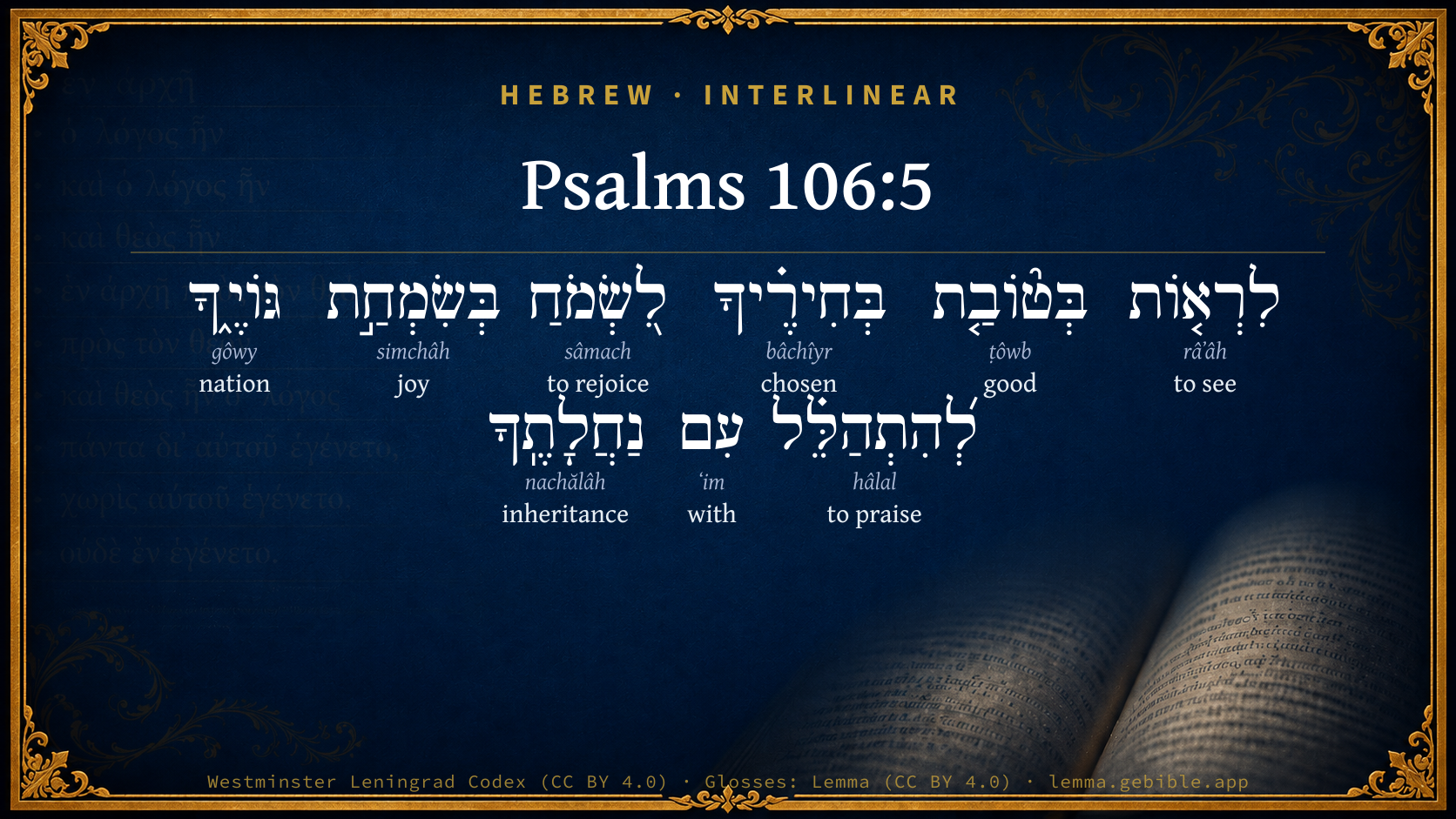
  1. לִרְא֤וֹת râʼâh H7200 “to see” Preposition + Verb, Qal, Infinitive Construct
  2. בְּט֘וֹבַ֤ת ṭôwb H2896 “in/at · good of” Preposition + Adjective, Adjective, Feminine, Singular, Construct
  3. לִ֭שְׂמֹחַ sâmach H8055 “to rejoice” Preposition + Verb, Qal, Infinitive Construct
  4. בְּשִׂמְחַ֣ת simchâh H8057 “in/at · joy of” Preposition + Noun, Common, Feminine, Singular, Construct
  5. גּוֹיֶ֑ךָ gôwy H1471 “nation · your” Noun, Common, Masculine, Singular, Construct + Suffix, Personal, 2nd Person, Masculine, Singular
  6. לְ֝הִתְהַלֵּ֗ל hâlal H1984 “to praise” Preposition + Verb, Hithpael, Infinitive Construct
  7. עִם ʻim H5973 “with” Preposition
  8. נַחֲלָתֶֽךָ nachălâh H5159 “inheritance · your” Noun, Common, Feminine, Singular, Construct + Suffix, Personal, 2nd Person, Masculine, Singular

About this verse

These counts appear in no published source. They are computed here, from the morphology-tagged text and Lemma’s own curated glosses. What Lemma adds →

9
words
9
distinct lemmas
Wisdom
section

Notable vocabulary

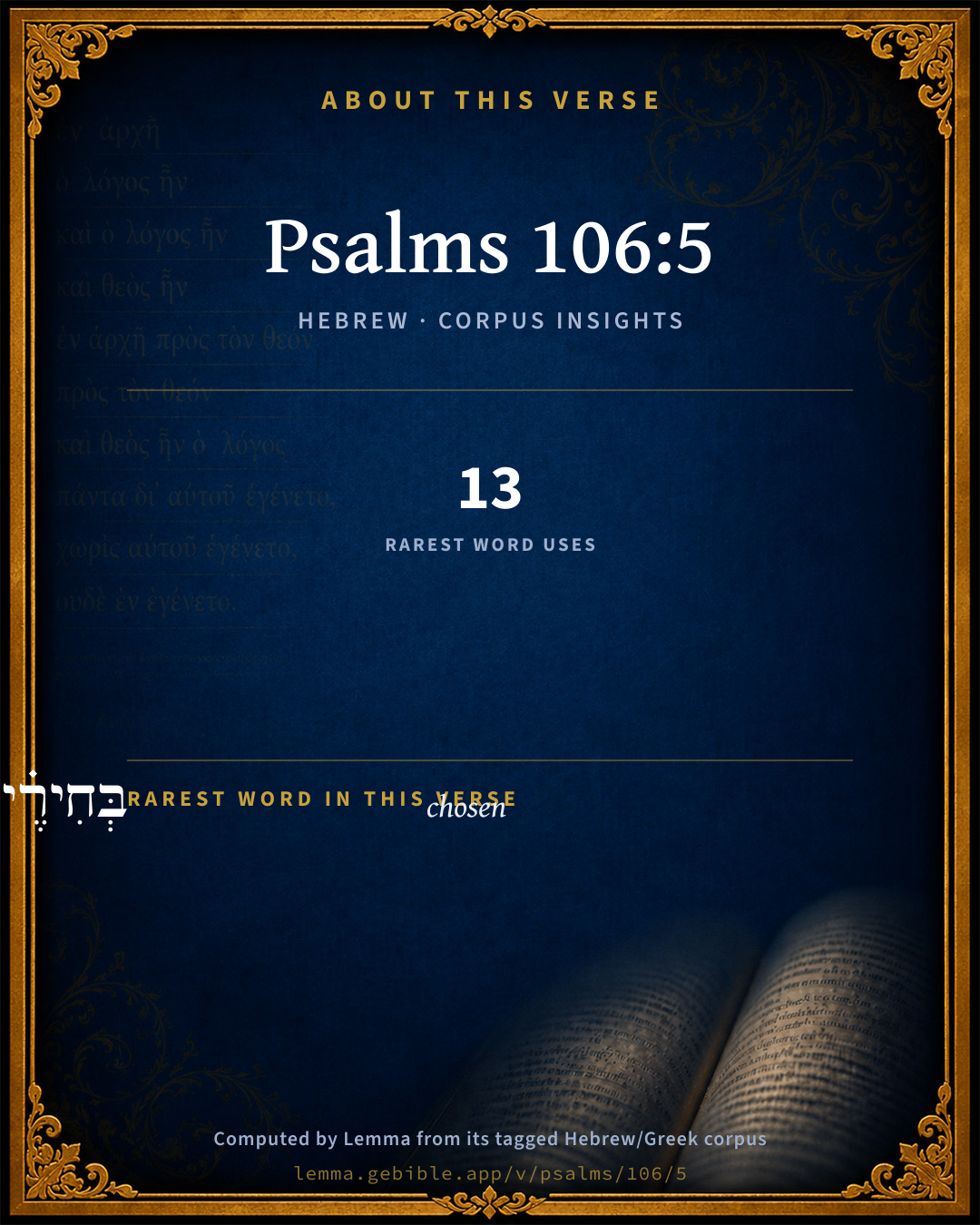
The rarest word here is בְּחִירֶ֗יךָ chosen H972 — appearing just 13 times in the whole Hebrew Bible.

Shared distinctive vocabulary

בְּחִירֶ֗יךָ chosen H972 occurs in 13 verses of the Hebrew Bible. Also found in:

Grammatical profile

  • 3 verbs
  • 3 nouns
  • 2 adjectives
  • 1 preposition

Verb forms

  • לִרְא֤וֹת Qal · Infinitive Construct
  • לִ֭שְׂמֹחַ Qal · Infinitive Construct
  • לְ֝הִתְהַלֵּ֗ל Hithpael · Infinitive Construct

Hebrew & Septuagint length

In English translation the verse runs 26 words from the Hebrew and 26 from the Septuagint (LXX English) — the same length.

A rough comparison of the two English renderings, which tokenize alike — not a word-level alignment.

Word counts can differ between the Hebrew and the Greek without any difference in meaning — e.g. the Hebrew direct-object marker אֵת has no separate Greek word, and Greek often adds the article ὁ.

Cross-references

24

Topical passages linked to Psalms 106:5 in the Treasury of Scripture Knowledge — connected by theme and wording, ordered by reader-vote popularity; previews shown in the World English Bible.

  • Psalms 105:43 He brought forth his people with joy, His chosen with singing.
  • John 15:16 You didn't choose me, but I chose you, and appointed you, that you should go and bear fruit, and that your fruit should remain; that whatever you will ask of the Father in my name, he may give it to you.
  • Psalms 1:3 He will be like a tree planted by the streams of water, That brings forth its fruit in its season, Whose leaf also does not wither. Whatever he does shall prosper.
  • Psalms 105:6 You seed of Abraham, his servant, You children of Jacob, his chosen ones.
  • Isaiah 12:6 Cry aloud and shout, you inhabitant of Zion; for great in the midst of you is the Holy One of Israel!"
  • Isaiah 66:10 Rejoice you with Jerusalem, and be glad for her, all you who love her: rejoice for joy with her, all you who mourn over her;
  • Zephaniah 3:14 Sing, daughter of Zion! Shout, Israel! Be glad and rejoice with all your heart, daughter of Jerusalem.
  • Zechariah 9:9 Rejoice greatly, daughter of Zion! Shout, daughter of Jerusalem! Behold, your king comes to you! He is righteous, and having salvation; Lowly, and riding on a donkey, Even on a colt, the foal of a donkey.
  • Ephesians 1:18 having the eyes of your hearts enlightened, that you may know what is the hope of his calling, and what are the riches of the glory of his inheritance in the saints,
  • Deuteronomy 7:6 For you are a holy people to Yahweh your God: Yahweh your God has chosen you to be a people for his own possession, above all peoples who are on the face of the earth.
  • Psalms 14:7 Oh that the salvation of Israel would come out of Zion! When Yahweh restores the fortunes of his people, Then Jacob shall rejoice, and Israel shall be glad.
  • Psalms 48:11 Let Mount Zion be glad! Let the daughters of Judah rejoice, Because of your judgments.
  • Psalms 118:15 The voice of rejoicing and salvation is in the tents of the righteous. "The right hand of Yahweh does valiantly.
  • Isaiah 35:10 and the ransomed of Yahweh shall return, and come with singing to Zion; and everlasting joy shall be on their heads: they shall obtain gladness and joy, and sorrow and sighing shall flee away.
  • Isaiah 45:25 In Yahweh shall all the seed of Israel be justified, and shall glory.
  • Joel 2:23 "Be glad then, you children of Zion, And rejoice in Yahweh, your God; For he gives you the former rain in just measure, And he causes the rain to come down for you, The former rain and the latter rain, As before.
  • John 16:22 Therefore you now have sorrow, but I will see you again, and your heart will rejoice, and no one will take your joy away from you.
  • Ephesians 1:4 even as he chose us in him before the foundation of the world, that we would be holy and without blemish before him in love;
  • Philippians 3:3 For we are the circumcision, who worship God in the Spirit, and rejoice in Christ Jesus, and have no confidence in the flesh;
  • 2 Thessalonians 2:13 But we are bound to always give thanks to God for you, brothers loved by the Lord, because God chose you from the beginning for salvation through sanctification of the Spirit and belief in the truth;
  • James 2:5 Listen, my beloved brothers. Didn't God choose those who are poor in this world to be rich in faith, and heirs of the Kingdom which he promised to those who love him?
  • Revelation 17:14 These will war against the Lamb, and the Lamb will overcome them, for he is Lord of lords, and King of kings. They also will overcome who are with him, called and chosen and faithful."
  • Acts 9:15 But the Lord said to him, "Go your way, for he is my chosen vessel to bear my name before the nations and kings, and the children of Israel.
  • 1 Peter 2:9 But you are a chosen race, a royal priesthood, a holy nation, a people for God's own possession, that you may show forth the excellencies of him who called you out of darkness into his marvelous light:

Cross-references courtesy of OpenBible.info (CC BY 4.0).

Hebrew and Greek witnesses Masoretic Hebrew ↔ Greek Septuagint

The same verse in the two great witnesses to the Old Testament, shown verse-for-verse.

You’re reading Greek Psalm 105 (Hebrew Psalm 106). The Septuagint counts the superscription, so verse numbers can differ from the Hebrew — chapter-level alignment, not verse-by-verse. Numbering follows Rahlfs.

These are two independent witnesses, not word-aligned to each other, and the Septuagint is shown in lemma (dictionary) form.

Hebrew Psalms 106:5 Masoretic · Westminster Leningrad Codex

לִרְא֤וֹת בְּט֘וֹבַ֤ת בְּחִירֶ֗יךָ לִ֭שְׂמֹחַ בְּשִׂמְחַ֣ת גּוֹיֶ֑ךָ לְ֝הִתְהַלֵּ֗ל עִם נַחֲלָתֶֽךָ

That I may see the prosperity of your chosen, That I may rejoice in the gladness of your nation, That I may glory with your inheritance.

World English Bible · Public Domain

Greek LXX Greek Psalm 105:5 Septuagint · lemma form

ὁ ὁράω ἐν ὁ χρηστότης ὁ ἐκλεκτός σύ ὁ εὐφραίνω ἐν ὁ εὐφροσύνη ὁ ἔθνος σύ ὁ ἐπιαἰνέω μετά ὁ κληρονομία σύ

that we may behold the good of your elect, that we may rejoice in the gladness of your nation, that we may glory with your inheritance.

LXX2012 (modern English Septuagint) · Public Domain

Hebrew: Westminster Leningrad Codex (CC BY 4.0). Greek: Septuagint (public domain); English from LXX2012 (modern English Septuagint) (Public Domain). How the Septuagint differs from the Hebrew →

Commentary

Notes on Psalms 106:5 from classic Christian and Jewish commentators (each source and its license shown beneath its notes). The classic Christian expositions comment on the surrounding passage and are grouped to its opening verse, so a note may address several verses; the Jewish commentaries on the Tanakh (Rashi and others) are per-verse, so they appear only where the commentator wrote on this verse.

Lemma curates 59 commentaries, every one of them public domain or Creative Commons licensed, each selected and text-cleaned for this edition rather than reprinted as found. About our sources →

Trapp's Complete Commentary

John Trapp

Psa 106:5 That I may see the good of thy chosen, that I may rejoice in the gladness of thy nation, that I may glory with thine inheritance.

Ver. 5. That I may see the good of thy chosen] Ut videam in bonum, that I may see it, and partake of it, have both the vision and fruition of thy great goodness, which thou hast laid up for them that fear thee, Psa 31:19, giving them a taste thereof aforehand, as a few grapes of that promised Canaan.

Of thy nation] i.e. By this name God’s elect are here and elsewhere styled, and therefore the Jews have no reason to reproach us, as they do, by it; calling us Gel, and Mamzer-goi, bastard heathens.

John Trapp, A Commentary or Exposition upon All the Books of the Old and New Testament (1647–1656) — public domain. Text from a community e-Sword module.

J. A. Alexander on Psalms

Joseph Addison Alexander

5. (Psa 106:5) To witness the welfare of thy chosen (ones), to rejoice in the joy of thy nation, to glory with thy heritage. Our idiom requires the subject of the verb to be more distinctly indicated. The meaning evidently is, that I may witness, that I may rejoice, that I may glory. The phrase translated witness the welfare literally means to see in the good, i.e. to look on, to be a spectator, when thy chosen ones are in possession or enjoyment of good. Thy nation is here used instead of the customary phrase thy people, perhaps because the meaning is, the nation which is thy chosen people. The general meaning of the whole verse is, that I may once more be recognised and treated as thy people.

Joseph Addison Alexander, The Psalms Translated and Explained (1850) — public domain. Text from a community e-Sword module.

Adam Clarke's Commentary

Verse 5. That I may see the good of thy chosen] That I may enjoy the good, for so the word see is understood among the Hebrews. "Blessed are the pure in heart for they shall see God," - they shall enjoy him, possess his favour, and be made like unto him.

Adam Clarke's Commentary on the Bible (1810–1826) — public domain. Text from a community e-Sword/MySword module.

Ellicott's Commentary for English Readers

(5) The tone of this verse indicates a prospect of a speedy advent of good.; and serves itself to give a probable date to the psalm.

A Bible Commentary for English Readers, edited by Charles John Ellicott (1878–1897) — public domain. Text from a community e-Sword module.

The Cambridge Bible for Schools and Colleges

gen. ed. J. J. S. Perowne

5. That I may see with satisfaction the prosperity of thy chosen ones (Psa_105:6; Psa_105:43).

thy nation] The word gôy, ‘nation,’ is not unfrequently applied to Israel, but only here and in Zep_2:9 is Israel spoken of as Jehovah’s nation. In the plural it is used of heathen nations only.

thine inheritance] Cp. Deu_4:20; Deu_9:29; and for the verse generally, Psa_33:12; “the nation whose God is Jehovah, the people he hath chosen for his inheritance.”

The Cambridge Bible for Schools and Colleges (gen. ed. J. J. S. Perowne; Cambridge University Press, 1878–1918) — public domain. Text from a community e-Sword module.

John Gill's Exposition

That I may see the good of thy chosen,.... The elect, according to the foreknowledge of God; who are chosen in Christ to holiness and happiness, through sanctification of the Spirit, and belief of the truth unto salvation by him; the vessels of mercy afore prepared unto glory, both of Jews and Gentiles. The "good" of those is not any goodness of their own, for there is none in them naturally; they are by nature no better than others, none are good, nor do good, no, not one: but the goodness of God laid up for them, and bestowed on them; the blessings of goodness with which Christ is preparing for them; all the good things secured for them in a well ordered covenant; which they partake of in time, and to eternity. To "see" these is not to have a superficial, notional, knowledge of them, as hypocrites may have; or a distant view of them, as Balaam, and the rich man in hell; but to have an experience of them, possess them, and enjoy them.

That I may rejoice in the gladness of thy nation; all the nations of the world are the Lord's; but there is a chosen generation, an holy nation, that is peculiarly his; a nation taken out of a nation, nay, taken out of all the nations that are upon earth: and these have a joy peculiar to them, which foreigners know nothing of, and strangers intermeddle not with; a spiritual joy in the Holy Ghost; a rejoicing in Christ Jesus, in his person, blood, righteousness, and sacrifice, and in hope of the glory of God; and such joy is desirable, a joy unspeakable, and full of glory.

That I may glory with thine inheritance; the same with his chosen people and nation: for the Lord's people is his portion, and the lot of his inheritance; they are chosen for an inheritance, given to Christ as such, with which he is well pleased, esteeming them a goodly heritage; they are his purchased possession, his jewels and peculiar treasure. These "glory" not in themselves, in their strength and wisdom, their riches and righteousness; but in Christ and in his righteousness, and in what he is made unto them. And the psalmist desires to join with them, and glory in what they did, and in no other; and unite with them in giving glory to God and Christ, now and hereafter, for his salvation, and all good things from him.

John Gill's Exposition of the Whole Bible (1746–1763) — public domain (CC PDM 1.0). Text via the HelloAO Bible API.

Albert Barnes' Notes on the Bible

That I may see the good of thy chosen - Thy chosen people; or, thine elect. That I may possess and enjoy the same favor and happiness which they do. It is implied here that there are special favors conferred on them; or, that happiness is found in the friendship of God which is not to be found elsewhere. It is a characteristic of true piety to desire to make that our own. A truly religious man more desires the happiness which results from being among the “chosen” of God than all that the world can confer.

That I may rejoice in the gladness of thy nation - The happiness found in the nation that serves thee. True religion - the favor of God - not only confers happiness on the “individual” who possesses it, but on the nation or people where it prevails. It is just as much suited to produce happiness there, and is just as necessary for happiness there, as in the case of an individual.

That I may glory with thine inheritance - That I may share the honor of thy people. The word “inheritance” here is used to denote that which is one’s own, and is thus applied to the people of God considered as “his.” The meaning is, that the psalmist desired no other glory, honor, or distinction, than that which pertained to God’s people as such. He sought not the “glory” connected with the distinctions of the world; the display of wealth; the triumph of genius, of conquest, of arms - but the “glory” of being a friend of God, and of partaking of that which God confers on his people.

Albert Barnes' Notes on the Bible (1834–1885) — public domain. Text from a community e-Sword/MySword module.

Matthew Poole's English Annotations

See, i.e. enjoy, as the next clause explains it, and as this word is frequently used.

Of thy chosen; of thy chosen people; which thou usest to give to thine elect, or to such as are Israelites indeed.

That I may rejoice in the gladness of thy nation; with such joy as thou hast formerly afforded unto thy beloved nation or people.

That I may glory; that we may have occasion to glory in God’s goodness to. wards us. With thine inheritance; either in the congregation of thy people, that we thy people may jointly and solemnly praise thy name; or, as thy people, who are commonly called God’s inheritance, in former ages have frequently done, for the particle with is sometimes used as a note of comparison, as it is in the very next verse, and Job 9:26; Ecc 2:16; 7:11.

Matthew Poole's English Annotations on the Holy Bible (1683–1685) — public domain. Text from a community e-Sword/MySword module.

The Treasury of David

Charles H. Spurgeon

Ver. 5. That I may see the good of thy chosen. His desire for the divine favour was excited by the hope that he might participate in all the good things which flow to the people of God through their election. The Father has blessed us with all spiritual blessings in Christ Jesus, according as he has chosen us in him, and in these precious gifts we desire to share through the saving visitation of the Lord. No other good do we wish to see, perceive, and apprehend, but that which is the peculiar treasure of the saints.

That I may rejoice in the gladness of thy nation. The psalmist, having sought his portion in the good of the chosen, now also begs to be a partaker in their joy for of all the nations under heaven the Lord's true people are the happiest.

That I may glory with thine inheritance. He would have a part and lot in their honour as well as their joy. He was willing to find glory where saints find it, namely, in being reproached for truth's sake. To serve the Lord and endure shame for his sake is the glory of the saints below: Lord, let me rejoice to bear my part therein. To be with God above, for ever blessed in Christ Jesus, is the glory of saints above: O Lord, be pleased to allot me a place there also.

These introductory thanksgivings and supplications, though they occur first in the psalm, are doubtless the result of the contemplations which succeed them, and may be viewed not only as the preface, but also as the moral of the whole sacred song.

Ver. 5. We may note that the threefold nature of man prompts the union of the three petitions of this verse in one. "That I may see, " is the prayer of the body, desiring the open vision of God; "and rejoice, "is the wish of the soul or mind, that the affections may likewise be gratified; and vice thanks, as the spirit needs to pour itself out in worship. Further, there are three names here given to the saints, each for a reason of its own. They are God's "chosen, " because of his predestinating grace, "according as he hath chosen us in him before the foundation of the world, that we should be holy and without blame before him in love" (Eph 1:4); they are his "nation, "having one law and one worship under him as sole king, "And what nation is there so great, that hath statutes and judgments so righteous as all this law?" (De 4:8) they are his "inheritance, "for it is written, "I shall give the heathen for thine inheritance" (Ps 2:8). Hugo Cardinalis and Albertus Magnus, in Neale and Littledale.

Ver. 5. That I may see the good of thy chosen. That, having been predestined, and justified, we may come to see the good of thy chosen, which means that the very face of the Lord may be made conspicuous to us. (1Jo 3:2). By the "good of thy chosen" we are not to understand their own probity or goodness, but the supreme happiness that is their lot. "That I may rejoice in the gladness of thy nation." That we may partake in that unspeakable joy which arises from the beatific vision, which is the peculiar property of the chosen people, of which strangers cannot taste, of which the gospel says, "Enter into the joy of thy Lord." Robert Bellarmine, 1542-1621.

Ver. 5.

1. The Persons: "Thy chosen"; "Thy nation"; "Thine inheritance."

2. The Privileges: "The good of thy chosen"; "The gladness of thy nation"; "The glory of thine inheritance."

3. The Pleas: "That I may see", etc. They were once as I am: make me what they are now.

(a) My salvation is everything to me. "That I may see",

etc. "That I may rejoice", etc. They are many, I am

but one. "That I may glory", etc.

G.R.

Psalms 106:6*

Charles H. Spurgeon's The Treasury of David (1869–1885) — public domain. Psalms only. Text from a community e-Sword/MySword module.

The Pulpit Commentary

That I may see the good of thy chosen; or, the good fortune, the prosperity, of thy chosen; i.e. their happiness when they are released from the captivity, and return to their own land (comp. ver. 47). That I may rejoice in the gladness of thy nation; i.e. "the gladness" that would be theirs when re-established in their own country. (see Ezr_3:12 Ezr_6:22) That I may glory with thins inheritance; or, triumph.

The Pulpit Commentary (1880–1919), ed. H.D.M. Spence-Jones & Joseph S. Exell — public domain. Text from a community e-Sword module.

John Wesley's Explanatory Notes

See - Enjoy. Chosen - Of thy chosen people; such as are Israelites indeed. Gladness - Such joy as thou hast formerly afforded unto thy beloved nation. Glory - That we may have occasion to glory in God's goodness towards us. Inheritance - In the congregation of thy people.

John Wesley, Explanatory Notes Upon the Whole Bible (1754–1765) — public domain. Text via the GEBible commentary corpus.

Lesson kit

Teaching starters — assembled from the data on this page, not authored interpretation. Every prompt links to the verse data it draws on. Edit before teaching.

Psalms, in the Wisdom, opens this verse with 9 words (9 distinct Hebrew lemmas). Its most distinctive word is bâchîyr (“chosen”). A historical commentator’s framing appears above. Read the whole chapter for the surrounding context.

Discussion questions

  1. How does “chosen” (bâchîyr) shape what this verse is saying?
  2. 2 Samuel 21:6 shares the word «chosen» with this verse. How do the two illuminate each other?
  3. The translations on this page render this verse differently — a whole-verse word diff, not a word-by-word alignment. What might account for the different wordings?
  4. The verb «לִרְא֤וֹת» is Qal Infinitive Construct. How does its form color the action?
  5. Reading how Trapp's Complete Commentary and J. A. Alexander on Psalms read this verse, where do the two commentators agree and where do they part?

Things to notice

Reading settings

Reading text

Shown beneath each verse's original-language words.

Old Testament
Old Testament edition

Read the OT as the Masoretic Hebrew (MT) or the Greek Septuagint (LXX).

English shown for the Greek Septuagint (in the Hebrew ↔ Greek comparison).

Comparing translations? Open the Compare panel on any verse page to stack up to four side by side.