
Ezekiel 25:10

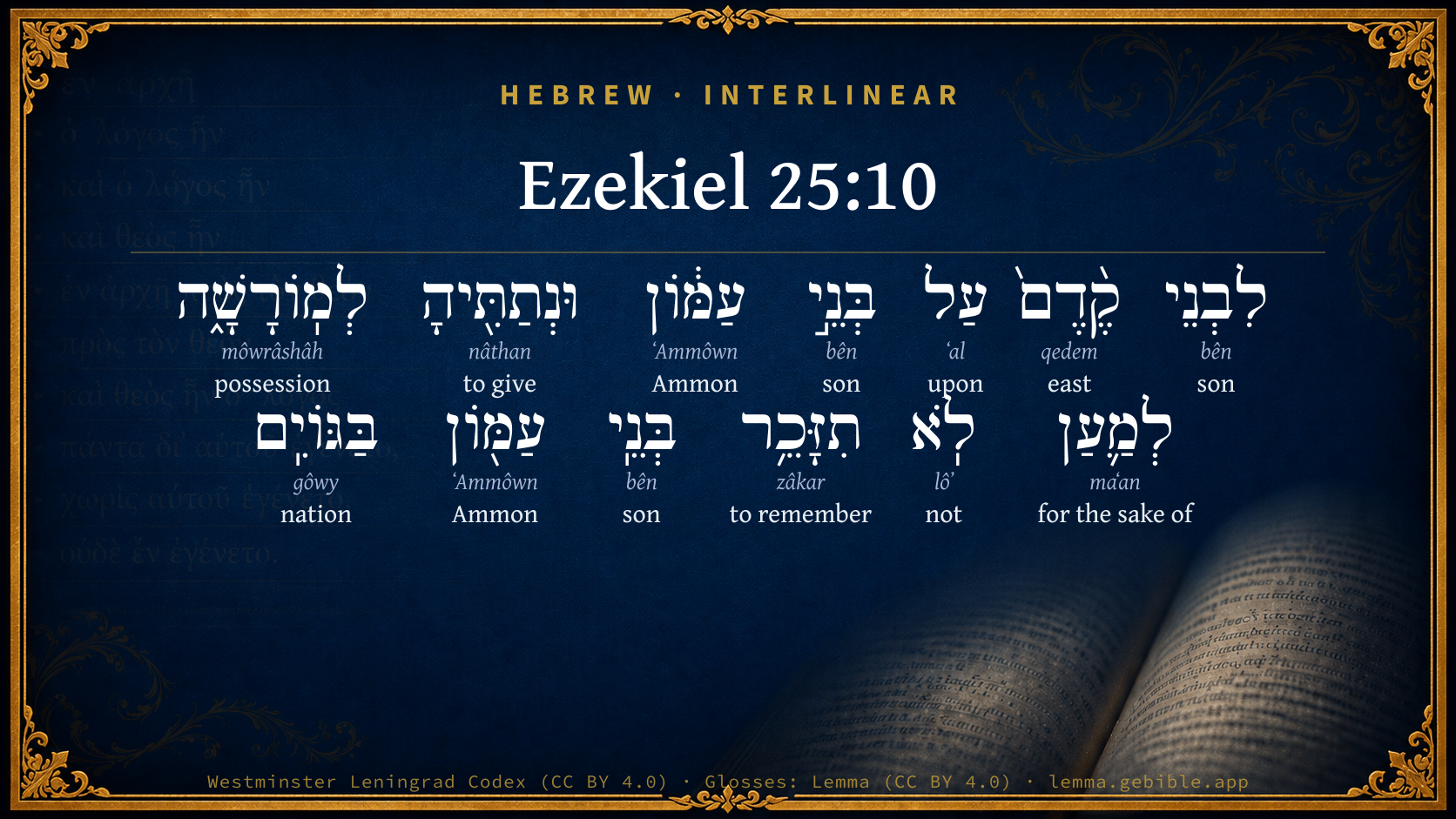
Hebrew (Westminster Leningrad Codex) Ezekiel 25:10 appears in the Hebrew Old Testament. The text above is from the Westminster Leningrad Codex. Each word links to its Strong’s number, a concise gloss, and parsing drawn from the Open Scriptures Hebrew Bible morphology. Click any word for its full Brown-Driver-Briggs (BDB) entry.
Download image
Cite this verse

Ezekiel 25:10 (World English Bible). Public Domain. Lemma interlinear Bible study tool, https://lemma.gebible.app/v/ezekiel/25/10.

Show BibTeX & RIS
BibTeX
RIS
English Translation
to the children of the east, [to go] against the children of Ammon; and I will give them for a possession, that the children of Ammon may not be remembered among the nations.
World English Bible · Public Domain
Download a study sheet

One document with this verse’s original text, its word-by-word gloss line, the meaning frame, cross-references with their text, attributed commentary, and full source and license credits — printable, and it pastes into notes with its structure intact.

This verse Autodidact and up

Study sheet (.html) Plain text (.txt)

A passage Seminary Student

Up to 50 verses in one chapter. A passage sheet keeps up to 6 commentary sources and 12 cross-references per verse, in the order this page ranks them, and says so on the sheet whenever that leaves anything out. Ask for a single verse and you get the Autodidact verse sheet above.

Everything on this page stays free to read, with no account — the sheet is a download of what is already on screen, not access to it.

Want to remove ads? Support Godless Engineer
Compare translations 3

The same verse in 3 English versions, stacked beneath the original-language interlinear above. Click any original word for its lexicon entry.

Each is an independent rendering of the whole verse — the interlinear is not word-aligned to these translations.

Highlighted words mark where these versions differ — a whole-verse word diff, not a word-by-word alignment.

  • World English Bible Public Domain
    to the children of the east, [to go] against the children of Ammon; and I will give them for a possession, that the children of Ammon may not be remembered among the nations.
  • King James Version Public Domain
    Unto the men of the east with the Ammonites, and will give them in possession, that the Ammonites may not be remembered among the nations.
  • unfoldingWord Literal Text CC BY-SA 4.0
    to the people of the east who have been against the people of Ammon. I will give them up as a possession so that the people of Ammon will not be remembered among the nations.

unfoldingWord Literal Text — © unfoldingWord, licensed CC BY-SA 4.0. Word-aligned USFM3 via Door43 (git.door43.org/unfoldingWord/en_ult).

Versions to compare (up to 4)

3 of 4 selected

Show all 18 translations

Every available English version of this verse, each an independent rendering of the whole verse.

  • World English Bible Public Domain
    to the children of the east, [to go] against the children of Ammon; and I will give them for a possession, that the children of Ammon may not be remembered among the nations.
  • Berean Standard Bible Public Domain
    I will give it along with the Ammonites as a possession to the people of the East, so that the Ammonites will no longer be remembered among the nations.
  • Majority Standard Bible Public Domain
    I will give it along with the Ammonites as a possession to the people of the East, so that the Ammonites will no longer be remembered among the nations.
  • King James Version Public Domain
    Unto the men of the east with the Ammonites, and will give them in possession, that the Ammonites may not be remembered among the nations.
  • American Standard Version (1901) Public Domain
    unto the children of the east, `to go' against the children of Ammon; and I will give them for a possession, that the children of Ammon may not be remembered among the nations.
  • Revised Version (1885) Public Domain
    unto the children of the east, to go against the children of Ammon, and I will give them for a possession, that the children of Ammon may not be remembered among the nations:
  • Geneva Bible (1599) Public Domain
    I will call the men of the East against the Ammonites, and will giue them in possession, so that the Ammonites shall no more be remembred among the nations,
  • Douay-Rheims (1899) Public Domain
    To the people of the east with the children of Ammon, and I will give it them for an inheritance: that there may be no more any remembrance of the children of Ammon among the nations.
  • Young's Literal Translation Public Domain
    To the sons of the east, with the sons of Ammon, And I have given it for a possession, So that the sons of Ammon are not remembered among nations.
  • Literal Standard Version CC BY-SA 4.0
    To the sons of the east, with the sons of Ammon, || And I have given it for a possession, || So that the sons of Ammon are not remembered among nations.
  • Unlocked Literal Bible CC BY-SA 4.0
    to the people of the east who have been against the people of Ammon. I will give them up as a possession so that the people of Ammon will not be remembered among the nations.
  • unfoldingWord Literal Text CC BY-SA 4.0
    to the people of the east who have been against the people of Ammon. I will give them up as a possession so that the people of Ammon will not be remembered among the nations.
  • Darby Bible Public Domain
    unto the children of the east, with [the land of] the children of Ammon; and I will give it them for a possession, that the children of Ammon may not be remembered among the nations:
  • World Messianic Bible Public Domain
    to the children of the east, to go against the children of Ammon; and I will give them for a possession, that the children of Ammon may not be remembered among the nations.
  • Webster's Bible Public Domain
    To the men of the east with the Ammonites, and will give them in possession, that the Ammonites may not be remembered among the nations.
  • Free Bible Version CC BY-SA 4.0
    I will hand Moab over to the people of the East for them to rule so that they will no longer exist as a nation just like the Ammonites.
  • Bible in Basic English Public Domain
    To the children of the east I have given her for a heritage, as well as the children of Ammon, so that there may be no memory of her among the nations:
  • JPS Tanakh (1917) Public Domain
    together with the children of Ammon, unto the children of the east, and I will give them for a possession, that the children of Ammon may not be remembered among the nations;

Literal Standard Version (2020), Covenant Press — licensed CC BY-SA 4.0. Text via the HelloAO Bible API (eBible.org). Unlocked Literal Bible (unfoldingWord) — licensed CC BY-SA 4.0. Text via the HelloAO Bible API (eBible.org). unfoldingWord Literal Text — © unfoldingWord, licensed CC BY-SA 4.0. Word-aligned USFM3 via Door43 (git.door43.org/unfoldingWord/en_ult). Free Bible Version, Dr. Jonathan Gallagher — licensed CC BY-SA 4.0. Text via the HelloAO Bible API (eBible.org).

Word by word

More ways to search: Search by grammar → Find every occurrence → Compare this word →

Practice this passage: Drill this verse → Learn its vocabulary →

לְמֽוֹרָשָׁ֑ה
môwrâshâh
H4181
“to/for · possession”
Preposition + Noun, Common, Feminine, Singular, Absolute
Part of Speech
Preposition + Noun
Type
Common
Gender
Feminine
Number
Singular
State
Absolute
Full BDB Definition

Origin: from H4180

TWOT: 920e

a possession
  1. לִבְנֵי bên H1121 “to/for · sons of” Preposition + Noun, Common, Masculine, Plural, Construct
  2. קֶ֨דֶם֙ qedem H6924 “east” Noun, Common, Masculine, Singular, Absolute
  3. עַל ʻal H5921 “upon” Preposition
  4. בְּנֵ֣י bên H1121 “sons of” Noun, Common, Masculine, Plural, Construct
  5. עַמּ֔וֹן ʻAmmôwn H5983 “Ammon” Noun, Proper
  6. וּנְתַתִּ֖יהָ nâthan H5414 “and · to give · her” Conjunction + Verb, Qal, Sequential Perfect, 1st Person, Common, Singular + Suffix, Personal, 3rd Person, Feminine, Singular
  7. לְמַ֛עַן maʻan H4616 “for the sake of” Preposition
  8. לֹֽא lôʼ H3808 “not” Particle, Negative
  9. תִזָּכֵ֥ר zâkar H2142 “to remember” Verb, Niphal, Imperfect, 3rd Person, Feminine, Singular
  10. בְּנֵֽי bên H1121 “sons of” Noun, Common, Masculine, Plural, Construct
  11. עַמּ֖וֹן ʻAmmôwn H5983 “Ammon” Noun, Proper
  12. בַּגּוֹיִֽם gôwy H1471 “in/at the · nations” Preposition, Determined + Noun, Common, Masculine, Plural, Absolute

About this verse

These counts appear in no published source. They are computed here, from the morphology-tagged text and Lemma’s own curated glosses. What Lemma adds →

13
words
10
distinct lemmas
Prophets
section

Notable vocabulary

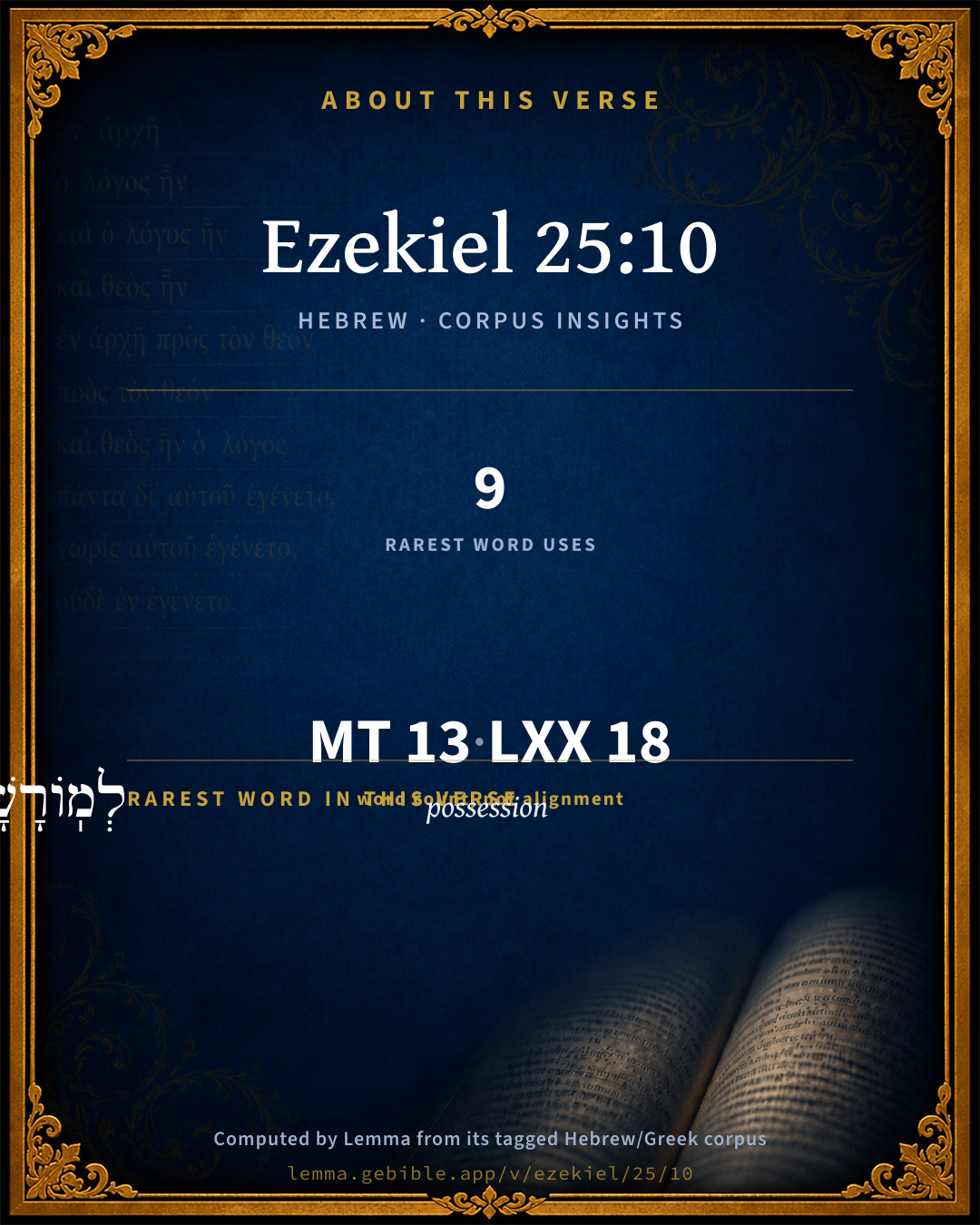
The rarest word here is לְמֽוֹרָשָׁ֑ה possession H4181 — appearing just 9 times in the whole Hebrew Bible.

Shared distinctive vocabulary

לְמֽוֹרָשָׁ֑ה possession H4181 occurs in 9 verses of the Hebrew Bible. Also found in:

Grammatical profile

  • 2 verbs
  • 8 nouns
  • 2 prepositions
  • 1 particle

Verb forms

  • וּנְתַתִּ֖יהָ Qal · Sequential Perfect
  • תִזָּכֵ֥ר Niphal · Imperfect

Repetition

Words recur within this verse — often emphatic in Hebrew:

  • לִבְנֵי son H1121 ×3
  • עַמּ֔וֹן Ammon H5983 ×2

Hebrew & Septuagint length

In English translation the verse runs 33 words from the Hebrew and 29 from the Septuagint (LXX English) — closely comparable.

A rough comparison of the two English renderings, which tokenize alike — not a word-level alignment.

Word counts can differ between the Hebrew and the Greek without any difference in meaning — e.g. the Hebrew direct-object marker אֵת has no separate Greek word, and Greek often adds the article ὁ.

In the original languages it is 13 Hebrew tokens and 18 Greek tokens — but the two are counted differently (Hebrew bundles its prefixes and suffixes into one token; the Greek is in lemma form), so that isn’t a like-for-like length.

Cross-references

4

Topical passages linked to Ezekiel 25:10 in the Treasury of Scripture Knowledge — connected by theme and wording, ordered by reader-vote popularity; previews shown in the World English Bible.

  • Ezekiel 21:32 You shall be for fuel to the fire; your blood shall be in the midst of the land; you shall be no more remembered: for I, Yahweh, have spoken it.
  • Psalms 83:3–6 They conspire with cunning against your people. They plot against your cherished ones.
  • Isaiah 23:16 Take a harp, go about the city, you prostitute that has been forgotten; make sweet melody, sing many songs, that you may be remembered.
  • Ezekiel 25:4 therefore, behold, I will deliver you to the children of the east for a possession, and they shall set their encampments in you, and make their dwellings in you; they shall eat your fruit, and they shall drink your milk.

Cross-references courtesy of OpenBible.info (CC BY 4.0).

Hebrew and Greek witnesses Masoretic Hebrew ↔ Greek Septuagint

The same verse in the two great witnesses to the Old Testament, shown verse-for-verse.

These are two independent witnesses, not word-aligned to each other, and the Septuagint is shown in lemma (dictionary) form.

Hebrew Ezekiel 25:10 Masoretic · Westminster Leningrad Codex

לִבְנֵי קֶ֨דֶם֙ עַל בְּנֵ֣י עַמּ֔וֹן וּנְתַתִּ֖יהָ לְמֽוֹרָשָׁ֑ה לְמַ֛עַן לֹֽא תִזָּכֵ֥ר בְּנֵֽי עַמּ֖וֹן בַּגּוֹיִֽם

to the children of the east, [to go] against the children of Ammon; and I will give them for a possession, that the children of Ammon may not be remembered among the nations.

World English Bible · Public Domain

Greek LXX Ezekiel 25:10 Septuagint · lemma form

ὁ υἱός κεδεμ ἐπί ὁ υἱός αμμων δίδωμι αὐτός εἰς κληρονομία ὅπως μή μνεία γίγνομαι ὁ υἱός αμμων

I have given him the children of Kedem in addition to the children of Ammon for an inheritance, that there may be no remembrance of the children of Ammon.

LXX2012 (modern English Septuagint) · Public Domain

Hebrew: Westminster Leningrad Codex (CC BY 4.0). Greek: Septuagint (public domain); English from LXX2012 (modern English Septuagint) (Public Domain). How the Septuagint differs from the Hebrew →

Targum (Aramaic paraphrase)

1

The Targum is the ancient Jewish Aramaic paraphrase of the Hebrew Scriptures — an interpretive translation, not the Hebrew text itself. Onkelos (literal) and Pseudo-Jonathan (expansive) render the Torah, and Jonathan the Prophets. Coverage is partial: where no permissively-licensed English translation exists for a verse, only the Aramaic is shown. This is verse-level text, not a word-by-word alignment to the Hebrew.

  1. Targum Jonathan Prophets (Joshua–Malachi)
    לִבְנֵי קֶדֶם עַל בְּנֵי עַמוֹן וְאֶמְסְרִינָהּ לִירוּתָא בְּדִיל דְלָא יְהֵי דָכְרָי בְּנֵי עַמוֹן בְּעַמְמַיָא:

    (no public-domain English translation for this verse)

    Targum Jonathan — Aramaic: “Mikraot Gedolot” (public domain). English: “Sefaria Community Translation” (CC0 1.0 (public-domain dedication)); “London "Chaldee Paraphrase," 1871” (public domain). Text via Sefaria.

Commentary

Notes on Ezekiel 25:10 from classic Christian and Jewish commentators (each source and its license shown beneath its notes). The classic Christian expositions comment on the surrounding passage and are grouped to its opening verse, so a note may address several verses; the Jewish commentaries on the Tanakh (Rashi and others) are per-verse, so they appear only where the commentator wrote on this verse.

Lemma curates 59 commentaries, every one of them public domain or Creative Commons licensed, each selected and text-cleaned for this edition rather than reprinted as found. About our sources →

Trapp's Complete Commentary

John Trapp

Eze 25:10 Unto the men of the east with the Ammonites, and will give them in possession, that the Ammonites may not be remembered among the nations.

Ver. 10. That the Ammonites may not be remembered among the nations.] A fearful hand of God upon them, as it was also upon some other peoples, who are so utterly extinct that the learned can now hardly divine where their seats were.

John Trapp, A Commentary or Exposition upon All the Books of the Old and New Testament (1647–1656) — public domain. Text from a community e-Sword module.

Jamieson, Fausset & Brown

Robert Jamieson, A. R. Fausset & David Brown

with the Ammonites--FAIRBAIRN explains and translates, "upon the children of Ammon" (elliptically for, "I will open Moab to the men of the east, who, having overrun the children of Ammon, shall then fall on Moab"). MAURER, as English Version, "with the Ammonites," that is, Moab, "together with the land of Ammon," is to be thrown "open to the men of the east," to enter and take possession (Jer. 49:1-39).

Jamieson, Fausset & Brown — Commentary Critical and Explanatory on the Whole Bible (1871) — public domain (CC PDM 1.0). Text via the HelloAO Bible API.

Adam Clarke's Commentary

Verse 10. That the Ammonites] The Syriac has, "That Rabbah of the sons of Ammon be not remembered."

Adam Clarke's Commentary on the Bible (1810–1826) — public domain. Text from a community e-Sword/MySword module.

Ellicott's Commentary for English Readers

(10) With the Ammonites.—The division between the verses here seriously obscures the sense. The meaning is that God will throw open Moab, as well as Ammon, to the sons of the east, and will give both nations in possession to them, so that Ammon shall be no more remembered, and judgment shall be executed on Moab. They were to be conquered and desolated by Nebuchadnezzar, but possessed by the Bedouins. The Ammonites and Moabites were nations so closely connected together that nearly all which has been said of the one applies to the other.

A Bible Commentary for English Readers, edited by Charles John Ellicott (1878–1897) — public domain. Text from a community e-Sword module.

The Cambridge Bible for Schools and Colleges

gen. ed. J. J. S. Perowne

10. Read, with full stop at Eze_25:9 : Unto the children of the East will I give it for possession together with the children of Ammon (Eze_25:4). Moab and Ammon alike shall become a possession of the wandering Bedawin. The name of Ammon shall disappear from among the nations, and Moab shall be visited with severe judgments.

The Cambridge Bible for Schools and Colleges (gen. ed. J. J. S. Perowne; Cambridge University Press, 1878–1918) — public domain. Text from a community e-Sword module.

John Gill's Exposition

Unto the men of the east with the Ammonites, and I will give them in possession,.... Or, "against the Ammonites", as the Targum; that is, way should be made for the same people of the east, the Chaldeans or Arabians, that came against the Ammonites and destroyed them, to enter into the land of Moab and possess it, as they had done the land of Ammon:

that the Ammonites may not be remembered among the nations: the name of that people, which is entirely lost; and Moab likewise, which underwent the same fate.

John Gill's Exposition of the Whole Bible (1746–1763) — public domain (CC PDM 1.0). Text via the HelloAO Bible API.

Albert Barnes' Notes on the Bible

Ammon and Moab, of common origin, whose lands had so often been interchanged, shall now share a common ruin. To “the men of the east” Eze 25:4 shall Moab with Ammon be given, that Ammon may be remembercd no more, and judgment be executed on Moab.

Albert Barnes' Notes on the Bible (1834–1885) — public domain. Text from a community e-Sword/MySword module.

Haydock's Catholic Bible Commentary

With, or "like thee." Moab (ver. 11.) shall be treated like Ammon. (Haydock) --- Hebrew, "As for the," &c. (Calmet)

George Leo Haydock (1774–1849), Haydock's Catholic Family Bible and Commentary, 1859 edition — public domain. Excludes Psalms (Douay-Rheims chapter numbering differs from Protestant) and Deuterocanonical books (Catholic canon only).

Matthew Poole's English Annotations

The men of the East: see Eze 25:4.

With; rather against, and so the Hebrew, and the sense is plain; or, as our translation reads it, with, i.e. as I have given Ammon, so I will with them give Moab to the Chaldeans first, who will give Moab to the Arabians.

Possession: see Eze 25:4.

That the Ammonites; I suppose here is either an ellipsis, thus, that as the Ammonites should so perish, as not to be remembered, so should Moab also; or else Ammon is appellative here, and speaks the numerousness of Moab, which yet should so cease as to be forgotten.

Matthew Poole's English Annotations on the Holy Bible (1683–1685) — public domain. Text from a community e-Sword/MySword module.

Whedon's Commentary on the Bible

Daniel D. Whedon

10. Unto the men of the east — R.V., margin, “Together with the children of Ammon, unto the children of the east.” The meaning must be that both Moabites and Ammonites would fall before these fierce nomadic hordes. They would finish the destruction which Nebuchadnezzar commenced.

Daniel D. Whedon (gen. ed.), Commentary on the Old and New Testaments (1874–1909) — public domain. Text from a community e-Sword module.

The Pulpit Commentary

Unto the men of the east with the Ammonites. The Authorized Version is obscure. What is meant is that the Moabites as well as the Ammonites were to be given to the nomadic tribes, the "children of the east," for a possession. The doom that Ammon was to be no more remembered (Eze_21:32) was to be carried out to the uttermost, and the children of the east were to complete what Nebuchadnezzar had begun. The utter destruction of Ammon was, as it were, uppermost in the prophet"s thoughts, and that of Moab was but secondary. Historically, the words received a partial fulfillment in Nebuchadnezzar"s conquests five years after the destruction of Jerusalem (Josephus," Ant.," 10:9.7, and M. yon Niebuhr"s "Geseh. Assurs," p. 215), but the Ammonites were still an important people in the time of the Maccabees (RAPC 1Ma 5:6, 30-45) and Justin Martyr ("Dial. cum Trypho, p. 272).

A forgotten people.

the Ammonites may not be remembered among the nations." We have the name of this little nation preserved, but even that only reaches us through its connection with Israel; or if archaeologists can point it out to us on ancient inscriptions, no history of value, nothing to identify the race, remains. It is, indeed, a forgotten people. Let us consider how a nation may bring upon itself this fate of oblivion.

I IT MAY CEASE TO EXIST. Though the Jewish nation was broken up eighteen centuries ago, the Jewish people remain among us to this day as a numerous, marvelously energetic, and quite distinct section of mankind. But where are the Ammonites? We do not hear of Ammonite bankers, Ammonite newspaper editors, or the admission of the Ammonites to Parliament. Neither in Europe nor in their ancient Syrian plains and uplands are those long-lost people ever mentioned except as a race of antiquity. Now, how comes it that a people thus ceases to exist? A nation can only withstand the shock of invasion, conquest, and deportation to foreign parts without the loss of separate existence if its members are inspired and bound together by the possession of one common great idea. It is the Hebrew idea that retains the Jewish name and race as a separate entity independent of geographical boundaries and political revolutions. If the English are not to become an extinct people, they must depend on more than a strong navy and a well-equipped army; for no one can predict the chances of war. If we continue distinguished in our mission as a civilizing, Christianizing people, we can never cease to have our part in the great world"s history. The Church will ultimately cease to exist if she eliminates all that is distinctive in Christian truth, and thinks to prosper simply on account of the strength of her organization and the wealth of her vested interests. But if she retains her sacred tradition of truth, she can outlive all revolutionary attacks on her worldly status.

II IT MAY FAIL TO EXERT INFLUENCE. Each nation has its own peculiar privileges and vocation. However small a people may be, if it truly appreciates its privileges and honestly fulfils its vocation, it cannot well be forgotten. Achaia was a small state, yet as long as civilization endures it can never be forgotten. The Greeks contributed permanent elements to the world"s civilization; and since Greek thought has passed into universal culture, it is impossible for Hellas to fall out of the memory of man, unless man degenerates to barbarism. The memory of Israel is greater than her present appearance and immediate influence. The Jews gave us the Bible, and with the Bible the eternal foundation of our faith. Therefore the Jews can never be forgotten. But what have the Ammonites given to the world? Contributing nothing, they deservedly sink into oblivion. If England is to live in history and in the world"s continuous course, she must do her part and contribute her elements towards the progress of the race. The Church of the apostolic era was too fruitful ever to be forgotten. The Church of the nineteenth century will live or be forgotten according as it contributes to the spread of the kingdom of heaven and the help of man in his higher thought and life, or fails in this mission and sinks back into ignominious inactivity, frivolous formalism, and unspiritual self-complacency.

The Pulpit Commentary (1880–1919), ed. H.D.M. Spence-Jones & Joseph S. Exell — public domain. Text from a community e-Sword module.

John Wesley's Explanatory Notes

With the Ammonites - As I have given Ammon, so I will with them give Moab to the Chaldeans, who will give it to the Arabians.

John Wesley, Explanatory Notes Upon the Whole Bible (1754–1765) — public domain. Text via the GEBible commentary corpus.

Rashi

Rabbi Shlomo Yitzchaki (Rashi)

To the children of the East I will expose them so that they should come upon the children of Ammon through the land of Moab.

Rashi on the Tanakh — English translations: “The Judaica Press complete Tanach with Rashi, translated by A. J. Rosenberg” (CC BY 4.0); “Pentateuch with Rashi's commentary by M. Rosenbaum and A.M. Silbermann, 1929-1934” (public domain); “The Metsudah Tanach series, Lakewood, N.J” (CC BY 4.0); and “The Book of Joshua, Metsudah Publications, 1997” (CC BY 4.0). Text via Sefaria.

Lesson kit

Teaching starters — assembled from the data on this page, not authored interpretation. Every prompt links to the verse data it draws on. Edit before teaching.

Ezekiel, in the Prophets, opens this verse with 13 words (10 distinct Hebrew lemmas). Its most distinctive word is môwrâshâh (“possession”). A historical commentator’s framing appears above. Read the whole chapter for the surrounding context.

Discussion questions

  1. What does “possession” (môwrâshâh) contribute to the verse as a whole?
  2. How does Exodus 6:8, which shares the word «possession», read alongside this verse?
  3. What does the repetition of “son” (3× in this one verse) do in this verse?
  4. These translations render this verse differently. What is at stake in choosing one wording over another?
  5. «וּנְתַתִּ֖יהָ» is a Qal Sequential Perfect verb. How does that grammatical form shape the action described?
  6. Compare how Trapp's Complete Commentary and Jamieson, Fausset & Brown read this verse. Where do they agree or differ?

Things to notice

Reading settings

Reading text

Shown beneath each verse's original-language words.

Old Testament
Old Testament edition

Read the OT as the Masoretic Hebrew (MT) or the Greek Septuagint (LXX).

English shown for the Greek Septuagint (in the Hebrew ↔ Greek comparison).

Comparing translations? Open the Compare panel on any verse page to stack up to four side by side.