
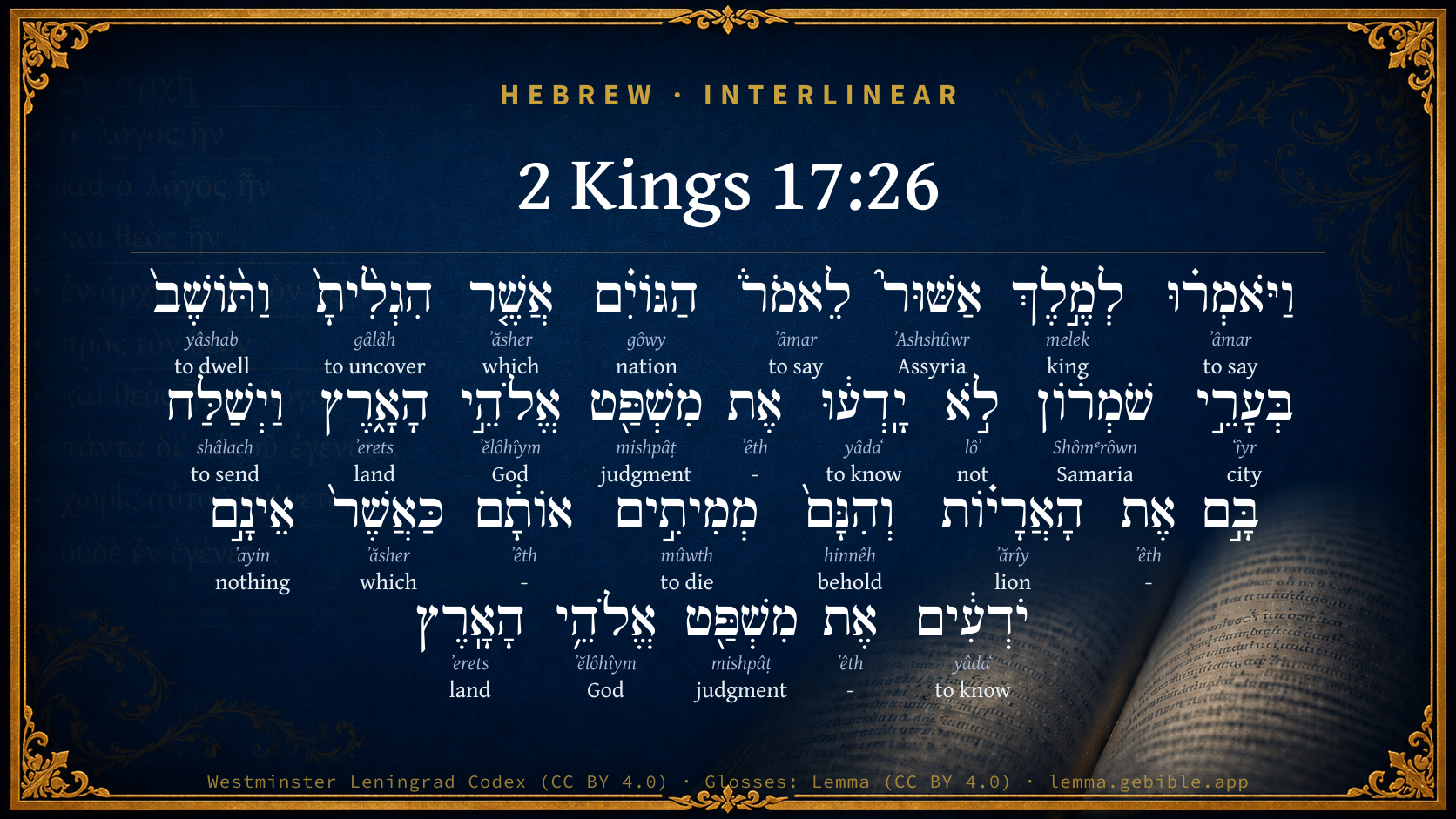
2 Kings 17:26

Hebrew (Westminster Leningrad Codex) 2 Kings 17:26 appears in the Hebrew Old Testament. The text above is from the Westminster Leningrad Codex. Each word links to its Strong’s number, a concise gloss, and parsing drawn from the Open Scriptures Hebrew Bible morphology. Click any word for its full Brown-Driver-Briggs (BDB) entry.
Download image
Cite this verse

2 Kings 17:26 (World English Bible). Public Domain. Lemma interlinear Bible study tool, https://lemma.gebible.app/v/2-kings/17/26.

Show BibTeX & RIS
BibTeX
RIS
English Translation
Therefore they spoke to the king of Assyria, saying, The nations which you have carried away, and placed in the cities of Samaria, don't know the law of the god of the land: therefore he has sent lions among them, and, behold, they kill them, because they don't know the law of the god of the land.
World English Bible · Public Domain
Download a study sheet

One document with this verse’s original text, its word-by-word gloss line, the meaning frame, cross-references with their text, attributed commentary, and full source and license credits — printable, and it pastes into notes with its structure intact.

This verse Autodidact and up

Study sheet (.html) Plain text (.txt)

A passage Seminary Student

Up to 50 verses in one chapter. A passage sheet keeps up to 6 commentary sources and 12 cross-references per verse, in the order this page ranks them, and says so on the sheet whenever that leaves anything out. Ask for a single verse and you get the Autodidact verse sheet above.

Everything on this page stays free to read, with no account — the sheet is a download of what is already on screen, not access to it.

Want to remove ads? Support Godless Engineer
Compare translations 3

The same verse in 3 English versions, stacked beneath the original-language interlinear above. Click any original word for its lexicon entry.

Each is an independent rendering of the whole verse — the interlinear is not word-aligned to these translations.

Highlighted words mark where these versions differ — a whole-verse word diff, not a word-by-word alignment.

  • World English Bible Public Domain
    Therefore they spoke to the king of Assyria, saying, The nations which you have carried away, and placed in the cities of Samaria, don't know the law of the god of the land: therefore he has sent lions among them, and, behold, they kill them, because they don't know the law of the god of the land.
  • King James Version Public Domain
    Wherefore they spake to the king of Assyria, saying, The nations which thou hast removed, and placed in the cities of Samaria, know not the manner of the God of the land: therefore he hath sent lions among them, and, behold, they slay them, because they know not the manner of the God of the land.
  • unfoldingWord Literal Text CC BY-SA 4.0
    And they spoke to the king of Assyria, saying, “The nations that you exiled and settled in the cities of Samaria do not know the custom of the God of the land. And he has sent lions against them, and behold them, killing them because they are not knowing the custom of the God of the land.”

unfoldingWord Literal Text — © unfoldingWord, licensed CC BY-SA 4.0. Word-aligned USFM3 via Door43 (git.door43.org/unfoldingWord/en_ult).

Versions to compare (up to 4)

3 of 4 selected

Show all 18 translations

Every available English version of this verse, each an independent rendering of the whole verse.

  • World English Bible Public Domain
    Therefore they spoke to the king of Assyria, saying, The nations which you have carried away, and placed in the cities of Samaria, don't know the law of the god of the land: therefore he has sent lions among them, and, behold, they kill them, because they don't know the law of the god of the land.
  • Berean Standard Bible Public Domain
    So they spoke to the king of Assyria, saying, “The peoples that you have removed and placed in the cities of Samaria do not know the requirements of the God of the land. Because of this, He has sent lions among them, which are indeed killing them off.”
  • Majority Standard Bible Public Domain
    So they spoke to the king of Assyria, saying, “The peoples that you have removed and placed in the cities of Samaria do not know the requirements of the God of the land. Because of this, He has sent lions among them, which are indeed killing them off.”
  • King James Version Public Domain
    Wherefore they spake to the king of Assyria, saying, The nations which thou hast removed, and placed in the cities of Samaria, know not the manner of the God of the land: therefore he hath sent lions among them, and, behold, they slay them, because they know not the manner of the God of the land.
  • American Standard Version (1901) Public Domain
    Wherefore they spake to the king of Assyria, saying, The nations which thou hast carried away, and placed in the cities of Samaria, know not the law of the god of the land: therefore he hath sent lions among them, and, behold, they slay them, because they know not the law of the god of the land.
  • Revised Version (1885) Public Domain
    Wherefore they spake to the king of Assyria, saying, The nations which thou hast carried away, and placed in the cities of Samaria, know not the manner of the God of the land: therefore he hath sent lions among them, and, behold, they slay them, because they know not the manner of the God of the land.
  • Geneva Bible (1599) Public Domain
    Wherefore they spake to the King of Asshur, saying, The nations which thou hast remoued, and placed in the cities of Samaria, knowe not the maner of the God of the land: therefore he hath sent lions among them, and behold, they slay them, because they knowe not the maner of the God of the land.
  • Douay-Rheims (1899) Public Domain
    And it was told the king of the Assyrians, and it was said: The nations which thou hast removed, and made to dwell in the cities of Samaria, know not the ordinances of the God of the land: and the Lord hath sent lions among them: and behold they kill them, because they know not the manner of the God of the land.
  • Young's Literal Translation Public Domain
    And they speak to the king of Asshur, saying, `The nations that thou hast removed, and dost place in the cities of Samaria, have not known the custom of the God of the land, and He sendeth among them the lions, and lo, they are destroying them, as they do not know the custom of the God of the land.'
  • Literal Standard Version CC BY-SA 4.0
    And they speak to the king of Asshur, saying, “The nations that you have removed and place in the cities of Samaria have not known the custom of the God of the land, and He sends the lions among them, and behold, they are destroying them, as they do not know the custom of the God of the land.”
  • Unlocked Literal Bible CC BY-SA 4.0
    So they spoke to the king of Assyria, saying, “The nations that you have carried away and placed in the cities of Samaria do not know the practices required by the god of the land. So he has sent lions among them, and, see, the lions are killing people there because they do not know the practices required by the god of the land.”
  • unfoldingWord Literal Text CC BY-SA 4.0
    And they spoke to the king of Assyria, saying, “The nations that you exiled and settled in the cities of Samaria do not know the custom of the God of the land. And he has sent lions against them, and behold them, killing them because they are not knowing the custom of the God of the land.”
  • Darby Bible Public Domain
    And they spoke to the king of Assyria saying, The nations that thou hast removed and made to dwell in the cities of Samaria know not the manner of the god of the land; therefore he has sent lions among them, and behold, they slay them, because they know not the manner of the god of the land.
  • World Messianic Bible Public Domain
    Therefore they spoke to the king of Assyria, saying, “The nations which you have carried away and placed in the cities of Samaria don’t know the law of the god of the land. Therefore he has sent lions among them; and behold, they kill them, because they don’t know the law of the god of the land.”
  • Webster's Bible Public Domain
    Wherefore they spoke to the king of Assyria, saying, The nations which thou hast removed, and placed in the cities of Samaria, know not the manner of the God of the land: therefore he hath sent lions among them, and behold, they slay them, because they know not the manner of the God of the land.
  • Free Bible Version CC BY-SA 4.0
    The king of Assyria was told, “The people that you brought and settled in the towns of Samaria they don't know the rules of the God of the land. As a result, he has sent lions among them, which are killing them off because they don't know what the God of the land requires.”
  • Bible in Basic English Public Domain
    So they said to the king of Assyria, The nations whom you have taken as prisoners and put in the towns of Samaria, have no knowledge of the way of the god of the land: so he has sent lions among them, causing their death, because they have no knowledge of his way.
  • JPS Tanakh (1917) Public Domain
    Wherefore they spoke to the king of Assyria, saying: 'The nations which thou hast carried away, and placed in the cities of Samaria, know not the manner of the God of the land; therefore He hath sent lions among them, and, behold, they slay them, because they know not the manner of the God of the land.'

Literal Standard Version (2020), Covenant Press — licensed CC BY-SA 4.0. Text via the HelloAO Bible API (eBible.org). Unlocked Literal Bible (unfoldingWord) — licensed CC BY-SA 4.0. Text via the HelloAO Bible API (eBible.org). unfoldingWord Literal Text — © unfoldingWord, licensed CC BY-SA 4.0. Word-aligned USFM3 via Door43 (git.door43.org/unfoldingWord/en_ult). Free Bible Version, Dr. Jonathan Gallagher — licensed CC BY-SA 4.0. Text via the HelloAO Bible API (eBible.org).

Word by word

More ways to search: Search by grammar → Find every occurrence → Compare this word →

Practice this passage: Drill this verse → Learn its vocabulary →

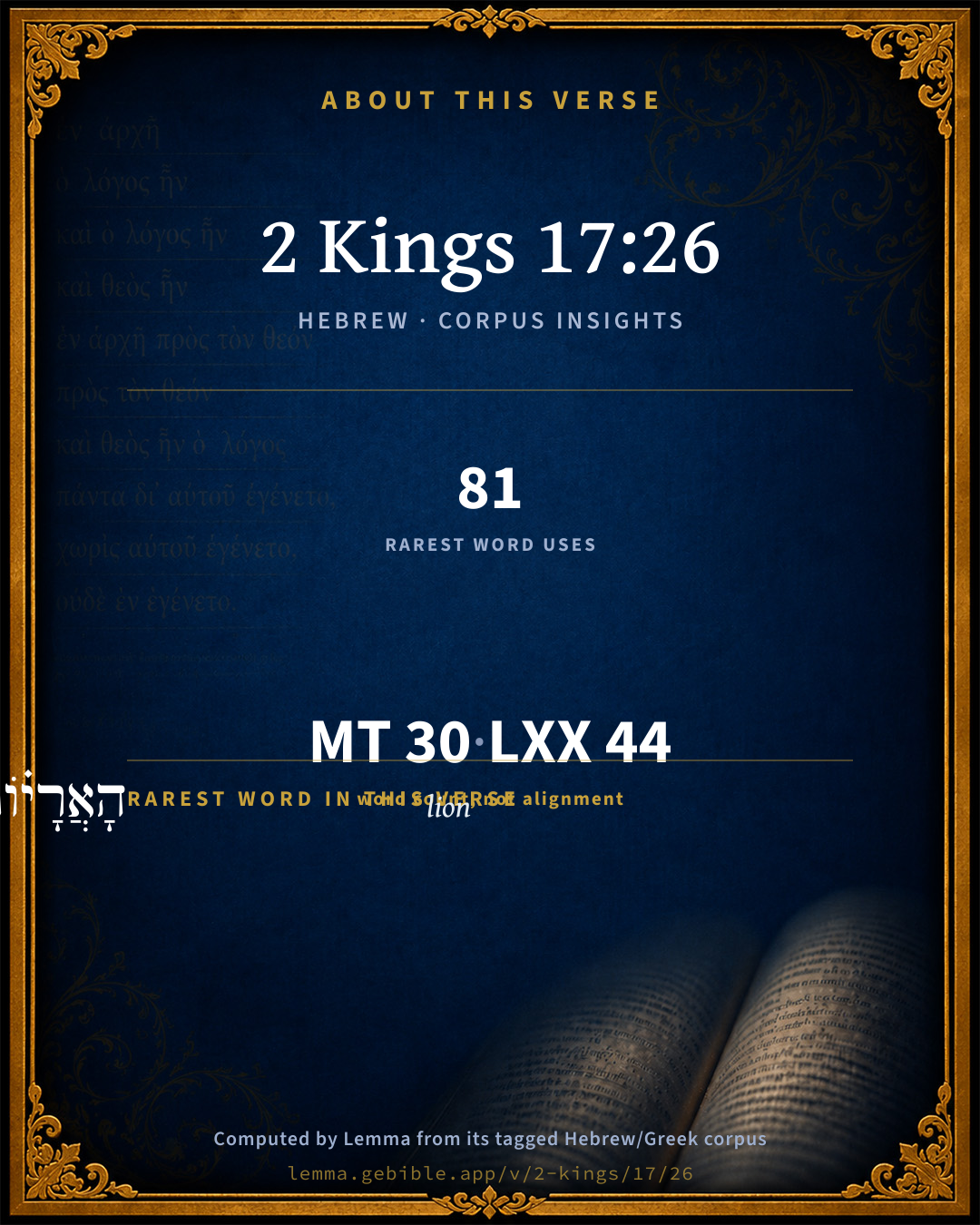
הָאֲרָי֗וֹת
ʼărîy
H738
“the · lions”
Particle, Definite Article + Noun, Common, Masculine, Plural, Absolute
Part of Speech
Particle + Noun
Type
Common
Gender
Masculine
Number
Plural
State
Absolute
Full BDB Definition

Origin: from H717 (in the sense of violence)

TWOT: 158a

lion - pictures or images of lions
  1. וַיֹּאמְר֗וּ ʼâmar H559 “and · to say” Conjunction + Verb, Qal, Sequential Imperfect, 3rd Person, Masculine, Plural
  2. לְמֶ֣לֶךְ melek H4428 “to/for · king of” Preposition + Noun, Common, Masculine, Singular, Construct
  3. אַשּׁוּר֮ ʼAshshûwr H804 “Assyria” Noun, Proper
  4. לֵאמֹר֒ ʼâmar H559 “to say” Preposition + Verb, Qal, Infinitive Construct
  5. הַגּוֹיִ֗ם gôwy H1471 “the · nations” Particle, Definite Article + Noun, Common, Masculine, Plural, Absolute
  6. אֲשֶׁ֤ר ʼăsher H834 “which” Particle, Relative
  7. הִגְלִ֨יתָ֙ gâlâh H1540 “to uncover” Verb, Hiphil, Perfect, 2nd Person, Masculine, Singular
  8. וַתּ֨וֹשֶׁב֙ yâshab H3427 “and · to dwell” Conjunction + Verb, Hiphil, Sequential Imperfect, 2nd Person, Masculine, Singular
  9. בְּעָרֵ֣י ʻîyr H5892 “in/at · cities of” Preposition + Noun, Common, Feminine, Plural, Construct
  10. שֹׁמְר֔וֹן Shômᵉrôwn H8111 “Samaria” Noun, Proper
  11. לֹ֣א lôʼ H3808 “not” Particle, Negative
  12. יָֽדְע֔וּ yâdaʻ H3045 “to know” Verb, Qal, Perfect, 3rd Person, Common, Plural
  13. אֶת ʼêth H853 “-” Particle, Direct Object
  14. מִשְׁפַּ֖ט mishpâṭ H4941 “judgment of” Noun, Common, Masculine, Singular, Construct
  15. אֱלֹהֵ֣י ʼĕlôhîym H430 “God(s) of” Noun, Common, Masculine, Plural, Construct
  16. הָאָ֑רֶץ ʼerets H776 “the · land” Particle, Definite Article + Noun, Common, Both, Singular, Absolute
  17. וַיְשַׁלַּח shâlach H7971 “and · to send” Conjunction + Verb, Piel, Sequential Imperfect, 3rd Person, Masculine, Singular
  18. אֶת ʼêth H853 “-” Particle, Direct Object
  19. וְהִנָּם֙ hinnêh H2009 “and · behold · them” Conjunction + Particle, Demonstrative + Suffix, Personal, 3rd Person, Masculine, Plural
  20. מְמִיתִ֣ים mûwth H4191 “dying” Verb, Hiphil, Participle Active, Masculine, Plural, Absolute
  21. אוֹתָ֔ם ʼêth H853 “- · them” Particle, Direct Object + Suffix, Personal, 3rd Person, Masculine, Plural
  22. כַּאֲשֶׁר֙ ʼăsher H834 “like/as · which” Preposition + Particle, Relative
  23. אֵינָ֣ם ʼayin H369 “nothing · them” Particle, Negative + Suffix, Personal, 3rd Person, Masculine, Plural
  24. יֹדְעִ֔ים yâdaʻ H3045 “knowing” Verb, Qal, Participle Active, Masculine, Plural, Absolute
  25. אֶת ʼêth H853 “-” Particle, Direct Object
  26. מִשְׁפַּ֖ט mishpâṭ H4941 “judgment of” Noun, Common, Masculine, Singular, Construct
  27. אֱלֹהֵ֥י ʼĕlôhîym H430 “God(s) of” Noun, Common, Masculine, Plural, Construct
  28. הָאָֽרֶץ ʼerets H776 “the · land” Particle, Definite Article + Noun, Common, Both, Singular, Absolute

About this verse

These counts appear in no published source. They are computed here, from the morphology-tagged text and Lemma’s own curated glosses. What Lemma adds →

30
words
20
distinct lemmas
Historical
section

Grammatical profile

  • 8 verbs
  • 12 nouns
  • 1 preposition
  • 9 particles

Verb forms

  • וַיֹּאמְר֗וּ Qal · Sequential Imperfect
  • לֵאמֹר֒ Qal · Infinitive Construct
  • הִגְלִ֨יתָ֙ Hiphil · Perfect
  • וַתּ֨וֹשֶׁב֙ Hiphil · Sequential Imperfect
  • יָֽדְע֔וּ Qal · Perfect
  • וַיְשַׁלַּח Piel · Sequential Imperfect
  • מְמִיתִ֣ים Hiphil · Participle Active
  • יֹדְעִ֔ים Qal · Participle Active

Repetition

Words recur within this verse — often emphatic in Hebrew:

  • וַיֹּאמְר֗וּ to say H559 ×2
  • יָֽדְע֔וּ to know H3045 ×2
  • מִשְׁפַּ֖ט judgment H4941 ×2
  • אֱלֹהֵ֣י God H430 ×2
  • הָאָ֑רֶץ land H776 ×2
  • אֲשֶׁ֤ר which H834 ×2

Hebrew & Septuagint length

In English translation the verse runs 57 words from the Hebrew and 62 from the Septuagint (LXX English) — closely comparable.

A rough comparison of the two English renderings, which tokenize alike — not a word-level alignment.

Word counts can differ between the Hebrew and the Greek without any difference in meaning — e.g. the Hebrew direct-object marker אֵת has no separate Greek word, and Greek often adds the article ὁ.

In the original languages it is 30 Hebrew tokens and 44 Greek tokens — but the two are counted differently (Hebrew bundles its prefixes and suffixes into one token; the Greek is in lemma form), so that isn’t a like-for-like length.

Cross-references

4

Topical passages linked to 2 Kings 17:26 in the Treasury of Scripture Knowledge — connected by theme and wording, ordered by reader-vote popularity; previews shown in the World English Bible.

  • 1 Samuel 8:9 Now therefore listen to their voice: however you shall protest solemnly to them, and shall show them the manner of the king who shall reign over them.
  • 1 Samuel 10:25 Then Samuel told the people the manner of the kingdom, and wrote it in a book, and laid it up before Yahweh. Samuel sent all the people away, every man to his house.
  • 2 Kings 17:27 Then the king of Assyria commanded, saying, Carry there one of the priests whom you brought from there; and let them go and dwell there, and let him teach them the law of the god of the land.
  • Amos 8:14 Those who swear by the sin of Samaria, And say, 'As your god, Dan, lives;' And, 'As the way of Beersheba lives;' They will fall, and never rise up again."

Cross-references courtesy of OpenBible.info (CC BY 4.0).

Hebrew and Greek witnesses Masoretic Hebrew ↔ Greek Septuagint

The same verse in the two great witnesses to the Old Testament, shown verse-for-verse.

These are two independent witnesses, not word-aligned to each other, and the Septuagint is shown in lemma (dictionary) form.

Hebrew 2 Kings 17:26 Masoretic · Westminster Leningrad Codex

וַיֹּאמְר֗וּ לְמֶ֣לֶךְ אַשּׁוּר֮ לֵאמֹר֒ הַגּוֹיִ֗ם אֲשֶׁ֤ר הִגְלִ֨יתָ֙ וַתּ֨וֹשֶׁב֙ בְּעָרֵ֣י שֹׁמְר֔וֹן לֹ֣א יָֽדְע֔וּ אֶת מִשְׁפַּ֖ט אֱלֹהֵ֣י הָאָ֑רֶץ וַיְשַׁלַּח בָּ֣ם אֶת הָאֲרָי֗וֹת וְהִנָּם֙ מְמִיתִ֣ים אוֹתָ֔ם כַּאֲשֶׁר֙ אֵינָ֣ם יֹדְעִ֔ים אֶת מִשְׁפַּ֖ט אֱלֹהֵ֥י הָאָֽרֶץ

Therefore they spoke to the king of Assyria, saying, The nations which you have carried away, and placed in the cities of Samaria, don't know the law of the god of the land: therefore he has sent lions among them, and, behold, they kill them, because they don't know the law of the god of the land.

World English Bible · Public Domain

Greek LXX 2 Kings 17:26 Septuagint · lemma form

καί εἶπον ὁ βασιλεύς ἀσσύριος λέγω ὁ ἔθνος ὅς ἀποοἰκίζω καί ἀντι καταἵζω ἐν πόλις σαμαρεία οὐ γιγνώσκω ὁ κρίμα ὁ θεός ὁ γῆ καί ἀποστέλλω εἰς αὐτός ὁ λέων καί ἰδού εἰμί θανατόω αὐτός καθότι οὐ οἶδα ὁ κρίμα ὁ θεός ὁ γῆ

And they spoke to the king of the Assyrians, saying, The nations whom you have removed and substituted in the cities of Samaria for the Israelites, know not the manner of the God of the land: and he has sent the lions against them, and, behold, they are slaying them, because they know not the manner of the God of the land.

LXX2012 (modern English Septuagint) · Public Domain

Hebrew: Westminster Leningrad Codex (CC BY 4.0). Greek: Septuagint (public domain); English from LXX2012 (modern English Septuagint) (Public Domain). How the Septuagint differs from the Hebrew →

Targum (Aramaic paraphrase)

1

The Targum is the ancient Jewish Aramaic paraphrase of the Hebrew Scriptures — an interpretive translation, not the Hebrew text itself. Onkelos (literal) and Pseudo-Jonathan (expansive) render the Torah, and Jonathan the Prophets. Coverage is partial: where no permissively-licensed English translation exists for a verse, only the Aramaic is shown. This is verse-level text, not a word-by-word alignment to the Hebrew.

  1. Targum Jonathan Prophets (Joshua–Malachi)
    וַאֲמַרוּ לְמַלְכָּא דְאַתּוּר לְמֵימָר עַמְמַיָא דְאַגְלֵיתָא וְאוֹתַבְתָּא בְּקִירְוֵי שֹׁמְרוֹן לָא הֲווֹ יָדְעִין יַת דִין אֱלָהָא דְאַרְעָא וְגָרֵי בְהוֹן יַת אַרְיְוָתָא וְהָא אִינוּן מְקַטְלִין יַתְהוֹן בִּדְלֵית אִינוּן יָדְעִין יַת דִין אֱלָהָא דְאַרְעָא:

    (no public-domain English translation for this verse)

    Targum Jonathan — Aramaic: “Mikraot Gedolot” (public domain). English: “Sefaria Community Translation” (CC0 1.0 (public-domain dedication)); “London "Chaldee Paraphrase," 1871” (public domain). Text via Sefaria.

Commentary

Notes on 2 Kings 17:26 from classic Christian and Jewish commentators (each source and its license shown beneath its notes). The classic Christian expositions comment on the surrounding passage and are grouped to its opening verse, so a note may address several verses; the Jewish commentaries on the Tanakh (Rashi and others) are per-verse, so they appear only where the commentator wrote on this verse.

Lemma curates 59 commentaries, every one of them public domain or Creative Commons licensed, each selected and text-cleaned for this edition rather than reprinted as found. About our sources →

Trapp's Complete Commentary

John Trapp

2Ki 17:26 Wherefore they spake to the king of Assyria, saying, The nations which thou hast removed, and placed in the cities of Samaria, know not the manner of the God of the land: therefore he hath sent lions among them, and, behold, they slay them, because they know not the manner of the God of the land.

Ver. 26. Know not the manner of the god of the land.] They foolishly thought that each land had its proper god, whenas both they and their posterity worshipped they knew not what; {Joh 4:22} worshipped devils. {Rev 9:20}

John Trapp, A Commentary or Exposition upon All the Books of the Old and New Testament (1647–1656) — public domain. Text from a community e-Sword module.

Joseph Benson's Commentary

2Ki 17:26. Wherefore they spake to the king of Assyria, &c. — They wrote, or sent messengers to him, to acquaint him with this grievance, setting forth, it is likely, the loss which their infant colony had sustained by the lions, and the continual fear they were in of them; and that they looked upon it as a judgment sent upon them for not worshipping the God of the land, which they could not, because they knew not how. The God of Israel was the God of the whole earth, but they ignorantly call him the God of the land, imagining him to be like one of their local deities, who were supposed to preside only over particular countries or provinces; and apprehending themselves to be within his reach, as being now in the country in which he governed, and therefore concerned to be upon good terms with him. Herein they shamed the Israelites, who were not so ready to hear the voice of God’s judgments as they were, and who had not served the God of that land, though he was the God of their fathers, and their great benefactor, and though they were well instructed in the manner of his worship. In short, these heathen beg to be taught that which Israelites hated to be taught!

Joseph Benson's Commentary on the Old and New Testaments (1811–1818) — public domain. Text from a community e-Sword module.

Tyndale Open Study Notes

Tyndale Open Resources

17:26-31 The king of Assyria was Sargon II (721–705 BC). • the God of the land . . . has sent lions: Religious belief in the ancient Near East held that the tranquility and success of a land was strongly identified with its god and the rites associated with his worship. • One of the priests . . . returned to Bethel, though his instruction in how to worship the Lord was doubtless influenced by the religion of Jeroboam I and mixed with paganism. • The foreigners also continued to worship their own gods. They simply added the worship of Israel’s God to the worship of their own gods. Most of the false gods mentioned here are unknown. Their names may have been altered by Jewish scribes. • Nergal was the Mesopotamian god of the underworld. Nibhaz and Tartak were probably Elamite deities.

Tyndale Open Study Notes — © Tyndale Open Resources, licensed CC BY-SA 4.0. Text via the HelloAO Bible API.

Adam Clarke's Commentary

Verse 26. The manner of the God of the land.] משפט mishpat, the judgment; the way in which the God of the land is to be worshipped.

Adam Clarke's Commentary on the Bible (1810–1826) — public domain. Text from a community e-Sword/MySword module.

Ellicott's Commentary for English Readers

(26) They spake.—Rather, men spake, i.e., the prefects of the province.

The manner of the God.—The word mishpât, “judgment,” “decision,” here means “appointed worship” or “cultus.” In the Koran the word din, “judgment,” is used in a similar way, as equivalent to “religion,” especially the religion of Islam.

A Bible Commentary for English Readers, edited by Charles John Ellicott (1878–1897) — public domain. Text from a community e-Sword module.

The Cambridge Bible for Schools and Colleges

gen. ed. J. J. S. Perowne

26. they spake to the king of Assyria] Whose thoughts on such a matter would be in accord with their own, and who would therefore take steps that the colonists should be instructed in the worship of the local deity, as he and they would consider Jehovah to be.

thou hast removed] R.V. carried away. For the word in the original is the same which is translated ‘carried away’ above in verse 11, and a different verb from that which is rendered ‘removed’ in verse 18.

the manner of the God of the land] i.e. The way in which he would desire to be worshipped. This must vary with the various attributes and characteristics which were assigned to the god of the place.

The Cambridge Bible for Schools and Colleges (gen. ed. J. J. S. Perowne; Cambridge University Press, 1878–1918) — public domain. Text from a community e-Sword module.

John Gill's Exposition

Wherefore they spake to the king of Assyria,.... In letters, or by messengers they sent unto him:

saying, the nations which thou hast removed; from different places before mentioned:

and placed in the cities of Samaria, know not the manner of the God of the land; taking Jehovah the God of Israel to be a topical deity, limited peculiarly to the land of Israel, whereas he was the God of the whole earth; a like notion obtained among the Syrians, see Kg1 20:28 now they say they know not his "manner" or "judgment" (n), the laws, statutes, ordinances, and judgments, according to which he was worshipped by the people of Israel:

therefore he hath sent lions among them, and, behold, they slay them; they perceived it was not a common case, nor could they impute it to any second cause, as want of food with the lions, &c. but the hand of a superior Being was in it: and they could think of no other reason, but

because they know not the manner of the God of the land; how he was to be worshipped; and because they did not worship him, and knew not how to do it, it was resented in this manner by him.

(n) "judicium", Pagninus, Montanus, &c.

John Gill's Exposition of the Whole Bible (1746–1763) — public domain (CC PDM 1.0). Text via the HelloAO Bible API.

Haydock's Catholic Bible Commentary

King; Assar-adon, 1 Esdras iv. 2. They did not send as soon as they came into the country. --- Land. They reason according to their false notions, as if a plurality of gods were not incompatible: and all would go on well, if each were served according to his will. On the same principle, they united the worship of the true God with that of idols, (Calmet) as had been done before by the Israelites. (Menochius) --- Yet God having shewn that he could have forced them to comply, (Tostat) was pleased to remove the scourge; as if he preferred that imperfect worship rather than to suffer pure idolatry to reign. (Genebrard)

George Leo Haydock (1774–1849), Haydock's Catholic Family Bible and Commentary, 1859 edition — public domain. Excludes Psalms (Douay-Rheims chapter numbering differs from Protestant) and Deuterocanonical books (Catholic canon only).

Matthew Poole's English Annotations

They spake, i.e. they wrote, or sent messengers to him for relief.

Know not the manner of the God of the land; they supposed the true God to be like one of their topical deities, who had their particular countries and provinces allotted to them.

Matthew Poole's English Annotations on the Holy Bible (1683–1685) — public domain. Text from a community e-Sword/MySword module.

Whedon's Commentary on the Bible

Daniel D. Whedon

26. The manner of the God of the land — The manner in which he ought to be recognised and worshipped. It was a common doctrine of ancient heathenism that each country had its local deity, its special tutelary god.

Therefore he hath sent lions — The idolaters recognise in their distress a divine dispensation.

Daniel D. Whedon (gen. ed.), Commentary on the Old and New Testaments (1874–1909) — public domain. Text from a community e-Sword module.

The Pulpit Commentary

Wherefore they spake to the Feng of Assyria, saying. The meaning seems to be, not that the colonists made direct complaint to the king, but that some of the persons about the court, having heard of the matter, reported it to him as one requiring consideration and remedy. Hence the use of the third person instead of the first. The nations which thou hast removed, and placed in the cities of Samaria (see ver. 24), know not the manner of the God of the land. It was the general belief of the heathen nations of antiquity that each country and nation had its own god or gods, who presided over its destinies, protected it, went out at the head of its armies, and fought for it against its enemies. Each god had his own "manner," or ritual and method of worship, which was, in some respects at any rate, different from that of all other gods. Unless this ritual and method were known, new-comers into any land were almost sure to displease the local deity, who did not allow of any departure from traditional usage in his worship. Therefore he hath sent lions among them, and, behold, they slay them, bemuse they know not the manner of the God of the land.

The Pulpit Commentary (1880–1919), ed. H.D.M. Spence-Jones & Joseph S. Exell — public domain. Text from a community e-Sword module.

Lesson kit

Teaching starters — assembled from the data on this page, not authored interpretation. Every prompt links to the verse data it draws on. Edit before teaching.

2 Kings, in the Historical, opens this verse with 30 words (20 distinct Hebrew lemmas). Its most distinctive word is ʼărîy (“lion”). A historical commentator’s framing appears above. Read the whole chapter for the surrounding context.

Discussion questions

  1. The word ʼărîy carries the sense “lion.” How does it shape the verse?
  2. 1 Samuel 8:9 shares this passage’s theme. How do the two illuminate each other?
  3. “to say” occurs 2× in this one verse. What is the effect of the repetition?
  4. The translations on this page render this verse differently — a whole-verse word diff, not a word-by-word alignment. What might account for the different wordings?
  5. The verb «וַיֹּאמְר֗וּ» is Qal Sequential Imperfect. How does its form color the action?
  6. Reading how Trapp's Complete Commentary and Joseph Benson's Commentary read this verse, where do the two commentators agree and where do they part?

Things to notice

Reading settings

Reading text

Shown beneath each verse's original-language words.

Old Testament
Old Testament edition

Read the OT as the Masoretic Hebrew (MT) or the Greek Septuagint (LXX).

English shown for the Greek Septuagint (in the Hebrew ↔ Greek comparison).

Comparing translations? Open the Compare panel on any verse page to stack up to four side by side.