
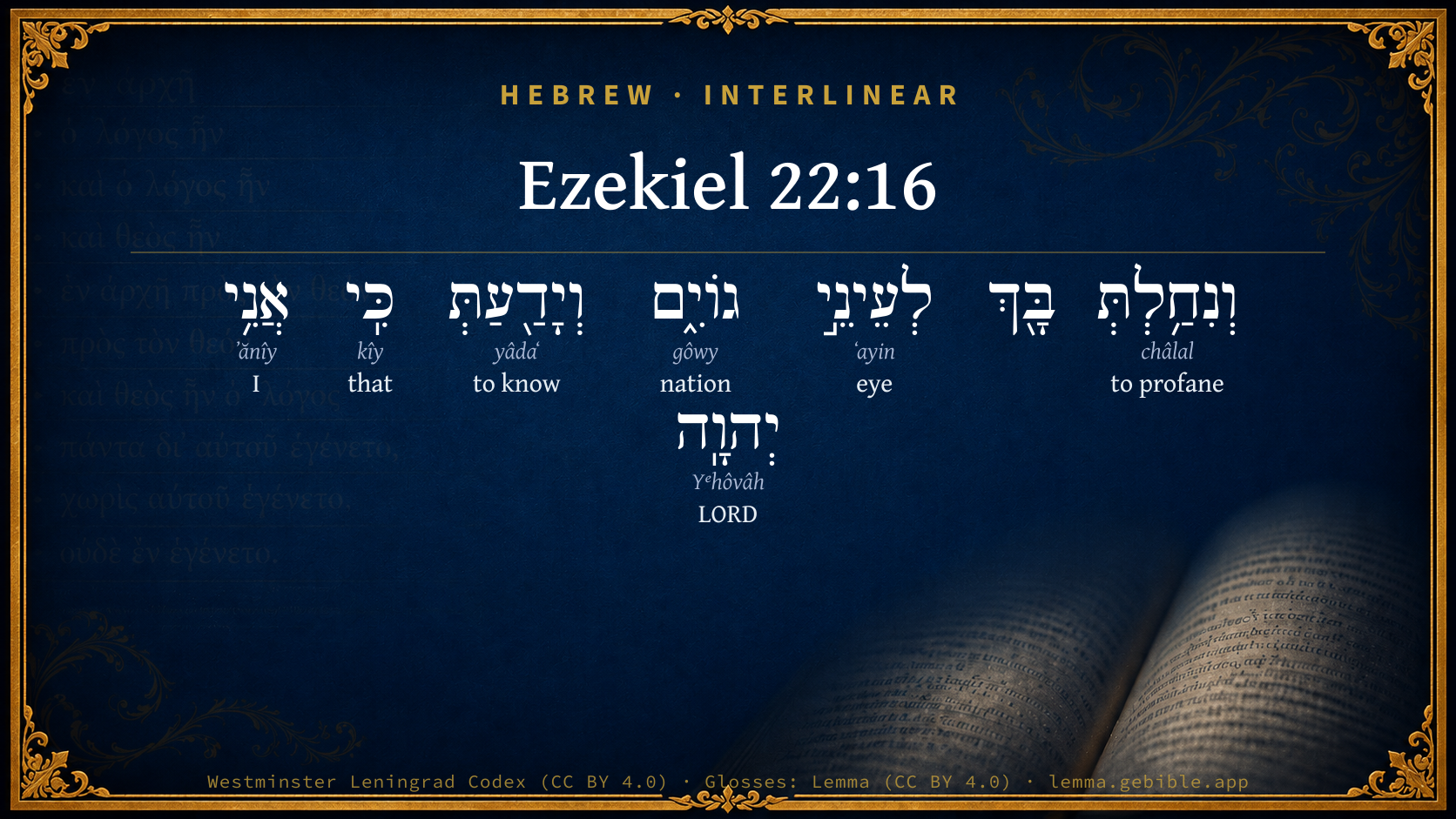
Ezekiel 22:16

Hebrew (Westminster Leningrad Codex) Ezekiel 22:16 appears in the Hebrew Old Testament. The text above is from the Westminster Leningrad Codex. Each word links to its Strong’s number, a concise gloss, and parsing drawn from the Open Scriptures Hebrew Bible morphology. Click any word for its full Brown-Driver-Briggs (BDB) entry.
Download image
Cite this verse

Ezekiel 22:16 (World English Bible). Public Domain. Lemma interlinear Bible study tool, https://lemma.gebible.app/v/ezekiel/22/16.

Show BibTeX & RIS
BibTeX
RIS
English Translation
You shall be profaned in yourself, in the sight of the nations; and you shall know that I am Yahweh.
World English Bible · Public Domain
Download a study sheet

One document with this verse’s original text, its word-by-word gloss line, the meaning frame, cross-references with their text, attributed commentary, and full source and license credits — printable, and it pastes into notes with its structure intact.

This verse Autodidact and up

Study sheet (.html) Plain text (.txt)

A passage Seminary Student

Up to 50 verses in one chapter. A passage sheet keeps up to 6 commentary sources and 12 cross-references per verse, in the order this page ranks them, and says so on the sheet whenever that leaves anything out. Ask for a single verse and you get the Autodidact verse sheet above.

Everything on this page stays free to read, with no account — the sheet is a download of what is already on screen, not access to it.

Want to remove ads? Support Godless Engineer
Compare translations 3

The same verse in 3 English versions, stacked beneath the original-language interlinear above. Click any original word for its lexicon entry.

Each is an independent rendering of the whole verse — the interlinear is not word-aligned to these translations.

Highlighted words mark where these versions differ — a whole-verse word diff, not a word-by-word alignment.

  • World English Bible Public Domain
    You shall be profaned in yourself, in the sight of the nations; and you shall know that I am Yahweh.
  • King James Version Public Domain
    And thou shalt take thine inheritance in thyself in the sight of the heathen, and thou shalt know that I am the LORD.
  • unfoldingWord Literal Text CC BY-SA 4.0
    So you will become unclean in the eyes of the nations. Then you will know that I am Yahweh.’”

unfoldingWord Literal Text — © unfoldingWord, licensed CC BY-SA 4.0. Word-aligned USFM3 via Door43 (git.door43.org/unfoldingWord/en_ult).

Versions to compare (up to 4)

3 of 4 selected

Show all 18 translations

Every available English version of this verse, each an independent rendering of the whole verse.

  • World English Bible Public Domain
    You shall be profaned in yourself, in the sight of the nations; and you shall know that I am Yahweh.
  • Berean Standard Bible Public Domain
    And when you have defiled yourself in the eyes of the nations, then you will know that I am the LORD.’”
  • Majority Standard Bible Public Domain
    And when you have defiled yourself in the eyes of the nations, then you will know that I am the LORD.’”
  • King James Version Public Domain
    And thou shalt take thine inheritance in thyself in the sight of the heathen, and thou shalt know that I am the LORD.
  • American Standard Version (1901) Public Domain
    And thou shalt be profaned in thyself, in the sight of the nations; and thou shalt know that I am Jehovah.
  • Revised Version (1885) Public Domain
    And thou shalt be profaned in thyself, in the sight of the nations; and thou shalt know that I am the LORD.
  • Geneva Bible (1599) Public Domain
    And thou shalt take thine inheritance in thy selfe in the sight of the heathen, and thou shalt knowe that I am the Lord.
  • Douay-Rheims (1899) Public Domain
    And I will possess thee in the sight of the Gentiles, and thou shalt know that I am the Lord.
  • Young's Literal Translation Public Domain
    And thou hast been polluted in thyself Before the eyes of nations, And thou hast known that I `am' Jehovah.'
  • Literal Standard Version CC BY-SA 4.0
    And you have been defiled in yourself || Before the eyes of nations, || And you have known that I [am] YHWH.”
  • Unlocked Literal Bible CC BY-SA 4.0
    So you will become unclean in the eyes of the nations. Then you will know that I am Yahweh.'”
  • unfoldingWord Literal Text CC BY-SA 4.0
    So you will become unclean in the eyes of the nations. Then you will know that I am Yahweh.’”
  • Darby Bible Public Domain
    And thou shalt be polluted through thyself in the sight of the nations, and thou shalt know that I [am] Jehovah.
  • World Messianic Bible Public Domain
    You will be profaned in yourself in the sight of the nations. Then you will know that I am the LORD.”’”
  • Webster's Bible Public Domain
    And thou shalt take thy inheritance in thyself in the sight of the heathen, and thou shalt know that I am the LORD.
  • Free Bible Version CC BY-SA 4.0
    For when everyone else sees how you've made yourselves unclean, then you will acknowledge that I am the Lord.”
  • Bible in Basic English Public Domain
    And you will be made low before the eyes of the nations; and it will be clear to you that I am the Lord.
  • JPS Tanakh (1917) Public Domain
    And thou shalt be profaned in thyself, in the sight of the nations; and thou shalt know that I am the LORD.'

Literal Standard Version (2020), Covenant Press — licensed CC BY-SA 4.0. Text via the HelloAO Bible API (eBible.org). Unlocked Literal Bible (unfoldingWord) — licensed CC BY-SA 4.0. Text via the HelloAO Bible API (eBible.org). unfoldingWord Literal Text — © unfoldingWord, licensed CC BY-SA 4.0. Word-aligned USFM3 via Door43 (git.door43.org/unfoldingWord/en_ult). Free Bible Version, Dr. Jonathan Gallagher — licensed CC BY-SA 4.0. Text via the HelloAO Bible API (eBible.org).

Word by word

More ways to search: Search by grammar → Find every occurrence → Compare this word →

Practice this passage: Drill this verse → Learn its vocabulary →

וְנִחַ֥לְתְּ
châlal
H2490
“and · to profane”
Conjunction + Verb, Niphal, Sequential Perfect, 2nd Person, Feminine, Singular
Part of Speech
Conjunction + Verb
Stem
Niphal
Form
Sequential Perfect
Person
2nd Person
Gender
Feminine
Number
Singular
Full BDB Definition

Origin: a primitive root [compare H2470 ]

TWOT: 660 , 661

to profane, defile, pollute, desecrate, begin - (Niphal) - to profane oneself, defile oneself, pollute oneself - ritually - sexually - to be polluted, be defiled - (Piel) - to profane, make common, defile, pollute - to violate the honour of, dishonour - to violate (a covenant) - to treat as common - (Pual) to profane (name of God) - (Hiphil) - to let be profaned - to begin - (Hophal) to be begun - to wound (fatally), bore through, pierce, bore - (Qal) to pierce - (Pual) to be slain - (Poel) to wound, pierce - (Poal) to be wounded - (Piel) to play the flute or pipe
  1. לְעֵינֵ֣י ʻayin H5869 “to/for · eyes of” Preposition + Noun, Common, Both, Dual, Construct
  2. גוֹיִ֑ם gôwy H1471 “nations” Noun, Common, Masculine, Plural, Absolute
  3. וְיָדַ֖עַתְּ yâdaʻ H3045 “and · to know” Conjunction + Verb, Qal, Sequential Perfect, 2nd Person, Feminine, Singular
  4. כִּֽי kîy H3588 “that” Conjunction
  5. אֲנִ֥י ʼănîy H589 “I” Pronoun, Personal, 1st Person, Common, Singular
  6. יְהוָֽה Yᵉhôvâh H3068 “LORD” Noun, Proper

About this verse

These counts appear in no published source. They are computed here, from the morphology-tagged text and Lemma’s own curated glosses. What Lemma adds →

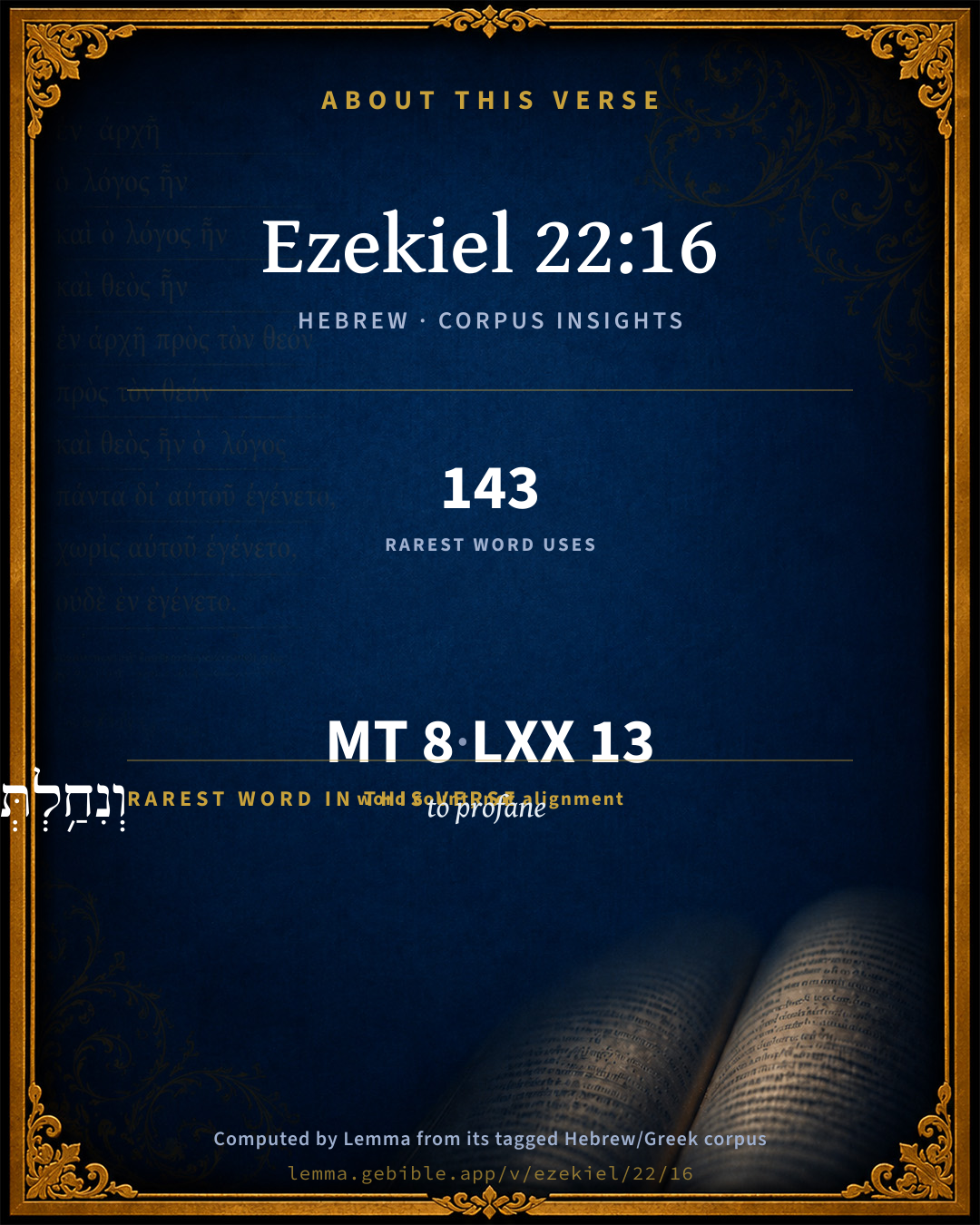
8
words
7
distinct lemmas
Prophets
section

Grammatical profile

  • 2 verbs
  • 3 nouns
  • 1 pronoun
  • 1 preposition
  • 1 conjunction

Verb forms

  • וְנִחַ֥לְתְּ Niphal · Sequential Perfect
  • וְיָדַ֖עַתְּ Qal · Sequential Perfect

Hebrew & Septuagint length

In English translation the verse runs 20 words from the Hebrew and 22 from the Septuagint (LXX English) — closely comparable.

A rough comparison of the two English renderings, which tokenize alike — not a word-level alignment.

Word counts can differ between the Hebrew and the Greek without any difference in meaning — e.g. the Hebrew direct-object marker אֵת has no separate Greek word, and Greek often adds the article ὁ.

In the original languages it is 8 Hebrew tokens and 13 Greek tokens — but the two are counted differently (Hebrew bundles its prefixes and suffixes into one token; the Greek is in lemma form), so that isn’t a like-for-like length.

Cross-references

15

Topical passages linked to Ezekiel 22:16 in the Treasury of Scripture Knowledge — connected by theme and wording, ordered by reader-vote popularity; previews shown in the World English Bible.

  • Psalms 83:18 That they may know that you alone, whose name is Yahweh, Are the Most High over all the earth.
  • Ezekiel 6:7 The slain shall fall in the midst of you, and you shall know that I am Yahweh.
  • Ezekiel 7:24 Therefore I will bring the worst of the nations, and they shall possess their houses: I will also make the pride of the strong to cease; and their holy places shall be profaned.
  • Exodus 8:22 I will set apart in that day the land of Goshen, in which my people dwell, that no swarms of flies shall be there; to the end you may know that I am Yahweh in the midst of the earth.
  • 1 Kings 20:13 Behold, a prophet came near to Ahab king of Israel, and said, Thus says Yahweh, Have you seen all this great multitude? behold, I will deliver it into your hand this day; and you shall know that I am Yahweh.
  • 1 Kings 20:28 A man of God came near and spoke to the king of Israel, and said, Thus says Yahweh, Because the Syrians have said, Yahweh is a god of the hills, but he is not a god of the valleys; therefore will I deliver all this great multitude into your hand, and you shall know that I am Yahweh.
  • Psalms 9:16 Yahweh has made himself known. He has executed judgment. The wicked is snared by the work of his own hands. Meditation. Selah.
  • Isaiah 37:20 Now therefore, Yahweh our God, save us from his hand, that all the kingdoms of the earth may know that you are Yahweh, even you only.
  • Isaiah 43:28 Therefore I will profane the princes of the sanctuary; and I will make Jacob a curse, and Israel a reviling.
  • Isaiah 47:6 I was angry with my people, I profaned my inheritance, and gave them into your hand: you did show them no mercy; on the aged have you very heavily laid your yoke.
  • Ezekiel 25:3 and tell the children of Ammon, Hear the word of the Lord Yahweh: Thus says the Lord Yahweh, Because you said, Aha, against my sanctuary, when it was profaned; and against the land of Israel, when it was made desolate; and against the house of Judah, when they went into captivity:
  • Ezekiel 39:6–7 I will send a fire on Magog, and on those who dwell securely in the isles; and they shall know that I am Yahweh.
  • Ezekiel 39:28 They shall know that I am Yahweh their God, in that I caused them to go into captivity among the nations, and have gathered them to their own land; and I will leave none of them any more there;
  • Daniel 4:25 that you shall be driven from men, and your dwelling shall be with the animals of the field, and you shall be made to eat grass as oxen, and shall be wet with the dew of the sky, and seven times shall pass over you; until you know that the Most High rules in the kingdom of men, and gives it to whoever he will.
  • Daniel 4:32–35 and you shall be driven from men; and they dwelling shall be with the animals of the field; you shall be made to eat grass as oxen; and seven times shall pass over you; until you know that the Most High rules in the kingdom of men, and gives it to whoever he will.

Cross-references courtesy of OpenBible.info (CC BY 4.0).

Hebrew and Greek witnesses Masoretic Hebrew ↔ Greek Septuagint

The same verse in the two great witnesses to the Old Testament, shown verse-for-verse.

These are two independent witnesses, not word-aligned to each other, and the Septuagint is shown in lemma (dictionary) form.

Hebrew Ezekiel 22:16 Masoretic · Westminster Leningrad Codex

וְנִחַ֥לְתְּ בָּ֖ךְ לְעֵינֵ֣י גוֹיִ֑ם וְיָדַ֖עַתְּ כִּֽי אֲנִ֥י יְהוָֽה

You shall be profaned in yourself, in the sight of the nations; and you shall know that I am Yahweh.

World English Bible · Public Domain

Greek LXX Ezekiel 22:16 Septuagint · lemma form

καί κατακληρονομέω ἐν σύ κατά ὀφθαλμός ὁ ἔθνος καί γιγνώσκω διότι ἐγώ κύριος

And I will give heritages in you in the sight of the nations, and you⌃ shall know that I am the Lord.

LXX2012 (modern English Septuagint) · Public Domain

On this verse, Haydock's Catholic Bible Commentary discusses the Septuagint’s reading. Read the note in Commentary ↓

Hebrew: Westminster Leningrad Codex (CC BY 4.0). Greek: Septuagint (public domain); English from LXX2012 (modern English Septuagint) (Public Domain). How the Septuagint differs from the Hebrew →

Targum (Aramaic paraphrase)

1

The Targum is the ancient Jewish Aramaic paraphrase of the Hebrew Scriptures — an interpretive translation, not the Hebrew text itself. Onkelos (literal) and Pseudo-Jonathan (expansive) render the Torah, and Jonathan the Prophets. Coverage is partial: where no permissively-licensed English translation exists for a verse, only the Aramaic is shown. This is verse-level text, not a word-by-word alignment to the Hebrew.

  1. Targum Jonathan Prophets (Joshua–Malachi)
    וְאֶתְקַדֵשׁ בִּיךְ לְעֵינֵי עַמְמַיָא וְתֵידְעוּן אֲרֵי אֲנָא יְיָ:

    (no public-domain English translation for this verse)

    Targum Jonathan — Aramaic: “Mikraot Gedolot” (public domain). English: “Sefaria Community Translation” (CC0 1.0 (public-domain dedication)); “London "Chaldee Paraphrase," 1871” (public domain). Text via Sefaria.

Commentary

Notes on Ezekiel 22:16 from classic Christian and Jewish commentators (each source and its license shown beneath its notes). The classic Christian expositions comment on the surrounding passage and are grouped to its opening verse, so a note may address several verses; the Jewish commentaries on the Tanakh (Rashi and others) are per-verse, so they appear only where the commentator wrote on this verse.

Lemma curates 59 commentaries, every one of them public domain or Creative Commons licensed, each selected and text-cleaned for this edition rather than reprinted as found. About our sources →

Trapp's Complete Commentary

John Trapp

Eze 22:16 And thou shalt take thine inheritance in thyself in the sight of the heathen, and thou shalt know that I [am] the LORD.

Ver. 16. And thou shalt take thine inheritance in thyself,] q.d., I will abandon thee. Or, Thou shall be profaned and polluted.

And thou shalt know that I am the Lord.] Thou shalt know me by my punishments, whom thou wouldst not know by my benefits.

John Trapp, A Commentary or Exposition upon All the Books of the Old and New Testament (1647–1656) — public domain. Text from a community e-Sword module.

The Biblical Illustrator

Joseph S. Exell

Eze_22:16

Thou shalt take thine inheritance in thyself.

Inheritance in thyself

Man, as a moral being, cannot have happiness or misery independently of his inner life. Each man in some sense farms his own nature, and reaps the harvest planted by his own hands. Man is a wealthy proprietor. No lordly acres, no wide domain of forest land can ever equal the enclosure of his own heart.

I. In a human sense we take our inheritance in ourselves. Most certainly we are inheritors of our past human delinquencies, or of the joy of duties fulfilled. All other inheritances drop off from us; like gathered flowers they fade! These are rooted in our hearts. Men may blame us and be wrong, or praise us and be wrong! But our conscience is a true rest, and happy the man whose smile is as bright, whose voice as cheery, and whose step is as elastic, whether the world crowns him with garlands or stones him with scorn!

II. In a mental sense we take our inheritance in ourselves. Mind is a most productive soil. Tend it well, and do not hurry the crops, and there is nothing so wonderful in the universe of God. When you enter the British Museum, remember that from year to year every little and every large volume has to be received and registered there. What a registry it is, but it is nothing to the registry of the human brain! How easily it works, how quickly it shelves for future use the rarest thoughts, how wonderfully at call it brings the fact or the illustration, not by some stately messenger, but by the swift telegraphy of its own sensations.

III. In a moral sense we take our inheritance in ourselves.

1. How true it is of national life. Rome took her inheritance when, ceasing the virtues of simplicity, honour, and home life, she chose luxury, pleasure, and the pomp of war. Greece took her inheritance when, choosing philosophic disquisitions and sophistical debates, she darkened the moral sense by mere casuistry. Jerusalem took her inheritance when, forsaking the sublime simplicity and tender spirituality of her faith, she became rabbinical in her theology, inhuman in her neglect of the needy, and proud in the speciality of her privileges. In each ease the inheritance came: the military strength of the northern armies crushed the power of Rome; the enfeeblement of Epicureanism and refined libertinism seized upon the heart of Greece; and the pride, prejudice, and pernicious formalism of the Pharisees slew the soul of Hebrew piety.

2. We, too--each of us--take the inheritance in ourselves; the harvests of life are either tares or wheat, according to our past sowing. Nor does the Gospel of Jesus Christ interfere with this law. When we become Christians our past sins are forgiven us through the precious blood of Christ., but their influence on our after character and life growth is not hereby destroyed. Old habits, old pursuits, old readings, old companionships are not dead and forgotten in a day. They, too, still will be helping or hindering our progress in the Divine life, and elevating or depressing the spirituality of our minds.

IV. In all these aspects of life we mark the Divine fitness of things. If men tell us that we have no business to occupy our thoughts with moral fitnesses, that Gods yea is yea, and Gods nay is nay, whatever we may judge, we answer that God is more considerate than such critics, for He has condescended to appeal to us, that we may judge between Him and His vineyard; He has permitted the record of those early cries--This be far from Thee, Lord, to destroy the righteous with the wicked. Shall not the Judge of all the earth do right? And he has sanctioned St. Pauls appeal not to every mans blind obedience, but to every mans conscience in the sight of God. Thus we can rest our arguments upon the unimpeachable bases of Scripture and conscience.

V. In the ministry of Christ we see this great fact recognised. The Divine Lord saw, as we never can, the hearts of men. He not only saw rich publicans and lowly Nazarenes, not only lordly Pharisees and impoverished Samaritans, but He saw the great heart burthens men were everywhere bearing.. Surely He was a Prophet, and more than a Prophet; for prophets came to warn and to condemn, to lift up the cry, Repent! repent! But this face was not like one of the old prophets. No! There were touches of tenderness in it such as they had not, womanly almost, yet weak. Out, out, they went to Christ. Surely the voice was strange, for great souls fill words with love as well as thought, and what would not the Divine soul do? Yes! they heard Jesus. Never man spake as He spake. And what was His theme? Ah! it is well that we know it. Come, ye inheritors of shame and woe and ill-gotten wealth, and long-repented lives of sensual sin! Come! you cannot lose your memories of life, you cannot cut off their influence on mind and heart; but the bitter, bitter inheritance of shame and agony and woe and guilt--you, even you, may lose all these! Listen to me: I am the Good Shepherd; the Good Shepherd giveth His life for the sheep. Come unto Me, all ye that labour and are heavy laden, and I will give you rest.

VI. In the future days the inheritance will work itself out. Yes! Thou shalt take it. As a pilgrim of eternity, you take the life burthen with you. He that soweth to the flesh, shall of the flesh reap corruption; and he that soweth to the spirit, shall of the spirit reap life everlasting. This is in exact harmony with moral law. (W. M. Statham.)

The Biblical Illustrator, edited by Joseph S. Exell (c. 1880s–1900s) — public domain. Text from a community e-Sword module.

Tyndale Open Study Notes

Tyndale Open Resources

22:16 when I have been dishonored among the nations because of you: Having his people scattered among the nations instead of dwelling in the land of promise inevitably dishonored the Lord, since it appeared that he was unable to give them what he had promised. However, the Lord was willing to endure that dishonor so that his forgetful people could learn to remember him.

Tyndale Open Study Notes — © Tyndale Open Resources, licensed CC BY-SA 4.0. Text via the HelloAO Bible API.

Geneva Bible (1599)

Geneva Bible translators

Thou shalt be no more the inheritance of the Lord, but forsaken.

Geneva Bible (1599) marginal notes — public domain. Text via Bolls.life.

Jamieson, Fausset & Brown

Robert Jamieson, A. R. Fausset & David Brown

take thine inheritance in thyself--Formerly thou wast Mine inheritance; but now, full of guilt, thou art no longer Mine, but thine own inheritance to thyself; "in the sight of the heathen," that is, even they shall see that, now that thou hast become a captive, thou art no longer owned as Mine [VATABLUS]. FAIRBAIRN and others needlessly take the Hebrew from a different root, "thou shalt be polluted by ('in,' [HENDERSON]) thyself," &c.; the heathen shall regard thee as a polluted thing, who hast brought thine own reproach on thyself.

Jamieson, Fausset & Brown — Commentary Critical and Explanatory on the Whole Bible (1871) — public domain (CC PDM 1.0). Text via the HelloAO Bible API.

Adam Clarke's Commentary

Verse 16. Thou shalt know that I am the Lord.] I shall so deal with and punish thee, that thou shalt be obliged to own the vindictive hand of a sin-avenging God.

Adam Clarke's Commentary on the Bible (1810–1826) — public domain. Text from a community e-Sword/MySword module.

Ellicott's Commentary for English Readers

(16) Shalt take thine inheritance.—Rather, thou shalt be profaned by thyself. The same word occurs in Eze_7:24, and is there rendered “shall be defiled;” it admits of either sense, according to its derivation. The meaning is that through their own misconduct they forfeit the privileges of a holy nation, and become profaned or dishonoured in the sight of the heathen. The first prophecy of this chapter closes with the terrible warning of Eze_22:14-16, showing the extreme suffering necessary for the purification of Israel.

A Bible Commentary for English Readers, edited by Charles John Ellicott (1878–1897) — public domain. Text from a community e-Sword module.

The Cambridge Bible for Schools and Colleges

gen. ed. J. J. S. Perowne

16. take thine inheritance] According to the points: and thou shalt be profaned in (through) thyself. The idea that Jehovah “profanes” his people by casting them out of their land is not uncommon, Isa_43:28; Isa_47:6, cf. Eze_24:21 (Eze_28:16). It is doubtful if it be anywhere said that this casting out of the people is a profanation of them “in the sight of the heathen.” On the other hand that phrase is often used when Jehovah himself, or his name, is spoken of as being profaned, ch. Eze_20:9; Eze_20:14; Eze_20:22. Particularly it is said that Israel’s dispersion among the nations profaned Jehovah’s name, ch. Eze_36:20-23, and in Eze_39:7 Jehovah says, I will not pollute (let be polluted) my name any more (by the humiliation of his people). A slight change of reading gives: and I will be profaned in thee in the sight.… The whole passage speaks of the chastisement of Israel, not of the purging away their uncleanness (Eze_22:15), which is mentioned incidentally (cf. Eze_22:22). This chastisement is dispersion among the nations, by which Jehovah is profaned and by which Israel learns to know that he who disperses them is the Lord. Corn. suggests: by which (uncleanness) I have been profaned in thee. Does the idea appear in the prophet that Jehovah was profaned in the eyes of the nations by Israel’s idolatries?

The Cambridge Bible for Schools and Colleges (gen. ed. J. J. S. Perowne; Cambridge University Press, 1878–1918) — public domain. Text from a community e-Sword module.

John Gill's Exposition

And thou shalt take thine inheritance in thyself in the sight of the Heathen,.... No longer be the inheritance of God, but their own; and not have God to be their portion and inheritance, but themselves; and a poor portion and inheritance that must be, being in captivity, poverty, and distress; enjoying neither their civil nor religious liberties, as heretofore; it would be now manifest to the Heathens that they were forsaken of God, and left to themselves. Some render it, "and thou shalt be profaned, or polluted in thyself" (e); shalt be known to be so to thyself, as well as appear so to others. The Targum is,

"I will be sanctified in thee before the people:''

and thou shalt know that I am the Lord; able to do what I say; faithful to my word; omniscient, omnipresent, and omnipotent; and this thou shalt not only know, but own and acknowledge, when these calamities take place, and have their effect.

(e) "et prophana effecta in te", Junius & Tremellius, Polanus; "prophana efficeris", Piscator; "et polluta eris in te", Grotius; "et prophnata eris in te", Starckiss; "et prophanaberis in te", Cocceius.

John Gill's Exposition of the Whole Bible (1746–1763) — public domain (CC PDM 1.0). Text via the HelloAO Bible API.

Albert Barnes' Notes on the Bible

Thou shalt take ... - Better as in the margin. Thou shalt by thine own fault forfeit the privileges of a holy nation.

Albert Barnes' Notes on the Bible (1834–1885) — public domain. Text from a community e-Sword/MySword module.

Haydock's Catholic Bible Commentary

Possess, "as an inheritance:" (Septuagint; Haydock) "I will defile:" (Aquila) "wound thee." (Symmachus) Hebrew is very different: (Calmet) "thou hast inherited in thyself," (Haydock) being no longer willing to be subject.

George Leo Haydock (1774–1849), Haydock's Catholic Family Bible and Commentary, 1859 edition — public domain. Excludes Psalms (Douay-Rheims chapter numbering differs from Protestant) and Deuterocanonical books (Catholic canon only).

Matthew Poole's English Annotations

Whereas I was thine inheritance, and thou enjoyedst all riches, delight, safety, peace, and honour in me, so long as thou wert a holy, obedient people; now that you are polluted, a very sink of all filthiness, for which I have cast thee off, and sent thee into captivity, there be to thyself what thou canst be, for I will not be thine inheritance. And this forlorn, abject, helpless state shall be so visible, that the very heathen shall discern, and know, that you are rejected of your God, and he very just in doing so.

Matthew Poole's English Annotations on the Holy Bible (1683–1685) — public domain. Text from a community e-Sword/MySword module.

Whedon's Commentary on the Bible

Daniel D. Whedon

16. And thou shalt take thine inheritance — Rather, as margin, thou shalt be profaned. The name of the holy people, like the holy name of Jehovah, is profaned by their idolatries and consequent punishment (note Eze_20:9). Jerusalem had sought by all manner of wickedness to win the applause and love of the heathen, but gains only their contempt.

Daniel D. Whedon (gen. ed.), Commentary on the Old and New Testaments (1874–1909) — public domain. Text from a community e-Sword module.

The Pulpit Commentary

Thou shalt take thine inheritance, etc.; better, with the Revised Version, Keil, and most other commentators, shalt be profaned in thyself, etc. The prophet is still speaking of punishment, not of restoration.

The Pulpit Commentary (1880–1919), ed. H.D.M. Spence-Jones & Joseph S. Exell — public domain. Text from a community e-Sword module.

John Wesley's Explanatory Notes

In thyself - Whereas I was thine inheritance so long as thou wert a holy, obedient people; now be an inheritance to thyself, if thou canst.

John Wesley, Explanatory Notes Upon the Whole Bible (1754–1765) — public domain. Text via the GEBible commentary corpus.

Rashi

Rabbi Shlomo Yitzchaki (Rashi)

And you shall be profaned within yourself Heb. וְנִחַלְתָּ בָּךְ, you shall be profaned within yourself for what you have done.

Rashi on the Tanakh — English translations: “The Judaica Press complete Tanach with Rashi, translated by A. J. Rosenberg” (CC BY 4.0); “Pentateuch with Rashi's commentary by M. Rosenbaum and A.M. Silbermann, 1929-1934” (public domain); “The Metsudah Tanach series, Lakewood, N.J” (CC BY 4.0); and “The Book of Joshua, Metsudah Publications, 1997” (CC BY 4.0). Text via Sefaria.

Lesson kit

Teaching starters — assembled from the data on this page, not authored interpretation. Every prompt links to the verse data it draws on. Edit before teaching.

Ezekiel, in the Prophets, opens this verse with 8 words (7 distinct Hebrew lemmas). Its most distinctive word is châlal (“to profane”). A historical commentator’s framing appears above. Read the whole chapter for the surrounding context.

Discussion questions

  1. What does “to profane” (châlal) contribute to the verse as a whole?
  2. Psalms 83:18 shares this passage’s theme. How do the two illuminate each other?
  3. These translations render this verse differently; the difference is in the English rendering, not the original. What questions does that raise?
  4. The verb «וְנִחַ֥לְתְּ» is Niphal Sequential Perfect. How does its form color the action?
  5. Reading how Trapp's Complete Commentary and The Biblical Illustrator read this verse, where do the two commentators agree and where do they part?

Things to notice

Reading settings

Reading text

Shown beneath each verse's original-language words.

Old Testament
Old Testament edition

Read the OT as the Masoretic Hebrew (MT) or the Greek Septuagint (LXX).

English shown for the Greek Septuagint (in the Hebrew ↔ Greek comparison).

Comparing translations? Open the Compare panel on any verse page to stack up to four side by side.