
Psalms 102:15

Hebrew (Westminster Leningrad Codex) Psalms 102:15 appears in the Hebrew Old Testament. The text above is from the Westminster Leningrad Codex. Each word links to its Strong’s number, a concise gloss, and parsing drawn from the Open Scriptures Hebrew Bible morphology. Click any word for its full Brown-Driver-Briggs (BDB) entry.
Download image
Cite this verse

Psalms 102:15 (World English Bible). Public Domain. Lemma interlinear Bible study tool, https://lemma.gebible.app/v/psalms/102/15.

Show BibTeX & RIS
BibTeX
RIS
English Translation
So the nations will fear the name of Yahweh; All the kings of the earth your glory.
World English Bible · Public Domain
Download a study sheet

One document with this verse’s original text, its word-by-word gloss line, the meaning frame, cross-references with their text, attributed commentary, and full source and license credits — printable, and it pastes into notes with its structure intact.

This verse Autodidact and up

Study sheet (.html) Plain text (.txt)

A passage Seminary Student

Up to 50 verses in one chapter. A passage sheet keeps up to 6 commentary sources and 12 cross-references per verse, in the order this page ranks them, and says so on the sheet whenever that leaves anything out. Ask for a single verse and you get the Autodidact verse sheet above.

Everything on this page stays free to read, with no account — the sheet is a download of what is already on screen, not access to it.

Want to remove ads? Support Godless Engineer
Compare translations 3

The same verse in 3 English versions, stacked beneath the original-language interlinear above. Click any original word for its lexicon entry.

Each is an independent rendering of the whole verse — the interlinear is not word-aligned to these translations.

Highlighted words mark where these versions differ — a whole-verse word diff, not a word-by-word alignment.

  • World English Bible Public Domain
    So the nations will fear the name of Yahweh; All the kings of the earth your glory.
  • King James Version Public Domain
    So the heathen shall fear the name of the LORD, and all the kings of the earth thy glory.
  • unfoldingWord Literal Text CC BY-SA 4.0
    The nations will fear the name of Yahweh, and all the kings of the earth, your glory.

unfoldingWord Literal Text — © unfoldingWord, licensed CC BY-SA 4.0. Word-aligned USFM3 via Door43 (git.door43.org/unfoldingWord/en_ult).

Versions to compare (up to 4)

3 of 4 selected

Show all 18 translations

Every available English version of this verse, each an independent rendering of the whole verse.

  • World English Bible Public Domain
    So the nations will fear the name of Yahweh; All the kings of the earth your glory.
  • Berean Standard Bible Public Domain
    So the nations will fear the name of the LORD, and all the kings of the earth will fear Your glory.
  • Majority Standard Bible Public Domain
    So the nations will fear the name of the LORD, and all the kings of the earth will fear Your glory.
  • King James Version Public Domain
    So the heathen shall fear the name of the LORD, and all the kings of the earth thy glory.
  • American Standard Version (1901) Public Domain
    So the nations shall fear the name of Jehovah, And all the kings of the earth thy glory.
  • Revised Version (1885) Public Domain
    So the nations shall fear the name of the LORD, and all the kings of the earth thy glory:
  • Geneva Bible (1599) Public Domain
    Then the heathen shall feare the Name of the Lord, and all the Kings of the earth thy glory,
  • Douay-Rheims (1899) Public Domain
    For the stones thereof have pleased thy servants: and they shall have pity on the earth thereof.
  • Young's Literal Translation Public Domain
    And nations fear the name of Jehovah, And all kings of the earth Thine honour,
  • Literal Standard Version CC BY-SA 4.0
    And nations fear the Name of YHWH, || And all kings of the earth Your glory,
  • Unlocked Literal Bible CC BY-SA 4.0
    The nations will respect your name, Yahweh, and all the kings of the earth will honor your glory.
  • unfoldingWord Literal Text CC BY-SA 4.0
    The nations will fear the name of Yahweh, and all the kings of the earth, your glory.
  • Darby Bible Public Domain
    And the nations shall fear the name of Jehovah, and all the kings of the earth thy glory.
  • World Messianic Bible Public Domain
    So the nations will fear the LORD’s name, all the kings of the earth your glory.
  • Webster's Bible Public Domain
    \\102:14\\For thy servants take pleasure in her stones, and favor the dust thereof.
  • Free Bible Version CC BY-SA 4.0
    Then the nations will be in awe of who you are, Lord; all the kings of the earth will be in awe of your glory.
  • Bible in Basic English Public Domain
    So the nations will give honour to the name of the Lord, and all the kings of the earth will be in fear of his glory:
  • JPS Tanakh (1917) Public Domain
    (102-16) So the nations will fear the name of the LORD, and all the kings of the earth Thy glory;

Literal Standard Version (2020), Covenant Press — licensed CC BY-SA 4.0. Text via the HelloAO Bible API (eBible.org). Unlocked Literal Bible (unfoldingWord) — licensed CC BY-SA 4.0. Text via the HelloAO Bible API (eBible.org). unfoldingWord Literal Text — © unfoldingWord, licensed CC BY-SA 4.0. Word-aligned USFM3 via Door43 (git.door43.org/unfoldingWord/en_ult). Free Bible Version, Dr. Jonathan Gallagher — licensed CC BY-SA 4.0. Text via the HelloAO Bible API (eBible.org).

Word by word

More ways to search: Search by grammar → Find every occurrence → Compare this word →

Practice this passage: Drill this verse → Learn its vocabulary →

כְּבוֹדֶֽךָ
kâbôwd
H3519
“glory · your”
Noun, Common, Both, Singular, Construct + Suffix, Personal, 2nd Person, Masculine, Singular
Part of Speech
Noun
Type
Common
Gender
Both
Number
Singular
State
Construct
Full BDB Definition

Origin: from H3513

TWOT: 943d , 943e

glory, honour, glorious, abundance - abundance, riches - honour, splendour, glory - honour, dignity - honour, reputation - honour, reverence, glory - glory
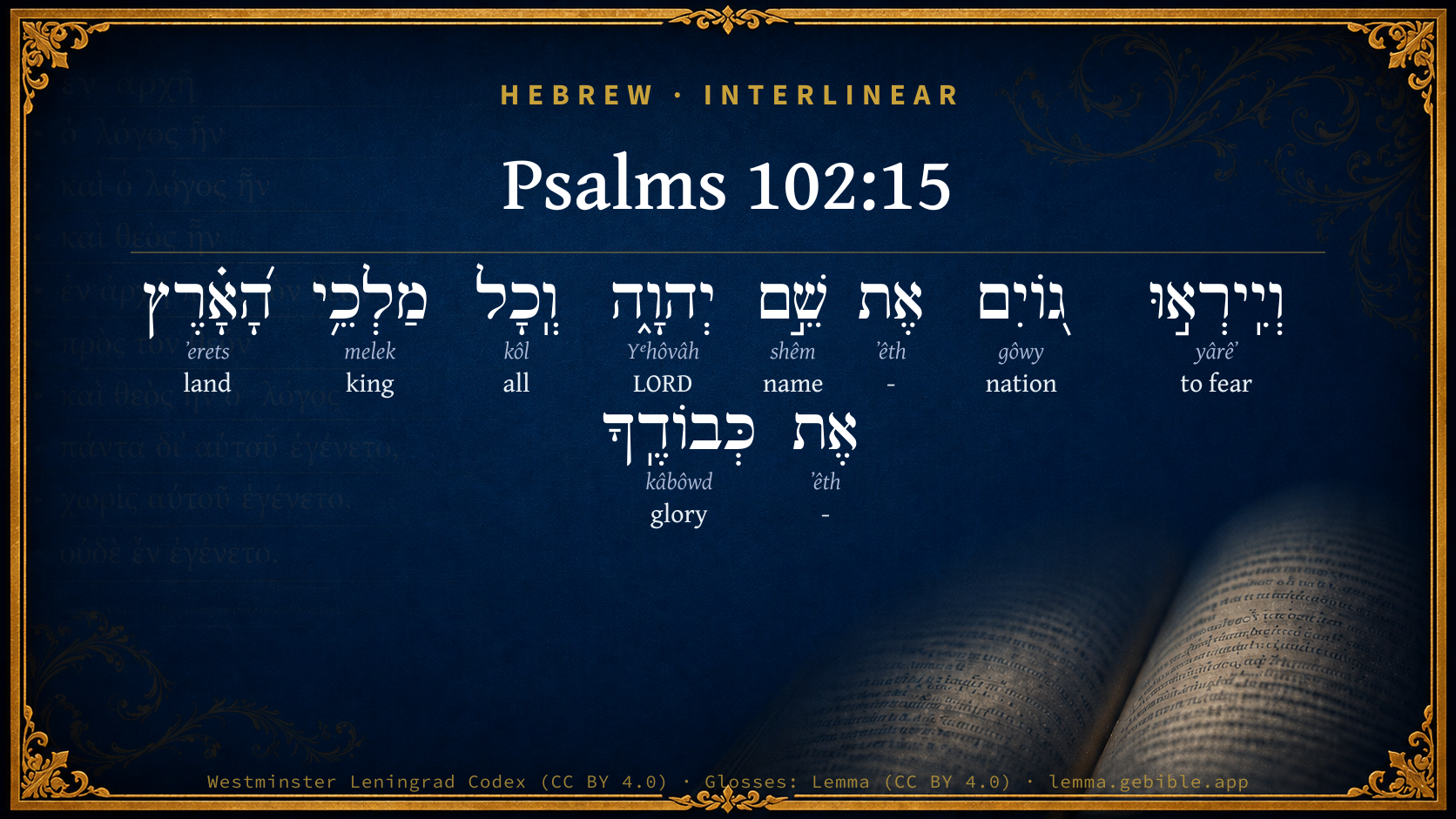
  1. וְיִֽירְא֣וּ yârêʼ H3372 “and · to fear” Conjunction + Verb, Qal, Imperfect, 3rd Person, Masculine, Plural
  2. ג֭וֹיִם gôwy H1471 “nations” Noun, Common, Masculine, Plural, Absolute
  3. אֶת ʼêth H853 “-” Particle, Direct Object
  4. שֵׁ֣ם shêm H8034 “name of” Noun, Common, Masculine, Singular, Construct
  5. יְהוָ֑ה Yᵉhôvâh H3068 “LORD” Noun, Proper
  6. וְֽכָל kôl H3605 “and · all of” Conjunction + Noun, Common, Masculine, Singular, Construct
  7. מַלְכֵ֥י melek H4428 “kings of” Noun, Common, Masculine, Plural, Construct
  8. הָ֝אָ֗רֶץ ʼerets H776 “the · land” Particle, Definite Article + Noun, Common, Both, Singular, Absolute
  9. אֶת ʼêth H853 “-” Particle, Direct Object

About this verse

These counts appear in no published source. They are computed here, from the morphology-tagged text and Lemma’s own curated glosses. What Lemma adds →

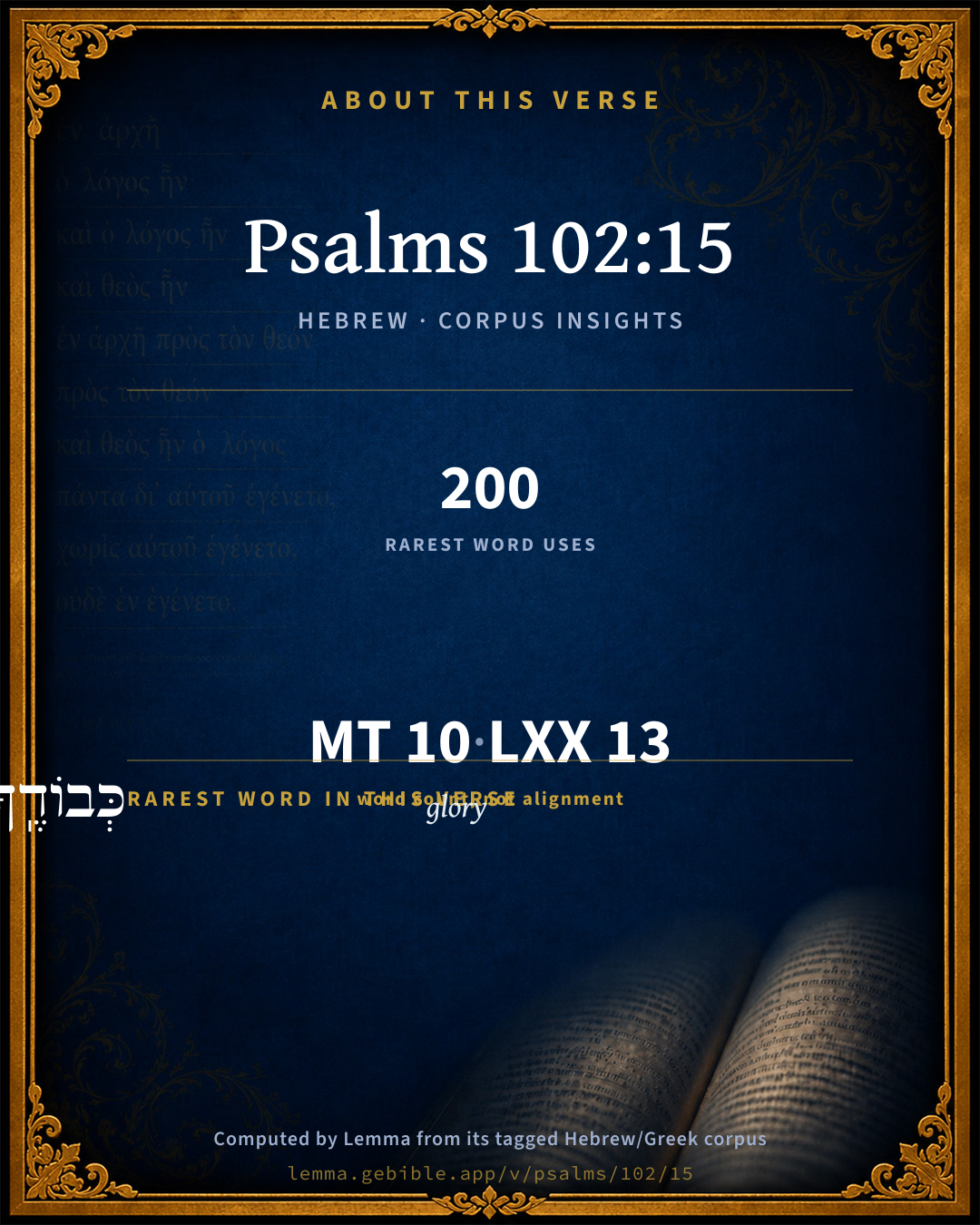
10
words
9
distinct lemmas
Wisdom
section

Grammatical profile

  • 1 verb
  • 7 nouns
  • 2 particles

Verb forms

  • וְיִֽירְא֣וּ Qal · Imperfect

Hebrew & Septuagint length

In English translation the verse runs 17 words from the Hebrew and 14 from the Septuagint (LXX English) — closely comparable.

A rough comparison of the two English renderings, which tokenize alike — not a word-level alignment.

Word counts can differ between the Hebrew and the Greek without any difference in meaning — e.g. the Hebrew direct-object marker אֵת has no separate Greek word, and Greek often adds the article ὁ.

In the original languages it is 10 Hebrew tokens and 13 Greek tokens — but the two are counted differently (Hebrew bundles its prefixes and suffixes into one token; the Greek is in lemma form), so that isn’t a like-for-like length.

Cross-references

11

Topical passages linked to Psalms 102:15 in the Treasury of Scripture Knowledge — connected by theme and wording, ordered by reader-vote popularity; previews shown in the World English Bible.

  • 1 Kings 8:43 hear in heaven, your dwelling-place, and do according to all that the foreigner calls to you for; that all the peoples of the earth may know your name, to fear you, as does your people Israel, and that they may know that this house which I have built is called by my name.
  • Psalms 138:4 All the kings of the earth will give you thanks, Yahweh, For they have heard the words of your mouth.
  • Isaiah 60:3–22 Nations shall come to your light, and kings to the brightness of your rising.
  • Psalms 86:9 All nations you have made will come and worship before you, Lord. They shall glorify your name.
  • Zechariah 8:20–23 Thus says Yahweh of Hosts: "Many peoples, and the inhabitants of many cities will yet come;
  • Psalms 67:2–4 That your way may be known on earth, And your salvation among all nations,
  • Psalms 68:31–32 Princes shall come out of Egypt. Ethiopia shall hurry to stretch out her hands to God.
  • Psalms 72:11 Yes, all kings shall fall down before him. All nations shall serve him.
  • Revelation 11:15 The seventh angel sounded, and great voices in heaven followed, saying, "The kingdom of the world has become the Kingdom of our Lord, and of his Christ. He will reign forever and ever!"
  • Isaiah 55:5 Behold, you shall call a nation that you don't know; and a nation that didn't know you shall run to you, because of Yahweh your God, and for the Holy One of Israel; for he has glorified you.
  • Revelation 21:24 The nations will walk in its light. The kings of the earth bring the glory and honor of the nations into it.

Cross-references courtesy of OpenBible.info (CC BY 4.0).

Hebrew and Greek witnesses Masoretic Hebrew ↔ Greek Septuagint

The same verse in the two great witnesses to the Old Testament, shown verse-for-verse.

You’re reading Greek Psalm 101 (Hebrew Psalm 102). The Septuagint counts the superscription, so verse numbers can differ from the Hebrew — chapter-level alignment, not verse-by-verse. Numbering follows Rahlfs.

These are two independent witnesses, not word-aligned to each other, and the Septuagint is shown in lemma (dictionary) form.

Hebrew Psalms 102:15 Masoretic · Westminster Leningrad Codex

וְיִֽירְא֣וּ ג֭וֹיִם אֶת שֵׁ֣ם יְהוָ֑ה וְֽכָל מַלְכֵ֥י הָ֝אָ֗רֶץ אֶת כְּבוֹדֶֽךָ

So the nations will fear the name of Yahweh; All the kings of the earth your glory.

World English Bible · Public Domain

Greek LXX Greek Psalm 101:15 Septuagint · lemma form

ὅτι εὐδοκέω ὁ δοῦλος σύ ὁ λίθος αὐτός καί ὁ χοῦς αὐτός οἰκτείρω

So the nations shall fear your name, O Lord, and all kings your glory.

LXX2012 (modern English Septuagint) · Public Domain

On this verse, Keil & Delitzsch discusses the Septuagint’s reading. Read the note in Commentary ↓

Hebrew: Westminster Leningrad Codex (CC BY 4.0). Greek: Septuagint (public domain); English from LXX2012 (modern English Septuagint) (Public Domain). How the Septuagint differs from the Hebrew →

Commentary

Notes on Psalms 102:15 from classic Christian and Jewish commentators (each source and its license shown beneath its notes). The classic Christian expositions comment on the surrounding passage and are grouped to its opening verse, so a note may address several verses; the Jewish commentaries on the Tanakh (Rashi and others) are per-verse, so they appear only where the commentator wrote on this verse.

Lemma curates 59 commentaries, every one of them public domain or Creative Commons licensed, each selected and text-cleaned for this edition rather than reprinted as found. About our sources →

Trapp's Complete Commentary

John Trapp

Psa 102:15 So the heathen shall fear the name of the LORD, and all the kings of the earth thy glory.

Ver. 15. So the heathen shall fear, &c.] By the restoration of Jerusalem, where the Messiah was to be born and manifested, the everlasting gospel shall be preached, and the Gentiles converted to the faith.

And all the kings of the earth] Caught by those fishermen, and their successors in the ministry.

John Trapp, A Commentary or Exposition upon All the Books of the Old and New Testament (1647–1656) — public domain. Text from a community e-Sword module.

Joseph Benson's Commentary

Psa 102:15. So the heathen shall fear the Lord, &c. — Shall have high thoughts of him and his people, and even the kings of the earth shall be affected with his glory. They shall think better of the church of God than they have done, when God, by his providence, thus puts honour upon it; and they shall be afraid of doing any thing against it, when they see God taking its part. Thus it is said, Est 8:17, that many of the people of the land became Jews, for the fear of the Jews fell upon them. This promise was in some sort fulfilled, when the rebuilding of the temple and city of God was carried on and completed, to the admiration, envy, and terror of their enemies, notwithstanding the many and great difficulties and oppositions which the Jews had to encounter, Neh 6:16; Psa 126:2; but it was much more truly and fully accomplished in the building of the spiritual Jerusalem by Christ, unto whom the Gentiles were gathered, and to whom the princes of the world paid their acknowledgments.

Joseph Benson's Commentary on the Old and New Testaments (1811–1818) — public domain. Text from a community e-Sword module.

J. A. Alexander on Psalms

Joseph Addison Alexander

16. (Psa 102:15) And nations shall fear the name of Jehovah, and all kings of the earth thy glory. The impression of awe, unavoidably produced by these exhibitions of Jehovah's attributes, shall not be limited to Israel, but extend to other nations, and even kings shall vie with each other in their reverential admiration of his regal honours. Compare the similar expressions of Isiah (Isa 59:19).

Joseph Addison Alexander, The Psalms Translated and Explained (1850) — public domain. Text from a community e-Sword module.

Tyndale Open Study Notes

Tyndale Open Resources

102:15-16 When the Lord arises (102:13), the nations will tremble with fear because they will see his glory (see 8:1; 19:1-4a; 24:7). The rebuilding of Zion and the Temple portray God’s glory and fulfill this promise. An even greater fulfillment will come with the New Jerusalem (Rev 21).

Tyndale Open Study Notes — © Tyndale Open Resources, licensed CC BY-SA 4.0. Text via the HelloAO Bible API.

Adam Clarke's Commentary

Verse 15. So the heathen shall fear the name of the Lord] It is granted that after the edict of Cyrus to restore and rebuild Jerusalem, which was about four hundred and ninety years before Christ, the name of the true God was more generally known among the heathen; and the translating the Sacred Writings into Greek, by the command of Ptolemy Philadelphus, king of Egypt, about two hundred and eighty-five years before the Christian era, spread a measure of the light of God in the Gentile world which they had not before seen. Add to this, the dispersion of the Jews into different parts of the Roman empire, after Judea became a Roman province, which took place about sixty years before the advent of our Lord; and we may consider these as so many preparatory steps to the conversion of the heathen by the Gospel of our Lord Jesus Christ. And to this last general illumination of the Gentile world the psalmist must allude here, when he speaks of "the heathen fearing God's name, and all the kings of the earth his glory."

Adam Clarke's Commentary on the Bible (1810–1826) — public domain. Text from a community e-Sword/MySword module.

John Calvin's Commentaries

15. And the nations shall fear the name of Jehovah The prophet here describes the fruit which would result from the deliverance of the ancient tribes; which is, that thereby God’s glory would be rendered illustrious among nations and kings. He tacitly intimates, that when the Church is oppressed, the Divine glory is at the same time debased; even as the God of Israel was, no doubt, at the period referred to, derided by the ungodly, as if he had been destitute of the power to succor his people. It is therefore declared, that if he redeem them, it will afford such a remarkable proof of his power as to constrain the Gentiles to reverence him whom they contemned.

John Calvin's Commentaries (1540-1563) — public domain. Text from the Calvin Translation Society English edition (1840s-50s) via the Christian Classics Ethereal Library (ccel.org). Calvin's coverage is partial (roughly two-thirds of the Bible); uncommented books and verses are honest gaps, never fabricated. The 19th-century editor's footnotes and remarks are omitted so the notes are faithfully Calvin's own voice.

Ellicott's Commentary for English Readers

(15) Heathen.—The same result of the restoration of the Holy City, viz., the recognition of Jehovah’s power and glory by the heathen, occupies the great prophecy, Isaiah 40-46.

A Bible Commentary for English Readers, edited by Charles John Ellicott (1878–1897) — public domain. Text from a community e-Sword module.

The Cambridge Bible for Schools and Colleges

gen. ed. J. J. S. Perowne

15. So the nations &c.] The restoration of Zion will be the prelude to the conversion of the world. God’s manifestation of His power and His faithfulness towards His people will win the homage of all the nations. This is a fundamental thought in Isaiah 40-66. See especially Isa_59:19; Isa_60:3.

The Cambridge Bible for Schools and Colleges (gen. ed. J. J. S. Perowne; Cambridge University Press, 1878–1918) — public domain. Text from a community e-Sword module.

John Gill's Exposition

When the Lord shall build up Zion,.... The church of God, fallen down, and in a ruinous condition, as it may be said to be when the doctrines of the Gospel are departed from; the ordinances of it are corrupted and altered, or not attended to; the worship and discipline of the Lord's house are neglected; great declensions in faith, love, and zeal, among the professors of religion, and but few instances of conversion: and it may be said to be built up again, as it will be in the latter day, when the doctrines of grace will be revived; the ordinances will be administered in their primitive purity; great spirituality, holiness, and brotherly love, among the saints, and large numbers converted and brought into it: and this will be the work of Christ, the great master builder; the materials of this building are the saints, those lively stones which will now be laid with fair colours; the ministers of the word will be the instruments that Christ will make use of in rebuilding his church; it is his Spirit, power, and grace, which will make all effectual; and he will have the glory, as follows: the Targum is,

"for the city of Zion is built by the Word of the Lord:''

he shall appear in his glory; or "shall be seen in his glory" (b), which will be upon his church and people, and on which there will be a defence, so that it shall continue; and this will lie chiefly in the purity of Gospel truths, ordinances, and worship; in the number of converts; in the gifts and graces of the Spirit of God upon them; in their peace, prosperity, unity, and spirituality; and in the presence of Christ with them, who will be seen in all the glory and majesty of his kingly office; he will now reign before his ancients gloriously.

(b) "videbitur", V. L. Pagninus, Montanus.

John Gill's Exposition of the Whole Bible (1746–1763) — public domain (CC PDM 1.0). Text via the HelloAO Bible API.

Albert Barnes' Notes on the Bible

So the heathen - The nations. That is, The surrounding people, who hear what thou hast done for thy people, will see the evidence that thou art God, and learn to love and worship thee.

Shall fear the name of the Lord - Shall reverence and honor thee.

And all the kings of the earth thy glory - The sovereigns of the earth will be especially affected and impressed with thy majesty. If this refers to the return from the captivity at Babylon, then it means that that event would be particularly suited to impress the minds of the rulers of the world, as showing that God had all nations under his control; that he could deliver a captive people from the grasp of the mighty; that he was the friend of those who worshipped him, and that he would frown on oppression and wrong.

Albert Barnes' Notes on the Bible (1834–1885) — public domain. Text from a community e-Sword/MySword module.

Matthew Poole's English Annotations

Which was in some sort fulfilled when the rebuilding of the temple and city of God was carried on and finished through so many and great difficulties and oppositions, to the admiration, envy, and terror of their enemies, as we read, Neh 6:16; compare Psa 126:2; but much more truly and fully in building of the spiritual Jerusalem by Christ, unto whom the Gentiles were gathered, and the princes of the world paid their acknowledgments.

Matthew Poole's English Annotations on the Holy Bible (1683–1685) — public domain. Text from a community e-Sword/MySword module.

The Treasury of David

Charles H. Spurgeon

Ver. 15. So the heathen shall fear the name of the LORD. Mercy within the church is soon perceived by those without. When a candle is lit in the house, it shines through the window. When Zion rejoices in her God, the heathen been to reverence his name, for they hear of the wonders of his power, and are impressed thereby.

And all the kings of the earth thy glory. The restoration of Jerusalem was a marvel among the princes who heard of it, and its ultimate resurrection in days yet to come will be one of the prodigies of history. A church quickened by divine power is so striking an object in current history that it cannot escape notice, rulers cannot ignore it, it affects the Legislature, and forces from the great ones of the earth a recognition of the divine working. Oh that we might see in our days such a revival of religion that our senators and princes might be compelled to pay homage to the Lord, and own his glorious grace. This cannot be till the saints are better edified, and more fully builded together for an habitation of God through the Spirit. Internal prosperity is the true source of the church's external influence.

Ver. 15. The inward prosperity of the church essential to her power in the world.

Psalms 102:16*

Ver. 16 When the LORD shall build up Zion, he shall appear in his glory. As kings display their skill and power and wealth in the erection of their capitals, so would the Lord reveal the splendour of his attributes in the restoration of Zion, and so will he now glorify himself in the edification of his church. Never is the Lord more honourable in the eyes of his saints than when he prospers the church. To add converts to her, to train these for holy service, to instruct, illuminate, and sanctify the brotherhood, to bind all together in the bonds of Christian love, and to fill the whole body with the energy of the Holy Spiritthis is to build up Zion. Other builders do but puff her up, and their wood, hay, and stubble come to an end almost as rapidly as it was heaped together; but what the Lord builds is surely and well done, and redounds to his glory. Truly, when we see the church in a low state, and mark the folly, helplessness, and indifference of those who profess to be her builders; and, on the other hand, the energy, craft, and influence of those opposed to her, we are fully prepared to own that it will be a glorious work of omnipotent grace should she ever rise to her pristine grandeur and purity.

Charles H. Spurgeon's The Treasury of David (1869–1885) — public domain. Psalms only. Text from a community e-Sword/MySword module.

Whedon's Commentary on the Bible

Daniel D. Whedon

15. So the heathen shall fear the name—Both the exile and the deliverance shall bear such marks of the supremacy and providence of Jehovah, that the nations shall be impressed with fear of his name. The result of all will be glory to God. This was literally true.

Daniel D. Whedon (gen. ed.), Commentary on the Old and New Testaments (1874–1909) — public domain. Text from a community e-Sword module.

The Pulpit Commentary

So the heathen shall fear the Name of the Lord. (comp. Isa_59:19) The restoration of Jerusalem could not but impress great numbers of the heathen, and tend to the enlargement of Jehovah"s kingdom. And all the kings of the earth thy glory. Oriental hyperbole, if confined to the immediate effects of the rebuilding of the earthly Jerusalem; but simple truth, if extended to the establishment on earth of the new and heavenly Jerusalem. (Isa_65:17-25 Rev_21:1-24)

The Pulpit Commentary (1880–1919), ed. H.D.M. Spence-Jones & Joseph S. Exell — public domain. Text from a community e-Sword module.

Keil & Delitzsch

C. F. Keil & F. Delitzsch

With וייראוּ we are told what will take place when that which is expected in Psa 102:14 comes to pass, and at the same time the fulfilment of that which is longed for is thereby urged home upon God: Jahve's own honour depends upon it, since the restoration of Jerusalem will become the means of the conversion of the world - a fundamental thought of Isa 40:1 (cf. more particularly Isa 59:19; Isa 60:2), which is also called to mind in the expression of this strophe. This prophetic prospect (Isa 40:1-5) that the restoration of Jerusalem will take place simultaneously with the glorious parusia of Jahve re-echoes here in a lyric form. כּי, Psa 102:17, states the ground of the reverence, just as Psa 102:20 the ground of the praise. The people of the Exile are called in Psa 102:18 הערער, from ערר, to be naked: homeless, powerless, honourless, and in the eyes of men, prospectless. The lxx renders this word in Jer 17:6 ἀγριομυρίκη, and its plural, formed by an internal change of vowel, ערוער, in Jer 48:6 ὄνος ἄγριος, which are only particularizations of the primary notion of that which is stark naked, neglected, wild. Psa 102:18 is an echo off Psa 22:25. In the mirror of this and of other Psalms written in times of affliction the Israel of the Exile saw itself reflected.

Keil & Delitzsch — Biblical Commentary on the Old Testament (1861–1891) — public domain (CC PDM 1.0). Text via the HelloAO Bible API. (Old Testament only.)

Scofield Reference Notes

C. I. Scofield

heathen i.e. nations.

fear (See Scofield "Psa 19:9").

The Scofield Reference Bible (1917 edition), notes by C. I. Scofield — public domain. Text from a community e-Sword module.

Rashi

Rabbi Shlomo Yitzchaki (Rashi)

For Your servants desired They loved even its stones and its earth. [According to] Midrash Aggadah, when Jeconiah and his exile left, they carried with them some of the stones and the earth of Jerusalem to build a synagogue for themselves there in Babylon.

Rashi on the Tanakh — English translations: “The Judaica Press complete Tanach with Rashi, translated by A. J. Rosenberg” (CC BY 4.0); “Pentateuch with Rashi's commentary by M. Rosenbaum and A.M. Silbermann, 1929-1934” (public domain); “The Metsudah Tanach series, Lakewood, N.J” (CC BY 4.0); and “The Book of Joshua, Metsudah Publications, 1997” (CC BY 4.0). Text via Sefaria.

Lesson kit

Teaching starters — assembled from the data on this page, not authored interpretation. Every prompt links to the verse data it draws on. Edit before teaching.

Psalms, in the Wisdom, opens this verse with 10 words (9 distinct Hebrew lemmas). Its most distinctive word is kâbôwd (“glory”). A historical commentator’s framing appears above. Read the whole chapter for the surrounding context.

Discussion questions

  1. The word kâbôwd carries the sense “glory.” How does it shape the verse?
  2. How does 1 Kings 8:43, which shares this passage’s theme, read alongside this verse?
  3. The translations on this page render this verse differently — a whole-verse word diff, not a word-by-word alignment. What might account for the different wordings?
  4. «וְיִֽירְא֣וּ» is a Qal Imperfect verb. How does that grammatical form shape the action described?
  5. Compare how Trapp's Complete Commentary and Joseph Benson's Commentary read this verse. Where do they agree or differ?

Things to notice

Reading settings

Reading text

Shown beneath each verse's original-language words.

Old Testament
Old Testament edition

Read the OT as the Masoretic Hebrew (MT) or the Greek Septuagint (LXX).

English shown for the Greek Septuagint (in the Hebrew ↔ Greek comparison).

Comparing translations? Open the Compare panel on any verse page to stack up to four side by side.