
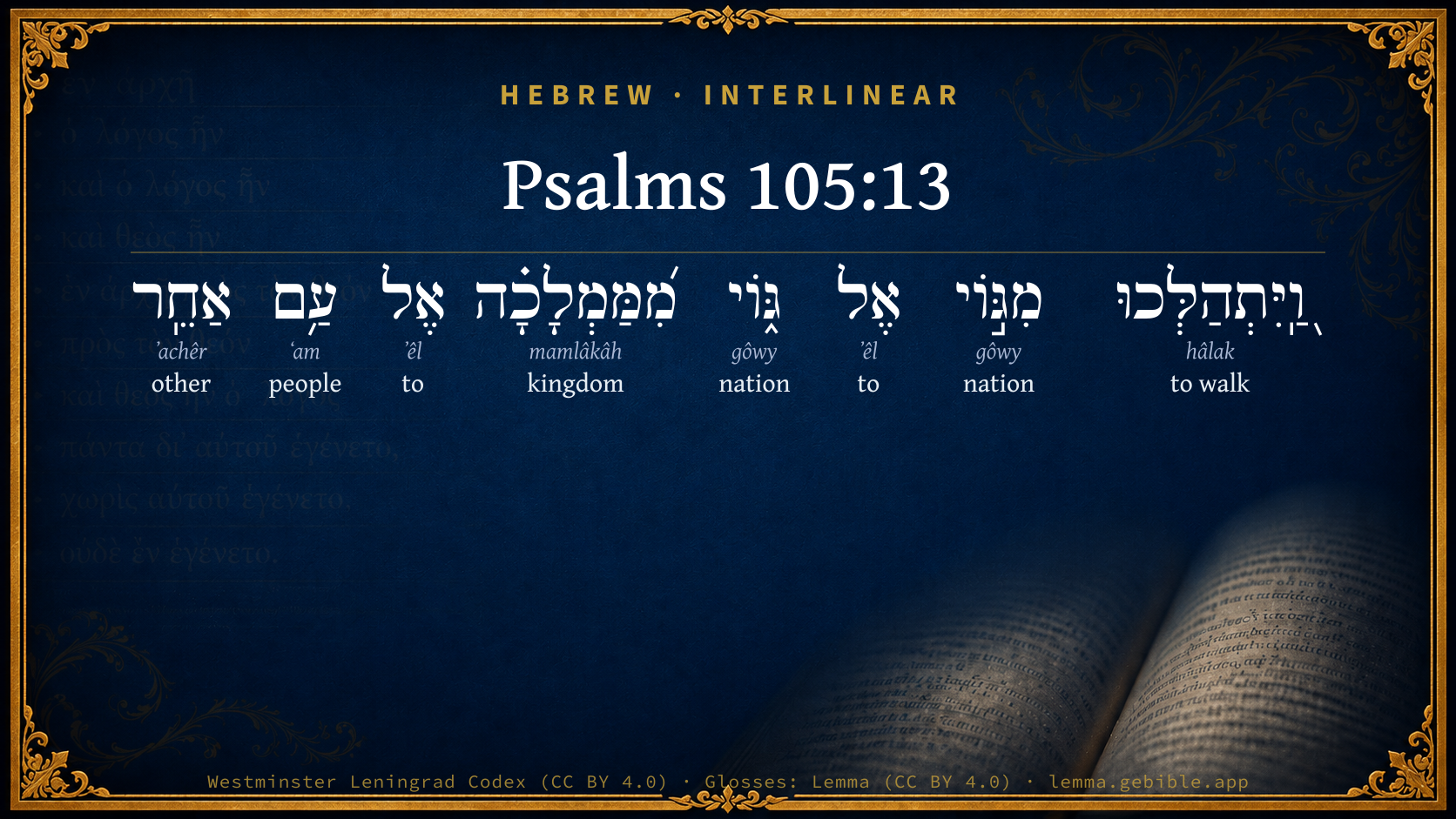
Psalms 105:13

Hebrew (Westminster Leningrad Codex) Psalms 105:13 appears in the Hebrew Old Testament. The text above is from the Westminster Leningrad Codex. Each word links to its Strong’s number, a concise gloss, and parsing drawn from the Open Scriptures Hebrew Bible morphology. Click any word for its full Brown-Driver-Briggs (BDB) entry.
Download image
Cite this verse

Psalms 105:13 (World English Bible). Public Domain. Lemma interlinear Bible study tool, https://lemma.gebible.app/v/psalms/105/13.

Show BibTeX & RIS
BibTeX
RIS
English Translation
They went about from nation to nation, From one kingdom to another people.
World English Bible · Public Domain
Download a study sheet

One document with this verse’s original text, its word-by-word gloss line, the meaning frame, cross-references with their text, attributed commentary, and full source and license credits — printable, and it pastes into notes with its structure intact.

This verse Autodidact and up

Study sheet (.html) Plain text (.txt)

A passage Seminary Student

Up to 50 verses in one chapter. A passage sheet keeps up to 6 commentary sources and 12 cross-references per verse, in the order this page ranks them, and says so on the sheet whenever that leaves anything out. Ask for a single verse and you get the Autodidact verse sheet above.

Everything on this page stays free to read, with no account — the sheet is a download of what is already on screen, not access to it.

Want to remove ads? Support Godless Engineer
Compare translations 3

The same verse in 3 English versions, stacked beneath the original-language interlinear above. Click any original word for its lexicon entry.

Each is an independent rendering of the whole verse — the interlinear is not word-aligned to these translations.

Highlighted words mark where these versions differ — a whole-verse word diff, not a word-by-word alignment.

  • World English Bible Public Domain
    They went about from nation to nation, From one kingdom to another people.
  • King James Version Public Domain
    When they went from one nation to another, from one kingdom to another people;
  • unfoldingWord Literal Text CC BY-SA 4.0
    They wandered from nation to nation, from a kingdom to other people.

unfoldingWord Literal Text — © unfoldingWord, licensed CC BY-SA 4.0. Word-aligned USFM3 via Door43 (git.door43.org/unfoldingWord/en_ult).

Versions to compare (up to 4)

3 of 4 selected

Show all 18 translations

Every available English version of this verse, each an independent rendering of the whole verse.

  • World English Bible Public Domain
    They went about from nation to nation, From one kingdom to another people.
  • Berean Standard Bible Public Domain
    they wandered from nation to nation, from one kingdom to another.
  • Majority Standard Bible Public Domain
    they wandered from nation to nation, from one kingdom to another.
  • King James Version Public Domain
    When they went from one nation to another, from one kingdom to another people;
  • American Standard Version (1901) Public Domain
    And they went about from nation to nation, From one kingdom to another people.
  • Revised Version (1885) Public Domain
    And they went about from nation to nation, from one kingdom to another people.
  • Geneva Bible (1599) Public Domain
    And walked about from nation to nation, from one kingdome to another people,
  • Douay-Rheims (1899) Public Domain
    And they passed from nation to nation, and from one kingdom to another people.
  • Young's Literal Translation Public Domain
    And they go up and down, from nation unto nation, From a kingdom unto another people.
  • Literal Standard Version CC BY-SA 4.0
    And they go up and down, from nation to nation, || From a kingdom to another people.
  • Unlocked Literal Bible CC BY-SA 4.0
    They went from nation to nation and from one kingdom to another.
  • unfoldingWord Literal Text CC BY-SA 4.0
    They wandered from nation to nation, from a kingdom to other people.
  • Darby Bible Public Domain
    And they went from nation to nation, from one kingdom to another people.
  • World Messianic Bible Public Domain
    They went about from nation to nation, from one kingdom to another people.
  • Webster's Bible Public Domain
    When they went from one nation to another, from one kingdom to another people;
  • Free Bible Version CC BY-SA 4.0
    They wandered from country to country, from one kingdom to the next.
  • Bible in Basic English Public Domain
    When they went about from one nation to another, and from one kingdom to another people.
  • JPS Tanakh (1917) Public Domain
    And when they went about from nation to nation, from one kingdom to another people,

Literal Standard Version (2020), Covenant Press — licensed CC BY-SA 4.0. Text via the HelloAO Bible API (eBible.org). Unlocked Literal Bible (unfoldingWord) — licensed CC BY-SA 4.0. Text via the HelloAO Bible API (eBible.org). unfoldingWord Literal Text — © unfoldingWord, licensed CC BY-SA 4.0. Word-aligned USFM3 via Door43 (git.door43.org/unfoldingWord/en_ult). Free Bible Version, Dr. Jonathan Gallagher — licensed CC BY-SA 4.0. Text via the HelloAO Bible API (eBible.org).

Word by word

More ways to search: Search by grammar → Find every occurrence → Compare this word →

Practice this passage: Drill this verse → Learn its vocabulary →

About this verse

These counts appear in no published source. They are computed here, from the morphology-tagged text and Lemma’s own curated glosses. What Lemma adds →

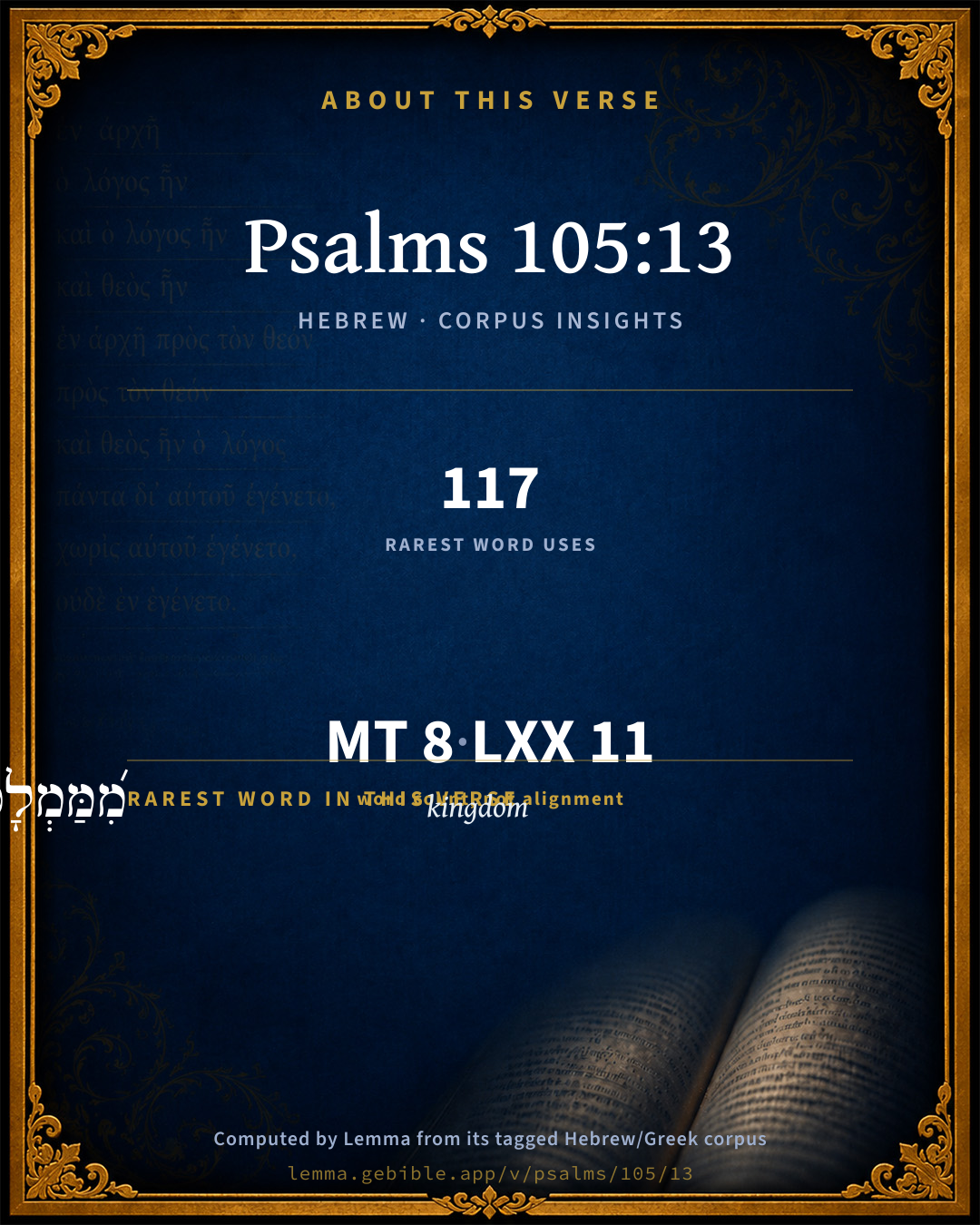
8
words
6
distinct lemmas
Wisdom
section

Grammatical profile

  • 1 verb
  • 4 nouns
  • 1 adjective
  • 2 prepositions

Verb forms

  • וַֽ֭יִּתְהַלְּכוּ Hithpael · Sequential Imperfect

Repetition

Words recur within this verse — often emphatic in Hebrew:

  • מִגּ֣וֹי nation H1471 ×2
  • אֶל to H413 ×2

Hebrew & Septuagint length

In English translation the verse runs 13 words from the Hebrew and 14 from the Septuagint (LXX English) — closely comparable.

A rough comparison of the two English renderings, which tokenize alike — not a word-level alignment.

Word counts can differ between the Hebrew and the Greek without any difference in meaning — e.g. the Hebrew direct-object marker אֵת has no separate Greek word, and Greek often adds the article ὁ.

In the original languages it is 8 Hebrew tokens and 11 Greek tokens — but the two are counted differently (Hebrew bundles its prefixes and suffixes into one token; the Greek is in lemma form), so that isn’t a like-for-like length.

Hebrew and Greek witnesses Masoretic Hebrew ↔ Greek Septuagint

The same verse in the two great witnesses to the Old Testament, shown verse-for-verse.

You’re reading Greek Psalm 104 (Hebrew Psalm 105). The Septuagint counts the superscription, so verse numbers can differ from the Hebrew — chapter-level alignment, not verse-by-verse. Numbering follows Rahlfs.

These are two independent witnesses, not word-aligned to each other, and the Septuagint is shown in lemma (dictionary) form.

Hebrew Psalms 105:13 Masoretic · Westminster Leningrad Codex

וַֽ֭יִּתְהַלְּכוּ מִגּ֣וֹי אֶל גּ֑וֹי מִ֝מַּמְלָכָ֗ה אֶל עַ֥ם אַחֵֽר

They went about from nation to nation, From one kingdom to another people.

World English Bible · Public Domain

Greek LXX Greek Psalm 104:13 Septuagint · lemma form

καί διαἔρχομαι ἐκ ἔθνος εἰς ἔθνος ἐκ βασιλεία εἰς λαός ἕτερος

And they went from nation to nation, and from one kingdom to another people.

LXX2012 (modern English Septuagint) · Public Domain

Hebrew: Westminster Leningrad Codex (CC BY 4.0). Greek: Septuagint (public domain); English from LXX2012 (modern English Septuagint) (Public Domain). How the Septuagint differs from the Hebrew →

Commentary

Notes on Psalms 105:13 from classic Christian and Jewish commentators (each source and its license shown beneath its notes). The classic Christian expositions comment on the surrounding passage and are grouped to its opening verse, so a note may address several verses; the Jewish commentaries on the Tanakh (Rashi and others) are per-verse, so they appear only where the commentator wrote on this verse.

Lemma curates 59 commentaries, every one of them public domain or Creative Commons licensed, each selected and text-cleaned for this edition rather than reprinted as found. About our sources →

The Cambridge Bible for Schools and Colleges

gen. ed. J. J. S. Perowne

13. When they went &c.] And (when) they went &c. The A.V. treats this verse as (virtually) the protasis to Psa_105:14 : the R.V. places a semicolon at the end of Psa_105:12, and a full stop at the end of Psa_105:13, and treats Psa_105:13 as the continuation of Psa_105:12. Either construction is grammatically possible, but that of the A.V. is preferable. Psa_105:12 emphasises the conditions under which the promise was given, and concludes the first division of the Psalms Vv13-15 describe the migrations of the patriarchs among the different nations of Canaan, the Egyptians, and the Philistines, as recorded in the Book of Genesis. In all their wanderings Jehovah guarded them from harm, reproving even kings such as Pharaoh (Gen_12:10 ff.) and Abimelech (Genesis 20, 26) on their account.

13–24. Jehovah’s providential guidance of the patriarchs in their migrations.

The Cambridge Bible for Schools and Colleges (gen. ed. J. J. S. Perowne; Cambridge University Press, 1878–1918) — public domain. Text from a community e-Sword module.

Trapp's Complete Commentary

John Trapp

Psa 105:13 When they went from one nation to another, from [one] kingdom to another people;

Ver. 13. When they went from one nation to another] There were seven several nations in that land wherein they sojourned, flitting from place to place, and having no settled habitation, αστατουνρες, 1Co 4:11.

From one kingdom] Forced by famine, or other necessity. See Gen 12:10; Gen 20:1-7 Gen 26:1-5

John Trapp, A Commentary or Exposition upon All the Books of the Old and New Testament (1647–1656) — public domain. Text from a community e-Sword module.

J. A. Alexander on Psalms

Joseph Addison Alexander

13. (Psa 105:13) And they went about from nation to nation, from kingdom to another people. This may be regarded as in contrast with ver. 12 (Psa 105:12), and (yet) they went about, notwithstanding their small number and their being strangers. Or Psa 105:12-13, may be the protasis of the sentence, and Psa 105:14 its apodosis. "When they were few and strangers, and went from nation to nation, he let no man," etc. This verse describes the characteristic feature in the condition of the chosen people, during the patriarchal period of their history, namely, their migratory intercourse with various nations. These are mentioned in the first clause as distinct races, in the last as distinct states or bodies politic. Where we might have expected from kingdom to kingdom, the ear is somewhat disappointed by the phrase from kingdom, to another people, which may have been intended to distinguish the Egyptian and other monarchies from the more democratical or patriarchal institutions of the Arabians and other nations. They went about seems to be the force of the reflexive or frequentative verb, as distinguished from that of the primitive, they went. See above, on Psa 26:3; Psa 35:14; Psa 101:2, and compare Gen 5:22; Gen 17:1; Gen 24:6; Gen 24:9; Gen 24:40; Gen 48:15.

Joseph Addison Alexander, The Psalms Translated and Explained (1850) — public domain. Text from a community e-Sword module.

Adam Clarke's Commentary

Verse 13. When they went from one nation to another] From several circumstances in the history of the travels of the ancient Hebrews, we find that the wilderness through which they then passed was well peopled.

Adam Clarke's Commentary on the Bible (1810–1826) — public domain. Text from a community e-Sword/MySword module.

John Gill's Exposition

When they went from one nation to another,.... From Chaldea to Mesopotamia; from thence to Canaan, and then into Egypt; and after that to Canaan again: which was the tour that Abraham took; and when in Canaan, and travelling from place to place there, might be said to go from nation to nation, since there were seven nations in that country.

From one kingdom to another people; from the kingdom of Palestine or Canaan to Egypt, which was a strange people; and of another language, as appears by the use of an interpreter between them, Gen 42:23. So Isaac, Jacob, and his posterity, journeyed from one of these kingdoms to the other. Thus the children of God are pilgrims and strangers in this world; they are unsettled in it; they are travelling through it, and a troublesome journey they have of it; they are bound to another country, to which they belong; and their hearts are there beforehand; and they look upon this world as a strange place, and at best but as an inn; where they tarry but for a time, till they get to their own country, the better and heavenly one.

John Gill's Exposition of the Whole Bible (1746–1763) — public domain (CC PDM 1.0). Text via the HelloAO Bible API.

Albert Barnes' Notes on the Bible

When they went from one nation to another ... - Wandered about, as if they had no home and no fixed habitation. See Gen 12:6, Gen 12:9-10; Gen 13:1; Gen 20:1; Gen 26:1, Gen 26:17, Gen 26:22-23.

Albert Barnes' Notes on the Bible (1834–1885) — public domain. Text from a community e-Sword/MySword module.

Matthew Poole's English Annotations

Both in Canaan, where there were seven nations, Deu 7:1, and in Egypt, &c.

Matthew Poole's English Annotations on the Holy Bible (1683–1685) — public domain. Text from a community e-Sword/MySword module.

The Treasury of David

Charles H. Spurgeon

Ver. 13. When they went from one nation, to another, from one Kingdom to another people. Migrating as the patriarchs did from the region of one tribe to the country of another they were singularly preserved. The little wandering family might have been cut off root and branch had not a special mandate been issued from the throne for their protection. It was not the gentleness of their neighbours which screened them; they were hedged about by the mysterious guardianship of heaven. Whether in Egypt, or in Philistia, or in Canaan, the heirs of the promises, dwelling in their tents, were always secure.

Ver. 13. From one kingdom to another people. Where we might have expected from kingdom to kingdom, the car is somewhat disappointed by the phrase, "from one kingdom to another people, " which may have been intended to distinguish the Egyptian and other monarchies from the more democratical or patriarchal institutions of the Arabians and other nations. Joseph Addison Alexander.

Ver. 13. Though frequent flitting is neither desirable nor commendable, yet sometimes there is a just and necessary occasion for it, and it may be the lot of some of the best of men. Matthew Henry.

Ver. 13.

1. God's people may be often removed.

2. They can never be injured.

3. God's property in them will not be renounced.

Psalms 105:14*

Charles H. Spurgeon's The Treasury of David (1869–1885) — public domain. Psalms only. Text from a community e-Sword/MySword module.

Whedon's Commentary on the Bible

Daniel D. Whedon

13. From one nation to another—From tribe to tribe among the original inhabitants of Canaan. The expression indicates not only an unsettled, but insecure, mode of life. The patriarchs sojourned among the Amorites, Hittites, Jebusites, Philistines, Canaanites, Perizzites, and were brought into contact with other tribes, besides their abode in Egypt.

Daniel D. Whedon (gen. ed.), Commentary on the Old and New Testaments (1874–1909) — public domain. Text from a community e-Sword module.

The Pulpit Commentary

When they went from one nation to another. Abraham "went from" Ur of the Chaldees to Haran of the Syrians, from Haran to Canaan, from Canaan to Philistia, and once as far as Egypt. Isaac and Jacob were also wanderers, though not to the same extent. From one kingdom to another people. Chaldea, Philistia, and Egypt were "kingdoms;" the Syrians and Canaanites, "peoples."

The Pulpit Commentary (1880–1919), ed. H.D.M. Spence-Jones & Joseph S. Exell — public domain. Text from a community e-Sword module.

John Wesley's Explanatory Notes

They went - Both in Canaan, where there were seven nations, and in Egypt.

John Wesley, Explanatory Notes Upon the Whole Bible (1754–1765) — public domain. Text via the GEBible commentary corpus.

Rashi

Rabbi Shlomo Yitzchaki (Rashi)

And they walked from nation to nation Abraham sojourned in the land of the Philistines, in Egypt, and in the land of Canaan, and so Isaac, and so Jacobthey all were exiled from one strange place to another strange place.

Rashi on the Tanakh — English translations: “The Judaica Press complete Tanach with Rashi, translated by A. J. Rosenberg” (CC BY 4.0); “Pentateuch with Rashi's commentary by M. Rosenbaum and A.M. Silbermann, 1929-1934” (public domain); “The Metsudah Tanach series, Lakewood, N.J” (CC BY 4.0); and “The Book of Joshua, Metsudah Publications, 1997” (CC BY 4.0). Text via Sefaria.

Lesson kit

Teaching starters — assembled from the data on this page, not authored interpretation. Every prompt links to the verse data it draws on. Edit before teaching.

Psalms, in the Wisdom, opens this verse with 8 words (6 distinct Hebrew lemmas). Its most distinctive word is mamlâkâh (“kingdom”). A historical commentator’s framing appears above. Read the whole chapter for the surrounding context.

Discussion questions

  1. The word mamlâkâh carries the sense “kingdom.” How does it shape the verse?
  2. “nation” occurs 2× in this one verse. What is the effect of the repetition?
  3. These translations render this verse differently. What is at stake in choosing one wording over another?
  4. The verb «וַֽ֭יִּתְהַלְּכוּ» is Hithpael Sequential Imperfect. How does its form color the action?
  5. Reading how The Cambridge Bible for Schools and Colleges and Trapp's Complete Commentary read this verse, where do the two commentators agree and where do they part?

Things to notice

Reading settings

Reading text

Shown beneath each verse's original-language words.

Old Testament
Old Testament edition

Read the OT as the Masoretic Hebrew (MT) or the Greek Septuagint (LXX).

English shown for the Greek Septuagint (in the Hebrew ↔ Greek comparison).

Comparing translations? Open the Compare panel on any verse page to stack up to four side by side.