Joel 1:6

Hebrew (Westminster Leningrad Codex) Joel 1:6 appears in the Hebrew Old Testament. The text above is from the Westminster Leningrad Codex. Each word links to its Strong’s number, a concise gloss, and parsing drawn from the Open Scriptures Hebrew Bible morphology. Click any word for its full Brown-Driver-Briggs (BDB) entry.
Download image
Cite this verse

Joel 1:6 (World English Bible). Public Domain. Lemma interlinear Bible study tool, https://lemma.gebible.app/v/joel/1/6.

Show BibTeX & RIS
BibTeX
RIS
English Translation
For a nation has come up on my land, strong, and without number. His teeth are the teeth of a lion, And he has the fangs of a lioness.
World English Bible · Public Domain
Download a study sheet

One document with this verse’s original text, its word-by-word gloss line, the meaning frame, cross-references with their text, attributed commentary, and full source and license credits — printable, and it pastes into notes with its structure intact.

This verse Autodidact and up

Study sheet (.html) Plain text (.txt)

A passage Seminary Student

Up to 50 verses in one chapter. A passage sheet keeps up to 6 commentary sources and 12 cross-references per verse, in the order this page ranks them, and says so on the sheet whenever that leaves anything out. Ask for a single verse and you get the Autodidact verse sheet above.

Everything on this page stays free to read, with no account — the sheet is a download of what is already on screen, not access to it.

Want to remove ads? Support Godless Engineer
Compare translations 3

The same verse in 3 English versions, stacked beneath the original-language interlinear above. Click any original word for its lexicon entry.

Each is an independent rendering of the whole verse — the interlinear is not word-aligned to these translations.

Highlighted words mark where these versions differ — a whole-verse word diff, not a word-by-word alignment.

  • World English Bible Public Domain
    For a nation has come up on my land, strong, and without number. His teeth are the teeth of a lion, And he has the fangs of a lioness.
  • King James Version Public Domain
    For a nation is come up upon my land, strong, and without number, whose teeth are the teeth of a lion, and he hath the cheek teeth of a great lion.
  • unfoldingWord Literal Text CC BY-SA 4.0
    For a nation has come up against my land, strong and without number. Its teeth the teeth of a lion, and the fangs of a lioness to it.

unfoldingWord Literal Text — © unfoldingWord, licensed CC BY-SA 4.0. Word-aligned USFM3 via Door43 (git.door43.org/unfoldingWord/en_ult).

Versions to compare (up to 4)

3 of 4 selected

Show all 18 translations

Every available English version of this verse, each an independent rendering of the whole verse.

  • World English Bible Public Domain
    For a nation has come up on my land, strong, and without number. His teeth are the teeth of a lion, And he has the fangs of a lioness.
  • Berean Standard Bible Public Domain
    For a nation has invaded My land, powerful and without number; its teeth are the teeth of a lion, and its fangs are the fangs of a lioness.
  • Majority Standard Bible Public Domain
    For a nation has invaded My land, powerful and without number; its teeth are the teeth of a lion, and its fangs are the fangs of a lioness.
  • King James Version Public Domain
    For a nation is come up upon my land, strong, and without number, whose teeth are the teeth of a lion, and he hath the cheek teeth of a great lion.
  • American Standard Version (1901) Public Domain
    For a nation is come up upon my land, strong, and without number; his teeth are the teeth of a lion, and he hath the jaw-teeth of a lioness.
  • Revised Version (1885) Public Domain
    For a nation is come up upon my land, strong, and without number; his teeth are the teeth of a lion, and he hath the jaw teeth of a great lion.
  • Geneva Bible (1599) Public Domain
    Yea, a nation commeth vpon my lande, mightie, and without nomber, whose teeth are like the teeth of a lyon, and he hath the iawes of a great lyon.
  • Douay-Rheims (1899) Public Domain
    For a nation is come up upon my land, strong and without number: his teeth are like the teeth of a lion: and his cheek teeth as of a lion's whelp.
  • Young's Literal Translation Public Domain
    For a nation hath come up on my land, Strong, and there is no number, Its teeth `are' the teeth of a lion, And it hath the jaw-teeth of a lioness.
  • Literal Standard Version CC BY-SA 4.0
    For a nation has come up on My land, || Strong, and there is no number, || Its teeth [are] the teeth of a lion, || And it has the jaw-teeth of a lioness.
  • Unlocked Literal Bible CC BY-SA 4.0
    For a nation has come up upon my land, strong and without number. His teeth are the teeth of a lion, and he has the teeth of a lioness.
  • unfoldingWord Literal Text CC BY-SA 4.0
    For a nation has come up against my land, strong and without number. Its teeth the teeth of a lion, and the fangs of a lioness to it.
  • Darby Bible Public Domain
    For a nation is come up upon my land, strong and without number: his teeth are the teeth of a lion, and he hath the cheek teeth of a lioness.
  • World Messianic Bible Public Domain
    For a nation has come up on my land, strong, and without number. His teeth are the teeth of a lion, and he has the fangs of a lioness.
  • Webster's Bible Public Domain
    For a nation is come up upon my land, strong, and without number, whose teeth are the teeth of a lion, and he hath the cheek teeth of a great lion.
  • Free Bible Version CC BY-SA 4.0
    A nation has invaded my land: powerful and too many to count. Their teeth are like lion's teeth, their fangs like those of a lioness.
  • Bible in Basic English Public Domain
    For a nation has come up over my land, strong and without number; his teeth are the teeth of a lion, and he has the back teeth of a great lion.
  • JPS Tanakh (1917) Public Domain
    For a people is come up upon my land, mighty, and without number; his teeth are the teeth of a lion, and he hath the jaw-teeth of a lioness.

Literal Standard Version (2020), Covenant Press — licensed CC BY-SA 4.0. Text via the HelloAO Bible API (eBible.org). Unlocked Literal Bible (unfoldingWord) — licensed CC BY-SA 4.0. Text via the HelloAO Bible API (eBible.org). unfoldingWord Literal Text — © unfoldingWord, licensed CC BY-SA 4.0. Word-aligned USFM3 via Door43 (git.door43.org/unfoldingWord/en_ult). Free Bible Version, Dr. Jonathan Gallagher — licensed CC BY-SA 4.0. Text via the HelloAO Bible API (eBible.org).

Word by word

More ways to search: Search by grammar → Find every occurrence → Compare this word →

Practice this passage: Drill this verse → Learn its vocabulary →

וּֽמְתַלְּע֥וֹת
mᵉthallᵉʻâh
H4973
“and · teeth of”
Conjunction + Noun, Common, Feminine, Plural, Construct
Part of Speech
Conjunction + Noun
Type
Common
Gender
Feminine
Number
Plural
State
Construct
Full BDB Definition

Origin: contr. from H3216

TWOT: 2516d

teeth, fangs, incisors
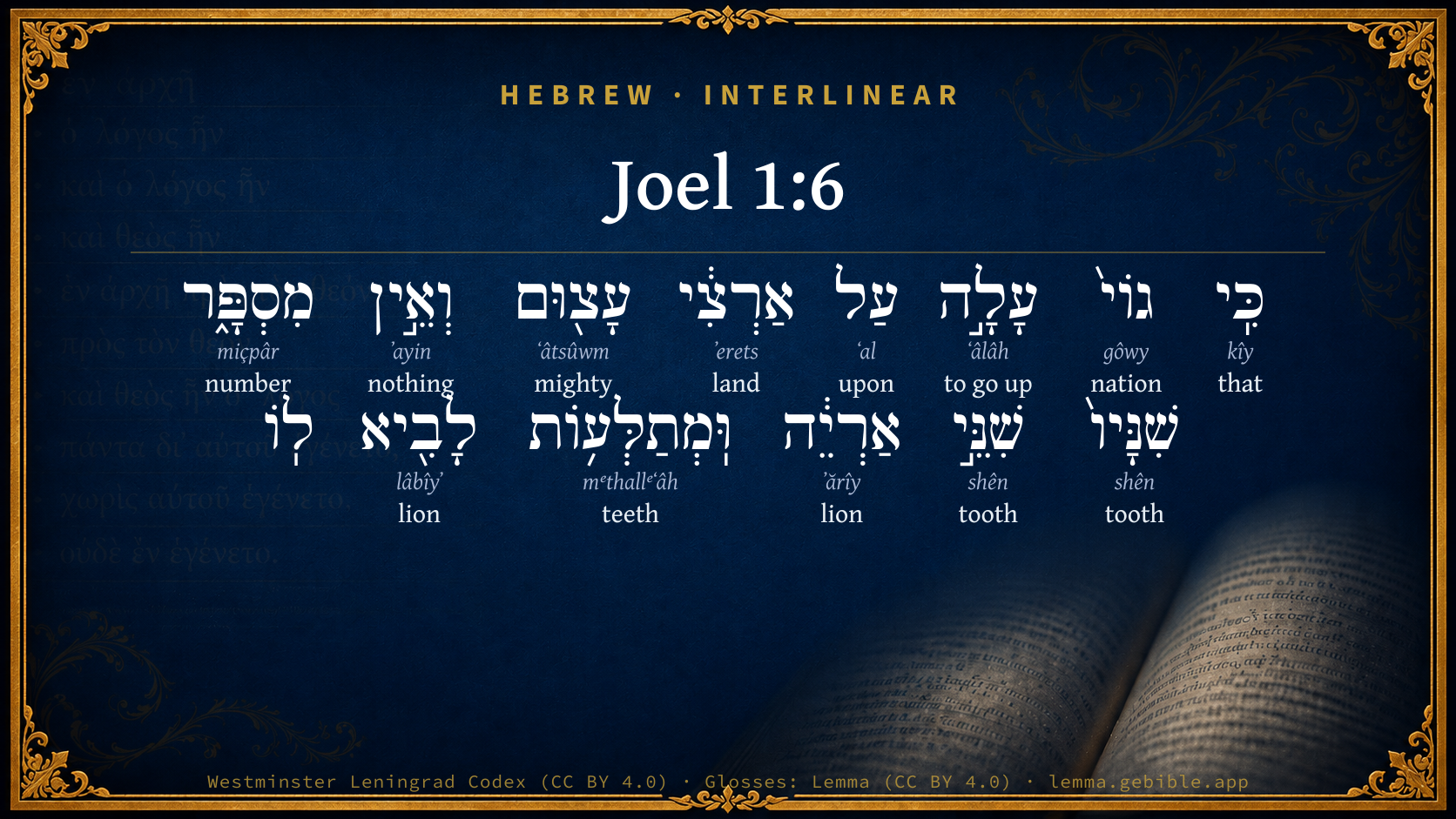
  1. כִּֽי kîy H3588 “that” Conjunction
  2. גוֹי֙ gôwy H1471 “nation” Noun, Common, Masculine, Singular, Absolute
  3. עָלָ֣ה ʻâlâh H5927 “to go up” Verb, Qal, Perfect, 3rd Person, Masculine, Singular
  4. עַל ʻal H5921 “upon” Preposition
  5. אַרְצִ֔י ʼerets H776 “land · my” Noun, Common, Both, Singular, Construct + Suffix, Personal, 1st Person, Common, Singular
  6. עָצ֖וּם ʻâtsûwm H6099 “mighty” Adjective, Adjective, Masculine, Singular, Absolute
  7. וְאֵ֣ין ʼayin H369 “and · nothing” Conjunction + Particle, Negative
  8. מִסְפָּ֑ר miçpâr H4557 “number” Noun, Common, Masculine, Singular, Absolute
  9. שִׁנָּיו֙ shên H8127 “teeth · his” Noun, Common, Both, Dual, Construct + Suffix, Personal, 3rd Person, Masculine, Singular
  10. שִׁנֵּ֣י shên H8127 “teeth of” Noun, Common, Both, Dual, Construct
  11. אַרְיֵ֔ה ʼărîy H738 “lion” Noun, Common, Masculine, Singular, Absolute
  12. לָבִ֖יא lâbîyʼ H3833 “lion” Noun, Common, Both, Singular, Absolute

About this verse

These counts appear in no published source. They are computed here, from the morphology-tagged text and Lemma’s own curated glosses. What Lemma adds →

14
words
12
distinct lemmas
Prophets
section

Notable vocabulary

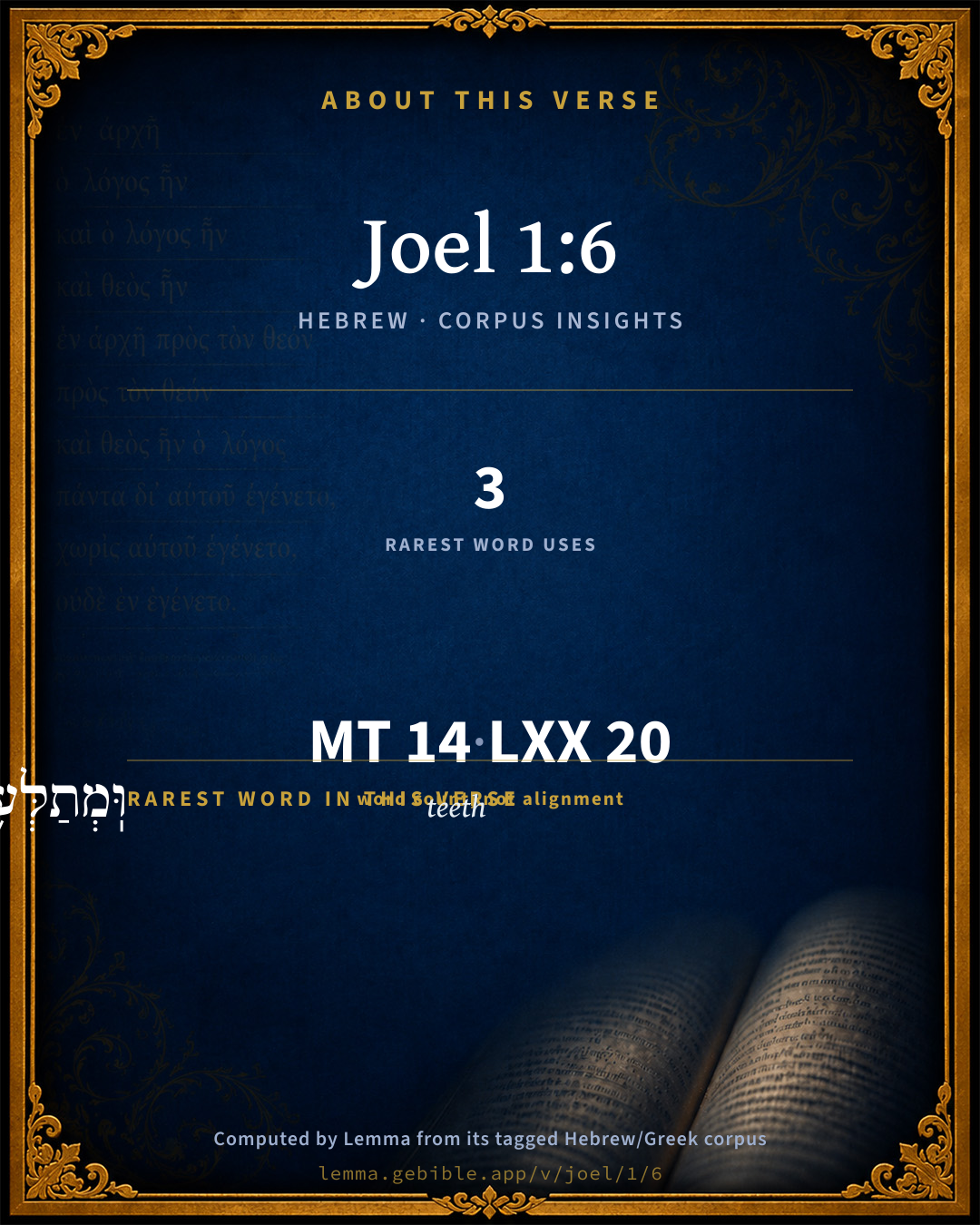
The rarest word here is וּֽמְתַלְּע֥וֹת teeth H4973 — appearing just 3 times in the whole Hebrew Bible.

Shared distinctive vocabulary

וּֽמְתַלְּע֥וֹת teeth H4973 occurs in 3 verses of the Hebrew Bible. Also found in:

Grammatical profile

  • 1 verb
  • 8 nouns
  • 1 adjective
  • 2 prepositions
  • 1 conjunction
  • 1 particle

Verb forms

  • עָלָ֣ה Qal · Perfect

Repetition

A word recurs within this verse — often emphatic in Hebrew:

  • שִׁנָּיו֙ tooth H8127 ×2

Hebrew & Septuagint length

In English translation the verse runs 29 words from the Hebrew and 26 from the Septuagint (LXX English) — closely comparable.

A rough comparison of the two English renderings, which tokenize alike — not a word-level alignment.

Word counts can differ between the Hebrew and the Greek without any difference in meaning — e.g. the Hebrew direct-object marker אֵת has no separate Greek word, and Greek often adds the article ὁ.

In the original languages it is 14 Hebrew tokens and 20 Greek tokens — but the two are counted differently (Hebrew bundles its prefixes and suffixes into one token; the Greek is in lemma form), so that isn’t a like-for-like length.

Cross-references

9

Topical passages linked to Joel 1:6 in the Treasury of Scripture Knowledge — connected by theme and wording, ordered by reader-vote popularity; previews shown in the World English Bible.

  • Joel 2:25 I will restore to you the years that the swarming locust has eaten, The great locust, the grasshopper, and the caterpillar, My great army, which I sent among you.
  • Proverbs 30:14 There is a generation whose teeth are like swords, And their jaws like knives, To devour the poor from the earth, and the needy from among men.
  • Isaiah 8:8 and it shall sweep onward into Judah; it shall overflow and pass through; it shall reach even to the neck; and the stretching out of its wings shall fill the breadth of your land, Immanuel.
  • Joel 2:2–11 A day of darkness and gloominess, A day of clouds and thick darkness. As the dawn spreading on the mountains, A great and strong people; There has never been the like, Neither will there be any more after them, Even to the years of many generations.
  • Revelation 9:7–10 The shapes of the locusts were like horses prepared for war. On their heads were something like golden crowns, and their faces were like people's faces.
  • Psalms 107:34 And a fruitful land into a salt waste, For the wickedness of those who dwell in it.
  • Proverbs 30:25–27 The ants are not a strong people, Yet they provide their food in the summer;
  • Isaiah 32:13 On the land of my people shall come up thorns and briers; yes, on all the houses of joy in the joyous city.
  • Hosea 9:3 They won't dwell in Yahweh's land; But Ephraim will return to Egypt, And they will eat unclean food in Assyria.

Cross-references courtesy of OpenBible.info (CC BY 4.0).

Hebrew and Greek witnesses Masoretic Hebrew ↔ Greek Septuagint

The same verse in the two great witnesses to the Old Testament, shown verse-for-verse.

These are two independent witnesses, not word-aligned to each other, and the Septuagint is shown in lemma (dictionary) form.

Hebrew Joel 1:6 Masoretic · Westminster Leningrad Codex

כִּֽי גוֹי֙ עָלָ֣ה עַל אַרְצִ֔י עָצ֖וּם וְאֵ֣ין מִסְפָּ֑ר שִׁנָּיו֙ שִׁנֵּ֣י אַרְיֵ֔ה וּֽמְתַלְּע֥וֹת לָבִ֖יא לֽוֹ

For a nation has come up on my land, strong, and without number. His teeth are the teeth of a lion, And he has the fangs of a lioness.

World English Bible · Public Domain

Greek LXX Joel 1:6 Septuagint · lemma form

ὅτι ἔθνος ἀναβαίνω ἐπί ὁ γῆ ἐγώ ἰσχυρός καί ἀναρίθμητος ὁ ὀδούς αὐτός ὀδούς λέων καί ὁ μύλη αὐτός σκύμνος

For a strong and innumerable nation is come up against my land, their teeth are lion's teeth, and their back teeth those of a lion's whelp.

LXX2012 (modern English Septuagint) · Public Domain

Hebrew: Westminster Leningrad Codex (CC BY 4.0). Greek: Septuagint (public domain); English from LXX2012 (modern English Septuagint) (Public Domain). How the Septuagint differs from the Hebrew →

Targum (Aramaic paraphrase)

1

The Targum is the ancient Jewish Aramaic paraphrase of the Hebrew Scriptures — an interpretive translation, not the Hebrew text itself. Onkelos (literal) and Pseudo-Jonathan (expansive) render the Torah, and Jonathan the Prophets. Coverage is partial: where no permissively-licensed English translation exists for a verse, only the Aramaic is shown. This is verse-level text, not a word-by-word alignment to the Hebrew.

  1. Targum Jonathan Prophets (Joshua–Malachi)
    אֲרֵי עַמָא סְלִיק עַל אַרְעִי תַקִיף וְלֵית מִנְיָן שִׁנוֹהִי שִׁנֵי אַרְיָא וְנִבוֹהִי כְּבַר אַרְיְוָן:

    (no public-domain English translation for this verse)

    Targum Jonathan — Aramaic: “Mikraot Gedolot” (public domain). English: “Sefaria Community Translation” (CC0 1.0 (public-domain dedication)); “London "Chaldee Paraphrase," 1871” (public domain). Text via Sefaria.

Commentary

Notes on Joel 1:6 from classic Christian and Jewish commentators (each source and its license shown beneath its notes). The classic Christian expositions comment on the surrounding passage and are grouped to its opening verse, so a note may address several verses; the Jewish commentaries on the Tanakh (Rashi and others) are per-verse, so they appear only where the commentator wrote on this verse.

Lemma curates 59 commentaries, every one of them public domain or Creative Commons licensed, each selected and text-cleaned for this edition rather than reprinted as found. About our sources →

Trapp's Complete Commentary

John Trapp

Joe 1:6 For a nation is come up upon my land, strong, and without number, whose teeth [are] the teeth of a lion, and he hath the cheek teeth of a great lion.

Ver. 6. For a nation is come up upon my land] A nation, sc. of vermin, by swarms, as Joe 2:9, called afterwards an army, Joe 2:11, and a people, Joe 2:2. See the like Pro 30:25-26. "Is come," that is, shortly shall come, "upon my land," this glorious and goodly land, as it is called, Dan 11:16. Tarnovius makes this by a mimesis {a} to be the drunkard’s lamentation. "A nation is come up," &c.

Strong and without number] Yea, therefore strong, because without number; insuperable, because innumerable. Feeble they are, and yet formidable; because set on by God Almighty, whose warriors they are, as the Roman spoilers are called, Mat 22:7. And perhaps the Assyrians may here be hinted at. I doubt not but the literal sense is chiefly intended; neither can I concur with Oecolampadius, who holdeth it to be propheta indignum, unbeseeming the prophet to preach thus concerning worms and locusts: for concerning such poor creatures deal the prophets by the instinct of the Holy Ghost, in sundry other places, Pro 6:6 Amo 4:9; Amo 7:1 Nah 3:15.

Whose teeth are the teeth of a lion] That is, they devour all that is in their way; as there is no standing before a lion, no, not before a moth that hath commission to crush a man, Job 4:19.

{a} Rhet. A figure of speech, whereby the supposed words or actions of another are imitated. ŒD

John Trapp, A Commentary or Exposition upon All the Books of the Old and New Testament (1647–1656) — public domain. Text from a community e-Sword module.

Joseph Benson's Commentary

Joe 1:6. For a nation is come up upon my land — Insects are described as a nation or people marching in order under their leaders, both by sacred and profane writers, because of their power to do mischief, and their being irresistible by human strength or art. Whose teeth are the teeth of a lion — They devour every thing that comes in their way, and there is no possibility of rescuing it from them. Pliny and other writers tell us, that they will not only destroy the leaves and fruits of the trees on which they fasten, but will even devour the very bark and stock thereof.

Joseph Benson's Commentary on the Old and New Testaments (1811–1818) — public domain. Text from a community e-Sword module.

Geneva Bible (1599)

Geneva Bible translators

This was another plague wherewith God had punished them when he stirred up the Assyrians against them.

Geneva Bible (1599) marginal notes — public domain. Text via Bolls.life.

Jamieson, Fausset & Brown

Robert Jamieson, A. R. Fausset & David Brown

nation--applied to the locusts, rather than "people" (Pro 30:25-26), to mark not only their numbers, but also their savage hostility; and also to prepare the mind of the hearer for the transition to the figurative locusts in the second chapter, namely, the "nation" or Gentile foe coming against Judea (compare Joe 2:2).

my land--that is, Jehovah's; which never would have been so devastated were I not pleased to inflict punishment (Joe 2:18; Isa 14:25; Jer 16:18; Eze 36:5; Eze 38:16).

strong--as irresistibly sweeping away before its compact body the fruits of man's industry.

without number--so Jdg 6:5; Jdg 7:12, "like grasshoppers (or "locusts") for multitude" (Jer 46:23; Nah 3:15).

teeth . . . lion--that is, the locusts are as destructive as a lion; there is no vegetation that can resist their bite (compare Rev 9:8). PLINY says "they gnaw even the doors of houses."

Jamieson, Fausset & Brown — Commentary Critical and Explanatory on the Whole Bible (1871) — public domain (CC PDM 1.0). Text via the HelloAO Bible API.

Adam Clarke's Commentary

Verse 6. A nation is come up upon my land] That real locusts are intended there can be little doubt; but it is thought that this may be a double prophecy, and that the destruction by the Chaldeans may also be intended, and that the four kinds of locusts mentioned above may mean the four several attacks made on Judea by them. The first in the last year of Nabonassar, (father of Nebuchadnezzar,) which was the third of Jehoiakim; the second when Jehoiakim was taken prisoner in the eleventh year of his reign; the third in the ninth year of Zedekiah; and the fourth, three years after, when Jerusalem was destroyed by Nebuchadnezzar. Others say that they mean four powers which have been enemies of the Jews:

1. The palmerworm, the Assyrians and Chaldeans.

2. The locust, the Persians and Medes.

3. The cankerworm, the Greeks, and particularly Antiochus Epiphanes.

4. The caterpillar, the Romans.

Others make them four kings; Tiglath-pileser, Shalmaneser, Sennacherib, and Nebuchadnezzar. But of such similitudes there is no end; and the best of them is arbitrary and precarious.

Adam Clarke's Commentary on the Bible (1810–1826) — public domain. Text from a community e-Sword/MySword module.

John Calvin's Commentaries

Of what some think, that punishment, not yet inflicted, is denounced here on the people, I again repeat, I do not approve; but, on the contrary, the Prophet, according to my view, records another judgment of God, in order to show that God had not only in one way warned the Jews of their sins, that he might restore them to a right mind; but that he had tried all means to bring them to the right way, though they proved to have been irreclaimable. After having then spoke of the sterility of the fields and of other calamities, he now adds that the Jews had been visited with war. Surely famine ought to have touched them, especially when they saw that evils, succeeding evils, had happened for several years contrary to the usual course of things, so that they could not be imputed to chance. But when God brought war upon them, when they were already worn out with famine, must they not have been more than insane in mind, to have continued astonied at God’s judgments and not to repent? Then the meaning of the Prophet is, that God had tried, by every means possible, to find out whether the Jews were healable, and had given them every opportunity to repent, but that they were wholly perverse and untamable.

Then he says, Verily a nation came up. The particle כי ki is not to be taken as a causative, but only as explanatory, Verily, or surely, he says, a nation came up; though an inference also is not amiss, if it be drawn from the beginning of the verse: ‘Hear, ye old men, and tell your children;’ what shall we tell? even this, that a nation, etc. But in this form also כי ki would be exegetical, and the sense would be the same. This much as to the meaning of the passage.

A nation, then, came up over my land. God here justly claims the land of Canaan as his own heritage, and does so designedly, that the Jews might more clearly know that he was angry with them; for their condition would not have been worse than that of other nations, had not God resolved to punish them for their sins. There is here then an implied comparison between Judea and other countries, as though the Prophet said, “How comes it, that your land is wasted by wars and many other calamities, while other countries are at rest? This land is no doubt sacred to God, for he has chosen it for himself, that he might rule in it; he has here his own habitation: it then must be that there is some cause for God’s wrath, as your land is so miserably wasted, when other lands enjoy tranquillity.” We now perceive what the Prophet means. A nation, he says, came up upon my land, and what then? God could surely have prevented this; he could have defended his own land, of which he was the keeper, and which was under his protection: how then had it happened that enemies with impunity inundated this land, having marched into it and utterly laid it waste, except that it had been forsaken by the Lord himself?

A nation, he says, came up upon my land, strong and without number; and further, who had the teeth of a lion, the jaw-bones of a young lion. The nations had no strength which God could not in an instant have broken down, nor had he need of mighty auxiliaries, for he could by a nod only have reduced to nothing whatever men might have attempted: when, therefore, the Assyrians so impetuously assailed the Jews they were necessarily exposed to the wantonness of their enemies, for they were unworthy of being protected, as hitherto, by the hand of God.

John Calvin's Commentaries (1540-1563) — public domain. Text from the Calvin Translation Society English edition (1840s-50s) via the Christian Classics Ethereal Library (ccel.org). Calvin's coverage is partial (roughly two-thirds of the Bible); uncommented books and verses are honest gaps, never fabricated. The 19th-century editor's footnotes and remarks are omitted so the notes are faithfully Calvin's own voice.

Ellicott's Commentary for English Readers

(6) A nation.—It was not uncommon with Hebrew writers to apply the name people or folk to animals, as, “The ants are a people not strong;” “The conies are but a feeble folk” (Pro_30:25-26); but the word used by Joel is different from that in the Proverbs. He selected a word indicative of foreign nations, suggestive of attack, including both the irrational invader and the foreign conqueror. The surpassing strength of the nation is indicated by the extraordinary power of the locust’s teeth, compared to that of the lion’s jaws. The same comparison is made by St. John (Rev_9:8): “Their teeth (the locusts) were as the teeth of lions.”

A Bible Commentary for English Readers, edited by Charles John Ellicott (1878–1897) — public domain. Text from a community e-Sword module.

The Cambridge Bible for Schools and Colleges

gen. ed. J. J. S. Perowne

6–7. By what agency this devastation has been wrought: an army of depredators has invaded Judah, countless in numbers and well equipped for their work; and vine and fig-tree have been left by them bare.

a nation] cf. for the figure Pro_30:24-26 : also Homer’s expression ἔθνεα μελισσάων, μυιάων, &c. (Il. 2:87, 469, &c.).

is come up upon (or against)] the phrase used of an invading army (e.g. 2Ki_18:13).

my land] the prophet speaks in the name of the people. So Joe_1:7; Joe_1:13; Joe_1:19 and frequently (cf. the writer’s Introduction, p. 366 f.).

strong] Cf. Joe_2:2; Joe_2:5; Joe_2:11. The term is used often of a powerful and numerous nation (e.g. Deu_26:5, Isa_60:22, Mic_4:7). The reference is partly to the strength of limb possessed by the locust, enabling it for instance to take long flights and to persevere incessantly in its work of destruction, partly to the irresistible numbers in which swarms of locusts are apt to invade a country.

without number] a characteristic of locust-swarms, often alluded to in the O.T.: Psa_105:34 (“and the yéleḳ without number”); and in comparisons Jdg_6:5; Jdg_7:12, Jer_46:23 (all of the arbeh), Jer_51:14; Jer_51:27 (of the yéleḳ). Modern travellers speak often of the literally incalculable numbers in which locusts come. Thus an observer in South Africa writes, “For the space of 10 miles on each side of the Sea-Cow river, and 80–90 miles in breadth, an area of 16–1800 square miles, the whole surface might literally be said to be covered with them: the water of the river was scarcely visible on account of the dead carcases which floated on the surface, drowned in the attempt to come at the weeds which grew in it.” Again, in Cyprus, “the locusts lay swarming above a foot deep in several parts of the high road, and thousands were destroyed by the wheels of the carriage driving over them.” A writer in Nature (1889, p. 153) states “that a flight of locusts that passed over the Red Sea in Nov. 1889, was 2000 square miles in extent,” and upon the assumption that it was 48 miles square, half a mile deep, and contained 144 locusts, each weighing 16 oz., to a cubic foot, he calculated that it contained 24,420 billions of insects, and weighed 42,850 millions of tons. “A second similar, perhaps even larger flight, was seen passing in the same direction the next day. In Cyprus in 1881, up to the end of October, 1,600,000,000 egg-cases bad that season been collected and destroyed, each case containing a considerable number of eggs. By the end of the season over 1300 tons of eggs had been collected; and yet not less than 5,076,000,000 egg-cases were, it is believed, deposited in the island two years afterwards” (Cambridge Nat. Hist. v. 292).

his teeth, &c.] the locust’s teeth are edged like a saw, and very powerful; hence, though infinitely smaller, they may for destructiveness be compared to those of a lion. Cp. Rev_9:8.

the cheek-teeth] or jaw teeth (R.V.), i.e. the sharp and prominent eye-teeth of the animal. The word is the same which is found in Job_29:17 and Pro_30:14; and (with two letters transposed) in Psa_58:6 (also of the lion: R.V. “great teeth”): it possibly signifies (from the Arabic) the projectors.

of a great lion] of a lioness. Hebrew has several distinct terms, all denoting generally the lion, but, unfortunately, seldom distinguishable in English except by the use of separate epithets. The ordinary word for lion is that used in the former clause of the present verse (aryçh, also ãrî), that used here (lâbhî’) is the lioness, Num_23:24, Deu_33:20 al., but only in poetry; another (kĕphîr) is the young lion (Isa_31:4, and frequently); other poetical words are layish, only Isa_30:6, Job_4:11, Pro_30:30; and shaḥal, properly the roarer, Hos_5:14; Hos_13:7, Job_4:10; Job_10:16; Job_28:8, Pro_26:13, Psa_91:13. Gûr (or gôr) is a lion’s whelp, Gen_49:9 al. In poetry, the synonyms for lion appear often, as they do here, in the parallel clauses of a verse: see esp. Job_4:10-11.

The Cambridge Bible for Schools and Colleges (gen. ed. J. J. S. Perowne; Cambridge University Press, 1878–1918) — public domain. Text from a community e-Sword module.

John Gill's Exposition

For a nation is come up upon my land,.... A nation of locusts, so called from their great numbers, and coming from foreign parts; just as the ants are called a "people", and the conies a "folk", Pro 30:25; and which were an emblem of the nation of the Chaldeans, which came up from Babylon, and invaded the land of Judea; called by the Lord "my land", because he had chosen it for the habitation of his people; here he himself had long dwelt, and had been served and worshipped in it: though Kimchi thinks these are the words of the inhabitants of the land, or of the prophet; but if it can be thought they are any other than the words of God, they rather seem to be expressed by the drunkards in particular, howling for want of wine, and observing the reason of it:

strong, and without number; this description seems better to agree with the Assyrians or Chaldeans, who were a mighty and powerful people, as well as numerous; though locusts, notwithstanding they are weak, singly taken, yet, coming in large bodies, carry all before them, and there is no stopping them:

whose teeth are the teeth of a lion, and he hath the cheek teeth of a great lion; or "the grinders" (m) of such an one; being hard, strong, and sharp, to bite off the tops, boughs, and branches of trees: Pliny (n) says, locusts will gnaw with their teeth the doors of houses; so the teeth of locusts are described in Rev 9:8; this may denote the strength, cruelty, and voraciousness of the Chaldean army.

(m) "molares", Pagninus, Mercerus, Burkius. (n) Nat. Hist. l. 11. c. 29.

John Gill's Exposition of the Whole Bible (1746–1763) — public domain (CC PDM 1.0). Text via the HelloAO Bible API.

Albert Barnes' Notes on the Bible

For a nation is come up upon my land - He calls this scourge of God a “nation,” giving them the title most used in Holy Scripture, of pagan nations. The like term, “people, folk,” is used of the “ants” and the “conies” Pro 30:25-26, for the wisdom with which God teaches them to act. Here it is used, in order to include at once, the irrational invader, guided by a Reason above its own, and the pagan conqueror. This enemy, he says, is “come up” (for the land as being God’s land, was exalted in dignity, above other lands,) “upon My land,” i. e. “the Lord’s land” Hos 9:3, hitherto owned protected as God’s land, a land which, Moses said to them, “the Lord thy God careth for; the eyes of the Lord thy God are always upon it, from the beginning of the year even unto the end of the year” Deu 11:12. Now it was to be bared of God’s protection, and to be trampled upon by a pagan foe.

Strong and without number - The figure is still from the locust, whose numbers are wholly countless by man. Travelers sometimes use likenesses to express their number, as clouds darkening the sun (see the note at Joe 2:10) or discharging flakes of snow ; some grave writers give it up, as hopeless. : “Their multitude is incredible, whereby they cover the earth and fill the air; they take away the brightness of the sun. I say again, the thing is incredible to one who has not seen them.” “It would not be a thing to be believed, if one had not seen it.” “On another day, it was beyond belief: they occupied a space of eight leagues (about 24 English miles). I do not mention the multitude of those without wings, because it is incredible.” : “When we were in the Seignory of Abrigima, in a place called Aquate, there came such a multitude of locusts, as cannot be said. They began to arrive one day about terce (nine) and until night they cease not to arrive; and when they arrived, they bestowed themselves. On the next day at the hour of prime they began to depart, and at mid-day there was not one, and there remained not a leaf on the trees. At this instant others began to come, and staved like the others to the next day at the same hour; and these left not a stick with its bark, nor a green herb, and thus did they five days one after another; and the people said that they were the sons, who went to seek their fathers, and they took the road toward the others which had no wings. After they were gone, we knew the breadth which they had occupied, and saw the destruction which they had made, it exceeded three leagues (nine miles) wherein there remained no bark on the trees.”

Another writes of South Africa ; “Of the innumerable multitudes of the incomplete insect or larva of the locusts, which at this time infested this part of Africa, no adequate idea could be conceived without having witnessed them. For the space of ten miles on each side of the Sea-Cow river, and eighty or ninety miles in length, an area of 16, or 1800 square miles, the whole surface might literally be said to be covered with them. The water of the river was scarcely visible on account of the dead carcasses which floated on the surface, drowned in the attempt to come at the weeds which grew in it.” : “The present year is the third of their continuance, and their increase has far exceeded that of a geometrical progression whose whole ratio is a million.” A writer of reputation says of a “column of locusts” in India ; “It extended, we were informed, 500 miles, and so compact was it when on the wing, that, like an eclipse, it completely hid the sun; so that no shadow was cast by any object, and some lofty tombs, not more than 200 yards distant, were rendered quite invisible.”

In one single neighborhood, even in Germany, it was once calculated that near 17,000,000 of their eggs were collected and destroyed . Even Volney writes of those in Syria , “the quantity of these insects is a thing incredible to anyone who has not seen it himself; the ground is covered with them for several leagues.” “The steppes,” says Clarke , an incredulous traveler, “were entirely covered by their bodies, and their numbers falling resembled flakes of snow, carried obliquely by the wind, and spreading thick mists over the sun. Myriads fell over the carriage, the horses, the drivers. The Tartars told us, that persons had been suffocated by a fall of locusts on the “steppes.” It was now the season, they added, in which they began to diminish.” : “It was incredible, that their breadth was eight leagues.”

Strong - The locust is remarkable for its long flights. “Its strength of limbs is amazing; when pressed down by the hand on the table, it has almost power to move the fingers” .

Whose teeth are the teeth of a lion - The teeth of the locust are said to be “harder than stone.” : “They appear to be created for a scourge; since to strength incredible for so small a creature, they add saw-like teeth admirably calculated to “eat up all the herbs in the land.”” Some near the Senegal, are described as “quite brown, of the thickness and length of a finger, and armed with two jaws, toothed like a saw, and very powerful.” The prophet ascribes to them the sharp or prominent eye-teeth of the lion and lioness, combining strength with number. The ideal of this scourge of God is completed by blending numbers, in which creatures so small only could exist together, with the strength of the fiercest. : “Weak and short-lived is man, yet when God is angered against a sinful people, what mighty power does He allow to man against it!” “And what more cruel than those who endeavor to slay souls, turning them from the Infinite and Eternal Good, and so dragging them to the everlasting torments of Hell?”

Albert Barnes' Notes on the Bible (1834–1885) — public domain. Text from a community e-Sword/MySword module.

Haydock's Catholic Bible Commentary

Nations. Some understand the Assyrians or Chaldeans. But locusts are here styled a nation, Proverbs xxx. 25. --- Lion. Such locusts are described, Apocalypse ix. 8. (Calmet) --- "In India they are said to be three feet long, and their legs and thighs are used for saws when dried." (Pliny, [Natural History?] xi. 29.) --- They were attacked by regular troops in Syria. (Pliny, [Natural History?] xi. 29.)

George Leo Haydock (1774–1849), Haydock's Catholic Family Bible and Commentary, 1859 edition — public domain. Excludes Psalms (Douay-Rheims chapter numbering differs from Protestant) and Deuterocanonical books (Catholic canon only).

Matthew Poole's English Annotations

This verse countenanceth their conjecture who take the locusts and vermin to be emblematical in part as well as literal; for it seems not very suitable to call their teeth teeth of a lion.

For a nation; an innumerable multitude of locusts and caterpillars, called a nation here, as Solomon calls the conies and the ants, Pro 30:25,26. A prognostic of a very numerous and mighty nation, that ere long will invade Judah.

Is come up, or suddenly will come, upon my land; upon Canaan, which God calls his land; or more particularly the two tribes, Judea strictly taken.

Strong; mighty in power and undaunted in courage, if you refer it to the Assyrians or Babylonians; if to those vermin, they are, though each weak by itself, yet in those multitudes which come, strong enough, and irresistible, and shall do God’s work, that is, waste the land, and devour all before them.

Without number; not simply numberless, but in such multitudes none of you shall be able to recount them.

Whose teeth are the teeth of a lion; a strong lion of the middle age, that hath whelps, and hunts the prey for them.

And he hath the cheek teeth of a great lion; which is old, and the more fierce and terrible in his looks, no way lessened in his strength, and that preys for his young ones: now what waste such lions make, such these locusts will make, such the Assyrians will make.

Matthew Poole's English Annotations on the Holy Bible (1683–1685) — public domain. Text from a community e-Sword/MySword module.

The Pulpit Commentary

For a nation is come up upon my land, strong and without number. The loss of the wine and of the sweet juice of the grape would be a source of genuine sorrow to the drinkers of wine; that loss would be occasioned by the destruction of the vines. In this and the following verse the prophet explains the instrumentality by which that destruction would be brought about. The prophet, fully identifying himself with his countrymen, speaking in their name and as their representative, says "my land." Kimchi understands the suffix to "land," like "my vine" and "my fig tree" in the next verse, as referring either to the prophet himself or to the people of the land; while some refer it to Jehovah, the great Proprietor, who had given the land to his people for their inheritance while they observed his covenant and obeyed his commandments. The locusts ore called a nation, just as the "ants are a people not strong," and the "conies are" said to be "but a feeble folk." Kimchi lays that "every collection of living things is called a nation (qoy); accordingly the prophet applies "nation" to the locust." Nor deem the weed "nation" thus applied support the allegorical sense any more than the Homeric "Even as go the swarms literally nations of closely thronging bees.

This army of locusts is characterized by the two qualities of strength and number. The preterite h, though past, really refers to the future, to express the certain occurrence of what is predicted; so with in the following verse, of which Kimchi says, "The past is in place of the future;" and Aben Ezra more fully, "A thing that is decreed to take place is spoken of in the past." This army has peculiar weapons, yet nothing the less powerful. Whose teeth are the teeth of a lion, and he hath the cheek-teeth of a great lion; or, lioness. Different descriptive terms are applied to lions the lion"s whelp is rWG the young lion, which, though young, is no longer a whelp, is rypiK; also the lion, from its hoarseness at a certain age, is called lojv; the lion, from its cry, is called by onomatopoeia, aYbil; the lion, from its strength, is called vyil; while the common name of a lion, derived probably from hra, to pluck or tear, is hyera. Having compared the invading locusts to an army powerful and countless, the prophet proceeds to speak of the weapons wielded by these warlike and hostile invaders. They are their teeth. While the common name for locust respects their multitude, the other names are of the nature of epithets, and all, as we have seen, derived from the vigour and voracity with which they use their teeth. Those teeth, so destructive, are compared to those of a lion and the molars or grinders of a great, stout, old lion or lioness, for the word has been translated in each of these ways.

The Pulpit Commentary (1880–1919), ed. H.D.M. Spence-Jones & Joseph S. Exell — public domain. Text from a community e-Sword module.

John Wesley's Explanatory Notes

A nation - An innumerable multitude of locusts and caterpillars, called a nation here, as Solomon calls the conies and the ant, Prov. xxx, 25, 26, and perhaps a prognostick of a very numerous and mighty nation, that ere long will invade Judah. Strong - Mighty in power, and undaunted in courage, if you refer it to the Assyrian or Babylonians; if to those vermin, they are, though each weak by itself, yet in those multitudes, strong and irresistible. A great lion - Such waste as lions make, these the locusts do, and the Assyrians will make.

John Wesley, Explanatory Notes Upon the Whole Bible (1754–1765) — public domain. Text via the GEBible commentary corpus.

Rashi

Rabbi Shlomo Yitzchaki (Rashi)

For a nation has ascended upon my land—He named these locusts as a host of nations.

and its molars are like those of a young lion—These are the thick teeth with which he chews.

Rashi on the Tanakh — English translations: “The Judaica Press complete Tanach with Rashi, translated by A. J. Rosenberg” (CC BY 4.0); “Pentateuch with Rashi's commentary by M. Rosenbaum and A.M. Silbermann, 1929-1934” (public domain); “The Metsudah Tanach series, Lakewood, N.J” (CC BY 4.0); and “The Book of Joshua, Metsudah Publications, 1997” (CC BY 4.0). Text via Sefaria.

Lesson kit

Teaching starters — assembled from the data on this page, not authored interpretation. Every prompt links to the verse data it draws on. Edit before teaching.

Joel, in the Prophets, opens this verse with 14 words (12 distinct Hebrew lemmas). Its most distinctive word is mᵉthallᵉʻâh (“teeth”). A historical commentator’s framing appears above. Read the whole chapter for the surrounding context.

Discussion questions

  1. The word mᵉthallᵉʻâh carries the sense “teeth.” How does it shape the verse?
  2. How does Job 29:17, which shares the word «teeth», read alongside this verse?
  3. What does the repetition of “tooth” (2× in this one verse) do in this verse?
  4. These translations render this verse differently. What is at stake in choosing one wording over another?
  5. «עָלָ֣ה» is a Qal Perfect verb. How does that grammatical form shape the action described?
  6. Compare how Trapp's Complete Commentary and Joseph Benson's Commentary read this verse. Where do they agree or differ?

Things to notice

Reading settings

Reading text

Shown beneath each verse's original-language words.

Old Testament
Old Testament edition

Read the OT as the Masoretic Hebrew (MT) or the Greek Septuagint (LXX).

English shown for the Greek Septuagint (in the Hebrew ↔ Greek comparison).

Comparing translations? Open the Compare panel on any verse page to stack up to four side by side.