Psalms 22:27

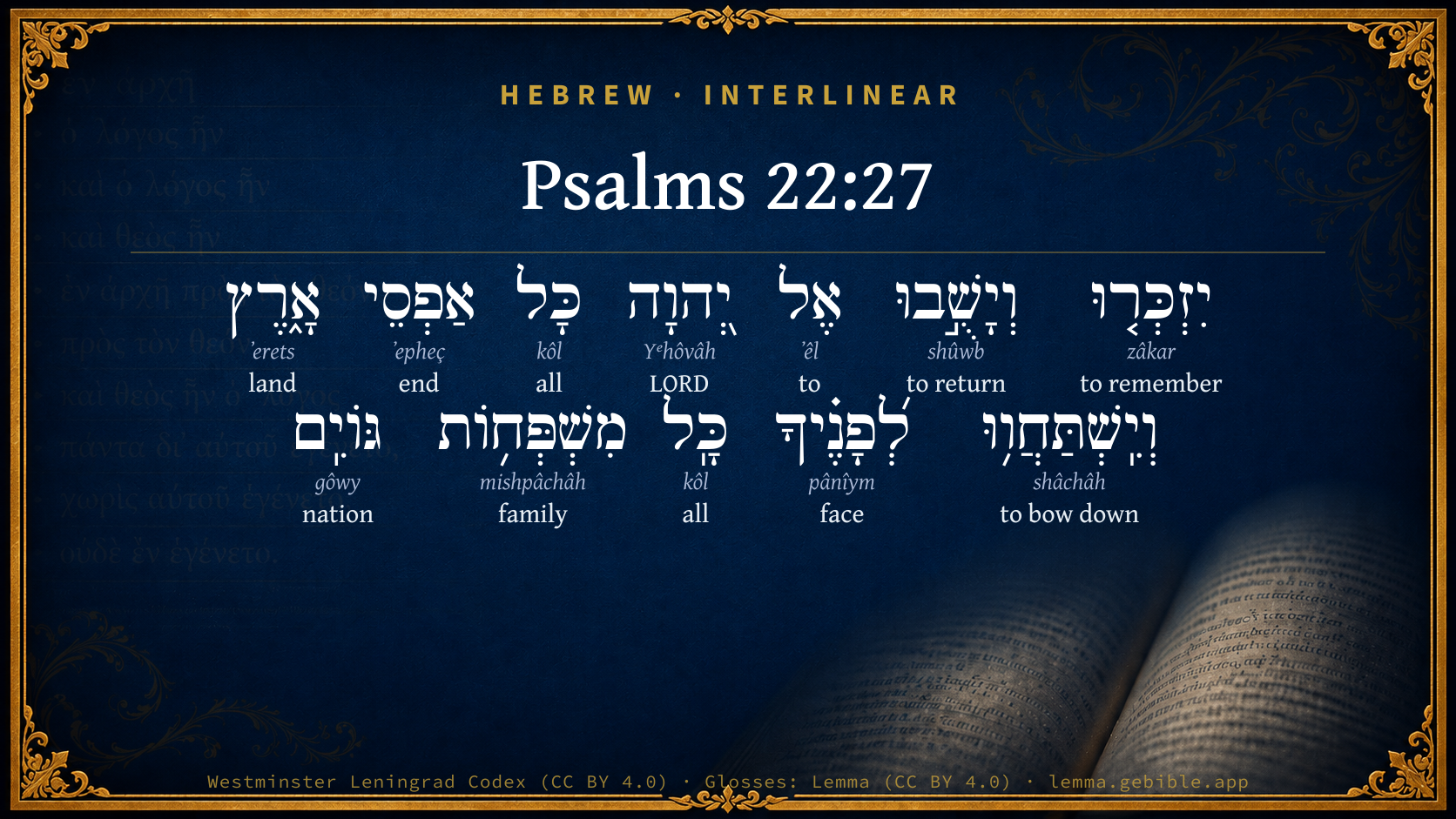
Hebrew (Westminster Leningrad Codex) Psalms 22:27 appears in the Hebrew Old Testament. The text above is from the Westminster Leningrad Codex. Each word links to its Strong’s number, a concise gloss, and parsing drawn from the Open Scriptures Hebrew Bible morphology. Click any word for its full Brown-Driver-Briggs (BDB) entry.
Download image
Cite this verse

Psalms 22:27 (World English Bible). Public Domain. Lemma interlinear Bible study tool, https://lemma.gebible.app/v/psalms/22/27.

Show BibTeX & RIS
BibTeX
RIS
English Translation
All the ends of the earth shall remember and turn to Yahweh. All the relatives of the nations shall worship before you.
World English Bible · Public Domain
Download a study sheet

One document with this verse’s original text, its word-by-word gloss line, the meaning frame, cross-references with their text, attributed commentary, and full source and license credits — printable, and it pastes into notes with its structure intact.

This verse Autodidact and up

Study sheet (.html) Plain text (.txt)

A passage Seminary Student

Up to 50 verses in one chapter. A passage sheet keeps up to 6 commentary sources and 12 cross-references per verse, in the order this page ranks them, and says so on the sheet whenever that leaves anything out. Ask for a single verse and you get the Autodidact verse sheet above.

Everything on this page stays free to read, with no account — the sheet is a download of what is already on screen, not access to it.

Want to remove ads? Support Godless Engineer
Compare translations 3

The same verse in 3 English versions, stacked beneath the original-language interlinear above. Click any original word for its lexicon entry.

Each is an independent rendering of the whole verse — the interlinear is not word-aligned to these translations.

Highlighted words mark where these versions differ — a whole-verse word diff, not a word-by-word alignment.

  • World English Bible Public Domain
    All the ends of the earth shall remember and turn to Yahweh. All the relatives of the nations shall worship before you.
  • King James Version Public Domain
    All the ends of the world shall remember and turn unto the LORD: and all the kindreds of the nations shall worship before thee.
  • unfoldingWord Literal Text CC BY-SA 4.0
    All of the ends of the earth will remember and turn to Yahweh, and all of the families of the nations will bow down to your face.

unfoldingWord Literal Text — © unfoldingWord, licensed CC BY-SA 4.0. Word-aligned USFM3 via Door43 (git.door43.org/unfoldingWord/en_ult).

Versions to compare (up to 4)

3 of 4 selected

Show all 18 translations

Every available English version of this verse, each an independent rendering of the whole verse.

  • World English Bible Public Domain
    All the ends of the earth shall remember and turn to Yahweh. All the relatives of the nations shall worship before you.
  • Berean Standard Bible Public Domain
    All the ends of the earth will remember and turn to the LORD. All the families of the nations will bow down before Him.
  • Majority Standard Bible Public Domain
    All the ends of the earth will remember and turn to the LORD. All the families of the nations will bow down before Him.
  • King James Version Public Domain
    All the ends of the world shall remember and turn unto the LORD: and all the kindreds of the nations shall worship before thee.
  • American Standard Version (1901) Public Domain
    All the ends of the earth shall remember and turn unto Jehovah; And all the kindreds of the nations shall worship before thee.
  • Revised Version (1885) Public Domain
    All the ends of the earth shall remember and turn unto the LORD: and all the kindreds of the nations shall worship before thee.
  • Geneva Bible (1599) Public Domain
    All the endes of the worlde shall remember themselues, and turne to the Lord: and all the kinreds of the nations shall worship before thee.
  • Douay-Rheims (1899) Public Domain
    The poor shall eat and shall be filled: and they shall praise the Lord that seek him: their hearts shall live for ever and ever.
  • Young's Literal Translation Public Domain
    Remember and return unto Jehovah, Do all ends of the earth, And before Thee bow themselves, Do all families of the nations,
  • Literal Standard Version CC BY-SA 4.0
    Remember and return to YHWH, || Do all the ends of the earth, || And bow themselves before You, || Do all families of the nations,
  • Unlocked Literal Bible CC BY-SA 4.0
    All the peoples of the earth will remember and turn to Yahweh; all the families of the nations will bow down before you.
  • unfoldingWord Literal Text CC BY-SA 4.0
    All of the ends of the earth will remember and turn to Yahweh, and all of the families of the nations will bow down to your face.
  • Darby Bible Public Domain
    All the ends of the earth shall remember and turn unto Jehovah, and all the families of the nations shall worship before thee:
  • World Messianic Bible Public Domain
    All the ends of the earth shall remember and turn to the LORD. All the relatives of the nations shall worship before you.
  • Webster's Bible Public Domain
    \\22:26\\The meek shall eat and be satisfied: they shall praise the LORD that seek him: your heart shall live for ever.
  • Free Bible Version CC BY-SA 4.0
    Everyone in the whole world will repent and return to the Lord; all the nations will worship before you.
  • Bible in Basic English Public Domain
    All the ends of the earth will keep it in mind and be turned to the Lord: all the families of the nations will give him worship.
  • JPS Tanakh (1917) Public Domain
    (22-28) All the ends of the earth shall remember and turn unto the LORD; and all the kindreds of the nations shall worship before Thee.

Literal Standard Version (2020), Covenant Press — licensed CC BY-SA 4.0. Text via the HelloAO Bible API (eBible.org). Unlocked Literal Bible (unfoldingWord) — licensed CC BY-SA 4.0. Text via the HelloAO Bible API (eBible.org). unfoldingWord Literal Text — © unfoldingWord, licensed CC BY-SA 4.0. Word-aligned USFM3 via Door43 (git.door43.org/unfoldingWord/en_ult). Free Bible Version, Dr. Jonathan Gallagher — licensed CC BY-SA 4.0. Text via the HelloAO Bible API (eBible.org).

Word by word

More ways to search: Search by grammar → Find every occurrence → Compare this word →

Practice this passage: Drill this verse → Learn its vocabulary →

אַפְסֵי
ʼepheç
H657
“ends of”
Noun, Common, Masculine, Plural, Construct
Part of Speech
Noun
Type
Common
Gender
Masculine
Number
Plural
State
Construct
Full BDB Definition

Origin: from H656

TWOT: 147a

ceasing, end, finality
  1. יִזְכְּר֤וּ zâkar H2142 “to remember” Verb, Qal, Imperfect, 3rd Person, Masculine, Plural
  2. וְיָשֻׁ֣בוּ shûwb H7725 “and · to return” Conjunction + Verb, Qal, Imperfect, 3rd Person, Masculine, Plural
  3. אֶל ʼêl H413 “to” Preposition
  4. יְ֭הוָה Yᵉhôvâh H3068 “LORD” Noun, Proper
  5. כָּל kôl H3605 “all of” Noun, Common, Masculine, Singular, Construct
  6. אָ֑רֶץ ʼerets H776 “land” Noun, Common, Both, Singular, Absolute
  7. וְיִֽשְׁתַּחֲו֥וּ shâchâh H7812 “and · to bow down” Conjunction + Verb, Hishtaphel, Imperfect, 3rd Person, Masculine, Plural
  8. לְ֝פָנֶ֗יךָ pânîym H6440 “to/for · face(s) · your” Preposition + Noun, Common, Both, Plural, Construct + Suffix, Personal, 2nd Person, Masculine, Singular
  9. כָּֽל kôl H3605 “all of” Noun, Common, Masculine, Singular, Construct
  10. מִשְׁפְּח֥וֹת mishpâchâh H4940 “families of” Noun, Common, Feminine, Plural, Construct
  11. גּוֹיִֽם gôwy H1471 “nations” Noun, Common, Masculine, Plural, Absolute

About this verse

These counts appear in no published source. They are computed here, from the morphology-tagged text and Lemma’s own curated glosses. What Lemma adds →

12
words
11
distinct lemmas
Wisdom
section

Shared distinctive vocabulary

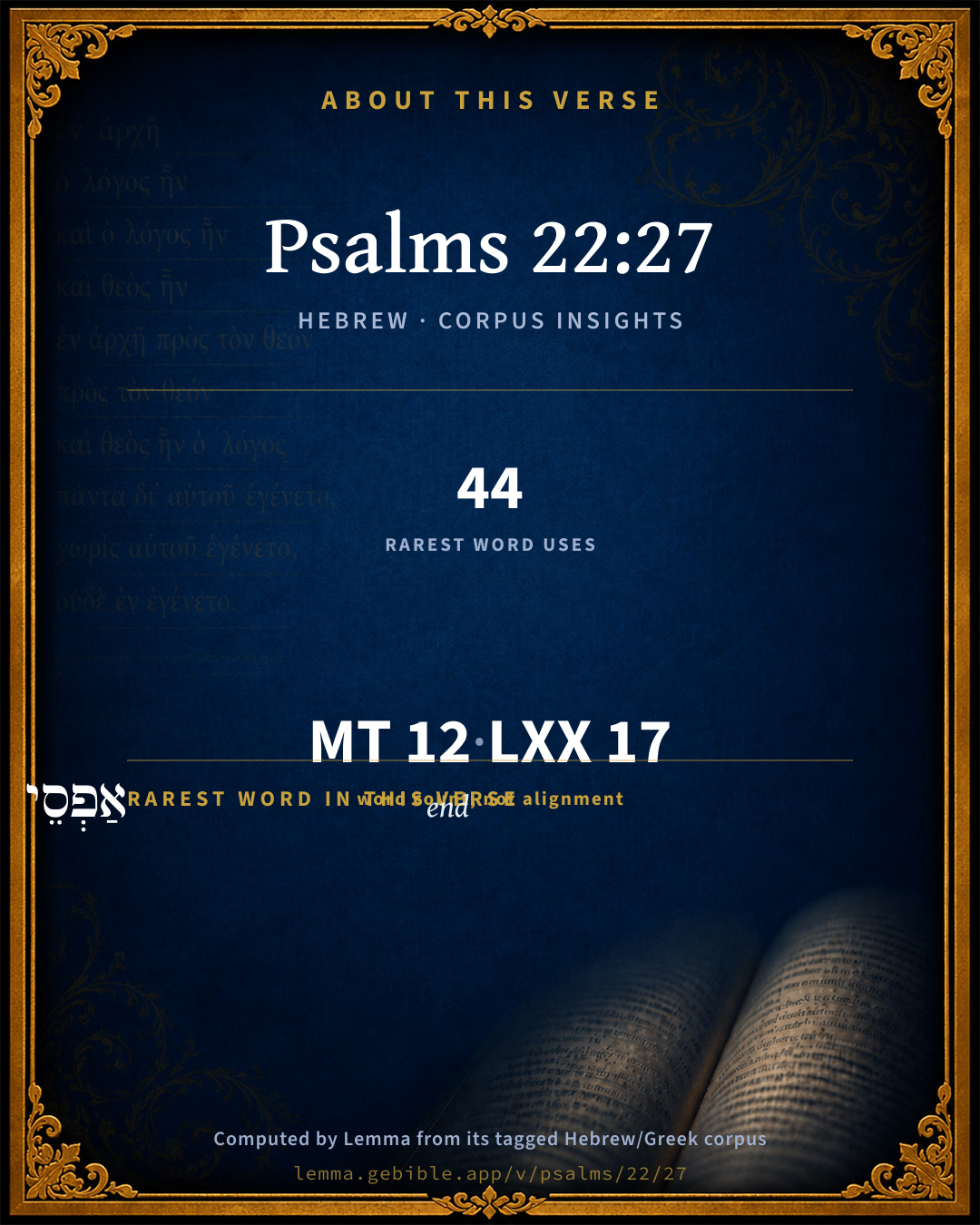
אַפְסֵי end H657 occurs in 43 verses of the Hebrew Bible. Also found in:

Grammatical profile

  • 3 verbs
  • 8 nouns
  • 1 preposition

Verb forms

  • יִזְכְּר֤וּ Qal · Imperfect
  • וְיָשֻׁ֣בוּ Qal · Imperfect
  • וְיִֽשְׁתַּחֲו֥וּ Hishtaphel · Imperfect

Repetition

A word recurs within this verse — often emphatic in Hebrew:

Hebrew & Septuagint length

In English translation the verse runs 22 words from the Hebrew and 24 from the Septuagint (LXX English) — closely comparable.

A rough comparison of the two English renderings, which tokenize alike — not a word-level alignment.

Word counts can differ between the Hebrew and the Greek without any difference in meaning — e.g. the Hebrew direct-object marker אֵת has no separate Greek word, and Greek often adds the article ὁ.

In the original languages it is 12 Hebrew tokens and 17 Greek tokens — but the two are counted differently (Hebrew bundles its prefixes and suffixes into one token; the Greek is in lemma form), so that isn’t a like-for-like length.

Cross-references

19

Topical passages linked to Psalms 22:27 in the Treasury of Scripture Knowledge — connected by theme and wording, ordered by reader-vote popularity; previews shown in the World English Bible.

  • Psalms 86:9 All nations you have made will come and worship before you, Lord. They shall glorify your name.
  • Isaiah 45:22 Look to me, and be you saved, all the ends of the earth; for I am God, and there is none else.
  • Revelation 7:9–12 After these things I looked, and behold, a great multitude, which no man could number, out of every nation and of all tribes, peoples, and languages, standing before the throne and before the Lamb, dressed in white robes, with palm branches in their hands.
  • Psalms 2:8 Ask of me, and I will give the nations for your inheritance, The uttermost parts of the earth for your possession.
  • Isaiah 49:6 yes, he says, It is too light a thing that you should be my servant to raise up the tribes of Jacob, and to restore the preserved of Israel: I will also give you for a light to the Gentiles, that you may be my salvation to the end of the earth.
  • Revelation 15:4 Who wouldn't fear you, Lord, And glorify your name? For you only are holy. For all the nations will come and worship before you. For your righteous acts have been revealed."
  • Psalms 72:11 Yes, all kings shall fall down before him. All nations shall serve him.
  • Psalms 96:7 Ascribe to Yahweh, you families of nations, Ascribe to Yahweh glory and strength.
  • Romans 16:26
  • Psalms 72:8 He shall have dominion also from sea to sea, From the River to the ends of the earth.
  • Psalms 102:22 When the peoples are gathered together, The kingdoms, to serve Yahweh.
  • Psalms 117:1 Praise Yahweh, all you nations! Extol him, all you peoples!
  • Isaiah 49:12 Behold, these shall come from far; and, behold, these from the north and from the west; and these from the land of Sinim.
  • Acts 26:18–20 to open their eyes, that they may turn from darkness to light and from the power of Satan to God, that they may receive remission of sins and an inheritance among those who are sanctified by faith in me.'
  • Acts 14:15 "Men, why are you doing these things? We also are men of like passions with you, and bring you good news, that you should turn from these vain things to the living God, who made the sky and the earth and the sea, and all that is in them;
  • Acts 20:21 testifying both to Jews and to Greeks repentance toward God, and faith toward our Lord Jesus.
  • 1 Thessalonians 1:9 For they themselves report concerning us what kind of a reception we had from you; and how you turned to God from idols, to serve a living and true God,
  • Psalms 98:3 He has remembered his loving kindness and his faithfulness toward the house of Israel. All the ends of the earth have seen the salvation of our God.
  • Isaiah 46:8–9 Remember this, and show yourselves men; bring it again to mind, you transgressors.

Cross-references courtesy of OpenBible.info (CC BY 4.0).

Hebrew and Greek witnesses Masoretic Hebrew ↔ Greek Septuagint

The same verse in the two great witnesses to the Old Testament, shown verse-for-verse.

You’re reading Greek Psalm 21 (Hebrew Psalm 22). The Septuagint counts the superscription, so verse numbers can differ from the Hebrew — chapter-level alignment, not verse-by-verse. Numbering follows Rahlfs.

These are two independent witnesses, not word-aligned to each other, and the Septuagint is shown in lemma (dictionary) form.

Hebrew Psalms 22:27 Masoretic · Westminster Leningrad Codex

יִזְכְּר֤וּ וְיָשֻׁ֣בוּ אֶל יְ֭הוָה כָּל אַפְסֵי אָ֑רֶץ וְיִֽשְׁתַּחֲו֥וּ לְ֝פָנֶ֗יךָ כָּֽל מִשְׁפְּח֥וֹת גּוֹיִֽם

All the ends of the earth shall remember and turn to Yahweh. All the relatives of the nations shall worship before you.

World English Bible · Public Domain

Greek LXX Greek Psalm 21:27 Septuagint · lemma form

ἐσθίω πένης καί ἐνπίμπλημι καί αἰνέω κύριος ὁ ἐκζητέω αὐτός ζάω ὁ καρδία αὐτός εἰς αἰών αἰών

All the ends of the earth shall remember and turn to the Lord: and all the kindred of the nations shall worship before him.

LXX2012 (modern English Septuagint) · Public Domain

On this verse, Keil & Delitzsch discusses the Septuagint’s reading. Read the note in Commentary ↓

Hebrew: Westminster Leningrad Codex (CC BY 4.0). Greek: Septuagint (public domain); English from LXX2012 (modern English Septuagint) (Public Domain). How the Septuagint differs from the Hebrew →

Commentary

Notes on Psalms 22:27 from classic Christian and Jewish commentators (each source and its license shown beneath its notes). The classic Christian expositions comment on the surrounding passage and are grouped to its opening verse, so a note may address several verses; the Jewish commentaries on the Tanakh (Rashi and others) are per-verse, so they appear only where the commentator wrote on this verse.

Lemma curates 59 commentaries, every one of them public domain or Creative Commons licensed, each selected and text-cleaned for this edition rather than reprinted as found. About our sources →

Trapp's Complete Commentary

John Trapp

Psa 22:27 All the ends of the world shall remember and turn unto the LORD: and all the kindreds of the nations shall worship before thee.

Ver. 27. All the ends of the world shall remember] Shall turn short again upon themselves, as those Solomon prayed for, 1Ki 8:47, and the prodigal, Luk 15:17.

And turn to the Lord] From their dead idols, 1Th 1:9.

And all the kindreds of the nations, &c.] Christ, when he is lifted up, shall draw all men to him, Joh 12:32; the heavenly eagles from all parts shall fly to this dead, but all-quickening carcase, and shall feed thereupon.

John Trapp, A Commentary or Exposition upon All the Books of the Old and New Testament (1647–1656) — public domain. Text from a community e-Sword module.

The Biblical Illustrator

Joseph S. Exell

Psa_22:27

All the ends of the world shall remember, and turn unto the Lord.

The return to the Father

In this Psalm the utterance of the believing heart in trial and in deliverance becomes, at various points, a prophetic anticipation of the experience of Christ. In one verse after another we seem to hear out of His own mouth the sorrow and the triumph of Christ. Regarding the text in this light, as an expectation which a believer might naturally express in the hour of his own enlargement, it brings before us an interesting connection of thought. A believer who has been brought into great temptation and trouble, and whose faith has been drawn out into lively and lowly exercise, when the deliverance comes will be aware of something more than the worth and the gladness of that particular deliverance. He has been holding converse with the mercy of God under pressure. There comes afresh into his heart the impression of the love of God, of which his own relief is only an instance and expression. So God teaches him--forces him to learn afresh--what a blessedness this is to have this God for his God forever and ever. Then how naturally he may go on to such an anticipation as that in the text he has a fresh sense of that in God which saves and blesses. How natural it becomes to cherish even so great an expectation as that the ends of the world may turn to the Lord! If all believers had the fresh sense they might have of Divine compassion there would be less uncertainty about the prosperity of the Gospel, less of feeble and dubious effort. And we may also hear the utterance of a Saviours joy and exultation when it is said, The ends of the world shall remember, and shall turn to the Lord.

I. The prospect from the cross. So taken, the text suggests to us our Lords consciousness of the virtue that lay in His atoning sacrifice. The life of perfect holiness and perfect love was crowned by the death in which He put away sin. Exceeding glory to God and good to man were to be unfolded from it. This lay fully before our Lords eye from the first. What He saw it becomes us to believe--the ends of the world shall remember, and turn to the Lord.

II. The souls awakening. They shall remember. It is as though something long forgotten had come to mind, had melted their hearts within them. In what sense is the truth in Christ new? It is not so new but that it has also something old in it. Just this lay behind many a transient conviction, many a vague and dim impression. Whatever of new has come has put unspeakable meaning into all the old.

III. Mans place with God. This is not so only with those for whom conversion comes after years of acquaintance with the Christian creed, and with the form of Godliness. It holds for men as men. The God who in Christ becomes ours is the very God for whom man was made. This is the meaning of man. And the blessedness which redemption brings is for the heart of man, as man was planned and made.

IV. The inevitable return. The text points to a time when turning to God shall be the main thing, the prevailing thing, as if a mighty tide setting that way, carried all before it. For the present we do not see this. (Robert Rainy, D. D.)

Three stages in religious life

I. Reflection. Shall remember. We use the word reflection here because the usual Bible significance of the word remember is not simply recollect, but meditate, consider. The act described is far more than one of memory; witness the words, Remember now thy Creator. Here also the Psalmist means remember the Lord. Thought is the first stage in true life. Right thought on a right subject is essential to right life. As a man thinketh in his heart, so is he.

1. Think about God.

2. Think what Gods ways with men are.

3. Think of your relationship to God. In the past; now; for the future.

II. conversion. Turn unto would be a synonym; or return. Turn ye, turn ye, why will ye die? These passages, with that in our text, remind us--

1. That man is turned away from God. There is aversion and alienation.

2. Man may be restored to God. His face may yet look into the face of the Father, his life spent in Godward sympathies and activities.

3. This conversion, i.e. moral turning round, implies human effort and Divine help. Man is to turn, and God will turn him. Then, and then only, will his back be towards vanities and sins, and his face towards the true and the pure. More than passing sentiment is needed. There must be the putting forth of all the strongest forces of manhood, and the energising grace of God.

III. Adoration. Shall worship. This is the climax. It is the fullest development of the higher life, the crown of human destiny. Adoration of God is--

1. The instinct.

2. The obligation.

3. The satisfaction of souls. (U. R. Thomas.)

The importance of true religion, and the care of God to preserve it

I. To glorify and enjoy God are the great ends of our creation and redemption. This is the great and fundamental article of religion. Gods design in the creation and government of the world must have been the manifestation of His perfection, and the conferring happiness on intelligent creatures in proportion to their capacities. To what purpose hath God distinguished man with a rational and immortal soul resembling Himself, but to make him capable of religion and eternal life. What the character of God and the nature of man so clearly demonstrate on principles of reason, God hath expressly declared to us in His Word.

II. God has given men proper information of His character, will, and grace as their rule of duty and their guide to happiness. The existence of the creation demonstrates the existence of the Creator; its greatness proves His immensity; its order, His wisdom; and the provision made for the happiness of His creatures, His boundless goodness. In every state of man the only perfect rule of religion is Divine revelation, which confirms all the principles of natural religion, and informs us of many things necessary to be known which our own reason could not have discovered. The dispensations of Gods providence subserved the design of His revelations for preserving religion and virtue in the world.

III. That before the coming of Christ the worship of the true God should be generally forgotten and neglected by mankind. This melancholy truth the history of the world hath but too amply verified. True religion must always have the true God for its object, and His moral character and revealed will for its rule. False religion originates in a departure from the worship of the true God to that of idols; either as objects of religious adoration or as the means of it. To this cause Moses ascribed the idolatry of Israel. The sun, moon, etc., from being worshipped only as representations of God, came to be considered and worshipped as so many distinct deities. As the multitude of gods worshipped by the heathen distracted their religion, and turned it away from the only true God, so their mean and immoral characters shamefully debased it. Religion is the chief part and foundation of moral righteousness. As before the coming of Christ the Gentiles had grossly departed from the knowledge and profession of the true religion, so the Jews had greatly degenerated from the sincere belief and practice of it.

IV. By the Gospel and the grace of Christ all nations should be brought to remember and turn unto the Lord. The coming of the Saviour was the era of light, reformation, and happiness to the world As to the proper improvement of these truths, let us ever live under the serious belief and impression that, to glorify and enjoy God, our Creator and Saviour, are the great ends of our existence, and can be attained only by the knowledge and practice of true religion. (W. Dalgleish, D. D.)

Nature and extent of true conversion under Messiahs reign

I. The nature of true conversion.

1. It is to remember. It is fitly expressed by the ease of the prodigal, who is said to have come to himself. The Holy Spirit is ever seeking to make us remember. Sometimes by adverse providences, as with Josephs brethren. At other times by His Word. Sometimes it is without any apparent cause. I thought on my ways, says David, and turned my feet unto Thy testimonies. And there will, however brought, be many ways which we shall remember with sorrow and shame. As our ways of open immorality: things which we thought were no harm, since other people did them; and ways which we have thought nothing about--sins of the heart. And ways, too, that you have counted good you will thus remember. All your religion while unconverted will appear odious to you.

2. It is turning unto the Lord. This is very important, for it is possible to remember our evil ways without turning from them. And it is possible both to remember and turn, and yet not to turn to the Lord. And--

3. There will be worship--the homage of the heart presented to God according to His will.

II. The extent. All the ends of the world; all the kindreds of the nations, etc. It was fit that the accessions of the Gentiles should be reserved for the Gospel day, that it might grace the triumph of Christ over His enemies. And the good work then begun must go on, no longer limited to the seed of Abraham. But the time will come when our text will be abundantly fulfilled. Nor can the time of fulfilment be far distant. The last branch of the last of the four beasts foretold by Daniel is now in its dying agonies. But while we are concerned for all the world, let us not forget our own souls. (Andrew Fuller.)

The assistance derived by Christianity from human learning

it is matter of doubt whether there is real improvement in the world in morals and religion. In some parts matters seem to have become worse. But in others, our own country especially, since the Reformation there has been improvement, and such as is not likely to be lost. Still, we are far enough from perfection. For that we must look on to the kingdom of God yet to be established, but meanwhile we must help it forward as we best can. But note--

I. What are the causes of the improvement we have noticed? They are--

1. General experience, though there are instances in which the moral and religious condition of the people are no better now than they were ages ago. The reason of this is that these communities have possessed no literature, and hence the teachings of experience have been lost and each generation has to begin anew.

2. Letters and learning. Hence these teachings no longer die with those who have acquired them, but are handed on to their successors. But we have instances in which--as in Egypt, Greece, and Rome, where there have been letters and learning, but because separated from true religion--the world has not been morally advanced by them. The experience of France in the eighteenth century is in point here.

3. The revelation of Christianity. But this from an early period down to the time of the Reformation being loaded with superstition, the moral life of men was but little benefited. Hence we gather that there must be the union of Learning and Christianity if any real progress is to be made.

II. What assistance Christianity has received from human learning. This learning may be distinguished--

1. As the study of ancient languages and composition. Hence now we have the Scriptures translated, and this learning is useful not only to translate but to teach us the rules of interpretation, and of just criticism, and of the best models of composition, and to give freedom and strength to the imagination. Even the elegance of ancient writers, though often considered as merely ornamental, is not without its use towards the perfection of Christian morals. There is a connection and a sympathy which, though they do not always appear, have yet a tendency to prevail, between whatever is simple and elegant in the arts, and a simplicity and elegance of manners. By this connection we are rendered more sensible of any thing that can soften the human mind, can heighten the enjoyment of social life, or prepare us for that Christian charity which is the bond of peace and of all virtue.

2. The study of philosophy, which is not merely useful in the discovery of curious and useful arts. It serves a much nobler and more generous purpose, that of promoting our progress towards the perfection of our nature, and of advancing the interests of true religion. (W. Pearce, D. D.)

The triumph of Christianity

Some regard this Psalm as our Lords soliloquy when expiring on the Cross. It may be so. Fitter words could not have been conceived. The mighty hero sees the conflict ended, anticipates the victory, and begins to chant the conquerors paean.

I. The conversion of the nations to God may be expected. It is much to be desired. But the battle is long and weary and the end is not yet. Some think it is not to be looked for. But--

1. Our newborn nature craves for it; and--

2. Is it not unlikely that on this earth where God has stood in the person of His Son, that evil, after all, should vanquish Him?

3. And see the promises of reward made to our Redeemer. He shall see of the travail of His soul and shall be satisfied. And the Scriptures are full of such promises, in the Psalms and in all the prophets. It is good to be reminded of them, for we shall not labour well if we do not labour in hope. And as yet we have not done so much as to give the fragments of the Gospel feast to the nations. When the Church is ready for great events they shall occur to her.

II. Such conversion will occur in the usual manner of other conversions. The nations, says our text, shall remember, and shall turn unto the Lord, and shall worship before Him.

1. They shall remember. In this manner conversion begins.

2. They shall turn.

3. They shall worship.

III. The means to accomplish this result are to be found at Calvary. This is a Calvary Psalm; its connection is full of sacrificial suffering. Every conversion is the result of Christs death. And His death is our motive for spreading the Gospel. And it is the security of future triumph. We shall conquer the world, but it will be by the Cross. The old legend of Constantine, In hoc signo vinces, hath truth in it for us. By this we shall conquer--by the Cross, by the preaching of Jesus Christ. (C. H. Spurgeon.)

The Biblical Illustrator, edited by Joseph S. Exell (c. 1880s–1900s) — public domain. Text from a community e-Sword module.

The Treasury of David

Charles H. Spurgeon

Ver. 27. The meek shall eat and be satisfied. Mark how the dying Lover of our souls solaces himself with the result of his death. The spiritually poor find a feast in Jesus, they feed upon him to the satisfaction of their hearts, they were famished until he gave himself for them, but now they are filled with royal dainties. The thought of the joy of his people gave comfort to our expiring Lord. Note the characters who partake of the benefit of his passion; "the meek, " the humble and lowly. Lord, make us so. Note also the certainty that gospel provisions shall not be wasted, "they shall eat; "and the sure result of such eating, "and be satisfied."

They shall praise the Lord that seek him. For a while they may keep a fast, but their thanksgiving days must and shall come.

Your heart shall live for ever. Your spirits shall not fail through trial, you shall not die of grief, immortal joys shall be your portion. Thus Jesus speaks even from the cross to the troubled seeker. If his dying words are so assuring, what consolation may we not find in the truth that he ever liveth to make intercession for us! They who eat at Jesus' table receive the fulfilment of the promise, "Whosoever eateth of this bread shall live for ever."

Ver. 27. In reading this verse one is struck with the Messiah's missionary spirit. It is evidently his grand consolation that Jehovah will be known throughout all places of his dominion.

All the ends of the world shall remember and turn unto the Lord. Out from the inner circle of the present church the blessing is to spread in growing power until the remotest parts of the earth shall be ashamed of their idols, mindful of the true God, penitent for their offences, and unanimously earnest for reconciliation with Jehovah. Then shall false worship cease,

and all the kindreds of the nations shall worship before thee, O thou only living and true God. This hope which was the reward of Jesus is a stimulus to those who fight his battles. It is well to mark the order of conversion as here set forth; they shall "remember" this is reflection, like the prodigal who came unto himself; "and turn unto Jehovah" this is repentance, like Manasseh who left his idols and "worship" this is holy service, as Paul adored the Christ whom once he abhorred.

Ver. 27. All the ends of the world shall remember and turn unto the Lord; and all the kindreds of the nations shall worship before him. This passage is a prediction of the conversion of the Gentiles. It furnishes us with two interesting ideas; the nature of true conversionand the extent of it under the reign of the Messiah.

1. The NATURE of true conversion: It is to "remember" to "turn to the Lord" and to "worship before him." This is a plain and simple process. Perhaps the first religious exercise of mind of which we are conscious is reflection. A state of unregeneracy is a state of forgetfulness. God is forgotten. Sinners have lost all just sense of his glory, authority, mercy, and judgment; living as if there were no God, or as if they thought there was none. But if ever we are brought to be the subjects of true conversion, we shall be brought to remember these things. This divine change is fitly expressed by the case of the prodigal, who is said to have come to himself, or to his right mind. But further, true conversion consists not only in remembering, but in "turning to the Lord." This part of the passage is expressive of a cordial relinquishment of our idols, whatever they have been, and an acquiescence in the gospel way of salvation by Christ alone. Once more, true conversion to Christ will be accompanied with the "worship" of him. Worship, as a religious exercise, is the homage of the heart, presented to God according to his revealed will... 2. The EXTENT of conversion under the kingdom or reign of the Messiah: "All the ends of the world shall remember and turn unto the Lord; and all the kindreds of the nations shall worship before him." It was fit that the accession of the Gentiles should be reserved for the gospel day, that it might grace the triumph of Christ over his enemies, and appear to be what it is, "the travail of his soul." This great and good work, begun in the apostles' day, must go on, and "must increase, "till "All the ends of the world shall remember and turn", and "all the kindreds of the nations shall worship before him." Conversion work has been individual; God has gathered sinners one by one. Thus it is at present with us; but it will not be thus always. People will flock to Zion as doves to their windows. Further, conversion work has hitherto been circumscribed within certain parts of the world. But the time will come when "all the kindreds of the earth" shall worship. These hopes are not the flight of an ardent imagination; they are founded on the true sayings of God. Finally, while we are concerned for the world, let us not forget our own souls. So the whole world be saved and we lost, what will it avail us? Condensed from Andrew Fuller.

Ver. 27. All the ends of the world shall REMEMBER this is a remarkable expression. It implies that man has forgotten God. It represents all the successive generations of the world as but one, and then it exhibits that one generation, as if it had been once in paradise, suddenly remembering the Lord whom it had known there, but had long forgotten... The converted nations, we learn by this verse, will not only obtain remembrance of their past loss, but will also be filled with the knowledge of present duty. John Stevenson.

Ver. 27. All the nations of the world ((wrkzy) jizkeru, the same Hebrew root with (rykza) azkir) shall remember; why? what is that? or what shall they remember? Even this: they shall turn to the Lord, and worship him, in his name, in his ordinances; as is explained in the words following of this verse: And all the families of the nations ((wwhtvyw) jishtachavu, "shall bow" down themselves, or) worship before thee, etc. And so in Ps 86:9, "All nations whom thou hast made shall come" ((wwxtayw) vejishtachavu) "and they shall worship before thee; "and how shall they do so? Even by recording, remembering, and making mention of the glory of thy name; as in the words following ((Kmv wdbkyw) vicabbedu lishmecha), "and shall glorify thy name." William Strong's "Saints Communion with God", 1656.

Ver. 27-28. The one undeviating object of the Son all through was, the glory of the Father: he came to do his will, and he fulfilled it with all the unvarying intensity of the most heavenly affection. What, then, will not be the exuberant joy of his heart, when in his glorious kingdom, he shall see the Father beyond all measure glorified?... The praise and honour and blessing which will be yielded to the Father in that day through him, so that God shall be all in all, will make him feel he underwent not a sorrow too much for such a precious consummation... Every note of thanksgiving which ascends to the Father, whether from the fowls of the air, or the beasts of the field, or the fishes of the sea, or the hills, or the mountains, or the trees of the forest, or the rivers of the valleysall shall gladden his heart, as sweet in the ears of God, for the sake of him who redeemed even them from the curse, and restored to them a harmony more musical than burst from them on the birthday of their creation. And man! renewed and regenerated man! for whose soul the blood was spilt, and for the redemption of whose body death was overcome, how shall the chorus of his thanksgiving, in its intelligent and articulate hallelujahs, be the incense which that Saviour shall still love to present unto the Father, a sweet smelling savour through himself, who, that he might sanctify his people by his own blood, suffered without the camp. How are the channels choked up or impaired in this evil world, wherein the praise and glory of our God should flow as a river! How will Christ then witness, to the delight of his soul, all cleared and restored! No chill upon the heart, no stammering in the tongue, in his Father's praises! No understanding dull, or eye feeble, in the apprehension of his glory! No hand unready, or foot stumbling, in the fulfilling of his commandments. God, the glory of his creatures: his glory their service and their love; and all this the reward to Jesus of once suffering himself. C. J. Goodhart, M.A., in "Bloomsbury Lent Lectures", 1848.

Ver. 27. (last clause). Life everlasting. What lives? Source of life. Manner of life. Why for ever? What occupation? What comfort to be derived from it?

Ver. 27. Nature of true conversion, and extent of it under the reign of the Messiah. Andrew Fuller.

Ver. 27. The universal triumph of Christianity certain.

Ver. 27. The order of conversion. See the Exposition.

Psalms 22:28*

Ver. 27-28. See Psalms on "Ps 22:27" for further information.

Charles H. Spurgeon's The Treasury of David (1869–1885) — public domain. Psalms only. Text from a community e-Sword/MySword module.

Joseph Benson's Commentary

Psa 22:27. All the ends of the world — All nations, from one end of the world to the other. So this is an evident prophecy of the calling of the Gentiles to the knowledge of God and Christ by the gospel, and a clear proof that this Psalm immediately speaks of Christ; to whom alone this and divers other passages of it belong. Shall remember — They shall remember their former wickedness with grief, and shame, and fear; particularly in worshipping dead and impotent idols. They shall remember their great and manifold obligations to God, which they had quite forgotten, his patience in sparing them so long, in the midst of all their impieties, and in revealing his gospel to them, and in giving his Son for them: they shall remember the gracious words and glorious works of Christ, what he did and suffered for them; which possibly divers of them had been eye and ear witnesses of. And turn unto the Lord — Unto the only true God, and unto Jesus Christ, to whom this name of Jehovah is often ascribed in Scripture. All the kindreds of the nations — Hebrew, כל משׁפחות, cal mishpechoth, all the families. Which is not to be understood strictly of every particular person and family, but of all sorts, and of great numbers of them; as such universal phrases are often to be understood in Scripture.

Joseph Benson's Commentary on the Old and New Testaments (1811–1818) — public domain. Text from a community e-Sword module.

Keil & Delitzsch

C. F. Keil & F. Delitzsch

(Heb.: 22:28-32)The long line closing strophe, which forms as it were the pedestal to the whole, shows how far not only the description of the affliction of him who is speaking here, but also the description of the results of his rescue, transcend the historical reality of David's experience. The sufferer expects, as the fruit of the proclamation of that which Jahve has done for him, the conversion of all peoples. The heathen have become forgetful and will again recollect themselves; the object, in itself clear enough in Psa 9:18, becomes clear from what follows: there is a γνῶσις τοῦ θεοῦ (Psychol. S. 346ff.; tr. pp. 407ff.) among the heathen, which the announcement of the rescue of this afflicted one will bring back to their consciousness.

(Note: Augustin De trinitate xiv. 13, Non igitur sic erant oblitae istae gentes Deum, ut ejus nec commemoratae recordarentur.)

This prospect (Jer 16:19.) is, in Psa 22:29 (cf. Jer 10:7), based upon Jahve's right of kingship over all peoples. A ruler is called משׁל as being exalted above others by virtue of his office (משׁל according to its primary meaning = Arab. mṯl, erectum stare, synonymous with כּחן, vid., on Psa 110:4, cf. עמד Mic 5:3). In וּמשׁל we have the part., used like the 3 praet., without any mark of the person (cf. Psa 7:10; Psa 55:20), to express the pure praes., and, so to speak, as tempus durans: He rules among the nations (ἔθνη). The conversion of the heathen by that sermon will, therefore, be the realisation of the kingdom of God.

Psa 22:29

The eating is here again brought to mind. The perfect, אכלוּ, and the future of sequence, ויּשׁתּחווּ, stand to one another in the relation of cause and effect. It is, as is clear from Psa 22:27, an eating that satisfies the soul, a spiritual meal, that is intended, and in fact, one that is brought about by the mighty act of rescue God has wrought. At the close of Ps 69, where the form of the ritual thank-offering is straightway ignored, ראוּ (Psa 22:23) takes the place of the אכלוּ. There it is the view of one who is rescued and who thankfully glorifies God, which leads to others sharing with him in the enjoyment of the salvation he has experienced; here it is an actual enjoyment of it, the joy, springing from thankfulness, manifesting itself not merely in words but in a thank-offering feast, at which, in Israel, those who long for salvation are the invited guests, for with them it is an acknowledgment of the mighty act of a God whom they already know; but among the heathen, men of the most diversified conditions, the richest and the poorest, for to them it is a favour unexpectedly brought to them, and which is all the more gratefully embraced by them on that account. So magnificent shall be the feast, that all דּשׁני־ארץ, i.e., those who stand out prominently before the world and before their own countrymen by reason of the abundance of their temporal possessions (compare on the ascensive use of ארץ, Psa 75:9; Psa 76:10; Isa 23:9), choose it before this abundance, in which they might revel, and, on account of the grace and glory which the celebration includes within itself, they bow down and worship. In antithesis to the "fat ones of the earth" stand those who go down to the dust (עפר, always used in this formula of the dust of the grave, like the Arabic turâb) by reason of poverty and care. In the place of the participle יורדי we now have with ונפשׁו (= ואשׁר נפשׁו) a clause with ולא, which has the value of a relative clause (as in Psalms 49:21; Psa 78:39, Pro 9:13, and frequently): and they who have not heretofore prolonged and could not prolong their life (Ges. 123, 3, c). By comparing Phi 2:10 Hupfeld understands it to be those who are actually dead; so that it would mean, His kingdom extends to the living and the dead, to this world and the nether world. But any idea of a thankful adoration of God on the part of the dwellers in Hades is alien to the Old Testament; and there is nothing to force us to it here, since יורד עפר, can just as well mean descensuri as qui descenderunt, and נפשׁו dna ,tnuredne חיּה (also in Eze 18:27) means to preserve his own life, - a phrase which can be used in the sense of vitam sustentare and of conservare with equal propriety. It is, therefore, those who are almost dead already with care and want, these also (and how thankfully do these very ones) go down upon their knees, because they are accounted worthy to be guests at this table. It is the same great feast, of which Isaiah, Isa 25:6, prophesies, and which he there accompanies with the music of his words. And the result of this evangel of the mighty act of rescue is not only of boundless universality, but also of unlimited duration: it propagates itself from one generation to another.

Formerly we interpreted Psa 22:31 "a seed, which shall serve Him, shall be reckoned to the Lord for a generation;" taking יספּר as a metaphor applying to the census, Ch2 2:16, cf. Psa 87:6, and לדּור, according to Psa 24:6 and other passages, as used of a totality of one kind, as זרע of the whole body of those of the same race. But the connection makes it more natural to take דור in a genealogical sense; and, moreover, with the former interpretation it ought to have been לדּור instead of לדּור. We must therefore retain the customary interpretation: "a seed (posterity) shall serve Him, it shall be told concerning the Lord to the generation (to come)." Decisive in favour of this interpretation is לדּור with the following יבאוּ, by which דור acquires the meaning of the future generation, exactly as in Psa 71:18, inasmuch as it at once becomes clear, that three generations are distinctly mentioned, viz., that of the fathers who turn unto Jahve, Psa 22:30, that of the coming דור, Psa 22:31, and עם נולד, to whom the news of the salvation is propagated by this דור, Psa 22:31 : "They shall come (בּוא as in Psa 71:18 : to come into being), and shall declare His righteousness to the people that shall be born, that He hath finished." Accordingly זרע is the principal notion, which divides itself into (יבאו) דור and עם נולד; from which it is at once clear, why the expression could be thus general, "a posterity," inasmuch as it is defined by what follows. עם נולד is the people which shall be born, or whose birth is near at hand (Psa 78:6); the lxx well renders it: λαῷ τῷ τεχθησομένῳ (cf. Psa 102:19 עם נברא populus creandus). צדקתו is the dikaiosu'nee of God, which has become manifest in the rescue of the great sufferer. That He did not suffer him to come down to the very border of death without snatching him out of the way of his murderous foes and raising him to a still greater glory, this was divine צדקה. That He did not snatch him out of the way of his murderous foes without suffering him to be on the point of death - even this wrathful phase of the divine צדקה, is indicated in Psa 22:16, but then only very remotely. For the fact, that the Servant of God, before spreading the feast accompanying the shelamim (thank-offering) in which He makes the whole world participants in the fruit of His suffering, offered Himself as an asham (sin-offering), does not become a subject of prophetic revelation until later on, and then under other typical relationships. The nature of the עשׂה, which is in accordance with the determinate counsel of God, is only gradually disclosed in the Old Testament. This one word, so full of meaning (as in Ps 52:11; Psa 37:5; Isa 44:23), implying the carrying through of the work of redemption, which is prefigured in David, comprehends everything within itself. It may be compared to the לעשׂות, Gen 2:3, at the close of the history of the creation. It is the last word of the Psalm, just as τετέλεσται is the last word of the Crucified One. The substance of the gospel in its preparatory history and its fulfilment, of the declaration concerning God which passes from generation to generation, is this, that God has accomplished what He planned when He anointed the son of Jesse and the Son of David as mediator in His work of redemption; that He accomplished it by leading the former through affliction to the throne, and making the cross to the latter a ladder leading up to heaven.

Keil & Delitzsch — Biblical Commentary on the Old Testament (1861–1891) — public domain (CC PDM 1.0). Text via the HelloAO Bible API. (Old Testament only.)

J. A. Alexander on Psalms

Joseph Addison Alexander

28. (Psa 22:27). Remember and return to Jehovah shall all the ends of the earth, and worship before thee all the kindreds of the nations. As the joyful effects of this deliverance were not to be restricted to himself or his domestic circle, but extended to the great congregation of God's people, so too we now read that they shall not be confined to any one race, but made to embrace all. The ends of the earth, here put for the remotest nations. See above, on Psa 2:8. These are named as the least likely to be comprehended in the promise, but of course without excluding those less distant. As if he had said, the ends of the earth and all that is between them. In the other clause, accordingly, we find as a parallel expression, not the furthest, but all nations. They shall remember this deliverance, this exhibition of God's faithfulness and might, and shall turn unto Jehovah, be converted to his worship and his service. Some suppose an allusion to the great original apostasy, or to the temporary casting off of the Gentiles: they shall remember their original condition, and return unto the Lord, from whom they have revolted. But this, though true and really implied, is not the strict sense of the words, which would then have no perceptible connection with the general subject of the psalm, and the immediate occasion of the praise which it contains.—Worship, literally prostrate themselves, the accustomed oriental indication both of civil and religious worship.—The form of expression in the last clause is evidently borrowed from the patriarchal promise. Compare Gen 12:3; Gen 28:14.

Joseph Addison Alexander, The Psalms Translated and Explained (1850) — public domain. Text from a community e-Sword module.

Tyndale Open Study Notes

Tyndale Open Resources

22:27 families of the nations: All clans and tribes of humanity (see Gen 12:3; Rev 5:9-10) will live in submission to the Lord (Ps 96:1-3; see Pss 2, 72; Isa 2:2-4; 1 Cor 15:25-27).

Tyndale Open Study Notes — © Tyndale Open Resources, licensed CC BY-SA 4.0. Text via the HelloAO Bible API.

Jamieson, Fausset & Brown

Robert Jamieson, A. R. Fausset & David Brown

His case illustrates God's righteous government. Beyond the existing time and people, others shall be brought to acknowledge and worship God; the fat ones, or the rich as well as the poor, the helpless who cannot keep themselves alive, shall together unite in celebrating God's delivering power, and transmit to unborn people the records of His grace.

Jamieson, Fausset & Brown — Commentary Critical and Explanatory on the Whole Bible (1871) — public domain (CC PDM 1.0). Text via the HelloAO Bible API.

Adam Clarke's Commentary

Verse 27. All the ends of the world] The Gospel shall be preached to every nation under heaven; and all the kindred of nations, משפחות mishpechoth, the families of the nations: not only the nations of the world shall receive the Gospel as a revelation from God, but each family shall embrace it for their own salvation. They shall worship before Jesus the Saviour, and through him shall all their praises be offered unto God.

Adam Clarke's Commentary on the Bible (1810–1826) — public domain. Text from a community e-Sword/MySword module.

John Calvin's Commentaries

27. All the ends of the earth shall remember. This passage, beyond all doubt, shows that David stops not at his own person, but that under himself, as a type, he describes the promised Messiah. For even then, it ought to have been a well-known point, that he had been created king by God, that the people might be united together and enjoy a happy life under one head; and this was at length completely fulfilled in Christ. David’s name, I admit, was great and renowned among the neighboring nations; but what was the territory which they occupied in comparison of the whole world? Besides, the foreign nations whom he had subdued had never been converted by him to the true worship of God. That forced and slavish submission, therefore, which the heathen nations had been brought by conquest to yield to an earthly king, was very different from the willing obedience of true godliness by which they would be recovered from their miserable wanderings, and gathered to God. Nor does the Psalmist mean an ordinary change, when he says, that the nations shall return to God, after having become well acquainted with his grace. Moreover, by uniting them to the fellowship of the holy feast, he manifestly grafts them into the body of the Church. Some explain these words, They shall remember, as meaning, that upon the restoration of the light of faith to the Gentiles, they should then come to remember God, whom they had for a time forgotten; As it is not said what they should remember, some commentators explain it thus: That they shall remember, with penitence, their sins; and, particularly, their idolatry. Others, that they shall remember the goodness and mercy of God, through Christ, to a lost world. And others, that they shall remember God whom they had forgotten, worshipping, instead of him, wood and stones. This last seems to be the view to which Calvin refers.

John Calvin's Commentaries (1540-1563) — public domain. Text from the Calvin Translation Society English edition (1840s-50s) via the Christian Classics Ethereal Library (ccel.org). Calvin's coverage is partial (roughly two-thirds of the Bible); uncommented books and verses are honest gaps, never fabricated. The 19th-century editor's footnotes and remarks are omitted so the notes are faithfully Calvin's own voice.

The Cambridge Bible for Schools and Colleges

gen. ed. J. J. S. Perowne

27. All the ends of the world] R.V., of the earth. The remotest countries. Cp. Psa_67:7; Psa_98:3.

shall remember &c.] There was a knowledge of God, to which the nations might attain through the witness of His works without and the witness of conscience within. But they ‘forgot Him’ (Psa_9:17) and turned away from Him to idols of their own imagination (Rom_1:21; Rom_1:28). But one day they will ‘remember’ and ‘return.’ Cp. Jer_16:19 ff.

all the kindreds of the nations] All the families of the nations; realising the patriarchal promise (Gen_12:3; Gen_28:14).

27–31. The Psalmist’s hopes take a wider range, extending to all mankind and to future ages. He anticipates the time when not he alone, not the seed of Israel only, but all nations to earth’s remotest bound, will pay homage to Jehovah. From personal hopes he passes to national hopes, from national hopes to universal hopes, reaching forward into the future from generation to generation. But this establishment of Jehovah’s kingdom is not explicitly regarded as the fruit of the Psalmist’s sufferings. We are not yet upon the level of Isaiah 53. Perhaps the nations are represented as being attracted by Jehovah’s deliverance of His servant, though even this is not clear.

The Cambridge Bible for Schools and Colleges (gen. ed. J. J. S. Perowne; Cambridge University Press, 1878–1918) — public domain. Text from a community e-Sword module.

John Gill's Exposition

All the ends of the world shall remember and turn unto the Lord,.... That is, all the elect of God among the Gentiles, who live in the farthermost parts of the world, for whom Christ is appointed to be their salvation, and whom he calls to look to him for it; these shall remember the Lord whom they have forgotten, and against whom they have sinned, how great and how good he is; they shall be put in mind of their sins and iniquities committed against him, and call to mind their latter end; and consider, that after death will come judgment to which they must be brought; they shall be apprised of the grace and goodness of God in Christ, in providing and sending him to be the Saviour of lost sinners, by his sufferings and death, at large described in this psalm; which will encourage them to turn unto the Lord, since they may hope for full pardon of sin, through his blood and sacrifice; and to turn from their idols, and from all their evil ways, and from all dependence on themselves or on creatures, to trust in and serve the living God in faith and fear; which turning is usually brought about under and by the ministry of the word; which is appointed to turn men from darkness to light, and from the power of Satan unto God; and has this effect when it is attended with the Spirit and power of God; for conversion is not the work of man, neither of ministers nor of men themselves, but of God, in which men are at first passive; they are turned, and then, under the influence of grace, become active, and turn to the Lord, by believing in him, and so cleave unto him: and likewise remembrance of the above things is not owing to themselves, but to the Spirit of God, who puts them into their minds; and which is very necessary and essential to conversion, even as a remembrance of past things is necessary to a restoration after backslidings, which is a second conversion;

and all the kindreds of the nations shall worship before thee; not only externally, by praying before the Lord, and attending on his word and ordinances; but internally, in spirit and in truth, which worshippers the Lord seeks; such spiritual worship being suitable to his nature, and such worshippers believers in him are; this must be understood of some of all nations, kindred and tongues, whom Christ has redeemed by his blood, and calls by his grace; see Zac 14:16.

John Gill's Exposition of the Whole Bible (1746–1763) — public domain (CC PDM 1.0). Text via the HelloAO Bible API.

Albert Barnes' Notes on the Bible

All the ends of the world - All parts of the earth; all nations. The earth is frequently represented in the Scriptures as having limits or boundaries; as spread out; as having corners, etc. Compare Isa 11:12; Jer 9:26; Jer 25:23; Jer 49:32; Rev 7:1. This language is in accordance with the prevailing modes of thinking, in the same way as we say, “the sun rises;” “the sun sets,” etc.

Shall remember - The nations are often represented as “forgetting” God; that is, they act as if they had once known him, and had then forgotten him. See Job 8:13; Psa 9:17; Psa 50:22; Rom 1:21. Here it is said that they would again call God to remembrance; that is, they would worship him as the true God.

And turn unto the Lord - Turn away from their idols to worship the living God.

And all the kindreds of the nations - All the families. The numerous families upon the earth that constitute the one great family of mankind.

Shall worship before thee - Shall worship in thy presence; that is, shall worship thee. The language is derived from the act of worshipping God in the tabernacle or the temple, before the visible symbol of his presence there. As applicable to the Redeemer, this language is in accordance with what is uniformly said of him and his work, that the world would be converted to the living and true God. Compare the notes at Psa 2:8.

Albert Barnes' Notes on the Bible (1834–1885) — public domain. Text from a community e-Sword/MySword module.

Matthew Poole's English Annotations

All the ends of the world, i.e. all nations, from one end of the world to the other. So this is an evident prophecy of the calling of the Gentilesto the knowledge of God and Christ by thy gospel, and consequently a clear proof that this Psalm doth directly and immediately speak of Christ; to whom alone, and not to David, this and divers other passages of it do manifestly belong.

Shall remember: it is not particularly expressed what they should remember, because there were several things that should and would be remembered by them, which were likely to occasion their turning to the Lord. They shall remember their former and manifold wickedness with grief, and shame, and fear; and particularly their sin and folly in worshipping dead and impotent idols that never did nor could do them either good or hurt. They shall remember that God who did make lively impressions upon their minds, which yet they had in great measure blotted out and forgotten, but now by the preaching of the gospel they shall be revived. They shall remember their great and manifold obligations to God, which they had quite forgotten; his patience and goodness in sparing them so long in the midst of all their impieties, and in revealing his gospel to them, and giving his Son for them. They shall remember the gracious words and glorious works of Christ, and what he did and suffered for them; which possibly divers of them had been eye and ear witnesses of in Judea, (although, with the unbelieving Jews, they despised and misconstrued them,) and others had heard the fame and tidings of them.

Unto the Lord; unto the only true God, and unto Jesus Christ, to whom this name of Jehovah is ofttimes ascribed in Scripture.

All the kindreds, Heb. all the families; which is not to be understood strictly of every particular person and family, but of all sorts and of great numbers of them; as such universal phrases are very frequently taken in Scripture.

Matthew Poole's English Annotations on the Holy Bible (1683–1685) — public domain. Text from a community e-Sword/MySword module.

Whedon's Commentary on the Bible

Daniel D. Whedon

27. All the ends of the world—The language of this verse cannot apply to David’s kingdom, but is a prophecy of the calling of the Gentiles by the preaching of the gospel. Mat_28:19; Rom_16:26; Zec_14:9. David could not, in sobriety of language, suppose that his personal sufferings and deliverance could have the worldwide effect to turn the heathen nations to God. It is one of those numerous passages foretelling Messiah’s universal reign, which lie along through the entire course of Old Testament revelation.

Shall remember—They shall call to mind the wonderful death, resurrection, and ascension of Messiah, his triumph over all his foes, and the resultant effect of the preaching of the gospel.

Daniel D. Whedon (gen. ed.), Commentary on the Old and New Testaments (1874–1909) — public domain. Text from a community e-Sword module.

The Pulpit Commentary

All the ends of the world shall remember and turn unto the Lord. The Gentiles from every quarter shall come into the new kingdom, remembering him whom they had so long forgotten, Jehovah, the true God. And all the kindreds of the nations shall worship before thee. Pleonastic. A repetition of the idea contained in the preceding clause. (For the fulfilment, the history of missions must be consulted)

The Pulpit Commentary (1880–1919), ed. H.D.M. Spence-Jones & Joseph S. Exell — public domain. Text from a community e-Sword module.

John Wesley's Explanatory Notes

The world - All nations from one end of the world to the other. So this is an evident prophecy of the calling of the Gentiles, and a clear proof, that this psalm immediately speaks of Christ; to whom alone, this and divers other passages of it, belong. Remember - They shall remember their former wickedness with grief and shame, and fear; particularly in worshiping dead and impotent idols. They shall remember their great and manifold obligation to God, which they had quite forgotten, his patience in sparing them so long, in the midst of all their impieties, and in giving his son for them: they shall remember the gracious words and glorious works of Christ, what he did, and suffered for them; which possibly divers of them had been eye and ear-witnesses of. The Lord - Into the only true God, and unto Jesus Christ, to whom this name of Jehovah is often ascribed in scripture.

John Wesley, Explanatory Notes Upon the Whole Bible (1754–1765) — public domain. Text via the GEBible commentary corpus.

Rashi

Rabbi Shlomo Yitzchaki (Rashi)

The humble shall eat at the time of our redemption in the days of our Messiah.

your hearts shall live forever I will say all this before them.

Rashi on the Tanakh — English translations: “The Judaica Press complete Tanach with Rashi, translated by A. J. Rosenberg” (CC BY 4.0); “Pentateuch with Rashi's commentary by M. Rosenbaum and A.M. Silbermann, 1929-1934” (public domain); “The Metsudah Tanach series, Lakewood, N.J” (CC BY 4.0); and “The Book of Joshua, Metsudah Publications, 1997” (CC BY 4.0). Text via Sefaria.

Radak

Rabbi David Kimhi (Radak)

The meek shall eat and be satisfied: They shall praise the Lord that seek after Him: – i.e. Israel, because they are meek, for the Gentiles have been proud until the time of the redemption of Israel; so also Israel is identical with those that seek after Him, for they are seeking after Him in the exile; and when they are redeemed they shall eat and be satisfied with the spoil of their enemies, and delight themselves – the reverse of what they experienced in exile – and they shall say to them:

Let your heart live: – the interpretation of which is on the lines of, “and the spirit of Jacob lived” (ibid. 45:27), the converse of “and his heart died” (1 Sam. 25:37); for the living spirit is in the heart, and when man is in trouble his heart dies, as he (the Psalmist) says (Ps. 109:22), and when he passes out from trouble to relief, behold, his heart lives. And the significance of

for ever (is): – they shall be no longer in exile, but shall be in their own land, rejoicing and glad of heart, they and their children, for ever.

Radak on the Tanakh — English translations: “Sefaria Community Translation” (CC0 1.0 (public-domain dedication)); “Eliyahu Munk, HaChut Hameshulash” (CC BY 4.0); “Rabbi Mike Feuer, Jerusalem Anthology” (CC BY 4.0); and “R. David Kimhi on the first book of Psalms, Translated by R.G. Finch, London, 1919” (public domain). Text via Sefaria.

Lesson kit

Teaching starters — assembled from the data on this page, not authored interpretation. Every prompt links to the verse data it draws on. Edit before teaching.

Psalms, in the Wisdom, opens this verse with 12 words (11 distinct Hebrew lemmas). Its most distinctive word is ʼepheç (“end”). A historical commentator’s framing appears above. Read the whole chapter for the surrounding context.

Discussion questions

  1. What does “end” (ʼepheç) contribute to the verse as a whole?
  2. How does Numbers 13:28, which shares the word «end», read alongside this verse?
  3. What does the repetition of “all” (2× in this one verse) do in this verse?
  4. The translations on this page render this verse differently — a whole-verse word diff, not a word-by-word alignment. What might account for the different wordings?
  5. «יִזְכְּר֤וּ» is a Qal Imperfect verb. How does that grammatical form shape the action described?
  6. Compare how Trapp's Complete Commentary and The Biblical Illustrator read this verse. Where do they agree or differ?

Things to notice

Reading settings

Reading text

Shown beneath each verse's original-language words.

Old Testament
Old Testament edition

Read the OT as the Masoretic Hebrew (MT) or the Greek Septuagint (LXX).

English shown for the Greek Septuagint (in the Hebrew ↔ Greek comparison).

Comparing translations? Open the Compare panel on any verse page to stack up to four side by side.