
Ezra 6:21

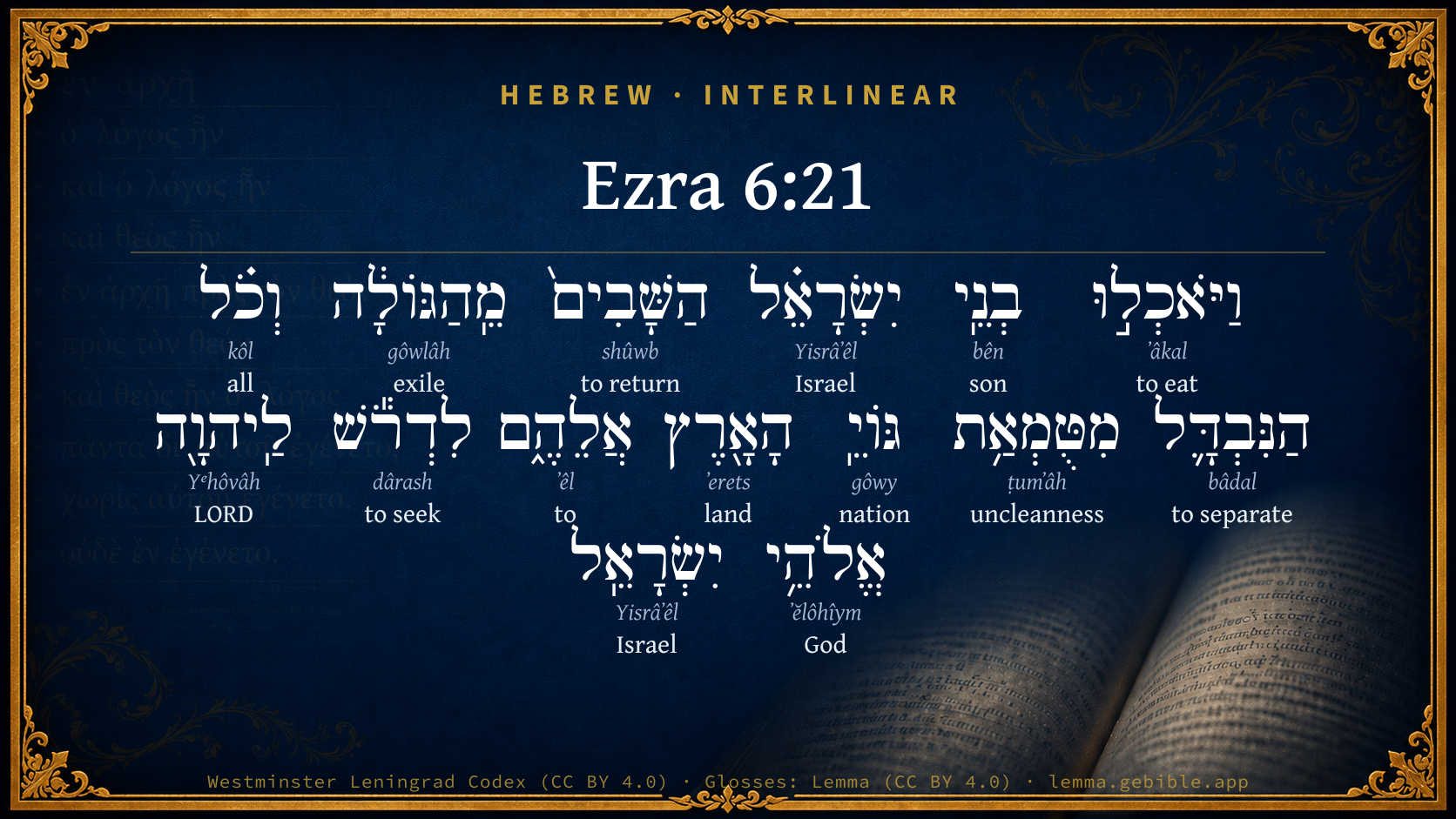
Hebrew (Westminster Leningrad Codex) Ezra 6:21 appears in the Hebrew Old Testament. The text above is from the Westminster Leningrad Codex. Each word links to its Strong’s number, a concise gloss, and parsing drawn from the Open Scriptures Hebrew Bible morphology. Click any word for its full Brown-Driver-Briggs (BDB) entry.
Download image
Cite this verse

Ezra 6:21 (World English Bible). Public Domain. Lemma interlinear Bible study tool, https://lemma.gebible.app/v/ezra/6/21.

Show BibTeX & RIS
BibTeX
RIS
English Translation
The children of Israel who had come again out of the captivity, and all such as had separated themselves to them from the filthiness of the nations of the land, to seek Yahweh, the God of Israel, ate,
World English Bible · Public Domain
Download a study sheet

One document with this verse’s original text, its word-by-word gloss line, the meaning frame, cross-references with their text, attributed commentary, and full source and license credits — printable, and it pastes into notes with its structure intact.

This verse Autodidact and up

Study sheet (.html) Plain text (.txt)

A passage Seminary Student

Up to 50 verses in one chapter. A passage sheet keeps up to 6 commentary sources and 12 cross-references per verse, in the order this page ranks them, and says so on the sheet whenever that leaves anything out. Ask for a single verse and you get the Autodidact verse sheet above.

Everything on this page stays free to read, with no account — the sheet is a download of what is already on screen, not access to it.

Want to remove ads? Support Godless Engineer
Compare translations 3

The same verse in 3 English versions, stacked beneath the original-language interlinear above. Click any original word for its lexicon entry.

Each is an independent rendering of the whole verse — the interlinear is not word-aligned to these translations.

Highlighted words mark where these versions differ — a whole-verse word diff, not a word-by-word alignment.

  • World English Bible Public Domain
    The children of Israel who had come again out of the captivity, and all such as had separated themselves to them from the filthiness of the nations of the land, to seek Yahweh, the God of Israel, ate,
  • King James Version Public Domain
    And the children of Israel, which were come again out of captivity, and all such as had separated themselves unto them from the filthiness of the heathen of the land, to seek the LORD God of Israel, did eat,
  • unfoldingWord Literal Text CC BY-SA 4.0
    And the sons of Israel ate, the ones who had returned from the exile and every one who separated himself to them from the uncleanness of the nations of the land in order to seek Yahweh, the God of Israel.

unfoldingWord Literal Text — © unfoldingWord, licensed CC BY-SA 4.0. Word-aligned USFM3 via Door43 (git.door43.org/unfoldingWord/en_ult).

Versions to compare (up to 4)

3 of 4 selected

Show all 18 translations

Every available English version of this verse, each an independent rendering of the whole verse.

  • World English Bible Public Domain
    The children of Israel who had come again out of the captivity, and all such as had separated themselves to them from the filthiness of the nations of the land, to seek Yahweh, the God of Israel, ate,
  • Berean Standard Bible Public Domain
    The Israelites who had returned from exile ate it, together with all who had separated themselves from the uncleanness of the peoples of the land to seek the LORD, the God of Israel.
  • Majority Standard Bible Public Domain
    The Israelites who had returned from exile ate it, together with all who had separated themselves from the uncleanness of the peoples of the land to seek the LORD, the God of Israel.
  • King James Version Public Domain
    And the children of Israel, which were come again out of captivity, and all such as had separated themselves unto them from the filthiness of the heathen of the land, to seek the LORD God of Israel, did eat,
  • American Standard Version (1901) Public Domain
    And the children of Israel that were come again out of the captivity, and all such as had separated themselves unto them from the filthiness of the nations of the land, to seek Jehovah, the God of Israel, did eat,
  • Revised Version (1885) Public Domain
    And the children of Israel, which were come again out of the captivity, and all such as had separated themselves unto them from the filthiness of the heathen of the land, to seek the LORD, the God of Israel, did eat,
  • Geneva Bible (1599) Public Domain
    So the children of Israel which were come againe out of captiuitie, and all such as had separated themselues vnto them, from the filthines of the Heathen of the land, to seeke the Lord God of Israel, did eate,
  • Douay-Rheims (1899) Public Domain
    And the children of Israel that were returned from captivity, and all that had separated themselves from the filthiness of the nations of the earth to them, to seek the Lord the God of Israel, did eat.
  • Young's Literal Translation Public Domain
    And the sons of Israel, those returning from the captivity, and every one who is separated from the uncleanness of the nations of the land unto them, to seek to Jehovah, God of Israel, do eat,
  • Literal Standard Version CC BY-SA 4.0
    And the sons of Israel, those returning from the captivity, and everyone who is separated from the uncleanness of the nations of the land to them, to seek to YHWH, God of Israel, eat,
  • Unlocked Literal Bible CC BY-SA 4.0
    The Israelite people who ate some of the Passover meat were those who had returned from exile and had separated themselves from the uncleanness of the people of the land and sought Yahweh, the God of Israel.
  • unfoldingWord Literal Text CC BY-SA 4.0
    And the sons of Israel ate, the ones who had returned from the exile and every one who separated himself to them from the uncleanness of the nations of the land in order to seek Yahweh, the God of Israel.
  • Darby Bible Public Domain
    And the children of Israel that were come back out of captivity, and all such as had separated themselves to them from the filthiness of the nations of the land, to seek Jehovah the God of Israel, did eat;
  • World Messianic Bible Public Domain
    The children of Israel who had returned out of the captivity, and all who had separated themselves to them from the filthiness of the nations of the land to seek the LORD, the God of Israel, ate,
  • Webster's Bible Public Domain
    And the children of Israel, who had returned from captivity, and all such as had separated themselves to them from the filthiness of the heathen of the land, to seek the LORD God of Israel, did eat,
  • Free Bible Version CC BY-SA 4.0
    The Passover was eaten by the people of Israel who had returned from exile, and by those who had joined them and had rejected the pagan practices of the peoples of the land in order to worship the Lord, the God of Israel.
  • Bible in Basic English Public Domain
    And the children of Israel, who had come back, and all those who were joined to them, after separating themselves from the evil ways of the people of the land to become the servants of the Lord, the God of Israel, took food together,
  • JPS Tanakh (1917) Public Domain
    And the children of Israel, that were come back out of the captivity, and all such as had separated themselves unto them from the filthiness of the nations of the land, to seek the LORD, the God of Israel, did eat,

Literal Standard Version (2020), Covenant Press — licensed CC BY-SA 4.0. Text via the HelloAO Bible API (eBible.org). Unlocked Literal Bible (unfoldingWord) — licensed CC BY-SA 4.0. Text via the HelloAO Bible API (eBible.org). unfoldingWord Literal Text — © unfoldingWord, licensed CC BY-SA 4.0. Word-aligned USFM3 via Door43 (git.door43.org/unfoldingWord/en_ult). Free Bible Version, Dr. Jonathan Gallagher — licensed CC BY-SA 4.0. Text via the HelloAO Bible API (eBible.org).

Word by word

More ways to search: Search by grammar → Find every occurrence → Compare this word →

Practice this passage: Drill this verse → Learn its vocabulary →

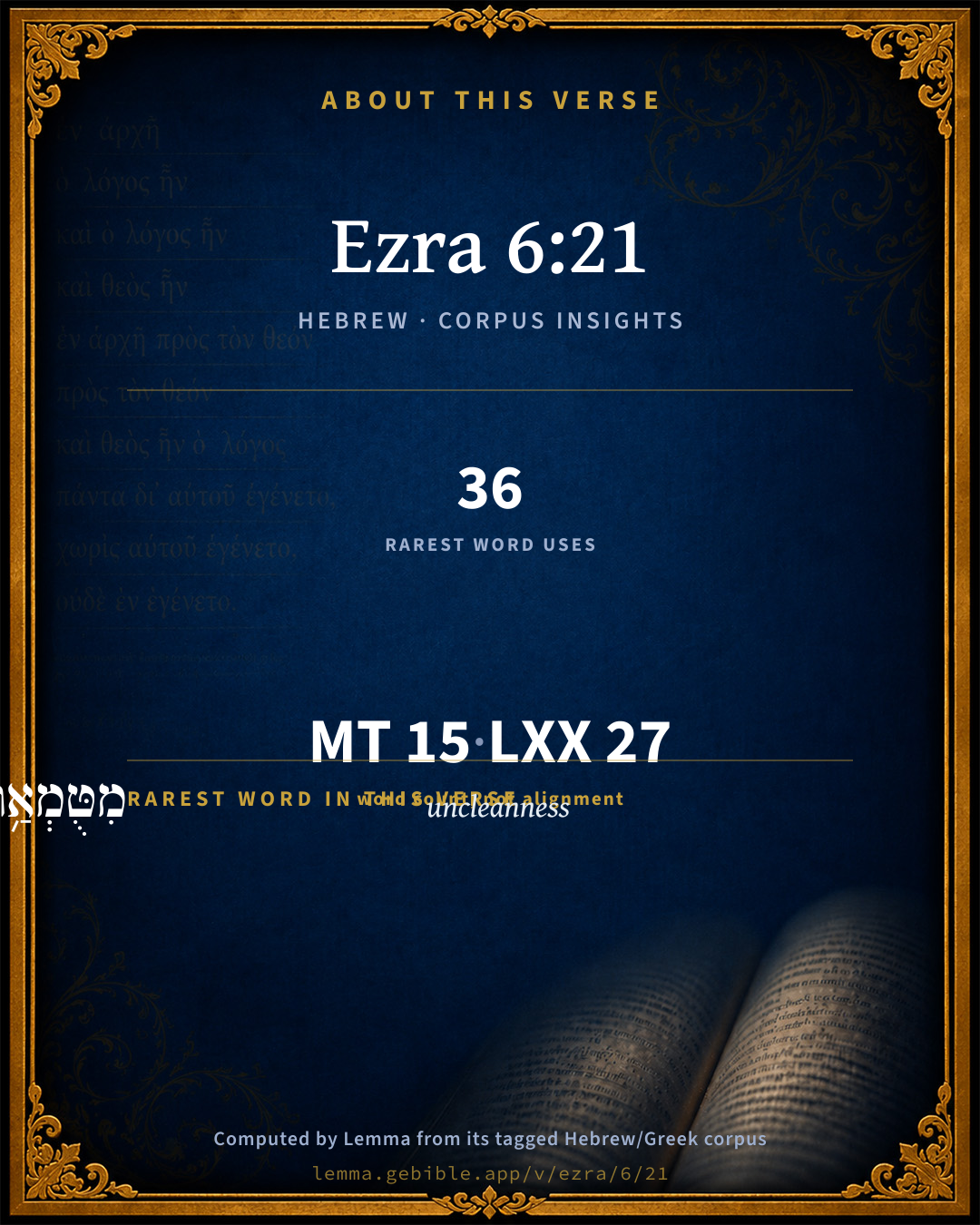
מִטֻּמְאַ֥ת
ṭumʼâh
H2932
“from · uncleanness of”
Preposition + Noun, Common, Feminine, Singular, Construct
Part of Speech
Preposition + Noun
Type
Common
Gender
Feminine
Number
Singular
State
Construct
Full BDB Definition

Origin: from H2930

TWOT: 809b

uncleanness - sexual - of filthy mass - ethical and religious - ritual - local (of nations)
  1. וַיֹּאכְל֣וּ ʼâkal H398 “and · to eat” Conjunction + Verb, Qal, Sequential Imperfect, 3rd Person, Masculine, Plural
  2. בְנֵֽי bên H1121 “sons of” Noun, Common, Masculine, Plural, Construct
  3. יִשְׂרָאֵ֗ל Yisrâʼêl H3478 “Israel” Noun, Proper
  4. הַשָּׁבִים֙ shûwb H7725 “the · returning” Particle, Definite Article + Verb, Qal, Participle Active, Masculine, Plural, Absolute
  5. מֵֽהַגּוֹלָ֔ה gôwlâh H1473 “from · the · exile” Preposition + Particle, Definite Article + Noun, Common, Feminine, Singular, Absolute
  6. וְכֹ֗ל kôl H3605 “and · all of” Conjunction + Noun, Common, Masculine, Singular, Construct
  7. הַנִּבְדָּ֛ל bâdal H914 “the · separated” Particle, Definite Article + Verb, Niphal, Participle Passive, Masculine, Singular, Absolute
  8. גּוֹיֵֽ gôwy H1471 “nations of” Noun, Common, Masculine, Plural, Construct
  9. הָאָ֖רֶץ ʼerets H776 “the · land” Particle, Definite Article + Noun, Common, Both, Singular, Absolute
  10. אֲלֵהֶ֑ם ʼêl H413 “to · them” Preposition + Suffix, Personal, 3rd Person, Masculine, Plural
  11. לִדְרֹ֕שׁ dârash H1875 “to seek” Preposition + Verb, Qal, Infinitive Construct
  12. לַֽיהוָ֖ה Yᵉhôvâh H3068 “to/for · LORD” Preposition + Noun, Proper
  13. אֱלֹהֵ֥י ʼĕlôhîym H430 “God(s) of” Noun, Common, Masculine, Plural, Construct
  14. יִשְׂרָאֵֽל Yisrâʼêl H3478 “Israel” Noun, Proper

About this verse

These counts appear in no published source. They are computed here, from the morphology-tagged text and Lemma’s own curated glosses. What Lemma adds →

15
words
14
distinct lemmas
Historical
section

Shared distinctive vocabulary

מִטֻּמְאַ֥ת uncleanness H2932 occurs in 31 verses of the Hebrew Bible. Also found in:

Grammatical profile

  • 4 verbs
  • 10 nouns
  • 1 preposition

Verb forms

  • וַיֹּאכְל֣וּ Qal · Sequential Imperfect
  • הַשָּׁבִים֙ Qal · Participle Active
  • הַנִּבְדָּ֛ל Niphal · Participle Passive
  • לִדְרֹ֕שׁ Qal · Infinitive Construct

Repetition

A word recurs within this verse — often emphatic in Hebrew:

  • יִשְׂרָאֵ֗ל Israel H3478 ×2

Hebrew & Septuagint length

In English translation the verse runs 38 words from the Hebrew and 39 from the Septuagint (LXX English) — closely comparable.

A rough comparison of the two English renderings, which tokenize alike — not a word-level alignment.

Word counts can differ between the Hebrew and the Greek without any difference in meaning — e.g. the Hebrew direct-object marker אֵת has no separate Greek word, and Greek often adds the article ὁ.

In the original languages it is 15 Hebrew tokens and 27 Greek tokens — but the two are counted differently (Hebrew bundles its prefixes and suffixes into one token; the Greek is in lemma form), so that isn’t a like-for-like length.

Cross-references

12

Topical passages linked to Ezra 6:21 in the Treasury of Scripture Knowledge — connected by theme and wording, ordered by reader-vote popularity; previews shown in the World English Bible.

  • Ezra 9:11 which you have commanded by your servants the prophets, saying, The land, to which you go to possess it, is an unclean land through the uncleanness of the peoples of the lands, through their abominations, which have filled it from one end to another with their filthiness:
  • Isaiah 52:11 Depart you, depart you, go you out from there, touch no unclean thing; go you out of the midst of her; cleanse yourselves, you who bear the vessels of Yahweh.
  • 2 Corinthians 7:1 Having therefore these promises, beloved, let us cleanse ourselves from all defilement of flesh and spirit, perfecting holiness in the fear of God.
  • Exodus 12:47–49 All the congregation of Israel shall keep it.
  • Ezra 9:1 Now when these things were done, the princes drew near to me, saying, The people of Israel, and the priests and the Levites, have not separated themselves from the peoples of the lands, [doing] according to their abominations, even of the Canaanites, the Hittites, the Perizzites, the Jebusites, the Ammonites, the Moabites, the Egyptians, and the Amorites.
  • Nehemiah 9:2 The seed of Israel separated themselves from all foreigners, and stood and confessed their sins, and the iniquities of their fathers.
  • Ezekiel 36:25 I will sprinkle clean water on you, and you shall be clean: from all your filthiness, and from all your idols, will I cleanse you.
  • Numbers 9:6–7 There were certain men, who were unclean because of the dead body of a man, so that they could not keep the Passover on that day, and they came before Moses and before Aaron on that day.
  • Numbers 9:10–14 "Say to the children of Israel, 'If any man of you or of your generations is unclean by reason of a dead body, or is on a journey far away, he shall still keep the Passover to Yahweh.
  • Nehemiah 10:28 The rest of the people, the priests, the Levites, the porters, the singers, the Nethinim, and all those who had separated themselves from the peoples of the lands to the law of God, their wives, their sons, and their daughters, everyone who had knowledge, and understanding;
  • Psalms 93:5 Your statutes stand firm. Holiness adorns your house, Yahweh, forevermore.
  • 2 Corinthians 6:17 Therefore, "'Come out from among them, And be separate,' says the Lord, 'Touch no unclean thing. I will receive you.

Cross-references courtesy of OpenBible.info (CC BY 4.0).

Hebrew and Greek witnesses Masoretic Hebrew ↔ Greek Septuagint

The same verse in the two great witnesses to the Old Testament, shown verse-for-verse.

These are two independent witnesses, not word-aligned to each other, and the Septuagint is shown in lemma (dictionary) form.

Hebrew Ezra 6:21 Masoretic · Westminster Leningrad Codex

וַיֹּאכְל֣וּ בְנֵֽי יִשְׂרָאֵ֗ל הַשָּׁבִים֙ מֵֽהַגּוֹלָ֔ה וְכֹ֗ל הַנִּבְדָּ֛ל מִטֻּמְאַ֥ת גּוֹיֵֽ הָאָ֖רֶץ אֲלֵהֶ֑ם לִדְרֹ֕שׁ לַֽיהוָ֖ה אֱלֹהֵ֥י יִשְׂרָאֵֽל

The children of Israel who had come again out of the captivity, and all such as had separated themselves to them from the filthiness of the nations of the land, to seek Yahweh, the God of Israel, ate,

World English Bible · Public Domain

Greek LXX Ezra 6:21 Septuagint · lemma form

καί ἐσθίω ὁ υἱός ἰσραήλ ὁ πασχα ὁ ἀπό ὁ ἀποικεσία καί πᾶς ὁ χωρίζω ὁ ἀκαθαρσία ἔθνος ὁ γῆ πρός αὐτός ὁ ἐκζητέω κύριος θεός ἰσραήλ

And the children of Israel ate the passover, even they that were of the captivity, and every one who separated himself to them from the uncleanness of the nations of the land, to seek the Lord God of Israel.

LXX2012 (modern English Septuagint) · Public Domain

In the Septuagint this is one book — Esdras B (2 Esdras): Ezra is chapters 1–10, Nehemiah 11–23.

Hebrew: Westminster Leningrad Codex (CC BY 4.0). Greek: Septuagint (public domain); English from LXX2012 (modern English Septuagint) (Public Domain). How the Septuagint differs from the Hebrew →

Commentary

Notes on Ezra 6:21 from classic Christian and Jewish commentators (each source and its license shown beneath its notes). The classic Christian expositions comment on the surrounding passage and are grouped to its opening verse, so a note may address several verses; the Jewish commentaries on the Tanakh (Rashi and others) are per-verse, so they appear only where the commentator wrote on this verse.

Lemma curates 59 commentaries, every one of them public domain or Creative Commons licensed, each selected and text-cleaned for this edition rather than reprinted as found. About our sources →

Trapp's Complete Commentary

John Trapp

Ezr 6:21 And the children of Israel, which were come again out of captivity, and all such as had separated themselves unto them from the filthiness of the heathen of the land, to seek the LORD God of Israel, did eat,

Ver. 21. And the children of Israel] The whole community, of what tribe soever.

And all such as had separated themselves] Who were the better to like, because not prosperity proselytes, such as came in (not a few) in Solomon’s time; but the Jews were very careful how they received them, as Josephus relateth.

From the filthiness of the heathen] Who had filled the land from one end to the other with their uncleannesses, Ezr 9:11. Great sins do greatly pollute.

To seek the Lord God of Israel] To seek not his omnipresence (for that none need to do, since he is not far from any one of us, Act 17:27), but his gracious presence. And such a seeker is every good soul: Psa 24:6, This is the generation of them that seek him, that seek thy face, that is, Jacob.

Did eat] Edebant, id est, credebant, They were eating, it is, they were believing, for even Christ their passover was sacrificed for them, 1Co 5:7.

John Trapp, A Commentary or Exposition upon All the Books of the Old and New Testament (1647–1656) — public domain. Text from a community e-Sword module.

The Biblical Illustrator

Joseph S. Exell

Ezr_6:21

To seek the Lord God of Israel

Seeking God

Birds are very fond of catching the last evening rays of a winters sun, and are often to be found in the afternoon on banks facing the west, or swinging, if there is no wind, on the topmost branch of trees.

On the mountains, too, all birds, as the sun gets low, take to the slopes to face the west, whilst in the morning they betake themselves to the eastern hanks and slopes to meet his rays. Golden plovers, in the evenings, ascend from elope to slope, as each becomes shaded by the intervening heights, until they are all collected on the very last ridge which the sun shines upon. Gods children resemble birds in seeking light, only the light they seek is the light of goodness, and truth, and righteousness which comes from God. They seek the Source of Light, and turn away from the darkness. (S. S. Chronicle.)

The Biblical Illustrator, edited by Joseph S. Exell (c. 1880s–1900s) — public domain. Text from a community e-Sword module.

Joseph Benson's Commentary

Ezr 6:21. All such as had separated themselves unto them, &c. — Had left their country, and the superstitions and vices of it; had become proselytes to the Jewish religion, and cast in their lot with the Israel of God, professing an entire subjection to the law of Moses. Such, and only such, might eat of the passover, Exo 12:48-49. From the manner in which the sacred writer expresses himself here, it would seem as if there were many proselytes, who forsook their heathenish customs, and were brought to the knowledge and worship of the true God, influenced, probably, by the encouragement which Cyrus and Darius had given to the Jewish religion. People of all nations, it must be observed, till proselyted, were accounted by the Jews polluted both in body and mind, because of their worshipping false gods, and not abstaining from the things which were accounted unclean by the law of Moses. The description here given of proselytes to Judaism may serve to characterize converts to the true religion in every age: they separate themselves from the filthiness of sin, and fellowship with sinners; join themselves to the Israel of God in conformity and communion, and set themselves to seek the God of Israel: and those that do so in sincerity, though strangers and foreigners, are welcome to eat of the gospel-feast, as fellow-citizens with the saints, and of the household of God.

Joseph Benson's Commentary on the Old and New Testaments (1811–1818) — public domain. Text from a community e-Sword module.

Tyndale Open Study Notes

Tyndale Open Resources

6:21 and by the others in the land who had turned from their immoral customs: The exclusion of foreigners in 4:1-5 was due to their pagan religious practices, not their ethnicity (see also 9:1-2).

Tyndale Open Study Notes — © Tyndale Open Resources, licensed CC BY-SA 4.0. Text via the HelloAO Bible API.

Geneva Bible (1599)

Geneva Bible translators

Which were of the heathen, and forsaked their idolatry to worship the true God.

Geneva Bible (1599) marginal notes — public domain. Text via Bolls.life.

Jamieson, Fausset & Brown

Robert Jamieson, A. R. Fausset & David Brown

AND OF THE PASSOVER. (Ezr 6:19-22)

all such as had separated themselves . . . from the filthiness of the heathen of the land--that is, who had given satisfactory evidence of being true proselytes by not only renouncing the impure worship of idolatry, but by undergoing the rite of circumcision, a condition indispensable to a participation of the passover.

Jamieson, Fausset & Brown — Commentary Critical and Explanatory on the Whole Bible (1871) — public domain (CC PDM 1.0). Text via the HelloAO Bible API.

Adam Clarke's Commentary

Verse 21. And all such as had separated themselves] These were the proselytes who had embraced the Jewish religion by having mingled with the Jews in their captivity. This proves that there the poor captives had so acted according to the principles of their religion, that the heathens saw it, and walked in the light of the Lord with them. A good example is very persuasive; and particularly so when founded on pure principles.

Adam Clarke's Commentary on the Bible (1810–1826) — public domain. Text from a community e-Sword/MySword module.

Ellicott's Commentary for English Readers

(21) Separated themselves . . .—Not proselytes from the heathen are intended, but the remnant of the Jews in the land who had consorted with the foreign populations introduced by the conquerors. Their intermarriages and other acts of conformity are constantly referred to throughout Ezra and Nehemiah.

A Bible Commentary for English Readers, edited by Charles John Ellicott (1878–1897) — public domain. Text from a community e-Sword module.

The Cambridge Bible for Schools and Colleges

gen. ed. J. J. S. Perowne

21. Those who partook of the Passover are described as belonging to two classes; (1) those who had returned from captivity, (2) those who had ‘separated themselves unto them from the filthiness of the heathen of the land’.

“The heathen of the land” (goyyê ha-ârec̣) is to be compared with “the peoples of the land” (’amme ha-ârec̣) in chap. Ezr_10:2; Ezr_10:11. “The land” is the land of Palestine: “the heathen” and “the peoples” are apparently the colonists and mixed population that had settled in the territory of the Northern and Southern Kingdoms. ‘The filthiness’ (cf. Ezr_9:11) is the ceremonial pollution of idolatry practised by these heathen races.

Who then are those described here as having ‘separated themselves’?

(a) By very many they are considered to be proselytes from the heathen who had attached themselves to the Jewish religion since the return from the Captivity.

(b) But it appears most probable that they are Israelites.

(1) Israelites are described in Ezr_9:1 as not having “separated themselves from the peoples of the lands”. (2) Ezra exhorts the Jews to “separate themselves from the peoples of the lands” (Ezr_10:11). If those who had not ‘separated’ themselves were Israelites, it is probable that these who had separated themselves were also Israelites; and if so, they would be those Israelites who had not been carried into captivity, but had continued to dwell in Palestine or among the adjoining races.

The two classes mentioned therefore are both Israelite; the one, those who had returned from Babylon; the other, those who having remained behind and having mixed with “the heathen of the land” now separated themselves and attached themselves once more to their countrymen.

to seek the Lord God of Israel] R.V. to seek the Lord, the God of Israel. See on chap. Ezr_1:3. To seek, i.e. with a view to worship: cf. on Ezr_4:2.

The Cambridge Bible for Schools and Colleges (gen. ed. J. J. S. Perowne; Cambridge University Press, 1878–1918) — public domain. Text from a community e-Sword module.

Haydock's Catholic Bible Commentary

To them, becoming proselytes, and receiving circumcision, Exodus xii. 48.

George Leo Haydock (1774–1849), Haydock's Catholic Family Bible and Commentary, 1859 edition — public domain. Excludes Psalms (Douay-Rheims chapter numbering differs from Protestant) and Deuterocanonical books (Catholic canon only).

Matthew Poole's English Annotations

From the filthiness of the heathen, i.e. such as had forsaken that filthy and idolatrous religion of the heathens, and were proselyted to the Jewish religion; for such were allowed to eat the passover, Exo 12:48; Num 9:14.

Matthew Poole's English Annotations on the Holy Bible (1683–1685) — public domain. Text from a community e-Sword/MySword module.

Whedon's Commentary on the Bible

Daniel D. Whedon

21. Such as had separated themselves unto them from the filthiness of the heathen — Blackslidden and apostate Israelites who had remained in the land when others went into exile, and had corrupted themselves by idolatry and by intermarriage with the heathen. Also, perhaps, some non-Israelitish dwellers in the land who had adopted the Jewish faith, and had become proselytes of the new community.

Daniel D. Whedon (gen. ed.), Commentary on the Old and New Testaments (1874–1909) — public domain. Text from a community e-Sword module.

The Pulpit Commentary

Such as had separated themselves unto them. i.e. such proselytes as had been made since the return from the captivity. We have perhaps a mention of some of these proselytes in the "Sherezer" and "Regem-melech" sent by the men of Bethel a short time before this to make inquiries of the priests at Jerusalem in respect of fasting. (Zec_7:2) These names are Assyrian, and not likely to have been given to persons born Jews. From the filthiness of the heathen means "from their moral defilements". (see Ezr_9:11) It is always to be borne in mind that heathen idolatry was full of such impurities.

The Pulpit Commentary (1880–1919), ed. H.D.M. Spence-Jones & Joseph S. Exell — public domain. Text from a community e-Sword module.

John Wesley's Explanatory Notes

Children of Israel - Probably some out of each of the twelve tribes.

John Wesley, Explanatory Notes Upon the Whole Bible (1754–1765) — public domain. Text via the GEBible commentary corpus.

unfoldingWord translationNotes

Door43 World Missions Community

separated themselves from the uncleanness of the people of the land

Separating themselves from uncleanness represents refusing to do things that make people unclean. AT: "They refused to do the things that the people of the land did that made them unclean" (See: Metaphor)

the uncleanness of the people of the land

Here "uncleanness" represents being unacceptable to God. AT: "the things that the people of the land did that made them unacceptable to God" (See: Metaphor)

sought Yahweh

Seeking Yahweh represents choosing to know, worship, and obey him. AT: "chose to obey Yahweh" (See: Metaphor)

turned the heart of Assyria's king

Turning the king's heart represents making him think differently about the work of the temple. AT: "changed the attitude of Assyria's king" or "made Assyria's king willing" (See: Metonymy)

to strengthen their hands in the work of his house

Strengthening their hands in the work represents helping them to work. The Assyrian king did this by telling them to do the work and providing the money for it. AT: "to help them do the work of his house" or "to make it possible for them to do the work of his house" (See: Metaphor)

the work of his house

This refers to building the temple.

translationWords

Israel

Passover

exile

Yahweh

God

festival

unleavened bread

heart

Assyria

unfoldingWord translationNotes — © Distant Shores Media and the Door43 World Missions Community, licensed CC BY-SA 4.0. Source: git.door43.org/Door43/en_tn.

Rashi

Rabbi Shlomo Yitzchaki (Rashi)

and whoever separated They are the proselytes, who were separated from the defilement of the nations to cleave to Israel.

Rashi on the Tanakh — English translations: “The Judaica Press complete Tanach with Rashi, translated by A. J. Rosenberg” (CC BY 4.0); “Pentateuch with Rashi's commentary by M. Rosenbaum and A.M. Silbermann, 1929-1934” (public domain); “The Metsudah Tanach series, Lakewood, N.J” (CC BY 4.0); and “The Book of Joshua, Metsudah Publications, 1997” (CC BY 4.0). Text via Sefaria.

Lesson kit

Teaching starters — assembled from the data on this page, not authored interpretation. Every prompt links to the verse data it draws on. Edit before teaching.

Ezra, in the Historical, opens this verse with 15 words (14 distinct Hebrew lemmas). Its most distinctive word is ṭumʼâh (“uncleanness”). A historical commentator’s framing appears above. Read the whole chapter for the surrounding context.

Discussion questions

  1. What does “uncleanness” (ṭumʼâh) contribute to the verse as a whole?
  2. How does Leviticus 5:3, which shares the word «uncleanness», read alongside this verse?
  3. What does the repetition of “Israel” (2× in this one verse) do in this verse?
  4. These translations render this verse differently. What is at stake in choosing one wording over another?
  5. «וַיֹּאכְל֣וּ» is a Qal Sequential Imperfect verb. How does that grammatical form shape the action described?
  6. Compare how Trapp's Complete Commentary and The Biblical Illustrator read this verse. Where do they agree or differ?

Things to notice

Reading settings

Reading text

Shown beneath each verse's original-language words.

Old Testament
Old Testament edition

Read the OT as the Masoretic Hebrew (MT) or the Greek Septuagint (LXX).

English shown for the Greek Septuagint (in the Hebrew ↔ Greek comparison).

Comparing translations? Open the Compare panel on any verse page to stack up to four side by side.