
Deuteronomy 26:19

Hebrew (Westminster Leningrad Codex) Deuteronomy 26:19 appears in the Hebrew Old Testament. The text above is from the Westminster Leningrad Codex. Each word links to its Strong’s number, a concise gloss, and parsing drawn from the Open Scriptures Hebrew Bible morphology. Click any word for its full Brown-Driver-Briggs (BDB) entry.
Download image
Cite this verse

Deuteronomy 26:19 (World English Bible). Public Domain. Lemma interlinear Bible study tool, https://lemma.gebible.app/v/deuteronomy/26/19.

Show BibTeX & RIS
BibTeX
RIS
English Translation
and to make you high above all nations that he has made, in praise, and in name, and in honor; and that you may be a holy people to Yahweh your God, as he has spoken.
World English Bible · Public Domain
Download a study sheet

One document with this verse’s original text, its word-by-word gloss line, the meaning frame, cross-references with their text, attributed commentary, and full source and license credits — printable, and it pastes into notes with its structure intact.

This verse Autodidact and up

Study sheet (.html) Plain text (.txt)

A passage Seminary Student

Up to 50 verses in one chapter. A passage sheet keeps up to 6 commentary sources and 12 cross-references per verse, in the order this page ranks them, and says so on the sheet whenever that leaves anything out. Ask for a single verse and you get the Autodidact verse sheet above.

Everything on this page stays free to read, with no account — the sheet is a download of what is already on screen, not access to it.

Want to remove ads? Support Godless Engineer
Compare translations 3

The same verse in 3 English versions, stacked beneath the original-language interlinear above. Click any original word for its lexicon entry.

Each is an independent rendering of the whole verse — the interlinear is not word-aligned to these translations.

Highlighted words mark where these versions differ — a whole-verse word diff, not a word-by-word alignment.

  • World English Bible Public Domain
    and to make you high above all nations that he has made, in praise, and in name, and in honor; and that you may be a holy people to Yahweh your God, as he has spoken.
  • King James Version Public Domain
    And to make thee high above all nations which he hath made, in praise, and in name, and in honor; and that thou mayest be an holy people unto the LORD thy God, as he hath spoken.
  • unfoldingWord Literal Text CC BY-SA 4.0
    and he will set you high above all the nations that he has made, for praise and for a name and for beauty. And you will be a sanctified people for Yahweh your God, just as he has spoken.”

unfoldingWord Literal Text — © unfoldingWord, licensed CC BY-SA 4.0. Word-aligned USFM3 via Door43 (git.door43.org/unfoldingWord/en_ult).

Versions to compare (up to 4)

3 of 4 selected

Show all 18 translations

Every available English version of this verse, each an independent rendering of the whole verse.

  • World English Bible Public Domain
    and to make you high above all nations that he has made, in praise, and in name, and in honor; and that you may be a holy people to Yahweh your God, as he has spoken.
  • Berean Standard Bible Public Domain
    that He will set you high in praise and name and honor above all the nations He has made, and that you will be a holy people to the LORD your God, as He has promised.
  • Majority Standard Bible Public Domain
    that He will set you high in praise and name and honor above all the nations He has made, and that you will be a holy people to the LORD your God, as He has promised.
  • King James Version Public Domain
    And to make thee high above all nations which he hath made, in praise, and in name, and in honor; and that thou mayest be an holy people unto the LORD thy God, as he hath spoken.
  • American Standard Version (1901) Public Domain
    and to make thee high above all nations that he hath made, in praise, and in name, and in honor; and that thou mayest be a holy people unto Jehovah thy God, as he hath spoken.
  • Revised Version (1885) Public Domain
    and to make thee high above all nations which he hath made, in praise, and in name, and in honour; and that thou mayest be an holy people unto the LORD thy God, as he hath spoken.
  • Geneva Bible (1599) Public Domain
    And to make thee high aboue al nations (which he hath made) in praise, and in name, and in glory, and that thou shouldest be an holy people vnto the Lord thy God, as he hath said.
  • Douay-Rheims (1899) Public Domain
    And the Lord hath chosen thee this day, to be his peculiar people, as he hath spoken to thee, and to keep all his commandments:
  • Young's Literal Translation Public Domain
    so as to make thee uppermost above all the nations whom He hath made for a praise, and for a name, and for beauty, and for thy being a holy people to Jehovah thy God, as He hath spoken.
  • Literal Standard Version CC BY-SA 4.0
    so as to make you highest above all the nations whom He has made for a praise, and for a name, and for beauty, and for your being a holy people to your God YHWH, as He has spoken.”
  • Unlocked Literal Bible CC BY-SA 4.0
    and he will set you high above all the other nations that he has made, and you will receive praise, fame, and honor. You will be a people that is set apart to Yahweh your God, just as he said.”
  • unfoldingWord Literal Text CC BY-SA 4.0
    and he will set you high above all the nations that he has made, for praise and for a name and for beauty. And you will be a sanctified people for Yahweh your God, just as he has spoken.”
  • Darby Bible Public Domain
    so that he should make thee high above all the nations which he hath made, in praise and in name and in honour; and that thou shouldest be a holy people to Jehovah thy God, as he hath said.
  • World Messianic Bible Public Domain
    He will make you high above all nations that he has made, in praise, in name, and in honor, and that you may be a holy people to the LORD your God, as he has spoken.
  • Webster's Bible Public Domain
    And to make thee high above all nations which he hath made, in praise, and in name, and in honor; and that thou mayest be a holy people to the LORD thy God, as he hath spoken.
  • Free Bible Version CC BY-SA 4.0
    He has announced that he will give you greater praise and reputation and honor than any other nation he has made. He has announced that you will be a holy people to the Lord your God, as he promised.
  • Bible in Basic English Public Domain
    And that he will make you high over all the nations he has made, in praise, in name, and in honour, and that you are to be a holy people to the Lord your God as he has said.
  • JPS Tanakh (1917) Public Domain
    and to make thee high above all nations that He hath made, in praise, and in name, and in glory; and that thou mayest be a holy people unto the LORD thy God, as He hath spoken.

Literal Standard Version (2020), Covenant Press — licensed CC BY-SA 4.0. Text via the HelloAO Bible API (eBible.org). Unlocked Literal Bible (unfoldingWord) — licensed CC BY-SA 4.0. Text via the HelloAO Bible API (eBible.org). unfoldingWord Literal Text — © unfoldingWord, licensed CC BY-SA 4.0. Word-aligned USFM3 via Door43 (git.door43.org/unfoldingWord/en_ult). Free Bible Version, Dr. Jonathan Gallagher — licensed CC BY-SA 4.0. Text via the HelloAO Bible API (eBible.org).

Word by word

More ways to search: Search by grammar → Find every occurrence → Compare this word →

Practice this passage: Drill this verse → Learn its vocabulary →

וּלְתִפְאָ֑רֶת
tiphʼârâh
H8597
“and · to/for · glory”
Conjunction + Preposition + Noun, Common, Feminine, Singular, Absolute
Part of Speech
Conjunction + Preposition + Noun
Type
Common
Gender
Feminine
Number
Singular
State
Absolute
Full BDB Definition

Origin: from H6286

TWOT: 1726b

beauty, splendour, glory - beauty, finery (of garments, jewels) - glory - of rank, renown - as attribute of God - honour (or nation Israel) - glorying, boasting (of individual)
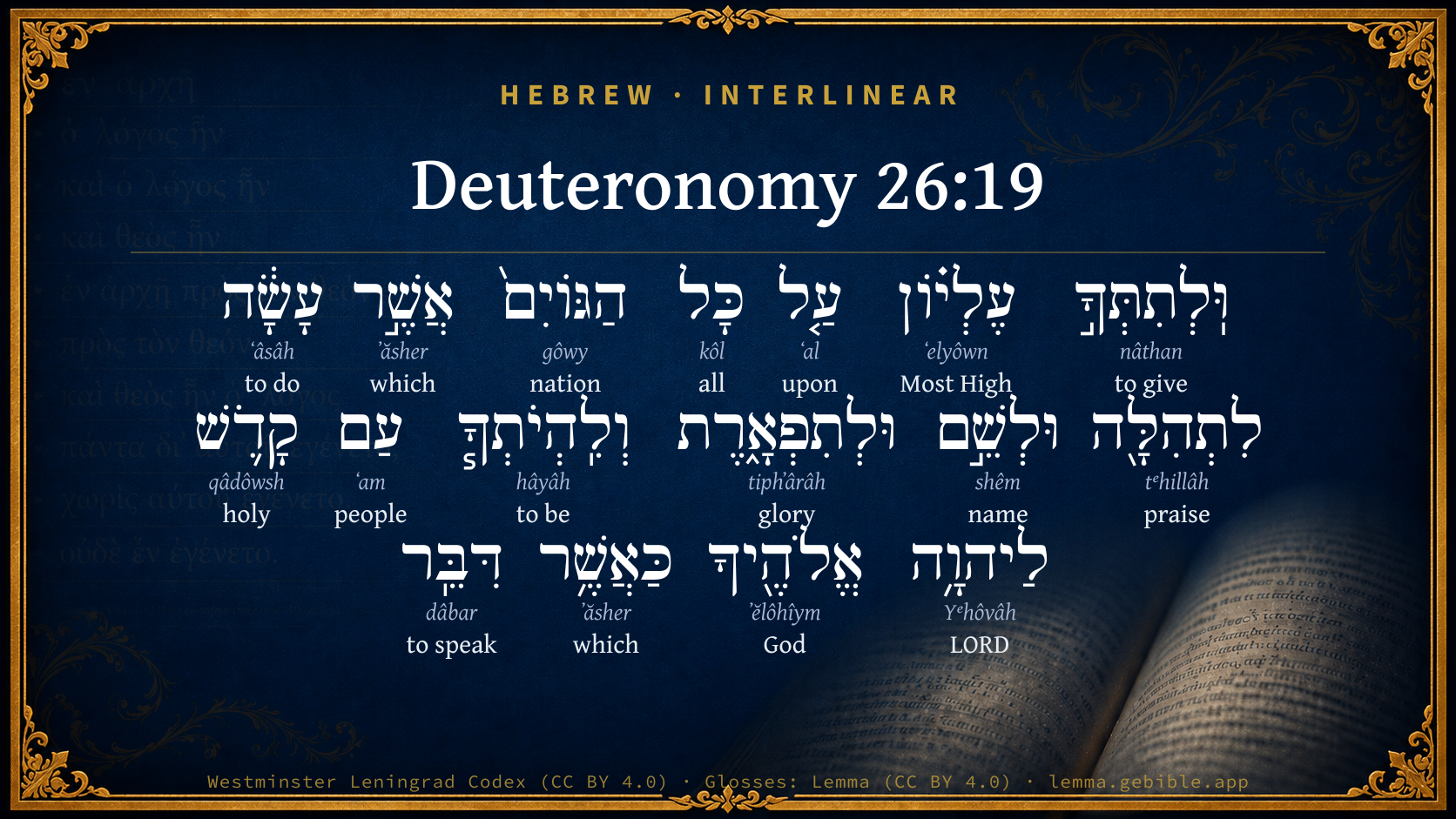
  1. וּֽלְתִתְּךָ֣ nâthan H5414 “and · to give · you” Conjunction + Preposition + Verb, Qal, Infinitive Construct + Suffix, Personal, 2nd Person, Masculine, Singular
  2. עֶלְי֗וֹן ʻelyôwn H5945 “Most High” Adjective, Adjective, Masculine, Singular, Absolute
  3. עַ֤ל ʻal H5921 “upon” Preposition
  4. כָּל kôl H3605 “all of” Noun, Common, Masculine, Singular, Construct
  5. הַגּוֹיִם֙ gôwy H1471 “the · nations” Particle, Definite Article + Noun, Common, Masculine, Plural, Absolute
  6. אֲשֶׁ֣ר ʼăsher H834 “which” Particle, Relative
  7. עָשָׂ֔ה ʻâsâh H6213 “to do” Verb, Qal, Perfect, 3rd Person, Masculine, Singular
  8. לִתְהִלָּ֖ה tᵉhillâh H8416 “to/for · praise” Preposition + Noun, Common, Feminine, Singular, Absolute
  9. וּלְשֵׁ֣ם shêm H8034 “and · to/for · name” Conjunction + Preposition + Noun, Common, Masculine, Singular, Absolute
  10. וְלִֽהְיֹתְךָ֧ hâyâh H1961 “and · to be · you” Conjunction + Preposition + Verb, Qal, Infinitive Construct + Suffix, Personal, 2nd Person, Masculine, Singular
  11. עַם ʻam H5971 “people” Noun, Common, Masculine, Singular, Absolute
  12. קָדֹ֛שׁ qâdôwsh H6918 “holy” Adjective, Adjective, Masculine, Singular, Absolute
  13. לַיהוָ֥ה Yᵉhôvâh H3068 “to/for · LORD” Preposition + Noun, Proper
  14. אֱלֹהֶ֖יךָ ʼĕlôhîym H430 “God(s) · your” Noun, Common, Masculine, Plural, Construct + Suffix, Personal, 2nd Person, Masculine, Singular
  15. כַּאֲשֶׁ֥ר ʼăsher H834 “like/as · which” Preposition + Particle, Relative
  16. דִּבֵּֽר dâbar H1696 “to speak” Verb, Piel, Perfect, 3rd Person, Masculine, Singular

About this verse

These counts appear in no published source. They are computed here, from the morphology-tagged text and Lemma’s own curated glosses. What Lemma adds →

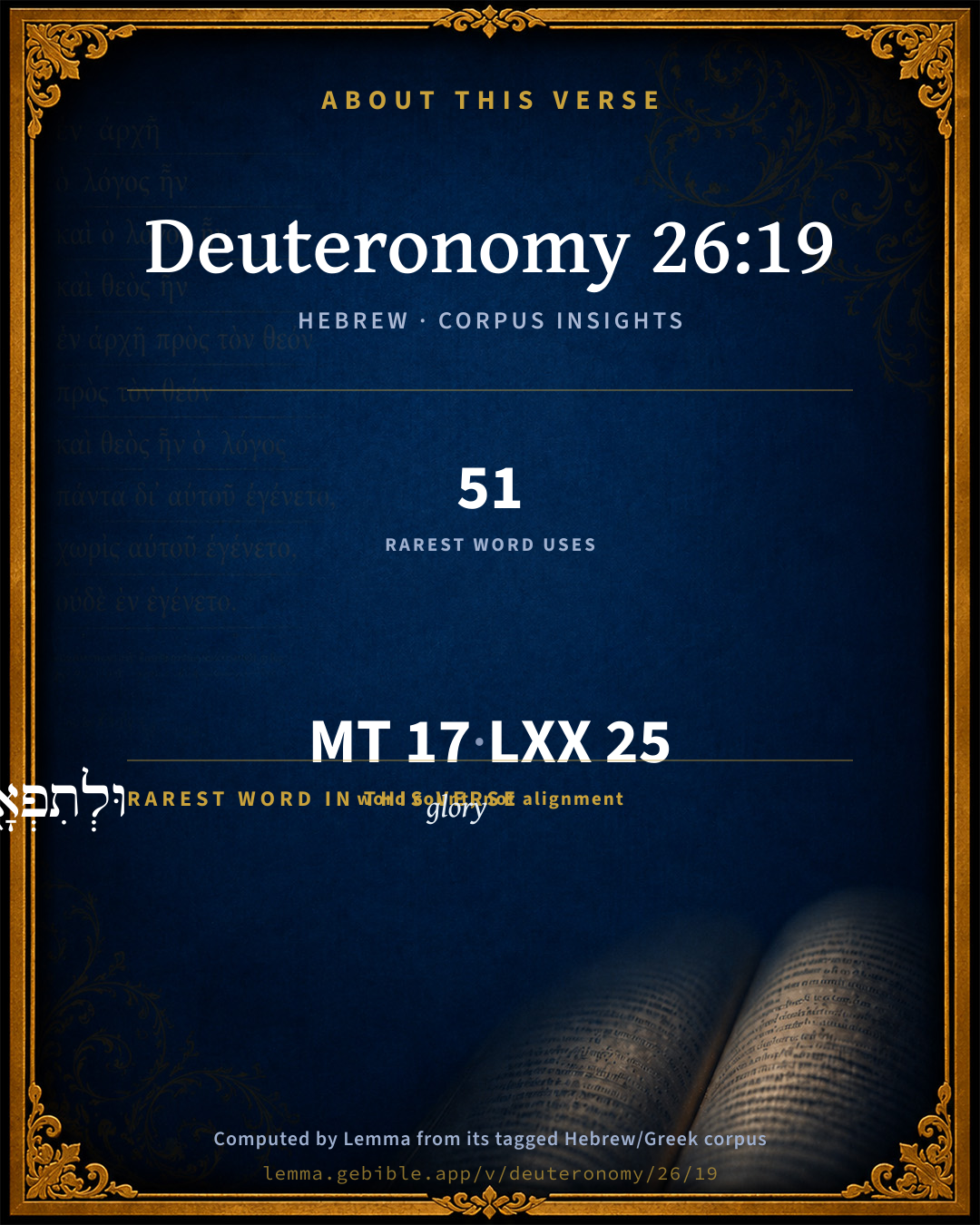
17
words
16
distinct lemmas
Pentateuch
section

Shared distinctive vocabulary

וּלְתִפְאָ֑רֶת glory H8597 occurs in 50 verses of the Hebrew Bible. Also found in:

Grammatical profile

  • 4 verbs
  • 8 nouns
  • 2 adjectives
  • 1 preposition
  • 2 particles

Verb forms

  • וּֽלְתִתְּךָ֣ Qal · Infinitive Construct
  • עָשָׂ֔ה Qal · Perfect
  • וְלִֽהְיֹתְךָ֧ Qal · Infinitive Construct
  • דִּבֵּֽר Piel · Perfect

Repetition

A word recurs within this verse — often emphatic in Hebrew:

  • אֲשֶׁ֣ר which H834 ×2

Hebrew & Septuagint length

In English translation the verse runs 36 words from the Hebrew and 35 from the Septuagint (LXX English) — closely comparable.

A rough comparison of the two English renderings, which tokenize alike — not a word-level alignment.

Word counts can differ between the Hebrew and the Greek without any difference in meaning — e.g. the Hebrew direct-object marker אֵת has no separate Greek word, and Greek often adds the article ὁ.

In the original languages it is 17 Hebrew tokens and 25 Greek tokens — but the two are counted differently (Hebrew bundles its prefixes and suffixes into one token; the Greek is in lemma form), so that isn’t a like-for-like length.

Cross-references

16

Topical passages linked to Deuteronomy 26:19 in the Treasury of Scripture Knowledge — connected by theme and wording, ordered by reader-vote popularity; previews shown in the World English Bible.

  • Deuteronomy 28:1 It shall happen, if you shall listen diligently to the voice of Yahweh your God, to observe to do all his commandments which I command you this day, who Yahweh your God will set you on high above all the nations of the earth:
  • 1 Peter 2:9 But you are a chosen race, a royal priesthood, a holy nation, a people for God's own possession, that you may show forth the excellencies of him who called you out of darkness into his marvelous light:
  • Deuteronomy 7:6 For you are a holy people to Yahweh your God: Yahweh your God has chosen you to be a people for his own possession, above all peoples who are on the face of the earth.
  • Deuteronomy 4:7–8 For what great nation is there, that has a god so near to them, as Yahweh our God is whenever we call on him?
  • Exodus 19:6 and you shall be to me a kingdom of priests, and a holy nation.' These are the words which you shall speak to the children of Israel."
  • Isaiah 62:12 They shall call them The holy people, The redeemed of Yahweh: and you shall be called Sought out, A city not forsaken.
  • 1 Peter 2:5 You also, as living stones, are built up as a spiritual house, to be a holy priesthood, to offer up spiritual sacrifices, acceptable to God through Jesus Christ.
  • Revelation 1:5–6 and from Jesus Christ, the faithful witness, the firstborn of the dead, and the ruler of the kings of the earth. To him who loves us, and washed us from our sins by his blood;
  • Ezekiel 16:12–14 I put a ring on your nose, and ear-rings in your ears, and a beautiful crown on your head.
  • Jeremiah 33:9 [This city] shall be to me for a name of joy, for a praise and for a glory, before all the nations of the earth, which shall hear all the good that I do to them, and shall fear and tremble for all the good and for all the peace that I procure to it.
  • Zephaniah 3:19 Behold, at that time I will deal with all those who afflict you, and I will save those who are lame, and gather those who were driven away. I will give them praise and honor, whose shame has been in all the earth.
  • Deuteronomy 28:9 Yahweh will establish you for a holy people to himself, as he has sworn to you; if you shall keep the commandments of Yahweh your God, and walk in his ways.
  • Deuteronomy 28:13 Yahweh will make you the head, and not the tail; and you shall be above only, and you shall not be beneath; if you shall listen to the commandments of Yahweh your God, which I command you this day, to observe and to do [them],
  • Psalms 148:14 He has lifted up the horn of his people, The praise of all his saints; Even of the children of Israel, a people near to him. Praise Yah!
  • Isaiah 66:20–21 They shall bring all your brothers out of all the nations for an offering to Yahweh, on horses, and in chariots, and in litters, and on mules, and on dromedaries, to my holy mountain Jerusalem, says Yahweh, as the children of Israel bring their offering in a clean vessel into the house of Yahweh.
  • Jeremiah 13:11 For as the belt cleaves to the loins of a man, so have I caused to cleave to me the whole house of Israel and the whole house of Judah, says Yahweh; that they may be to me for a people, and for a name, and for a praise, and for a glory: but they would not hear.

Cross-references courtesy of OpenBible.info (CC BY 4.0).

Hebrew and Greek witnesses Masoretic Hebrew ↔ Greek Septuagint

The same verse in the two great witnesses to the Old Testament, shown verse-for-verse.

These are two independent witnesses, not word-aligned to each other, and the Septuagint is shown in lemma (dictionary) form.

Hebrew Deuteronomy 26:19 Masoretic · Westminster Leningrad Codex

וּֽלְתִתְּךָ֣ עֶלְי֗וֹן עַ֤ל כָּל הַגּוֹיִם֙ אֲשֶׁ֣ר עָשָׂ֔ה לִתְהִלָּ֖ה וּלְשֵׁ֣ם וּלְתִפְאָ֑רֶת וְלִֽהְיֹתְךָ֧ עַם קָדֹ֛שׁ לַיהוָ֥ה אֱלֹהֶ֖יךָ כַּאֲשֶׁ֥ר דִּבֵּֽר

and to make you high above all nations that he has made, in praise, and in name, and in honor; and that you may be a holy people to Yahweh your God, as he has spoken.

World English Bible · Public Domain

Greek LXX Deuteronomy 26:19 Septuagint · lemma form

καί εἰμί σύ ὑπεράνω πᾶς ὁ ἔθνος ὡς ποιέω σύ ὀνομαστός καί καύχημα καί δόξαστος εἰμί σύ λαός ἅγιος κύριος ὁ θεός σύ καθώς λαλέω

and that you should be above all nations, as he has made you renowned, and a boast, and glorious, that you should be a holy people to the Lord your God, as he has spoken.

LXX2012 (modern English Septuagint) · Public Domain

On this verse, Haydock's Catholic Bible Commentary discusses the Septuagint’s reading. Read the note in Commentary ↓

Hebrew: Westminster Leningrad Codex (CC BY 4.0). Greek: Septuagint (public domain); English from LXX2012 (modern English Septuagint) (Public Domain). How the Septuagint differs from the Hebrew →

Targum (Aramaic paraphrase)

2

The Targum is the ancient Jewish Aramaic paraphrase of the Hebrew Scriptures — an interpretive translation, not the Hebrew text itself. Onkelos (literal) and Pseudo-Jonathan (expansive) render the Torah, and Jonathan the Prophets. Coverage is partial: where no permissively-licensed English translation exists for a verse, only the Aramaic is shown. This is verse-level text, not a word-by-word alignment to the Hebrew.

  1. Targum Onkelos Torah (Genesis–Deuteronomy)
    וּלְמִתְּנָךְ עִלָאָה עַל כָּל עַמְמַיָא דִי עֲבַד לְתֻשְׁבָּחָא וּלְשׁוּם וְלִרְבוּ וּלְמֶהֱוָךְ עַם קַדִישׁ קֳדָם יְיָ אֱלָהָךְ כְּמָא דִי מַלִיל

    (no public-domain English translation for this verse)

    Targum Onkelos — Aramaic: “Onkelos Genesis” (public domain); “Onkelos Exodus” (public domain); “Onkelos Leviticus” (public domain); “Onkelos Numbers” (public domain); “Onkelos Deuteronomy” (public domain). English: “Sefaria Community Translation” (CC0 1.0 (public-domain dedication)); “J.W. Etheridge. The Targums of Onkelos and Jonathan Ben Uzziel on the Pentateuch. London: Longmans, Green, 1862” (public domain). Text via Sefaria.

  2. Targum Pseudo-Jonathan Torah (Genesis–Deuteronomy)
    וּלְמַנָאָה יַתְכוֹן רָמִין וְגֵיוְתָנִין עַל כָּל עַמְמַיָא דְעָבַד לִרְבוּ וּלְשׁוּם דִיקַר וּלְשִׁיבְהוֹרָא מְטוּל לְמֶהֱוֵי עַם קַדִישׁ קֳדָם יְיָ אֱלָהָכוֹן הֵיכְמָא דְמַלֵיל

    And He will set you on high, and exalt you above all the peoples He hath made in greatness, and with a name of glory and splendour, that you may be a holy people before the Lord your God, as He hath spoken.

    Targum Pseudo-Jonathan — Aramaic: “Targum Jonathan on Genesis” (public domain); “Targum Jonathan on Exodus” (public domain); “Targum Jonathan on Leviticus” (public domain); “Targum Jonathan on Numbers” (public domain); “Targum Jonathan on Deuteronomy” (public domain). English: “The Targum of Jonathan ben Uzziel, trans. J. W. Etheridge, London, 1862” (public domain). Text via Sefaria.

Commentary

Notes on Deuteronomy 26:19 from classic Christian and Jewish commentators (each source and its license shown beneath its notes). The classic Christian expositions comment on the surrounding passage and are grouped to its opening verse, so a note may address several verses; the Jewish commentaries on the Tanakh (Rashi and others) are per-verse, so they appear only where the commentator wrote on this verse.

Lemma curates 59 commentaries, every one of them public domain or Creative Commons licensed, each selected and text-cleaned for this edition rather than reprinted as found. About our sources →

Trapp's Complete Commentary

John Trapp

Deu 26:19 And to make thee high above all nations which he hath made, in praise, and in name, and in honour; and that thou mayest be an holy people unto the LORD thy God, as he hath spoken.

Ver. 19. And to make thee high.] "Assyria is the work of God’s hand," but "Israel is his inheritance." {Isa 19:25; Isa 43:3}

John Trapp, A Commentary or Exposition upon All the Books of the Old and New Testament (1647–1656) — public domain. Text from a community e-Sword module.

Adam Clarke's Commentary

Verse 19. Make thee high above all nations] It is written, Righteousness exalteth a nation, but sin is a reproach to any people, Pr 14:34. While Israel regarded God's word and kept his testimonies, they were the greatest and most respectable of all nations; but when they forsook God and his law, they became the most contemptible. O Britain, even more highly favoured than ancient Israel! learn wisdom by what they have suffered. It is not thy fleets nor thine armies, howsoever excellent and well appointed, that can ultimately exalt and secure thy permanence among the nations. It is righteousness alone. Become irreligious, neglect God's ordinances, profane his Sabbath, despise his word, persecute his followers, and thou art lost. But fear, love, and serve him, and thy enemies shall be found liars, thou shalt defeat their projects, and trample on their high places.

THE form of confession when bringing the first-fruits, related De 26:4-10, is both affecting and edifying. Even when brought into a state of affluence and rest, they were commanded to remember and publicly acknowledge their former degradation and wretchedness, that they might be ever kept humble and dependent; and they must bring their offering as a public acknowledgment to God that it was by his mercy their state was changed, and by his bounty their comforts were continued. If a man rise from poverty to affluence, and forget his former state, he becomes proud, insolent, and oppressive. If a Christian convert forget his former state, the rock whence he was hewn, and the hole of the pit whence he was digged, he soon becomes careless, unthankful, and unholy. The case of the ten lepers that were cleansed, of whom only one returned to give God thanks, is an awful lesson. How many are continually living on the bounty of God, who feel no gratitude for his mercies! Reader, Is this thy state? If so, then expect the just God to curse thy blessings.

Adam Clarke's Commentary on the Bible (1810–1826) — public domain. Text from a community e-Sword/MySword module.

The Cambridge Bible for Schools and Colleges

gen. ed. J. J. S. Perowne

19. and to make thee high above all nations, etc.] As remarked above on Deu_26:17, this belongs properly not to Israel’s but to Jehovah’s declaration. High or highest, cp. Deu_15:6, Deu_28:1.

which he hath made] Psa_86:9. For a similar assertion in Deut. of Jehovah’s supreme providence, see Deu_4:19.

for a praise, and for a name, and for an honour] As in R.V. marg., cp. Jer_13:11 b. That is a praise, etc., to Himself; Berth, prefers ‘to other nations,’ who must acknowledge Israel’s excellence and superiority.

and that thou wilt be an holy people] This continues naturally the people’s declaration in Deu_26:18. Holy people, Deu_7:6, Deu_14:2; Deu_14:21, Deu_28:9; cp. J, Exo_19:6, holy nation (gôi for ‘am), to which passage the phrase as he hath spoken (possibly editorial) refers.

The Cambridge Bible for Schools and Colleges (gen. ed. J. J. S. Perowne; Cambridge University Press, 1878–1918) — public domain. Text from a community e-Sword module.

John Gill's Exposition

To make thee high above all nations,.... None of them having the Lord to be their God and King in such sense as Israel, nor they his people in such a peculiar sense as they were; nor having such laws and statutes as he had given to them; these things gave them a superiority over all other nations:

which he hath made, in praise, and in name, and in honour; that is, which nations he made praiseworthy, famous, and honourable, for their extent, wealth, riches, and number; and yet on the above accounts Israel was advanced higher than they:

and that thou mayest be an holy people unto the Lord thy God, as he hath spoken; the end of the Lord in being their God, and making them his people, was not only to make them high above all others, but to make them more holy than others; to set them apart for himself, as a people sacred to his worship and service, as he had both determined and declared, Deu 7:6.

Next: Deuteronomy Chapter 27

John Gill's Exposition of the Whole Bible (1746–1763) — public domain (CC PDM 1.0). Text via the HelloAO Bible API.

Haydock's Catholic Bible Commentary

CHAPTER XXVI.

To his own praise. Hebrew, Septuagint, &c., "higher...in praise, reputation, and glory." (Haydock)

George Leo Haydock (1774–1849), Haydock's Catholic Family Bible and Commentary, 1859 edition — public domain. Excludes Psalms (Douay-Rheims chapter numbering differs from Protestant) and Deuterocanonical books (Catholic canon only).

Whedon's Commentary on the Bible

Daniel D. Whedon

19. A holy people — The purpose of the divine choice of Israel was, that a nation set apart for his service might be an example to the other nations. If Israel had become and remained a holy people what an influence its religion, its literature, its character might have exerted!

Daniel D. Whedon (gen. ed.), Commentary on the Old and New Testaments (1874–1909) — public domain. Text from a community e-Sword module.

The Pulpit Commentary

cf. Jer_13:11 Jer_33:9; Zep_3:19, 20 A holy people (cf. Exo_19:5, Exo_19:6) "The sanctification of Israel was the design and end of its election of God, and would be accomplished in the glory to which the people of God were to be exalted" (Keil).

The Pulpit Commentary (1880–1919), ed. H.D.M. Spence-Jones & Joseph S. Exell — public domain. Text from a community e-Sword module.

Rashi

Rabbi Shlomo Yitzchaki (Rashi)

ולהיתך עם קדש … כאשר דבר AND THAT THOU MAYEST BE AN HOLY PEOPLE … AS HE HATH SPOKEN — in the words, (Leviticus 20:26) “And ye shall be holy unto Me” (Mekhilta).

Rashi on the Tanakh — English translations: “The Judaica Press complete Tanach with Rashi, translated by A. J. Rosenberg” (CC BY 4.0); “Pentateuch with Rashi's commentary by M. Rosenbaum and A.M. Silbermann, 1929-1934” (public domain); “The Metsudah Tanach series, Lakewood, N.J” (CC BY 4.0); and “The Book of Joshua, Metsudah Publications, 1997” (CC BY 4.0). Text via Sefaria.

Ramban (Nachmanides)

Rabbi Moshe ben Nachman (Ramban / Nachmanides)

AND TO MAKE THEE HIGH ABOVE ALL NATIONS THAT HE HATH MADE, IN PRAISE — that all the peoples of the earth should praise you for the fact that G-d will be near whenever you call upon Him.

AND IN NAME — that thy renown will go forth among the nations for His splendor which He had placed upon thee, for you are exalted above all.

AND IN GLORY — for you will be glorified over them by being able to do with them whatever you will desire; thou shalt decree a thing, and it shall be established unto thee, similar to what is stated, lest Israel vaunt themselves against Me, saying: Mine own hand hath saved me.

AND THAT THOU MAYEST BE A HOLY PEOPLE UNTO THE ETERNAL — to cleave to Him ultimately. And by way of the Truth, [the mystic teachings of the Cabala], in praise suggests that the G-d of Israel is thy praise, 10:21. and His Great Name is thy G-d, 10:21. and this is your Glory, similar to what is written, For Thou art the Glory of their strength; the Glory of Israel.

Ramban (Nachmanides) on the Tanakh — English translation: “Commentary on the Torah by Ramban (Nachmanides). Translated and annotated by Charles B. Chavel. New York, Shilo Pub. House, 1971-1976” (CC BY 4.0). Text via Sefaria.

Lesson kit

Teaching starters — assembled from the data on this page, not authored interpretation. Every prompt links to the verse data it draws on. Edit before teaching.

Deuteronomy, in the Pentateuch, opens this verse with 17 words (16 distinct Hebrew lemmas). Its most distinctive word is tiphʼârâh (“glory”). A historical commentator’s framing appears above. Read the whole chapter for the surrounding context.

Discussion questions

  1. The word tiphʼârâh carries the sense “glory.” How does it shape the verse?
  2. How does Exodus 28:2, which shares the word «glory», read alongside this verse?
  3. What does the repetition of “which” (2× in this one verse) do in this verse?
  4. These translations render this verse differently; the difference is in the English rendering, not the original. What questions does that raise?
  5. «וּֽלְתִתְּךָ֣» is a Qal Infinitive Construct verb. How does that grammatical form shape the action described?
  6. Compare how Trapp's Complete Commentary and Adam Clarke's Commentary read this verse. Where do they agree or differ?

Things to notice

Reading settings

Reading text

Shown beneath each verse's original-language words.

Old Testament
Old Testament edition

Read the OT as the Masoretic Hebrew (MT) or the Greek Septuagint (LXX).

English shown for the Greek Septuagint (in the Hebrew ↔ Greek comparison).

Comparing translations? Open the Compare panel on any verse page to stack up to four side by side.