Ezekiel 19:4

Hebrew (Westminster Leningrad Codex) Ezekiel 19:4 appears in the Hebrew Old Testament. The text above is from the Westminster Leningrad Codex. Each word links to its Strong’s number, a concise gloss, and parsing drawn from the Open Scriptures Hebrew Bible morphology. Click any word for its full Brown-Driver-Briggs (BDB) entry.
Download image
Cite this verse

Ezekiel 19:4 (World English Bible). Public Domain. Lemma interlinear Bible study tool, https://lemma.gebible.app/v/ezekiel/19/4.

Show BibTeX & RIS
BibTeX
RIS
English Translation
The nations also heard of him; he was taken in their pit; and they brought him with hooks to the land of Egypt.
World English Bible · Public Domain
Download a study sheet

One document with this verse’s original text, its word-by-word gloss line, the meaning frame, cross-references with their text, attributed commentary, and full source and license credits — printable, and it pastes into notes with its structure intact.

This verse Autodidact and up

Study sheet (.html) Plain text (.txt)

A passage Seminary Student

Up to 50 verses in one chapter. A passage sheet keeps up to 6 commentary sources and 12 cross-references per verse, in the order this page ranks them, and says so on the sheet whenever that leaves anything out. Ask for a single verse and you get the Autodidact verse sheet above.

Everything on this page stays free to read, with no account — the sheet is a download of what is already on screen, not access to it.

Want to remove ads? Support Godless Engineer
Compare translations 3

The same verse in 3 English versions, stacked beneath the original-language interlinear above. Click any original word for its lexicon entry.

Each is an independent rendering of the whole verse — the interlinear is not word-aligned to these translations.

Highlighted words mark where these versions differ — a whole-verse word diff, not a word-by-word alignment.

  • World English Bible Public Domain
    The nations also heard of him; he was taken in their pit; and they brought him with hooks to the land of Egypt.
  • King James Version Public Domain
    The nations also heard of him; he was taken in their pit, and they brought him with chains unto the land of Egypt.
  • unfoldingWord Literal Text CC BY-SA 4.0
    Then the nations heard about him. He was caught in their trap, and they brought him with hooks to the land of Egypt.

unfoldingWord Literal Text — © unfoldingWord, licensed CC BY-SA 4.0. Word-aligned USFM3 via Door43 (git.door43.org/unfoldingWord/en_ult).

Versions to compare (up to 4)

3 of 4 selected

Show all 18 translations

Every available English version of this verse, each an independent rendering of the whole verse.

  • World English Bible Public Domain
    The nations also heard of him; he was taken in their pit; and they brought him with hooks to the land of Egypt.
  • Berean Standard Bible Public Domain
    When the nations heard of him, he was trapped in their pit. With hooks they led him away to the land of Egypt.
  • Majority Standard Bible Public Domain
    When the nations heard of him, he was trapped in their pit. With hooks they led him away to the land of Egypt.
  • King James Version Public Domain
    The nations also heard of him; he was taken in their pit, and they brought him with chains unto the land of Egypt.
  • American Standard Version (1901) Public Domain
    The nations also heard of him; he was taken in their pit; and they brought him with hooks unto the land of Egypt.
  • Revised Version (1885) Public Domain
    The nations also heard of him; he was taken in their pit: and they brought him with hooks unto the land of Egypt.
  • Geneva Bible (1599) Public Domain
    The nations also heard of him, and he was taken in their nets, and they brought him in chaines vnto the land of Egypt.
  • Douay-Rheims (1899) Public Domain
    And the nations heard of him, and took him, but not without receiving wounds: and they brought him in chains into the land of Egypt.
  • Young's Literal Translation Public Domain
    And hear of it do nations, In their pit it hath been caught, And they bring it in with chains unto the land of Egypt.
  • Literal Standard Version CC BY-SA 4.0
    And nations hear of him, || He has been caught in their pit, || And they bring him to the land of Egypt in chains.
  • Unlocked Literal Bible CC BY-SA 4.0
    Then the nations heard about him. He was caught in their trap, and they brought him with hooks to the land of Egypt.
  • unfoldingWord Literal Text CC BY-SA 4.0
    Then the nations heard about him. He was caught in their trap, and they brought him with hooks to the land of Egypt.
  • Darby Bible Public Domain
    And the nations heard of him; he was taken in their pit, and they brought him with nose-rings into the land of Egypt.
  • World Messianic Bible Public Domain
    The nations also heard of him. He was taken in their pit; and they brought him with hooks to the land of Egypt.
  • Webster's Bible Public Domain
    The nations also heard of him; he was taken in their pit, and they brought him with chains to the land of Egypt.
  • Free Bible Version CC BY-SA 4.0
    But when the nations heard about him, he was caught in their trap. They used hooks to drag him away to Egypt.
  • Bible in Basic English Public Domain
    And the nations had news of him; he was taken in the hole they had made: and, pulling him with hooks, they took him into the land of Egypt.
  • JPS Tanakh (1917) Public Domain
    Then the nations assembled against him, he was taken in their pit; and they brought him with hooks unto the land of Egypt.

Literal Standard Version (2020), Covenant Press — licensed CC BY-SA 4.0. Text via the HelloAO Bible API (eBible.org). Unlocked Literal Bible (unfoldingWord) — licensed CC BY-SA 4.0. Text via the HelloAO Bible API (eBible.org). unfoldingWord Literal Text — © unfoldingWord, licensed CC BY-SA 4.0. Word-aligned USFM3 via Door43 (git.door43.org/unfoldingWord/en_ult). Free Bible Version, Dr. Jonathan Gallagher — licensed CC BY-SA 4.0. Text via the HelloAO Bible API (eBible.org).

Word by word

More ways to search: Search by grammar → Find every occurrence → Compare this word →

Practice this passage: Drill this verse → Learn its vocabulary →

בַֽחַחִ֖ים
châch
H2397
“in/at the · rings”
Preposition, Determined + Noun, Common, Masculine, Plural, Absolute
Part of Speech
Preposition + Noun
Type
Common
Gender
Masculine
Number
Plural
State
Absolute
Full BDB Definition

Origin: from the same as H2336

TWOT: 620b

hook, ring, fetter, brooch - hook, ring (in nose of captive) - hook, ring (as jewellery) - nose ring - bracelet
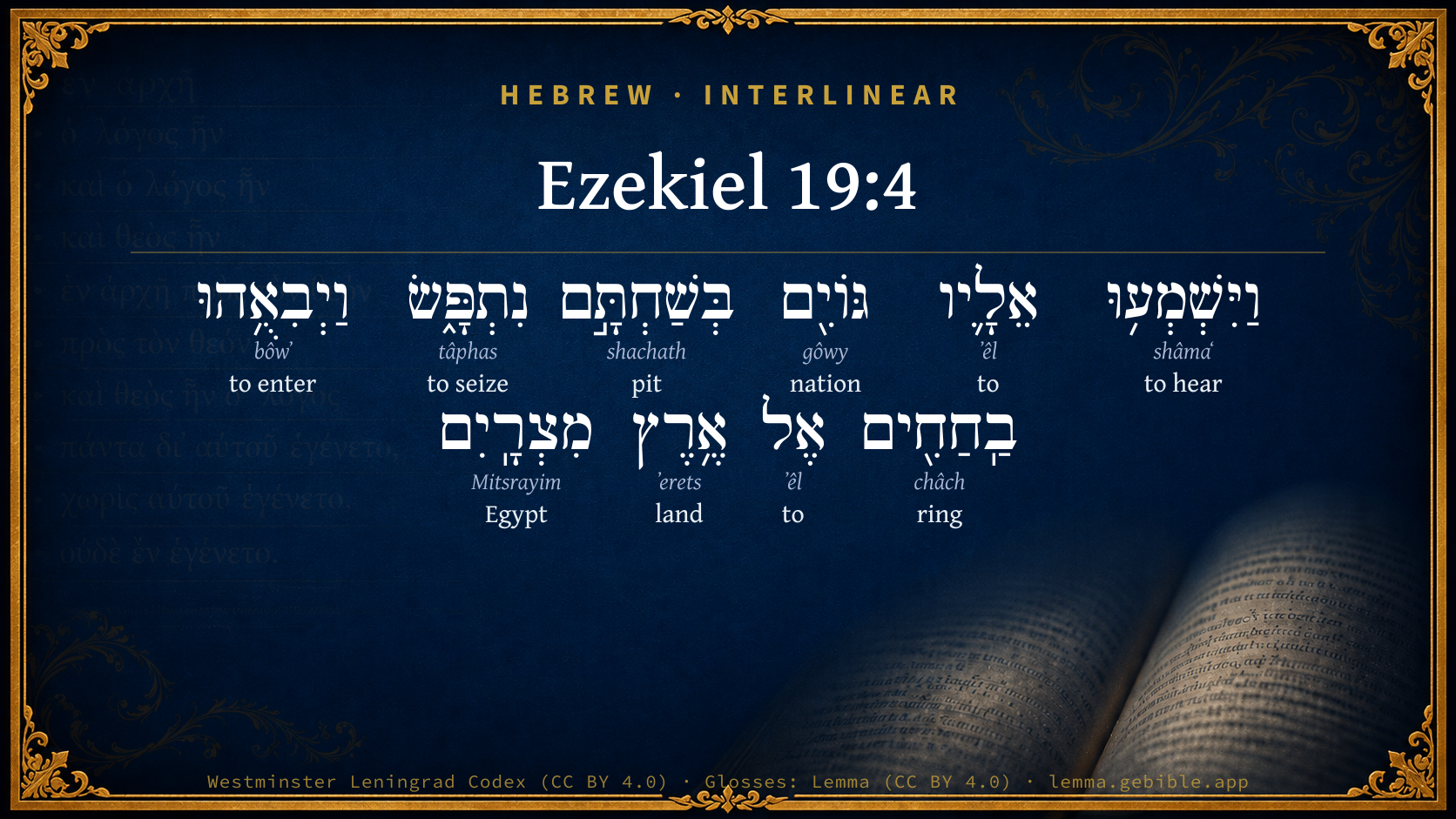
  1. וַיִּשְׁמְע֥וּ shâmaʻ H8085 “and · to hear” Conjunction + Verb, Qal, Sequential Imperfect, 3rd Person, Masculine, Plural
  2. אֵלָ֛יו ʼêl H413 “to · him” Preposition + Suffix, Personal, 3rd Person, Masculine, Singular
  3. גּוֹיִ֖ם gôwy H1471 “nations” Noun, Common, Masculine, Plural, Absolute
  4. בְּשַׁחְתָּ֣ם shachath H7845 “in/at · pit · their” Preposition + Noun, Common, Feminine, Singular, Construct + Suffix, Personal, 3rd Person, Masculine, Plural
  5. נִתְפָּ֑שׂ tâphas H8610 “to seize” Verb, Niphal, Perfect, 3rd Person, Masculine, Singular
  6. וַיְבִאֻ֥הוּ bôwʼ H935 “and · to enter · him” Conjunction + Verb, Hiphil, Sequential Imperfect, 3rd Person, Masculine, Plural + Suffix, Personal, 3rd Person, Masculine, Singular
  7. אֶל ʼêl H413 “to” Preposition
  8. אֶ֥רֶץ ʼerets H776 “land of” Noun, Common, Both, Singular, Construct
  9. מִצְרָֽיִם Mitsrayim H4714 “Egypt” Noun, Proper

About this verse

These counts appear in no published source. They are computed here, from the morphology-tagged text and Lemma’s own curated glosses. What Lemma adds →

10
words
9
distinct lemmas
Prophets
section

Notable vocabulary

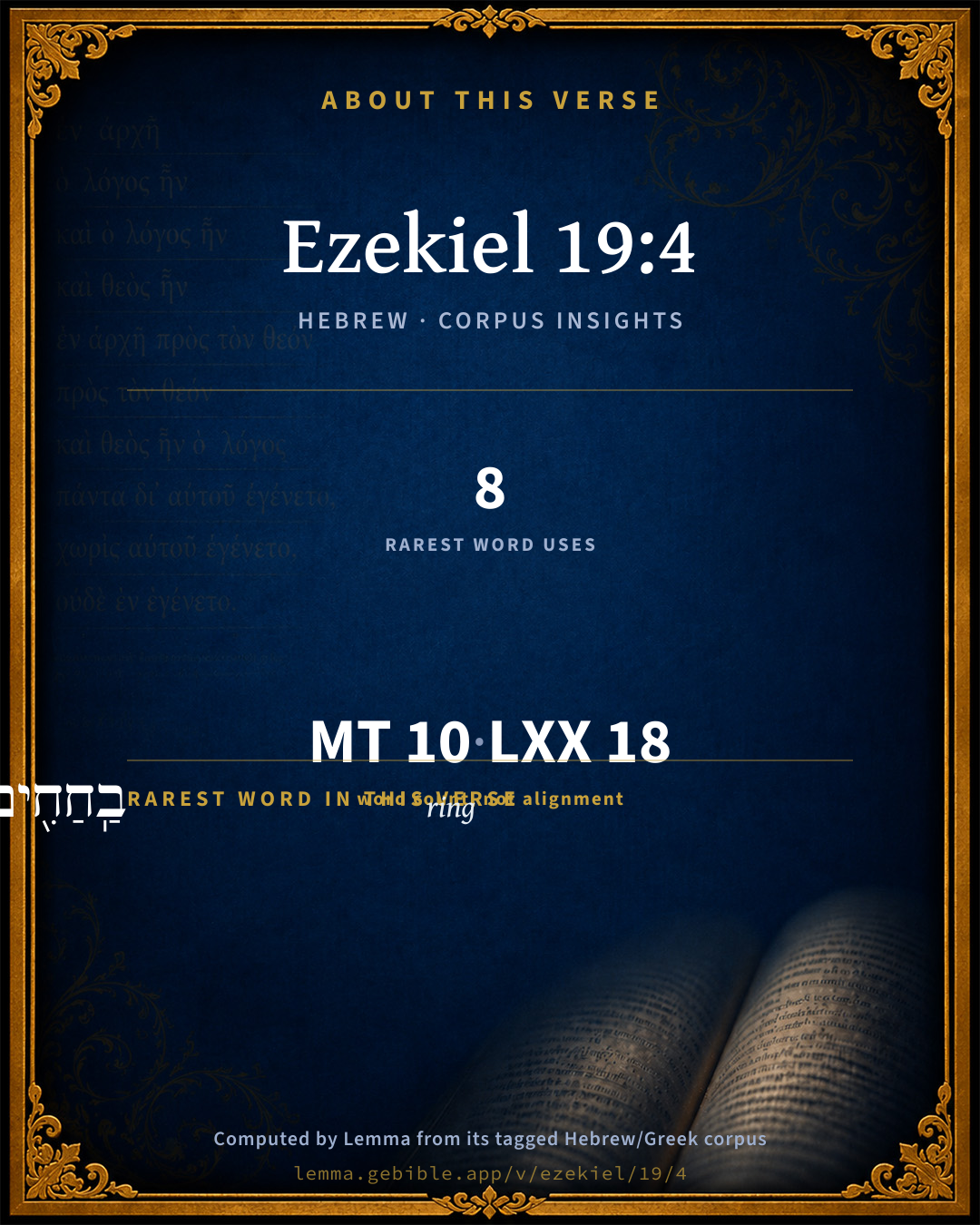
The rarest word here is בַֽחַחִ֖ים ring H2397 — appearing just 8 times in the whole Hebrew Bible.

Shared distinctive vocabulary

בַֽחַחִ֖ים ring H2397 occurs in 7 verses of the Hebrew Bible. Also found in:

Grammatical profile

  • 3 verbs
  • 5 nouns
  • 2 prepositions

Verb forms

  • וַיִּשְׁמְע֥וּ Qal · Sequential Imperfect
  • נִתְפָּ֑שׂ Niphal · Perfect
  • וַיְבִאֻ֥הוּ Hiphil · Sequential Imperfect

Repetition

A word recurs within this verse — often emphatic in Hebrew:

  • אֵלָ֛יו to H413 ×2

Hebrew & Septuagint length

In English translation the verse runs 23 words from the Hebrew and 25 from the Septuagint (LXX English) — closely comparable.

A rough comparison of the two English renderings, which tokenize alike — not a word-level alignment.

Word counts can differ between the Hebrew and the Greek without any difference in meaning — e.g. the Hebrew direct-object marker אֵת has no separate Greek word, and Greek often adds the article ὁ.

In the original languages it is 10 Hebrew tokens and 18 Greek tokens — but the two are counted differently (Hebrew bundles its prefixes and suffixes into one token; the Greek is in lemma form), so that isn’t a like-for-like length.

Cross-references

6

Topical passages linked to Ezekiel 19:4 in the Treasury of Scripture Knowledge — connected by theme and wording, ordered by reader-vote popularity; previews shown in the World English Bible.

  • 2 Kings 23:33–34 Pharaoh Necoh put him in bonds at Riblah in the land of Hamath, that he might not reign in Jerusalem; and put the land to a tribute of one hundred talents of silver, and a talent of gold.
  • 2 Chronicles 36:4 The king of Egypt made Eliakim his brother king over Judah and Jerusalem, and changed his name to Jehoiakim. Neco took Joahaz his brother, and carried him to Egypt.
  • 2 Chronicles 36:6 Against him came up Nebuchadnezzar king of Babylon, and bound him in fetters, to carry him to Babylon.
  • Jeremiah 22:11–12 For thus says Yahweh touching Shallum the son of Josiah, king of Judah, who reigned instead of Josiah his father, [and] who went forth out of this place: He shall not return there any more.
  • 2 Kings 23:31 Jehoahaz was twenty-three years old when he began to reign; and he reigned three months in Jerusalem: and his mother's name was Hamutal the daughter of Jeremiah of Libnah.
  • Jeremiah 22:18 Therefore thus says Yahweh concerning Jehoiakim the son of Josiah, king of Judah: they shall not lament for him, [saying], Ah my brother! or, Ah sister! They shall not lament for him, [saying] Ah lord! or, Ah his glory!

Cross-references courtesy of OpenBible.info (CC BY 4.0).

Hebrew and Greek witnesses Masoretic Hebrew ↔ Greek Septuagint

The same verse in the two great witnesses to the Old Testament, shown verse-for-verse.

These are two independent witnesses, not word-aligned to each other, and the Septuagint is shown in lemma (dictionary) form.

Hebrew Ezekiel 19:4 Masoretic · Westminster Leningrad Codex

וַיִּשְׁמְע֥וּ אֵלָ֛יו גּוֹיִ֖ם בְּשַׁחְתָּ֣ם נִתְפָּ֑שׂ וַיְבִאֻ֥הוּ בַֽחַחִ֖ים אֶל אֶ֥רֶץ מִצְרָֽיִם

The nations also heard of him; he was taken in their pit; and they brought him with hooks to the land of Egypt.

World English Bible · Public Domain

Greek LXX Ezekiel 19:4 Septuagint · lemma form

καί ἀκούω κατά αὐτός ἔθνος ἐν ὁ διαφθορά αὐτός συνλαμβάνω καί ἄγω αὐτός ἐν κημός εἰς γῆ αἴγυπτος

And the nations heard a report of him; he was caught in their pit, and they brought him into the land of Egypt in chains.

LXX2012 (modern English Septuagint) · Public Domain

On this verse, John Gill's Exposition discusses the Septuagint’s reading. Read the note in Commentary ↓

Hebrew: Westminster Leningrad Codex (CC BY 4.0). Greek: Septuagint (public domain); English from LXX2012 (modern English Septuagint) (Public Domain). How the Septuagint differs from the Hebrew →

Targum (Aramaic paraphrase)

1

The Targum is the ancient Jewish Aramaic paraphrase of the Hebrew Scriptures — an interpretive translation, not the Hebrew text itself. Onkelos (literal) and Pseudo-Jonathan (expansive) render the Torah, and Jonathan the Prophets. Coverage is partial: where no permissively-licensed English translation exists for a verse, only the Aramaic is shown. This is verse-level text, not a word-by-word alignment to the Hebrew.

  1. Targum Jonathan Prophets (Joshua–Malachi)
    וּשְׁמָעוּ עֲלוֹהִי עַמְמַיָא בִּסְרִיגַתְהוֹן אִתְאֲחַד וְאַיְתִיאוּהוּ בְּשַׁלְשְׁלָן לְאַרְעָא דְמִצְרָיִם:

    (no public-domain English translation for this verse)

    Targum Jonathan — Aramaic: “Mikraot Gedolot” (public domain). English: “Sefaria Community Translation” (CC0 1.0 (public-domain dedication)); “London "Chaldee Paraphrase," 1871” (public domain). Text via Sefaria.

Commentary

Notes on Ezekiel 19:4 from classic Christian and Jewish commentators (each source and its license shown beneath its notes). The classic Christian expositions comment on the surrounding passage and are grouped to its opening verse, so a note may address several verses; the Jewish commentaries on the Tanakh (Rashi and others) are per-verse, so they appear only where the commentator wrote on this verse.

Lemma curates 59 commentaries, every one of them public domain or Creative Commons licensed, each selected and text-cleaned for this edition rather than reprinted as found. About our sources →

Trapp's Complete Commentary

John Trapp

Eze 19:4 The nations also heard of him; he was taken in their pit, and they brought him with chains unto the land of Egypt.

Ver. 4. The nations also heard of him.] His lion-like disposition and practices were soon noised and noticed.

He was taken in their pit.] As lions are taken by their hunters. Tyrants hold not their own long those beasts are "made to be taken and destroyed"; as Nero, whom the senate judged to death as an enemy to mankind; {a} and as Commodus, who was, saith Orosius, cunctis incommodus, a mischief to mankind.

{a} Ex condicto omnes conveniunt ut eum capiant.

John Trapp, A Commentary or Exposition upon All the Books of the Old and New Testament (1647–1656) — public domain. Text from a community e-Sword module.

Geneva Bible (1599)

Geneva Bible translators

By Pharaoh Necho king of Egypt, 2 Kings 23:33.

Geneva Bible (1599) marginal notes — public domain. Text via Bolls.life.

Jamieson, Fausset & Brown

Robert Jamieson, A. R. Fausset & David Brown

The nations--Egypt, in the case of Jehoahaz, who probably provoked Pharaoh by trying to avenge the death of his father by assailing the bordering cities of Egypt (Kg2 23:29-30).

in their pit--image from the pitfalls used for catching wild beasts (Jer 22:11-12).

chains--or hooks, which were fastened in the noses of wild beasts (see on Eze 19:9).

Jamieson, Fausset & Brown — Commentary Critical and Explanatory on the Whole Bible (1871) — public domain (CC PDM 1.0). Text via the HelloAO Bible API.

Adam Clarke's Commentary

Verse 4. The nations also heard of him] The king of Egypt, whose subjects were of divers nations, marched against Jerusalem, took Jehoahaz prisoner, and brought him to Egypt. Thus -

He was taken in their pit] Here is an allusion to those trap-pits digged in forests, into which the wild beasts fall, when the huntsmen, surrounding a given portion of the forest, drive the beasts in; by degrees narrowing the inclosure, till the animals come to the place where the pits are, which, being lightly covered over with branches and turf, are not perceived, and the beasts tread on them and fall in. Jehoahaz reigned only three months before he was dethroned by the king of Egypt, against whom it is apparent some craft was used, here signified by the pit, into which he fell.

Adam Clarke's Commentary on the Bible (1810–1826) — public domain. Text from a community e-Sword/MySword module.

John Calvin's Commentaries

He afterwards adds, that the nations had heard, and were taken in their pit-fall. Here Ezekiel states that Jehoahaz was hurled from the royal throne, and taken captive by the Egyptians, not only because God had beheld his cruelty, but because the Gentiles had observed it; and it was notorious among them all. In this way he signifies that the cruelty of King Jehoahaz was intolerable: and he mentions him, since all the neighboring nations had heard of his fame, and had conspired to destroy him; and so he was taken in their pit, and confined by chains, and led away into Egypt. He means, as I said, Jehoahaz, whom King Pharaoh-nechoh took captive. (2 Kings 23; 2 Chronicles 36.) For when he thought that the Egyptians were distracted by foreign wars, he took the opportunity of collecting an army, and endeavored to seize on certain neighboring cities. But Pharaoh, after he was disengaged from other business, entered Judea, and since Jehoahaz was unable to resist, he was taken. We now understand the Prophet’s meaning, namely, when this first calamity and destruction happened to the Jews they were justly chastised, because they were young lions; and a lion had sprung from them whose cruelty was already intolerable to the profane Gentiles: this is the sense of the passage. Now if we consider who was the father of Jehoahaz this will be more detestable. For we know, that if ever any king excelled in piety and every virtue, Josiah was among the number: and from the son being so unlike his father, we perceive his perverse disposition. There can be no doubt that his father desired to instruct him in the fear and worship of God, and to train him to the discharge of the royal office. But if we descend to the whole people, the prodigy will be yet more detestable. For we know with what fervor and zeal Josiah strove to form the morals of the people, so that the kingdom should be entirely renewed. But the people soon declined, so that the Holy Spirit says, their mother was a lioness, and lay down among lions, whence we see their depraved nature. It now follows —

John Calvin's Commentaries (1540-1563) — public domain. Text from the Calvin Translation Society English edition (1840s-50s) via the Christian Classics Ethereal Library (ccel.org). Calvin's coverage is partial (roughly two-thirds of the Bible); uncommented books and verses are honest gaps, never fabricated. The 19th-century editor's footnotes and remarks are omitted so the notes are faithfully Calvin's own voice.

Ellicott's Commentary for English Readers

(4) Brought him with chains unto the land of Egypt.—Jehoahaz was conquered by Pharaohnecho, deposed, and carried captive (2Ki_23:33; 2Ch_36:4). “Chains” is literally nose-rings, keeping up the figure of the lion. In the first part of the verse also there is allusion to the custom of assembling the neighbourhood to secure a lion or other wild beast.

A Bible Commentary for English Readers, edited by Charles John Ellicott (1878–1897) — public domain. Text from a community e-Sword module.

John Gill's Exposition

The nations also heard of him,.... The neighbouring nations, particularly the Egyptians; the fame of his behaviour reached them; they were informed how he used his own subjects, and what designs he had formed, and what preparations he was making against his neighbours; wherefore they thought it proper to oppose his measures in time, and to hinder him from proceeding and putting his projects into execution, by coming out against him, and fighting with him, as they did:

he was taken in their pit; alluding to the manner of hunting and taking lions, and such like beasts of prey; which was done by digging pits, and covering the mouths of them with straw, as Jarchi observes, into which in their flight they fell unawares: so Pharaohnecho king of Egypt came out against Jehoahaz, and took him, and put him in bonds at Riblah in the land of Hamath, that he might reign no more in Jerusalem, after he had been on the throne but three months, Kg2 23:31;

and they brought him with chains into the land of Egypt; or, "with hooks" (u); in his nose, as in Isa 37:29; or with a bridle, as the Septuagint; or with branches, as the Syriac version, in his jaws; the Targum renders it in chains, as we do: it is certain that Jehoahaz was put in bonds or fetters, and carried into Egypt, where he died, Kg2 23:33.

(u) "in, vel cum hamis", Montanus, Tigurine version, Cocceius, Starckius.

John Gill's Exposition of the Whole Bible (1746–1763) — public domain (CC PDM 1.0). Text via the HelloAO Bible API.

Albert Barnes' Notes on the Bible

Chains - See the marginal rendering to Eze 19:9 and Isa 27:9, note.

Eze 19:5

Another - Jehoiachin who soon showed himself no less unworthy than Jehoahaz. The “waiting” of the people was during the absence of their rightful lord Jehoahaz, a captive in Egypt while Jehoiakim, whom they deemed an usurper, was on the throne. It was not until Jehoiachin succeeded, that they seemed to themselves to have a monarch of their own 2Ki 24:6.

Eze 19:7

Their desolate palaces - Rather, his palaces, built upon the ground, from where he had ejected the former owners.

Eze 19:8

The nations - are here the Chaldaeans: see the marginal references.

Albert Barnes' Notes on the Bible (1834–1885) — public domain. Text from a community e-Sword/MySword module.

Haydock's Catholic Bible Commentary

But. Hebrew, "he was taken in their pit," (Protestants; Haydock) as also [in] ver. 8. Septuagint, "in his or their corruption." We do not read that Joachaz fought, (Calmet) though this passage insinuates as much. (Sanctius) (4 Kings xxiii. 30., &c.)

George Leo Haydock (1774–1849), Haydock's Catholic Family Bible and Commentary, 1859 edition — public domain. Excludes Psalms (Douay-Rheims chapter numbering differs from Protestant) and Deuterocanonical books (Catholic canon only).

Matthew Poole's English Annotations

The Egyptians heard and considered what he did, they had intelligence of Jehoahaz’s rigours against them, and all that abetted their interest; this made them (as neighbours do when a lion is reported to waste their flocks) gather together against him. He was taken in their pit; or, in their net, as hunters in those parts dig pits and spread nets, into which they drive the hunted lion, or bear: so here. Or else thus, This lion was taken at last, though he did some mischief first to the Egyptians; so the word may bear.

They brought him with chains unto the land of Egypt; the story of it you have 2Ki 23:33; these barbarous conquerors used him as men use a lion, put and keep him in chains; carried him captive into Egypt, where he died, Jer 22:10-12, with 2Ki 23:34.

Matthew Poole's English Annotations on the Holy Bible (1683–1685) — public domain. Text from a community e-Sword/MySword module.

The Pulpit Commentary

The nations also heard of him, etc. The fact that lies under the parable is that Egypt and its allies began to be alarmed as they watched the aggressive policy of Jehoahaz, as men are alarmed when they hear that a young lion is in the neighbourhood, and proceed to lay snares for him. In chains, etc.; literally, nose rings, such as were put into the nostrils of brutes or men. (Eze_38:4; 2Ki_19:28; Isa_37:29) The mention of Egypt points to the deportation of Jehoahaz by Pharaoh-Necho. (2Ki_23:34; Jer_22:11)

The Pulpit Commentary (1880–1919), ed. H.D.M. Spence-Jones & Joseph S. Exell — public domain. Text from a community e-Sword module.

John Wesley's Explanatory Notes

The nations - The Egyptians heard what he did.

John Wesley, Explanatory Notes Upon the Whole Bible (1754–1765) — public domain. Text via the GEBible commentary corpus.

Rashi

Rabbi Shlomo Yitzchaki (Rashi)

Nations gathered around him Pharaoh the king of Egypt.

in their pit he was caught Heb. בְּשַּׁחְתָם. They dig pits and cover their openings with straw, and the beast falls into them.

and they brought him with hooks A sort of iron ring. They puncture his nose and pull him with them.

Rashi on the Tanakh — English translations: “The Judaica Press complete Tanach with Rashi, translated by A. J. Rosenberg” (CC BY 4.0); “Pentateuch with Rashi's commentary by M. Rosenbaum and A.M. Silbermann, 1929-1934” (public domain); “The Metsudah Tanach series, Lakewood, N.J” (CC BY 4.0); and “The Book of Joshua, Metsudah Publications, 1997” (CC BY 4.0). Text via Sefaria.

Lesson kit

Teaching starters — assembled from the data on this page, not authored interpretation. Every prompt links to the verse data it draws on. Edit before teaching.

Ezekiel, in the Prophets, opens this verse with 10 words (9 distinct Hebrew lemmas). Its most distinctive word is châch (“ring”). A historical commentator’s framing appears above. Read the whole chapter for the surrounding context.

Discussion questions

  1. How does “ring” (châch) shape what this verse is saying?
  2. How does Exodus 35:22, which shares the word «ring», read alongside this verse?
  3. What does the repetition of “to” (2× in this one verse) do in this verse?
  4. These translations render this verse differently; the difference is in the English rendering, not the original. What questions does that raise?
  5. «וַיִּשְׁמְע֥וּ» is a Qal Sequential Imperfect verb. How does that grammatical form shape the action described?
  6. Compare how Trapp's Complete Commentary and Geneva Bible (1599) read this verse. Where do they agree or differ?

Things to notice

Reading settings

Reading text

Shown beneath each verse's original-language words.

Old Testament
Old Testament edition

Read the OT as the Masoretic Hebrew (MT) or the Greek Septuagint (LXX).

English shown for the Greek Septuagint (in the Hebrew ↔ Greek comparison).

Comparing translations? Open the Compare panel on any verse page to stack up to four side by side.