Psalms 79:6

Hebrew (Westminster Leningrad Codex) Psalms 79:6 appears in the Hebrew Old Testament. The text above is from the Westminster Leningrad Codex. Each word links to its Strong’s number, a concise gloss, and parsing drawn from the Open Scriptures Hebrew Bible morphology. Click any word for its full Brown-Driver-Briggs (BDB) entry.
Download image
Cite this verse

Psalms 79:6 (World English Bible). Public Domain. Lemma interlinear Bible study tool, https://lemma.gebible.app/v/psalms/79/6.

Show BibTeX & RIS
BibTeX
RIS
English Translation
Pour out your wrath on the nations that don't know you; On the kingdoms that don't call on your name;
World English Bible · Public Domain
Download a study sheet

One document with this verse’s original text, its word-by-word gloss line, the meaning frame, cross-references with their text, attributed commentary, and full source and license credits — printable, and it pastes into notes with its structure intact.

This verse Autodidact and up

Study sheet (.html) Plain text (.txt)

A passage Seminary Student

Up to 50 verses in one chapter. A passage sheet keeps up to 6 commentary sources and 12 cross-references per verse, in the order this page ranks them, and says so on the sheet whenever that leaves anything out. Ask for a single verse and you get the Autodidact verse sheet above.

Everything on this page stays free to read, with no account — the sheet is a download of what is already on screen, not access to it.

Want to remove ads? Support Godless Engineer
Compare translations 3

The same verse in 3 English versions, stacked beneath the original-language interlinear above. Click any original word for its lexicon entry.

Each is an independent rendering of the whole verse — the interlinear is not word-aligned to these translations.

Highlighted words mark where these versions differ — a whole-verse word diff, not a word-by-word alignment.

  • World English Bible Public Domain
    Pour out your wrath on the nations that don't know you; On the kingdoms that don't call on your name;
  • King James Version Public Domain
    Pour out thy wrath upon the heathen that have not known thee, and upon the kingdoms that have not called upon thy name.
  • unfoldingWord Literal Text CC BY-SA 4.0
    Pour out your wrath on the nations that have not known you and on the kingdoms that have not called on your name.

unfoldingWord Literal Text — © unfoldingWord, licensed CC BY-SA 4.0. Word-aligned USFM3 via Door43 (git.door43.org/unfoldingWord/en_ult).

Versions to compare (up to 4)

3 of 4 selected

Show all 18 translations

Every available English version of this verse, each an independent rendering of the whole verse.

  • World English Bible Public Domain
    Pour out your wrath on the nations that don't know you; On the kingdoms that don't call on your name;
  • Berean Standard Bible Public Domain
    Pour out Your wrath on the nations that do not acknowledge You, on the kingdoms that refuse to call on Your name,
  • Majority Standard Bible Public Domain
    Pour out Your wrath on the nations that do not acknowledge You, on the kingdoms that refuse to call on Your name,
  • King James Version Public Domain
    Pour out thy wrath upon the heathen that have not known thee, and upon the kingdoms that have not called upon thy name.
  • American Standard Version (1901) Public Domain
    Pour out thy wrath upon the nations that know thee not, And upon the kingdoms that call not upon thy name.
  • Revised Version (1885) Public Domain
    Pour out thy wrath upon the heathen that know thee not, and upon the kingdoms that call not upon thy name.
  • Geneva Bible (1599) Public Domain
    Powre out thy wrath vpon the heathen that haue not knowen thee, and vpon the kingdomes that haue not called vpon thy Name.
  • Douay-Rheims (1899) Public Domain
    Pour out thy wrath upon the nations that have not known thee: and upon the kingdoms that have not called upon thy name.
  • Young's Literal Translation Public Domain
    Pour Thy fury on the nations who have not known Thee, And on kingdoms that have not called in Thy name.
  • Literal Standard Version CC BY-SA 4.0
    Pour Your fury on the nations who have not known You, || And on kingdoms that have not called on Your Name.
  • Unlocked Literal Bible CC BY-SA 4.0
    Pour out your wrath on the nations that do not know you and on the kingdoms that do not call upon your name.
  • unfoldingWord Literal Text CC BY-SA 4.0
    Pour out your wrath on the nations that have not known you and on the kingdoms that have not called on your name.
  • Darby Bible Public Domain
    Pour out thy fury upon the nations that have not known thee, and upon the kingdoms that call not upon thy name:
  • World Messianic Bible Public Domain
    Pour out your wrath on the nations that don’t know you, on the kingdoms that don’t call on your name,
  • Webster's Bible Public Domain
    Pour out thy wrath upon the heathen that have not known thee, and upon the kingdoms that have not called upon thy name.
  • Free Bible Version CC BY-SA 4.0
    Pour out your anger on the heathen nations that don't know you, and on those kingdoms that don't worship you!
  • Bible in Basic English Public Domain
    Let your wrath be on the nations who have no knowledge of you, and on the kingdoms who have not made prayer to your name.
  • JPS Tanakh (1917) Public Domain
    Pour out Thy wrath upon the nations that know Thee not, and upon the kingdoms that call not upon Thy name.

Literal Standard Version (2020), Covenant Press — licensed CC BY-SA 4.0. Text via the HelloAO Bible API (eBible.org). Unlocked Literal Bible (unfoldingWord) — licensed CC BY-SA 4.0. Text via the HelloAO Bible API (eBible.org). unfoldingWord Literal Text — © unfoldingWord, licensed CC BY-SA 4.0. Word-aligned USFM3 via Door43 (git.door43.org/unfoldingWord/en_ult). Free Bible Version, Dr. Jonathan Gallagher — licensed CC BY-SA 4.0. Text via the HelloAO Bible API (eBible.org).

Word by word

More ways to search: Search by grammar → Find every occurrence → Compare this word →

Practice this passage: Drill this verse → Learn its vocabulary →

שְׁפֹ֤ךְ
shâphak
H8210
“pour”
Verb, Qal, Imperative, 2nd Person, Masculine, Singular
Part of Speech
Verb
Stem
Qal
Form
Imperative
Person
2nd Person
Gender
Masculine
Number
Singular
Full BDB Definition

Origin: a primitive root

TWOT: 2444

to pour, pour out, spill - (Qal) - to pour, pour out - to shed (blood) - to pour out (anger or heart) (figuratively) - (Niphal) to be poured out, be shed - (Pual) to be poured out, be shed - (Hithpael) - to be poured out - to pour out oneself
  1. חֲמָתְךָ֨ chêmâh H2534 “wrath · your” Noun, Common, Feminine, Singular, Construct + Suffix, Personal, 2nd Person, Masculine, Singular
  2. אֶֽל ʼêl H413 “to” Preposition
  3. הַגּוֹיִם֮ gôwy H1471 “the · nations” Particle, Definite Article + Noun, Common, Masculine, Plural, Absolute
  4. אֲשֶׁ֪ר ʼăsher H834 “which” Particle, Relative
  5. לֹא lôʼ H3808 “not” Particle, Negative
  6. יְדָ֫ע֥וּךָ yâdaʻ H3045 “to know · you” Verb, Qal, Perfect, 3rd Person, Common, Plural + Suffix, Personal, 2nd Person, Masculine, Singular
  7. וְעַ֥ל ʻal H5921 “and · upon” Conjunction + Preposition
  8. מַמְלָכ֑וֹת mamlâkâh H4467 “kingdoms” Noun, Common, Feminine, Plural, Absolute
  9. אֲשֶׁ֥ר ʼăsher H834 “which” Particle, Relative
  10. בְּ֝שִׁמְךָ֗ shêm H8034 “in/at · name · your” Preposition + Noun, Common, Masculine, Singular, Construct + Suffix, Personal, 2nd Person, Masculine, Singular
  11. לֹ֣א lôʼ H3808 “not” Particle, Negative
  12. קָרָֽאוּ qârâʼ H7121 “to call” Verb, Qal, Perfect, 3rd Person, Common, Plural

About this verse

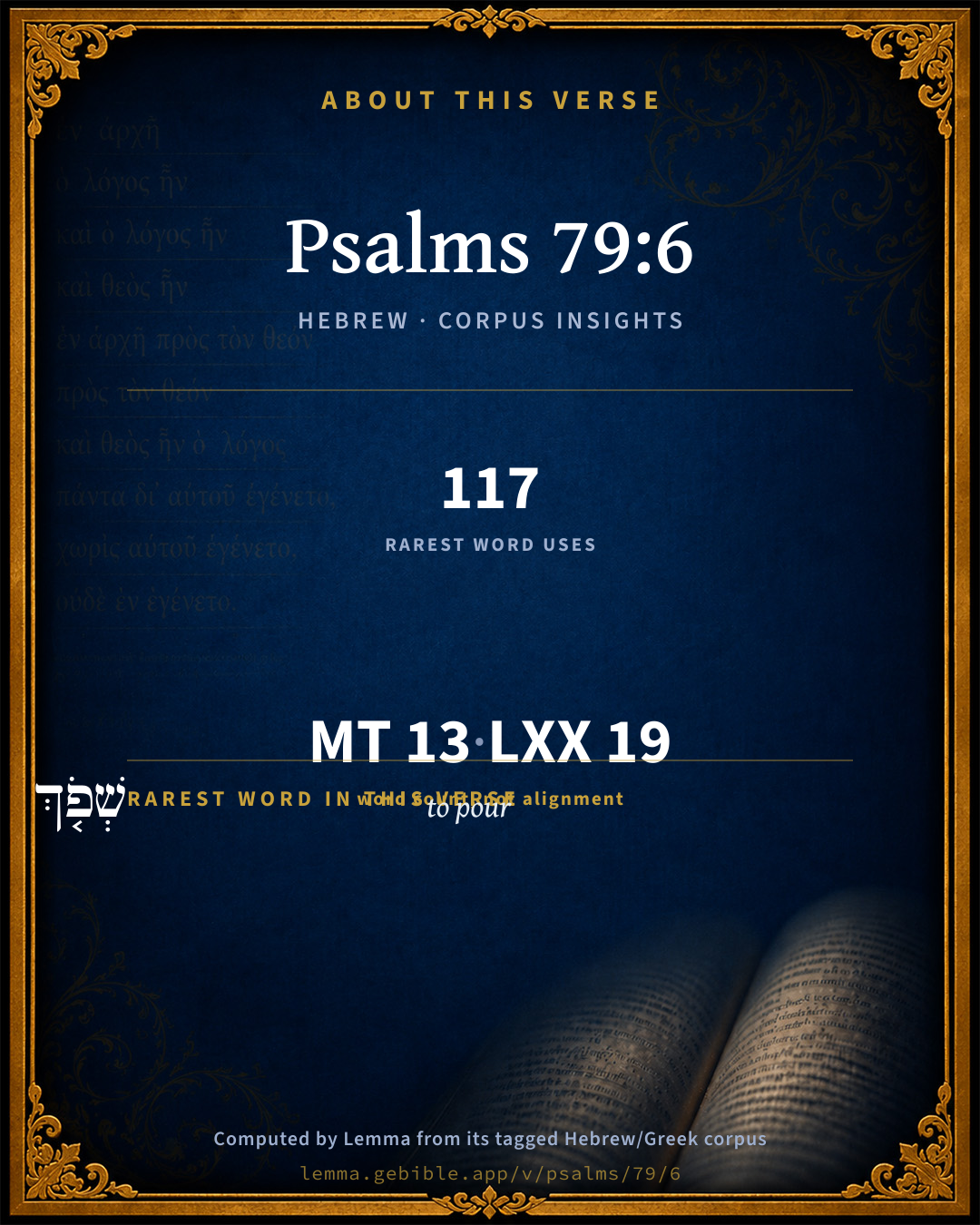
These counts appear in no published source. They are computed here, from the morphology-tagged text and Lemma’s own curated glosses. What Lemma adds →

13
words
11
distinct lemmas
Wisdom
section

Grammatical profile

  • 3 verbs
  • 4 nouns
  • 2 prepositions
  • 4 particles

Verb forms

  • שְׁפֹ֤ךְ Qal · Imperative
  • יְדָ֫ע֥וּךָ Qal · Perfect
  • קָרָֽאוּ Qal · Perfect

Repetition

Words recur within this verse — often emphatic in Hebrew:

  • אֲשֶׁ֪ר which H834 ×2
  • לֹא not H3808 ×2

Hebrew & Septuagint length

In English translation the verse runs 20 words from the Hebrew and 23 from the Septuagint (LXX English) — closely comparable.

A rough comparison of the two English renderings, which tokenize alike — not a word-level alignment.

Word counts can differ between the Hebrew and the Greek without any difference in meaning — e.g. the Hebrew direct-object marker אֵת has no separate Greek word, and Greek often adds the article ὁ.

In the original languages it is 13 Hebrew tokens and 19 Greek tokens — but the two are counted differently (Hebrew bundles its prefixes and suffixes into one token; the Greek is in lemma form), so that isn’t a like-for-like length.

Cross-references

22

Topical passages linked to Psalms 79:6 in the Treasury of Scripture Knowledge — connected by theme and wording, ordered by reader-vote popularity; previews shown in the World English Bible.

  • Jeremiah 10:25 Pour out your wrath on the nations that don't know you, and on the families that don't call on your name: for they have devoured Jacob, yes, they have devoured him and consumed him, and have laid waste his habitation.
  • 2 Thessalonians 1:8 giving vengeance to those who don't know God, and to those who don't obey the Gospel of our Lord Jesus,
  • Psalms 14:4 Have all the workers of iniquity no knowledge, Who eat up my people as they eat bread, And don't call on Yahweh?
  • Psalms 53:4 Have the workers of iniquity no knowledge, Who eat up my people as they eat bread, And don't call on God?
  • Psalms 69:24 Pour out your indignation on them. Let the fierceness of your anger overtake them.
  • Isaiah 45:4–5 For Jacob my servant's sake, and Israel my chosen, I have called you by your name: I have surnamed you, though you have not known me.
  • Romans 1:28 Even as they refused to have God in their knowledge, God gave them up to a reprobate mind, to do those things which are not fitting;
  • Psalms 9:16–17 Yahweh has made himself known. He has executed judgment. The wicked is snared by the work of his own hands. Meditation. Selah.
  • Psalms 145:18 Yahweh is near to all those who call on him, To all who call on him in truth.
  • Isaiah 13:1–22 The burden of Babylon, which Isaiah the son of Amoz did see.
  • Isaiah 21:1–17 The burden of the wilderness of the sea. As whirlwinds in the South sweep through, it comes from the wilderness, from an awesome land.
  • Isaiah 23:1–18 The burden of Tyre. Howl, you ships of Tarshish; for it is laid waste, so that there is no house, no entering in: from the land of Kittim it is revealed to them.
  • Isaiah 42:25 Therefore he poured on him the fierceness of his anger, and the strength of battle; and it set him on fire round about, yet he didn't know; and it burned him, yet he didn't lay it to heart.
  • Jeremiah 25:29 For, behold, I begin to work evil at the city which is called by my name; and should you be utterly unpunished? You shall not be unpunished; for I will call for a sword on all the inhabitants of the earth, says Yahweh of Hosts.
  • Jeremiah 46:1–28 The word of Yahweh which came to Jeremiah the prophet concerning the nations.
  • Zephaniah 3:8 "Therefore wait for me," says Yahweh, "until the day that I rise up to the prey, for my determination is to gather the nations, that I may assemble the kingdoms, to pour on them my indignation, even all my fierce anger, for all the earth will be devoured with the fire of my jealousy.
  • John 16:3 They will do these things because they have not known the Father, nor me.
  • Acts 17:23 For as I passed along, and observed the objects of your worship, I found also an altar with this inscription: 'TO AN UNKNOWN GOD.' What therefore you worship in ignorance, this I announce to you.
  • Romans 10:12–14 For there is no distinction between Jew and Greek; for the same Lord is Lord of all, and is rich to all who call on him.
  • Revelation 16:1–21 I heard a loud voice out of the temple, saying to the seven angels, "Go and pour out the seven bowls of the wrath of God on the earth!"
  • John 17:25 Righteous Father, the world hasn't known you, but I knew you; and these knew that you sent me.
  • 1 Corinthians 1:2 to the assembly of God which is at Corinth; those who are sanctified in Christ Jesus, called to be saints, with all who call on the name of our Lord Jesus Christ in every place, both theirs and ours:

Cross-references courtesy of OpenBible.info (CC BY 4.0).

Hebrew and Greek witnesses Masoretic Hebrew ↔ Greek Septuagint

The same verse in the two great witnesses to the Old Testament, shown verse-for-verse.

You’re reading Greek Psalm 78 (Hebrew Psalm 79). The Septuagint counts the superscription, so verse numbers can differ from the Hebrew — chapter-level alignment, not verse-by-verse. Numbering follows Rahlfs.

These are two independent witnesses, not word-aligned to each other, and the Septuagint is shown in lemma (dictionary) form.

Hebrew Psalms 79:6 Masoretic · Westminster Leningrad Codex

שְׁפֹ֤ךְ חֲמָתְךָ֨ אֶֽל הַגּוֹיִם֮ אֲשֶׁ֪ר לֹא יְדָ֫ע֥וּךָ וְעַ֥ל מַמְלָכ֑וֹת אֲשֶׁ֥ר בְּ֝שִׁמְךָ֗ לֹ֣א קָרָֽאוּ

Pour out your wrath on the nations that don't know you; On the kingdoms that don't call on your name;

World English Bible · Public Domain

Greek LXX Greek Psalm 78:6 Septuagint · lemma form

ἐκχέω ὁ ὀργή σύ ἐπί ἔθνος ὁ μή γιγνώσκω σύ καί ἐπί βασιλεία ὅς ὁ ὄνομα σύ οὐ ἐπικαλέω

Pour out your wrath upon the heathen that have not known you, and upon the kingdoms which have not called upon your name.

LXX2012 (modern English Septuagint) · Public Domain

Hebrew: Westminster Leningrad Codex (CC BY 4.0). Greek: Septuagint (public domain); English from LXX2012 (modern English Septuagint) (Public Domain). How the Septuagint differs from the Hebrew →

Commentary

Notes on Psalms 79:6 from classic Christian and Jewish commentators (each source and its license shown beneath its notes). The classic Christian expositions comment on the surrounding passage and are grouped to its opening verse, so a note may address several verses; the Jewish commentaries on the Tanakh (Rashi and others) are per-verse, so they appear only where the commentator wrote on this verse.

Lemma curates 59 commentaries, every one of them public domain or Creative Commons licensed, each selected and text-cleaned for this edition rather than reprinted as found. About our sources →

Matthew Henry's Commentary

The petitions here put up to God are very suitable to the present distresses of the church, and they have pleas to enforce them, interwoven with them, taken mostly from God's honour.

I. They pray that God would so turn away his anger from them as to turn it upon those that persecuted and abused them (Psa 79:6): "Pour out thy wrath, the full vials of it, upon the heathen; let them wring out the dregs of it, and drink them." This prayer is in effect a prophecy, in which the wrath of God is revealed from heaven against all ungodliness and unrighteousness of men. Observe here, 1. The character of those he prays against; they are such as have not known God, nor called upon his name. The reason why men do not call upon God is because they do not know him, how able and willing he is to help them. Those that persist in ignorance of God, and neglect of prayer, are the ungodly, who live without God in the world. There are kingdoms that know not God and obey not the gospel, but neither their multitude nor their force united will secure them from his just judgments. 2. Their crime: They have devoured Jacob, Psa 79:7. That is crime enough in the account of him who reckons that those who touch his people touch the apple of his eye. They have not only disturbed, but devoured, Jacob, not only encroached upon his dwelling place, the land of Canaan, but laid it waste by plundering and depopulating it. (3.) Their condemnation: "Pour out thy wrath upon them; do not only restrain them from doing further mischief, but reckon with them for the mischief they have done."

II. They pray for the pardon of sin, which they own to be the procuring cause of all their calamities. How unrighteous soever men were, God was righteous in permitting them to do what they did. They pray, 1. That God would not remember against them their former iniquities (Psa 79:8), either their own former iniquities, that now, when they were old, they might not be made to possess the iniquities of their youth, or the former iniquities of their people, the sins of their ancestors. In the captivity of Babylon former iniquities were brought to account; but God promises not again to do so (Jer 31:29, Jer 31:30), and so they pray, "Remember not against us our first sins," which some make to look as far back as the golden calf, because God said, In the day when I visit I will visit for this sin of theirs upon them, Exo 32:34. If the children by repentance and reformation cut off the entail of the parents' sin, they may in faith pray that God will not remember them against them. When God pardons sin he blots it out and remembers it no more. 2. That he would purge away the sins they had been lately guilty of, by the guilt of which their minds and consciences had been defiled: Deliver us, and purge away our sins, Psa 79:9. Then deliverances from trouble are granted in love, and are mercies indeed, when they are grounded upon the pardon of sin and flow from that; we should therefore be more earnest with God in prayer for the removal of our sins than for the removal of our afflictions, and the pardon of them is the foundation and sweetness of our deliverances.

III. They pray that God would work deliverance for them, and bring their troubles to a good end and that speedily: Let thy tender mercies speedily prevent us, Psa 79:8. They had no hopes but from God's mercies, his tender mercies; their case was so deplorable that they looked upon themselves as the proper objects of divine compassion, and so near to desperate that, unless divine mercy did speedily interpose to prevent their ruin, they were undone. This whets their importunity: "Lord, help us; Lord, deliver us; help us under our troubles, that we may bear them well; help us out of our troubles, that the spirit may not fail. Deliver us from sin, from sinking." Three things they plead: - 1. The great distress they were reduced to: "We are brought very low, and, being low, shall be lost if thou help us not." The lower we are brought the more need we have of help from heaven and the more will divine power be magnified in raising us up. 2. Their dependence upon him: "Thou art the God of our salvation, who alone canst help. Salvation belongs to the Lord, from whom we expect help; for in the Lord alone is the salvation of his people." Those who make God the God of their salvation shall find him so. 3. The interest of his own honour in their case. They plead no merit of theirs; they pretend to none; but, "Help us for the glory of thy name; pardon us for thy name's sake." The best encouragements in prayer are those that are taken from God only, and those things whereby he has made himself known. Two things are insinuated in this plea: - (1.) That God's name and honour would be greatly injured if he did not deliver them; for those that derided them blasphemed God, as if he were weak and could not help them, or had withdrawn and would not; therefore they plead (Psa 79:10), "Wherefore should the heathen say, Where is their God? He has forsaken them, and forgotten them; and this they get by worshipping a God whom they cannot see." (Nil praeter nubes et coeli numen adorant. Juv. - They adore no other divinity than the clouds and the sky.) That which was their praise (that they served a God that is every where) was now turned to their reproach and his too, as if they served a God that is nowhere. "Lord," say they, "Make it to appear that thou art by making it to appear that thou art with us and for us, that when we are asked, Where is your God? we may be able to say, He is nigh unto us in all that which we call upon him for, and you see he is so by what he does for us." (2.) That God's name and honour would be greatly advanced if he did deliver them; his mercy would be glorified in delivering those that were so miserable and helpless. By making bare his everlasting arm on their behalf he would make unto himself an everlasting name; and their deliverance would be a type and figure of the great salvation, which in the fulness of time Messiah the Prince would work out, to the glory of God's name.

IV. They pray that God would avenge them on their adversaries, 1. For their cruelty and barbarity (Psa 79:10): "Let the avenging of our blood" (according to the ancient law, Gen 9:6) "be known among the heathen; let them be made sensible that what judgments are brought upon them are punishments of the wrong they have done to us; let this be in our sight, and by this means let God be known among the heathen as the God to whom vengeance belongs (Psa 94:1) and the God that espouses his people's cause." Those that have intoxicated themselves with the blood of the saints shall have blood given them to drink, for they are worthy. 2. For their insolence and scorn (Psa 79:12): "Render to them their reproach. The indignities which by word and deed they have done to the people of God himself and his name let them be repaid to them with interest." The reproach wherewith men have reproached us only we must leave it to God whether he will render to them or no, and must pray that he would forgive them; but the reproach wherewith they have blasphemed God himself we may in faith pray that God would render seven-fold into their bosoms, so as to strike at their hearts, to humble them, and bring them to repentance. This prayer is a prophecy, of the same import with that of Enoch, that God will convince sinners of all their hard speeches which they have spoken against him (Jde 1:15) and will return them into their own bosoms by everlasting terrors at the remembrance of them.

V. They pray that God would find out a way for the rescue of his poor prisoners, especially the condemned prisoners, Psa 79:11. The case of their brethren who had fallen into the hands of the enemy was very sad; they were kept close prisoners, and, because they durst not be heard to bemoan themselves, they vented their griefs in deep and silent sighs. All their breathing was sighing, and so was their praying. They were appointed to die, as sheep for the slaughter, and had received the sentence of death within themselves. This deplorable case the psalmist recommends, 1. To the divine pity: "Let their sighs come up before thee, and be thou pleased to take cognizance of their moans." 2. To the divine power: "According to the greatness of thy arm, which no creature can contest with, preserve thou those that are appointed to die from the death to which they are appointed." Man's extremity is God's opportunity to appear for his people. See Co2 1:8-10.

Lastly, They promise the returns of praise for the answers of prayer (Psa 79:13): So we will give thee thanks for ever. Observe, 1. How they please themselves with their relation to God. "Though we are oppressed and brought low, yet we are the sheep of thy pasture, not disowned and cast off by thee for all this: We are thine; save us." 2. How they promise themselves an opportunity of praising God for their deliverance, which they therefore desired, and would bid welcome, because it would furnish them with matter for thanksgiving and put their hearts in tune for that excellent work, the work of heaven. 3. How they oblige themselves not only to give God thanks at present, but to show forth his praise unto all generations, that is, to do all they could both to perpetuate the remembrance of God's favours to them and to engage their posterity to keep up the work of praise. 4. How they plead this with God: "Lord, appear for us against our enemies; for, if they get the better, they will blaspheme thee (Psa 79:12); but, if we be delivered, we will praise thee. Lord, we are that people of thine which thou hast formed for thyself, to show forth thy praise; if we be cut off, whence shall that rent, that tribute, be raised?" Note, Those lives that are entirely devoted to God's praise are assuredly taken under his protection.

Matthew Henry's Commentary on the Whole Bible (1708–1710) — public domain (CC PDM 1.0). Text via the HelloAO Bible API.

Trapp's Complete Commentary

John Trapp

Psa 79:6 Pour out thy wrath upon the heathen that have not known thee, and upon the kingdoms that have not called upon thy name.

Ver. 6. Pour out thy wrath, &c.] Even the full vials of it.

That have not known thee] More than by the book of the creatures, wherein there is indeed a τογνωστον του θεου, something of God manifested, Rom 1:19-20, even his eternal power and Godhead, rendering men without excuse, but nothing of his goodness and patience, leading them to repentance, Psa 2:4.

That have not called upon thy name] A note of profaneness, Psa 14:4.

John Trapp, A Commentary or Exposition upon All the Books of the Old and New Testament (1647–1656) — public domain. Text from a community e-Sword module.

The Treasury of David

Charles H. Spurgeon

Ver. 6. "Pour out thy wrath upon the heathen that have not known thee." If thou must smite look further afield; spare thy children and strike thy foes. There are lands where thou art in no measure acknowledged; be pleased to visit these first with thy judgments, and let thine erring Israel have a respite.

"And upon the kingdoms that have not called upon thy name." Hear us the prayerful, and avenge thyself upon the prayerless. Sometimes providence appears to deal much more severely with the righteous than with the wicked, and this verse is a bold appeal founded upon such an appearance. It in effect says--Lord, if thou must empty out the vials of thy wrath, begin with those who have no measure of regard for thee, but are openly up in arms against thee; and be pleased to spare thy people, who are thine notwithstanding all their sins.

Whole Psalm. See Psalms on "Ps 79:1" for further information.

Ver. 6. Neglect of prayer by unbelievers is threatened with punishment. The prophet's imprecation is the same in effect with a threatening, see Jer 10:25, and same imprecation, Ps 79:6. The prophets would not have used such an imprecation against those that call not upon God, but that their neglect of calling on his name makes them liable to his wrath and fury; and no neglect makes men liable to the wrath of God but the neglect of duty. Prayer, then, is a duty even to the heathen, the neglect of which provokes him to pour out his fury on them. David Clarkson.

None.

Psalms 79:7*

Charles H. Spurgeon's The Treasury of David (1869–1885) — public domain. Psalms only. Text from a community e-Sword/MySword module.

Joseph Benson's Commentary

Psa 79:6-7. Pour out thy wrath upon the heathen — Though we confess that we have deserved thy wrath, yet the heathen, by whom thou hast scourged us, have deserved it much more, as being guilty of far greater impieties than we, living in gross ignorance and contempt of thee and thy worship. And, therefore, we pray thee to transfer thy wrath from us to them. But the prayer is rather to be considered as a prophecy, in which the wrath of God is revealed from heaven against all ungodliness and unrighteousness of men. For they have devoured Jacob — The posterity of Jacob, whom thou didst love, and with whom, and his seed, thou madest a sure and everlasting covenant; whereby thou didst engage thyself to be an enemy to their enemies, Exo 23:22. Besides, thou hatest cruelty, especially when the wicked devour those that are more righteous than themselves, Hab 1:13.

Joseph Benson's Commentary on the Old and New Testaments (1811–1818) — public domain. Text from a community e-Sword module.

Whedon's Commentary on the Bible

Daniel D. Whedon

6. Pour out thy wrath upon the heathen—All such imprecations must be viewed from the standpoint of justice between nation and nation, and the rights of God in the land and people of his covenant as against the acts of hostile kings who invade them. The rights of peace and virtue in the earth cry to God against the perpetrators of crime and the authors of oppression. Humanly speaking, the invasion of Palestine by Nebuchadnezzar was without cause, and his treatment of the Jewish religion without parallel of impiety. Justice would seem to reverse this strange order of things. The kingdoms referred to in this verse were such as were subject to and assisted Nebuchadnezzar in his wars. Psa_79:6-7 seem borrowed from Jer_10:25

Daniel D. Whedon (gen. ed.), Commentary on the Old and New Testaments (1874–1909) — public domain. Text from a community e-Sword module.

J. A. Alexander on Psalms

Joseph Addison Alexander

6. (Psa 79:6) Pour out thy wrath against the nations which have not known thee, and upon kingdoms which thy name have not invoked. This is commonly explained as a prayer for divine judgments on the nations which combined for the destruction of Judah (2Ki 24:2). But it seems to be rather an expostulation and complaint that God had made no difference between his own people and the heathen. As if he had said, If thou must pour out thy wrath, let it rather be on those who neither know nor worship thee than on thine own peculiar people.

Joseph Addison Alexander, The Psalms Translated and Explained (1850) — public domain. Text from a community e-Sword module.

Tyndale Open Study Notes

Tyndale Open Resources

79:6 The repentant among God’s people ask him to vent his anger not on them but on their wicked and unrepentant enemies.

Tyndale Open Study Notes — © Tyndale Open Resources, licensed CC BY-SA 4.0. Text via the HelloAO Bible API.

Adam Clarke's Commentary

Verse 6. Pour out thy wrath] Bad as we are, we are yet less wicked than they. We, it is true, have been unfaithful; but they never knew thy name, and are totally abandoned to idolatry.

Adam Clarke's Commentary on the Bible (1810–1826) — public domain. Text from a community e-Sword/MySword module.

John Calvin's Commentaries

6. Pour out thy fury upon the heathen, who have not known thee. This prayer is apparently inconsistent with the rule of charity; for, while we feel anxious about our own calamities, and desire to be delivered from them, we ought to desire that others may be relieved as well as ourselves. It would seem, therefore, that the faithful are to be blamed in here wishing the destruction of unbelievers, for whose salvation they ought rather to have been solicitous. But it becomes us to bear in mind what I have previously stated, that the man who would offer up such a prayer as this in a right manner, must be under the influence of zeal for the public welfare; so that, by the wrongs done to himself personally, he may not suffer his carnal affections to be excited, nor allow himself to be carried away with rage against his enemies; but, forgetting his individual interests, he must have a sole regard to the common salvation of the Church, and to what conduces thereto. Secondly, he must implore God to grant him the spirit of discretion and judgment, that in prayer he may not be impelled by an inconsiderate zeal: a subject which we have treated more at large in another place. Besides, it is to be observed, that the pious Jews here not only lay out of consideration their own particular advantage in order to consult the good of the whole Church, but also chiefly direct their eyes to Christ, beseeching him to devote to destruction his enemies whose repentance is hopeless. They, therefore, do not rashly break forth into this prayer, that God would destroy these or other enemies, nor do they anticipate the judgment of God; but desiring that the reprobate may be involved in the condemnation which they deserve, they, at the same time, patiently wait until the heavenly judge separate the reprobate from the elect. In doing this, they do not cast aside the affection which charity requires; for, although they would desire all to be saved, they yet know that the reformation of some of the enemies of Christ is hopeless, and their perdition absolutely certain.

The question, however, is not yet fully answered; for, when in the seventh verse they arraign the cruelty of their enemies, they seem to desire vengeance. But what I have just now observed must be remembered, that none can pray in this manner but those who have clothed themselves with a public character, and who, laying aside all personal considerations, have espoused, and are deeply interested in, the welfare of the whole Church; or, rather, who have set before their eyes Christ, the Head of the Church; and, lastly, none but those who, under the guidance of the Holy Spirit, have elevated their minds to the judgment of God; so that, being ready to forgive, they do not indiscriminately adjudge to death every enemy by whom they are injured, but only the reprobate. With regard to those who make haste in demanding the execution of the Divine vengeance before all hope of repentance is lost, Christ has condemned them as chargeable with inconsiderate and ill-regulated zeal, when he says,

“Ye know not what manner of spirit ye are of,” (Luke 9:55.)

Moreover, the faithful do not here simply wish the destruction of those who so wickedly persecuted the Church, but, using that familiarity which God allows them in their dealings with him, they set forth how inconsistent it would be did he not punish their persecutors, and reason thus: Lord, how is it that thou afflictest us so severely, upon whom thy name is invoked, and sparest the heathen nations who despise thee? In short, they mean to say, that God has sufficient ground for executing his wrath elsewhere, since they were not the only people in the world who had sinned. Although it does not become us to prescribe to God the rule of his conduct, but rather patiently to submit to this ordination,

“That judgment must begin at the house of God” (1 Peter 4:17;)

yet he permits his saints to take the liberty of pleading, that at least they may not be worse dealt with than unbelievers, and those who despise him.

These two sentences, who have not known thee, and which call not upon thy name, it is to be observed, are to be taken in the same sense. By these different forms of expression, it is intimated that it is impossible for any to call upon God without a previous knowledge of him, as the Apostle Paul teaches, in Romans 10:14,

“How, then, shall they call on him in whom they have not believed? and how shall they believe in him of whom they have not heard?” (Romans 10:14)

It belongs not to us to answer, “Thou art our God,” till He has anticipated us by saying, “Thou art my people,” (Hosea 2:23;) but he opens our mouths to speak to him in this manner, when he invites us to himself. Calling on the name of God is often synonymous with prayer; but it is not here to be exclusively limited to that exercise. The amount is, that unless we are directed by the knowledge of God, it is impossible for us sincerely to profess the true religion. At that time the Gentiles everywhere boasted that they served God; but, being destitute of his word, and as they fabricated to themselves gods of their own corrupt imaginations, all their religious services were detestable; even as in our own day, the human invented religious observances of the blind and deluded votaries of the Man of Sin, who have no right knowledge of the God whom they profess to worship, and who inquire not at his mouth what he approves, are certainly rejected by Him, because they set up idols in his place.

John Calvin's Commentaries (1540-1563) — public domain. Text from the Calvin Translation Society English edition (1840s-50s) via the Christian Classics Ethereal Library (ccel.org). Calvin's coverage is partial (roughly two-thirds of the Bible); uncommented books and verses are honest gaps, never fabricated. The 19th-century editor's footnotes and remarks are omitted so the notes are faithfully Calvin's own voice.

Ellicott's Commentary for English Readers

(6-7) The poet prays in prophetical strain, that the fire of indignation may be turned from Israel and directed against the heathen oppressors, (For the relation to Jer_10:25, see Introduction.)

A Bible Commentary for English Readers, edited by Charles John Ellicott (1878–1897) — public domain. Text from a community e-Sword module.

The Cambridge Bible for Schools and Colleges

gen. ed. J. J. S. Perowne

6. upon the heathen &c.] Not upon the nations as such, but upon the nations which refuse to acknowledge Jehovah, and make havoc of His people. Render with R.V., that know thee not … that call not upon thy name.

The Cambridge Bible for Schools and Colleges (gen. ed. J. J. S. Perowne; Cambridge University Press, 1878–1918) — public domain. Text from a community e-Sword module.

John Gill's Exposition

Pour out thy wrath upon the Heathen that have not known thee,.... Who had poured out the blood of the saints like water, and therefore it was a righteous thing with God to pour out the cup of wrath in his hands, and cause them to drink the dregs of it: these words, though they are in the form of an imprecation, yet regard not private revenge, but public justice, and the honour of God; and, besides, may be considered as a prophecy of what would be, and particularly of God's pouring out the vials of his wrath on the antichristian states; who, though they profess Christianity, are no other than Heathens, and have no spiritual and serious knowledge of Christ:

and upon the kingdoms that have not called upon thy name; but upon their idols of gold, silver, brass, and stone, on the Virgin Mary, angels, and saints departed; for these, besides the kingdoms of Babylon, Syria, and Rome Pagan, are the kingdoms of the ten kings, that gave their kingdoms to the beast, and committed fornication, i.e. idolatry, with the whore of Rome; see Rev 17:2, these words are referred to in Jer 10:25 and also the following.

John Gill's Exposition of the Whole Bible (1746–1763) — public domain (CC PDM 1.0). Text via the HelloAO Bible API.

Albert Barnes' Notes on the Bible

Pour out thy wrath upon the heathen - Punish, as they deserve, the nations that have risen up against thy people, and that have brought; desolation upon the land. The word rendered here pour out is used with reference to a cup or vial, as containing a mixture for the people to drink - of intoxication, or of poison. See the notes at Rev 16:1; notes at Psa 11:6; notes at Isa 51:17; compare Jer 25:15, Jer 25:17; Mat 20:22; Mat 26:39, Mat 26:42.

That have not known thee - Who are strangers to thee; who are thy enemies. The prayer that the wrath of God might be poured upon them was not because they were ignorant of him, but on account of their wicked conduct toward the people of God. The phrase “that have not known thee” is used merely to designate them, or to describe their character. The prayer is not necessarily a prayer for vengeance, or in the spirit of revenge; it is simply a prayer that justice might be done to them, and is such a prayer as any man may offer who is anxious that justice may be done in the world. See remarks on the imprecations in the Psalms. General Introduction Section 6. It is not proper, however, to use this as a proof-text that God will punish the “pagan,” or will consign them to destruction. The passage obviously has no reference to such a doctrine, whether that doctrine be true or false.

And upon the kingdoms that have not called upon thy name - The people that do not worship thee; referring here particularly to those who had invaded the land, and made it desolate.

Albert Barnes' Notes on the Bible (1834–1885) — public domain. Text from a community e-Sword/MySword module.

Matthew Poole's English Annotations

Though we confess that we have deserved thy wrath, yet the heathen, by whom thou hast scourged us, deserve it much more, as being guilty of far greater impieties than we, living in gross ignorance and contempt of God and of his worship; and therefore we pray transfer thy wrath from us to them.

Matthew Poole's English Annotations on the Holy Bible (1683–1685) — public domain. Text from a community e-Sword/MySword module.

The Pulpit Commentary

Pour out thy wrath upon the heathen that have not known thee. It is not the heathen that had never heard of God who are intended, but those who, having heard of him, had refused to "know" him, (comp. Exo_5:2) as was the case with all the nations round about Canaan. And upon the kingdoms that have not called upon thy Name. Now that we are punished, go on to punish those who have persecuted us, and who are at least as guilty as ourselves. "The prayer rests," as Hengstenberg remarks, "upon what God does constantly. Judgment begins at the house of God; but it proceeds thence to those whom God has employed as the instrument of his punishment. The storm of the wrath of God always remains to fall at last upon the world at enmity with his Church.

Vers. 6, 7. Praying against our enemies.

The gravest difficulties in treating the Book of Psalms concern the entire psalms, and the passages in the psalms, which seem to be invocations of wrath on personal enemies. This is reasonably felt to be wholly contrary to the spirit of Christianity. It is not, however, usually noticed, that it is a hopeful sign for a man to speak his bad feelings out to God. He will do mischief if he speaks them out to his fellow men. He will do no mischief if he speaks them out to God. Before him the man will soon grow calm, and begin to think more kindly. Illustrate by the relief it is, when we feel very strongly about a matter, to speak out quite freely to some one who, we are sure, will not make mischief of it. We feel better when we have got it out. The psalmists were wise in this that when they felt disagreeably towards their fellows, they told God, and not their fellows. It is also pointed out that most, if not all, the imprecatory psalms represent official rather than personal feelings; and a king or governor may pray against the national enemies, as Hezekiah might properly pray against the Assyrians. From a person acting officially, we presume that the element of temper is excluded. The mischief done by the invaders was distinctly national the desecration of the temple, the reduction of the city to a heap of ruins, the exposure of the dead, the captivity of multitudes. Prayer for the turning of God"s judgments on the nation"s enemies could not be regarded as improper, seeing that exactly this God had done over and over again, notably in the case of Sennacherib. What God would do it could not be wrong to pray him to do. And seeing God says, "Avenge not yourselves;" "Vengeance is mine, I will repay, saith the Lord;" it may even be regarded as an act of virtue and piety to restrain our vengeance, and commit our vindications unto the Lord. He who prays against his enemies will not take upon himself his own vindications. The following thoughts may be opened and illustrated.

I We had better pray against our enemies than fight against them.

II When we pray we commit all the times and ways of judgment on them to the infinitely wise and gracious Lord. In even this prayer we should say, "Nevertheless, not as I will, but as thou wilt.

III If we pray about persons, we soon begin to change our feelings towards them.

IV But it is the height to which Christian principle raises us, when we pray for our enemies rather than against them. The older religion prayed for vengeance on them, the newer religion prays for mercy towards them. "If thine enemy hunger, feed him: if he thirst, give him drink. R.T.

The Pulpit Commentary (1880–1919), ed. H.D.M. Spence-Jones & Joseph S. Exell — public domain. Text from a community e-Sword module.

unfoldingWord translationNotes

Door43 World Missions Community

General Information:

These two pairs of phrases each share similar meanings and are combined for emphasis. (See: Parallelism)

Pour out your wrath on the nations

Asaph speaks of God's wrath as if it were a liquid. AT: "Since you are angry, punish the nations" (See: Metaphor)

do not call upon your name

The word "name" is a metonym for the person's power and authority. AT: "do not belong to you" or "do not ask you to help them" (See: Metonymy)

they have devoured Jacob

The word "Jacob" is a mentonym for his descendants, the people of Israel. AT: "they have completely destroyed the people of Israel" (See: Metonymy)

translationWords

wrath

nation

know

kingdom

call

name

devour

Jacob

unfoldingWord translationNotes — © Distant Shores Media and the Door43 World Missions Community, licensed CC BY-SA 4.0. Source: git.door43.org/Door43/en_tn.

Lesson kit

Teaching starters — assembled from the data on this page, not authored interpretation. Every prompt links to the verse data it draws on. Edit before teaching.

Psalms, in the Wisdom, opens this verse with 13 words (11 distinct Hebrew lemmas). Its most distinctive word is shâphak (“to pour”). A historical commentator’s framing appears above. Read the whole chapter for the surrounding context.

Discussion questions

  1. What does “to pour” (shâphak) contribute to the verse as a whole?
  2. Jeremiah 10:25 shares this passage’s theme. How do the two illuminate each other?
  3. “which” occurs 2× in this one verse. What is the effect of the repetition?
  4. These translations render this verse differently. What is at stake in choosing one wording over another?
  5. The verb «שְׁפֹ֤ךְ» is Qal Imperative. How does its form color the action?
  6. Reading how Matthew Henry's Commentary and Trapp's Complete Commentary read this verse, where do the two commentators agree and where do they part?

Things to notice

Reading settings

Reading text

Shown beneath each verse's original-language words.

Old Testament
Old Testament edition

Read the OT as the Masoretic Hebrew (MT) or the Greek Septuagint (LXX).

English shown for the Greek Septuagint (in the Hebrew ↔ Greek comparison).

Comparing translations? Open the Compare panel on any verse page to stack up to four side by side.